
















HASSAN MOAVIA 12080702-018
UNIVERSITY OF GUJRAT
TOPIC:
USE OF CORPUS TO INVESTIGATE AND
DEVELOP LEXICAL KNOWLEDGE
CONTINUE…
• Use of corpus to investigate and develop lexical knowledge through phrase,
phraseology, collocation, colligation ,polysymy, word formation ,lexical sets
etc.
WHAT IS LEXIS
• According to oxford dictionary the level of language consisting of
vocabulary , as opposed to grammar or syntax: the distinction between
grammar and lexis.
• According to Collins English dictionary the totality of vocabulary items in a
language, including all forms having lexical meaning and grammatical
function from the Greek lexis words.
CONTINUE….
• Linguistic is the scientific study of language.
• According to ‘Sinclair’ ‘one does not study all botany by
making artificial flowers’.
• According to ‘Trudgill’ Trudgill is even harsher in his criticism
of those who do not base their descriptions on actual
language use. in the final analysis if linguistic is not about
language as it is opposed actually being spoken or written
by human beings, then it is about nothing at all.
WHAT IS CORPUS?
• Corpus is not just any collection of text, a corpus is a collection of naturally
occurring language text chosen to characterize a state or variety of a
language. in other words corpus is designed and complied based on corpus
design principles. another feature which is fundamental to corpus linguistic is
that a corpus is ‘machine readable’.
LIMITATIONS OF CORPUS
• Corpora can tell us whether something is frequent, or not, but they are not
able to tell us if something is possible in a language.
• Corpora can only show us what they contain.
• Corpora can give us evidence but the user must then interpret this
information.
• Corpora contain examples of language outside of divorced from their
original ‘visual and social context’.
CONTINUE….
• It’s a healthy, vibrant discipline’.
• The key to its success remains the same basic method.
• Large quantities of ‘raw’ text are opposed directly in order to present the
researcher with objective evidence.
CORPUS-DRIVEN AND CORPUS-BASED
APPROACHES
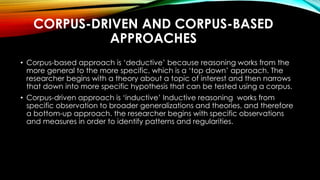
• Corpus-based approach is ‘deductive’ because reasoning works from the
more general to the more specific, which is a ‘top down’ approach. The
researcher begins with a theory about a topic of interest and then narrows
that down into more specific hypothesis that can be tested using a corpus.
• Corpus-driven approach is ‘inductive’ Inductive reasoning works from
specific observation to broader generalizations and theories, and therefore
a bottom-up approach. the researcher begins with specific observations
and measures in order to identify patterns and regularities.
PHRASE
• In everyday speech, a phrase may refer to any group of words. In linguistics,
a phrase is a group of words that form a constituent and so function as a
single unit in the syntax of a sentence.
• Examples
• in the big hall
• at the market day
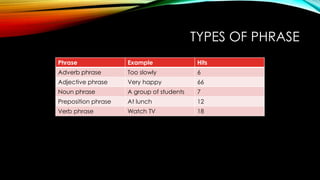
TYPES OF PHRASE
Phrase Example Hits
Adverb phrase Too slowly 6
Adjective phrase Very happy 66
Noun phrase A group of students 7
Preposition phrase At lunch 12
Verb phrase Watch TV 18
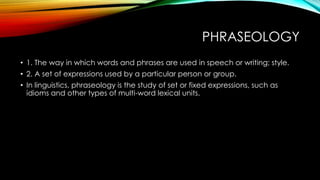
PHRASEOLOGY
• 1. The way in which words and phrases are used in speech or writing; style.
• 2. A set of expressions used by a particular person or group.
• In linguistics, phraseology is the study of set or fixed expressions, such as
idioms and other types of multi-word lexical units.
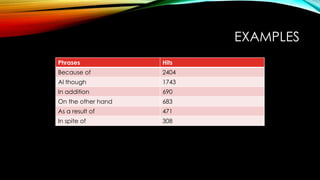
EXAMPLES
Phrases Hits
Because of 2404
Al though 1743
In addition 690
On the other hand 683
As a result of 471
In spite of 308
FIXED EXPRESSION
• A fixed expression is a little like a secret code that allows access to a club
that not everyone can enter. It’s a phrase that has a very specific meaning
that can’t be expressed any other way and also can’t be deduced just by
considering the sum of its parts.
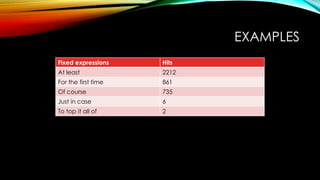
EXAMPLES
Fixed expressions Hits
At least 2212
For the first time 861
Of course 735
Just in case 6
To top it all of 2
IDIOM
• An idiom is a phrase where the words together have a meaning that is
different from the dictionary definitions of the individual words, which can
make idioms hard for ESL students and learners to understand.
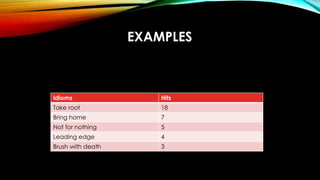
EXAMPLES
Idioms Hits
Take root 18
Bring home 7
Not for nothing 5
Leading edge 4
Brush with death 3
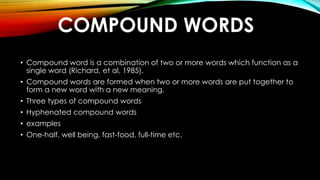
COMPOUND WORDS
• Compound word is a combination of two or more words which function as a
single word (Richard, et al, 1985).
• Compound words are formed when two or more words are put together to
form a new word with a new meaning.
• Three types of compound words
• Hyphenated compound words
• examples
• One-half, well being, fast-food, full-time etc.
• Open compound words
• Ice cream, post office, middle class etc.
• Close compound words
• examples
• Bedroom, motorcycle, software, everything, football etc.
COLLOCATION
AND
COLLIGATION
COLLOCATION
• Collocation is aexpression consisting of two or more words that correspond
to some convertional way of saying things.
• Collocation is a sequence of two or more consecutive words.
• The words togather can mean more then their sum of parts.
• For example
red bull, dark age, the time of india
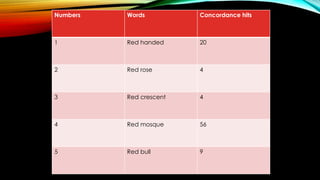
Numbers Words Concordance hits
1 Red handed 20
2 Red rose 4
3 Red crescent 4
4 Red mosque 56
5 Red bull 9
COLLIGATION
• It is a grammatical category . This idea is given by hoey.
• The grammatical company that a word or phrases is associative with
• For example
he eats, they go,
EXAMPLE OF “THEY GO”
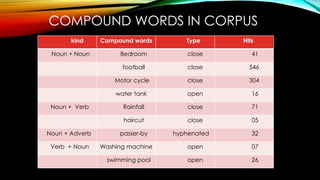
COMPOUND WORDS IN CORPUS
kind Compound words Type Hits
Noun + Noun Bedroom close 41
football close 546
Motor cycle close 304
water tank open 16
Noun + Verb Rainfall close 71
haircut close 05
Noun + Adverb passer-by hyphenated 32
Verb + Noun Washing machine open 07
swimming pool open 26
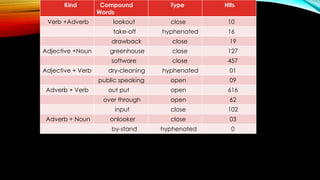
Kind Compound
Words
Type Hits
Verb +Adverb lookout close 10
take-off hyphenated 16
drawback close 19
Adjective +Noun greenhouse close 127
software close 457
Adjective + Verb dry-cleaning hyphenated 01
public speaking open 09
Adverb + Verb out put open 616
over through open 62
input close 102
Adverb + Noun onlooker close 03
by-stand hyphenated 0
COINAGE
• One of the least common processes of word formation in English is coinage,
that is, the invention of totally new terms.
• The act of creating new word or phrase that other people begin to use.
• Examples:
blog, google, aspirin, nylon, zipper.
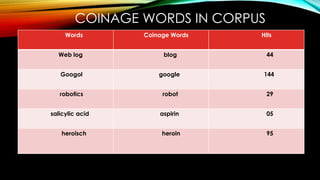
COINAGE WORDS IN CORPUS
Words Coinage Words Hits
Web log blog 44
Googol google 144
robotics robot 29
salicylic acid aspirin 05
heroisch heroin 95
BORROWING
• A word adopted from one language to use in another language.
• English has borrowed extensively from other languages.
• Especially French, Latin, Greek and other languages also included.
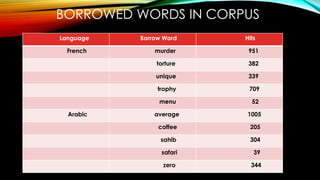
BORROWED WORDS IN CORPUS
Language Borrow Word Hits
French murder 951
torture 382
unique 339
trophy 709
menu 52
Arabic average 1005
coffee 205
sahib 304
safari 39
zero 344
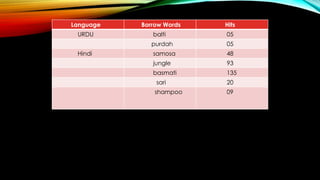
Language Borrow Words Hits
URDU balti 05
purdah 05
Hindi samosa 48
jungle 93
basmati 135
sari 20
shampoo 09
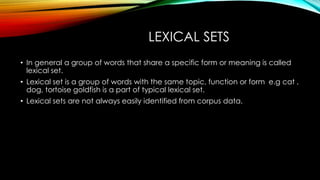
LEXICAL SETS
• In general a group of words that share a specific form or meaning is called
lexical set.
• Lexical set is a group of words with the same topic, function or form e.g cat ,
dog, tortoise goldfish is a part of typical lexical set.
• Lexical sets are not always easily identified from corpus data.
TYPES OF LEXICAL SETS
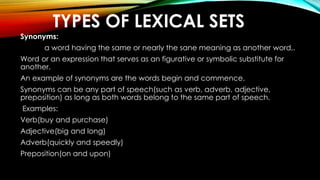
Synonyms:
a word having the same or nearly the sane meaning as another word,.
Word or an expression that serves as an figurative or symbolic substitute for
another.
An example of synonyms are the words begin and commence.
Synonyms can be any part of speech(such as verb, adverb, adjective,
preposition) as long as both words belong to the same part of speech.
Examples:
Verb(buy and purchase)
Adjective(big and long)
Adverb(quickly and speedly)
Preposition(on and upon)
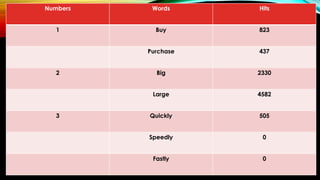
Numbers Words Hits
1 Buy 823
Purchase 437
2 Big 2330
Large 4582
3 Quickly 505
Speedly 0
Fastly 0
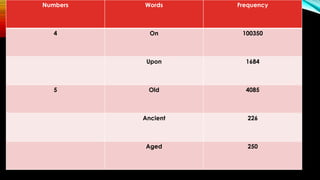
Numbers Words Frequency
4 On 100350
Upon 1684
5 Old 4085
Ancient 226
Aged 250
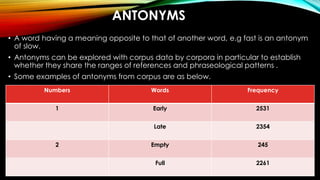
ANTONYMS
• A word having a meaning opposite to that of another word, e.g fast is an antonym
of slow.
• Antonyms can be explored with corpus data by corpora in particular to establish
whether they share the ranges of references and phraseological patterns .
• Some examples of antonyms from corpus are as below.
Numbers Words Frequency
1 Early 2531
Late 2354
2 Empty 245
Full 2261
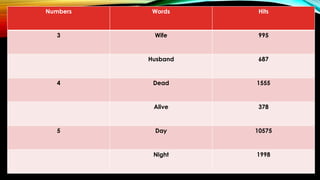
Numbers Words Hits
3 Wife 995
Husband 687
4 Dead 1555
Alive 378
5 Day 10575
Night 1998
POLYSEMY
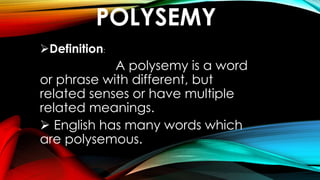
Definition:
A polysemy is a word
or phrase with different, but
related senses or have multiple
related meanings.
 English has many words which
are polysemous.
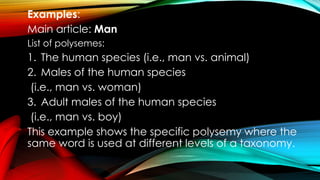
Examples:
Main article: Man
List of polysemes:
1. The human species (i.e., man vs. animal)
2. Males of the human species
(i.e., man vs. woman)
3. Adult males of the human species
(i.e., man vs. boy)
This example shows the specific polysemy where the
same word is used at different levels of a taxonomy.
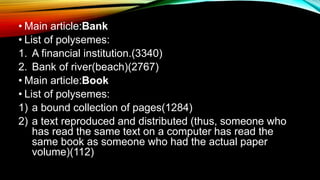
• Main article:Bank
• List of polysemes:
1. A financial institution.(3340)
2. Bank of river(beach)(2767)
• Main article:Book
• List of polysemes:
1) a bound collection of pages(1284)
2) a text reproduced and distributed (thus, someone who
has read the same text on a computer has read the
same book as someone who had the actual paper
volume)(112)
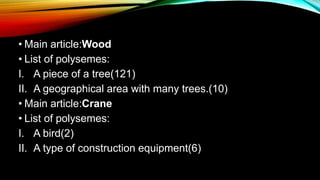
• Main article:Wood
• List of polysemes:
I. A piece of a tree(121)
II. A geographical area with many trees.(10)
• Main article:Crane
• List of polysemes:
I. A bird(2)
II. A type of construction equipment(6)
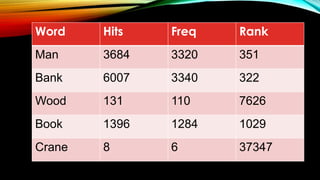
Word Hits Freq Rank
Man 3684 3320 351
Bank 6007 3340 322
Wood 131 110 7626
Book 1396 1284 1029
Crane 8 6 37347
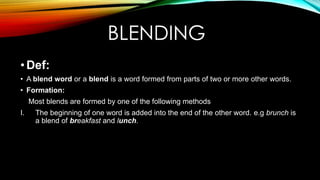
BLENDING
•Def:
• A blend word or a blend is a word formed from parts of two or more other words.
• Formation:
Most blends are formed by one of the following methods
I. The beginning of one word is added into the end of the other word. e.g brunch is
a blend of breakfast and lunch.
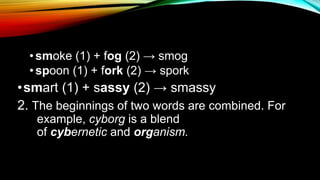
• smoke (1) + fog (2) → smog
• spoon (1) + fork (2) → spork
•smart (1) + sassy (2) → smassy
2. The beginnings of two words are combined. For
example, cyborg is a blend
of cybernetic and organism.
3. Two words are blended around a common
sequence of sounds. For example, the word motel
is a blend of motor and hotel.
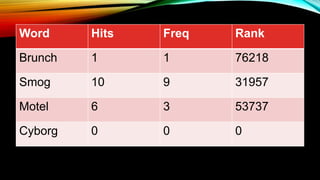
Word Hits Freq Rank
Brunch 1 1 76218
Smog 10 9 31957
Motel 6 3 53737
Cyborg 0 0 0
DERIVATION
• Definition:
derivation is the process of forming a new word
on the basis of an existing word,
e.g. happiness and unhappy from happy,
Derivational morphology often involves the addition of a
derivational suffix or other affix.
• Adjective-to-noun: -ness (slow → slowness)
• Adjective-to-verb: -ise (modern → modernise)
• Adjective-to-adverb: -ly (personal → personally)
• Noun-to-verb: -fy (glory → glorify)
• Verb-to-adjective: -able (drink → drinkable)
• Verb-to-noun (abstract): -ance (deliver → deliverance)
• Verb-to-noun (agent): -er (write → writer)
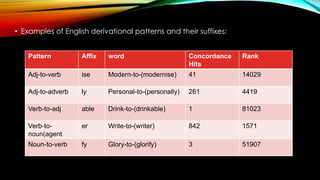
• Examples of English derivational patterns and their suffixes:
Pattern Affix word Concordance
Hits
Rank
Adj-to-verb ise Modern-to-(modernise) 41 14029
Adj-to-adverb ly Personal-to-(personally) 261 4419
Verb-to-adj able Drink-to-(drinkable) 1 81023
Verb-to-
noun(agent
er Write-to-(writer) 842 1571
Noun-to-verb fy Glory-to-(glorify) 3 51907
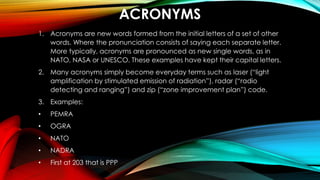
ACRONYMS
1. Acronyms are new words formed from the initial letters of a set of other
words. Where the pronunciation consists of saying each separate letter.
More typically, acronyms are pronounced as new single words, as in
NATO, NASA or UNESCO. These examples have kept their capital letters.
2. Many acronyms simply become everyday terms such as laser (“light
amplification by stimulated emission of radiation”), radar (“radio
detecting and ranging”) and zip (“zone improvement plan”) code.
3. Examples:
• PEMRA
• OGRA
• NATO
• NADRA
• First at 203 that is PPP
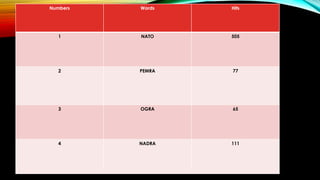
Numbers Words Hits
1 NATO 505
2 PEMRA 77
3 OGRA 65
4 NADRA 111
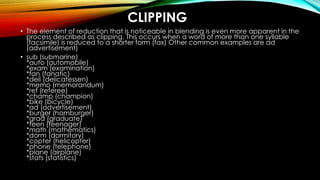
CLIPPING
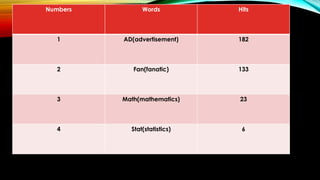
• The element of reduction that is noticeable in blending is even more apparent in the
process described as clipping. This occurs when a word of more than one syllable
(facsimile) is reduced to a shorter form (fax) Other common examples are ad
(advertisement)
• sub (submarine)
*auto (automobile)
*exam (examination)
*fan (fanatic)
*deli (delicatessen)
*memo (memorandum)
*ref (referee)
*champ (champion)
*bike (bicycle)
*ad (advertisement)
*burger (hamburger)
*grad (graduate)
*teen (teenager)
*math (mathematics)
*dorm (dormitory)
*copter (helicopter)
*phone (telephone)
*plane (airplane)
*stats (statistics)
Numbers Words Hits
1 AD(advertisement) 182
2 Fan(fanatic) 133
3 Math(mathematics) 23
4 Stat(statistics) 6
BACK FORMATION
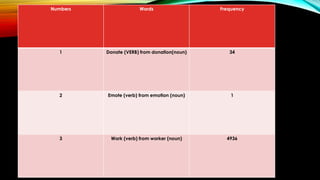
• A very specialized type of reduction process is known as backformation.
Typically, a word of one type (usually a noun) is reduced to form a word of
another type (usually a verb. A good example of backformation is the
process whereby the noun television first came into use and then the verb
televise was created from it. Other examples of words created by this
process are: donate (from “donation”), emote (from“emotion”), other
examples are.
Numbers Words Frequency
1 Donate (VERB) from donation(noun) 34
2 Emote (verb) from emotion (noun) 1
3 Work (verb) from worker (noun) 4936
CONVERSION
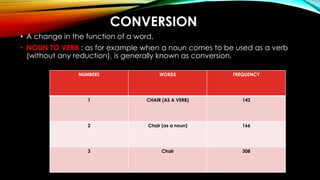
• A change in the function of a word,
• NOUN TO VERB : as for example when a noun comes to be used as a verb
(without any reduction), is generally known as conversion.
NUMBERS WORDS FREQUENCY
1 CHAIR (AS A VERB) 142
2 Chair (as a noun) 166
3 Chair 308
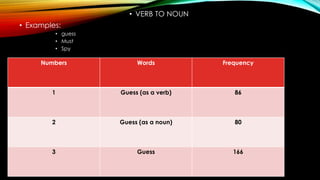
• VERB TO NOUN
• Examples:
• guess
• Must
• Spy
Numbers Words Frequency
1 Guess (as a verb) 86
2 Guess (as a noun) 80
3 Guess 166
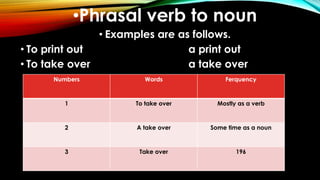
•Phrasal verb to noun
• Examples are as follows.
• To print out a print out
• To take over a take over
Numbers Words Ferquency
1 To take over Mostly as a verb
2 A take over Some time as a noun
3 Take over 196
•Verb to adjective
• Examples are as follows:
• See through in see through material
• Stand up standup comedian
•Adjective to verb:
• Dirty floor to dirty
• Empty room to empty

Hassan presentation of corpus

  • 1.
  • 2.
    TOPIC: USE OF CORPUSTO INVESTIGATE AND DEVELOP LEXICAL KNOWLEDGE
  • 3.
    CONTINUE… • Use ofcorpus to investigate and develop lexical knowledge through phrase, phraseology, collocation, colligation ,polysymy, word formation ,lexical sets etc.
  • 4.
    WHAT IS LEXIS •According to oxford dictionary the level of language consisting of vocabulary , as opposed to grammar or syntax: the distinction between grammar and lexis. • According to Collins English dictionary the totality of vocabulary items in a language, including all forms having lexical meaning and grammatical function from the Greek lexis words.
  • 5.
    CONTINUE…. • Linguistic isthe scientific study of language. • According to ‘Sinclair’ ‘one does not study all botany by making artificial flowers’. • According to ‘Trudgill’ Trudgill is even harsher in his criticism of those who do not base their descriptions on actual language use. in the final analysis if linguistic is not about language as it is opposed actually being spoken or written by human beings, then it is about nothing at all.
  • 6.
    WHAT IS CORPUS? •Corpus is not just any collection of text, a corpus is a collection of naturally occurring language text chosen to characterize a state or variety of a language. in other words corpus is designed and complied based on corpus design principles. another feature which is fundamental to corpus linguistic is that a corpus is ‘machine readable’.
  • 7.
    LIMITATIONS OF CORPUS •Corpora can tell us whether something is frequent, or not, but they are not able to tell us if something is possible in a language. • Corpora can only show us what they contain. • Corpora can give us evidence but the user must then interpret this information. • Corpora contain examples of language outside of divorced from their original ‘visual and social context’.
  • 8.
    CONTINUE…. • It’s ahealthy, vibrant discipline’. • The key to its success remains the same basic method. • Large quantities of ‘raw’ text are opposed directly in order to present the researcher with objective evidence.
  • 9.
    CORPUS-DRIVEN AND CORPUS-BASED APPROACHES •Corpus-based approach is ‘deductive’ because reasoning works from the more general to the more specific, which is a ‘top down’ approach. The researcher begins with a theory about a topic of interest and then narrows that down into more specific hypothesis that can be tested using a corpus. • Corpus-driven approach is ‘inductive’ Inductive reasoning works from specific observation to broader generalizations and theories, and therefore a bottom-up approach. the researcher begins with specific observations and measures in order to identify patterns and regularities.
  • 10.
    PHRASE • In everydayspeech, a phrase may refer to any group of words. In linguistics, a phrase is a group of words that form a constituent and so function as a single unit in the syntax of a sentence. • Examples • in the big hall • at the market day
  • 11.
    TYPES OF PHRASE PhraseExample Hits Adverb phrase Too slowly 6 Adjective phrase Very happy 66 Noun phrase A group of students 7 Preposition phrase At lunch 12 Verb phrase Watch TV 18
  • 12.
    PHRASEOLOGY • 1. Theway in which words and phrases are used in speech or writing; style. • 2. A set of expressions used by a particular person or group. • In linguistics, phraseology is the study of set or fixed expressions, such as idioms and other types of multi-word lexical units.
  • 13.
    EXAMPLES Phrases Hits Because of2404 Al though 1743 In addition 690 On the other hand 683 As a result of 471 In spite of 308
  • 14.
    FIXED EXPRESSION • Afixed expression is a little like a secret code that allows access to a club that not everyone can enter. It’s a phrase that has a very specific meaning that can’t be expressed any other way and also can’t be deduced just by considering the sum of its parts.
  • 15.
    EXAMPLES Fixed expressions Hits Atleast 2212 For the first time 861 Of course 735 Just in case 6 To top it all of 2
  • 16.
    IDIOM • An idiomis a phrase where the words together have a meaning that is different from the dictionary definitions of the individual words, which can make idioms hard for ESL students and learners to understand.
  • 17.
    EXAMPLES Idioms Hits Take root18 Bring home 7 Not for nothing 5 Leading edge 4 Brush with death 3
  • 18.
    COMPOUND WORDS • Compoundword is a combination of two or more words which function as a single word (Richard, et al, 1985). • Compound words are formed when two or more words are put together to form a new word with a new meaning. • Three types of compound words • Hyphenated compound words • examples • One-half, well being, fast-food, full-time etc.
  • 19.
    • Open compoundwords • Ice cream, post office, middle class etc. • Close compound words • examples • Bedroom, motorcycle, software, everything, football etc.
  • 20.
  • 21.
    COLLOCATION • Collocation isaexpression consisting of two or more words that correspond to some convertional way of saying things. • Collocation is a sequence of two or more consecutive words. • The words togather can mean more then their sum of parts. • For example red bull, dark age, the time of india
  • 22.
    Numbers Words Concordancehits 1 Red handed 20 2 Red rose 4 3 Red crescent 4 4 Red mosque 56 5 Red bull 9
  • 23.
    COLLIGATION • It isa grammatical category . This idea is given by hoey. • The grammatical company that a word or phrases is associative with • For example he eats, they go,
  • 24.
  • 27.
    COMPOUND WORDS INCORPUS kind Compound words Type Hits Noun + Noun Bedroom close 41 football close 546 Motor cycle close 304 water tank open 16 Noun + Verb Rainfall close 71 haircut close 05 Noun + Adverb passer-by hyphenated 32 Verb + Noun Washing machine open 07 swimming pool open 26
  • 28.
    Kind Compound Words Type Hits Verb+Adverb lookout close 10 take-off hyphenated 16 drawback close 19 Adjective +Noun greenhouse close 127 software close 457 Adjective + Verb dry-cleaning hyphenated 01 public speaking open 09 Adverb + Verb out put open 616 over through open 62 input close 102 Adverb + Noun onlooker close 03 by-stand hyphenated 0
  • 29.
    COINAGE • One ofthe least common processes of word formation in English is coinage, that is, the invention of totally new terms. • The act of creating new word or phrase that other people begin to use. • Examples: blog, google, aspirin, nylon, zipper.
  • 30.
    COINAGE WORDS INCORPUS Words Coinage Words Hits Web log blog 44 Googol google 144 robotics robot 29 salicylic acid aspirin 05 heroisch heroin 95
  • 31.
    BORROWING • A wordadopted from one language to use in another language. • English has borrowed extensively from other languages. • Especially French, Latin, Greek and other languages also included.
  • 32.
    BORROWED WORDS INCORPUS Language Borrow Word Hits French murder 951 torture 382 unique 339 trophy 709 menu 52 Arabic average 1005 coffee 205 sahib 304 safari 39 zero 344
  • 33.
    Language Borrow WordsHits URDU balti 05 purdah 05 Hindi samosa 48 jungle 93 basmati 135 sari 20 shampoo 09
  • 34.
    LEXICAL SETS • Ingeneral a group of words that share a specific form or meaning is called lexical set. • Lexical set is a group of words with the same topic, function or form e.g cat , dog, tortoise goldfish is a part of typical lexical set. • Lexical sets are not always easily identified from corpus data.
  • 35.
    TYPES OF LEXICALSETS Synonyms: a word having the same or nearly the sane meaning as another word,. Word or an expression that serves as an figurative or symbolic substitute for another. An example of synonyms are the words begin and commence. Synonyms can be any part of speech(such as verb, adverb, adjective, preposition) as long as both words belong to the same part of speech. Examples: Verb(buy and purchase) Adjective(big and long) Adverb(quickly and speedly) Preposition(on and upon)
  • 36.
    Numbers Words Hits 1Buy 823 Purchase 437 2 Big 2330 Large 4582 3 Quickly 505 Speedly 0 Fastly 0
  • 37.
    Numbers Words Frequency 4On 100350 Upon 1684 5 Old 4085 Ancient 226 Aged 250
  • 38.
    ANTONYMS • A wordhaving a meaning opposite to that of another word, e.g fast is an antonym of slow. • Antonyms can be explored with corpus data by corpora in particular to establish whether they share the ranges of references and phraseological patterns . • Some examples of antonyms from corpus are as below. Numbers Words Frequency 1 Early 2531 Late 2354 2 Empty 245 Full 2261
  • 39.
    Numbers Words Hits 3Wife 995 Husband 687 4 Dead 1555 Alive 378 5 Day 10575 Night 1998
  • 40.
    POLYSEMY Definition: A polysemy isa word or phrase with different, but related senses or have multiple related meanings.  English has many words which are polysemous.
  • 41.
    Examples: Main article: Man Listof polysemes: 1. The human species (i.e., man vs. animal) 2. Males of the human species (i.e., man vs. woman) 3. Adult males of the human species (i.e., man vs. boy) This example shows the specific polysemy where the same word is used at different levels of a taxonomy.
  • 42.
    • Main article:Bank •List of polysemes: 1. A financial institution.(3340) 2. Bank of river(beach)(2767) • Main article:Book • List of polysemes: 1) a bound collection of pages(1284) 2) a text reproduced and distributed (thus, someone who has read the same text on a computer has read the same book as someone who had the actual paper volume)(112)
  • 43.
    • Main article:Wood •List of polysemes: I. A piece of a tree(121) II. A geographical area with many trees.(10) • Main article:Crane • List of polysemes: I. A bird(2) II. A type of construction equipment(6)
  • 44.
    Word Hits FreqRank Man 3684 3320 351 Bank 6007 3340 322 Wood 131 110 7626 Book 1396 1284 1029 Crane 8 6 37347
  • 45.
    BLENDING •Def: • A blendword or a blend is a word formed from parts of two or more other words. • Formation: Most blends are formed by one of the following methods I. The beginning of one word is added into the end of the other word. e.g brunch is a blend of breakfast and lunch.
  • 46.
    • smoke (1)+ fog (2) → smog • spoon (1) + fork (2) → spork •smart (1) + sassy (2) → smassy 2. The beginnings of two words are combined. For example, cyborg is a blend of cybernetic and organism.
  • 47.
    3. Two wordsare blended around a common sequence of sounds. For example, the word motel is a blend of motor and hotel.
  • 48.
    Word Hits FreqRank Brunch 1 1 76218 Smog 10 9 31957 Motel 6 3 53737 Cyborg 0 0 0
  • 49.
    DERIVATION • Definition: derivation isthe process of forming a new word on the basis of an existing word, e.g. happiness and unhappy from happy, Derivational morphology often involves the addition of a derivational suffix or other affix.
  • 50.
    • Adjective-to-noun: -ness(slow → slowness) • Adjective-to-verb: -ise (modern → modernise) • Adjective-to-adverb: -ly (personal → personally) • Noun-to-verb: -fy (glory → glorify) • Verb-to-adjective: -able (drink → drinkable) • Verb-to-noun (abstract): -ance (deliver → deliverance) • Verb-to-noun (agent): -er (write → writer)
  • 51.
    • Examples ofEnglish derivational patterns and their suffixes: Pattern Affix word Concordance Hits Rank Adj-to-verb ise Modern-to-(modernise) 41 14029 Adj-to-adverb ly Personal-to-(personally) 261 4419 Verb-to-adj able Drink-to-(drinkable) 1 81023 Verb-to- noun(agent er Write-to-(writer) 842 1571 Noun-to-verb fy Glory-to-(glorify) 3 51907
  • 52.
    ACRONYMS 1. Acronyms arenew words formed from the initial letters of a set of other words. Where the pronunciation consists of saying each separate letter. More typically, acronyms are pronounced as new single words, as in NATO, NASA or UNESCO. These examples have kept their capital letters. 2. Many acronyms simply become everyday terms such as laser (“light amplification by stimulated emission of radiation”), radar (“radio detecting and ranging”) and zip (“zone improvement plan”) code. 3. Examples: • PEMRA • OGRA • NATO • NADRA • First at 203 that is PPP
  • 53.
    Numbers Words Hits 1NATO 505 2 PEMRA 77 3 OGRA 65 4 NADRA 111
  • 54.
    CLIPPING • The elementof reduction that is noticeable in blending is even more apparent in the process described as clipping. This occurs when a word of more than one syllable (facsimile) is reduced to a shorter form (fax) Other common examples are ad (advertisement) • sub (submarine) *auto (automobile) *exam (examination) *fan (fanatic) *deli (delicatessen) *memo (memorandum) *ref (referee) *champ (champion) *bike (bicycle) *ad (advertisement) *burger (hamburger) *grad (graduate) *teen (teenager) *math (mathematics) *dorm (dormitory) *copter (helicopter) *phone (telephone) *plane (airplane) *stats (statistics)
  • 55.
    Numbers Words Hits 1AD(advertisement) 182 2 Fan(fanatic) 133 3 Math(mathematics) 23 4 Stat(statistics) 6
  • 56.
    BACK FORMATION • Avery specialized type of reduction process is known as backformation. Typically, a word of one type (usually a noun) is reduced to form a word of another type (usually a verb. A good example of backformation is the process whereby the noun television first came into use and then the verb televise was created from it. Other examples of words created by this process are: donate (from “donation”), emote (from“emotion”), other examples are.
  • 57.
    Numbers Words Frequency 1Donate (VERB) from donation(noun) 34 2 Emote (verb) from emotion (noun) 1 3 Work (verb) from worker (noun) 4936
  • 58.
    CONVERSION • A changein the function of a word, • NOUN TO VERB : as for example when a noun comes to be used as a verb (without any reduction), is generally known as conversion. NUMBERS WORDS FREQUENCY 1 CHAIR (AS A VERB) 142 2 Chair (as a noun) 166 3 Chair 308
  • 59.
    • VERB TONOUN • Examples: • guess • Must • Spy Numbers Words Frequency 1 Guess (as a verb) 86 2 Guess (as a noun) 80 3 Guess 166
  • 60.
    •Phrasal verb tonoun • Examples are as follows. • To print out a print out • To take over a take over Numbers Words Ferquency 1 To take over Mostly as a verb 2 A take over Some time as a noun 3 Take over 196
  • 61.
    •Verb to adjective •Examples are as follows: • See through in see through material • Stand up standup comedian •Adjective to verb: • Dirty floor to dirty • Empty room to empty