Lexical Approach
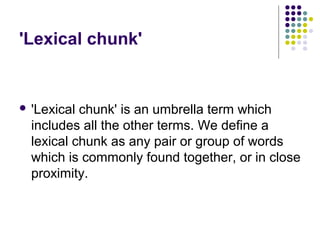
'Lexical chunk'


 'Lexical chunk' is an umbrella term which
  includes all the other terms. We define a
  lexical chunk as any pair or group of words
  which is commonly found together, or in close
  proximity.
'Collocation'

   'Collocation' is also included in the term 'lexical
    chunk', but we refer to it separately from time to
    time, so we define it as a pair of lexical content
    words commonly found together. Following this
    definition, 'basic' + 'principles' is a collocation, but
    'look' + 'at' is not because it combines a lexical
    content word and a grammar function word.
    Identifying chunks and collocations is often a
    question of intuition, unless you have access to a
    corpus.
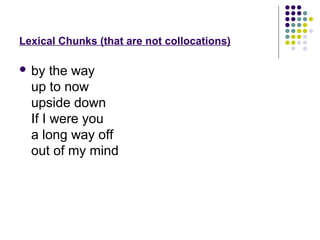
Lexical Chunks (that are not collocations)

 by   the way
  up to now
  upside down
  If I were you
  a long way off
  out of my mind
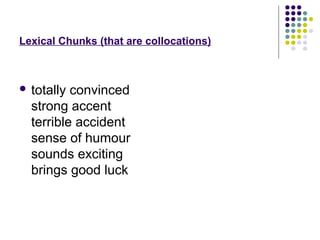
Lexical Chunks (that are collocations)


 totally convinced
  strong accent
  terrible accident
  sense of humour
  sounds exciting
  brings good luck
A theory of learning
 According  to Lewis (1997, 2000) native
 speakers carry a pool of hundreds of
 thousands, and possibly millions, of lexical
 chunks in their heads ready to draw upon in
 order to produce fluent, accurate and
 meaningful language.
 How then are the learners going to learn the
 lexical items they need?
Criticism :
 One of the criticisms levelled at the Lexical
 Approach is its lack of a detailed learning
 theory. It is worth noting, however, that Lewis
 (1993) argues the Lexical Approach is not a
 break with the Communicative Approach, but
 a development of it.
According to Lewis:
   Language is not learnt by learning individual sounds
    and structures and then combining them, but by an
    increasing ability to break down wholes into parts.
   Grammar is acquired by a process of observation,
    hypothesis and experiment.
   We can use whole phrases without understanding
    their constituent parts.
   Acquisition is accelerated by contact with a
    sympathetic interlocutor with a higher level of
    competence in the target language.

Lexical approach

  • 1.
  • 2.
    'Lexical chunk'  'Lexicalchunk' is an umbrella term which includes all the other terms. We define a lexical chunk as any pair or group of words which is commonly found together, or in close proximity.
  • 3.
    'Collocation'  'Collocation' is also included in the term 'lexical chunk', but we refer to it separately from time to time, so we define it as a pair of lexical content words commonly found together. Following this definition, 'basic' + 'principles' is a collocation, but 'look' + 'at' is not because it combines a lexical content word and a grammar function word. Identifying chunks and collocations is often a question of intuition, unless you have access to a corpus.
  • 4.
    Lexical Chunks (thatare not collocations)  by the way up to now upside down If I were you a long way off out of my mind
  • 5.
    Lexical Chunks (thatare collocations)  totally convinced strong accent terrible accident sense of humour sounds exciting brings good luck
  • 6.
    A theory oflearning  According to Lewis (1997, 2000) native speakers carry a pool of hundreds of thousands, and possibly millions, of lexical chunks in their heads ready to draw upon in order to produce fluent, accurate and meaningful language.  How then are the learners going to learn the lexical items they need?
  • 7.
    Criticism :  Oneof the criticisms levelled at the Lexical Approach is its lack of a detailed learning theory. It is worth noting, however, that Lewis (1993) argues the Lexical Approach is not a break with the Communicative Approach, but a development of it.
  • 8.
    According to Lewis:  Language is not learnt by learning individual sounds and structures and then combining them, but by an increasing ability to break down wholes into parts.  Grammar is acquired by a process of observation, hypothesis and experiment.  We can use whole phrases without understanding their constituent parts.  Acquisition is accelerated by contact with a sympathetic interlocutor with a higher level of competence in the target language.