






Lexical games
Let’s play! let’s learn…!! 
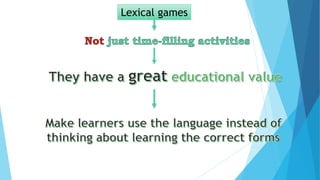
Lexical games
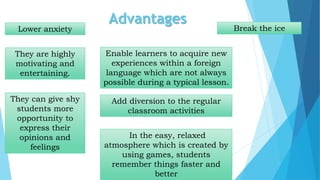
Advantages
Lower anxiety
They are highly
motivating and
entertaining.
They can give shy
students more
opportunity to
express their
opinions and
feelings
Enable learners to acquire new
experiences within a foreign
language which are not always
possible during a typical lesson.
Add diversion to the regular
classroom activities
Break the ice
In the easy, relaxed
atmosphere which is created by
using games, students
remember things faster and
better
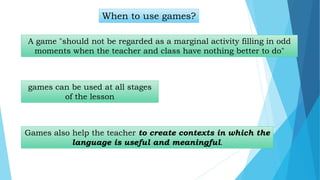
When to use games?
A game "should not be regarded as a marginal activity filling in odd
moments when the teacher and class have nothing better to do"
games can be used at all stages
of the lesson
Games also help the teacher to create contexts in which the
language is useful and meaningful.
Games encourage learners to
interact, cooperate, to be
creative and spontaneous in
using the language in a
meaningful way.
Huyen (2003) identifies the
advantages of using games to
learn vocabulary in the
classroom: • a) Games add relaxation and fun
• b) Games involve friendly competition, so
it keeps learners interested and motivated.
• c) Vocabulary games bring real world
context to the classroom.
Games
Encourages
active
learning, as
well as
collaboration
and
interactivity.
hold memory, performance and social benefits.
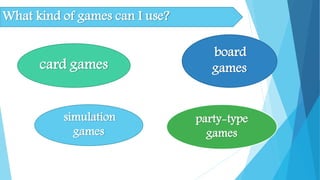
What kind of games can I use?
card games
board
games
simulation
games
party-type
games
Many games require
modification in use when
the students' needs are
taken into consideration.
Teachers have to ensure that their
games are age appropriate and not
too easy or challenging for their
students.
questions to keep in mind when considering which game to
choose for the different age groups:
• Which language does the game target?
• Which skills does it practice?
• What type of game is it?
• What's the purpose for using it?
• Does it fit the students?
• How could I simplify or make it more complex if
necessary?
• How much interaction and participation is there? Do I
like the game myself?
Important things to consider when using games in the classroom
• Choose suitable games
• The way students perceive a game depends on the actual design and
implementation of the game.
• Give clear instructions, give clear rules and give clear time limits.
• Rather demonstrate than explain.
• There must be a clear purpose and achievable goals.
• Clear objectives and goals must match the difficulty level of the game
and ability level of the students.
• Ensure that shy or quiet students are not alienated and have an
opportunity to take part.
• Debriefing, or the evaluation of results/ events in the game, is crucial
to the game’s success.
• It must still be fun, but still help the students to learn.
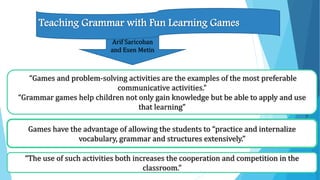
Arif Saricoban
and Esen Metin
“Games and problem-solving activities are the examples of the most preferable
communicative activities.”
“Grammar games help children not only gain knowledge but be able to apply and use
that learning”
Teaching Grammar with Fun Learning Games
Games have the advantage of allowing the students to “practice and internalize
vocabulary, grammar and structures extensively.”
“The use of such activities both increases the cooperation and competition in the
classroom.”
“Games encourage, entertain,
teach, and promote fluency. If
not for any of these reasons,
they should be used just
because they help students
see beauty in a foreign
language and not just
problems that at times seem
overwhelming.' (Uberman,
1998)
Sources
• http://www.teflgames.com/why.html
• http://www.witslanguageschool.com/NewsRoom/ArticleView/tabid/180/ArticleId/
85/Teaching-Tips-Using-Games-in-the-English-Second-or-Foreign-Language-
classroom.aspx
• http://www.eslbase.com/teaching/teaching-grammar-fun-learning-games

Lexical games

  • 1.
    Lexical games Let’s play!let’s learn…!! 
  • 2.
  • 3.
    Advantages Lower anxiety They arehighly motivating and entertaining. They can give shy students more opportunity to express their opinions and feelings Enable learners to acquire new experiences within a foreign language which are not always possible during a typical lesson. Add diversion to the regular classroom activities Break the ice In the easy, relaxed atmosphere which is created by using games, students remember things faster and better
  • 4.
    When to usegames? A game "should not be regarded as a marginal activity filling in odd moments when the teacher and class have nothing better to do" games can be used at all stages of the lesson Games also help the teacher to create contexts in which the language is useful and meaningful.
  • 5.
    Games encourage learnersto interact, cooperate, to be creative and spontaneous in using the language in a meaningful way.
  • 6.
    Huyen (2003) identifiesthe advantages of using games to learn vocabulary in the classroom: • a) Games add relaxation and fun • b) Games involve friendly competition, so it keeps learners interested and motivated. • c) Vocabulary games bring real world context to the classroom.
  • 7.
  • 9.
    What kind ofgames can I use? card games board games simulation games party-type games
  • 10.
    Many games require modificationin use when the students' needs are taken into consideration.
  • 11.
    Teachers have toensure that their games are age appropriate and not too easy or challenging for their students.
  • 12.
    questions to keepin mind when considering which game to choose for the different age groups: • Which language does the game target? • Which skills does it practice? • What type of game is it? • What's the purpose for using it? • Does it fit the students? • How could I simplify or make it more complex if necessary? • How much interaction and participation is there? Do I like the game myself?
  • 13.
    Important things toconsider when using games in the classroom • Choose suitable games • The way students perceive a game depends on the actual design and implementation of the game. • Give clear instructions, give clear rules and give clear time limits. • Rather demonstrate than explain. • There must be a clear purpose and achievable goals. • Clear objectives and goals must match the difficulty level of the game and ability level of the students. • Ensure that shy or quiet students are not alienated and have an opportunity to take part. • Debriefing, or the evaluation of results/ events in the game, is crucial to the game’s success. • It must still be fun, but still help the students to learn.
  • 14.
    Arif Saricoban and EsenMetin “Games and problem-solving activities are the examples of the most preferable communicative activities.” “Grammar games help children not only gain knowledge but be able to apply and use that learning” Teaching Grammar with Fun Learning Games Games have the advantage of allowing the students to “practice and internalize vocabulary, grammar and structures extensively.” “The use of such activities both increases the cooperation and competition in the classroom.”
  • 15.
    “Games encourage, entertain, teach,and promote fluency. If not for any of these reasons, they should be used just because they help students see beauty in a foreign language and not just problems that at times seem overwhelming.' (Uberman, 1998)
  • 16.