Abdellah’s 21
Nursing
Problems
Reporters: Maurene Marie Papilota and Russlie Ann Persona
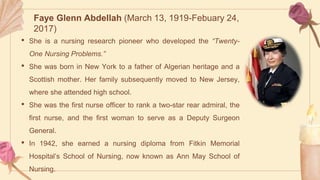
Faye Glenn Abdellah (March 13, 1919-Febuary 24,
2017)
• She is a nursing research pioneer who developed the “Twenty-
One Nursing Problems.”
• She was born in New York to a father of Algerian heritage and a
Scottish mother. Her family subsequently moved to New Jersey,
where she attended high school.
• She was the first nurse officer to rank a two-star rear admiral, the
first nurse, and the first woman to serve as a Deputy Surgeon
General.
• In 1942, she earned a nursing diploma from Fitkin Memorial
Hospital’s School of Nursing, now known as Ann May School of
Nursing.
• Abdellah considers her greatest accomplishment being able to “play a role in
establishing a foundation for nursing research as a science.”
• Her book, Patient-Centered Approaches to Nursing, emphasizes nursing science and
has elicited changes throughout nursing curricula.
• Abdellah went on to earn three degrees from Columbia University: a bachelor of
science degree in nursing in 1945, a master of arts degree in physiology in 1947, and
a doctor of education degree in 1955.
• Recognized as a leader in the development of nursing research and nursing as a
profession within the US Public Health Service (PHS) and as an international expert
on health problems
• She believed that nursing care should be based on research, not hours of care.
• She is a prolific author with more than 150 publications. Her publications
include Better Nursing Care Through Nursing Research and Patient-Centered
Approaches to Nursing. She also developed educational materials in many areas of
public health, including AIDS, hospice care, and drug addiction.
• After retirement, Abdellah founded and served as the first dean in the Graduate
School of Nursing, GSN, Uniformed Services University of the Health Sciences
(USUHS).
21 Nursing
Problems
Theory
Abdellah’s typology of 21 nursing problems is a conceptual model mainly
concerned with patient’s needs and nurses’ role in problem identification
using a problem analysis approach.
Description of the Theory
The 21 Nursing Problems fall into three categories:
1. Physical sociological and emotional needs of clients
2. Types of interpersonal relationships between the nurse and patient
3. Common elements of client care
- She used Henderson’s 14 basic human needs and nursing research to establish
the classification of nursing problems.
Problem Solving
• Is a process involves identifying the problem, selecting pertinent data,
formulating hypothesis, testing hypothesis through the collection of data, and
revising hypothesis where necessary on the basis of conclusions obtained from
the data.
Classification of the 21 Nursing Problems
1. Basic to all Patients
2. Sustenal Care Needs
3. Remedial Care Needs
4. Restorative Care Needs
Basic to all Patients
1. To maintain good hygiene and physical comfort.
2. To promote optimal activity; exercise, rest, sleep.
3. To promote safety through prevention of accident, injury or other trauma, and
through prevention of the spread of infection.
4. To maintain good body mechanics and prevent and correct deformity.
Sustenal Care Needs
5. To facilitate the maintenance of a supply of oxygen to all body cells.
6. To facilitate the maintenance of nutrition for all body cells.
7. To facilitate the maintenance of elimination.
8. To facilitate the maintenance of fluid and electrolyte balance.
9. To recognize the physiological responses of the body to disease conditions-
pathological, physiology, and compensatory.
10. To facilitate the maintenance of regulatory mechanisms and functions.
11. To facilitate the maintenance of sensory function.
Remedial Care Needs
12. To identify and accept positive and negative expressions, feelings, and
reactions.
13. To identify and accept interrelatedness of emotions and organic illness.
14. To facilitate the maintenance of effective verbal and nonverbal communication.
15. To promote the development of productive interpersonal relationships.
16. To facilitate progress toward achievement and personal spiritual relationships.
17. To create or maintain a therapeutic environment.
18. To facilitate awareness of self as an individual with varying physical, emotional,
developmental needs.
Restorative Care Needs
19. To accept the optimum possible goals in the light of limitations, physical and
emotional.
20. To use community resources as an aid in resolving problems that arise from
illness.
21. To understand the role of social problems as influencing factors in the cause of
illness.
Nursing
Metaparadigm of
Faye Glenn
Abdellah
I. Person:
She describes nursing recipients as individuals (and families), although she
does not delineate her beliefs or assumptions about the nature of human
beings.
II. Health:
Health, or the achieving of it, is the purpose of nursing services. Although
Abdellah does not define health, she speaks to “total health needs” and “a
healthy state of mind and body.”
III. Environment:
• Society is included in “planning for optimum health on local, state, and
international levels.” However, as Abdellah further delineated her ideas, the
focus of nursing service is clearly the individual
• The environment is the home or community from which patient comes.
IV. Nursing:
• Nursing is a helping profession which included doing something to or for
the person or providing information to the person.
• It is a comprehensive service to individuals, to families, and therefore to
society
• Abdellah’s theory has interrelated concepts of health and nursing problems,
as well as problem-solving.
Uses of 21 Nursing Problems in the Nursing Process:
1. Assessment Phase
2. Nursing Diagnosis
3. Planning Phase
4. Implementation
5. Evaluation
Assessment Phase
• Nursing problems provide guidelines for the collection of data
• A practice underlying the problem solving approach is that for each identified
problem, pertinent data are collected.
• The overt or covert nature of the problems necessitates a direct or indirect
approach, respectively.
Nursing Diagnosis
• The results of data collection would determine the client’s specific overt or covert
problems.
• These specific problems would be grouped under one or more of the broader
nursing problems
Planning Phase
• The statements of nursing problems most closely resemble goal statements.
Therefore, once the problem has been diagnosed, the goals have established.
Implementation
• Using the goals as the framework, a plan is developed and appropriate nursing
intervention are determined.
Evaluation
• The most appropriate evaluation would be the nurse progress or lack of progress
toward the achievement of the stated goals.
Assumptions
• Abdellah’s assumptions relate to change and anticipated changes that affect
nursing.
• The need to appreciate the interconnectedness of social enterprises and
social problems;
• The impact of problems such as poverty, racism, pollution, education, and so
forth on health and health care delivery;
• Changing nursing education; continuing education for professional nurses;
development of nursing leaders from undeserved groups.
Application Nursing
Practice
• Abdellah’s main goal is the improvement of nursing education
• The most important impact of Abdellah’s theory to nursing practice is that, it
helped transform the focus of the profession from being “disease-centered”
to “patient-centered”.
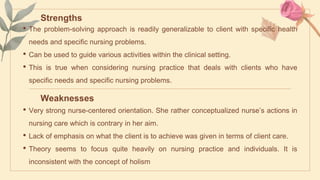
• The problem-solving approach is readily generalizable to client with specific health
needs and specific nursing problems.
• Can be used to guide various activities within the clinical setting.
• This is true when considering nursing practice that deals with clients who have
specific needs and specific nursing problems.
Strengths
Weaknesses
• Very strong nurse-centered orientation. She rather conceptualized nurse’s actions in
nursing care which is contrary in her aim.
• Lack of emphasis on what the client is to achieve was given in terms of client care.
• Theory seems to focus quite heavily on nursing practice and individuals. It is
inconsistent with the concept of holism
Conclusion
• Abdellah’s theory provides basis for determining and organizing nursing care. The

problems also provide a basis for organizing appropriate nursing strategies.
• As a whole, the theory is intended to guide care not just in the hospital setting, but
can also be applied to community nursing as well.
• This theory is mainly focused on the clients and nurses role in identification and
solving these problems.
• Her theory has changed the entire nursing focus from disease to patient centered
approach.
Thank you for
listening

Abdellahs-21-Nursing-Problem.pptx

  • 1.
    Abdellah’s 21 Nursing Problems Reporters: MaureneMarie Papilota and Russlie Ann Persona
  • 2.
    Faye Glenn Abdellah(March 13, 1919-Febuary 24, 2017) • She is a nursing research pioneer who developed the “Twenty- One Nursing Problems.” • She was born in New York to a father of Algerian heritage and a Scottish mother. Her family subsequently moved to New Jersey, where she attended high school. • She was the first nurse officer to rank a two-star rear admiral, the first nurse, and the first woman to serve as a Deputy Surgeon General. • In 1942, she earned a nursing diploma from Fitkin Memorial Hospital’s School of Nursing, now known as Ann May School of Nursing.
  • 3.
    • Abdellah considersher greatest accomplishment being able to “play a role in establishing a foundation for nursing research as a science.” • Her book, Patient-Centered Approaches to Nursing, emphasizes nursing science and has elicited changes throughout nursing curricula. • Abdellah went on to earn three degrees from Columbia University: a bachelor of science degree in nursing in 1945, a master of arts degree in physiology in 1947, and a doctor of education degree in 1955. • Recognized as a leader in the development of nursing research and nursing as a profession within the US Public Health Service (PHS) and as an international expert on health problems
  • 4.
    • She believedthat nursing care should be based on research, not hours of care. • She is a prolific author with more than 150 publications. Her publications include Better Nursing Care Through Nursing Research and Patient-Centered Approaches to Nursing. She also developed educational materials in many areas of public health, including AIDS, hospice care, and drug addiction. • After retirement, Abdellah founded and served as the first dean in the Graduate School of Nursing, GSN, Uniformed Services University of the Health Sciences (USUHS).
  • 5.
  • 6.
    Abdellah’s typology of21 nursing problems is a conceptual model mainly concerned with patient’s needs and nurses’ role in problem identification using a problem analysis approach. Description of the Theory
  • 7.
    The 21 NursingProblems fall into three categories: 1. Physical sociological and emotional needs of clients 2. Types of interpersonal relationships between the nurse and patient 3. Common elements of client care - She used Henderson’s 14 basic human needs and nursing research to establish the classification of nursing problems. Problem Solving • Is a process involves identifying the problem, selecting pertinent data, formulating hypothesis, testing hypothesis through the collection of data, and revising hypothesis where necessary on the basis of conclusions obtained from the data.
  • 8.
    Classification of the21 Nursing Problems 1. Basic to all Patients 2. Sustenal Care Needs 3. Remedial Care Needs 4. Restorative Care Needs
  • 9.
    Basic to allPatients 1. To maintain good hygiene and physical comfort. 2. To promote optimal activity; exercise, rest, sleep. 3. To promote safety through prevention of accident, injury or other trauma, and through prevention of the spread of infection. 4. To maintain good body mechanics and prevent and correct deformity. Sustenal Care Needs 5. To facilitate the maintenance of a supply of oxygen to all body cells. 6. To facilitate the maintenance of nutrition for all body cells. 7. To facilitate the maintenance of elimination. 8. To facilitate the maintenance of fluid and electrolyte balance.
  • 10.
    9. To recognizethe physiological responses of the body to disease conditions- pathological, physiology, and compensatory. 10. To facilitate the maintenance of regulatory mechanisms and functions. 11. To facilitate the maintenance of sensory function. Remedial Care Needs 12. To identify and accept positive and negative expressions, feelings, and reactions. 13. To identify and accept interrelatedness of emotions and organic illness. 14. To facilitate the maintenance of effective verbal and nonverbal communication. 15. To promote the development of productive interpersonal relationships. 16. To facilitate progress toward achievement and personal spiritual relationships. 17. To create or maintain a therapeutic environment.
  • 11.
    18. To facilitateawareness of self as an individual with varying physical, emotional, developmental needs. Restorative Care Needs 19. To accept the optimum possible goals in the light of limitations, physical and emotional. 20. To use community resources as an aid in resolving problems that arise from illness. 21. To understand the role of social problems as influencing factors in the cause of illness.
  • 12.
  • 13.
    I. Person: She describesnursing recipients as individuals (and families), although she does not delineate her beliefs or assumptions about the nature of human beings. II. Health: Health, or the achieving of it, is the purpose of nursing services. Although Abdellah does not define health, she speaks to “total health needs” and “a healthy state of mind and body.”
  • 14.
    III. Environment: • Societyis included in “planning for optimum health on local, state, and international levels.” However, as Abdellah further delineated her ideas, the focus of nursing service is clearly the individual • The environment is the home or community from which patient comes.
  • 15.
    IV. Nursing: • Nursingis a helping profession which included doing something to or for the person or providing information to the person. • It is a comprehensive service to individuals, to families, and therefore to society • Abdellah’s theory has interrelated concepts of health and nursing problems, as well as problem-solving.
  • 16.
    Uses of 21Nursing Problems in the Nursing Process: 1. Assessment Phase 2. Nursing Diagnosis 3. Planning Phase 4. Implementation 5. Evaluation
  • 17.
    Assessment Phase • Nursingproblems provide guidelines for the collection of data • A practice underlying the problem solving approach is that for each identified problem, pertinent data are collected. • The overt or covert nature of the problems necessitates a direct or indirect approach, respectively. Nursing Diagnosis • The results of data collection would determine the client’s specific overt or covert problems. • These specific problems would be grouped under one or more of the broader nursing problems
  • 18.
    Planning Phase • Thestatements of nursing problems most closely resemble goal statements. Therefore, once the problem has been diagnosed, the goals have established. Implementation • Using the goals as the framework, a plan is developed and appropriate nursing intervention are determined. Evaluation • The most appropriate evaluation would be the nurse progress or lack of progress toward the achievement of the stated goals.
  • 19.
    Assumptions • Abdellah’s assumptionsrelate to change and anticipated changes that affect nursing. • The need to appreciate the interconnectedness of social enterprises and social problems; • The impact of problems such as poverty, racism, pollution, education, and so forth on health and health care delivery; • Changing nursing education; continuing education for professional nurses; development of nursing leaders from undeserved groups.
  • 20.
    Application Nursing Practice • Abdellah’smain goal is the improvement of nursing education • The most important impact of Abdellah’s theory to nursing practice is that, it helped transform the focus of the profession from being “disease-centered” to “patient-centered”.
  • 21.
    • The problem-solvingapproach is readily generalizable to client with specific health needs and specific nursing problems. • Can be used to guide various activities within the clinical setting. • This is true when considering nursing practice that deals with clients who have specific needs and specific nursing problems. Strengths Weaknesses • Very strong nurse-centered orientation. She rather conceptualized nurse’s actions in nursing care which is contrary in her aim. • Lack of emphasis on what the client is to achieve was given in terms of client care. • Theory seems to focus quite heavily on nursing practice and individuals. It is inconsistent with the concept of holism
  • 22.
    Conclusion • Abdellah’s theoryprovides basis for determining and organizing nursing care. The problems also provide a basis for organizing appropriate nursing strategies. • As a whole, the theory is intended to guide care not just in the hospital setting, but can also be applied to community nursing as well. • This theory is mainly focused on the clients and nurses role in identification and solving these problems. • Her theory has changed the entire nursing focus from disease to patient centered approach.
  • 23.