1

•Introduction
•Biography and carrier of Nola Pender
•Background of the theory
•Assumptions of the model
•Propositions of Health Promotion Model
•Major concepts of Health Promotion Model
•Individual Factors and Experiences
•Behavior-Specific Cognitions and Affect
•Barnum’s criteria for theory analysis, evaluation and application of HPM
•Interpretation & Inference and Implications & Consequences
•Conclusion
•References 2
Content

 Improving and protecting the health of the people have always
been a priority for healthcare workers and policy makers.
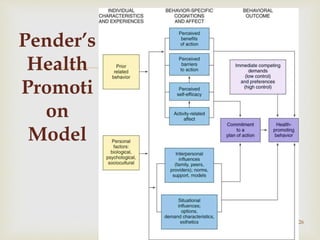
 Initially, healthcare focused mainly on recovering health and later
stages, more attention paid towards prevention of illness and
health promotion.
 WHO states that health promotion is the fundamental strategy in
healthcare that implies changes in behavior and adoption of
patterns that promote good health.
 Among the many models of health related quality of life, Pender’s
Health promotion behavior model helps to identify factors
influenced the decisions and actions of individuals that were made
to prevent disease and promote a healthy lifestyle. 3
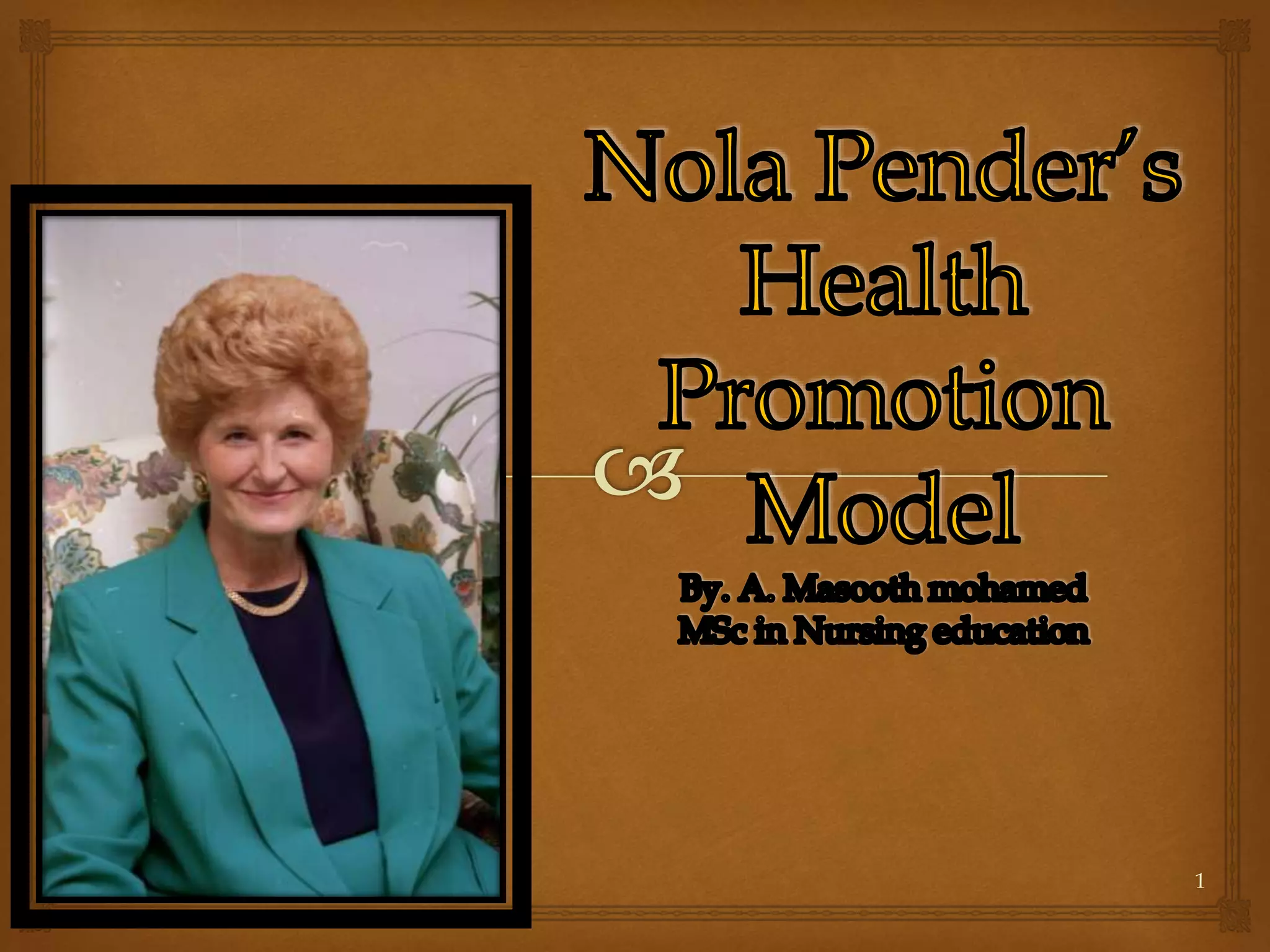
Introduction

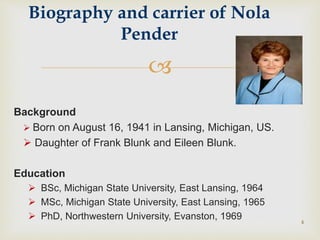
Background
 Born on August 16, 1941 in Lansing, Michigan, US.
 Daughter of Frank Blunk and Eileen Blunk.
Education
 BSc, Michigan State University, East Lansing, 1964
 MSc, Michigan State University, East Lansing, 1965
 PhD, Northwestern University, Evanston, 1969 4
Biography and carrier of Nola
Pender

Membership
 American community health nursing educator.
 Fellow American Academy Nursing; member
American Nurses Association (chairman research
cabinet 1982-1984).
 Midwest Nursing Research Society (president 1985-
1987).
 American Academy Nursing (president 1991-1993).
 National Institutes of Health (national advisory
council nursing research National Center for Nursing
Research 1987-1990, research program grantee
1985-1991).
5
Biography and carrier of Nola
Pender

Achievements
 Nola J. Pender has been listed as a noteworthy Community
health nursing educator.
 Designated as a living legend of the American Academy of
Nursing in 2012.
Professor Emerita
Division of Health Promotion & Risk Reduction, Michigan State
University School of Nursing.
Distinguished Professor
Loyola University Chicago, School of Nursing
6

 Experience - As a young girl observed professional nurses
caring for her aunt and developed a belief that “the goal of
nursing was to help people care for themselves” (Sakraida,
2010, p. 434).
 Educational influences – A master’s degree in human
growth and development facilitated and interest in health over
the human life span. A PhD in psychology and education lead
to thoughts about “how people think and how a person’s
thoughts motivate behavior” (Sakraida, 2010, p. 434).
7
Pender’s motivation for developing
the Health Promotion Model

 The Health Promotion Model (HPM) proposed by Nola J
Pender (1982; revised, 1996) was designed to be a
“complementary counterpart to models of health
promotion.”
 It defines health as “ a positive dynamic state not merely
the absence of disease”.
 Health promotion is directed at increasing a client’s level of
well being.
 The model describes the multi dimensional nature of
persons as they interact within their environment to pursue 8
Background of the theory

 Expectancy value theory
 Fishbein and Ajzen
 Patients will work towards goal they see as beneficial
and achievable.
 Social cognitive theory
 Self efficacy-Confidence of the patient to carry out an
action.
9
Conceptual model-Parent theories

1. Individuals seek to actively regulate their own behavior.
2. Individuals in all their biopsychosocial complexity interact
with the environment, progressively transforming the
environment and being transformed over time.
3. Health professionals constitute a part of the interpersonal
environment, which exerts influence on persons
throughout their life span.
4. Self-initiated reconfiguration of person-environment
interactive patterns is essential to behavior change. 10
Assumptions of the model
 Prior behavior and inherited and acquired characteristics
influence beliefs, affect, and enactment of health-promoting
behavior.
 Persons commit to engaging in behaviors from which they
anticipate deriving personally valued benefits.
 Perceived barriers can constrain commitment to action, a
mediator of behavior as well as actual behavior.
 Perceived competence or self-efficacy to execute a given
behavior increases the likelihood of commitment to action and
actual performance of the behavior. 11
Theoretical propositions of the health
promotion model

 Greater perceived self-efficacy results in fewer perceived barriers
to a specific health behavior.
 Positive affect toward a behavior results in greater perceived
self-efficacy, which can in turn, result in increased positive affect.
 When positive emotions or affect are associated with a behavior,
the probability of commitment and action is increased.
 Persons are more likely to commit to and engage in health-
promoting behaviors when significant others model the behavior,
expect the behavior to occur, and provide assistance and
support to enable the behavior.
 Families, peers, and health care providers are important sources
of interpersonal influence that can increase or decrease
commitment to and engagement in health-promoting behavior. 12

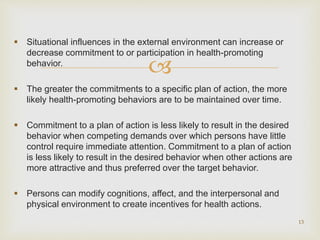
 Situational influences in the external environment can increase or
decrease commitment to or participation in health-promoting
behavior.
 The greater the commitments to a specific plan of action, the more
likely health-promoting behaviors are to be maintained over time.
 Commitment to a plan of action is less likely to result in the desired
behavior when competing demands over which persons have little
control require immediate attention. Commitment to a plan of action
is less likely to result in the desired behavior when other actions are
more attractive and thus preferred over the target behavior.
 Persons can modify cognitions, affect, and the interpersonal and
physical environment to create incentives for health actions.
13

14

15

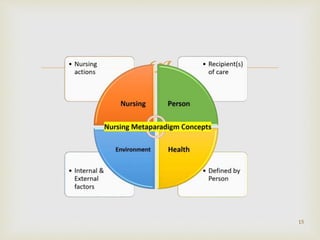
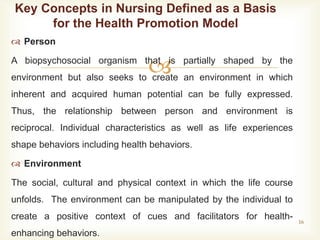
 Person
A biopsychosocial organism that is partially shaped by the
environment but also seeks to create an environment in which
inherent and acquired human potential can be fully expressed.
Thus, the relationship between person and environment is
reciprocal. Individual characteristics as well as life experiences
shape behaviors including health behaviors.
 Environment
The social, cultural and physical context in which the life course
unfolds. The environment can be manipulated by the individual to
create a positive context of cues and facilitators for health-
enhancing behaviors.
16
Key Concepts in Nursing Defined as a Basis
for the Health Promotion Model

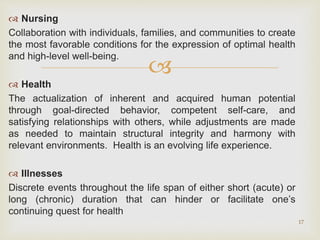
 Nursing
Collaboration with individuals, families, and communities to create
the most favorable conditions for the expression of optimal health
and high-level well-being.
 Health
The actualization of inherent and acquired human potential
through goal-directed behavior, competent self-care, and
satisfying relationships with others, while adjustments are made
as needed to maintain structural integrity and harmony with
relevant environments. Health is an evolving life experience.
 Illnesses
Discrete events throughout the life span of either short (acute) or
long (chronic) duration that can hinder or facilitate one’s
continuing quest for health
17

Major concepts of Health Promotion Model
Pender recognized that there are particular behaviors that
promote individual ownership of prevention of illness and continued
awareness of personal health. The Health Promotion Model focuses
on prior behavior and personal factors that contributed to the outcome.
1. Individual Characteristics and Experiences
2. Behavior-Specific Cognitions and Affect
3. Behavioral Outcome- Health Promoting Behavior
18

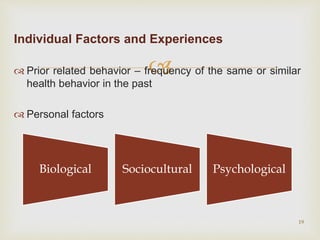
Individual Factors and Experiences
 Prior related behavior – frequency of the same or similar
health behavior in the past
 Personal factors
19
Biological Sociocultural Psychological

20
Biological factors

Sociocultural factors
21

Self esteem
Self motivation
Perceived health status
22
Psychological factors

Behavior-Specific Cognitions and Affect
 Perceived barriers to action – perceptions of the blocks,
hurdles, and personal costs of understanding a health
behavior.
 Perceived self-efficacy – judgment of personal capability to
organize and execute a particular health behavior; self-
confidence in performing the health behavior successfully.
 Activity-related affect – subjective feeling states or emotions
occurring prior to, during and following a specific health
behavior.
 Interpersonal influences (family, peers, providers): norms,
social support, role models, perceptions concerning the
behaviors, beliefs, or attitudes of relevant others in regard to
23

 Situational influences (options, demand characteristics,
aesthetics) – perceptions of the compatibility of life
context or the environment with engaging in a specific
health behavior.
 Commitment to a plan of action -- intention to carry out a
particular health behavior including the identification of
specific strategies to do so successfully.
 Immediate competing demands and preferences –
alternative behaviors that intrude into consciousness as
possible courses of action just prior to the intended
occurrence of a planned health behavior
24

Behavioral Outcome- Health Promoting Behavior
 Health promoting behavior – the desired behavioral end
point or outcome of health decision-making and
preparation for action.
25

Pender’s
Health
Promoti
on
Model
26
Internal criticism
Clarity
 Clarity means to what extent the theory is understandable and how
ideas are conceptualized in the theory.
 Pender’s model provides a reciprocal interaction worldview. The person
is a holistic and multidimensional phenomena and includes
biopsychosocial, spiritual, environmental and cultural attributes and
interacts with their environment. The philosophical claims and content
of the HPM are congruent and clear.
27
Barnum’s criteria for theory analysis,
evaluation and application of HPM

 Conceptual frameworks in nursing, the metaparadigms of health,
person, environment and nursing are included in the model.
 One cannot be healthy in an unhealthy society or world. Within the
metaparadigm, nurses serve as change agents through interpersonal
relationships and assess individuals ’ self-perceptions holistically, and
they tailor nursing interventions to facilitate health-promoting
behaviors.
 Overall the clarity of Pender’s HPM is adequate and its concepts are
easily understood by health professionals without the need for special
training.
28

Consistency
 Based on the research studies reviewed in the literature, the HPM was
applied to diverse age groups from different cultures with varying health
concerns. Studies have shown that the application of Pender’s HPM in
research consistently demonstrated the ability to predict behavior
outcomes for individuals.
 The theory is structurally correct and based on well accepted and
published theories. The model clearly explains the phenomena of
interest. It is about people’s perceptions and how these perceptions can
affect their behaviors.
29

Adequacy
 It should be supported by the literature and current evidence. A literature
review of “Health Promotion Model” on CINHAL and Medline produced
over one hundred studies.
 Because the model is concise, its use has increased nursing knowledge.
Future research needs to be done using the HPM with interactive health
care applications.
 Health planning is essential and including patient input can be useful. This
model is feasible because it allows interventions to be personal to each
patient and increases the likelihood of success of goal achievements. 30

Level of theory development
 To specify the level of theory development, the ultimate aim of any
theory is to reach the stage in which nursing intervention can be
derived and leads to predictable patient outcomes.
 The perceived benefits of action, perceived barriers to action, perceived
self-efficacy and activity-related effect, all influence individuals
motivation to pursue health promoting behavior. Nurses must assist
individuals in identifying and intervening when barriers are presented.
31

Utility
 The criterion of utility requires that a nursing theory be useful to the
practitioners, whether it be nursing practice, education, research, or
administration.
 Since its inception, multiple research studies have been done using
the HPM. The research supports the HPM’s predictive ability, logical
development and revision in 1996 as it applies to nursing knowledge.
32

Significance
 The HPM provides a counterpart to models based on illness-prevention.
 Enhances individuals’ functional ability and improves their quality of life.
 Benefits society as a whole which include economic prosperity,
interpersonal harmony, decreased social violence, suicide, sexually
transmitted disease, and reduced health care costs.
 Useful in many different settings such as workplaces, homes and health
centers.
33

 Research using the HPM: smoking cessation, weight management,
exercise and stress management.
 The HPM allows for personalized nursing interventions with care plans
designed with patient-specific goals.
 Can be used for conducting studies that predict effective
factors/barriers in health-promotion behaviors, detect impacts of
intervention program for improving health promotion behaviors, test
this model, and identify quality of life.
34

Discrimination
 The important question for defining discrimination is, “Does theory
differentiate nursing from other health professions”?
 HPM has unique characteristics in health behaviors and prevention of
disease. So it can be useful for public health and prevention of many
disorders.
35

Scope of theory
 The narrower the theory, the more potential for guidance; the broader
the theory, the more global its terms and meaning, hence the less
potential for guidance.
 Pender’s theory is a middle-range theory which fills the gaps between
grand nursing theories and nursing practice. The model’s scope is
narrow with limited concepts that can be applied easily in practice and
research.
36

Complexity
 Complexity enables a theory to account for the richness of its subject
matter.
 Model has changed the focus of the role of the nurse from simply
disease prevention to health promotion and it adds knowledge to its
discipline.
 Nursing goals can focus on “strengthening resources, potentials and
capabilities” for individuals, families, and communities to help them
obtain a better quality of life.
 A vital part of advancing the discipline of nursing through the
knowledge gained from its application and has proven useful in nursing
practice and research. 37

 The idea behind the model is helping people change their lifestyles, and
move toward a state of optimal health.
 It is a simple model to comprehend although it involves complex
variables of behavior, biological and sociocultural factors.
 Guide nurses in helping clients achieve improved health, enhanced
functional ability and better quality of life.
 Justified by its ability to account for lifestyle factors and need for
“improvements in society”.
 Based on two other theories: expectancy value theory and social
cognitive theory.
38
Conclusion

 Scholary articles related to Pender’s Health Promotion Model
 Agazio, J., & Buckley, K. (2010). Finding a balance: health promotion challenges of military
women. Health Care for Women International, 31(9), 848-868. Retrieved from CINAHL
database.
This journal discusses health promotion in military women. The military women used
different tools to evaluate factors effecting their performance in health promoting
activities. Self-efficacy and interpersonal influences most influence on health promotion. This
article focused on working military women meeting health promotion activities. It also
concentrates on how to best support their ability to participate in healthy behaviors.
 Byam-Williams, J.B. (2010), Salyer, J. Factors influencing the health-related lifestyle of
community-dwelling older adults. Home Healthcare Nurse, 28(2), p 115–121,
doi: 10.1097/NHH.0b013e3181cb5750
People are living longer, but are not necessarily healthier. This study examined factors
influencing health related life styles with a goal of increasing knowledge to encourage
healthy lifestyles. Pender's revised Health Promotion Model (HPM) guided the study.
A self-administered questionnaire was used to collect data. It points out that nurses in
the community setting could function in supportive and educational roles. This could
be done in churches and senior apartments by developing strategies to encourage older
adults to use existing skills to practice more behaviors that contribute to a healthy
lifestyle.
39
Resources and Web-links

 Lannon, S. (1997). Using a health promotion model to enhance medication
compliance. Journal of Neuroscience Nursing,(29)3, 170-178. Retrieved from
Health and Wellness Resource Center.
This article looks specifically at three individual case studies and how their
compliance to seizure medication for control of their epilepsy has an effect on their
level of wellbeing. The author uses Pender’s Health Promotion Model to look at how each
factor relates to their compliance with antiepileptic drugs. This article shows how
Pender’s model is used in the clinical setting.
 Kelley, J. A., Sherrod, R. A., & Smyth, P. (2009). Coronary artery disease and smoking
cessation intervention by primary care providers in a rural clinic. Online Journal of
Rural Nursing & Health Care, 9(2), 78-90.Retrieved from Academic
OneFile database.
This article discusses how Kelley, Sherrod, and Smyth (2009) did a study that was
published in the Online Journal of Rural Nursing and Health Care about smoking
cessation intervention by primary care providers for patients who smoke and have
been diagnosed with coronary artery disease (CAD) within the past year. Nola J.
Pender’s revised Health Promotion Model was the basis and structure for this study.
40
Resources and Web-links
 Srof, B.J., & Velsor- Friedrich, B. (2006). Health promotion in
adolescents: a review of Pender’s health promotion model. E-
Journal of Nursing Science Quarterly, 19 (4), 366-373. Retrieved from
http://www.ncbi.nlm.nih.gov/pubmed/16982726
This journal discusses teen-adolescents role from transition of parent
managed care to self-care responsibilities. Pender’s health promotion
model is explored related to change in adolescent behavior. Social
cognitive theories are reviewed supporting Pender’s theoretical
underpinnings. It notes that further research is also recommended.
41
Resources and Web-links

Sally , a 25 year old, student wants to lose weight. She would like to
have more energy during the day. She is tired of seeing the scale in
the 90s. High blood pressure runs in her family. Her father has had
three stents put into his heart by the age of 50 and had a mild heart
attack. Upon assessment her blood pressure is 118/44 mmHg,
height is 5’3”, weight 95kg. Sally States that her stress level is high.
She is unable to get a job, and has two children to take care of. He
husband works full-time making minimum wage. She is a non
smoker. She levels the office to have more blood work completed.
Questions
1. What evidence would show Sally is ready for weight loss management?
2. What are some perceived barriers and perceived benefits of action?
3. What are some personal factors that affect her weight loss and health?
4. What are some behavior options to go over with Sally? 42
Case Study
Answer Key
1. What evidence would show Sally is ready for weight loss management?
 She came to the office on her own
 She is tired of the scale being in the 90s
 Family history
2. What are some perceived barriers and perceived benefits of action?
 Perceived barriers
 Not having enough time or energy to exercise
 Not having money to buy healthy foods
 High stress level
 Perceived benefits of action
 More energy to play with children
 Healthier
 Decreased chances of heart disease
43
Case Study
Answer Key
3. What are some personal factors that affect her weight loss and health?
 Young adult
 BMI is obese
 Sees self as overweight
 Lower socioeconomic status
 College education
4. What are some behavior options to go over with Sally?
 Help establish an exercise routine that fits into her schedule
 Set short and long term goals
 Schedule weekly weight checks
 Go over a healthy diet
 Talk about stress management
 Address any dietary concerns
44
Case Study

 Byam-Williams, J.B. (2010), Salyer, J. Factors influencing the health-
related lifestyle of community- dwelling older adults. Home Healthcare
Nurse. 28(2), p 115–121, doi:10.1097/NHH.0b013e3181cb5750
 Current Nursing. (2010). Health Promotion Model. Retrieved from
http://currentnursing.com/nursing_theory/health_promotion_model.ht
ml
 Nursing Theory. (2010). Health Promotion Model. Retrieved from
http://www.nursingtheory.net /mr_healthpromotion.html
 Pender, N. J., Murdaugh, C. L., & Parsons, M. (2006). Health Promotion in
Nursing Practice.
Upper Saddle River, New Jersey: Pearson Prentice Hall.
 Sakraida, T.J. (2010). Nola J. Pender: Health Promotion Model. In M. R.
Alligood, & A. M. Tomey (Eds.), Nursing Theorists and Their Work
(pp.434-454) (7th ed). Maryland Heights, MO: Mosby Elsevier.
45
References

 Web-links
 http:// currentnursing.com/nursing_theory/health_promotion_model.html
Current Nursing. (2010). Health promotion model.
This website provides further information on the Health Promotion Model. It includes the concepts
and how the model works and relates to a patient’s level of wellbeing.
 http://nursingtheories.blogspot.com/2008/07/health-promotion-model-heuristic-device.html
Philippines Open University (2008), Health Promotion Model: Heuristic Device for Health Care
Professionals. Nursing theories blog spot.
This is a blog about nursing theories. It contains a full summery and is interactive for blog comments and
questions.
 http://www.ehow.com/about_6367507_pender-nursing-theory.html
Ehow. (2010). Walter J. Johnson.
This web-link is a summary of the health promotion model. This summary is in basic terms so anyone
could read it and understand the article. At the end of the article it talks about Pender helping decreasing
healthcare costs because of this model.
 http://www.nurses.info/nursing_theory_midrange_theories_nola_pender.htm
Nurses.info. (2010). Nola J. Pender.
This website provides intellectual information that is proposed by Nola Pender regarding the Health
Promotion Model. Included are links to relevant books, articles, and Propositions.
 http://www.nursingtheory.net/mr_healthpromotion.html
Nursingtheory.net. (2005). Health promotion model.
This web-link provides information on places to search to find scholarly articles that are related to the
Health Promotion Model. It also discusses that multiples variables are the important concept in
deciding which variables would affect each individual.
46

47

Nola penders theory

  • 1.
  • 2.
     •Introduction •Biography and carrierof Nola Pender •Background of the theory •Assumptions of the model •Propositions of Health Promotion Model •Major concepts of Health Promotion Model •Individual Factors and Experiences •Behavior-Specific Cognitions and Affect •Barnum’s criteria for theory analysis, evaluation and application of HPM •Interpretation & Inference and Implications & Consequences •Conclusion •References 2 Content
  • 3.
      Improving andprotecting the health of the people have always been a priority for healthcare workers and policy makers.  Initially, healthcare focused mainly on recovering health and later stages, more attention paid towards prevention of illness and health promotion.  WHO states that health promotion is the fundamental strategy in healthcare that implies changes in behavior and adoption of patterns that promote good health.  Among the many models of health related quality of life, Pender’s Health promotion behavior model helps to identify factors influenced the decisions and actions of individuals that were made to prevent disease and promote a healthy lifestyle. 3 Introduction
  • 4.
     Background  Born onAugust 16, 1941 in Lansing, Michigan, US.  Daughter of Frank Blunk and Eileen Blunk. Education  BSc, Michigan State University, East Lansing, 1964  MSc, Michigan State University, East Lansing, 1965  PhD, Northwestern University, Evanston, 1969 4 Biography and carrier of Nola Pender
  • 5.
     Membership  American communityhealth nursing educator.  Fellow American Academy Nursing; member American Nurses Association (chairman research cabinet 1982-1984).  Midwest Nursing Research Society (president 1985- 1987).  American Academy Nursing (president 1991-1993).  National Institutes of Health (national advisory council nursing research National Center for Nursing Research 1987-1990, research program grantee 1985-1991). 5 Biography and carrier of Nola Pender
  • 6.
     Achievements  Nola J.Pender has been listed as a noteworthy Community health nursing educator.  Designated as a living legend of the American Academy of Nursing in 2012. Professor Emerita Division of Health Promotion & Risk Reduction, Michigan State University School of Nursing. Distinguished Professor Loyola University Chicago, School of Nursing 6
  • 7.
      Experience -As a young girl observed professional nurses caring for her aunt and developed a belief that “the goal of nursing was to help people care for themselves” (Sakraida, 2010, p. 434).  Educational influences – A master’s degree in human growth and development facilitated and interest in health over the human life span. A PhD in psychology and education lead to thoughts about “how people think and how a person’s thoughts motivate behavior” (Sakraida, 2010, p. 434). 7 Pender’s motivation for developing the Health Promotion Model
  • 8.
      The HealthPromotion Model (HPM) proposed by Nola J Pender (1982; revised, 1996) was designed to be a “complementary counterpart to models of health promotion.”  It defines health as “ a positive dynamic state not merely the absence of disease”.  Health promotion is directed at increasing a client’s level of well being.  The model describes the multi dimensional nature of persons as they interact within their environment to pursue 8 Background of the theory
  • 9.
      Expectancy valuetheory  Fishbein and Ajzen  Patients will work towards goal they see as beneficial and achievable.  Social cognitive theory  Self efficacy-Confidence of the patient to carry out an action. 9 Conceptual model-Parent theories
  • 10.
     1. Individuals seekto actively regulate their own behavior. 2. Individuals in all their biopsychosocial complexity interact with the environment, progressively transforming the environment and being transformed over time. 3. Health professionals constitute a part of the interpersonal environment, which exerts influence on persons throughout their life span. 4. Self-initiated reconfiguration of person-environment interactive patterns is essential to behavior change. 10 Assumptions of the model
  • 11.
     Prior behaviorand inherited and acquired characteristics influence beliefs, affect, and enactment of health-promoting behavior.  Persons commit to engaging in behaviors from which they anticipate deriving personally valued benefits.  Perceived barriers can constrain commitment to action, a mediator of behavior as well as actual behavior.  Perceived competence or self-efficacy to execute a given behavior increases the likelihood of commitment to action and actual performance of the behavior. 11 Theoretical propositions of the health promotion model
  • 12.
      Greater perceivedself-efficacy results in fewer perceived barriers to a specific health behavior.  Positive affect toward a behavior results in greater perceived self-efficacy, which can in turn, result in increased positive affect.  When positive emotions or affect are associated with a behavior, the probability of commitment and action is increased.  Persons are more likely to commit to and engage in health- promoting behaviors when significant others model the behavior, expect the behavior to occur, and provide assistance and support to enable the behavior.  Families, peers, and health care providers are important sources of interpersonal influence that can increase or decrease commitment to and engagement in health-promoting behavior. 12
  • 13.
      Situational influencesin the external environment can increase or decrease commitment to or participation in health-promoting behavior.  The greater the commitments to a specific plan of action, the more likely health-promoting behaviors are to be maintained over time.  Commitment to a plan of action is less likely to result in the desired behavior when competing demands over which persons have little control require immediate attention. Commitment to a plan of action is less likely to result in the desired behavior when other actions are more attractive and thus preferred over the target behavior.  Persons can modify cognitions, affect, and the interpersonal and physical environment to create incentives for health actions. 13
  • 14.
  • 15.
  • 16.
      Person A biopsychosocialorganism that is partially shaped by the environment but also seeks to create an environment in which inherent and acquired human potential can be fully expressed. Thus, the relationship between person and environment is reciprocal. Individual characteristics as well as life experiences shape behaviors including health behaviors.  Environment The social, cultural and physical context in which the life course unfolds. The environment can be manipulated by the individual to create a positive context of cues and facilitators for health- enhancing behaviors. 16 Key Concepts in Nursing Defined as a Basis for the Health Promotion Model
  • 17.
      Nursing Collaboration withindividuals, families, and communities to create the most favorable conditions for the expression of optimal health and high-level well-being.  Health The actualization of inherent and acquired human potential through goal-directed behavior, competent self-care, and satisfying relationships with others, while adjustments are made as needed to maintain structural integrity and harmony with relevant environments. Health is an evolving life experience.  Illnesses Discrete events throughout the life span of either short (acute) or long (chronic) duration that can hinder or facilitate one’s continuing quest for health 17
  • 18.
     Major concepts ofHealth Promotion Model Pender recognized that there are particular behaviors that promote individual ownership of prevention of illness and continued awareness of personal health. The Health Promotion Model focuses on prior behavior and personal factors that contributed to the outcome. 1. Individual Characteristics and Experiences 2. Behavior-Specific Cognitions and Affect 3. Behavioral Outcome- Health Promoting Behavior 18
  • 19.
     Individual Factors andExperiences  Prior related behavior – frequency of the same or similar health behavior in the past  Personal factors 19 Biological Sociocultural Psychological
  • 20.
  • 21.
  • 22.
     Self esteem Self motivation Perceivedhealth status 22 Psychological factors
  • 23.
     Behavior-Specific Cognitions andAffect  Perceived barriers to action – perceptions of the blocks, hurdles, and personal costs of understanding a health behavior.  Perceived self-efficacy – judgment of personal capability to organize and execute a particular health behavior; self- confidence in performing the health behavior successfully.  Activity-related affect – subjective feeling states or emotions occurring prior to, during and following a specific health behavior.  Interpersonal influences (family, peers, providers): norms, social support, role models, perceptions concerning the behaviors, beliefs, or attitudes of relevant others in regard to 23
  • 24.
      Situational influences(options, demand characteristics, aesthetics) – perceptions of the compatibility of life context or the environment with engaging in a specific health behavior.  Commitment to a plan of action -- intention to carry out a particular health behavior including the identification of specific strategies to do so successfully.  Immediate competing demands and preferences – alternative behaviors that intrude into consciousness as possible courses of action just prior to the intended occurrence of a planned health behavior 24
  • 25.
     Behavioral Outcome- HealthPromoting Behavior  Health promoting behavior – the desired behavioral end point or outcome of health decision-making and preparation for action. 25
  • 26.
  • 27.
    Internal criticism Clarity  Claritymeans to what extent the theory is understandable and how ideas are conceptualized in the theory.  Pender’s model provides a reciprocal interaction worldview. The person is a holistic and multidimensional phenomena and includes biopsychosocial, spiritual, environmental and cultural attributes and interacts with their environment. The philosophical claims and content of the HPM are congruent and clear. 27 Barnum’s criteria for theory analysis, evaluation and application of HPM
  • 28.
      Conceptual frameworksin nursing, the metaparadigms of health, person, environment and nursing are included in the model.  One cannot be healthy in an unhealthy society or world. Within the metaparadigm, nurses serve as change agents through interpersonal relationships and assess individuals ’ self-perceptions holistically, and they tailor nursing interventions to facilitate health-promoting behaviors.  Overall the clarity of Pender’s HPM is adequate and its concepts are easily understood by health professionals without the need for special training. 28
  • 29.
     Consistency  Based onthe research studies reviewed in the literature, the HPM was applied to diverse age groups from different cultures with varying health concerns. Studies have shown that the application of Pender’s HPM in research consistently demonstrated the ability to predict behavior outcomes for individuals.  The theory is structurally correct and based on well accepted and published theories. The model clearly explains the phenomena of interest. It is about people’s perceptions and how these perceptions can affect their behaviors. 29
  • 30.
     Adequacy  It shouldbe supported by the literature and current evidence. A literature review of “Health Promotion Model” on CINHAL and Medline produced over one hundred studies.  Because the model is concise, its use has increased nursing knowledge. Future research needs to be done using the HPM with interactive health care applications.  Health planning is essential and including patient input can be useful. This model is feasible because it allows interventions to be personal to each patient and increases the likelihood of success of goal achievements. 30
  • 31.
     Level of theorydevelopment  To specify the level of theory development, the ultimate aim of any theory is to reach the stage in which nursing intervention can be derived and leads to predictable patient outcomes.  The perceived benefits of action, perceived barriers to action, perceived self-efficacy and activity-related effect, all influence individuals motivation to pursue health promoting behavior. Nurses must assist individuals in identifying and intervening when barriers are presented. 31
  • 32.
     Utility  The criterionof utility requires that a nursing theory be useful to the practitioners, whether it be nursing practice, education, research, or administration.  Since its inception, multiple research studies have been done using the HPM. The research supports the HPM’s predictive ability, logical development and revision in 1996 as it applies to nursing knowledge. 32
  • 33.
     Significance  The HPMprovides a counterpart to models based on illness-prevention.  Enhances individuals’ functional ability and improves their quality of life.  Benefits society as a whole which include economic prosperity, interpersonal harmony, decreased social violence, suicide, sexually transmitted disease, and reduced health care costs.  Useful in many different settings such as workplaces, homes and health centers. 33
  • 34.
      Research usingthe HPM: smoking cessation, weight management, exercise and stress management.  The HPM allows for personalized nursing interventions with care plans designed with patient-specific goals.  Can be used for conducting studies that predict effective factors/barriers in health-promotion behaviors, detect impacts of intervention program for improving health promotion behaviors, test this model, and identify quality of life. 34
  • 35.
     Discrimination  The importantquestion for defining discrimination is, “Does theory differentiate nursing from other health professions”?  HPM has unique characteristics in health behaviors and prevention of disease. So it can be useful for public health and prevention of many disorders. 35
  • 36.
     Scope of theory The narrower the theory, the more potential for guidance; the broader the theory, the more global its terms and meaning, hence the less potential for guidance.  Pender’s theory is a middle-range theory which fills the gaps between grand nursing theories and nursing practice. The model’s scope is narrow with limited concepts that can be applied easily in practice and research. 36
  • 37.
     Complexity  Complexity enablesa theory to account for the richness of its subject matter.  Model has changed the focus of the role of the nurse from simply disease prevention to health promotion and it adds knowledge to its discipline.  Nursing goals can focus on “strengthening resources, potentials and capabilities” for individuals, families, and communities to help them obtain a better quality of life.  A vital part of advancing the discipline of nursing through the knowledge gained from its application and has proven useful in nursing practice and research. 37
  • 38.
      The ideabehind the model is helping people change their lifestyles, and move toward a state of optimal health.  It is a simple model to comprehend although it involves complex variables of behavior, biological and sociocultural factors.  Guide nurses in helping clients achieve improved health, enhanced functional ability and better quality of life.  Justified by its ability to account for lifestyle factors and need for “improvements in society”.  Based on two other theories: expectancy value theory and social cognitive theory. 38 Conclusion
  • 39.
      Scholary articlesrelated to Pender’s Health Promotion Model  Agazio, J., & Buckley, K. (2010). Finding a balance: health promotion challenges of military women. Health Care for Women International, 31(9), 848-868. Retrieved from CINAHL database. This journal discusses health promotion in military women. The military women used different tools to evaluate factors effecting their performance in health promoting activities. Self-efficacy and interpersonal influences most influence on health promotion. This article focused on working military women meeting health promotion activities. It also concentrates on how to best support their ability to participate in healthy behaviors.  Byam-Williams, J.B. (2010), Salyer, J. Factors influencing the health-related lifestyle of community-dwelling older adults. Home Healthcare Nurse, 28(2), p 115–121, doi: 10.1097/NHH.0b013e3181cb5750 People are living longer, but are not necessarily healthier. This study examined factors influencing health related life styles with a goal of increasing knowledge to encourage healthy lifestyles. Pender's revised Health Promotion Model (HPM) guided the study. A self-administered questionnaire was used to collect data. It points out that nurses in the community setting could function in supportive and educational roles. This could be done in churches and senior apartments by developing strategies to encourage older adults to use existing skills to practice more behaviors that contribute to a healthy lifestyle. 39 Resources and Web-links
  • 40.
      Lannon, S.(1997). Using a health promotion model to enhance medication compliance. Journal of Neuroscience Nursing,(29)3, 170-178. Retrieved from Health and Wellness Resource Center. This article looks specifically at three individual case studies and how their compliance to seizure medication for control of their epilepsy has an effect on their level of wellbeing. The author uses Pender’s Health Promotion Model to look at how each factor relates to their compliance with antiepileptic drugs. This article shows how Pender’s model is used in the clinical setting.  Kelley, J. A., Sherrod, R. A., & Smyth, P. (2009). Coronary artery disease and smoking cessation intervention by primary care providers in a rural clinic. Online Journal of Rural Nursing & Health Care, 9(2), 78-90.Retrieved from Academic OneFile database. This article discusses how Kelley, Sherrod, and Smyth (2009) did a study that was published in the Online Journal of Rural Nursing and Health Care about smoking cessation intervention by primary care providers for patients who smoke and have been diagnosed with coronary artery disease (CAD) within the past year. Nola J. Pender’s revised Health Promotion Model was the basis and structure for this study. 40 Resources and Web-links
  • 41.
     Srof, B.J.,& Velsor- Friedrich, B. (2006). Health promotion in adolescents: a review of Pender’s health promotion model. E- Journal of Nursing Science Quarterly, 19 (4), 366-373. Retrieved from http://www.ncbi.nlm.nih.gov/pubmed/16982726 This journal discusses teen-adolescents role from transition of parent managed care to self-care responsibilities. Pender’s health promotion model is explored related to change in adolescent behavior. Social cognitive theories are reviewed supporting Pender’s theoretical underpinnings. It notes that further research is also recommended. 41 Resources and Web-links
  • 42.
     Sally , a25 year old, student wants to lose weight. She would like to have more energy during the day. She is tired of seeing the scale in the 90s. High blood pressure runs in her family. Her father has had three stents put into his heart by the age of 50 and had a mild heart attack. Upon assessment her blood pressure is 118/44 mmHg, height is 5’3”, weight 95kg. Sally States that her stress level is high. She is unable to get a job, and has two children to take care of. He husband works full-time making minimum wage. She is a non smoker. She levels the office to have more blood work completed. Questions 1. What evidence would show Sally is ready for weight loss management? 2. What are some perceived barriers and perceived benefits of action? 3. What are some personal factors that affect her weight loss and health? 4. What are some behavior options to go over with Sally? 42 Case Study
  • 43.
    Answer Key 1. Whatevidence would show Sally is ready for weight loss management?  She came to the office on her own  She is tired of the scale being in the 90s  Family history 2. What are some perceived barriers and perceived benefits of action?  Perceived barriers  Not having enough time or energy to exercise  Not having money to buy healthy foods  High stress level  Perceived benefits of action  More energy to play with children  Healthier  Decreased chances of heart disease 43 Case Study
  • 44.
    Answer Key 3. Whatare some personal factors that affect her weight loss and health?  Young adult  BMI is obese  Sees self as overweight  Lower socioeconomic status  College education 4. What are some behavior options to go over with Sally?  Help establish an exercise routine that fits into her schedule  Set short and long term goals  Schedule weekly weight checks  Go over a healthy diet  Talk about stress management  Address any dietary concerns 44 Case Study
  • 45.
      Byam-Williams, J.B.(2010), Salyer, J. Factors influencing the health- related lifestyle of community- dwelling older adults. Home Healthcare Nurse. 28(2), p 115–121, doi:10.1097/NHH.0b013e3181cb5750  Current Nursing. (2010). Health Promotion Model. Retrieved from http://currentnursing.com/nursing_theory/health_promotion_model.ht ml  Nursing Theory. (2010). Health Promotion Model. Retrieved from http://www.nursingtheory.net /mr_healthpromotion.html  Pender, N. J., Murdaugh, C. L., & Parsons, M. (2006). Health Promotion in Nursing Practice. Upper Saddle River, New Jersey: Pearson Prentice Hall.  Sakraida, T.J. (2010). Nola J. Pender: Health Promotion Model. In M. R. Alligood, & A. M. Tomey (Eds.), Nursing Theorists and Their Work (pp.434-454) (7th ed). Maryland Heights, MO: Mosby Elsevier. 45 References
  • 46.
      Web-links  http://currentnursing.com/nursing_theory/health_promotion_model.html Current Nursing. (2010). Health promotion model. This website provides further information on the Health Promotion Model. It includes the concepts and how the model works and relates to a patient’s level of wellbeing.  http://nursingtheories.blogspot.com/2008/07/health-promotion-model-heuristic-device.html Philippines Open University (2008), Health Promotion Model: Heuristic Device for Health Care Professionals. Nursing theories blog spot. This is a blog about nursing theories. It contains a full summery and is interactive for blog comments and questions.  http://www.ehow.com/about_6367507_pender-nursing-theory.html Ehow. (2010). Walter J. Johnson. This web-link is a summary of the health promotion model. This summary is in basic terms so anyone could read it and understand the article. At the end of the article it talks about Pender helping decreasing healthcare costs because of this model.  http://www.nurses.info/nursing_theory_midrange_theories_nola_pender.htm Nurses.info. (2010). Nola J. Pender. This website provides intellectual information that is proposed by Nola Pender regarding the Health Promotion Model. Included are links to relevant books, articles, and Propositions.  http://www.nursingtheory.net/mr_healthpromotion.html Nursingtheory.net. (2005). Health promotion model. This web-link provides information on places to search to find scholarly articles that are related to the Health Promotion Model. It also discusses that multiples variables are the important concept in deciding which variables would affect each individual. 46
  • 47.