Functions of Management Practical Management
Learning objectives Understand: The skills & attributes required by managers The role & functions of management The management environment The challenges of management How to match attributes to the roles Our own management abilities & needs
Your thoughts:
What is a Manager Anyway? Traditional Person who plans, directs people and resources New Organization Person who supports, coaches, coordinates, and leads Peter Principle A person promoted to their level of incompetence Dilbert’s Principle The most ineffective workers are systematically moved where they can do the least damage
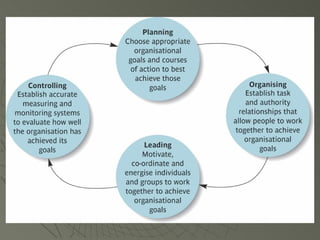
THE 4 FUNCTIONS Planning Organising  Leading  Controlling
 
Planning What is planning? What kind of things do we plan? Strategic planning Tactical planning Project planning Marketing HR planning
Organising  What is organising? What do we organise? Ourselves People Time Other resources like finance, equipment etc.
Leading Establishing direction and influencing people to follow that direction What do we lead? Others Direction & focus Culture Innovation & technology Markets & marketing
Controlling Monitoring and adjusting resources and processes to achieve goals People Finance & budget Legal implications Time & targets  Quality H&S
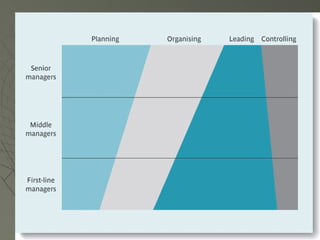
Time Allocation What amount of time do managers allocate to the 4 main functions? How does this change over career development?
 
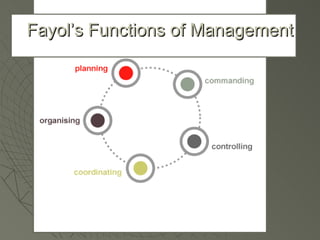
Fayol’s Functions of Management
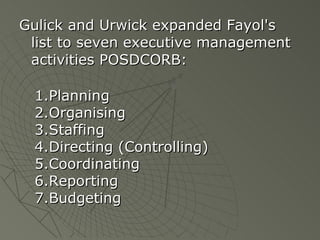
Gulick and Urwick expanded Fayol's list to seven executive management activities POSDCORB: Planning Organising Staffing  Directing (Controlling) Coordinating  Reporting Budgeting
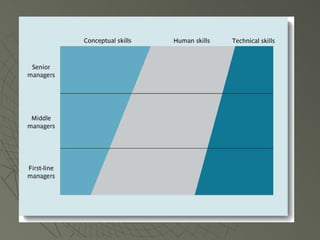
Management Skills Compare the skills managers need more of at the start with those they need as they develop into senior management.  Use a diagram to illustrate your thoughts.
 
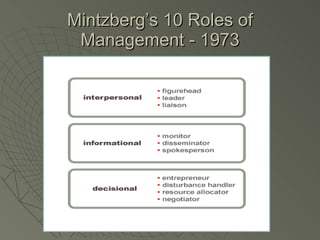
Mintzberg’s 10 Roles of Management - 1973

Functions of management

  • 2.
    Functions of ManagementPractical Management
  • 3.
    Learning objectives Understand:The skills & attributes required by managers The role & functions of management The management environment The challenges of management How to match attributes to the roles Our own management abilities & needs
  • 4.
  • 5.
    What is aManager Anyway? Traditional Person who plans, directs people and resources New Organization Person who supports, coaches, coordinates, and leads Peter Principle A person promoted to their level of incompetence Dilbert’s Principle The most ineffective workers are systematically moved where they can do the least damage
  • 6.
    THE 4 FUNCTIONSPlanning Organising Leading Controlling
  • 7.
  • 8.
    Planning What isplanning? What kind of things do we plan? Strategic planning Tactical planning Project planning Marketing HR planning
  • 9.
    Organising Whatis organising? What do we organise? Ourselves People Time Other resources like finance, equipment etc.
  • 10.
    Leading Establishing directionand influencing people to follow that direction What do we lead? Others Direction & focus Culture Innovation & technology Markets & marketing
  • 11.
    Controlling Monitoring andadjusting resources and processes to achieve goals People Finance & budget Legal implications Time & targets Quality H&S
  • 12.
    Time Allocation Whatamount of time do managers allocate to the 4 main functions? How does this change over career development?
  • 13.
  • 14.
  • 15.
    Gulick and Urwickexpanded Fayol's list to seven executive management activities POSDCORB: Planning Organising Staffing Directing (Controlling) Coordinating Reporting Budgeting
  • 16.
    Management Skills Comparethe skills managers need more of at the start with those they need as they develop into senior management. Use a diagram to illustrate your thoughts.
  • 17.
  • 18.
    Mintzberg’s 10 Rolesof Management - 1973

Editor's Notes

  • #7 (C) 2011 Karl Duff
  • #9 Planning typically includes identifying goals, objectives, methods, resources needed to carry out methods, responsibilities and dates for completion of tasks (C) 2011 Karl Duff
  • #10 allocating and configuring resources to accomplish the preferred goals and objectives establishing during the planning processes (C) 2011 Karl Duff
  • #14 Important Figure 1.4 Relative Amount of Time That Managers Spend on the Four Managerial Functions (C) 2011 Karl Duff
  • #15 See p.19 of Tiernan et al for diagram of how management fits into 6 main organisational activities Of Fayol's six generic activities for industrial undertakings (technical, commercial, financial, security, accounting, managerial), the most important were The Five Functions of Management that focused on the key relationships between personnel and its management. The Five Functions are: Planning: drawing up plans of actions that combine unity, continuity, flexibility and precision given the organisation's resources, type and significance of work and future trends. Creating a plan of action is the most difficult of the five tasks and requires the active participation of the entire organisation. Planning must be coordinated on different levels and with different time horizons; Organising: providing capital, personnel and raw materials for the day-to-day running of the business, and building a structure to match the work. Organisational structure depends entirely on the number of employees. An increase in the number of functions expands the organisation horizontally and promotes additional layers of supervision; Commanding: optimising return from all employees in the interest of the entire enterprise. Successful managers have personal integrity, communicate clearly and base their judgments on regular audits. Their thorough knowledge of personnel creates unity, energy, initiative and loyalty and eliminates incompetence; Coordinating: unifying and harmonizing activities and efforts to maintain the balance between the activities of the organisation as in sales to production and procurement to production. Fayol recommended weekly conferences for department heads to solve problems of common interest; Controlling: identifying weaknesses and errors by controlling feedback, and conforming activities with plans, policies and instructions. (C) 2011 Karl Duff
  • #16 - planning: determine objectives in advance and the methods to achieve them; - organising: establish a structure of authority for all work; - staffing: recruit, hire and train workers; maintain favourable working conditions; - directing: make decisions, issue orders and directives; - coordinating: interrelate all sectors of the organisation; - reporting: inform hierarchy through reports, records and inspections; - budgeting: depend on fiscal planning, accounting and control. (C) 2011 Karl Duff
  • #17 (C) 2011 Karl Duff