Management And Management Structures
Management Management is the process of reaching goals through the use of human resources, technology, and material resources. A position in management is one of the greatest challenges any employee can face.  Management involves communication and interpersonal skills, plus the abilities to plan, organize, supervise, and solve problems.
Vocabulary Vertical Organization Top Management Middle Management Supervisory-Level Management Horizontal Organization Empowerment
Types of Management Structures To facilitate effective management, businesses are organized in two ways: Vertically Horizontally
Vertical Organization Usually in large, traditional companies. Managers look up to higher levels of management or down to employees all within a single department. Their goal is to perform a particular department function well.
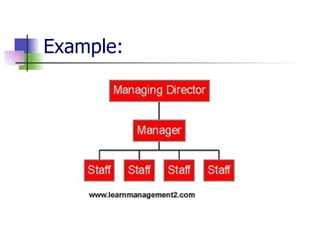
Vertical Organization There are three levels of management in vertically organized companies: Top Management Middle Management Supervisory-Level Management
Example:
Top Management These are people   who make planning decisions that affect the  whole company.  They are the persons with the greatest responsibility. Top management job titles include: Chief Executive Officer President Chief Operating Officer Vice President
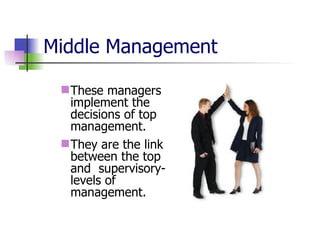
Middle Management These managers   implement the decisions of top management.  They are the link between the top and  supervisory-levels of management.
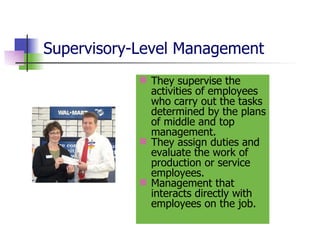
Supervisory-Level Management They supervise the activities of employees who carry out the tasks determined by the plans of middle and top management. They assign duties and evaluate the work of production or service employees. Management that interacts directly with employees on the job.
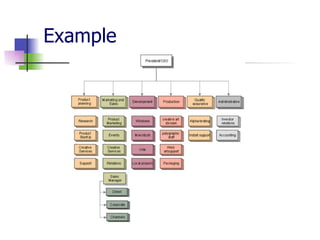
Horizontal Organization This type of organizational structure involves self-managing teams that set their own goals and make their own decisions.  This type of management structure is organized by process instead of  function and is  customer-oriented. A newer method of management brought about by downsizing in the late 1980s and early 1990s, to make companies more efficient and productive.
Example
There are three characteristics of a Horizontal Organization Self-Managing Teams Organization by Process Customer Orientation
Self-Managing Teams Instead of reporting up a chain of command, employees are organized into teams that manage themselves.  Each team has an "owner" who has ultimate responsibility for ensuring the team meets its goals. He or she acts  like a coach. The team shares responsibility for the consequences of its decisions.
Empowerment Encourage team members to contribute to and take responsibility for the management process is known as empowerment.
Organization by Process. Teams of people with different specializations are organized around processes, such as developing new products or providing customer support. Team members share opinions, decisions, and responsibility for the team's success or failure.
Customer Orientation Where teams get their direction from the customer, rather than from management. In vertical companies the sources of direction is management. In horizontal companies, it is the customers.  Customer satisfaction should produce  large profits, high productivity, and  satisfied investors.
 

Management structures

  • 1.
  • 2.
    Management Management isthe process of reaching goals through the use of human resources, technology, and material resources. A position in management is one of the greatest challenges any employee can face. Management involves communication and interpersonal skills, plus the abilities to plan, organize, supervise, and solve problems.
  • 3.
    Vocabulary Vertical OrganizationTop Management Middle Management Supervisory-Level Management Horizontal Organization Empowerment
  • 4.
    Types of ManagementStructures To facilitate effective management, businesses are organized in two ways: Vertically Horizontally
  • 5.
    Vertical Organization Usuallyin large, traditional companies. Managers look up to higher levels of management or down to employees all within a single department. Their goal is to perform a particular department function well.
  • 6.
    Vertical Organization Thereare three levels of management in vertically organized companies: Top Management Middle Management Supervisory-Level Management
  • 7.
  • 8.
    Top Management Theseare people who make planning decisions that affect the whole company. They are the persons with the greatest responsibility. Top management job titles include: Chief Executive Officer President Chief Operating Officer Vice President
  • 9.
    Middle Management Thesemanagers implement the decisions of top management. They are the link between the top and supervisory-levels of management.
  • 10.
    Supervisory-Level Management Theysupervise the activities of employees who carry out the tasks determined by the plans of middle and top management. They assign duties and evaluate the work of production or service employees. Management that interacts directly with employees on the job.
  • 11.
    Horizontal Organization Thistype of organizational structure involves self-managing teams that set their own goals and make their own decisions. This type of management structure is organized by process instead of function and is customer-oriented. A newer method of management brought about by downsizing in the late 1980s and early 1990s, to make companies more efficient and productive.
  • 12.
  • 13.
    There are threecharacteristics of a Horizontal Organization Self-Managing Teams Organization by Process Customer Orientation
  • 14.
    Self-Managing Teams Insteadof reporting up a chain of command, employees are organized into teams that manage themselves. Each team has an "owner" who has ultimate responsibility for ensuring the team meets its goals. He or she acts like a coach. The team shares responsibility for the consequences of its decisions.
  • 15.
    Empowerment Encourage teammembers to contribute to and take responsibility for the management process is known as empowerment.
  • 16.
    Organization by Process.Teams of people with different specializations are organized around processes, such as developing new products or providing customer support. Team members share opinions, decisions, and responsibility for the team's success or failure.
  • 17.
    Customer Orientation Whereteams get their direction from the customer, rather than from management. In vertical companies the sources of direction is management. In horizontal companies, it is the customers. Customer satisfaction should produce large profits, high productivity, and satisfied investors.
  • 18.