The document discusses the concept of span of control, which refers to the number of subordinates managed by a manager and its impact on organizational structure. Factors influencing span of control include managerial ability, time for supervision, work nature, enterprise plans, subordinate efficiency, control techniques, decentralization, and expert services. It also describes the implications of narrow and wide spans of control, highlighting their advantages and disadvantages in terms of management effectiveness and organizational dynamics.
Introduces the concept of span of control, defining it as the number of staff reporting to a manager.
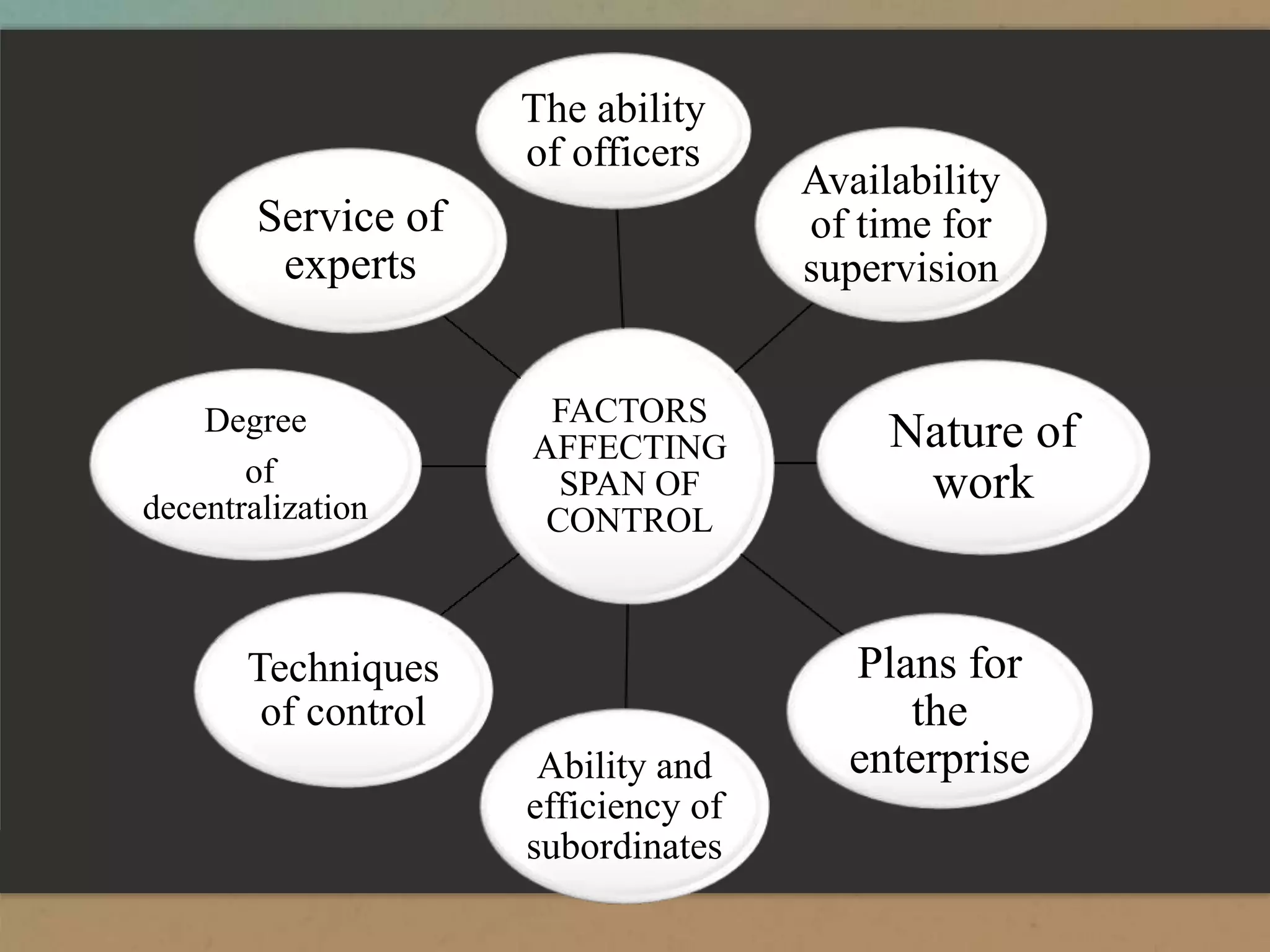
Details eight factors affecting span of control, including officer ability, time availability, work nature, plans, subordinate efficiency, control techniques, decentralization degree, and expert services.
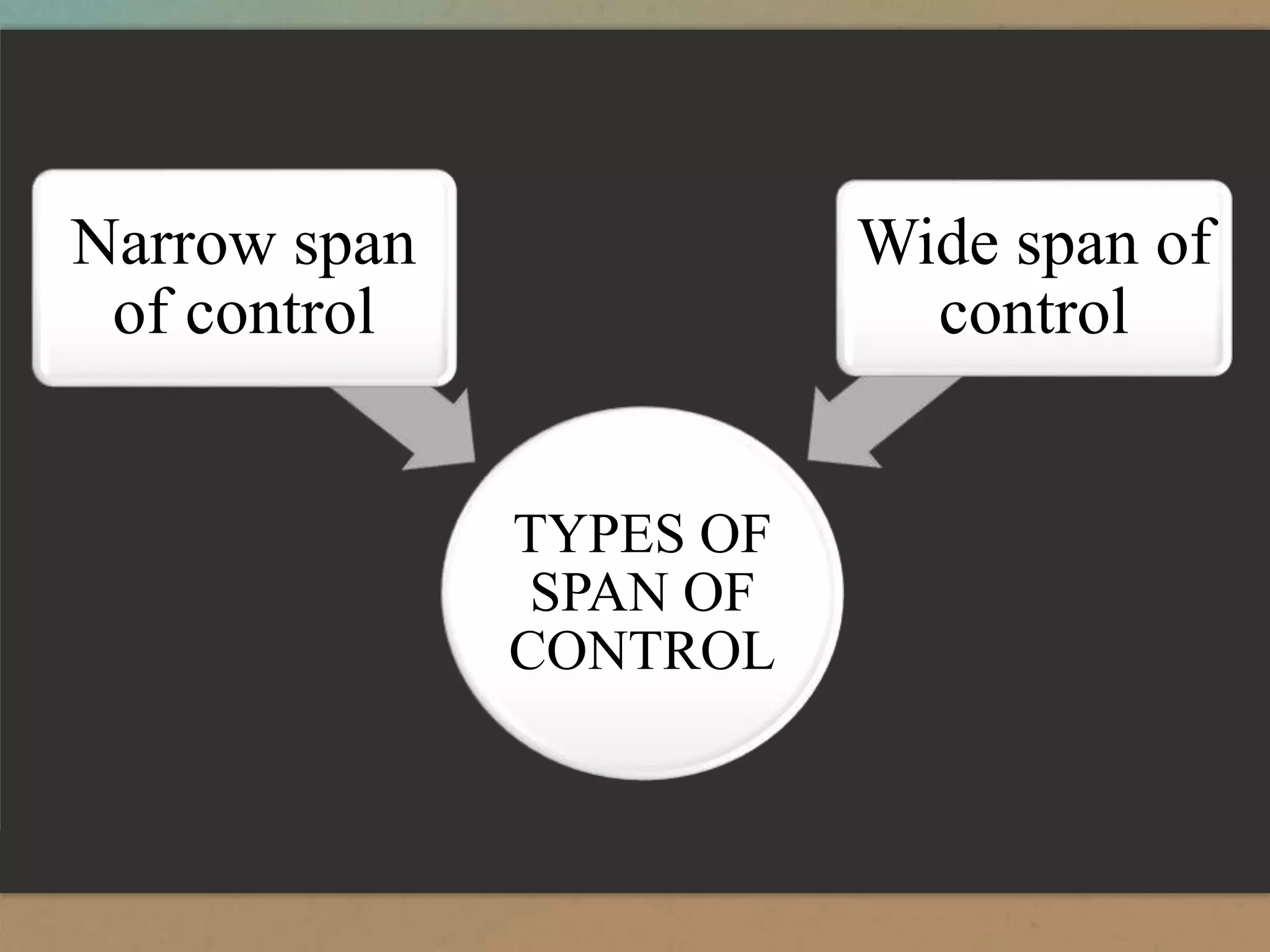
Discusses narrow and wide span of control, their implications for organizational structure.
Explains narrow span of control, its advantages like improved supervision and communication, and disadvantages such as cost and limited independence.
Explains wide span of control, noting benefits like empowerment and cost savings, alongside drawbacks such as rushed decisions and manager workload.
INTRODUCTION:
Span of controlis the number of staff
members that report to a manager. A higher
number of reports per manager results in a
flatter organizational structure and fewer
opportunities for promotion. A lower number
of reports per manager results in a taller
organizational structure and
more management direction and input.
3.
DEFINITION:
A span ofcontrol is a concept that
describes the number of people that are
managed by someone. It is a chain of
command notion where the number of
subordinates are properly identified to
understand a manager’s reach.
4.
FACTORS
AFFECTING
SPAN OF
CONTROL
The ability
ofofficers
Availability
of time for
supervision
Nature of
work
Plans for
the
enterpriseAbility and
efficiency of
subordinates
Techniques
of control
Degree
of
decentralization
Service of
experts
5.
1) The abilityof officers:
The very first and most important factor in
determining the span of control is the ability of
officers who have to manage. If they are very
efficient and capable. They can control a large
number of subordinates on the contrary.
If the officers are less efficient they would not
be able to control that much number of
subordinates.
6.
2) Availability oftime for supervision:
The second factor which determines the span of
control is the availability of time with the
managers of higher cadre for supervision.
If they have less time for supervision, they
would not be able to control a large number of
subordinates.
7.
3) Nature ofwork:
The span of management is affected by the
nature of work also. If the work is of a simple
and routine nature, managers can control a large
number of persons.
On the contrary, If the work is more
complicated, Managers cannot have effective
control over a small number of employees only.
8.
4) Plans forthe enterprise:
If the plans of the enterprise are clear and
stable, the managers feel it easy to control the
activities of their subordinates.
On the contrary, If the plans of the enterprise are
not stable, it becomes very difficult for the
managers to control the activities of a large
number of subordinates.
9.
5) Ability andefficiency of
subordinates:
A very important factor affecting the span of
management is the ability, efficiency, and
willingness of subordinates.
If the subordinates are able and efficient and
they are willing to coordinate with their higher
officers, Managers can control a large number of
subordinates.
10.
6) Techniques ofcontrol:
The span of control depends upon the
techniques of control also. If the techniques of
control effective the managers can control a
large number of subordinates.
On the contrary, It is the technique of
individual supervision is used, the managers will
not be able to maintain effective control of all
the employees.
11.
7) Degree ofdecentralization:
If there is an adequate decentralization of power
in the enterprise, The managers can control a
large number of subordinates because their
burden of work will be light.
On the company, If the centralization is not so
much adopted, Managers will be able to have
effective control over as a small number of
subordinates only.
12.
8) Service ofexperts:
If the service of experts is available in an
enterprise, The number of subordinates under the
control of one official may be more and if the
services of experts not available in the enterprise.
The number of subordinates under the control of
one officer will be Limited.
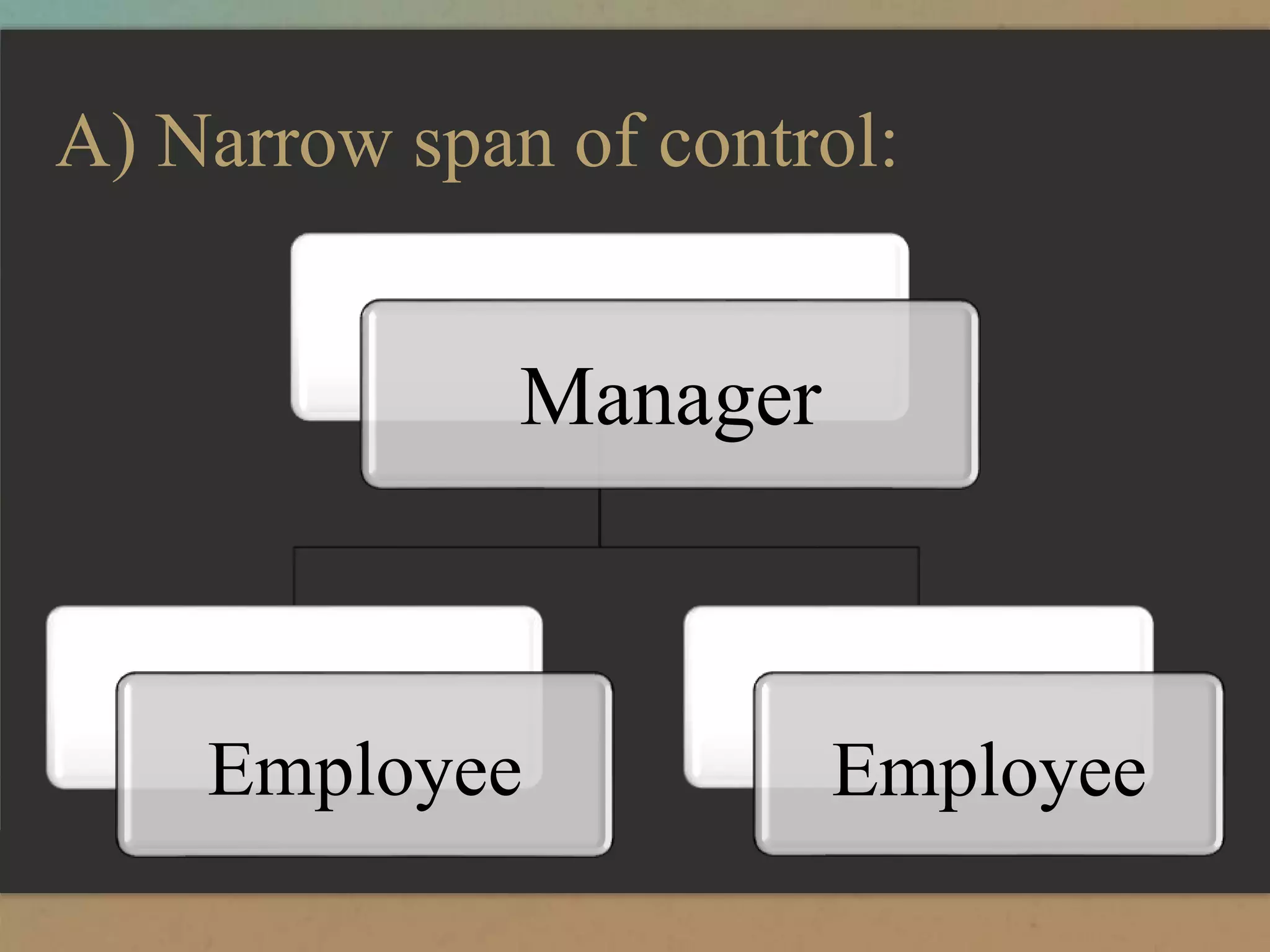
A. Narrow spanof control: An organization’s
span of control can be determined by the
number of employees reporting to the
manager/ supervisor. A narrow span of control
refers to a structure with few employees
reporting to the manager.
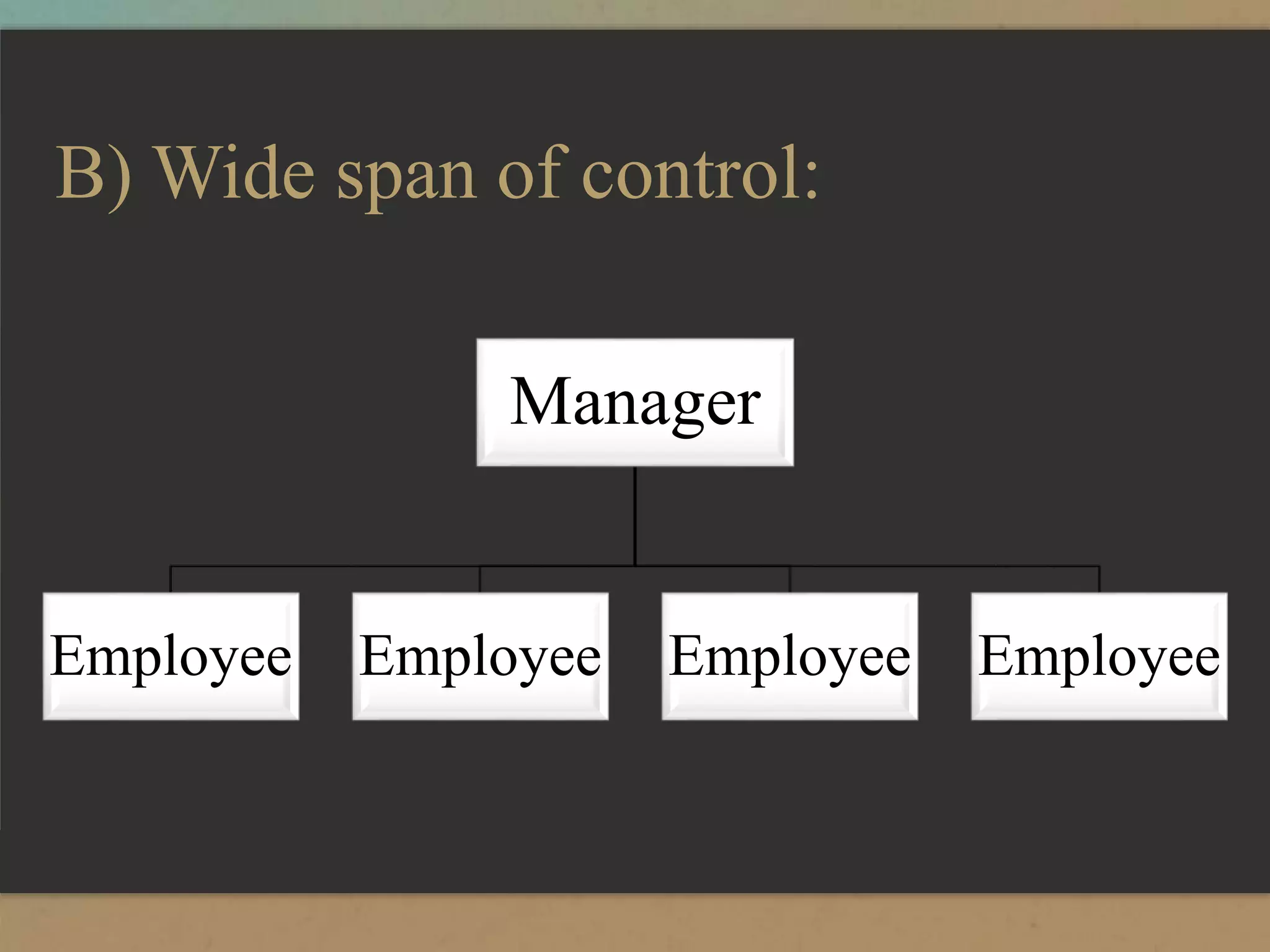
B. Wide span of control: This means a
single managers or supervisor oversees a large
number of subordinates. This gives a rise to a
flat structure. Boxes define the label
of managers or subordinates
Advantages :
A narrowspan of control increases the level of
contact between the manager and members of the
team.
The increased contact improves the ability to
supervise activities carried out by the employees
effectively, which may increase productivity.
17.
A narrow spanof control enhances
communication between the supervisor and
the team members.
The team members can easily access the
supervisor for assistance. Enhanced
communication also helps in faster decision-
making and problem-solving.
18.
Disadvantages :
A narrowspan of control may be expensive to
implement depending on the number of teams in
the organization.
A narrow span of control may limit the ability of
team members to exercise independence in
decision-making and problem-solving processes.
19.
B) Wide spanof control:
Manager
Employee Employee Employee Employee
20.
Advantages :
Staff areempowered to make their own decisions
and to carry out their own tasks without
interference by managers.
Less managers are required and wages are saved.
Less levels of communication for decisions to
pass through.
High quality staff should exist.
21.
Disadvantages :
Managers maymake snap decisions as they are
looking after too many employees.
Managers time will be at a premium.
Managers will have less time for planning.
Subordinates may make decisions they are not
trained to make.