RADIATION METHOD
 Atoms with same chemical behavior but with a different
number of neutrons are called isotopes.
 Most elements have unstable (radio active) isotopes.
 The unstable isotopes disintegrate to form elements or
stable isotopes.
 Radio active disintegration is accompanied by the
emission of three different kinds of rays namely
 Alpha(α ) radiation,
 Beta (β ) radiation
 Gamma (g) rays
 The penetrating power of the three rays are
approximately
 α = 1
 β = 100
 g = 10000.
 Since Gamma rays have greater penetrating power and
cannot be deflected
 Hence gamma radiation sources are chosen for use in
level detecting equipment
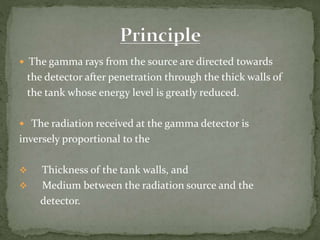
 The gamma rays from the source are directed towards
the detector after penetration through the thick walls of
the tank whose energy level is greatly reduced.
 The radiation received at the gamma detector is
inversely proportional to the
 Thickness of the tank walls, and
 Medium between the radiation source and the
detector.
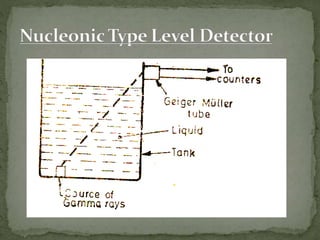
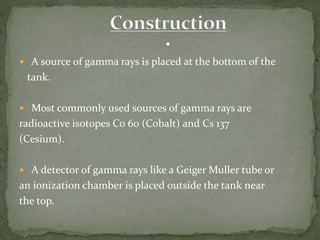
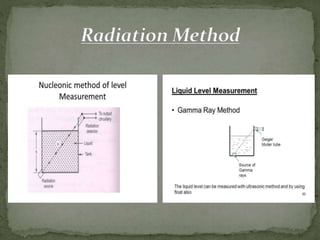
 A source of gamma rays is placed at the bottom of the
tank.
 Most commonly used sources of gamma rays are
radioactive isotopes Co 60 (Cobalt) and Cs 137
(Cesium).
 A detector of gamma rays like a Geiger Muller tube or
an ionization chamber is placed outside the tank near
the top.
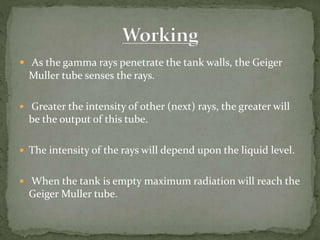
 As the gamma rays penetrate the tank walls, the Geiger
Muller tube senses the rays.
 Greater the intensity of other (next) rays, the greater will
be the output of this tube.
 The intensity of the rays will depend upon the liquid level.
 When the tank is empty maximum radiation will reach the
Geiger Muller tube.
 When the liquid level rises, some of the radiation is
absorbed by the liquid.
 Then radiations reaching the tube will be reduced and
hence its output is small.
 The higher the level of the liquid in the tank, the greater is
the absorption.
 Hence lesser will be the output of the Geiger Muller tube.
 Thus the output of the Geiger Muller tube is inversely
proportional to the liquid level.
 The output of the Geiger Muller tube is in the form of
pulses which is counted by a suitable counter.
 Thus the counter is directly calibrated in terms of the
liquid level.
 No physical contact with the liquid.
 They are suitable for molten metals as well as liquids
of all types ( corrosive, abrasive, highly viscous , adherent).
 Useful at very high temperatures/pressures.
 They have good accuracy and response
 No moving parts
 The reading is affected by density change of liquid
 Radiation source holders may be heavy
 Cost is relatively high
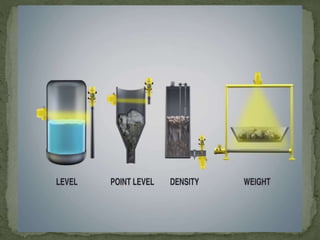
 Non contact measurement of liquids and solids
 Radiation level detection is very appealing for
 hard-to-handle,
 toxic,
 corrosive processes
 Because it does not require vessel wall penetrations
Level Measurement With Radiation Method

Level Measurement With Radiation Method

  • 2.
  • 3.
     Atoms withsame chemical behavior but with a different number of neutrons are called isotopes.  Most elements have unstable (radio active) isotopes.  The unstable isotopes disintegrate to form elements or stable isotopes.
  • 4.
     Radio activedisintegration is accompanied by the emission of three different kinds of rays namely  Alpha(α ) radiation,  Beta (β ) radiation  Gamma (g) rays
  • 5.
     The penetratingpower of the three rays are approximately  α = 1  β = 100  g = 10000.  Since Gamma rays have greater penetrating power and cannot be deflected  Hence gamma radiation sources are chosen for use in level detecting equipment
  • 7.
     The gammarays from the source are directed towards the detector after penetration through the thick walls of the tank whose energy level is greatly reduced.  The radiation received at the gamma detector is inversely proportional to the  Thickness of the tank walls, and  Medium between the radiation source and the detector.
  • 8.
     A sourceof gamma rays is placed at the bottom of the tank.  Most commonly used sources of gamma rays are radioactive isotopes Co 60 (Cobalt) and Cs 137 (Cesium).  A detector of gamma rays like a Geiger Muller tube or an ionization chamber is placed outside the tank near the top.
  • 9.
     As thegamma rays penetrate the tank walls, the Geiger Muller tube senses the rays.  Greater the intensity of other (next) rays, the greater will be the output of this tube.  The intensity of the rays will depend upon the liquid level.  When the tank is empty maximum radiation will reach the Geiger Muller tube.
  • 10.
     When theliquid level rises, some of the radiation is absorbed by the liquid.  Then radiations reaching the tube will be reduced and hence its output is small.  The higher the level of the liquid in the tank, the greater is the absorption.  Hence lesser will be the output of the Geiger Muller tube.
  • 11.
     Thus theoutput of the Geiger Muller tube is inversely proportional to the liquid level.  The output of the Geiger Muller tube is in the form of pulses which is counted by a suitable counter.  Thus the counter is directly calibrated in terms of the liquid level.
  • 12.
     No physicalcontact with the liquid.  They are suitable for molten metals as well as liquids of all types ( corrosive, abrasive, highly viscous , adherent).  Useful at very high temperatures/pressures.  They have good accuracy and response  No moving parts
  • 14.
     The readingis affected by density change of liquid  Radiation source holders may be heavy  Cost is relatively high
  • 15.
     Non contactmeasurement of liquids and solids  Radiation level detection is very appealing for  hard-to-handle,  toxic,  corrosive processes  Because it does not require vessel wall penetrations