

Virtual University ENG 101
Lesson -30
Dr.Surriya Shaffi Mir
Lesson 30 – Effective Writing (paragraphs)
In today’s lesson and the following couple of
lessons you will learn the principles of writing.
We will begin with how to write an effective
paragraph and the principles you learn here will
help you to write longer essays/papers.
Writing is not easy, especially in a foreign
language. Writing is in fact, a process. It is done
in a series of steps & stages. It is a skill that
comes with great effort, hard work and practice.
If you want to learn to write, you can.
The first thing of concern in writing is
content i.e. what you have to say - your
ideas, thoughts and feelings. Unfortunately,
some students are so self-conscious about
rules and about making mistakes, that they
don’t focus on what they want to say. Rules
do matter but not at the beginning stage.
Now students in Pakistan have a fear of
English, especially writing.
Because they have never learned to write they
resort to learning model essays and answers
to questions by heart. Your attitude in this
respect is very crucial or important. It is your
attitude that will determine how much effort
you will put in in learning to write.
We will begin with a paragraph. A paragraph
is a series of sentences about one main
thought, idea or point. The paragraph is like
the sentence in that it must concern itself with
one thought. But while some ideas can be
adequately treated in a single
sentence, others require the fuller treatment
which is afforded by a series of sentences
(i.e. the paragraph) or a group of
paragraphs, chapters, section(s) or even a
book. A paragraph typically starts with a
point and the rest of the paragraph provides
details to support and develop that point.
Your goal in writing a paragraph should be
i) To make a point
ii) To support the point
iii)Orderly arrangement of material
iv)Write error free sentences
In writing a paragraph you should
i) make a point
ii) support the point
iii) orderly arrange the material
iv) write error free sentences
i) It is best to state the point in the first
sentence. The sentence that expresses the
main idea or point of a paragraph is called
the TOPIC SENTENCE. The topic
sentence is a general statement and the
other sentences provide support for the
general statement. If you recall at the
beginning of the course you had a lesson or
two on identifying the topic sentence and its
supporting details.
ii) To support the point you need to provide
specific reasons, examples, & other details
that explain & develop the point.
iii)You can organize the support in a
paragraph in 2 ways. You can use a listing
order ( first of all, secondly next in
addition…) or time order (first, next, and
finally…)
iv) If you use correct spelling & follow
grammar, punctuation & usage rules your
sentences will be clear & well written.
Look at the following two passages.
Notice how the topic sentence, which is
underlined is supported by the sentences
that follow. The first passage is written by
a student. The second one by a famous
writer. Notice how both make a point at
the beginning and then go on to support
that point with specific evidence. And
that’s what we are going to concentrate in
this lesson.
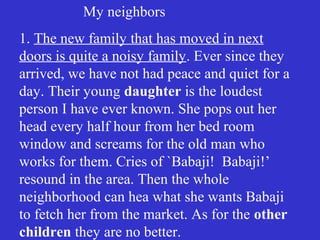
My neighbors
1. The new family that has moved in next
doors is quite a noisy family. Ever since they
arrived, we have not had peace and quiet for a
day. Their young daughter is the loudest
person I have ever known. She pops out her
head every half hour from her bed room
window and screams for the old man who
works for them. Cries of `Babaji! Babaji!’
resound in the area. Then the whole
neighborhood can hea what she wants Babaji
to fetch her from the market. As for the other
children they are no better.
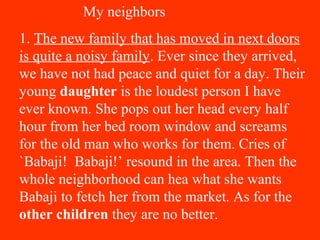
My neighbors
1. The new family that has moved in next doors
is quite a noisy family. Ever since they arrived,
we have not had peace and quiet for a day. Their
young daughter is the loudest person I have
ever known. She pops out her head every half
hour from her bed room window and screams
for the old man who works for them. Cries of
`Babaji! Babaji!’ resound in the area. Then the
whole neighborhood can hea what she wants
Babaji to fetch her from the market. As for the
other children they are no better.
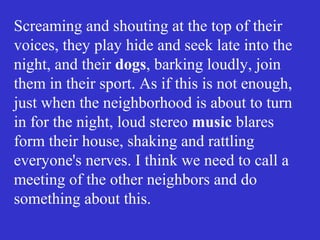
Screaming and shouting at the top of their
voices, they play hide and seek late into the
night, and their dogs, barking loudly, join
them in their sport. As if this is not enough,
just when the neighborhood is about to turn
in for the night, loud stereo music blares
form their house, shaking and rattling
everyone's nerves. I think we need to call a
meeting of the other neighbors and do
something about this.
Screaming and shouting at the top of their
voices, they play hide and seek late into the
night, and their dogs, barking loudly, join
them in their sport. As if this is not enough,
just when the neighborhood is about to turn
in for the night, loud stereo music blares
form their house, shaking and rattling
everyone's nerves. I think we need to call a
meeting of the other neighbors and do
something about this.
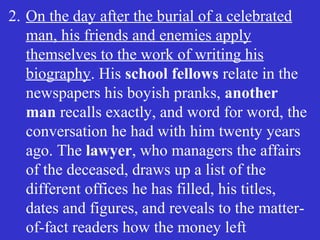
2. On the day after the burial of a celebrated
man, his friends and enemies apply
themselves to the work of writing his
biography. His school fellows relate in the
newspapers his boyish pranks, another
man recalls exactly, and word for word, the
conversation he had with him twenty years
ago. The lawyer, who managers the affairs
of the deceased, draws up a list of the
different offices he has filled, his titles,
dates and figures, and reveals to the matter-
of-fact readers how the money left
2. On the day after the burial of a celebrated
man, his friends and enemies apply
themselves to the work of writing his
biography. His school fellows relate in the
newspapers his boyish pranks, another
man recalls exactly, and word for word, the
conversation he had with him twenty years
ago. The lawyer, who managers the affairs
of the deceased, draws up a list of the
different offices he has filled, his titles,
dates and figures, and reveals to the matter-
of-fact readers how the money left
has been invested and how the fortune has
been made; the grand nephews and second
cousins publish an account of his acts of
humanity, and the catalogue of his domestic
virtues.
- Taine, History of English Literature
has been invested and how the fortune has
been made; the grand nephews and second
cousins publish an account of his acts of
humanity, and the catalogue of his domestic
virtues.
- Taine, History of English Literature
Some writers like to start with an idea and
then collect evidence to support it.
Evidence is supporting materials –
statistics, examples, comparisons,
contrasts, causes, effects, and expert
opinion. Other writers like to start with
facts on a topic and then form their ideas
from those facts. Still others like to work
with ideas and evidence at the same time.
They shape their ideas as new facts turn up
and collect new evidence as they find fresh
ideas.
Practice 1: Arrange the ideas and evidence
in logical order, the most general coming
first.
A. 1
The first shelf was crammed with
copies of the daily newspapers, The
Pakistan Times, The News, The Dawn and
The Nation. 2
To the left of the papers he
had piled copies of The Herald, She, The
Friday Times and Mag. 3
On the middle
shelf he had a set of the great Urdu and
Punjabi classics and a vast collection of
science fiction novels and detective stories.
Practice 1: Arrange the ideas and evidence
in logical order, the most general coming
first.
A. 1
The first shelf was crammed with
copies of the daily newspapers, The
Pakistan Times, The News, The Dawn and
The Nation. 2
To the left of the papers he
had piled copies of The Herald, She, The
Friday Times and Mag. 3
On the middle
shelf he had a set of the great Urdu and
Punjabi classics and a vast collection of
science fiction novels and detective stories.
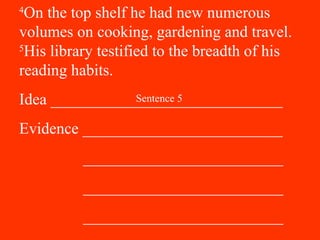
4
On the top shelf he had new numerous
volumes on cooking, gardening and travel.
5
His library testified to the breadth of his
reading habits.
Idea _____________________________
Evidence _________________________
_________________________
_________________________
_________________________
Sentence 5
4
On the top shelf he had new numerous
volumes on cooking, gardening and travel.
5
His library testified to the breadth of his
reading habits.
Idea _____________________________
Evidence _________________________
_________________________
_________________________
_________________________
Sentence 5
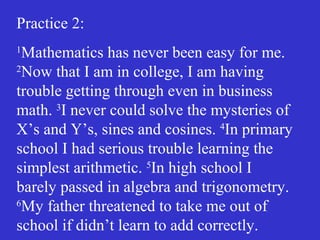
Practice 2:
1
Mathematics has never been easy for me.
2
Now that I am in college, I am having
trouble getting through even in business
math. 3
I never could solve the mysteries of
X’s and Y’s, sines and cosines. 4
In primary
school I had serious trouble learning the
simplest arithmetic. 5
In high school I
barely passed in algebra and trigonometry.
6
My father threatened to take me out of
school if didn’t learn to add correctly.
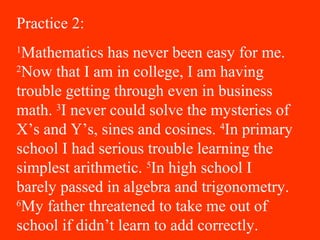
Practice 2:
1
Mathematics has never been easy for me.
2
Now that I am in college, I am having
trouble getting through even in business
math. 3
I never could solve the mysteries of
X’s and Y’s, sines and cosines. 4
In primary
school I had serious trouble learning the
simplest arithmetic. 5
In high school I
barely passed in algebra and trigonometry.
6
My father threatened to take me out of
school if didn’t learn to add correctly.
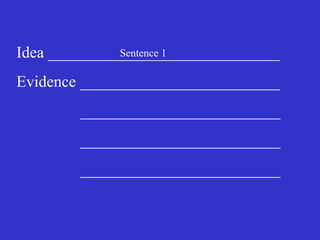
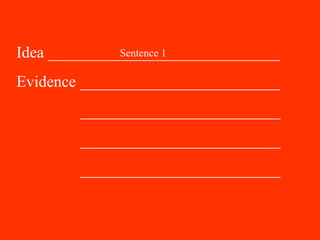
Idea _____________________________
Evidence _________________________
_________________________
_________________________
_________________________
Sentence 1
Idea _____________________________
Evidence _________________________
_________________________
_________________________
_________________________
Sentence 1
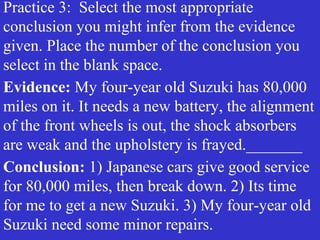
Practice 3: Select the most appropriate
conclusion you might infer from the evidence
given. Place the number of the conclusion you
select in the blank space.
Evidence: My four-year old Suzuki has 80,000
miles on it. It needs a new battery, the alignment
of the front wheels is out, the shock absorbers
are weak and the upholstery is frayed._______
Conclusion: 1) Japanese cars give good service
for 80,000 miles, then break down. 2) Its time
for me to get a new Suzuki. 3) My four-year old
Suzuki need some minor repairs.
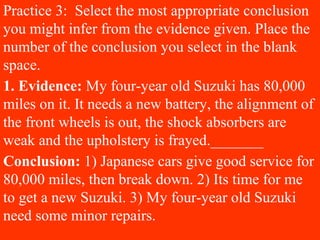
Practice 3: Select the most appropriate conclusion
you might infer from the evidence given. Place the
number of the conclusion you select in the blank
space.
1. Evidence: My four-year old Suzuki has 80,000
miles on it. It needs a new battery, the alignment of
the front wheels is out, the shock absorbers are
weak and the upholstery is frayed._______
Conclusion: 1) Japanese cars give good service for
80,000 miles, then break down. 2) Its time for me
to get a new Suzuki. 3) My four-year old Suzuki
need some minor repairs.
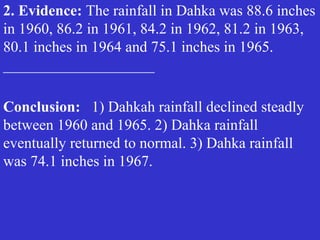
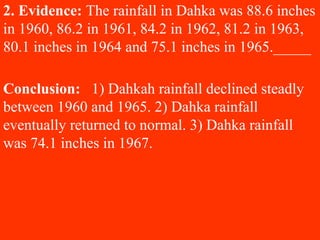
2. Evidence: The rainfall in Dahka was 88.6 inches
in 1960, 86.2 in 1961, 84.2 in 1962, 81.2 in 1963,
80.1 inches in 1964 and 75.1 inches in 1965.
____________________
Conclusion: 1) Dahkah rainfall declined steadly
between 1960 and 1965. 2) Dahka rainfall
eventually returned to normal. 3) Dahka rainfall
was 74.1 inches in 1967.
2. Evidence: The rainfall in Dahka was 88.6 inches
in 1960, 86.2 in 1961, 84.2 in 1962, 81.2 in 1963,
80.1 inches in 1964 and 75.1 inches in 1965._____
Conclusion: 1) Dahkah rainfall declined steadly
between 1960 and 1965. 2) Dahka rainfall
eventually returned to normal. 3) Dahka rainfall
was 74.1 inches in 1967.
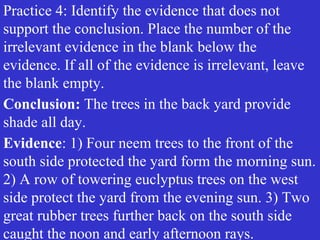
Practice 4: Identify the evidence that does not
support the conclusion. Place the number of the
irrelevant evidence in the blank below the
evidence. If all of the evidence is irrelevant, leave
the blank empty.
Conclusion: The trees in the back yard provide
shade all day.
Evidence: 1) Four neem trees to the front of the
south side protected the yard form the morning sun.
2) A row of towering euclyptus trees on the west
side protect the yard from the evening sun. 3) Two
great rubber trees further back on the south side
caught the noon and early afternoon rays.
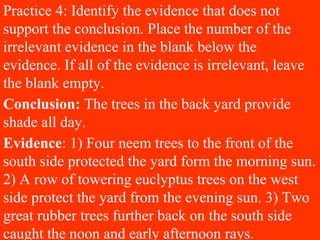
Practice 4: Identify the evidence that does not
support the conclusion. Place the number of the
irrelevant evidence in the blank below the
evidence. If all of the evidence is irrelevant, leave
the blank empty.
Conclusion: The trees in the back yard provide
shade all day.
Evidence: 1) Four neem trees to the front of the
south side protected the yard form the morning sun.
2) A row of towering euclyptus trees on the west
side protect the yard from the evening sun. 3) Two
great rubber trees further back on the south side
caught the noon and early afternoon rays.
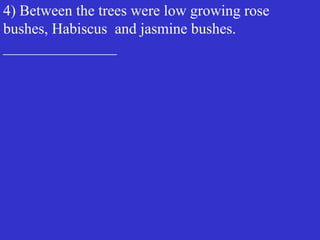
4) Between the trees were low growing rose
bushes, Habiscus and jasmine bushes.
_______________
4) Between the trees were low growing rose
bushes, Habiscus and jasmine bushes.
_______________
4) Between the trees were low growing rose
bushes, Habiscus and jasmine bushes.
_______________
As I stated earlier writing usually takes
place in steps. These are
(1) brainstorming (2) making brief outline
(3) writing 1st draft (4) revising (5) proof
reading
Step I: Brainstorming
(a) Jot down points or ideas and their
details as they come to your mind just
write them down without putting them in
any special order. Try to accumulate as
many details as you can think of
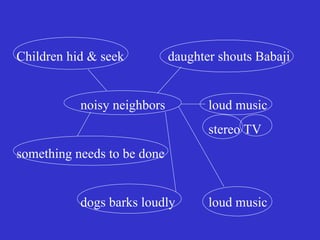
(b) clustering is another strategy. Begin by
stating your subject in the center of a blank
sheet of paper. Then as ideas come into
your mind put them in boxes / circles
around the subject / topic.
Children hid & seek daughter shouts Babaji
noisy neighbors loud music
stereo TV
something needs to be done
dogs barks loudly loud music
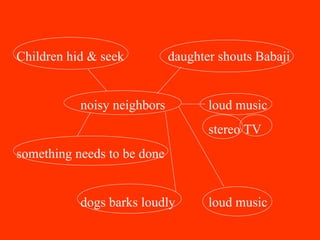
Children hid & seek daughter shouts Babaji
noisy neighbors loud music
stereo TV
something needs to be done
dogs barks loudly loud music
In today’s lesson you learnt about
paragraph writing making the main point
and supporting evidence.
Till next time then…….
ALLAH HAFIZ

ENG101- English Comprehension- Lecture 30

  • 1.
    Virtual University ENG101 Lesson -30 Dr.Surriya Shaffi Mir
  • 2.
    Lesson 30 –Effective Writing (paragraphs) In today’s lesson and the following couple of lessons you will learn the principles of writing. We will begin with how to write an effective paragraph and the principles you learn here will help you to write longer essays/papers. Writing is not easy, especially in a foreign language. Writing is in fact, a process. It is done in a series of steps & stages. It is a skill that comes with great effort, hard work and practice. If you want to learn to write, you can.
  • 3.
    The first thingof concern in writing is content i.e. what you have to say - your ideas, thoughts and feelings. Unfortunately, some students are so self-conscious about rules and about making mistakes, that they don’t focus on what they want to say. Rules do matter but not at the beginning stage. Now students in Pakistan have a fear of English, especially writing.
  • 4.
    Because they havenever learned to write they resort to learning model essays and answers to questions by heart. Your attitude in this respect is very crucial or important. It is your attitude that will determine how much effort you will put in in learning to write. We will begin with a paragraph. A paragraph is a series of sentences about one main thought, idea or point. The paragraph is like the sentence in that it must concern itself with one thought. But while some ideas can be adequately treated in a single
  • 5.
    sentence, others requirethe fuller treatment which is afforded by a series of sentences (i.e. the paragraph) or a group of paragraphs, chapters, section(s) or even a book. A paragraph typically starts with a point and the rest of the paragraph provides details to support and develop that point. Your goal in writing a paragraph should be i) To make a point ii) To support the point iii)Orderly arrangement of material iv)Write error free sentences
  • 6.
    In writing aparagraph you should i) make a point ii) support the point iii) orderly arrange the material iv) write error free sentences
  • 7.
    i) It isbest to state the point in the first sentence. The sentence that expresses the main idea or point of a paragraph is called the TOPIC SENTENCE. The topic sentence is a general statement and the other sentences provide support for the general statement. If you recall at the beginning of the course you had a lesson or two on identifying the topic sentence and its supporting details.
  • 8.
    ii) To supportthe point you need to provide specific reasons, examples, & other details that explain & develop the point. iii)You can organize the support in a paragraph in 2 ways. You can use a listing order ( first of all, secondly next in addition…) or time order (first, next, and finally…) iv) If you use correct spelling & follow grammar, punctuation & usage rules your sentences will be clear & well written.
  • 9.
    Look at thefollowing two passages. Notice how the topic sentence, which is underlined is supported by the sentences that follow. The first passage is written by a student. The second one by a famous writer. Notice how both make a point at the beginning and then go on to support that point with specific evidence. And that’s what we are going to concentrate in this lesson.
  • 10.
    My neighbors 1. Thenew family that has moved in next doors is quite a noisy family. Ever since they arrived, we have not had peace and quiet for a day. Their young daughter is the loudest person I have ever known. She pops out her head every half hour from her bed room window and screams for the old man who works for them. Cries of `Babaji! Babaji!’ resound in the area. Then the whole neighborhood can hea what she wants Babaji to fetch her from the market. As for the other children they are no better.
  • 11.
    My neighbors 1. Thenew family that has moved in next doors is quite a noisy family. Ever since they arrived, we have not had peace and quiet for a day. Their young daughter is the loudest person I have ever known. She pops out her head every half hour from her bed room window and screams for the old man who works for them. Cries of `Babaji! Babaji!’ resound in the area. Then the whole neighborhood can hea what she wants Babaji to fetch her from the market. As for the other children they are no better.
  • 12.
    Screaming and shoutingat the top of their voices, they play hide and seek late into the night, and their dogs, barking loudly, join them in their sport. As if this is not enough, just when the neighborhood is about to turn in for the night, loud stereo music blares form their house, shaking and rattling everyone's nerves. I think we need to call a meeting of the other neighbors and do something about this.
  • 13.
    Screaming and shoutingat the top of their voices, they play hide and seek late into the night, and their dogs, barking loudly, join them in their sport. As if this is not enough, just when the neighborhood is about to turn in for the night, loud stereo music blares form their house, shaking and rattling everyone's nerves. I think we need to call a meeting of the other neighbors and do something about this.
  • 14.
    2. On theday after the burial of a celebrated man, his friends and enemies apply themselves to the work of writing his biography. His school fellows relate in the newspapers his boyish pranks, another man recalls exactly, and word for word, the conversation he had with him twenty years ago. The lawyer, who managers the affairs of the deceased, draws up a list of the different offices he has filled, his titles, dates and figures, and reveals to the matter- of-fact readers how the money left
  • 15.
    2. On theday after the burial of a celebrated man, his friends and enemies apply themselves to the work of writing his biography. His school fellows relate in the newspapers his boyish pranks, another man recalls exactly, and word for word, the conversation he had with him twenty years ago. The lawyer, who managers the affairs of the deceased, draws up a list of the different offices he has filled, his titles, dates and figures, and reveals to the matter- of-fact readers how the money left
  • 16.
    has been investedand how the fortune has been made; the grand nephews and second cousins publish an account of his acts of humanity, and the catalogue of his domestic virtues. - Taine, History of English Literature
  • 17.
    has been investedand how the fortune has been made; the grand nephews and second cousins publish an account of his acts of humanity, and the catalogue of his domestic virtues. - Taine, History of English Literature
  • 18.
    Some writers liketo start with an idea and then collect evidence to support it. Evidence is supporting materials – statistics, examples, comparisons, contrasts, causes, effects, and expert opinion. Other writers like to start with facts on a topic and then form their ideas from those facts. Still others like to work with ideas and evidence at the same time. They shape their ideas as new facts turn up and collect new evidence as they find fresh ideas.
  • 19.
    Practice 1: Arrangethe ideas and evidence in logical order, the most general coming first. A. 1 The first shelf was crammed with copies of the daily newspapers, The Pakistan Times, The News, The Dawn and The Nation. 2 To the left of the papers he had piled copies of The Herald, She, The Friday Times and Mag. 3 On the middle shelf he had a set of the great Urdu and Punjabi classics and a vast collection of science fiction novels and detective stories.
  • 20.
    Practice 1: Arrangethe ideas and evidence in logical order, the most general coming first. A. 1 The first shelf was crammed with copies of the daily newspapers, The Pakistan Times, The News, The Dawn and The Nation. 2 To the left of the papers he had piled copies of The Herald, She, The Friday Times and Mag. 3 On the middle shelf he had a set of the great Urdu and Punjabi classics and a vast collection of science fiction novels and detective stories.
  • 21.
    4 On the topshelf he had new numerous volumes on cooking, gardening and travel. 5 His library testified to the breadth of his reading habits. Idea _____________________________ Evidence _________________________ _________________________ _________________________ _________________________ Sentence 5
  • 22.
    4 On the topshelf he had new numerous volumes on cooking, gardening and travel. 5 His library testified to the breadth of his reading habits. Idea _____________________________ Evidence _________________________ _________________________ _________________________ _________________________ Sentence 5
  • 23.
    Practice 2: 1 Mathematics hasnever been easy for me. 2 Now that I am in college, I am having trouble getting through even in business math. 3 I never could solve the mysteries of X’s and Y’s, sines and cosines. 4 In primary school I had serious trouble learning the simplest arithmetic. 5 In high school I barely passed in algebra and trigonometry. 6 My father threatened to take me out of school if didn’t learn to add correctly.
  • 24.
    Practice 2: 1 Mathematics hasnever been easy for me. 2 Now that I am in college, I am having trouble getting through even in business math. 3 I never could solve the mysteries of X’s and Y’s, sines and cosines. 4 In primary school I had serious trouble learning the simplest arithmetic. 5 In high school I barely passed in algebra and trigonometry. 6 My father threatened to take me out of school if didn’t learn to add correctly.
  • 25.
  • 26.
  • 27.
    Practice 3: Selectthe most appropriate conclusion you might infer from the evidence given. Place the number of the conclusion you select in the blank space. Evidence: My four-year old Suzuki has 80,000 miles on it. It needs a new battery, the alignment of the front wheels is out, the shock absorbers are weak and the upholstery is frayed._______ Conclusion: 1) Japanese cars give good service for 80,000 miles, then break down. 2) Its time for me to get a new Suzuki. 3) My four-year old Suzuki need some minor repairs.
  • 28.
    Practice 3: Selectthe most appropriate conclusion you might infer from the evidence given. Place the number of the conclusion you select in the blank space. 1. Evidence: My four-year old Suzuki has 80,000 miles on it. It needs a new battery, the alignment of the front wheels is out, the shock absorbers are weak and the upholstery is frayed._______ Conclusion: 1) Japanese cars give good service for 80,000 miles, then break down. 2) Its time for me to get a new Suzuki. 3) My four-year old Suzuki need some minor repairs.
  • 29.
    2. Evidence: Therainfall in Dahka was 88.6 inches in 1960, 86.2 in 1961, 84.2 in 1962, 81.2 in 1963, 80.1 inches in 1964 and 75.1 inches in 1965. ____________________ Conclusion: 1) Dahkah rainfall declined steadly between 1960 and 1965. 2) Dahka rainfall eventually returned to normal. 3) Dahka rainfall was 74.1 inches in 1967.
  • 30.
    2. Evidence: Therainfall in Dahka was 88.6 inches in 1960, 86.2 in 1961, 84.2 in 1962, 81.2 in 1963, 80.1 inches in 1964 and 75.1 inches in 1965._____ Conclusion: 1) Dahkah rainfall declined steadly between 1960 and 1965. 2) Dahka rainfall eventually returned to normal. 3) Dahka rainfall was 74.1 inches in 1967.
  • 31.
    Practice 4: Identifythe evidence that does not support the conclusion. Place the number of the irrelevant evidence in the blank below the evidence. If all of the evidence is irrelevant, leave the blank empty. Conclusion: The trees in the back yard provide shade all day. Evidence: 1) Four neem trees to the front of the south side protected the yard form the morning sun. 2) A row of towering euclyptus trees on the west side protect the yard from the evening sun. 3) Two great rubber trees further back on the south side caught the noon and early afternoon rays.
  • 32.
    Practice 4: Identifythe evidence that does not support the conclusion. Place the number of the irrelevant evidence in the blank below the evidence. If all of the evidence is irrelevant, leave the blank empty. Conclusion: The trees in the back yard provide shade all day. Evidence: 1) Four neem trees to the front of the south side protected the yard form the morning sun. 2) A row of towering euclyptus trees on the west side protect the yard from the evening sun. 3) Two great rubber trees further back on the south side caught the noon and early afternoon rays.
  • 33.
    4) Between thetrees were low growing rose bushes, Habiscus and jasmine bushes. _______________
  • 34.
    4) Between thetrees were low growing rose bushes, Habiscus and jasmine bushes. _______________
  • 35.
    4) Between thetrees were low growing rose bushes, Habiscus and jasmine bushes. _______________
  • 36.
    As I statedearlier writing usually takes place in steps. These are (1) brainstorming (2) making brief outline (3) writing 1st draft (4) revising (5) proof reading Step I: Brainstorming (a) Jot down points or ideas and their details as they come to your mind just write them down without putting them in any special order. Try to accumulate as many details as you can think of
  • 37.
    (b) clustering isanother strategy. Begin by stating your subject in the center of a blank sheet of paper. Then as ideas come into your mind put them in boxes / circles around the subject / topic.
  • 38.
    Children hid &seek daughter shouts Babaji noisy neighbors loud music stereo TV something needs to be done dogs barks loudly loud music
  • 39.
    Children hid &seek daughter shouts Babaji noisy neighbors loud music stereo TV something needs to be done dogs barks loudly loud music
  • 40.
    In today’s lessonyou learnt about paragraph writing making the main point and supporting evidence. Till next time then……. ALLAH HAFIZ