Identifying Topics,
Main Ideas, and
Supporting Details
ELT 205- English Communication Skills
Rejean O. Ramirez
Lesson Objectives
• Define and explain the concepts of main idea, supporting details,
and inference.
• Identify the main idea in different kinds of texts.
• Distinguish between key supporting details and irrelevant
information.
• Make inferences using textual evidence and prior knowledge.
• Apply reading skills through interactive activities and HOTS
questions.
Why Reading Skills Matter?
Understanding the TOPIC, the gist, or
the big ideas of a textbook chapter, an
article, a paragraph, a sentence or a
passage is a sophisticated reading task.
Being able to draw conclusions,
evaluate, and interpret articles or
chapters is important for overall
comprehension in non-fiction reading.
Textbook chapters, articles, paragraphs,
sentences, or passages all have topics and
main ideas.
The TOPIC is the broad, general theme or
message.
It is what some call the subject.
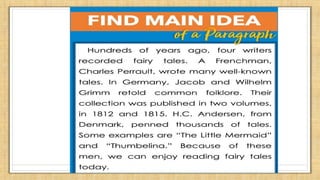
The MAIN IDEA is the
“important point"
being expressed.
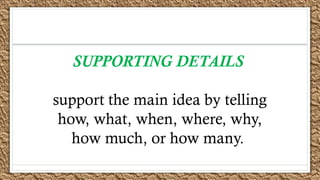
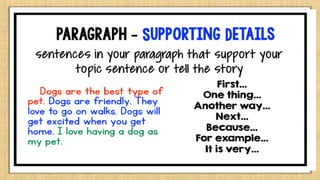
SUPPORTING DETAILS
support the main idea by telling
how, what, when, where, why,
how much, or how many.
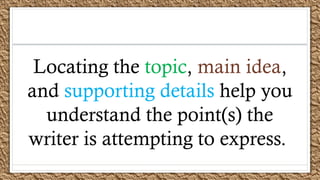
Locating the topic, main idea,
and supporting details help you
understand the point(s) the
writer is attempting to express.
Why understanding the
relationship between main ideas
and details will increase your
reading comprehension skills?
What is the importance of
supporting details?
Grasping the Main Idea
A paragraph is a group of sentences related to a
particular topic.
Every paragraph has a purpose, important point
or main idea.
The main idea is the most important piece of
information the author wants you to know about
that paragraph.
A writer will state his/her main idea clearly somewhere in
the paragraph.
That main idea may be stated at the beginning of the
paragraph, in the middle, or at the end.
The sentence in which the main idea is stated is called the
topic sentence of that paragraph.
The topic sentence announces the general subject, ideas or
arguments to be dealt with in the paragraph.
Although the topic sentence may appear anywhere in the
paragraph, it is usually first - and for a very good reason:
This sentence provides focus for the writer while
writing and for the reader while reading.
Difference between a topic sentence and a main
idea:
Main Idea – the most important point or message that the
author wants to communicate about the topic. It’s the big picture
or central thought of the paragraph.
Topic Sentence – the actual sentence in the paragraph that
states the main idea. It often appears at the beginning, but it can
also be found in the middle or at the end.
In short: the main idea is the thought, while the topic sentence is
the sentence that expresses that thought.
Strategy:
When you find the topic sentence, be
sure to underline it so that it will stand
out not only now, but also later when
you review.
Making Inferences
Making Inferences: using clues from the
text + background knowledge.
It helps readers understand meaning not
directly stated.
Inference is 'reading between the lines.'
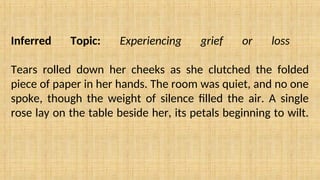
Inferred Topic: Experiencing grief or loss
Tears rolled down her cheeks as she clutched the folded
piece of paper in her hands. The room was quiet, and no one
spoke, though the weight of silence filled the air. A single
rose lay on the table beside her, its petals beginning to wilt.
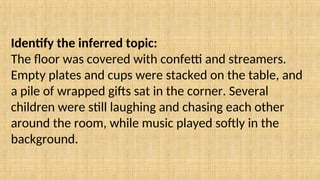
Identify the inferred topic:
The floor was covered with confetti and streamers.
Empty plates and cups were stacked on the table, and
a pile of wrapped gifts sat in the corner. Several
children were still laughing and chasing each other
around the room, while music played softly in the
background.
Identify the inferred topic:
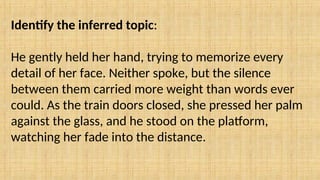
He gently held her hand, trying to memorize every
detail of her face. Neither spoke, but the silence
between them carried more weight than words ever
could. As the train doors closed, she pressed her palm
against the glass, and he stood on the platform,
watching her fade into the distance.
Identifying the Topic
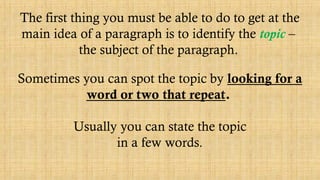
The first thing you must be able to do to get at the
main idea of a paragraph is to identify the topic –
the subject of the paragraph.
Sometimes you can spot the topic by looking for a
word or two that repeat.
Usually you can state the topic
in a few words.
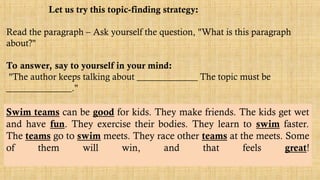
Let us try this topic-finding strategy:
Read the paragraph – Ask yourself the question, "What is this paragraph
about?"
To answer, say to yourself in your mind:
"The author keeps talking about _____________ The topic must be
______________."
Swim teams can be good for kids. They make friends. The kids get wet
and have fun. They exercise their bodies. They learn to swim faster.
The teams go to swim meets. They race other teams at the meets. Some
of them will win, and that feels great!
Read the second paragraph. Ask yourself "What is this paragraph about?"
Tim Cordes went blind as a teen. He did not let his
blindness stop him. He learned how to water ski and how
to canoe. He learned how to compose music. He became a
black belt in martial arts. He carried the Olympic torch in
2002. He went to school and became a doctor!
The bulk of an expository paragraph is made up of
supporting sentences (details), which help to explain or
prove the main idea.
These sentences present facts, reasons, examples,
definitions, comparison, contrasts, and other pertinent
details.
They are most important because they expand on the
main idea.
The last sentence of a paragraph is likely to be a
concluding sentence.
It is used to sum up a discussion, to emphasize a
point, or to restate all or part of the topic sentence
so as to bring the paragraph to a close.
The last sentence may also be a transitional
sentence leading to the next paragraph.
Playing sports is a great way for students to stay healthy. Sports
help them exercise their bodies and build strong muscles. They
also teach teamwork and discipline, which are important life
skills. In addition, playing sports gives students a chance to relax
and have fun after a long day of studying. For these reasons,
sports are an important part of a student’s life.
Reading books can open doors to new worlds of knowledge.
Through books, readers can travel to different countries and
even different time periods without leaving their homes. Reading
also strengthens vocabulary and improves writing skills. It can
even inspire creativity and critical thinking by exposing readers
to new ideas. Clearly, reading is one of the best ways to learn
and grow.
Expository paragraphs, in which new
information is presented and discussed,
these longer writings contain three types
of paragraphs:
introductory, transitional, and summarizing
Introductory paragraphs tell you, in advance, such things as (1) the main
ideas of the chapter or section; (2) how the topic is developed; and (3) the
writer's attitude toward the topic.
Detail paragraphs are usually short; their sole function is to expand on the
thesis of the paper and provides answers to the readers questions using
details, descriptions, facts, and opinions.
Summarizing paragraphs are used to restate briefly the main ideas of the
chapter or section. The writer may also draw some conclusion from these
ideas, or speculate on some conclusion based on the evidence he/she has
presented.
EXERCISE:
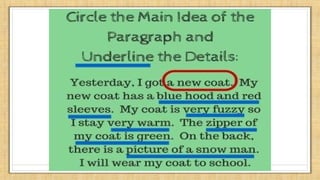
Read the following paragraph and
underline the stated main idea.
Write down in your own words what
you are able to conclude from the
information.
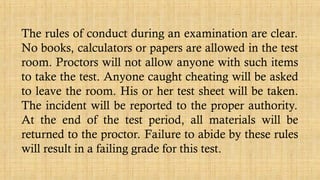
The rules of conduct during an examination are clear.
No books, calculators or papers are allowed in the test
room. Proctors will not allow anyone with such items
to take the test. Anyone caught cheating will be asked
to leave the room. His or her test sheet will be taken.
The incident will be reported to the proper authority.
At the end of the test period, all materials will be
returned to the proctor. Failure to abide by these rules
will result in a failing grade for this test.
Answer:
You should have underlined the first sentence
in the paragraph - this is the stated main idea.
What can be concluded from the information
is: If you do not follow the rules, you will
automatically fail the test.
This concluding information is found in
the last sentence.
You can't comprehend the subject
matter if you haven't identified the
topic, the main idea, and the
supporting details.
Read each paragraph carefully. Choose the
best answer to the questions that follow.
Juan loves to play games. His favorite game is chess
because it requires a great deal of thought. Juan also
likes to play less demanding board games that are
based mostly on luck. He prefers Monopoly because
it requires luck and skill. If he’s alone, Juan likes to
play action video games as long as they aren’t too
violent.
What is the main idea of this paragraph?
a. Juan dislikes violence.
b. Juan likes to think.
c. Juan enjoys Monopoly.
d. Juan enjoys playing games.
Maria is watching too much television. A toddler
shouldn’t be spending hours staring blankly at a
screen. Worse yet, some of her wild behavior has
been inspired by those awful cartoons she watches.
We need to spend more time reading books with
her and pull the plug on the TV!
What is the main idea of this
paragraph?
a) Watching a lot of television isn’t good for
Maria.
b) Books are good.
c) All cartoons are bad.
d) Some cartoons are bad for Maria.
“Samantha, I can’t eat or sleep when you are gone.
I need to hear your scratchy voice and see your
lovely toothless smile. I miss that special way you
laugh and smile at me. Please come home soon!”
What is the main idea of this
paragraph?
a) Samantha, you have bad manners.
b) Samantha, you should see a dentist.
c) Samantha, I miss you.
d) Samantha, I have lost my appetite.
Expository Paragraph A
Do you have a favorite season? Winter, fall, and spring have many
advantages. However, summertime is my favorite season because it offers
the tranquility of the beach as well as the exhilaration of outdoor sports.
First, sitting on the other side of a sand dune, hidden by sea oats and sedge,
I like looking at the Atlantic Ocean, scanning for dolphins and pelicans.
Looking at something larger than I am gives me a sense of awe and
gratitude and provides a backdrop for some deep musings. Second,
summertime provides me with the chance to go sailing, surfing, and hiking
along the shore. The exercise enhances my sense of well being and creates a
feeling of optimism.
The topic of the paragraph is: a) summertime
b) seasons at the beach
c) ways to develop optimism
A rite of passage, according to psychologists, is an event that prompts
movement from one stage of life to another. Weddings and graduations are two
examples of new beginnings that are considered significant rites of passage. For
the bride and groom, a wedding signifies the covenant of fidelity and the
couple's public declaration of love. 4
Making the promise for life before loved
ones is the first step to their new life together. Graduations also signify a rite of
passage. 6
Tests will not be scheduled, and paperwork will no longer be graded
on a curve. Whether it is a high school or college graduation, students
acknowledge they are beginning a new path on their journey.
The topic of the paragraph is:
a.a psychologist's view of life.
b.stages of life.
c.new beginnings in life.
d.the importance of weddings.
Most of the students can read the words on the page, yet
the meaning slips away like sand through their fingers.
What does this reveal about the deeper challenge of true reading
comprehension compared to simply reading?
QUESTION:
"How can the Department of Education support
teachers so they can dedicate more time to
addressing students’ low reading comprehension
levels?"
“A reader lives a thousand lives before he dies. The man
who never reads lives only one.” – George R.R. Martin
Congratulations!!
You are now an expert at
Identifying topic,
main idea,
and supporting details!!

RAMIREZ, REJEAN_Reading Skills_Identifying Main Ideas.ppt

  • 1.
    Identifying Topics, Main Ideas,and Supporting Details ELT 205- English Communication Skills Rejean O. Ramirez
  • 2.
    Lesson Objectives • Defineand explain the concepts of main idea, supporting details, and inference. • Identify the main idea in different kinds of texts. • Distinguish between key supporting details and irrelevant information. • Make inferences using textual evidence and prior knowledge. • Apply reading skills through interactive activities and HOTS questions.
  • 3.
  • 4.
    Understanding the TOPIC,the gist, or the big ideas of a textbook chapter, an article, a paragraph, a sentence or a passage is a sophisticated reading task.
  • 5.
    Being able todraw conclusions, evaluate, and interpret articles or chapters is important for overall comprehension in non-fiction reading.
  • 6.
    Textbook chapters, articles,paragraphs, sentences, or passages all have topics and main ideas. The TOPIC is the broad, general theme or message. It is what some call the subject.
  • 8.
    The MAIN IDEAis the “important point" being expressed.
  • 10.
    SUPPORTING DETAILS support themain idea by telling how, what, when, where, why, how much, or how many.
  • 12.
    Locating the topic,main idea, and supporting details help you understand the point(s) the writer is attempting to express.
  • 13.
    Why understanding the relationshipbetween main ideas and details will increase your reading comprehension skills?
  • 14.
    What is theimportance of supporting details?
  • 15.
  • 16.
    A paragraph isa group of sentences related to a particular topic. Every paragraph has a purpose, important point or main idea. The main idea is the most important piece of information the author wants you to know about that paragraph.
  • 17.
    A writer willstate his/her main idea clearly somewhere in the paragraph. That main idea may be stated at the beginning of the paragraph, in the middle, or at the end. The sentence in which the main idea is stated is called the topic sentence of that paragraph.
  • 18.
    The topic sentenceannounces the general subject, ideas or arguments to be dealt with in the paragraph. Although the topic sentence may appear anywhere in the paragraph, it is usually first - and for a very good reason: This sentence provides focus for the writer while writing and for the reader while reading.
  • 19.
    Difference between atopic sentence and a main idea: Main Idea – the most important point or message that the author wants to communicate about the topic. It’s the big picture or central thought of the paragraph. Topic Sentence – the actual sentence in the paragraph that states the main idea. It often appears at the beginning, but it can also be found in the middle or at the end. In short: the main idea is the thought, while the topic sentence is the sentence that expresses that thought.
  • 20.
    Strategy: When you findthe topic sentence, be sure to underline it so that it will stand out not only now, but also later when you review.
  • 21.
  • 22.
    Making Inferences: usingclues from the text + background knowledge. It helps readers understand meaning not directly stated. Inference is 'reading between the lines.'
  • 23.
    Inferred Topic: Experiencinggrief or loss Tears rolled down her cheeks as she clutched the folded piece of paper in her hands. The room was quiet, and no one spoke, though the weight of silence filled the air. A single rose lay on the table beside her, its petals beginning to wilt.
  • 24.
    Identify the inferredtopic: The floor was covered with confetti and streamers. Empty plates and cups were stacked on the table, and a pile of wrapped gifts sat in the corner. Several children were still laughing and chasing each other around the room, while music played softly in the background.
  • 25.
    Identify the inferredtopic: He gently held her hand, trying to memorize every detail of her face. Neither spoke, but the silence between them carried more weight than words ever could. As the train doors closed, she pressed her palm against the glass, and he stood on the platform, watching her fade into the distance.
  • 26.
  • 27.
    The first thingyou must be able to do to get at the main idea of a paragraph is to identify the topic – the subject of the paragraph. Sometimes you can spot the topic by looking for a word or two that repeat. Usually you can state the topic in a few words.
  • 28.
    Let us trythis topic-finding strategy: Read the paragraph – Ask yourself the question, "What is this paragraph about?" To answer, say to yourself in your mind: "The author keeps talking about _____________ The topic must be ______________." Swim teams can be good for kids. They make friends. The kids get wet and have fun. They exercise their bodies. They learn to swim faster. The teams go to swim meets. They race other teams at the meets. Some of them will win, and that feels great!
  • 29.
    Read the secondparagraph. Ask yourself "What is this paragraph about?" Tim Cordes went blind as a teen. He did not let his blindness stop him. He learned how to water ski and how to canoe. He learned how to compose music. He became a black belt in martial arts. He carried the Olympic torch in 2002. He went to school and became a doctor!
  • 30.
    The bulk ofan expository paragraph is made up of supporting sentences (details), which help to explain or prove the main idea. These sentences present facts, reasons, examples, definitions, comparison, contrasts, and other pertinent details. They are most important because they expand on the main idea.
  • 31.
    The last sentenceof a paragraph is likely to be a concluding sentence. It is used to sum up a discussion, to emphasize a point, or to restate all or part of the topic sentence so as to bring the paragraph to a close. The last sentence may also be a transitional sentence leading to the next paragraph.
  • 32.
    Playing sports isa great way for students to stay healthy. Sports help them exercise their bodies and build strong muscles. They also teach teamwork and discipline, which are important life skills. In addition, playing sports gives students a chance to relax and have fun after a long day of studying. For these reasons, sports are an important part of a student’s life.
  • 33.
    Reading books canopen doors to new worlds of knowledge. Through books, readers can travel to different countries and even different time periods without leaving their homes. Reading also strengthens vocabulary and improves writing skills. It can even inspire creativity and critical thinking by exposing readers to new ideas. Clearly, reading is one of the best ways to learn and grow.
  • 34.
    Expository paragraphs, inwhich new information is presented and discussed, these longer writings contain three types of paragraphs: introductory, transitional, and summarizing
  • 35.
    Introductory paragraphs tellyou, in advance, such things as (1) the main ideas of the chapter or section; (2) how the topic is developed; and (3) the writer's attitude toward the topic. Detail paragraphs are usually short; their sole function is to expand on the thesis of the paper and provides answers to the readers questions using details, descriptions, facts, and opinions. Summarizing paragraphs are used to restate briefly the main ideas of the chapter or section. The writer may also draw some conclusion from these ideas, or speculate on some conclusion based on the evidence he/she has presented.
  • 36.
    EXERCISE: Read the followingparagraph and underline the stated main idea. Write down in your own words what you are able to conclude from the information.
  • 37.
    The rules ofconduct during an examination are clear. No books, calculators or papers are allowed in the test room. Proctors will not allow anyone with such items to take the test. Anyone caught cheating will be asked to leave the room. His or her test sheet will be taken. The incident will be reported to the proper authority. At the end of the test period, all materials will be returned to the proctor. Failure to abide by these rules will result in a failing grade for this test.
  • 38.
    Answer: You should haveunderlined the first sentence in the paragraph - this is the stated main idea. What can be concluded from the information is: If you do not follow the rules, you will automatically fail the test. This concluding information is found in the last sentence.
  • 39.
    You can't comprehendthe subject matter if you haven't identified the topic, the main idea, and the supporting details.
  • 40.
    Read each paragraphcarefully. Choose the best answer to the questions that follow.
  • 41.
    Juan loves toplay games. His favorite game is chess because it requires a great deal of thought. Juan also likes to play less demanding board games that are based mostly on luck. He prefers Monopoly because it requires luck and skill. If he’s alone, Juan likes to play action video games as long as they aren’t too violent.
  • 42.
    What is themain idea of this paragraph? a. Juan dislikes violence. b. Juan likes to think. c. Juan enjoys Monopoly. d. Juan enjoys playing games.
  • 43.
    Maria is watchingtoo much television. A toddler shouldn’t be spending hours staring blankly at a screen. Worse yet, some of her wild behavior has been inspired by those awful cartoons she watches. We need to spend more time reading books with her and pull the plug on the TV!
  • 44.
    What is themain idea of this paragraph? a) Watching a lot of television isn’t good for Maria. b) Books are good. c) All cartoons are bad. d) Some cartoons are bad for Maria.
  • 45.
    “Samantha, I can’teat or sleep when you are gone. I need to hear your scratchy voice and see your lovely toothless smile. I miss that special way you laugh and smile at me. Please come home soon!”
  • 46.
    What is themain idea of this paragraph? a) Samantha, you have bad manners. b) Samantha, you should see a dentist. c) Samantha, I miss you. d) Samantha, I have lost my appetite.
  • 47.
    Expository Paragraph A Doyou have a favorite season? Winter, fall, and spring have many advantages. However, summertime is my favorite season because it offers the tranquility of the beach as well as the exhilaration of outdoor sports. First, sitting on the other side of a sand dune, hidden by sea oats and sedge, I like looking at the Atlantic Ocean, scanning for dolphins and pelicans. Looking at something larger than I am gives me a sense of awe and gratitude and provides a backdrop for some deep musings. Second, summertime provides me with the chance to go sailing, surfing, and hiking along the shore. The exercise enhances my sense of well being and creates a feeling of optimism. The topic of the paragraph is: a) summertime b) seasons at the beach c) ways to develop optimism
  • 48.
    A rite ofpassage, according to psychologists, is an event that prompts movement from one stage of life to another. Weddings and graduations are two examples of new beginnings that are considered significant rites of passage. For the bride and groom, a wedding signifies the covenant of fidelity and the couple's public declaration of love. 4 Making the promise for life before loved ones is the first step to their new life together. Graduations also signify a rite of passage. 6 Tests will not be scheduled, and paperwork will no longer be graded on a curve. Whether it is a high school or college graduation, students acknowledge they are beginning a new path on their journey. The topic of the paragraph is: a.a psychologist's view of life. b.stages of life. c.new beginnings in life. d.the importance of weddings.
  • 49.
    Most of thestudents can read the words on the page, yet the meaning slips away like sand through their fingers. What does this reveal about the deeper challenge of true reading comprehension compared to simply reading?
  • 50.
    QUESTION: "How can theDepartment of Education support teachers so they can dedicate more time to addressing students’ low reading comprehension levels?"
  • 51.
    “A reader livesa thousand lives before he dies. The man who never reads lives only one.” – George R.R. Martin
  • 52.
    Congratulations!! You are nowan expert at Identifying topic, main idea, and supporting details!!
Editor's Notes