All in the mind
UNIT 3
STARTING OFF
• Is it possible to measure a person’s
intelligence fairly and accurately?
• Should we measure intelligence?
• Why? / Why not?
What type of thinker
are you?
LISTENING Part 2
• In this part you listen to a talk or
lecture and you have to complete 8
sentences with a word or short phrase.
• There will be no more than three words
missing from each sentence.
• The sentences on the question paper
are not exactly what you will hear on
the recording.
EXAM
INFORMATION
The son of man
PROSOPAGNOSIA
Face –
blindnes
s
LISTENING: Part 2
KEY
1
2
3
4
5
perfectly illustrates
leaves
severely affected
(human) evolution
private brain
mechanism
6 face-blind
volunteers
7
8
Other objects
face recognition
skills
ANSWER
• How good are you at remembering
people’s names? What about their
phone numbers?
• How easily do you recognise
places you have been to before?
• Have you ever experienced déjà vu ?
How do you explain this phenomenon?
The experience of feeling sure that one has already
witnessed or experienced a current situation
no, not, none
no + noun
no + adjective
aux + not None
(pronoun)
•There’s no time
left.
•I have no idea.
•This week has
been no different
than last.
•I haven’t got
money with me
now.
•I don’t know.
•I won’t forget
you.
•None of my
friends knows
about it.
•We have to
buy more
bananas.
There’s none
left.
THE PASSIVE
a.We were shown the photographs.
b.They have been asked to send their
resumés.
c.She won’t be given the job.
d.The latest iPhones are being sold quickly.
e.It is believed that Colombus arrived first
in America.
f. That has been proved false though.
g.As evidence of Vikings settlements has
been found in North America.
THE PASSIVE
 In formal writing we often begin sentences with It
+ passive, especially if we want to focus
attention on ideas and arguments.
e.g.
• It has been shown in experiments …
• It is commonly believed that …
• It has been reported in the last few days that …
THE PASSIVE
 Rewrite the following:
• Evidence shows that the Vikings arrived in
American long before Colombus.
• It …
Sherwood forest is where the legend says Robin
Hood used to lived.
• It …
has been shown that the Vikings arrived in America long
before Colombus.
is said that Sherwood forest is where Robin Hood used to
live.
READING Part 3
• In Reading Part 3 you have to answer
seven multiple – choice questions, each
with four options, on a text of 550 – 850
words.
• The answers to the questions appear in
the text in the same order as in the
questions.
• You have about 18 minutes for this part.
EXAM
INFORMATION
READING Part 3
•Digital native
•Digital immigrant
READING – pages 32, 33
KEY
1
2
3
4
5
C
A
B
C
D
6
C
7
C
DISCUSS
• The behaviour of Feld and her generation … is being
shaped by digital technology. It may even be the next
step in evolution, transforming our brains and the way
we think.
• Do you find sitting down and reading or watching TV too
slow and boring?
• The writer says Many parents fear that children who
spend hours glued to computer screens will end up as
zombies.
Use of English – Part 3
• What physical characteristics
have you inherited from your
parents?
• Where do your likes, dislikes,
tastes and interests come from –
your genes or your experience?
Use of English Part 2
• In Use of English Part 2 there is a text with 15
gaps. You have to write one word in each gap.
Most missing words are ‘grammar words’, e.g.
• Articles (the, an)
• Auxiliary verbs (are, is, can)
• Pronouns (he, us)
• Conjunctions (but, although)
• A few may be ‘meaning’ words, for example
nouns, verbs, adjectives.
• Spelling must be correct.
EXAM
INFORMATION
STRATEGY
• Try to work out which type of word is
missing e.g. a noun, a verb, singular or
plural, etc.
• Read the sentences with the gaps
carefully.
• Especially at the words before and after
each gap.
Nature vs Nurture
1
2
3
4
5
for
your
by
less
and
6 has
7
do
8
9
10
11
12
13
14
15
of
play
as
is
Other
because
of
with
SPEAKING PAPER Part 3
• You have to work with a partner to try to
answer a question.
• The examiner will:
a. Show you a set of pictures on a common
theme.
b. Ask you a question connected to that
theme.
• You have three (03) minutes to discuss the
question and decide together with your
partner what the best answer is.
EXAM
INFORMATION
SPEAKING PAPER Part 3
• The skills being tested here are FLUENCY and the
ability to PARTICIPATE IN and MAINTAIN a
conversation.
• During the discussion you are expected to:
a. exchange ideas.
b. express and justify opinions.
c. agree and/or disagree.
d. suggest, speculate and evaluate.
Skills being tested
https://fronter.com/cambridge/
How can stress affect people in these situations?
Which of the situations is the most stressful for people?
How important is money in today’s society?
Which picture shows the safest way of paying for something?
Useful Phrases
• Do you have any thoughts on this?
• I’d say that …
• Let’s move on to the next picture.
• Shall we go on to the second
question?
• I completely agree.
• I totally disagree.
• Yes, you’ve got a point there.
• Now, we have to decide …
• Ok, lets’ make our decision.
Do you enjoy maths? Why? Why not?
What do you find difficult/easy?
QUESTION 1
It took 2 hours for two men to dig a
hole two metres deep. How deep
would it have been if ten men had
dug for two hours?
The deeper a hole is, the more effort is required to dig.
Because waste soil has to be lifted higher to the ground
level.
Ten men would need more room to work side-by-side, and
so may need to dig the hole wider rather than deeper.
It is possible that with more people digging, each person
may become less efficient due to increased opportunity
for distractions.
Deeper soil layers may be harder to dig out. You may hit
rock or water.
Ten men are more likely to disagree on a digging method
than two.
LATERAL THINKING
Lateral thinking is the (1) …………
coined by the psychologyst Edward
de Bono to (2) ………… ways of
thinking about situations or problems
(3) ……………. and creatively rather
than by (4) …………… traditional step-
by-step logic.
describe
term
imaginativel
y
using
Red light
The police car had stopped at
a crossroad controlled by
traffic lights, whereas the
teenager was travelling on the
road that crossed the road the
police car was on. The police
officers did not react because
the teenager had driven
Crossing the river
The two men were on different
sides of the river. The first
man crossed in the boat on his
own, then the other man
crossed the river in the
opposite direction, also on his
own.
Bottle in the bag.
The last person took
both the bag and the
bottle of water.
The best builder
The council asked each
bulding company to suggest
the name of the second best
builder in case the company
was unable to fulfil the
contract. The contract was
awarded to the bulding
company which was named
AN ARTICLE
WRITING
WRITING PAPER Part 1
• You may be asked to write an article in Part 1
or Part 2.
• You will be told to write an article for a
newspaper or a magazine.
• The target readers are assumed to have the
same interests as you.
• The main purpose is to interest and engage the
reader.
• You have to use your own opinions to develop
the point.
AN ARTICLE
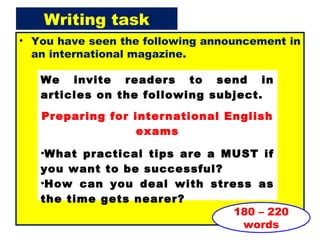
Writing task
• You have seen the following announcement in
an international magazine.
180 – 220
words
We invite readers to send in
articles on the following subject.
Preparing for international English
exams
•What practical tips are a MUST if
you want to be successful?
•How can you deal with stress as
the time gets nearer?
Which plan is most appropriate?
PLAN A
• Paragraph 1:
Introduction – grab
reader’s attention and tell
about your experience.
• Paragraph 2: Describe
one particular successful
event.
• Paragraph 3: Give
some tips.
• Paragraph 4:
Conclusion – encourage
other people to follow
your advice.
PLAN B
TITLE
• Paragraph 1:
Introduction – grab
reader’s attention, make
the reader feel involved.
• Paragraph 2: Advice or
tips and give some
examples.
• Paragraph 3: Dealing
with stress. Suggestions.
• Paragraph 4:
Concluding paragraph.
End on an optimistic note.
ADVICE
• Always plan your paragraphs
before starting to write.
• Don’t forget to include and
introduction and a conclusion.
• Make sure you have covered all
the requested points.
• Put these points in a logical order.
• Use semi formal language.
Writing reference
p. 166
HOMEWORK
Wednesady 15th, May
• Notebooks
• E – mailed at:
jorge.linares@sanjoseobrero.edu.pe

Unit 3

  • 1.
    All in themind UNIT 3
  • 2.
    STARTING OFF • Isit possible to measure a person’s intelligence fairly and accurately? • Should we measure intelligence? • Why? / Why not? What type of thinker are you?
  • 3.
    LISTENING Part 2 •In this part you listen to a talk or lecture and you have to complete 8 sentences with a word or short phrase. • There will be no more than three words missing from each sentence. • The sentences on the question paper are not exactly what you will hear on the recording. EXAM INFORMATION
  • 4.
  • 5.
  • 6.
    LISTENING: Part 2 KEY 1 2 3 4 5 perfectlyillustrates leaves severely affected (human) evolution private brain mechanism 6 face-blind volunteers 7 8 Other objects face recognition skills
  • 7.
    ANSWER • How goodare you at remembering people’s names? What about their phone numbers? • How easily do you recognise places you have been to before? • Have you ever experienced déjà vu ? How do you explain this phenomenon? The experience of feeling sure that one has already witnessed or experienced a current situation
  • 8.
    no, not, none no+ noun no + adjective aux + not None (pronoun) •There’s no time left. •I have no idea. •This week has been no different than last. •I haven’t got money with me now. •I don’t know. •I won’t forget you. •None of my friends knows about it. •We have to buy more bananas. There’s none left.
  • 9.
    THE PASSIVE a.We wereshown the photographs. b.They have been asked to send their resumés. c.She won’t be given the job. d.The latest iPhones are being sold quickly. e.It is believed that Colombus arrived first in America. f. That has been proved false though. g.As evidence of Vikings settlements has been found in North America.
  • 10.
    THE PASSIVE  Informal writing we often begin sentences with It + passive, especially if we want to focus attention on ideas and arguments. e.g. • It has been shown in experiments … • It is commonly believed that … • It has been reported in the last few days that …
  • 11.
    THE PASSIVE  Rewritethe following: • Evidence shows that the Vikings arrived in American long before Colombus. • It … Sherwood forest is where the legend says Robin Hood used to lived. • It … has been shown that the Vikings arrived in America long before Colombus. is said that Sherwood forest is where Robin Hood used to live.
  • 12.
    READING Part 3 •In Reading Part 3 you have to answer seven multiple – choice questions, each with four options, on a text of 550 – 850 words. • The answers to the questions appear in the text in the same order as in the questions. • You have about 18 minutes for this part. EXAM INFORMATION
  • 13.
    READING Part 3 •Digitalnative •Digital immigrant
  • 14.
    READING – pages32, 33 KEY 1 2 3 4 5 C A B C D 6 C 7 C
  • 15.
    DISCUSS • The behaviourof Feld and her generation … is being shaped by digital technology. It may even be the next step in evolution, transforming our brains and the way we think. • Do you find sitting down and reading or watching TV too slow and boring? • The writer says Many parents fear that children who spend hours glued to computer screens will end up as zombies.
  • 16.
    Use of English– Part 3 • What physical characteristics have you inherited from your parents? • Where do your likes, dislikes, tastes and interests come from – your genes or your experience?
  • 17.
    Use of EnglishPart 2 • In Use of English Part 2 there is a text with 15 gaps. You have to write one word in each gap. Most missing words are ‘grammar words’, e.g. • Articles (the, an) • Auxiliary verbs (are, is, can) • Pronouns (he, us) • Conjunctions (but, although) • A few may be ‘meaning’ words, for example nouns, verbs, adjectives. • Spelling must be correct. EXAM INFORMATION
  • 18.
    STRATEGY • Try towork out which type of word is missing e.g. a noun, a verb, singular or plural, etc. • Read the sentences with the gaps carefully. • Especially at the words before and after each gap.
  • 19.
    Nature vs Nurture 1 2 3 4 5 for your by less and 6has 7 do 8 9 10 11 12 13 14 15 of play as is Other because of with
  • 20.
    SPEAKING PAPER Part3 • You have to work with a partner to try to answer a question. • The examiner will: a. Show you a set of pictures on a common theme. b. Ask you a question connected to that theme. • You have three (03) minutes to discuss the question and decide together with your partner what the best answer is. EXAM INFORMATION
  • 21.
    SPEAKING PAPER Part3 • The skills being tested here are FLUENCY and the ability to PARTICIPATE IN and MAINTAIN a conversation. • During the discussion you are expected to: a. exchange ideas. b. express and justify opinions. c. agree and/or disagree. d. suggest, speculate and evaluate. Skills being tested https://fronter.com/cambridge/
  • 22.
    How can stressaffect people in these situations? Which of the situations is the most stressful for people?
  • 23.
    How important ismoney in today’s society? Which picture shows the safest way of paying for something?
  • 24.
    Useful Phrases • Doyou have any thoughts on this? • I’d say that … • Let’s move on to the next picture. • Shall we go on to the second question? • I completely agree. • I totally disagree. • Yes, you’ve got a point there. • Now, we have to decide … • Ok, lets’ make our decision.
  • 25.
    Do you enjoymaths? Why? Why not? What do you find difficult/easy?
  • 26.
    QUESTION 1 It took2 hours for two men to dig a hole two metres deep. How deep would it have been if ten men had dug for two hours?
  • 28.
    The deeper ahole is, the more effort is required to dig. Because waste soil has to be lifted higher to the ground level. Ten men would need more room to work side-by-side, and so may need to dig the hole wider rather than deeper. It is possible that with more people digging, each person may become less efficient due to increased opportunity for distractions. Deeper soil layers may be harder to dig out. You may hit rock or water. Ten men are more likely to disagree on a digging method than two.
  • 29.
    LATERAL THINKING Lateral thinkingis the (1) ………… coined by the psychologyst Edward de Bono to (2) ………… ways of thinking about situations or problems (3) ……………. and creatively rather than by (4) …………… traditional step- by-step logic. describe term imaginativel y using
  • 30.
    Red light The policecar had stopped at a crossroad controlled by traffic lights, whereas the teenager was travelling on the road that crossed the road the police car was on. The police officers did not react because the teenager had driven
  • 31.
    Crossing the river Thetwo men were on different sides of the river. The first man crossed in the boat on his own, then the other man crossed the river in the opposite direction, also on his own.
  • 32.
    Bottle in thebag. The last person took both the bag and the bottle of water.
  • 33.
    The best builder Thecouncil asked each bulding company to suggest the name of the second best builder in case the company was unable to fulfil the contract. The contract was awarded to the bulding company which was named
  • 34.
  • 35.
    WRITING PAPER Part1 • You may be asked to write an article in Part 1 or Part 2. • You will be told to write an article for a newspaper or a magazine. • The target readers are assumed to have the same interests as you. • The main purpose is to interest and engage the reader. • You have to use your own opinions to develop the point. AN ARTICLE
  • 36.
    Writing task • Youhave seen the following announcement in an international magazine. 180 – 220 words We invite readers to send in articles on the following subject. Preparing for international English exams •What practical tips are a MUST if you want to be successful? •How can you deal with stress as the time gets nearer?
  • 37.
    Which plan ismost appropriate? PLAN A • Paragraph 1: Introduction – grab reader’s attention and tell about your experience. • Paragraph 2: Describe one particular successful event. • Paragraph 3: Give some tips. • Paragraph 4: Conclusion – encourage other people to follow your advice. PLAN B TITLE • Paragraph 1: Introduction – grab reader’s attention, make the reader feel involved. • Paragraph 2: Advice or tips and give some examples. • Paragraph 3: Dealing with stress. Suggestions. • Paragraph 4: Concluding paragraph. End on an optimistic note.
  • 38.
    ADVICE • Always planyour paragraphs before starting to write. • Don’t forget to include and introduction and a conclusion. • Make sure you have covered all the requested points. • Put these points in a logical order. • Use semi formal language. Writing reference p. 166
  • 39.
    HOMEWORK Wednesady 15th, May •Notebooks • E – mailed at: jorge.linares@sanjoseobrero.edu.pe