Writing
techniques_ ​
constructing
a paragraph​
Paragraphs
• A written composition that consists of one or more
sentences that form a distinct unit, develops one major
idea, and begins on a new usually indented line.
2
Parts of a paragraph
• An effective paragraph has a topic,
topic sentence, supporting details, and a
terminator.
A topic is the central idea/ theme discussed or
to be discussed in the paragraph.
A title/ heading is the summary of the topic,
usually written with a single word or phrase.
3
• The title is the name of the matter it refers to.
• All paragraphs may not necessarily have a title,
but a title or a topic is always in the mind of the
writer.
• Paragraph topics and titles should be narrow
enough to be fully developed within the given
length
4
Narrowing aTopic
• Unless you make your topic specific, you may not fully
develop its major idea, hence your paragraph will be
incomplete.
• The following example shows how a broad topic can be
narrowed down to a specific one.
• Farming-Farming in Ethiopia- Animal Farming in
Ethiopia- Dairy Farming in Ethiopia- Dairy Farming in
Addis Ababa-The Shola Dairy Farm
5
Exercise 1
• For each of the following, suggest a narrow title that
may be adequately developed in one paragraph.
• A. Myself
• B. My Kebele
• C. My Mother
• My undergraduate life
6
ATopic sentence
• ATopic sentence is one that contains the central or
controlling idea of a paragraph,
i.e. it points out the most important aspect of the topic to be
discussed and may state the writer’s view or attitude
towards it
7
Supporting details
• Supporting details are sentences developing the central
idea indicated in the topic sentence in various ways.
• For example:
narrating, describing, comparing, contrasting, or
analyzing information, arguing, exemplifying,
illustrating, etc.
8
The terminator
• The terminator of a paragraph is the part that winds up or
closes the discussion.This can be done in various ways:
restatement, conclusion, giving remarks,
recommendation, question, etc.
9
Exercise 2
Go back to the paragraph titles you developed in exercise 1.
For each title, write one topic sentence.
Exercise 3
Read the paragraphs below and write out the topic, the
topic sentence, and the terminator of each paragraph.
10
• Professional athletes earn large salaries but often do
not know how to handle their money. Sometimes they
spend huge amount of money on expensive cars and
other luxuries because they want to impress every one
with their wealth. If they have little business
experience, they may throw money away on unwise
investments. Or, in trying to be generous to less
fortunate relatives or friends, they may simply give
away their money or make loans that are never paid.
An athlete’s ability to earn a top salary lasts just a
few years, as a rule, and during those years a strict,
competent business manager is a real necessity.
11
Women of the Land ofThe Rising Sun
• For almost a thousand years, Japanese women
were virtual slaves. During her life, a woman had
three masters: her father when she was young,
her husband when she married, and her son
when she became old. Her husband could divorce
her for anyone of seven reasons – if she did not
bear children, was immoral, did not serve his parents,
stole, talked too much, was jealous, or had
communicable disease. A good wife was supposed to be
the first one to get up in the morning, and the last to go
to bed at night. Her only duty through out the day was to
serve her man.
12
• The annex of City Hospital should be closed at once.
The building is in poor physical condition, and the city
cannot afford to make urgently needed repairs to roofs,
floors and walls. Also, doctors on the annex staff have
complained that surgical facilities are dangerously
obsolete.Visitors to the annex can no longer reach it
easily by public transportation because bus lines
serving the annex area run too infrequently.The annex
is a relic of an earlier time and should be allowed to
retire.
13
Qualities of a Good Paragraph
1. UNITY - singleness or "oneness" of purpose. All the detail
sentences clearly point to or support the topic sentence.
2. COHERENCE - all the sentences and ideas in the
paragraph connect and flow smoothly together to make
clear and logical points about the topic.
14
Purpose
• The paragraph is always written to achieve a
purpose
• Every word, sentence, and every point in a
paragraph should have a role to play in
fulfilling the purpose of the paragraph
15
Emphasis
• The important points in the paragraph should
be clearly emphasized so as to help the reader
focus on the main idea.
16
Completeness:
Completeness refers to providing adequate
information to make a paragraph well-
developed.
If all sentences clearly and sufficiently
support the main idea, then your paragraph is
complete.
17
Length of a paragraph
• According to the complexity of the main idea
to be developed, the length varies.
• However, a typical paragraph usually has
about 100 words or seven to ten sentences
18
Planning a Paragraph
1. Choose a topic or make sure you understand the topic
given.
2. Prepare a topic sentence
3. List the points that help you to develop the central
idea.
4. Check your final list and cross out points not directly
relevant.
5. Arrange the points in a logical order.
6. Draft your paragraph-put the ideas into sentences
linked with cohesive devices.
7. Read through and check your work.
8.Write out your final draft
19
Exercise
• Choose one of the topic sentences you developed and
write a paragraph. Make sure you have the three parts
of a paragraph
20
Techniques that can be used to establish
coherence in paragraphs
• Repeating key words or phrases
• Being consistent in point of view, verb tense, and
number
• Creating parallel structures
21
In addition,
• Coherence can also be achieved through the use
of:
• Chronological order
• Spatial order
• Emphatic order
• Sequential or Procedural order
22
Transition Words and Phrases - used to
show connection among sentence
• To show addition:
again, and, also, besides, equally important,
first (second, etc.), further, furthermore, in
addition, in the first place, moreover, next,
too
23
• To give examples:
for example, for instance, in fact, specifically,
that is, to illustrate, thus, such as
• To compare:
also, in the same manner, likewise, similarly
24
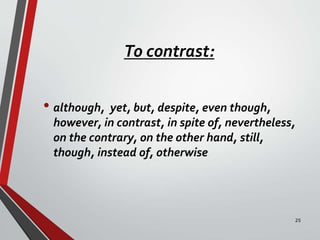
To contrast:
• although, yet, but, despite, even though,
however, in contrast, in spite of, nevertheless,
on the contrary, on the other hand, still,
though, instead of, otherwise
25
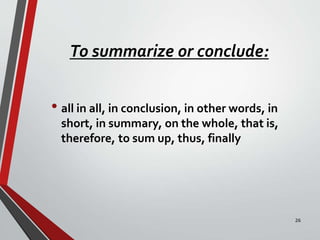
To summarize or conclude:
• all in all, in conclusion, in other words, in
short, in summary, on the whole, that is,
therefore, to sum up, thus, finally
26
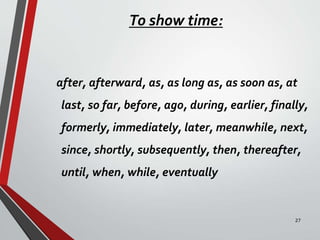
To show time:
after, afterward, as, as long as, as soon as, at
last, so far, before, ago, during, earlier, finally,
formerly, immediately, later, meanwhile, next,
since, shortly, subsequently, then, thereafter,
until, when, while, eventually
27
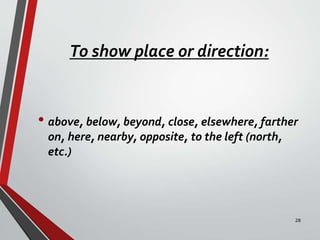
To show place or direction:
• above, below, beyond, close, elsewhere, farther
on, here, nearby, opposite, to the left (north,
etc.)
28
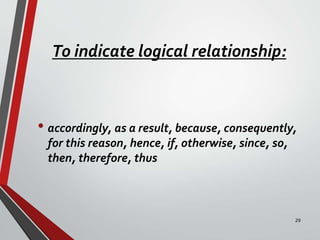
To indicate logical relationship:
• accordingly, as a result, because, consequently,
for this reason, hence, if, otherwise, since, so,
then, therefore, thus
29
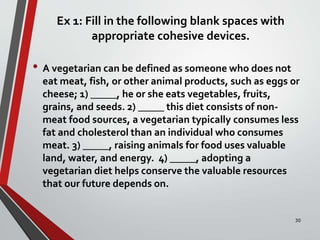
Ex 1: Fill in the following blank spaces with
appropriate cohesive devices.
• A vegetarian can be defined as someone who does not
eat meat, fish, or other animal products, such as eggs or
cheese; 1) _____, he or she eats vegetables, fruits,
grains, and seeds. 2) _____ this diet consists of non-
meat food sources, a vegetarian typically consumes less
fat and cholesterol than an individual who consumes
meat. 3) _____, raising animals for food uses valuable
land, water, and energy. 4) _____, adopting a
vegetarian diet helps conserve the valuable resources
that our future depends on.
30
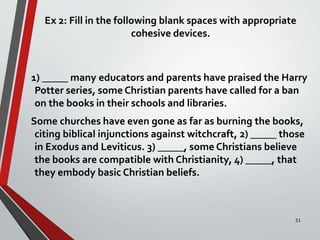
Ex 2: Fill in the following blank spaces with appropriate
cohesive devices.
1) _____ many educators and parents have praised the Harry
Potter series, some Christian parents have called for a ban
on the books in their schools and libraries.
Some churches have even gone as far as burning the books,
citing biblical injunctions against witchcraft, 2) _____ those
in Exodus and Leviticus. 3) _____, some Christians believe
the books are compatible with Christianity, 4) _____, that
they embody basic Christian beliefs.
31
Exercises
• The following groups of sentences can be rearranged to
form paragraphs.
• Make a note of the order in which they should be placed
(e.g. b., d., c., a., e.) and encircle the letter that
corresponds to what you think is the topic sentence.
32
A. Next, add antifreeze to your windshield washer fluid;
otherwise, the fluid will freeze and possibly break the
container.
B. First, put on snow tires if you plan to drive on snowy,
icy roads very often.
C. Driving in winter, especially on snowy, icy roads, can be
less troublesome if you take a few simple precautions.
D. Finally, it is also a good idea to carry tire chains, a can
of spray to unfreeze door locks, and a windshield
scraper in your car when driving in winter weather.
E. Second, check the amount of antifreeze in your radiator
and add more if necessary. Cbead
33
GuidedWriting
• Write a paragraph about smoking using the jumbled notes
below following the order of the linking words.
34
Linking words The jumbled notes
1. Fifty years ago,
2. Therefore,
3. Eventually,
4. Because of this,
5. In spite of this,
6. For example,
7. Thus, we can say that
___
A. Other people started to smoke, and many continued to die.
B.The battle against smoking is not yet over.
C. Smoking was not seen as a major health risk; it just caused
coughs.
D. 700 people die in Britain of lung cancer last month.
E. No studies were made on the effects of tobacco on health.
F. Some people, especially doctors stopped smoking.
G. Some link between smoking, cancer and heart disease was
discovered.
Types of Paragraphs
•Paragraphs can be classified into various
types based on the purpose they are
written for, and the way the topic is
developed.
35
Types of Paragraphs
• Here are the basic types of paragraphs:
36
Cause and effect
Classification
Illustrative
Identification
Definition
Compare and contrast
Descriptive
Narrative
Exposition
Persuasive
argumentative
Analysis
Compare/Contrast
• Oceans and lakes have much in common, but they are
also quite different. Both are bodies of water, but oceans
are very large bodies of salt water, while lakes are much
smaller bodies of fresh water. Lakes are usually
surrounded by land, while oceans are what surround
continents. Both have plants and animals living in them.
The ocean is home to the largest animals on the planet,
whereas lakes support much smaller forms of life. When it
is time for a vacation, both will make a great place to visit
and enjoy.
37
Cause/Effect
• I do well in school, and people think I am smart because
of it. In fact, two years ago I decided to get serious
about school and made a few changes. First, I decided I
would become interested in whatever was being taught,
regardless of what other people thought. I also decided I
would work hard every day and never give up on any
assignment. Finally, I decided to make school a priority
over friends and fun. After that, I became an active
participant in classroom discussions. Then my test
scores began to rise. I think, being smart is simply a
matter of working hard and being interested.
38
Illustrative Paragraph
• This type of paragraph makes a general idea clear by
providing specific examples and statistical data that
support it.
39
Example of an illustrative paragraph
• A true friendship that stands the test of time requires patience,
sacrifice, and shared experiences. Friends must be patient with each
other. Even though friends may be alike in many ways, they will be
different in other ways. So if you are a fast eater, but your friend is a
slow eater, you may have to wait for him or her to finish eating if you
go out to a restaurant. Friends must also sacrifice for each other. If you
want to go to a concert, but your friend is having his or her birthday
party somewhere else the same time, you’re going to have to go to the
party. If you make a lame excuse to get out of the birthday party,
you’re really not a good friend. Lastly, friends rely on shared
experiences to bond them together and give them things to talk about
later in life. My friends and I still laugh about the time we decided to go
to the movies without the knowledge of our parents. Shared
experiences like this, as well as patience and sacrifice, make
friendships what they are.
40
The Method of Classification
• In this method a general concept or entity is divided into
its component parts.
• These may again be sub-divided until the smallest unit
desired is reached.
41
Example of Classification
• A first date can end up being categorized as
successful, clingy, boastful, or awkward. Successful first dates
include both parties expressing information about what they like,
who they are, and so forth. Usually, these dates will end in tentative
plans for a second one. Clingy dates end up with one of the parties
practically begging for information about the other. However, the
non-clinger is not interested. On boastful dates, one member of the
duo talks about all of his or her skills, talents, and abilities. The
listening end of the pair is never asked about his or her life. Awkward
first dates generally involve lots of silence or one or both of the
partners not knowing how to act appropriately. While many dates
occur every day, they can generally fall into one of these categories.
42
The method of definition
• In this method you define a person or an object. When
you define, use precise words and expressions. Be
objective, scientific and dispassionate in defining
things.
There are three kinds of definition:
1. Ordinary definition uses synonyms and examples: eg.
Daft: silly, foolish.
2. Logical definition states the smallest class the thing to
be defined belongs to and states the factors that
differentiate it from other similar ones: eg. Water is a
liquid made up of H2O.
3. Extended definition is a logical definition with additional
details. 43
Example of an extended definition
• The elephant is an animal that is the largest among those
living on land. In the animal kingdom, only the whale is
larger. An elephant has a nose that protrudes into a long
trunk which it uses as a hand. Elephants have the largest ears
in the world, and their tusks are the largest teeth
44
The method of analysis
• This method requires the breaking up of the various
parts of an object, an idea, or process and showing
how they are related to each other.
• The method is particularly suited to describing
processes
45
Example ofThe method of analysis
• Here is the perfect system for cleaning your room.
First, move all of the items that do not have a proper
place to the center of the room. Get rid of at least five
things that you have not used within the last year.
Take out all of the trash, and place all of the dirty dishes in the
kitchen sink. Now find a location for each of the items you had
placed in the center of the room. For any remaining items, see
if you can squeeze them in under your bed or stuff them into
the back of your closet. See, that was easy!
46
Narrative
• A narrative paragraph tells a story with specific details.
• It usually establishes time and place and is chronologically
organized
47
Narrative Paragraph Example
• Around 2 a.m. something woke Chanyalew Habtamu up. He lay in the
dark listening. Outside, birds were singing. It was too quiet. At home in
Addis, the nights are filled with the busy, comforting sounds of traffic.
You always have the comforting knowledge that other people are all
around you. And light: At home, he can read in bed by the glow of the
streetlight. In the new place, it was too quiet. And much too dark.
Moving his hands in all directions, he found where his pants were
hanging and, as he felt the pockets for a box of matches, something
rustled in the leaves right outside the window. He heard his wife,
Weynitu, walk slowly; she was awake, too. Then, the huge silence of
the night seemed to come inside the camper, stifling them. Then he
decided to pack up and move to a motel.
48
Exposition
• Exposition is explanatory writing which is done by using a
combination of all or some of the following methods of
developing ideas: cause and effect, classification, illustration,
identification, analysis, definition, and compare and contrast
• What makes your explanation believable? Normally is citation
and references.
49
Exposition Example
• This family was a victim of a problem they could have
avoided-a problem that, according to Florida park rangers,
hundreds of visitors suffer each year. For example, several
times a month, people get scared and leave the park in the
middle of the night. Those people picked the wrong kind of
park to visit. Not that there was anything wrong with the
park: The hikers camped next to them loved the wild
isolation of it. If the couple had known about the different
kinds of parks in Florida, they might have stayed in a place
they loved.
50
Description
• The descriptive paragraph describes something and
shows the reader what a thing or a person is like.
• The words chosen in the description often appeal to
the five senses of touch, smell, sight, sound, and
taste.
• Descriptive paragraphs can be artistic and may
deviate from grammatical norms.
51
Description Example
• When I think of the home town of my youth, all
that I seem to remember is dust- the brown, crumbly
dust of late summer- arid, sterile dust that gets into the eyes
and makes them water, gets into the throat and between the
toes of bare brown feet. I don’t know why I should remember
only the dust… And so, when I think of that time and that
place, I remember only the dry September of the dirt roads
and grassless of the shanty-town where I lived.
52
Persuasive
• This method uses direct approach Calls readers to action or to
take a stand on an important issue
• More than just opinion, information, analysis, and context
must be given to the reader to let him/her make a decision
53
Persuasive Example
• Students are currently getting ripped off. Students who
spend an average of 10 hours or more on extracurricular
activities should receive some kind of academic credit.
Most students who are involved in sports, music,
journalism, or theater activities are actively learning on a
daily basis. They attend practice and events and
participate regularly as they would in class. Furthermore,
their participation helps them become more responsible
and disciplined students. Students are putting forth the
effort, and not getting any recognition for their time.
54
Argumentative Paragraph
• In this type of paragraph you present a series of
facts and judgments arranged coherently to make
a conclusion for or against a proposition.
55
Argumentative Paragraph
• You should attend the school fair. The school fair is right
around the corner, and tickets have just gone on sale. Even
if you don’t have much money, you don’t have to worry. The
school fair is a community event, and therefore prices are
kept low. Perhaps, you are still not convinced. Maybe you
feel you are too old for fairs, or you just don’t like them.
Well, that’s what my grandfather thought, but he came to
last year’s school fair and had this to say about it: “I had the
best time of my life!” While it’s true you may be able to think
of a reason not to come, I’m also sure you can think of
several reasons why you must come. We look forward to
seeing you at the school fair!
56
Tips
Paragraphs are the building
blocks of an argument, not
only an essay
Plan your essays carefully
and clarify your argument
before beginning
Structure your paragraphs
clearly

Paragraph_writing.pptbfhfbdbhrbdbhhhfhfjfj

  • 1.
  • 2.
    Paragraphs • A writtencomposition that consists of one or more sentences that form a distinct unit, develops one major idea, and begins on a new usually indented line. 2
  • 3.
    Parts of aparagraph • An effective paragraph has a topic, topic sentence, supporting details, and a terminator. A topic is the central idea/ theme discussed or to be discussed in the paragraph. A title/ heading is the summary of the topic, usually written with a single word or phrase. 3
  • 4.
    • The titleis the name of the matter it refers to. • All paragraphs may not necessarily have a title, but a title or a topic is always in the mind of the writer. • Paragraph topics and titles should be narrow enough to be fully developed within the given length 4
  • 5.
    Narrowing aTopic • Unlessyou make your topic specific, you may not fully develop its major idea, hence your paragraph will be incomplete. • The following example shows how a broad topic can be narrowed down to a specific one. • Farming-Farming in Ethiopia- Animal Farming in Ethiopia- Dairy Farming in Ethiopia- Dairy Farming in Addis Ababa-The Shola Dairy Farm 5
  • 6.
    Exercise 1 • Foreach of the following, suggest a narrow title that may be adequately developed in one paragraph. • A. Myself • B. My Kebele • C. My Mother • My undergraduate life 6
  • 7.
    ATopic sentence • ATopicsentence is one that contains the central or controlling idea of a paragraph, i.e. it points out the most important aspect of the topic to be discussed and may state the writer’s view or attitude towards it 7
  • 8.
    Supporting details • Supportingdetails are sentences developing the central idea indicated in the topic sentence in various ways. • For example: narrating, describing, comparing, contrasting, or analyzing information, arguing, exemplifying, illustrating, etc. 8
  • 9.
    The terminator • Theterminator of a paragraph is the part that winds up or closes the discussion.This can be done in various ways: restatement, conclusion, giving remarks, recommendation, question, etc. 9
  • 10.
    Exercise 2 Go backto the paragraph titles you developed in exercise 1. For each title, write one topic sentence. Exercise 3 Read the paragraphs below and write out the topic, the topic sentence, and the terminator of each paragraph. 10
  • 11.
    • Professional athletesearn large salaries but often do not know how to handle their money. Sometimes they spend huge amount of money on expensive cars and other luxuries because they want to impress every one with their wealth. If they have little business experience, they may throw money away on unwise investments. Or, in trying to be generous to less fortunate relatives or friends, they may simply give away their money or make loans that are never paid. An athlete’s ability to earn a top salary lasts just a few years, as a rule, and during those years a strict, competent business manager is a real necessity. 11
  • 12.
    Women of theLand ofThe Rising Sun • For almost a thousand years, Japanese women were virtual slaves. During her life, a woman had three masters: her father when she was young, her husband when she married, and her son when she became old. Her husband could divorce her for anyone of seven reasons – if she did not bear children, was immoral, did not serve his parents, stole, talked too much, was jealous, or had communicable disease. A good wife was supposed to be the first one to get up in the morning, and the last to go to bed at night. Her only duty through out the day was to serve her man. 12
  • 13.
    • The annexof City Hospital should be closed at once. The building is in poor physical condition, and the city cannot afford to make urgently needed repairs to roofs, floors and walls. Also, doctors on the annex staff have complained that surgical facilities are dangerously obsolete.Visitors to the annex can no longer reach it easily by public transportation because bus lines serving the annex area run too infrequently.The annex is a relic of an earlier time and should be allowed to retire. 13
  • 14.
    Qualities of aGood Paragraph 1. UNITY - singleness or "oneness" of purpose. All the detail sentences clearly point to or support the topic sentence. 2. COHERENCE - all the sentences and ideas in the paragraph connect and flow smoothly together to make clear and logical points about the topic. 14
  • 15.
    Purpose • The paragraphis always written to achieve a purpose • Every word, sentence, and every point in a paragraph should have a role to play in fulfilling the purpose of the paragraph 15
  • 16.
    Emphasis • The importantpoints in the paragraph should be clearly emphasized so as to help the reader focus on the main idea. 16
  • 17.
    Completeness: Completeness refers toproviding adequate information to make a paragraph well- developed. If all sentences clearly and sufficiently support the main idea, then your paragraph is complete. 17
  • 18.
    Length of aparagraph • According to the complexity of the main idea to be developed, the length varies. • However, a typical paragraph usually has about 100 words or seven to ten sentences 18
  • 19.
    Planning a Paragraph 1.Choose a topic or make sure you understand the topic given. 2. Prepare a topic sentence 3. List the points that help you to develop the central idea. 4. Check your final list and cross out points not directly relevant. 5. Arrange the points in a logical order. 6. Draft your paragraph-put the ideas into sentences linked with cohesive devices. 7. Read through and check your work. 8.Write out your final draft 19
  • 20.
    Exercise • Choose oneof the topic sentences you developed and write a paragraph. Make sure you have the three parts of a paragraph 20
  • 21.
    Techniques that canbe used to establish coherence in paragraphs • Repeating key words or phrases • Being consistent in point of view, verb tense, and number • Creating parallel structures 21
  • 22.
    In addition, • Coherencecan also be achieved through the use of: • Chronological order • Spatial order • Emphatic order • Sequential or Procedural order 22
  • 23.
    Transition Words andPhrases - used to show connection among sentence • To show addition: again, and, also, besides, equally important, first (second, etc.), further, furthermore, in addition, in the first place, moreover, next, too 23
  • 24.
    • To giveexamples: for example, for instance, in fact, specifically, that is, to illustrate, thus, such as • To compare: also, in the same manner, likewise, similarly 24
  • 25.
    To contrast: • although,yet, but, despite, even though, however, in contrast, in spite of, nevertheless, on the contrary, on the other hand, still, though, instead of, otherwise 25
  • 26.
    To summarize orconclude: • all in all, in conclusion, in other words, in short, in summary, on the whole, that is, therefore, to sum up, thus, finally 26
  • 27.
    To show time: after,afterward, as, as long as, as soon as, at last, so far, before, ago, during, earlier, finally, formerly, immediately, later, meanwhile, next, since, shortly, subsequently, then, thereafter, until, when, while, eventually 27
  • 28.
    To show placeor direction: • above, below, beyond, close, elsewhere, farther on, here, nearby, opposite, to the left (north, etc.) 28
  • 29.
    To indicate logicalrelationship: • accordingly, as a result, because, consequently, for this reason, hence, if, otherwise, since, so, then, therefore, thus 29
  • 30.
    Ex 1: Fillin the following blank spaces with appropriate cohesive devices. • A vegetarian can be defined as someone who does not eat meat, fish, or other animal products, such as eggs or cheese; 1) _____, he or she eats vegetables, fruits, grains, and seeds. 2) _____ this diet consists of non- meat food sources, a vegetarian typically consumes less fat and cholesterol than an individual who consumes meat. 3) _____, raising animals for food uses valuable land, water, and energy. 4) _____, adopting a vegetarian diet helps conserve the valuable resources that our future depends on. 30
  • 31.
    Ex 2: Fillin the following blank spaces with appropriate cohesive devices. 1) _____ many educators and parents have praised the Harry Potter series, some Christian parents have called for a ban on the books in their schools and libraries. Some churches have even gone as far as burning the books, citing biblical injunctions against witchcraft, 2) _____ those in Exodus and Leviticus. 3) _____, some Christians believe the books are compatible with Christianity, 4) _____, that they embody basic Christian beliefs. 31
  • 32.
    Exercises • The followinggroups of sentences can be rearranged to form paragraphs. • Make a note of the order in which they should be placed (e.g. b., d., c., a., e.) and encircle the letter that corresponds to what you think is the topic sentence. 32
  • 33.
    A. Next, addantifreeze to your windshield washer fluid; otherwise, the fluid will freeze and possibly break the container. B. First, put on snow tires if you plan to drive on snowy, icy roads very often. C. Driving in winter, especially on snowy, icy roads, can be less troublesome if you take a few simple precautions. D. Finally, it is also a good idea to carry tire chains, a can of spray to unfreeze door locks, and a windshield scraper in your car when driving in winter weather. E. Second, check the amount of antifreeze in your radiator and add more if necessary. Cbead 33
  • 34.
    GuidedWriting • Write aparagraph about smoking using the jumbled notes below following the order of the linking words. 34 Linking words The jumbled notes 1. Fifty years ago, 2. Therefore, 3. Eventually, 4. Because of this, 5. In spite of this, 6. For example, 7. Thus, we can say that ___ A. Other people started to smoke, and many continued to die. B.The battle against smoking is not yet over. C. Smoking was not seen as a major health risk; it just caused coughs. D. 700 people die in Britain of lung cancer last month. E. No studies were made on the effects of tobacco on health. F. Some people, especially doctors stopped smoking. G. Some link between smoking, cancer and heart disease was discovered.
  • 35.
    Types of Paragraphs •Paragraphscan be classified into various types based on the purpose they are written for, and the way the topic is developed. 35
  • 36.
    Types of Paragraphs •Here are the basic types of paragraphs: 36 Cause and effect Classification Illustrative Identification Definition Compare and contrast Descriptive Narrative Exposition Persuasive argumentative Analysis
  • 37.
    Compare/Contrast • Oceans andlakes have much in common, but they are also quite different. Both are bodies of water, but oceans are very large bodies of salt water, while lakes are much smaller bodies of fresh water. Lakes are usually surrounded by land, while oceans are what surround continents. Both have plants and animals living in them. The ocean is home to the largest animals on the planet, whereas lakes support much smaller forms of life. When it is time for a vacation, both will make a great place to visit and enjoy. 37
  • 38.
    Cause/Effect • I dowell in school, and people think I am smart because of it. In fact, two years ago I decided to get serious about school and made a few changes. First, I decided I would become interested in whatever was being taught, regardless of what other people thought. I also decided I would work hard every day and never give up on any assignment. Finally, I decided to make school a priority over friends and fun. After that, I became an active participant in classroom discussions. Then my test scores began to rise. I think, being smart is simply a matter of working hard and being interested. 38
  • 39.
    Illustrative Paragraph • Thistype of paragraph makes a general idea clear by providing specific examples and statistical data that support it. 39
  • 40.
    Example of anillustrative paragraph • A true friendship that stands the test of time requires patience, sacrifice, and shared experiences. Friends must be patient with each other. Even though friends may be alike in many ways, they will be different in other ways. So if you are a fast eater, but your friend is a slow eater, you may have to wait for him or her to finish eating if you go out to a restaurant. Friends must also sacrifice for each other. If you want to go to a concert, but your friend is having his or her birthday party somewhere else the same time, you’re going to have to go to the party. If you make a lame excuse to get out of the birthday party, you’re really not a good friend. Lastly, friends rely on shared experiences to bond them together and give them things to talk about later in life. My friends and I still laugh about the time we decided to go to the movies without the knowledge of our parents. Shared experiences like this, as well as patience and sacrifice, make friendships what they are. 40
  • 41.
    The Method ofClassification • In this method a general concept or entity is divided into its component parts. • These may again be sub-divided until the smallest unit desired is reached. 41
  • 42.
    Example of Classification •A first date can end up being categorized as successful, clingy, boastful, or awkward. Successful first dates include both parties expressing information about what they like, who they are, and so forth. Usually, these dates will end in tentative plans for a second one. Clingy dates end up with one of the parties practically begging for information about the other. However, the non-clinger is not interested. On boastful dates, one member of the duo talks about all of his or her skills, talents, and abilities. The listening end of the pair is never asked about his or her life. Awkward first dates generally involve lots of silence or one or both of the partners not knowing how to act appropriately. While many dates occur every day, they can generally fall into one of these categories. 42
  • 43.
    The method ofdefinition • In this method you define a person or an object. When you define, use precise words and expressions. Be objective, scientific and dispassionate in defining things. There are three kinds of definition: 1. Ordinary definition uses synonyms and examples: eg. Daft: silly, foolish. 2. Logical definition states the smallest class the thing to be defined belongs to and states the factors that differentiate it from other similar ones: eg. Water is a liquid made up of H2O. 3. Extended definition is a logical definition with additional details. 43
  • 44.
    Example of anextended definition • The elephant is an animal that is the largest among those living on land. In the animal kingdom, only the whale is larger. An elephant has a nose that protrudes into a long trunk which it uses as a hand. Elephants have the largest ears in the world, and their tusks are the largest teeth 44
  • 45.
    The method ofanalysis • This method requires the breaking up of the various parts of an object, an idea, or process and showing how they are related to each other. • The method is particularly suited to describing processes 45
  • 46.
    Example ofThe methodof analysis • Here is the perfect system for cleaning your room. First, move all of the items that do not have a proper place to the center of the room. Get rid of at least five things that you have not used within the last year. Take out all of the trash, and place all of the dirty dishes in the kitchen sink. Now find a location for each of the items you had placed in the center of the room. For any remaining items, see if you can squeeze them in under your bed or stuff them into the back of your closet. See, that was easy! 46
  • 47.
    Narrative • A narrativeparagraph tells a story with specific details. • It usually establishes time and place and is chronologically organized 47
  • 48.
    Narrative Paragraph Example •Around 2 a.m. something woke Chanyalew Habtamu up. He lay in the dark listening. Outside, birds were singing. It was too quiet. At home in Addis, the nights are filled with the busy, comforting sounds of traffic. You always have the comforting knowledge that other people are all around you. And light: At home, he can read in bed by the glow of the streetlight. In the new place, it was too quiet. And much too dark. Moving his hands in all directions, he found where his pants were hanging and, as he felt the pockets for a box of matches, something rustled in the leaves right outside the window. He heard his wife, Weynitu, walk slowly; she was awake, too. Then, the huge silence of the night seemed to come inside the camper, stifling them. Then he decided to pack up and move to a motel. 48
  • 49.
    Exposition • Exposition isexplanatory writing which is done by using a combination of all or some of the following methods of developing ideas: cause and effect, classification, illustration, identification, analysis, definition, and compare and contrast • What makes your explanation believable? Normally is citation and references. 49
  • 50.
    Exposition Example • Thisfamily was a victim of a problem they could have avoided-a problem that, according to Florida park rangers, hundreds of visitors suffer each year. For example, several times a month, people get scared and leave the park in the middle of the night. Those people picked the wrong kind of park to visit. Not that there was anything wrong with the park: The hikers camped next to them loved the wild isolation of it. If the couple had known about the different kinds of parks in Florida, they might have stayed in a place they loved. 50
  • 51.
    Description • The descriptiveparagraph describes something and shows the reader what a thing or a person is like. • The words chosen in the description often appeal to the five senses of touch, smell, sight, sound, and taste. • Descriptive paragraphs can be artistic and may deviate from grammatical norms. 51
  • 52.
    Description Example • WhenI think of the home town of my youth, all that I seem to remember is dust- the brown, crumbly dust of late summer- arid, sterile dust that gets into the eyes and makes them water, gets into the throat and between the toes of bare brown feet. I don’t know why I should remember only the dust… And so, when I think of that time and that place, I remember only the dry September of the dirt roads and grassless of the shanty-town where I lived. 52
  • 53.
    Persuasive • This methoduses direct approach Calls readers to action or to take a stand on an important issue • More than just opinion, information, analysis, and context must be given to the reader to let him/her make a decision 53
  • 54.
    Persuasive Example • Studentsare currently getting ripped off. Students who spend an average of 10 hours or more on extracurricular activities should receive some kind of academic credit. Most students who are involved in sports, music, journalism, or theater activities are actively learning on a daily basis. They attend practice and events and participate regularly as they would in class. Furthermore, their participation helps them become more responsible and disciplined students. Students are putting forth the effort, and not getting any recognition for their time. 54
  • 55.
    Argumentative Paragraph • Inthis type of paragraph you present a series of facts and judgments arranged coherently to make a conclusion for or against a proposition. 55
  • 56.
    Argumentative Paragraph • Youshould attend the school fair. The school fair is right around the corner, and tickets have just gone on sale. Even if you don’t have much money, you don’t have to worry. The school fair is a community event, and therefore prices are kept low. Perhaps, you are still not convinced. Maybe you feel you are too old for fairs, or you just don’t like them. Well, that’s what my grandfather thought, but he came to last year’s school fair and had this to say about it: “I had the best time of my life!” While it’s true you may be able to think of a reason not to come, I’m also sure you can think of several reasons why you must come. We look forward to seeing you at the school fair! 56
  • 57.
    Tips Paragraphs are thebuilding blocks of an argument, not only an essay Plan your essays carefully and clarify your argument before beginning Structure your paragraphs clearly