STUDENT NAME:
SAIRA YOUSAF
ROLL #:
404
NOTES:
ENGLISH
SMESTER:
SECOND (2ND
)
PREPARED BY:
ENGINEER SAIRA YOUSAF
DISCIPLINE :
Chemistry
ENGLISH NOTES
(Prof.Nadeeha Ihtisham )
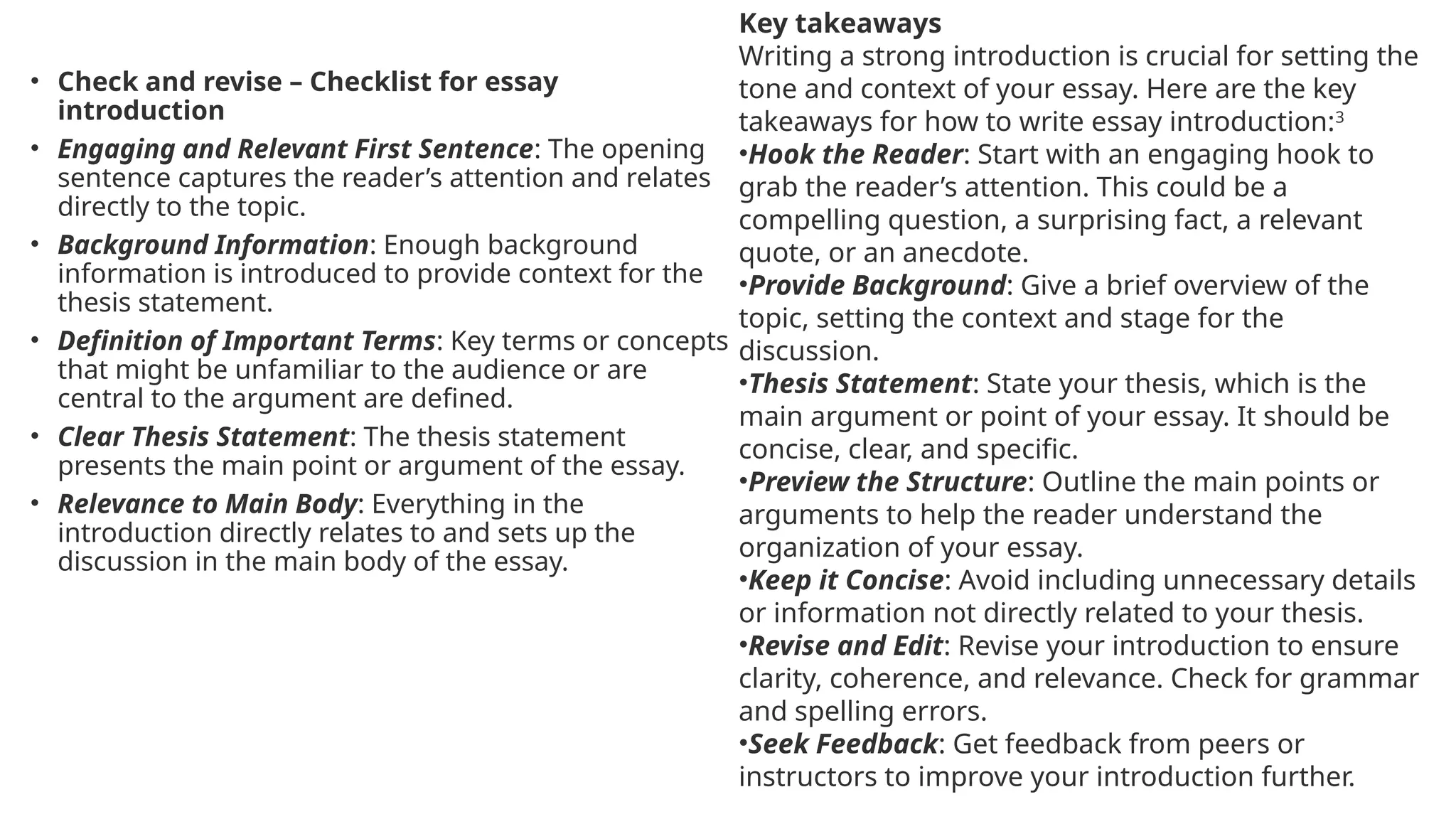
Paragraph Unity, Coherence, and
Development
• Menu
• About the Writing Center
• People
• Writing Resources
• English Language Support
• FAQ
• Writing at Wheaton
• In each paragraph of an essay, one particular idea or topic is developed and explained. In order to
successfully do so, however, it is essential that the paragraph be written in
a unified and coherent manner.
• A unified paragraph must follow the idea mentioned in the topic sentence and must not deviate
from it. For a further explanation on topic sentences, see the Write Right on Topic Sentences.
• A coherent paragraph has sentences that all logically follow each other; they
are not isolated thoughts. Coherence can be achieved in several ways. First,
using transitions helps connect ideas from one sentence to the next. For more
on transitions, see the Write Right on Transitions. Second, ordering thoughts in
numerical sequence helps to direct the reader from one point to the next. Third,
structuring each paragraph according to one of the following patterns helps to
organize sentences: general to particular; particular to general; whole to parts;
question to answer; or effect to cause.
• Remember that a paragraph should have enough sentences so that the main
idea of the topic sentence is completely developed. Generalizations should be
supported with examples or illustrations. Also, details and descriptions help the
reader to understand what you mean. Don't ever assume that the reader can
read your mind: be specific enough to develop your ideas thoroughly, but avoid
repetition
• An effective paragraph might look like this:
• It is commonly recognized that dogs have an extreme antagonism toward
cats. This enmity between these two species can be traced back to the time of
the early Egyptian dynasties. Archaeologists in recent years have discovered
Egyptian texts in which there are detailed accounts of canines brutally
mauling felines. Today this type of cruelty between these two domestic pets
can be witnessed in regions as close as your own neighborhood. For example,
when dogs are walked by their masters (and they happen to catch sight of a
stray cat), they will pull with all their strength on their leash until the master is
forced to yield; the typical result is that a feline is chased up a tree. The
hatred between dogs and cats has lasted for many centuries, so it is unlikely
that this conflict will ever end.
• This paragraph is effective for the following reasons:
• The paragraph shows unity. All the sentences effectively relate back
to the topic sentence at the beginning of the paragraph.
• The paragraph shows coherence. There is a flow of thoughts and
ideas among the sentences in this paragraph. There are good
transitions employed in the paragraph. The writer also presents her
sub-topics in an orderly fashion that the reader can follow easily.
• The paragraph is developed. The writer gives herself enough space
to develop the topic. She gives us at least two reasons to accept her
argument and incorporates some examples in order to give those
reasons more validity.
Supporting Paragraphs
• "A paragraph is a sentence or group of sentences that develops
a main idea. Paragraphs serve as the primary building blocks of
essays, reports, memos, and other forms of written
composition" (Hult and Huckin, The New Century Handbook, 103).
• In essence, paragraphs control the design and structure of the
written composition. Paragraphs in the middle of your
composition develop the thesis statement and provide
transition ideas between supporting details.
• Paragraphs should be "unified, coherent, and adequately
developed, while flowing from one to the next as smoothly as
possible" (Hult and Huckin, The New Century Handbook, 103).
• "A unified paragraph focuses on and develops a single
main idea. This idea is typically captured in a single
sentence, called a topic sentence. The other sentences in
the paragraph, the supporting sentences, should
elaborate on the topic sentence in a logical fashion (Hult
and Huckin, The New Century Handbook, 104).
• The supporting sentences, also called the body of the
paragraph, are used to support, explain, illustrate, or
provide evidence for the idea expressed in the topic
sentence.
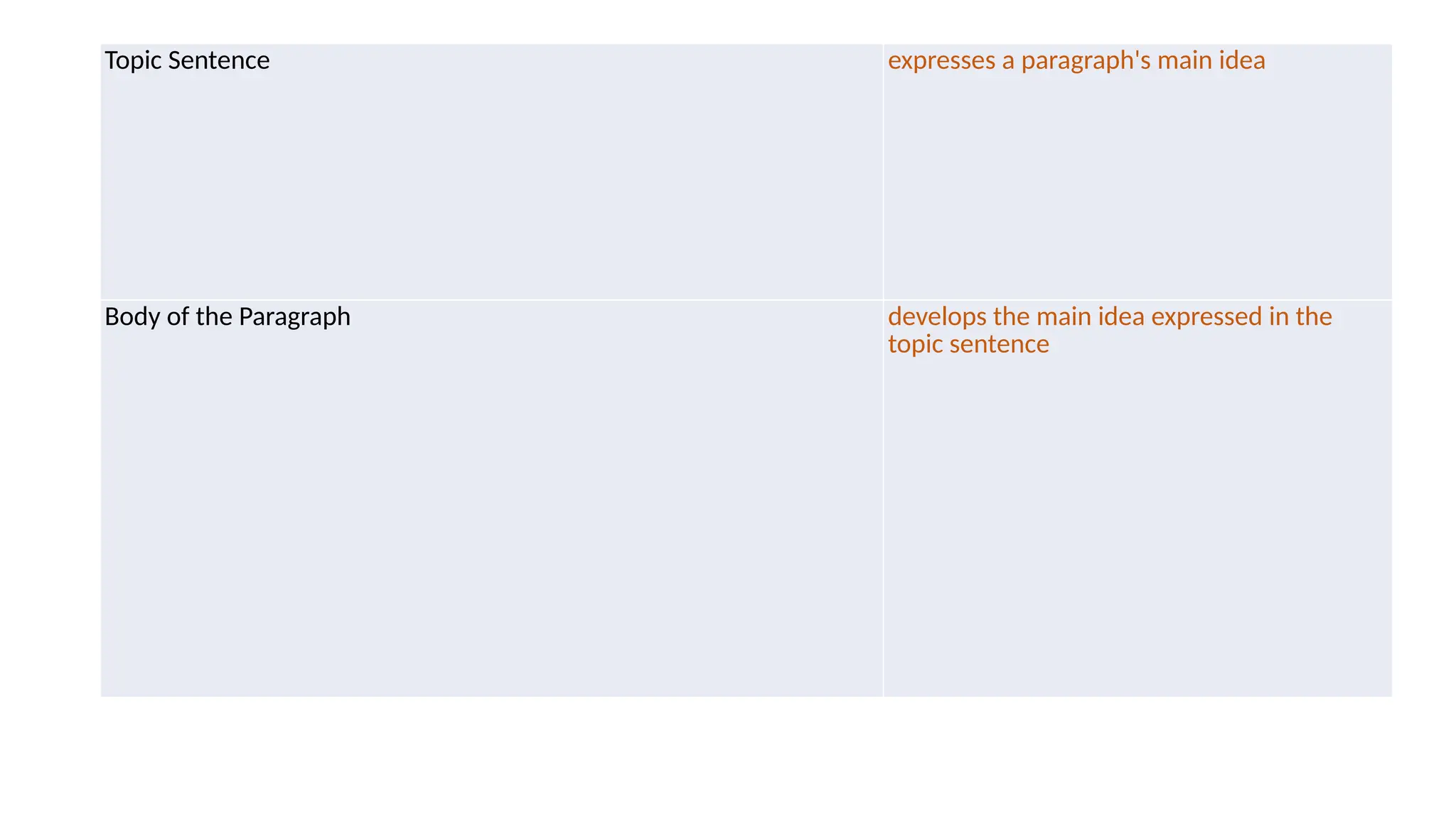
Topic Sentence expresses a paragraph's main idea
Body of the Paragraph develops the main idea expressed in the
topic sentence
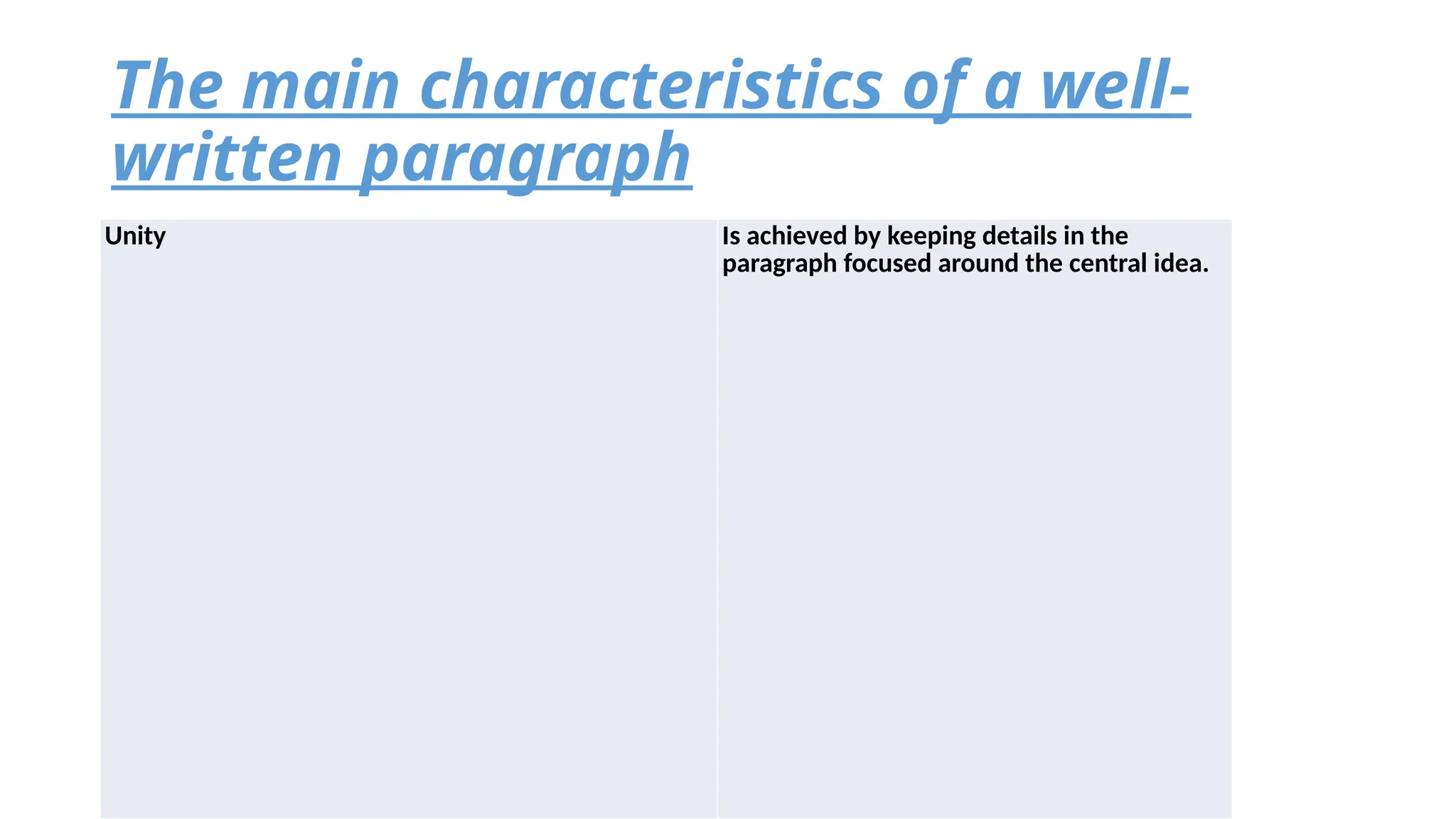
The main characteristics of a well-
written paragraph
Unity Is achieved by keeping details in the
paragraph focused around the central idea.
Coherence
• Linking individual sentences within a paragraph should be
done in a logical way; the paragraph itself should
be connected with the rest of the composition by
following the natural progression of thought. Use
transitional words and phrases to ensure the smooth flow of
thought
Adequate Development
• Each paragraph should be long enough to develop in full
the main idea expressed in the topic sentence.
• A paragraph should not introduce any other evidence or
provide information that does not support the main idea;
otherwise, the paragraph will lack unity and coherence.
• Find logical subdivisions in your argument and organize
them into unified paragraphs.
• It is common to start a paragraph with a topic sentence and
then let the rest of the sentences build details to support it.
However, this is not by any means the only or the best
pattern. The topic sentence can appear in any part of the
paragraph or sometimes it can be implied.
Topic sentences at the beginning of a
paragraph
• In the following two paragraphs, the topic sentence appears at the beginning:
• The environment the teacher creates in the classroom plays one of the most crucial roles
in successful learning. This is true of any setting, whether the teaching occurs in a long
academic program or in a tutoring situation. The teacher is a role model, a person
students can trust, a guide, and a mentor. It is the responsibility of the teacher to
create a low-anxiety environment in order to allow the students to enjoy the learning
process. A good teacher tries to find out what works best with a particular learner or a
group of learners and goes from there. What needs to come first in any learning situation
is not a specific aspect or principle of methodology but the learners themselves.
• From a Teaching Practicum Reflection Paper
• Online education has become more popular than other forms of distance education because it
offers learners a great deal of flexibility. Students have the freedom to work at their
own pace, time, and chosen location. The flexibility of online learning makes it a very
powerful tool that enhances learning, provides motivation for self-directed study, and, at
the same time, increases convenience for learners with effective use of place and time.
Online education is an excellent solution for those who consider learning to be a lifelong
process. For adult learners, it provides the possibility to manage work, family, and other
activities while still being able to take classes.
From a student research paper on Advantages
and Limitations of Web-Based Instruction
• "A topic sentence should, if possible, do four things: (1)
provide a transition from a the preceding paragraph, (2)
introduce the topic of the paragraph, (3) make a main point
about this topic, and (4) suggest how the rest of the
paragraph will develop this point" (Hult and Huckin, The New
Century Handbook, 104).
Suggestions for writing paragraphs
• Avoid paragraphs that are either too long or too short
• Develop a single idea in a paragraph
• Use different patterns of paragraph development (narration,
description, definition, example, comparison and contrast,
analogy, cause and effect, or process)
• Provide transitions between paragraphs to make your
writing flow smoothly (refer to the section on Transitions)
Reasons to start a new paragraph
• Introduce a new idea
• Emphasize an idea
• Introduce a logical pause
• Introduce a subtopic
• Conclude the composition
Difference Between Extensive and
Intensive Reading
• Extensive means covering a substantial area and
so, extensive reading refers to that type of reading in
which students read and refer to large quantities of
material, chosen by themselves. As against, intensive refers
to in-depth or concentrated. Therefore, intensive
reading means that type of reading in which the material
has to be read carefully and thoroughly, to get specific
details.
• Reading is the means to study something, wherein the
reader looks at the words, symbol and characters of the
material so as to comprehend its meaning. Extensive
reading and Intensive Reading are the two common
approaches to language learning.
• Basically, an ideal reading program combines both the
approaches, wherein intensive reading can be used to
acquaint new language and extensive reading can be
helpful in spreading awareness of that language. Let’s move
further to know the difference between extensive and
intensive reading.
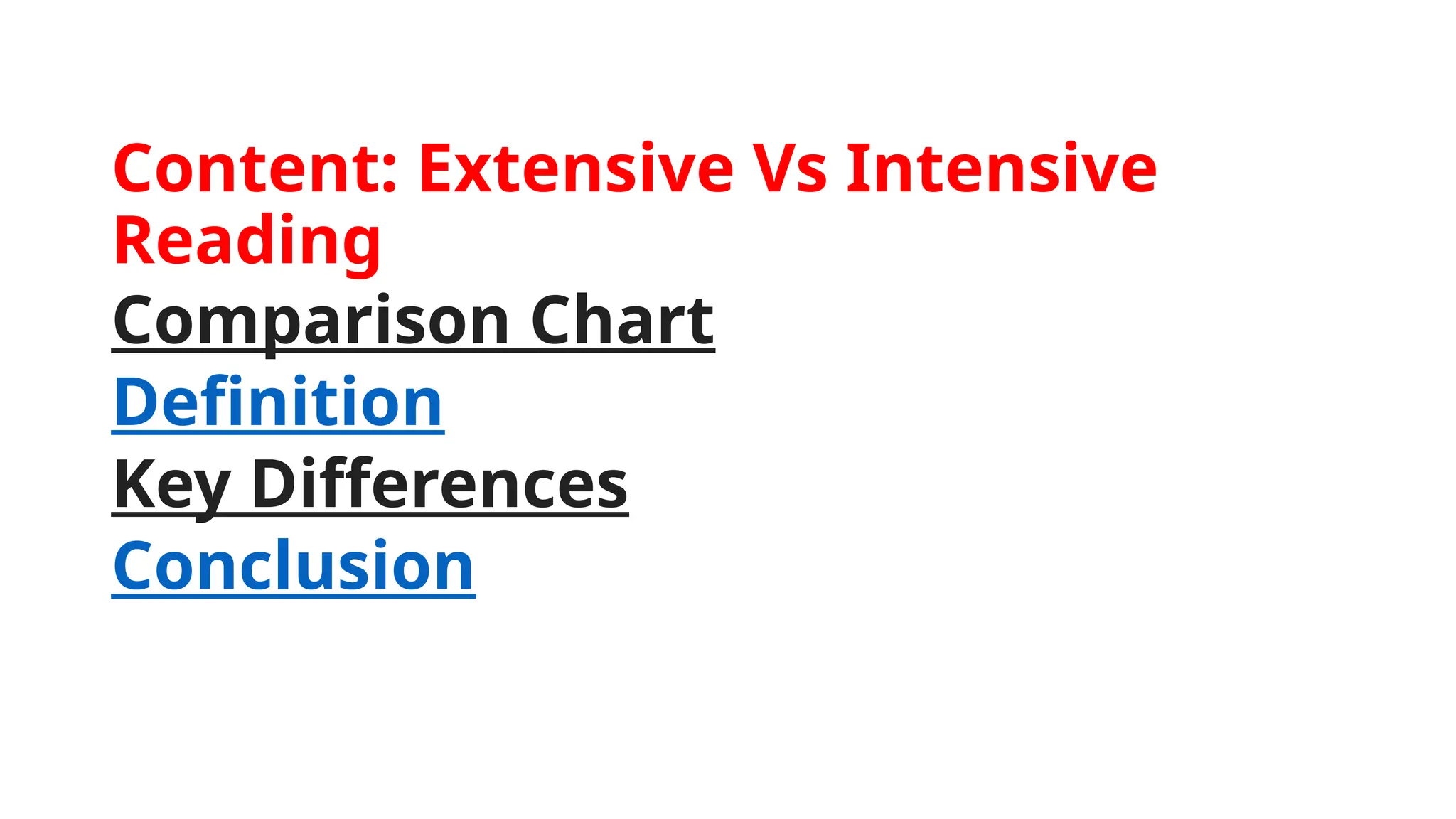
Content: Extensive Vs Intensive
Reading
Comparison Chart
Definition
Key Differences
Conclusion
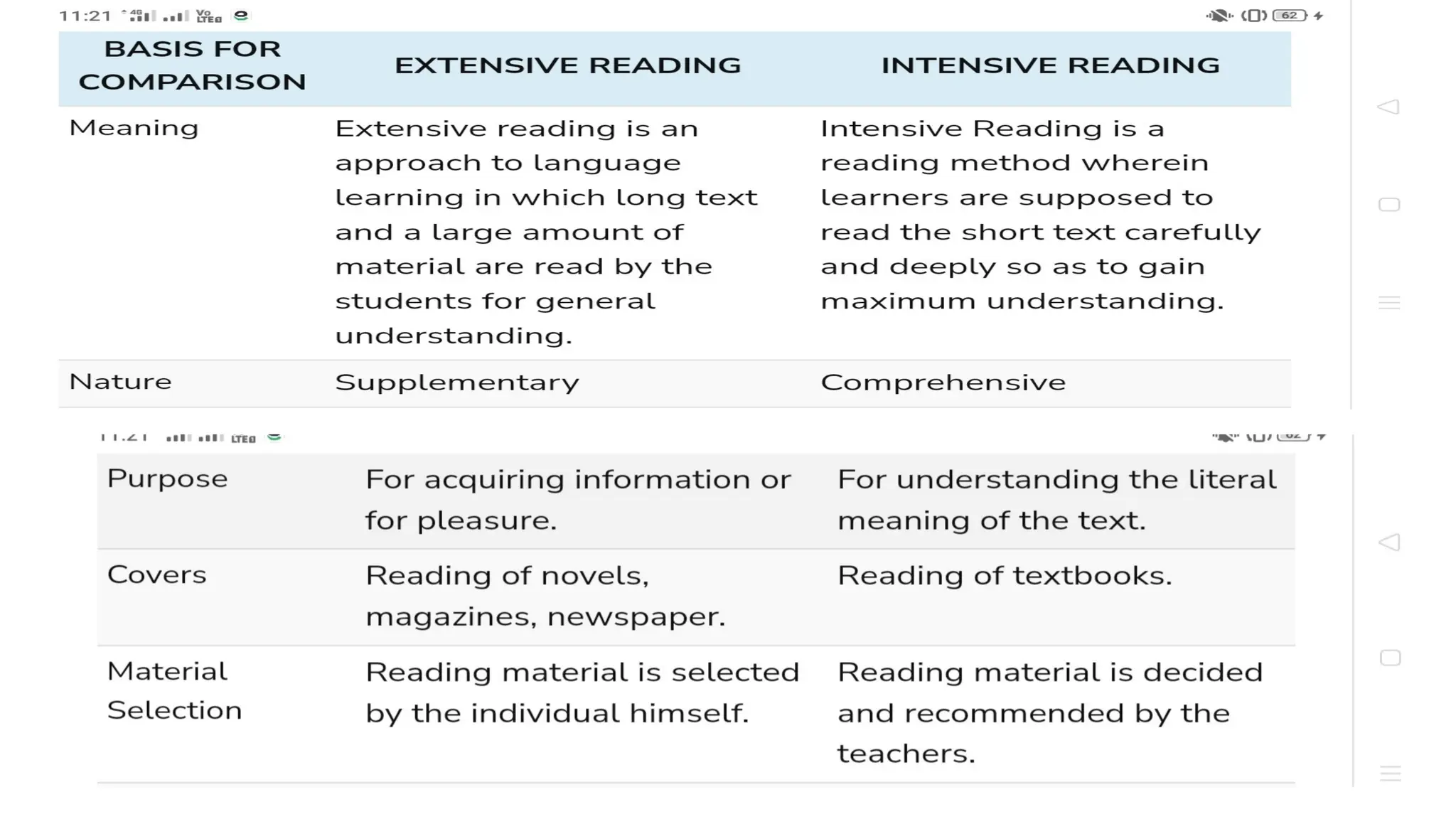
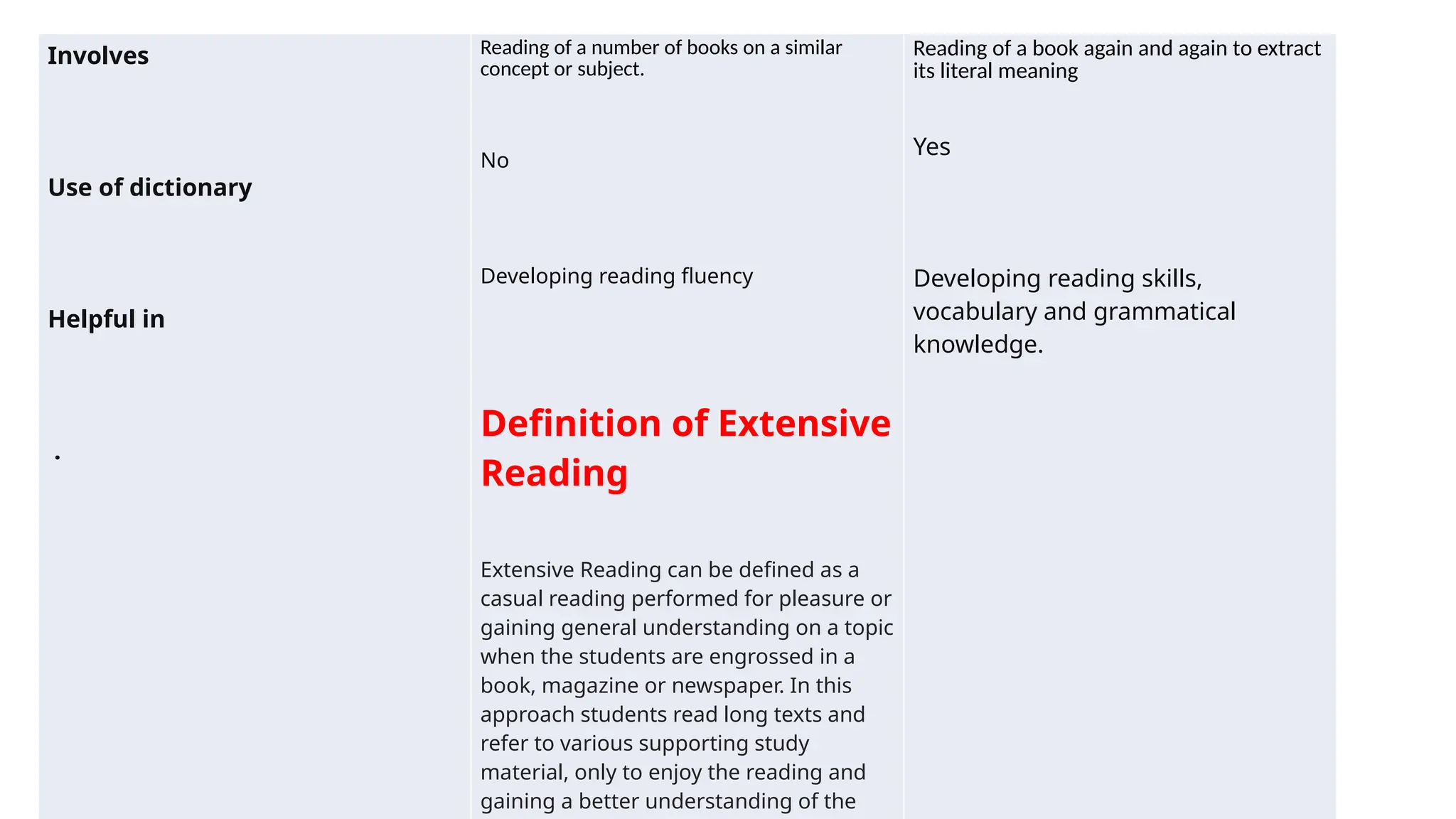
Involves
Use of dictionary
Helpful in
.
Reading of a number of books on a similar
concept or subject.
No
Developing reading fluency
Definition of Extensive
Reading
Extensive Reading can be defined as a
casual reading performed for pleasure or
gaining general understanding on a topic
when the students are engrossed in a
book, magazine or newspaper. In this
approach students read long texts and
refer to various supporting study
material, only to enjoy the reading and
gaining a better understanding of the
Reading of a book again and again to extract
its literal meaning
Yes
Developing reading skills,
vocabulary and grammatical
knowledge.
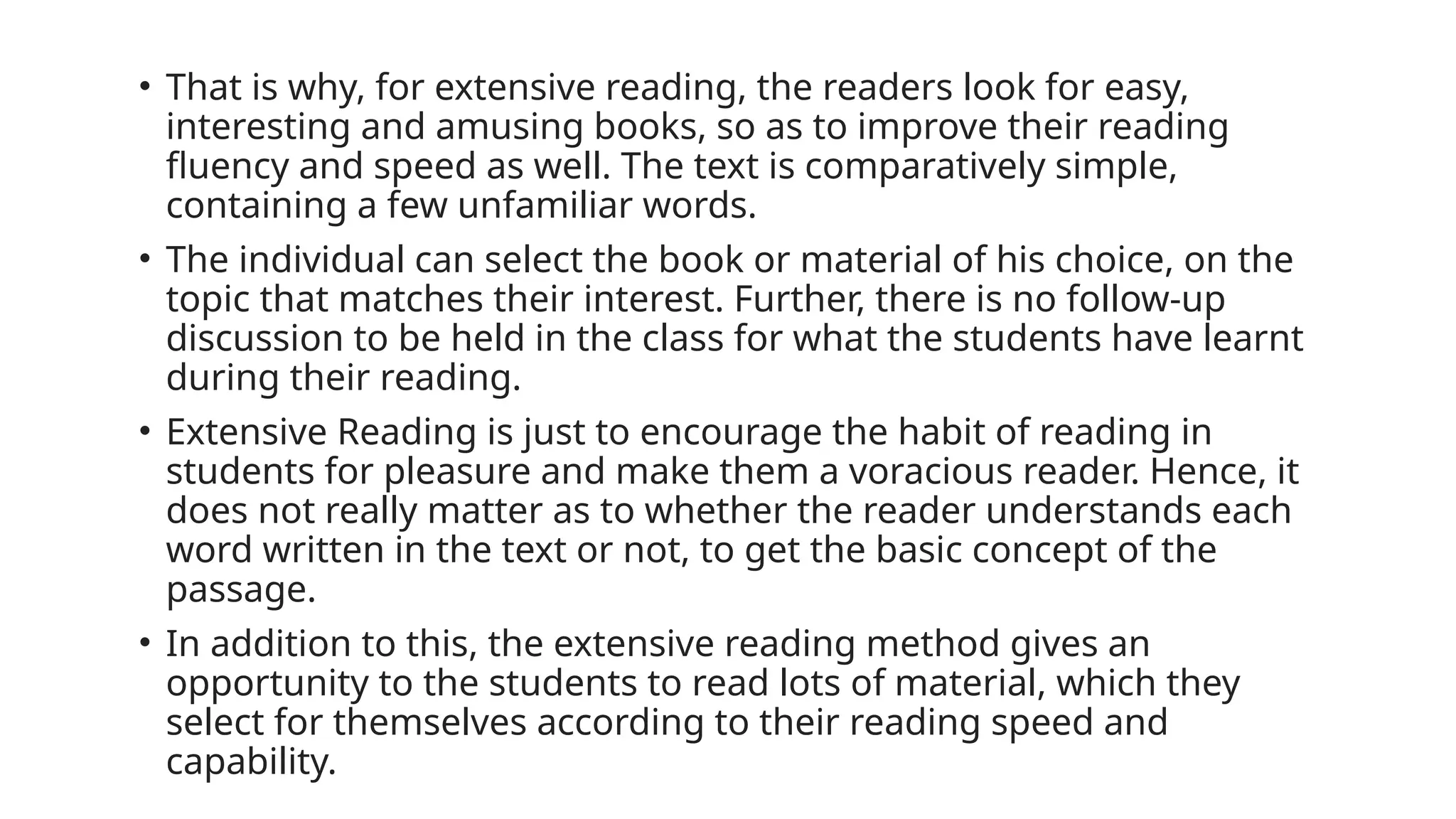
• That is why, for extensive reading, the readers look for easy,
interesting and amusing books, so as to improve their reading
fluency and speed as well. The text is comparatively simple,
containing a few unfamiliar words.
• The individual can select the book or material of his choice, on the
topic that matches their interest. Further, there is no follow-up
discussion to be held in the class for what the students have learnt
during their reading.
• Extensive Reading is just to encourage the habit of reading in
students for pleasure and make them a voracious reader. Hence, it
does not really matter as to whether the reader understands each
word written in the text or not, to get the basic concept of the
passage.
• In addition to this, the extensive reading method gives an
opportunity to the students to read lots of material, which they
select for themselves according to their reading speed and
capability.
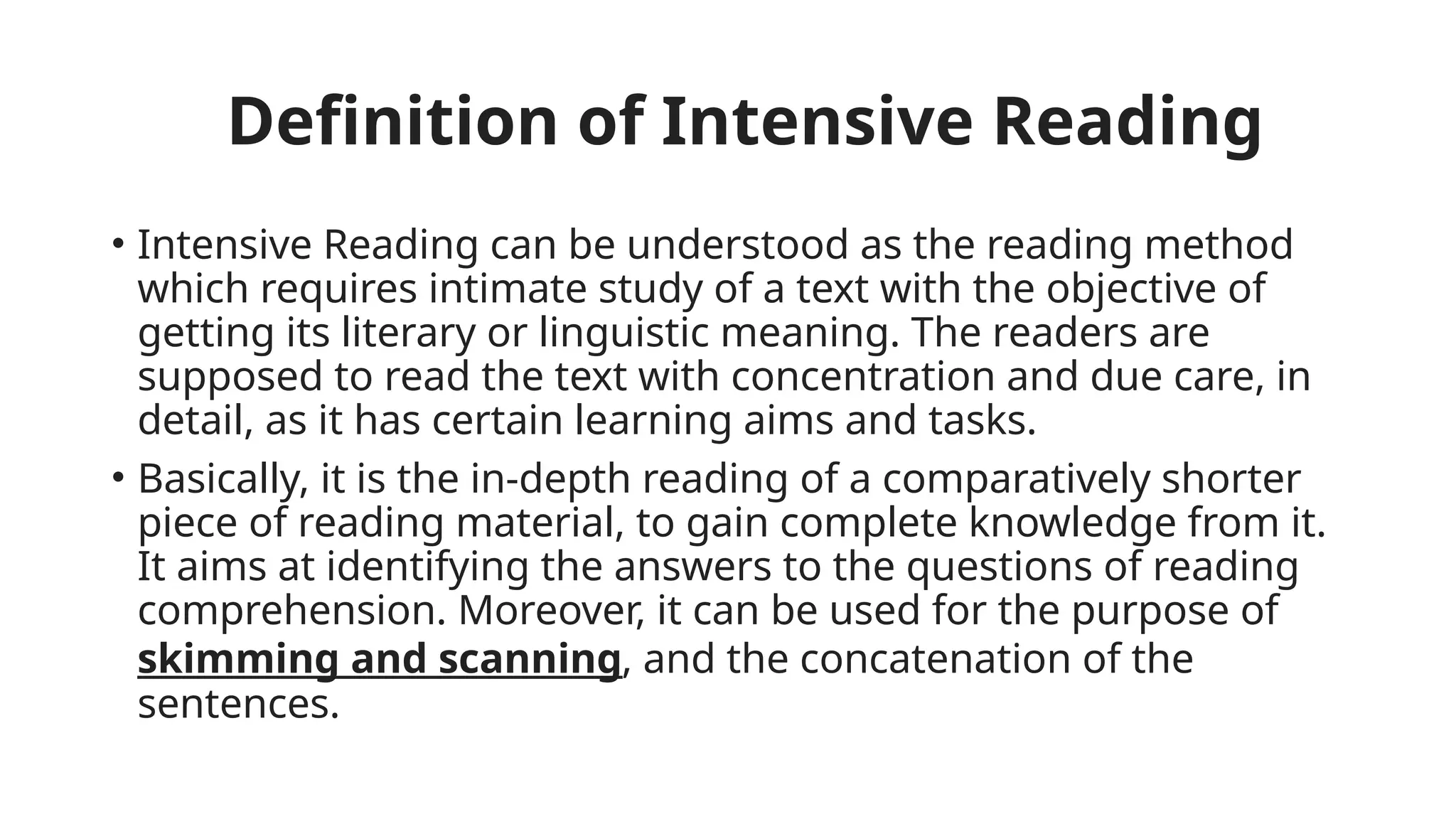
Definition of Intensive Reading
• Intensive Reading can be understood as the reading method
which requires intimate study of a text with the objective of
getting its literary or linguistic meaning. The readers are
supposed to read the text with concentration and due care, in
detail, as it has certain learning aims and tasks.
• Basically, it is the in-depth reading of a comparatively shorter
piece of reading material, to gain complete knowledge from it.
It aims at identifying the answers to the questions of reading
comprehension. Moreover, it can be used for the purpose of
skimming and scanning, and the concatenation of the
sentences.
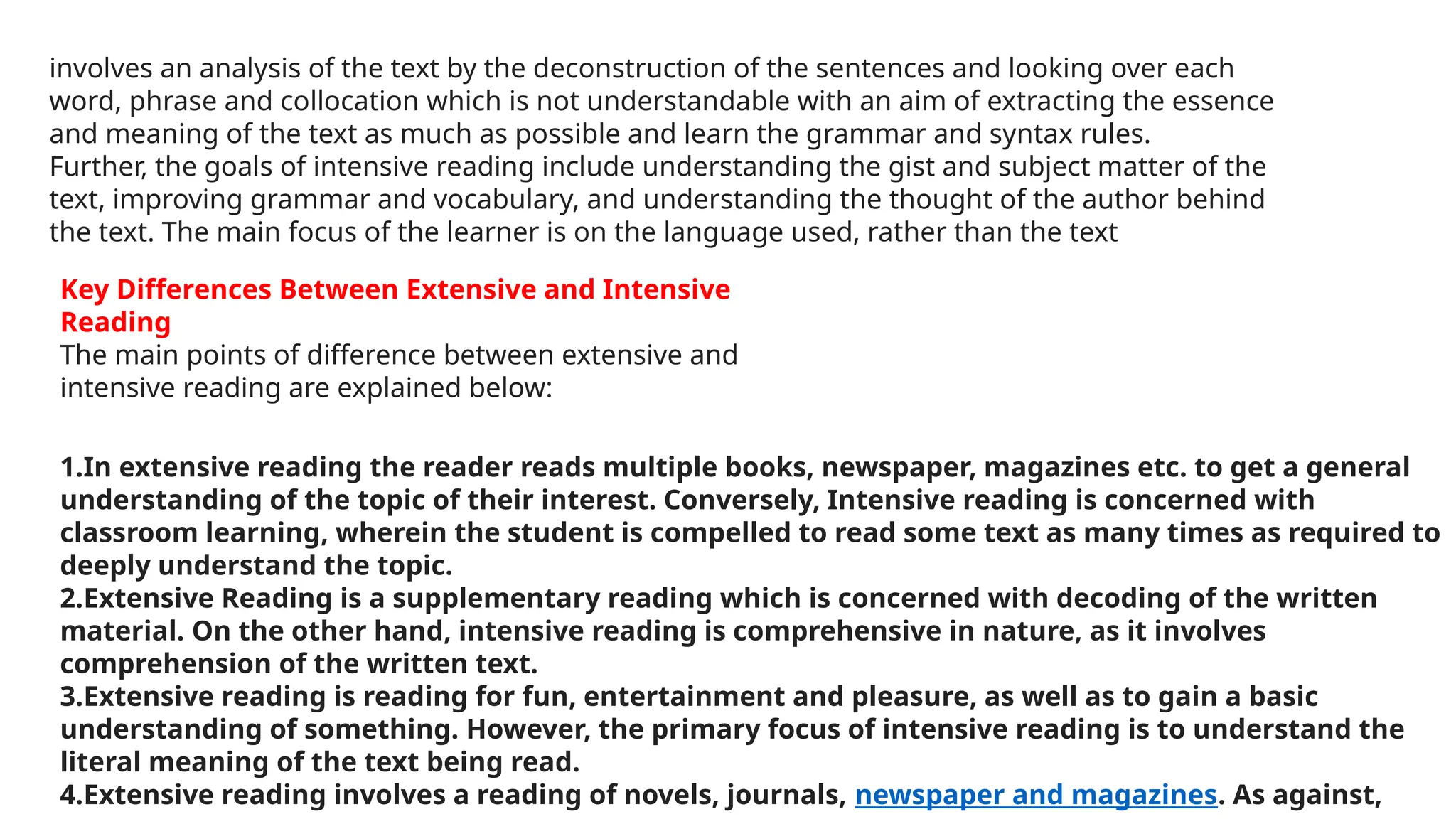
involves an analysis of the text by the deconstruction of the sentences and looking over each
word, phrase and collocation which is not understandable with an aim of extracting the essence
and meaning of the text as much as possible and learn the grammar and syntax rules.
Further, the goals of intensive reading include understanding the gist and subject matter of the
text, improving grammar and vocabulary, and understanding the thought of the author behind
the text. The main focus of the learner is on the language used, rather than the text
Key Differences Between Extensive and Intensive
Reading
The main points of difference between extensive and
intensive reading are explained below:
1.In extensive reading the reader reads multiple books, newspaper, magazines etc. to get a general
understanding of the topic of their interest. Conversely, Intensive reading is concerned with
classroom learning, wherein the student is compelled to read some text as many times as required to
deeply understand the topic.
2.Extensive Reading is a supplementary reading which is concerned with decoding of the written
material. On the other hand, intensive reading is comprehensive in nature, as it involves
comprehension of the written text.
3.Extensive reading is reading for fun, entertainment and pleasure, as well as to gain a basic
understanding of something. However, the primary focus of intensive reading is to understand the
literal meaning of the text being read.
4.Extensive reading involves a reading of novels, journals, newspaper and magazines. As against,
5-As the topic is chosen by the teacher in case of intensive reading, it may not be appropriate as per
the student’s interest. On the contrary, in extensive reading, the students are free to choose the
material they want to read.
6_ Extensive reading is concerned with reading different books and other study material based on a
similar concept or idea. In contrast, intensive reading involves reading the given material, again and
again, to understand it in full.
. 7_In extensive reading, readers are not supposed to use a dictionary, as understanding each and
every word contained in the material is not vital. As opposed, in intensive reading readers have to
use the dictionary, to understand the meaning of every single word which is unfamiliar to them.
8_While extensive reading is important for improving the reading speed and fluency of the reader,
intensive reading develops critical thinking, analytical skills in the reader, along with improving
reading skills, vocabulary and grammatical knowledge
Conclusion
a nutshell, extensive reading is mainly used when an overall or superficial knowledge is
required on a subject, as no focus is made on the detailed study. On the other hand, intensive
reading is used where due attention is required, to learn specific details about the topic or
subject under study.
How to Read Faster: 11 Ways to
Increase Your Reading Speed
• Do you have a lot of paperwork to get through with a
deadline that continues to stalk you around every corner?
Do you have a lot of reading to do? Do you simply just
want to read at a faster rate, whether it be for your own
personal reasons, or for work?
• On average, an adult can read somewhere between 200 to
300 words per minute. With speed reading skills, you can
read much faster—around 1500 words per minute.[1]
Yes,
that sounds impossible, but it’s true.
• If you’re wondering how to read faster so you can get
more done quickly, these speed-reading tips are for you
• What Is Speed Reading?
• In order to understand how speed reading works, you first
need to know how the reading process works inside a
human’s brain.Thee Reading Process
• The first step is for the eyes to look at a word. This “fixation”
on every word takes around 0.25 seconds.
• Next, you start moving your eyes to the following word. It
takes 0.1 seconds for the brain to move from one word to
the next. This is called “saccade.”
• ADVERTISING
Usually, you take in 4-5 words in your head, or a sentence, at once. After all the fixations and
saccades, the brain goes over the entire phrase again in order to process the meaning. This
takes around half a second.
All in all, this means average people read 200 to 300 words in a minute.
• Speeding up the Process
• The concept of speed reading is to speed up this process by at
least 5 times. Since the saccade period cannot be shortened
any further, speed reading emphasizes quicker fixations.
• To accomplish this, scientists recommend that the reader skips
the sub-vocalization: when the readers actually say the word in
their mind, even when reading silently.
• Basically, speed reading is the technique of only seeing the
words instead of speaking them silently.
• Do not confuse this with skimming. When a reader skims
through a text, they skip the parts that their brain considers to
be unnecessary. You may skip important information in this
process, and skimming does not allow the brain to retain what
has been read.
Why Speed Read?
Speed reading is not just quick, but it’s also effective. This skill saves a lot of of time without sacrificing
information.
Also, it has been proven to improve memory. The brain’s performance improves during speed reading,
which allows the reader to remember more information than before[2]
.
ADVERTISING
Since speed reading stabilizes the brain, the information is processed faster and more efficiently.
Believe it or not, this technique leads to improved focus, too. As the brain receives a lot of information
during speed reading, there is far less chance of distraction. The brain focuses solely on the job at
hand.
Since the brain is, after all, a muscle, the process of speed reading acts as an exercise. Just
like the rest of your muscles, your brain needs exercise to grow stronger, too.
A focused brain means improved logical thinking. As your brain gets used to receiving and
organizing so much information so quickly, your thinking process will become faster. As
soon as a problem is thrown at you, your brain will quickly put two and two together. You
will be able to retrieve stored information, figure out correlations, and come up with new
solutions, all within seconds!
With a healthier brain, you can expect better things in other parts of your life, too. A boost
in self-esteem is just one of them.
As you begin to understand information at a faster pace, you will also begin to figure out
more opportunities all around you.
With the ability to deeply understand information in a shorter period of time, your
confidence levels will quickly grow.
Moreover, all the aforementioned benefits will relieve you of stress. With all these
advantages, your emotional well-being will be healthier than ever. You’ll feel less stress
11 Ways to Help You Read Faster
Here are 11 proven ways to help increase your reading speed.
1. Stop the Inner Monologue
One’s inner monologue, also known as subvocalization, is an extremely common trait among
readers. It is the process of speaking the words in your head as you read, and it is the biggest
obstacle that gets in the way of you being able to increase your reading speed.
If you’re hearing voices in your head when you’re reading, don’t fret. As long as it is your own
voice, reading along with you, you’re fine. In fact, this is how teachers teach kids to read – say the
words silently in your head as you read.
Do you recall the instructions, “Read in your head, as I read the passage aloud”, that were said
fairly often in the classrooms? That is one of the ways in which this habit of having an inner
monologue was ingrained into you as a young reader.
When you were initially taught to read, you were taught to sound out everything and read aloud.
Once you were proficient enough at that, your teacher had you start saying the words in your
head. This is how the habit originated, and most people continue reading this way. It does not
adversely affect them in any way, until they start wanting to read at a faster pace. If you are
seeking to increase your reading speed, this is the first thing you must learn to overcome.
Why does this slow you down? The average reading speed is pretty much the same as the average
talking speed. According to Forbes, the average adult reading speed is 300 words per minute.[3]
The average talking speed is the same.
Since most people are in the habit of saying the words aloud in their head as they read, they tend
to read around the same pace as they talk. This means, your reading speed will only increase so
much if you continue to keep up that inner monologue. If you want to continue to increase your
To do this, you need to understand one thing: It’s unnecessary. You do not need to say every word in your
head in order to understand the material you are reading. It was when you are younger, but now you are able
to input the meaning from just seeing the words. Your brain still processes the information.
For example, when you see a “YIELD” sign, do you actually stop to speak the word in your head? Of course
not. You just look at it and process it automatically. This is what you need to be doing when you read your
print material, such as books or paperwork.
If you have a hard time attempting this, try reading with instrumental music playing in headphones or chew
on some gum. A distraction will keep your brain less focused on subvocalization, though you will still look at
the words and process them
. Word–Chunking
Word-chunking closely parallels with the idea of eliminating the inner monologue. This is the act of
reading multiple words at once, and is the key to reading faster. All of these reading tips tie together,
yet word-chunking is probably the most active tool to use when you work to increase your reading
speed.
person can take in several words at a time, even though we are trained – as mentioned
with the inner monologue – to read each word at a time and not miss a single article. Using
your peripheral vision is one way to make this step easier, but we will get to that in the next
section.
For now, focus on trying to read three words with one glance. Continue on down the page
like that, taking note of how much faster you complete the entire page of text. You are still
able to process and comprehend what you read, but spend far less time doing it.
Now, take that concept one step further. Take a pencil and
lightly draw two vertical, parallel lines down your page,
separating the text into three sections. Start at the top left of
the page as usual, and cover up everything below that line
with your hand or a piece of paper.
Focus on reading the text in each section as one thing. Chunk
the words together, and read them at a glance as you would a
road sign. Keep doing this down the page, moving the paper
accordingly. You will notice that your speed was faster than
before.
Continue with this method until you feel comfortable enough
to challenge yourself a bit more.
3. Do Not Reread the Words on the Page
Before we move on to the peripheral vision part – that’s the real kicker – you’re going
to want to make sure you break the habit of rereading the words on the page.
If you watch the average person’s eyes as they read, you will notice they jump and flit
about. They do not just flow evenly back and forth, as they should. This is because the
average person – you do this, too – tends to backtrack over words they have already
read. This is one thing that prevents you from being able to increase your reading
speed.
You most likely do this without even realizing that you are doing it, which makes it a
bit of a tricky habit to break out of. The easiest way, even though you may feel a bit
childish, is to use your finger or bookmark to guide you along.
Keep your finger running back and forth across the page, without stopping or going
back. Keep tracking the words as your finger continues to make its way down the text.
When you get to the end, think about what you read. You did not go back over a single
word (I hope!), and yet you still recall what you have read.
ADVERTISING
4. Use Peripheral Vision
Congratulations! You’ve made it to the key step that really ties everything together. While this may
not be the final step, it’s certainly a critical one.
Use the techniques from everything above to view and comprehend several words at one time.
Instead of chunking in smaller groups of words, try reading one line at a time. This involves looking
at the center of the line, and using your peripheral vision to read the rest of it. Scan the page in this
manner and, when you reach the bottom, you will find that you still understood what you read, but
you did it in record time.
4. Use a Timer
Congratulations! You’ve made it to the key step that really ties everything together. While this may not be
the final step, it’s certainly a critical one.
Use the techniques from everything above to view and comprehend several words at one time. Instead of
chunking in smaller groups of words, try reading one line at a time. This involves looking at the center of
the line, and using your peripheral vision to read the rest of it. Scan the page in this manner and, when
you reach the bottom, you will find that you still understood what you read, but you did it in record time.
6. Set a Goal
Holding yourself accountable will better ensure you stick with your reading and your timer tests.
Give yourself a goal of a certain number of pages to read each day/week/etc., and stick to it. When
you reach it, treat yourself. Incentive never hurt anyone!
7. Read MORE
The old adage, “Practice makes perfect,” is actually pretty darn accurate. Any professional, artist,
musician, etc. practices their work regularly.
A reader should be doing the same thing. The more you read, the more you will be better at it. The
better you are at reading, the more you will increase your reading speed
Theodore Roosevelt read one book before breakfast, and then three or four more in the evening. He
also read papers and other such pamphlet-style reading material. I’m not sure how long these books
were, but I am going to assume they were of average length. Use his obsession as fuel for your own
goal.
Use a Marker
Do you find your vision slipping and sliding through the page as you read? Not a problem.
Simply place an index card below each line, and slip it down as you read. This will ensure
you stay at reading one line at a time, rather than flitting your eyes about and taking
nothing in.
Work on Improving Your Vocabulary
Think about it: You’re reading along, and then you run into a word you don’t know. Do you skip it? Do
you try to figure it out by context? Do you stop to look it up? Whichever course of action you take, you
are slowing your time significantly, if not stopping it all together to go and look up the retarding word.
If you work on improving your vocabulary, you will know more words. The more words you add to your
repertoire, the faster you read. The faster you read, the more you can read. It may be self-evident, but
it’s important.
Skim the Main Points FIRST
Finally, when you’re in a real time-crunch and need to get something read by yesterday, take a deep
breath and calm down. Open the book, and take some time reading over all the main points. Read the
table of contents. Read the subtitles. Read the captions under the diagrams. Get an overall feel for the
chapter/section/etc..
Next, read the first paragraph of each main section. Read the last. Read the middle. Think this over in
your head, and piece it together.
11. Read with a Purpose
Do you have a goal before starting to read a book?
Whether it’s to find out how a story goes, learn a new skill, or get some answers, keep that goal in your
mind while reading. When you read with a clear goal or purpose, this pushes you to keep on reading.
Especially when you’re reading a self-help book, having some background questions can help you get
your answers or insights more quickly.
Find out more about this in my article Reading With Purpose Can Change Your Life.
Final Thoughts
Start reading while employing the techniques we have just discussed. You’ll retain your
information better, as well as your get your reading done faster.
The next time you need to read something quickly, simply tell yourself to “Shut up and look at the
page
What Is Speed Reading?
Speed reading is the process of rapidly recognizing and absorbing phrases or sentences on a page all at once, rather
than identifying individual words.
The amount of information that we process seems to be growing by the day, whether it's emails, reports and websites
at work, or social media, books and magazines at home. We likely feel pressure to get through this information more
quickly, so that we can "stay in the loop" and make informed decisions.
Most people read at an average rate of 250 words per minute (wpm), though some are naturally quicker than others.
But, the ability to speed read could mean that you double this rate.
We'll now explore some of the skills that you can use to accelerate your reading.
How to Speed Read
All speed reading techniques have one thing in common: you avoid pronouncing and "hearing" each word in your
head as you read it, a process known as as "sub-vocalization." Instead, you "skim" lines or groups of words, as you
can understand words more quickly than you can say them.
One way to stop yourself from sub-vocalizing is to focus on blocks of words rather than on individual ones. Do this by
relaxing your face and "softening" or expanding your gaze on the page, so that you stop seeing words as single,
distinct units. As you practice this, your eyes will skip faster across the page.
Then, when you approach the end of a line, allow your peripheral vision to take your eye to the final set of words.
This will help to stop pauses in your reading (often at full points), meaning that you scan across and down to the next
line more quickly.
Now let's look at three methods to boost your reading speed:
. The Pointer Method
Utah school teacher Evelyn Nielsen Wood was one of the pioneers of speed reading. In the 1950s, she
claimed that she could read at up to 2,700 wpm if she swept a finger along the line as she read.
This became known as the Pointer method, and is also sometimes called "hand pacing" or "meta guiding."
Holding a card under each line and drawing it down the page as you read works just as well.
2. The Tracker-and-Pacer Method
This is a variant of the Pointer method where you hold a pen, with its cap still on, and underline or track each
line as you read it, keeping your eye above the tip of the pen. This will help to increase the pace at which you
take in each line, and improve your focus on the words. Whether you actually underline the words is your
choice.
Try to spend no more than one second on each line and then increase your speed with each subsequent page.
You will probably find that you retain very little information at first, but, as you train your brain and you become
more comfortable with the technique, your comprehension should improve.
3. The Scanning (or Previewing) Method
"Scanning" involves moving your eyes quickly down the page – often down the center – and identifying specific
words and phrases as you go. These can be key sentences (often the first sentence of each paragraph),
names, numbers, or trigger words and ideas. Learning to expand your peripheral vision can help with this.
You won't read every word, but your eye will land on what is important to allow you to grasp the basic idea. It
may be helpful to use a mind map® to organize the information you take in.
How to Improve Your Speed Reading
Knowing the "how" and "when" of speed reading is only the first step to success. Here are some more tips to help
you:
 Avoid distractions. Create an environment where there are as few interruptions and distractions as possible,
to allow you to focus fully on the words in front of you.
 Go easy. Read an uncomplicated novel or a simple online article to get a feel for which technique is going to
work best for you. Gauge how much you've remembered or understood, and set a timer to see how much faster
you are now reading.
 Cover words that you've already read. This helps you to stop your eyes flitting back to earlier words and
slowing down your reading.
 Know what you want from the text. This can be useful if you are using the skimming method, as it primes
you to pay attention when you see relevant words, sentences or phrases. You can then slow down at these
points, or circle them for emphasis, but otherwise move across the page quickly.
 Benchmark your progress. This way you can tell whether your practice is paying off
 Practice, practice, practice. You have to practice speed reading to get good at it. The more you train
yourself, the more natural it will feel.
Faulty reading habits By Muteeba
Aslam.pptx
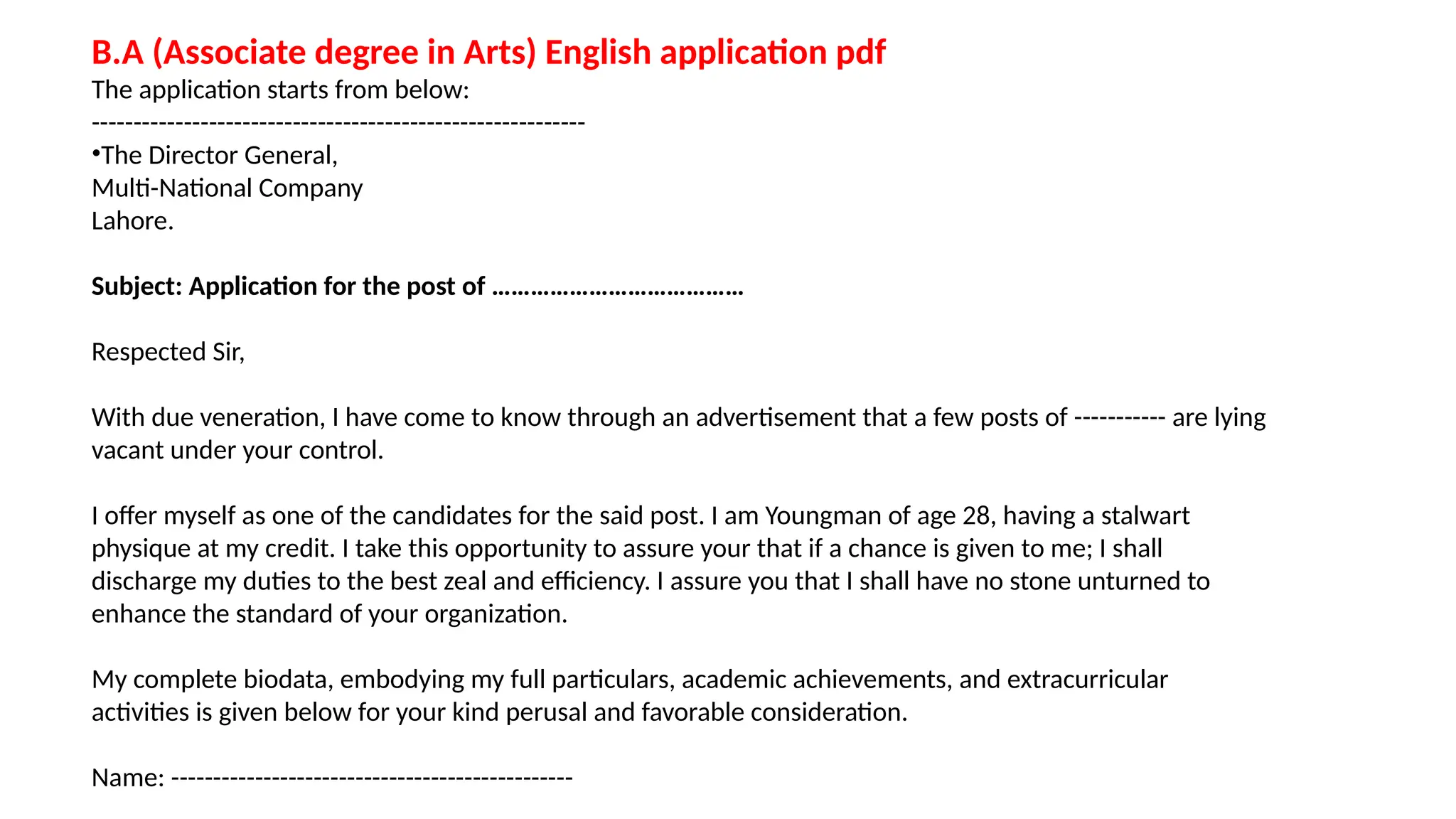
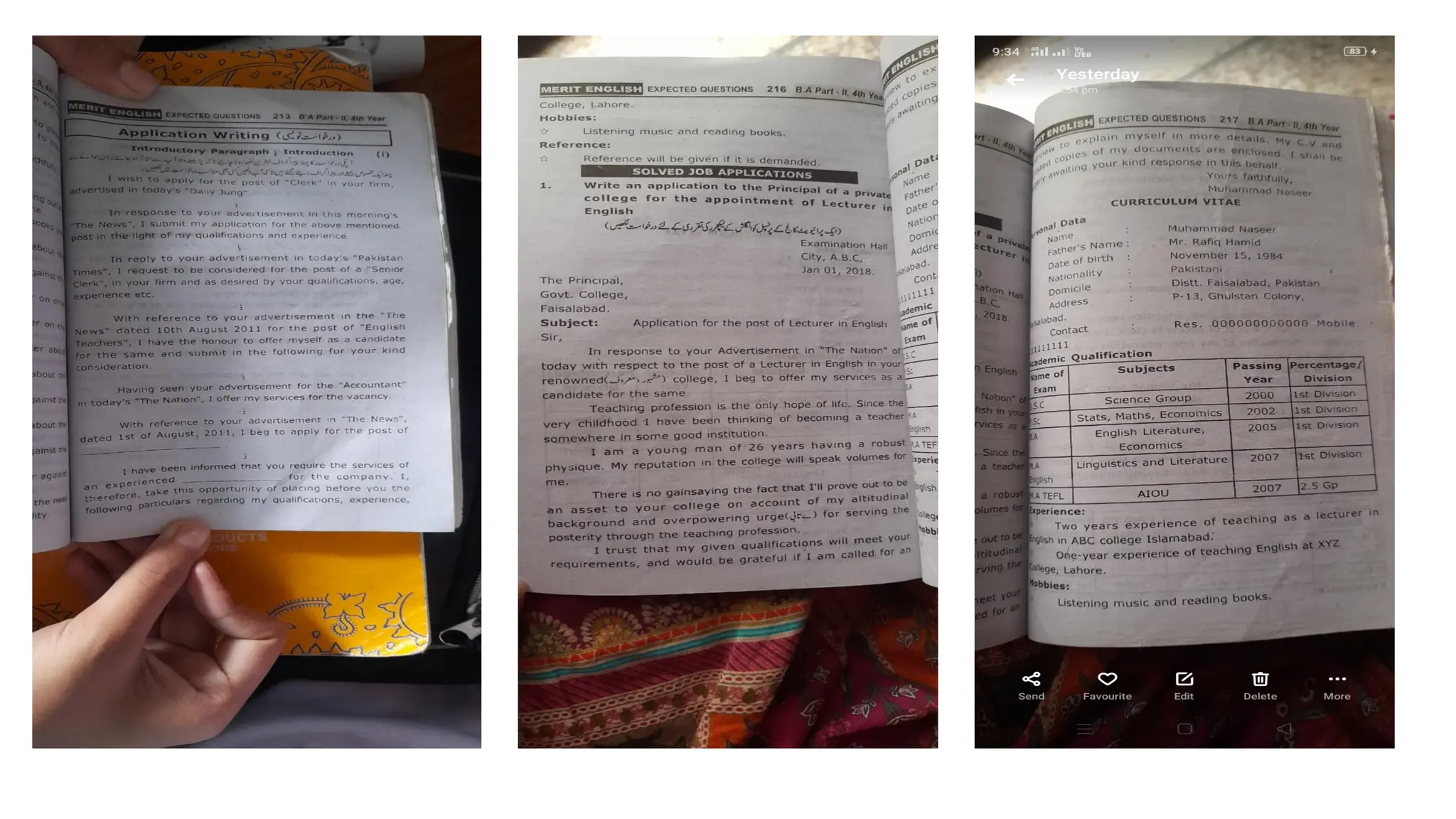
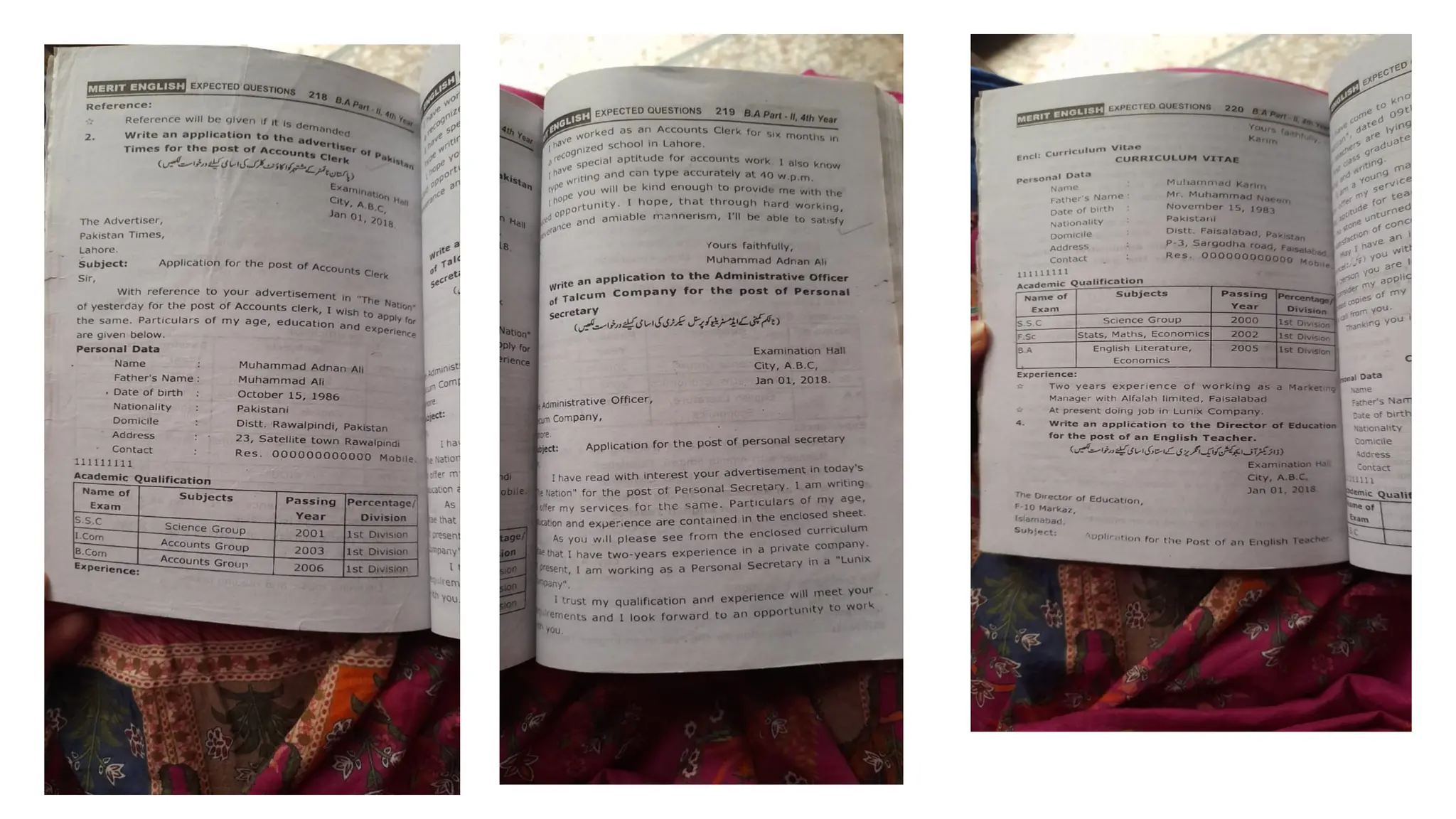
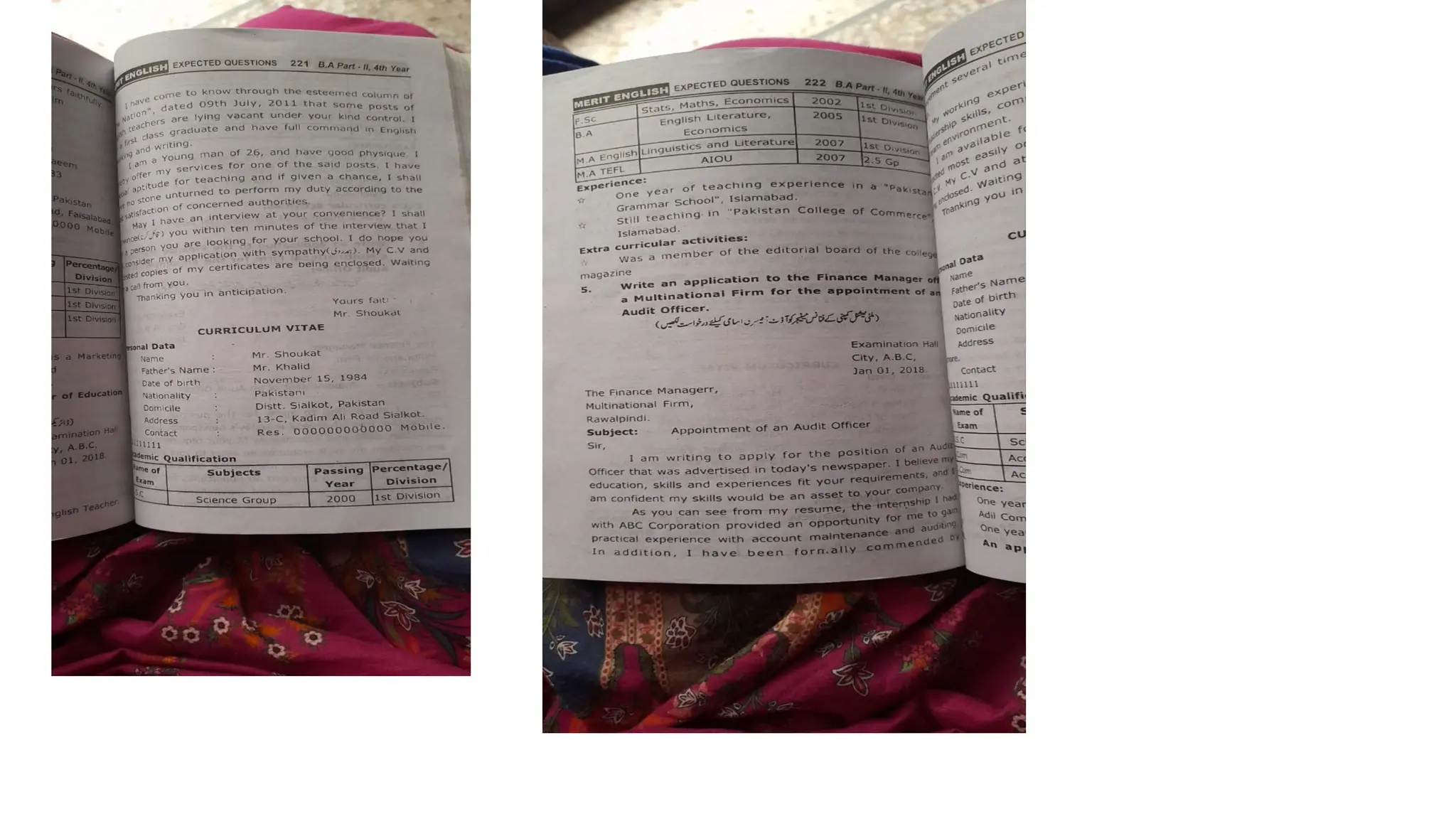
B.A (Associate degree in Arts) English application pdf
The application starts from below:
-----------------------------------------------------------
•The Director General,
Multi-National Company
Lahore.
Subject: Application for the post of …………………………………
Respected Sir,
With due veneration, I have come to know through an advertisement that a few posts of ----------- are lying
vacant under your control.
I offer myself as one of the candidates for the said post. I am Youngman of age 28, having a stalwart
physique at my credit. I take this opportunity to assure your that if a chance is given to me; I shall
discharge my duties to the best zeal and efficiency. I assure you that I shall have no stone unturned to
enhance the standard of your organization.
My complete biodata, embodying my full particulars, academic achievements, and extracurricular
activities is given below for your kind perusal and favorable consideration.
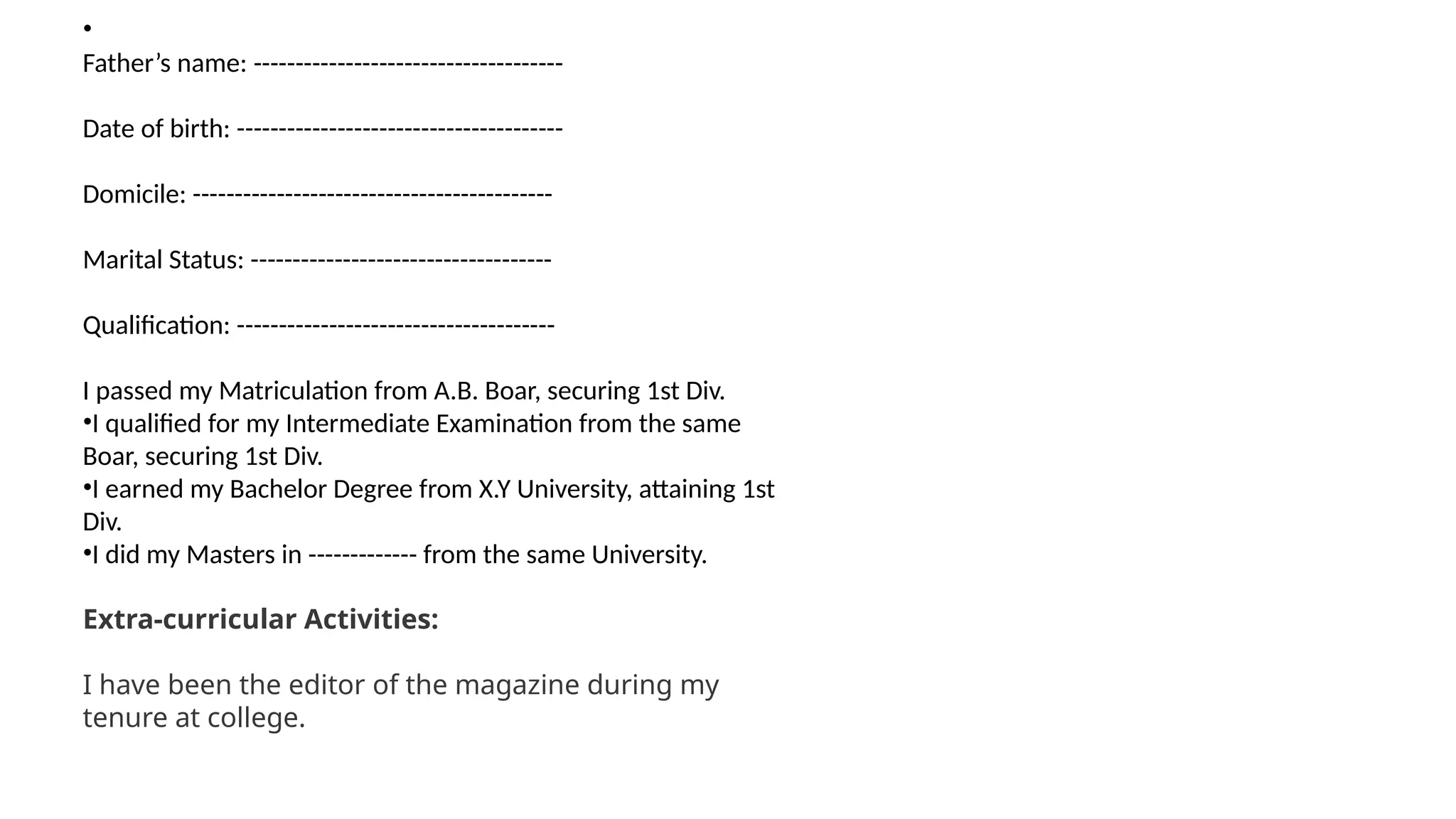
Name: ------------------------------------------------
•
Father’s name: -------------------------------------
Date of birth: ---------------------------------------
Domicile: -------------------------------------------
Marital Status: ------------------------------------
Qualification: --------------------------------------
I passed my Matriculation from A.B. Boar, securing 1st Div.
•I qualified for my Intermediate Examination from the same
Boar, securing 1st Div.
•I earned my Bachelor Degree from X.Y University, attaining 1st
Div.
•I did my Masters in ------------- from the same University.
Extra-curricular Activities:
I have been the editor of the magazine during my
tenure at college.
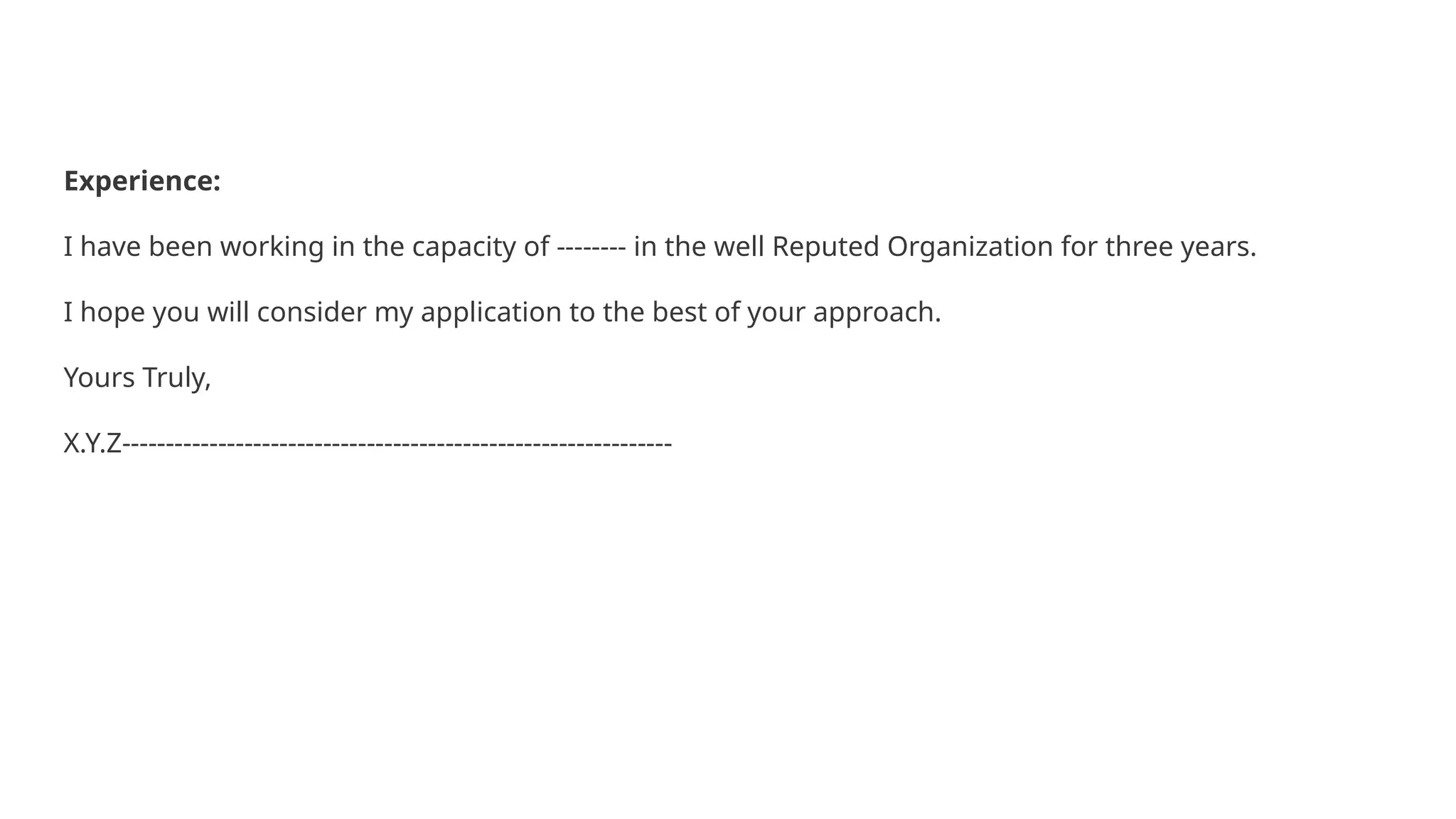
Experience:
I have been working in the capacity of -------- in the well Reputed Organization for three years.
I hope you will consider my application to the best of your approach.
Yours Truly,
X.Y.Z---------------------------------------------------------------
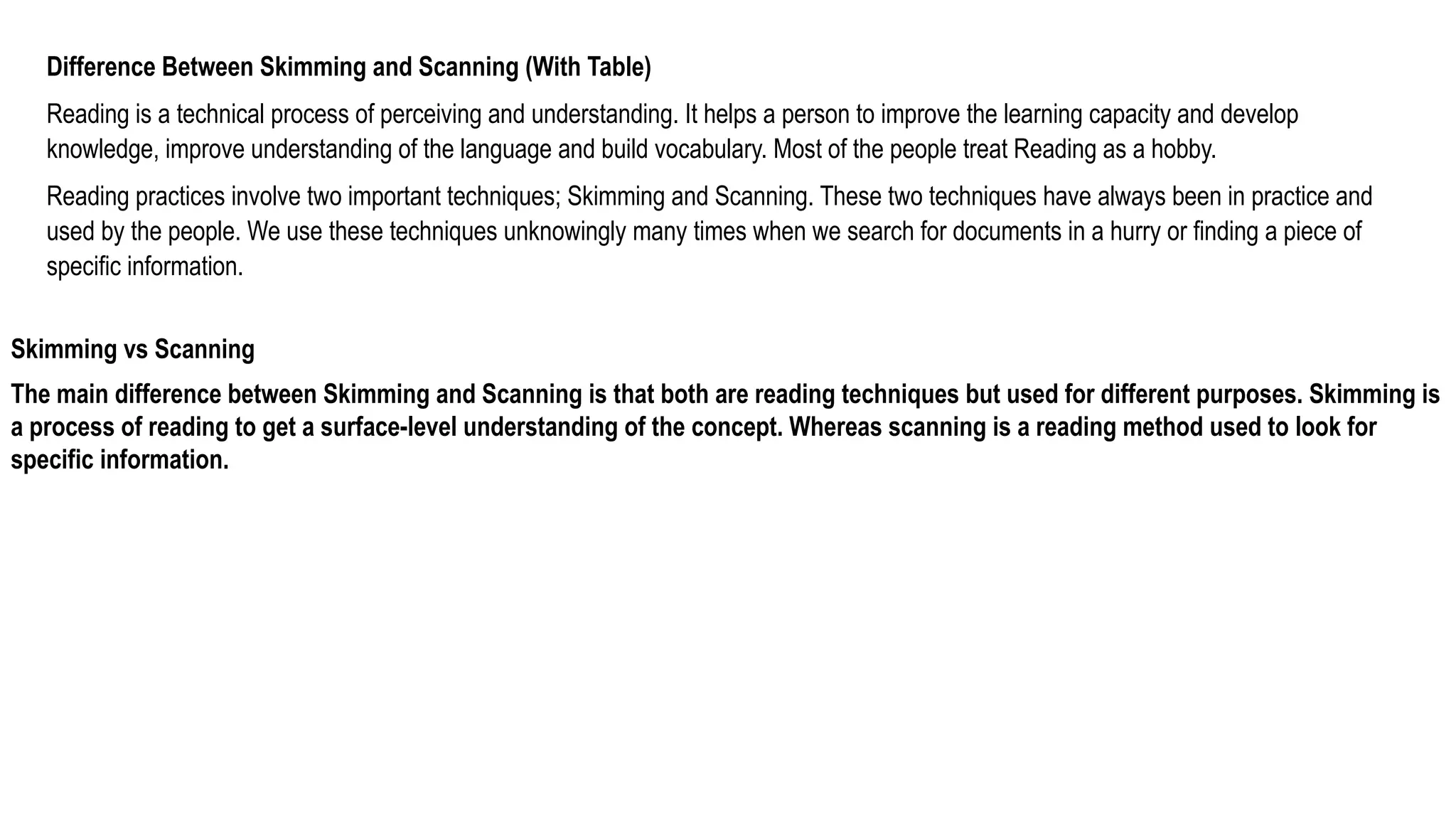
Difference Between Skimming and Scanning (With Table)
Reading is a technical process of perceiving and understanding. It helps a person to improve the learning capacity and develop
knowledge, improve understanding of the language and build vocabulary. Most of the people treat Reading as a hobby.
Reading practices involve two important techniques; Skimming and Scanning. These two techniques have always been in practice and
used by the people. We use these techniques unknowingly many times when we search for documents in a hurry or finding a piece of
specific information.
Skimming vs Scanning
The main difference between Skimming and Scanning is that both are reading techniques but used for different purposes. Skimming is
a process of reading to get a surface-level understanding of the concept. Whereas scanning is a reading method used to look for
specific information.
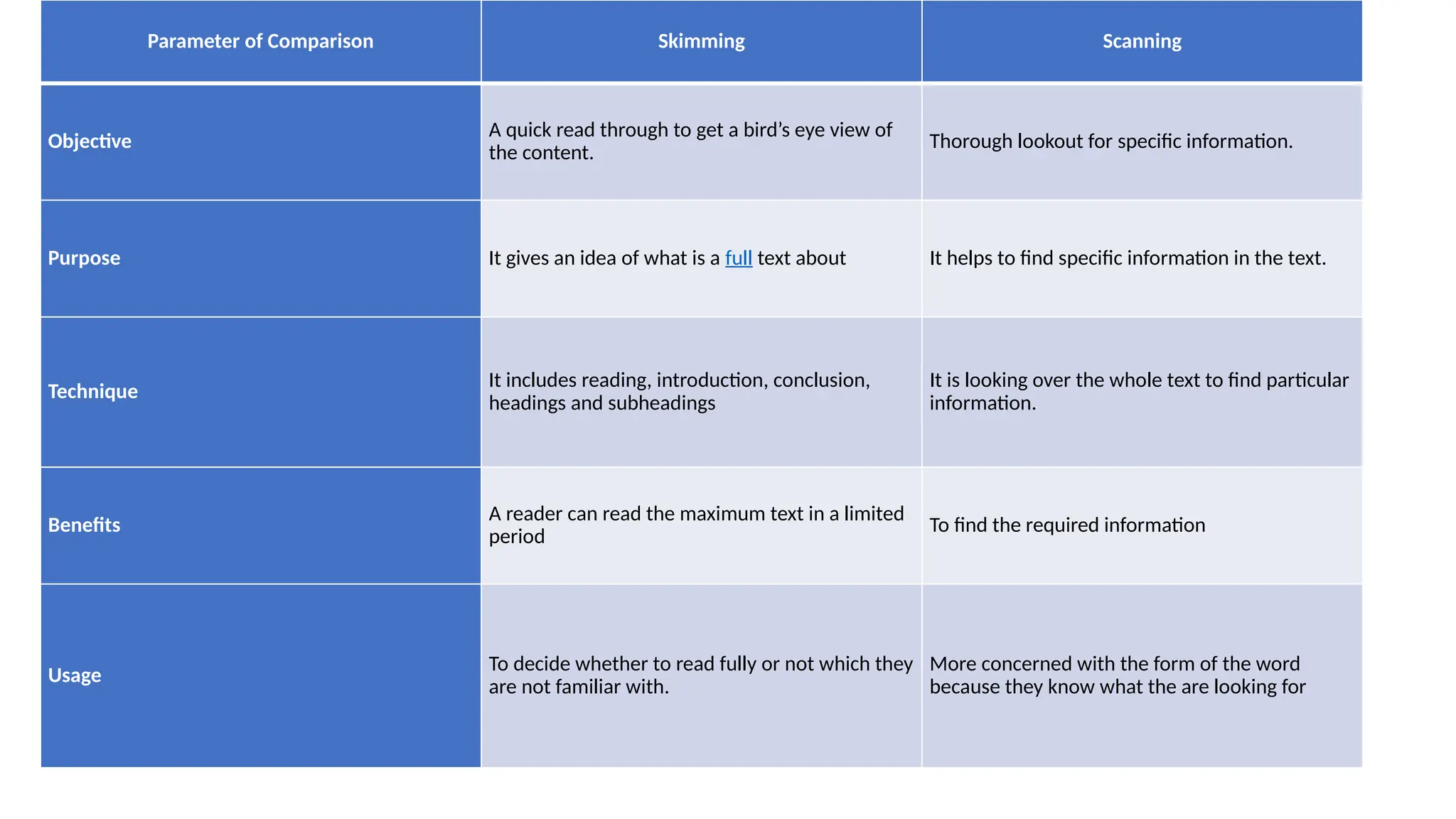
Parameter of Comparison Skimming Scanning
Objective
A quick read through to get a bird’s eye view of
the content.
Thorough lookout for specific information.
Purpose It gives an idea of what is a full text about It helps to find specific information in the text.
Technique
It includes reading, introduction, conclusion,
headings and subheadings
It is looking over the whole text to find particular
information.
Benefits
A reader can read the maximum text in a limited
period
To find the required information
Usage
To decide whether to read fully or not which they
are not familiar with.
More concerned with the form of the word
because they know what the are looking for
The main difference between Skimming and Scanning is, the former is a quick read through to know
what the plot is, while scanning is a method to investigate a particular context.
Skimming gives the idea of what is a full text about and Scanning helps to find specific information in the
text.
Skimming includes reading the main parts quickly; introduction, conclusion, headings, and subheadings.
While Scanning is looking over the whole text or a particular part to find specific information.
Using the Skimming technique, a reader can read the maximum text in a limited period and Scanning is used
to find required data.
Skimming is a technique helps to know a lot of information in a shorter period while scanning gives limited
but concrete information.
How to use both skills in your reading
1. Effective reading with skimming
When learning to skim, get yourself ready to move your eyes quickly through the pages. Skimming is not about placing
your eyes wherever your attention is drawn to. The effective work of skimming does not require you to do that.
You know that you don’t read every word but carefully pay attention to what forms the structure of that reading material.
So what exactly are we talking about? Headings, bulleted lists, numbered lists, bold text, italic text… These are just some
of them, though. Now here are some steps you should take if you do skimming:
 Look at the table of contents if there is. It’s a fast way to figure out what’s going on.
 The main headings are of the most essential, so don’t forget to read them. Remember that tables
and charts have headings, too (e.g., U.S population by age and gender, Healthcare cost from 2010
2017, and Risks of environmental impacts). Some may miss the headings of tables and charts as a
habit, so keep in mind they are there for some good reasons.
 After reading the first sentences, scroll your eyes down to the last ones of each paragraph. Thes
sentences can be the topic sentences that hold the main idea. This should not take you too much
time as there’re only a few important words to follow. However, don’t hesitate to stop if you think
something needs to be read entirely. Make sure you leave the paragraph and move to the next afte
carefully skimming.
 Attentively read the keywords. They can be nouns, dates, events, names, numbers,… These very
single words or phrases that give details are worth considering. Questions about these kinds of
information usually show up in the IELTS test.
 Along with your skimming process, underline or highlight important words and phrases. It’s goo
to use a marker or pencil (if you think you might want to erase the lines after that). This is also a
preparation for scanning.
 Remember it’s you who decide what rate of speed you want to skim. Of course, it’s not necessarily
equal in every part. The situations may vary, it could be a slow-down when you skim through an
unfamiliar word, for example. Sometimes, there are sentences that need more than one glance.
As far as what we have agreed in the previous section, you only scan when you know what to scan. Th
are some facts you want to find out. So what are the facts that you need? If you have questions and a
looking for a specific answer, there are probably some keywords in the question.
2. Effective reading with scanning
You can now leave out all the rest of the text as you’re in search of some specific question-
related information. In case there’re not any given keywords, establish them. Choose a few
words or phrases to search for. It’s your choice to look for one or more keywords at a time.
Let’s see if you can practice these suggestions below:
 Use a finger of your hand to scan, which is a helpful way to stay focused. The calmness
of mind together with the strong physical image of your finger-pointing along the lines will
provide you with confidence. You’re also sure of what you’ve scanned and what’s left to be
scanned.
 Repeat silently in your mind the keywords while scanning. You may think you’re sure of
what you need, but keeping on telling yourself the wanted word or phrase can never be
anything of disadvantages. Whether it’s a phone number, a person’s name, a location, a
country… keep saying quietly that’s the destination.
 When you come across a keyword while scanning, stop, and carefully read the
surrounding text. If there’s anything serving your purposes, note them down to review
later and see if this information needs noticing. The chances we find needed sentences and
then lose them can happen without a warning. If we do not prepare for surprises, we’ll be
surprisingly slower than planning.
Types of essays
Like any form of writing, essays come in many different types. Sometimes the assignment dictate
the type, as with admissions essays, and other times the thesis will determine it. Regardless, it
helps to know what your options are, so here are some of the most common essay types:
1. Argumentative essay
2. Persuasive essay
3. Compare-and-contrast essay
4. Personal essay
5. Expository essay
The essay writing process
Writing the introduction
The introduction sets the tone for your essay. It should grab the reader’s interest and inform
them of what to expect. The introduction generally comprises 10–20% of the text.
That idea is introduced in a topic sentence. The topic sentence should generally lead on from th
paragraph and introduce the point to be made in this paragraph. Transition words can be used t
clear connections between sentences.
After the topic sentence, present evidence such as data, examples, or quotes from relevant sou
to interpret and explain the evidence, and show how it helps develop your overall argument.
Writing the conclusion
The conclusion is the final paragraph of an essay. It should generally take up no more than 10–1
text. A strong essay conclusion:
Returns to your thesis
Ties together your main points
Shows why your argument matters
A great conclusion should finish with a memorable or impactful sentence that leaves the reader
strong final impression.
Coherence
When sentences, ideas, and details fit together clearly, readers can follow along easily, and the writing
is coherent. The ideas tie together smoothly and clearly. To establish the links that readers need, you
can use the methods listed here. Note that good writers use a combination of these methods. Do not
rely on and overuse any single method – especially transitional words.
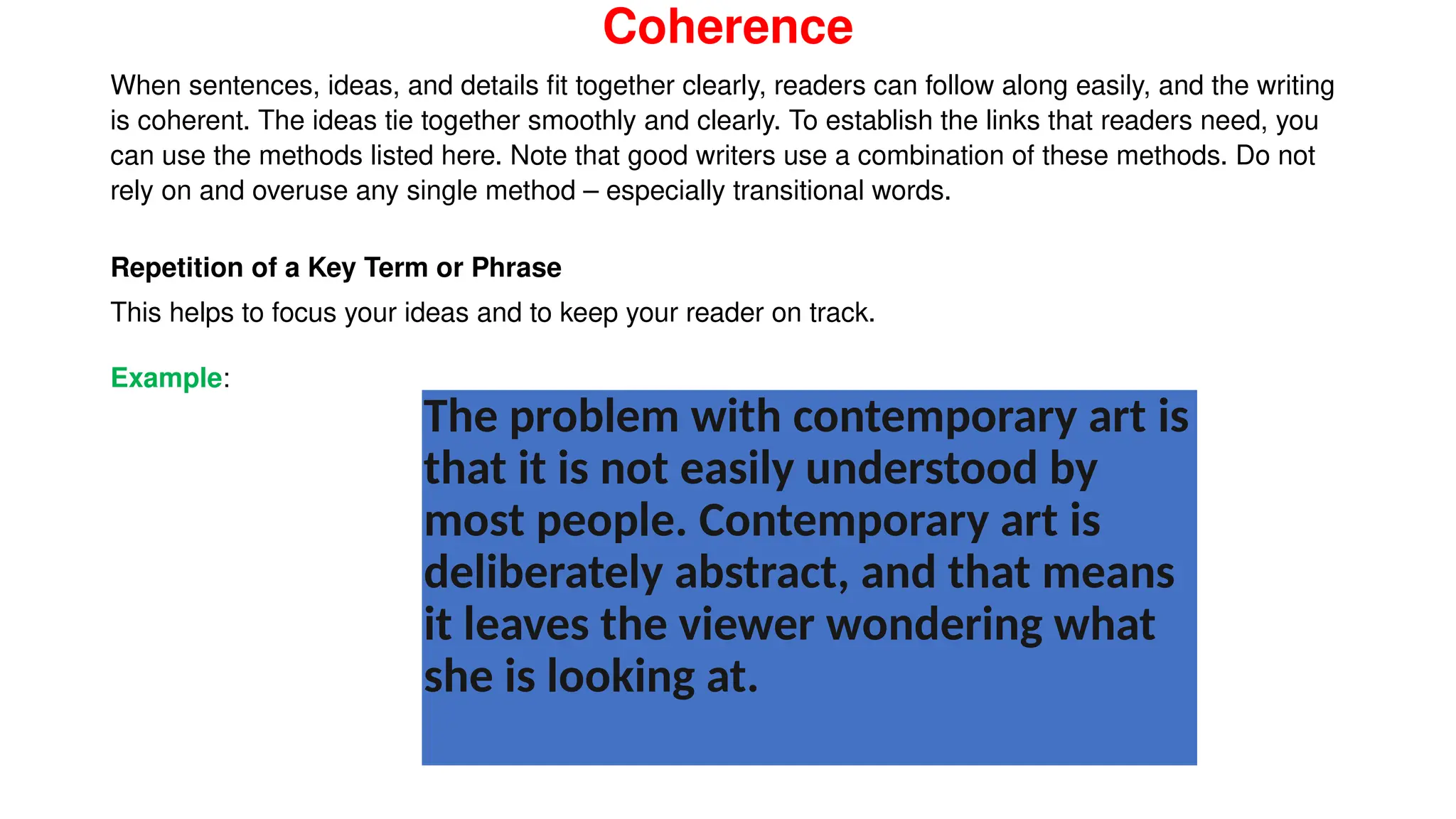
Repetition of a Key Term or Phrase
This helps to focus your ideas and to keep your reader on track.
Example:
The problem with contemporary art is
that it is not easily understood by
most people. Contemporary art is
deliberately abstract, and that means
it leaves the viewer wondering what
she is looking at.
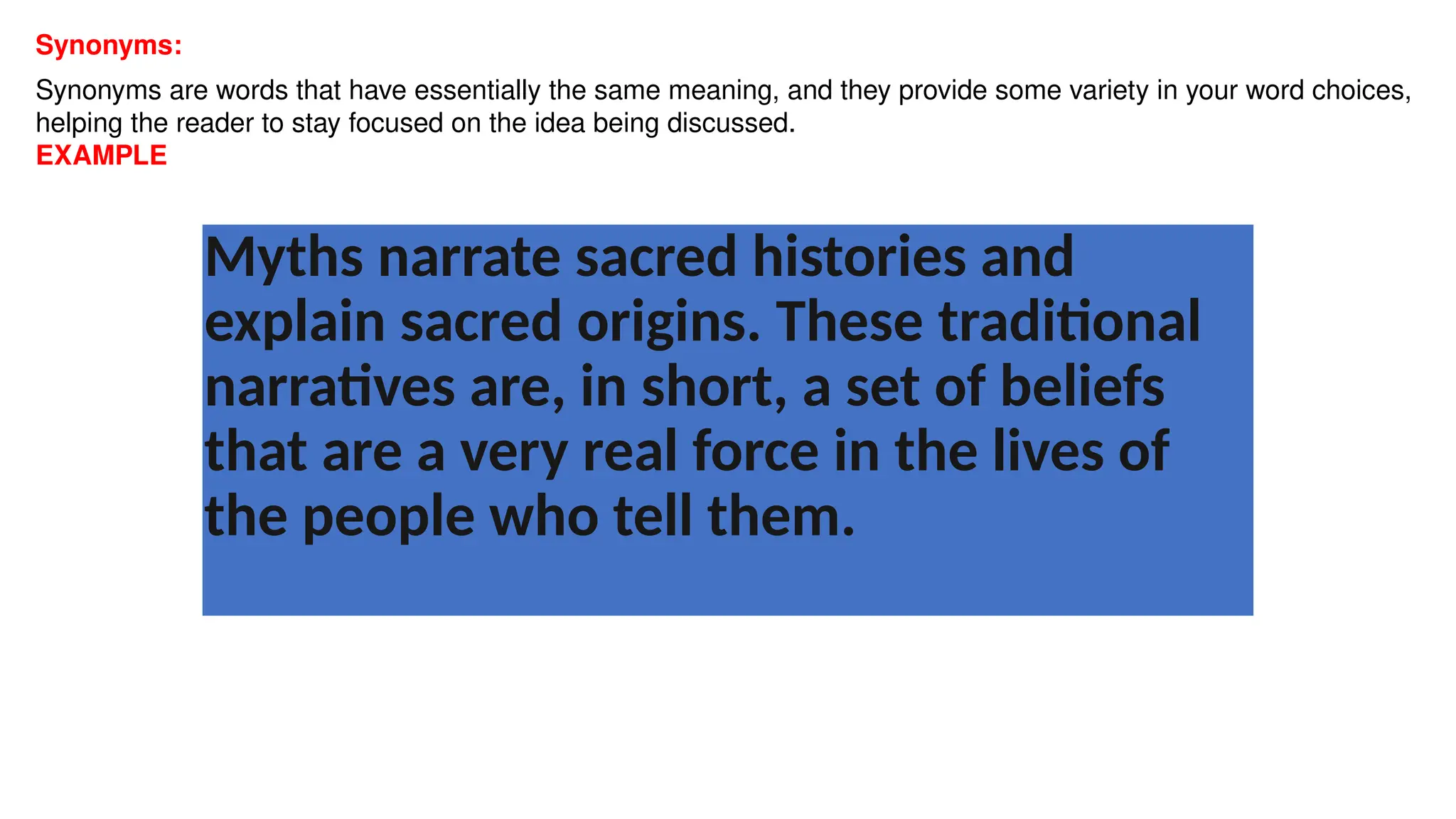
Synonyms:
Synonyms are words that have essentially the same meaning, and they provide some variety in your word choices,
helping the reader to stay focused on the idea being discussed.
EXAMPLE
Myths narrate sacred histories and
explain sacred origins. These traditional
narratives are, in short, a set of beliefs
that are a very real force in the lives of
the people who tell them.
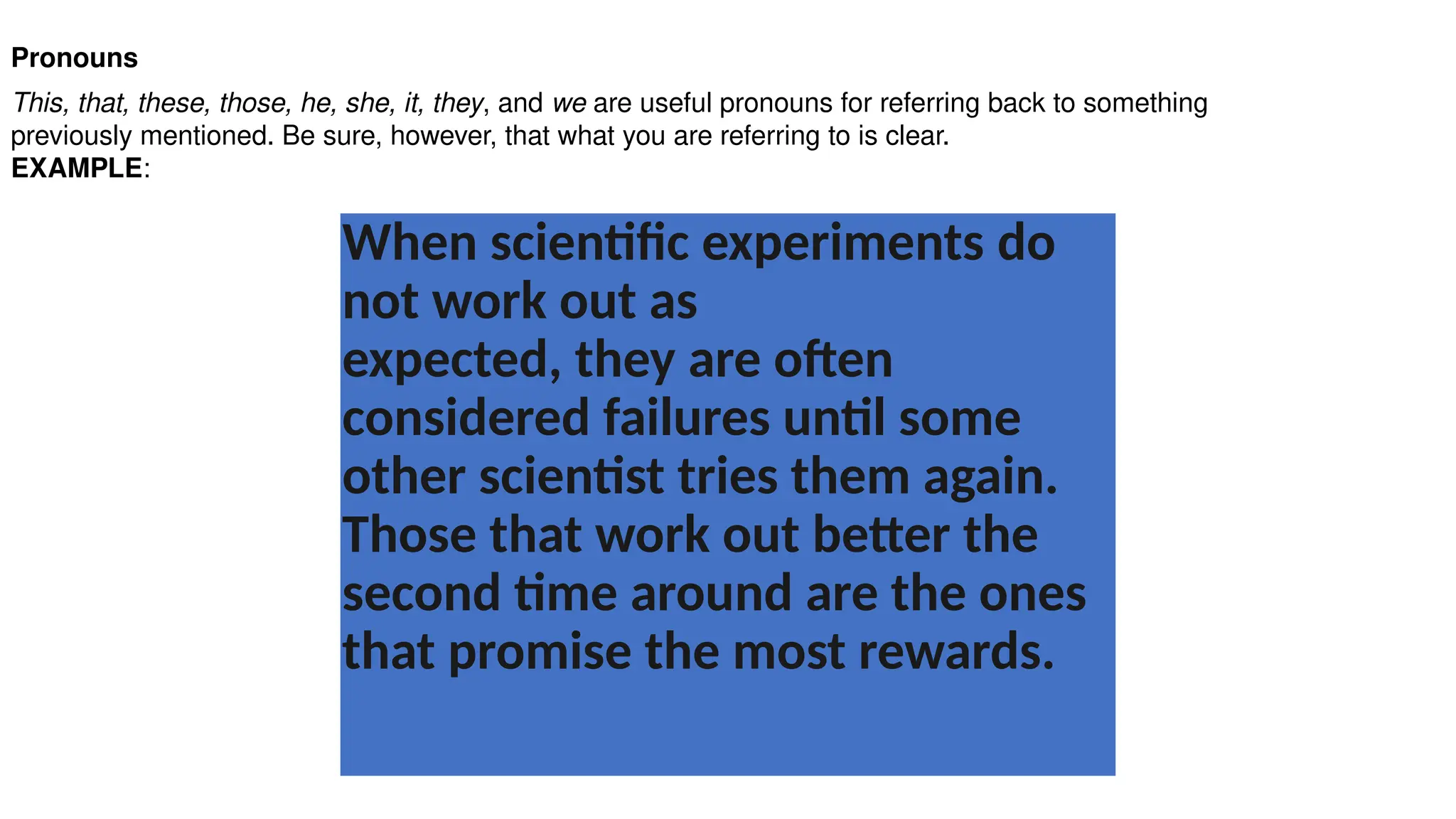
Pronouns
This, that, these, those, he, she, it, they, and we are useful pronouns for referring back to something
previously mentioned. Be sure, however, that what you are referring to is clear.
EXAMPLE:
When scientific experiments do
not work out as
expected, they are often
considered failures until some
other scientist tries them again.
Those that work out better the
second time around are the ones
that promise the most rewards.
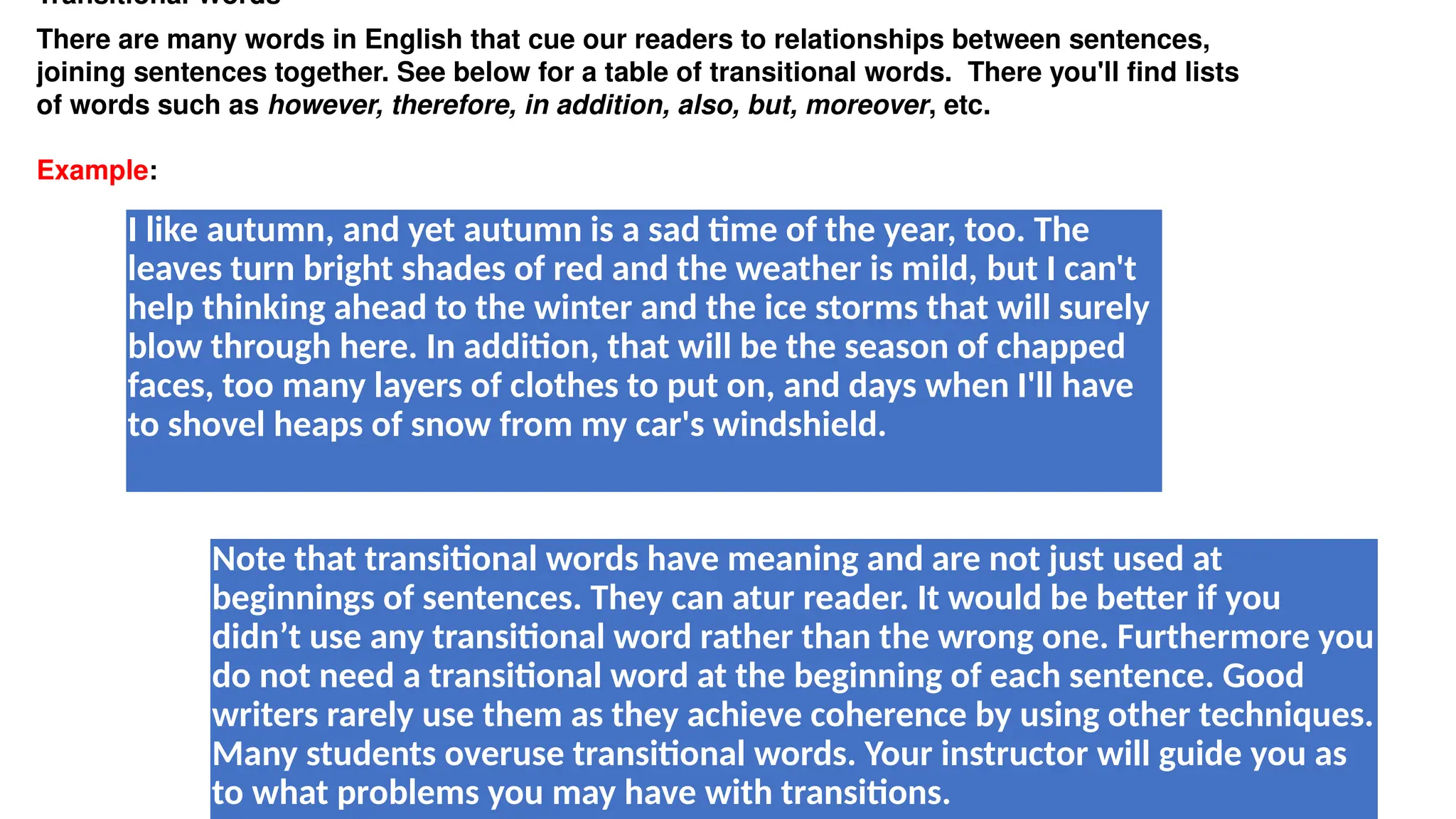
Transitional Words
There are many words in English that cue our readers to relationships between sentences,
joining sentences together. See below for a table of transitional words. There you'll find lists
of words such as however, therefore, in addition, also, but, moreover, etc.
Example:
I like autumn, and yet autumn is a sad time of the year, too. The
leaves turn bright shades of red and the weather is mild, but I can't
help thinking ahead to the winter and the ice storms that will surely
blow through here. In addition, that will be the season of chapped
faces, too many layers of clothes to put on, and days when I'll have
to shovel heaps of snow from my car's windshield.
Note that transitional words have meaning and are not just used at
beginnings of sentences. They can atur reader. It would be better if you
didn’t use any transitional word rather than the wrong one. Furthermore you
do not need a transitional word at the beginning of each sentence. Good
writers rarely use them as they achieve coherence by using other techniques.
Many students overuse transitional words. Your instructor will guide you as
to what problems you may have with transitions.
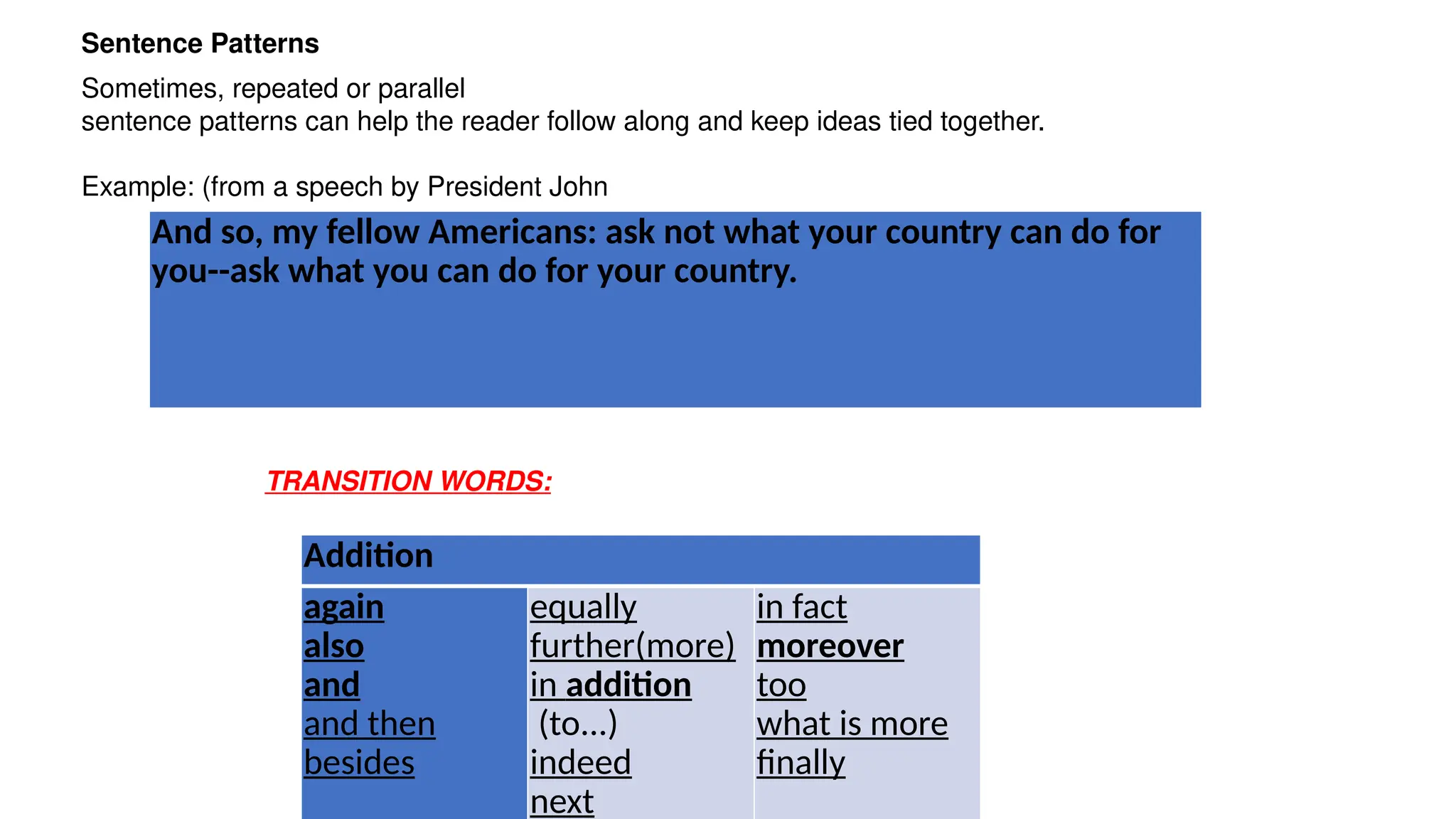
Sentence Patterns
Sometimes, repeated or parallel
sentence patterns can help the reader follow along and keep ideas tied together.
Example: (from a speech by President John
TRANSITION WORDS:
And so, my fellow Americans: ask not what your country can do for
you--ask what you can do for your country.
Addition
again
also
and
and then
besides
equally
further(more)
in addition
(to...)
indeed
next
in fact
moreover
too
what is more
finally
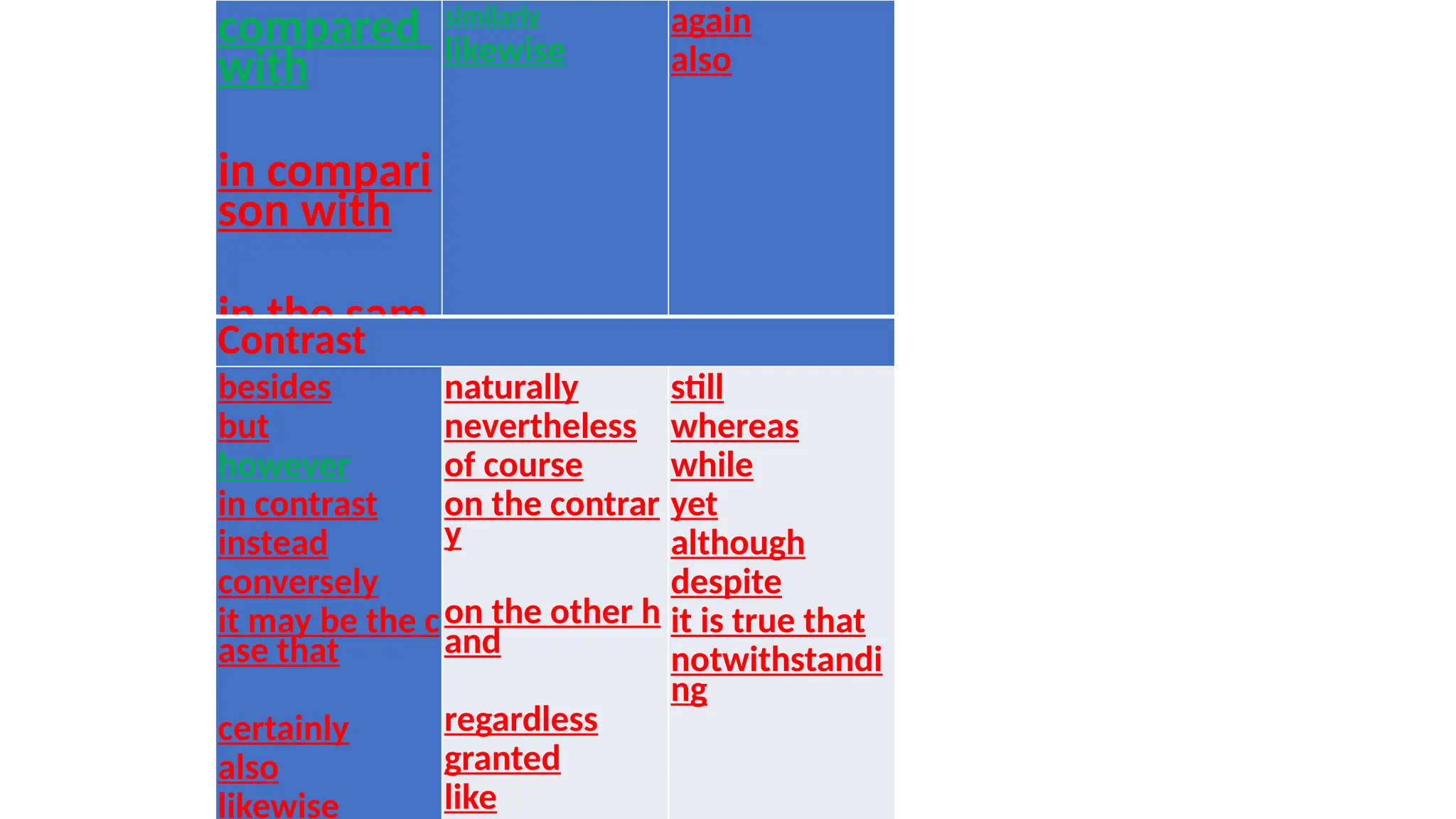
compared
with
in compari
son with
in the sam
e way
/manner
similarly
likewise
again
also
Contrast
besides
but
however
in contrast
instead
conversely
it may be the c
ase that
certainly
also
likewise
naturally
nevertheless
of course
on the contrar
y
on the other h
and
regardless
granted
like
still
whereas
while
yet
although
despite
it is true that
notwithstandi
ng
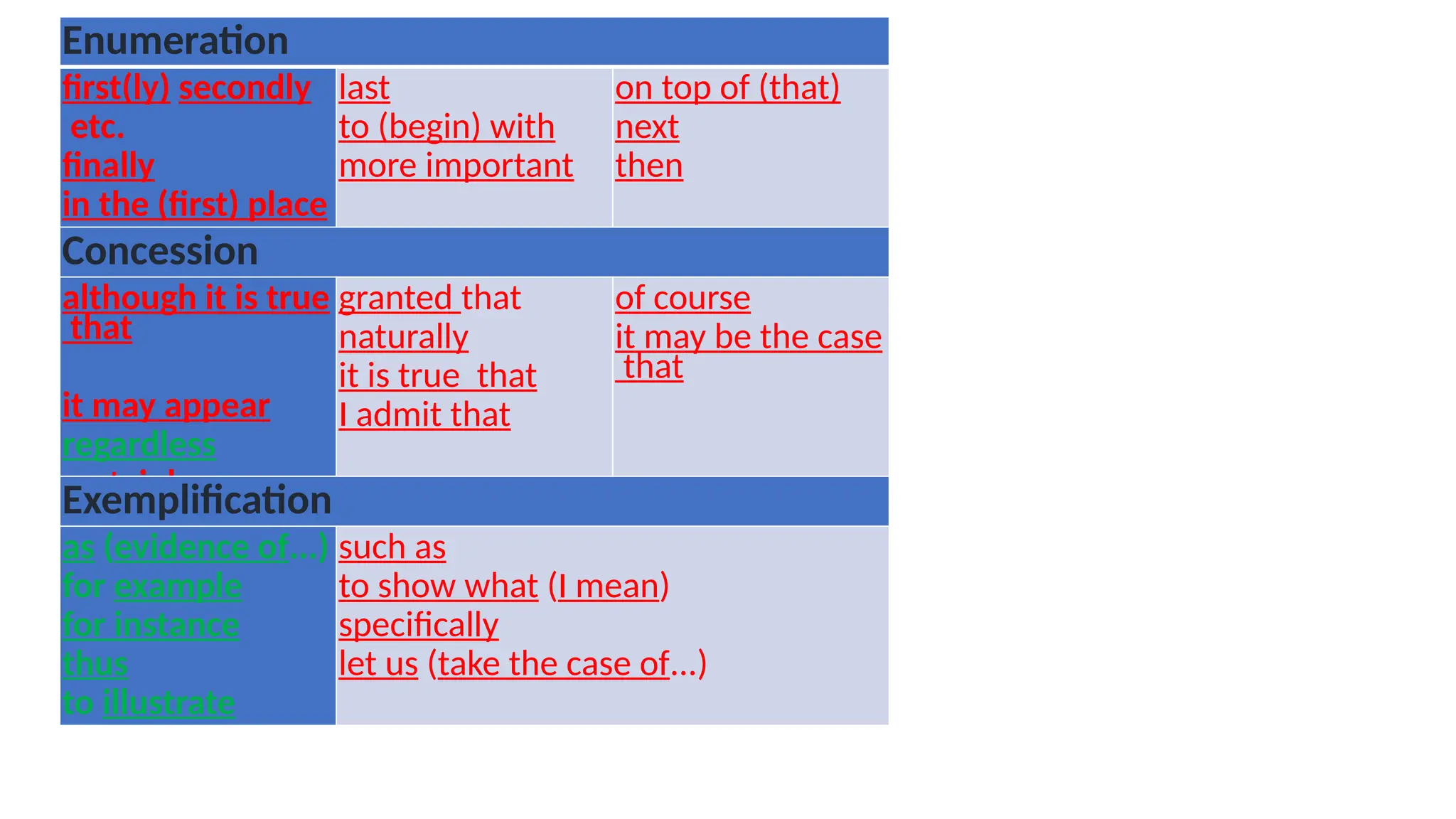
Enumeration
first(ly) secondly
etc.
finally
in the (first) place
last
to (begin) with
more important
on top of (that)
next
then
Concession
although it is true
that
it may appear
regardless
certainly
granted that
naturally
it is true that
I admit that
of course
it may be the case
that
Exemplification
as (evidence of...)
for example
for instance
thus
to illustrate
such as
to show what (I mean)
specifically
let us (take the case of...)
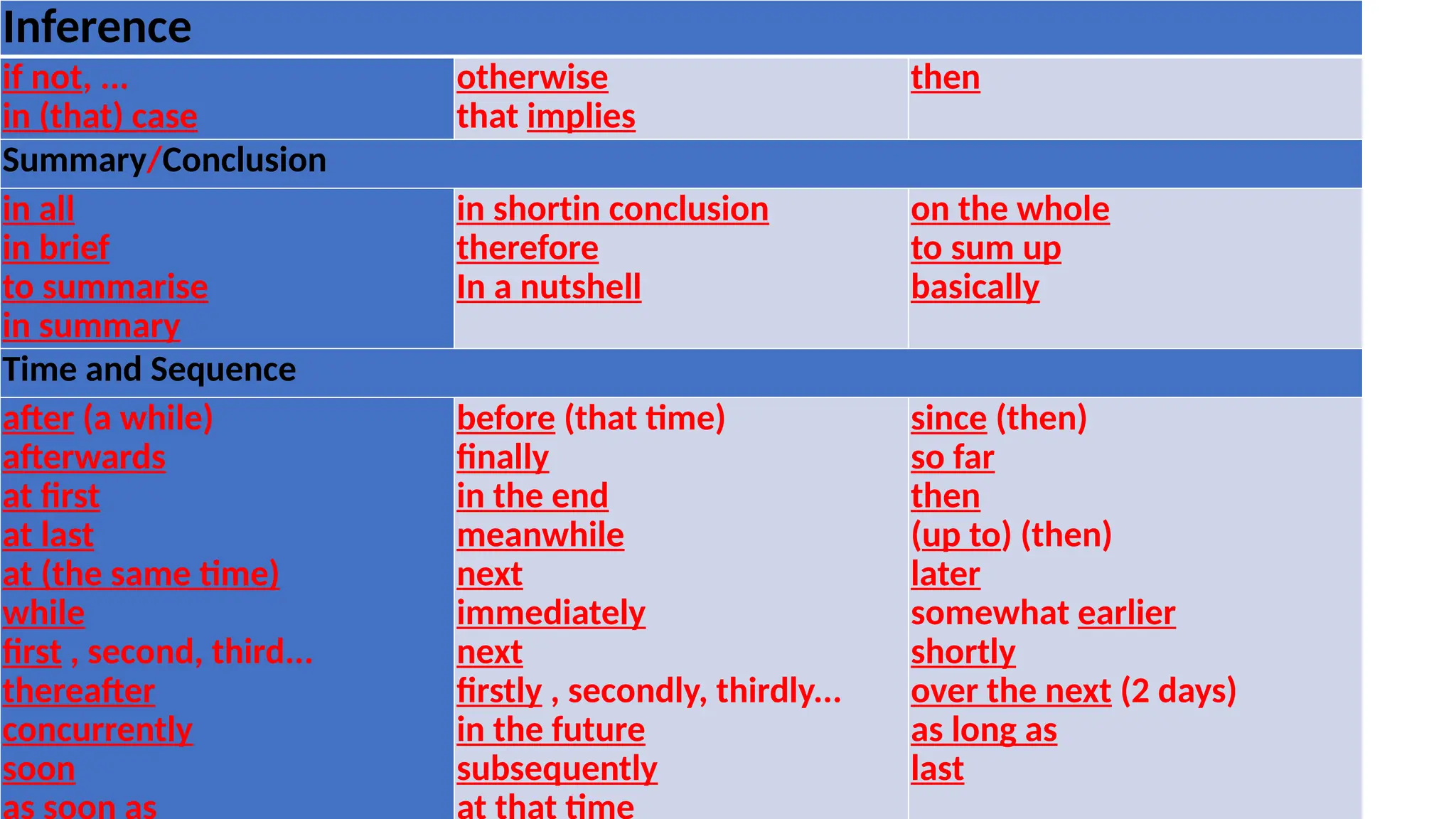
Inference
if not, ...
in (that) case
otherwise
that implies
then
Summary/Conclusion
in all
in brief
to summarise
in summary
in shortin conclusion
therefore
In a nutshell
on the whole
to sum up
basically
Time and Sequence
after (a while)
afterwards
at first
at last
at (the same time)
while
first , second, third...
thereafter
concurrently
soon
as soon as
before (that time)
finally
in the end
meanwhile
next
immediately
next
firstly , secondly, thirdly...
in the future
subsequently
at that time
since (then)
so far
then
(up to) (then)
later
somewhat earlier
shortly
over the next (2 days)
as long as
last
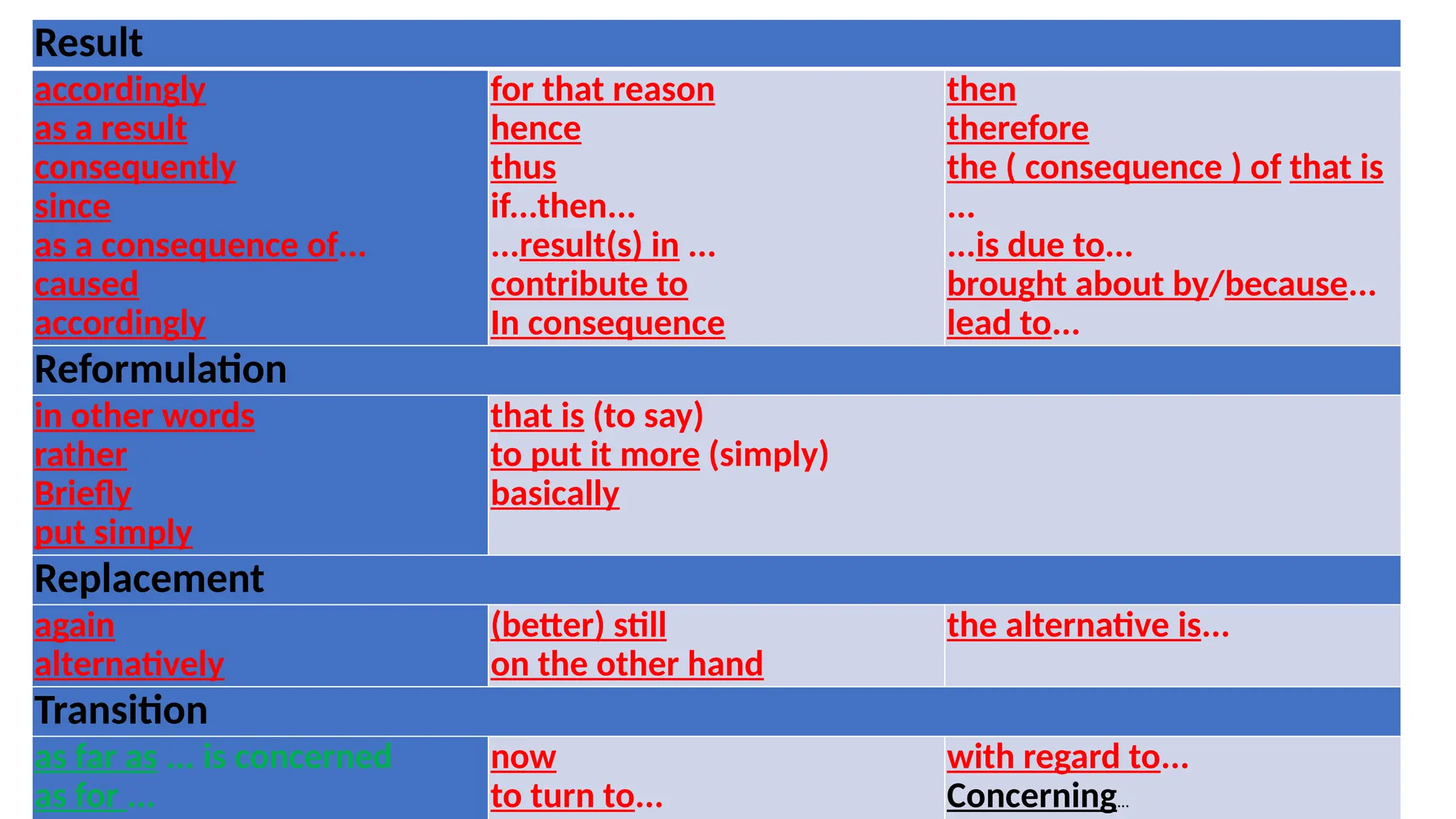
Result
accordingly
as a result
consequently
since
as a consequence of...
caused
accordingly
for that reason
hence
thus
if...then...
...result(s) in ...
contribute to
In consequence
then
therefore
the ( consequence ) of that is
...
...is due to...
brought about by/because...
lead to...
Reformulation
in other words
rather
Briefly
put simply
that is (to say)
to put it more (simply)
basically
Replacement
again
alternatively
(better) still
on the other hand
the alternative is...
Transition
as far as ... is concerned
as for ...
now
to turn to...
with regard to...
Concerning...
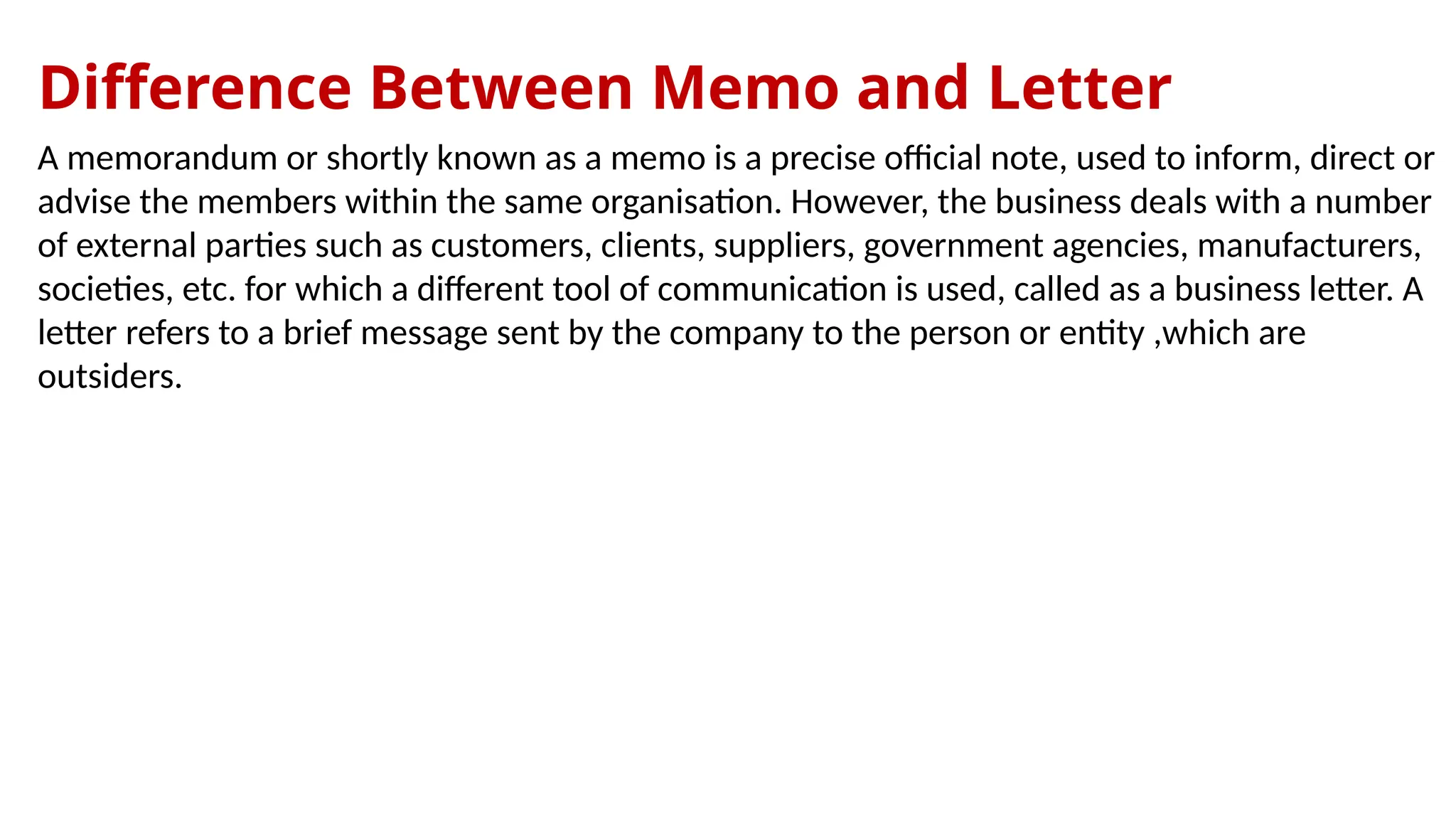
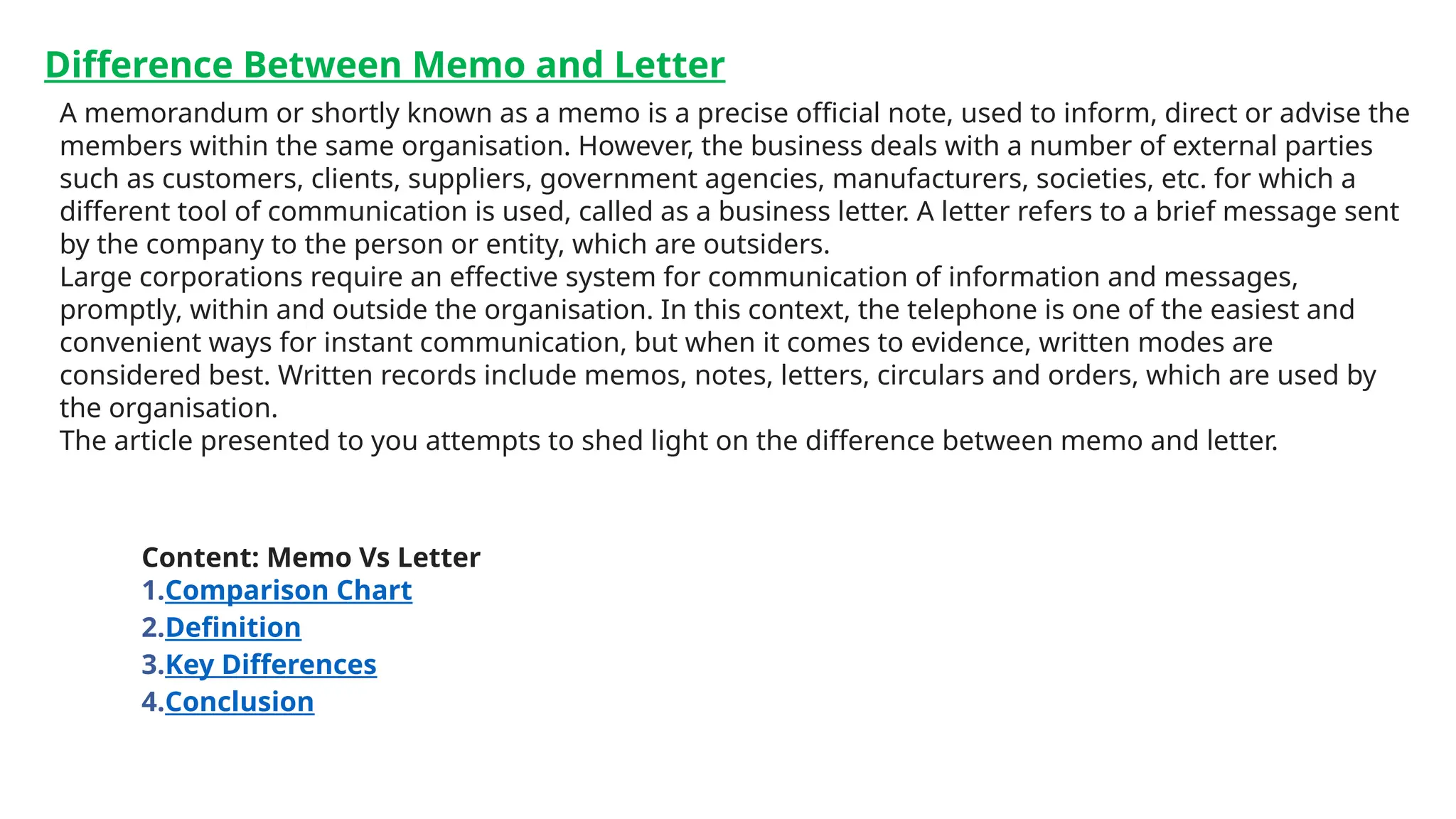
Difference Between Memo and Letter
A memorandum or shortly known as a memo is a precise official note, used to inform, direct or
advise the members within the same organisation. However, the business deals with a number
of external parties such as customers, clients, suppliers, government agencies, manufacturers,
societies, etc. for which a different tool of communication is used, called as a business letter. A
letter refers to a brief message sent by the company to the person or entity ,which are
outsiders.
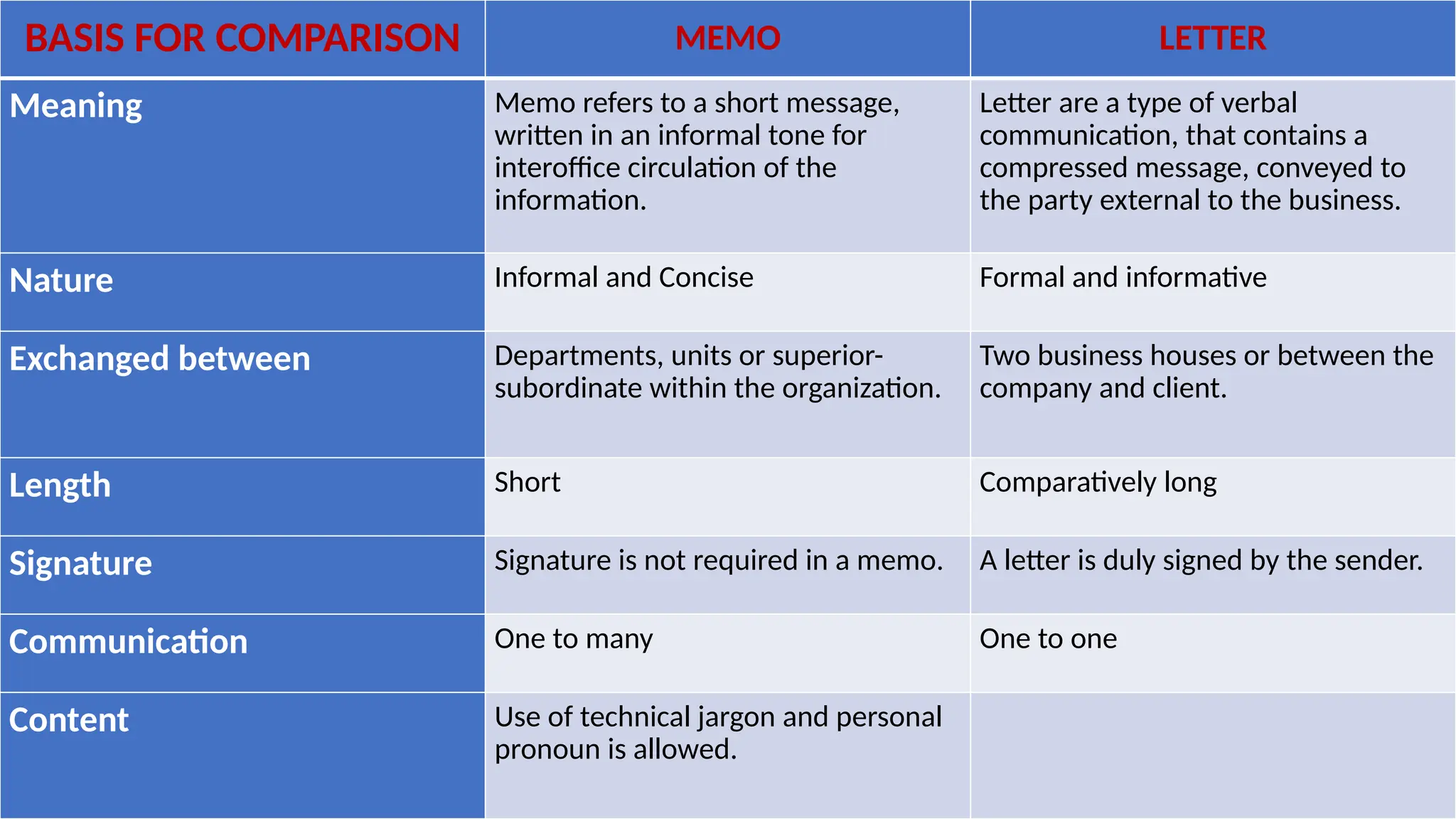
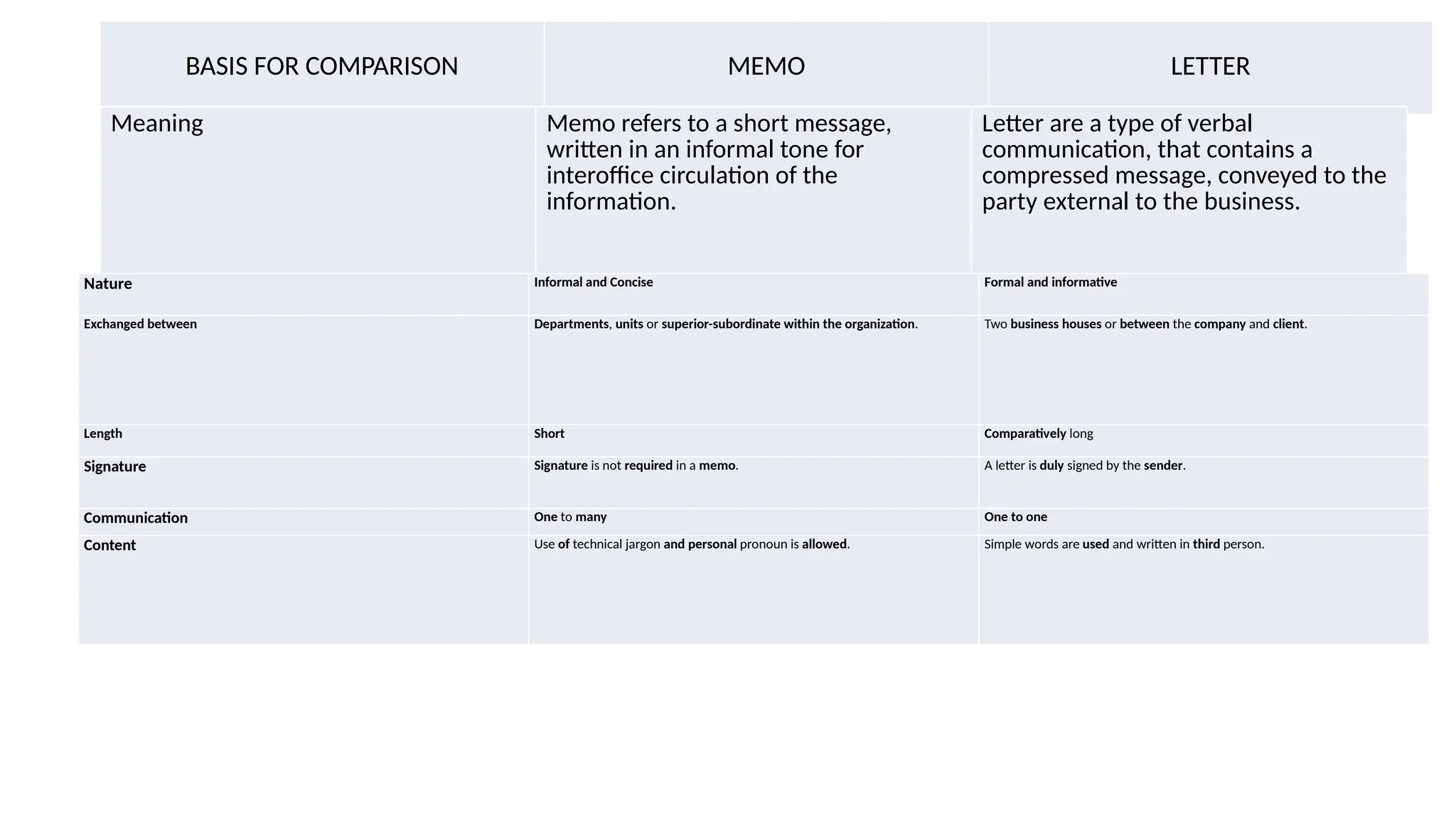
BASIS FOR COMPARISON MEMO LETTER
Meaning Memo refers to a short message,
written in an informal tone for
interoffice circulation of the
information.
Letter are a type of verbal
communication, that contains a
compressed message, conveyed to
the party external to the business.
Nature Informal and Concise Formal and informative
Exchanged between Departments, units or superior-
subordinate within the organization.
Two business houses or between the
company and client.
Length Short Comparatively long
Signature Signature is not required in a memo. A letter is duly signed by the sender.
Communication One to many One to one
Content Use of technical jargon and personal
pronoun is allowed.
Difference Between Memo and Letter
A memorandum or shortly known as a memo is a precise official note, used to inform, direct or advise the
members within the same organisation. However, the business deals with a number of external parties
such as customers, clients, suppliers, government agencies, manufacturers, societies, etc. for which a
different tool of communication is used, called as a business letter. A letter refers to a brief message sent
by the company to the person or entity, which are outsiders.
Large corporations require an effective system for communication of information and messages,
promptly, within and outside the organisation. In this context, the telephone is one of the easiest and
convenient ways for instant communication, but when it comes to evidence, written modes are
considered best. Written records include memos, notes, letters, circulars and orders, which are used by
the organisation.
The article presented to you attempts to shed light on the difference between memo and letter.
Content: Memo Vs Letter
1.Comparison Chart
2.Definition
3.Key Differences
4.Conclusion
BASIS FOR COMPARISON MEMO LETTER
Meaning Memo refers to a short message,
written in an informal tone for
interoffice circulation of the
information.
Letter are a type of verbal
communication, that contains a
compressed message, conveyed to the
party external to the business.
Nature Informal and Concise Formal and informative
Exchanged between Departments, units or superior-subordinate within the organization. Two business houses or between the company and client.
Length Short Comparatively long
Signature Signature is not required in a memo. A letter is duly signed by the sender.
Communication One to many One to one
Content Use of technical jargon and personal pronoun is allowed. Simple words are used and written in third person.
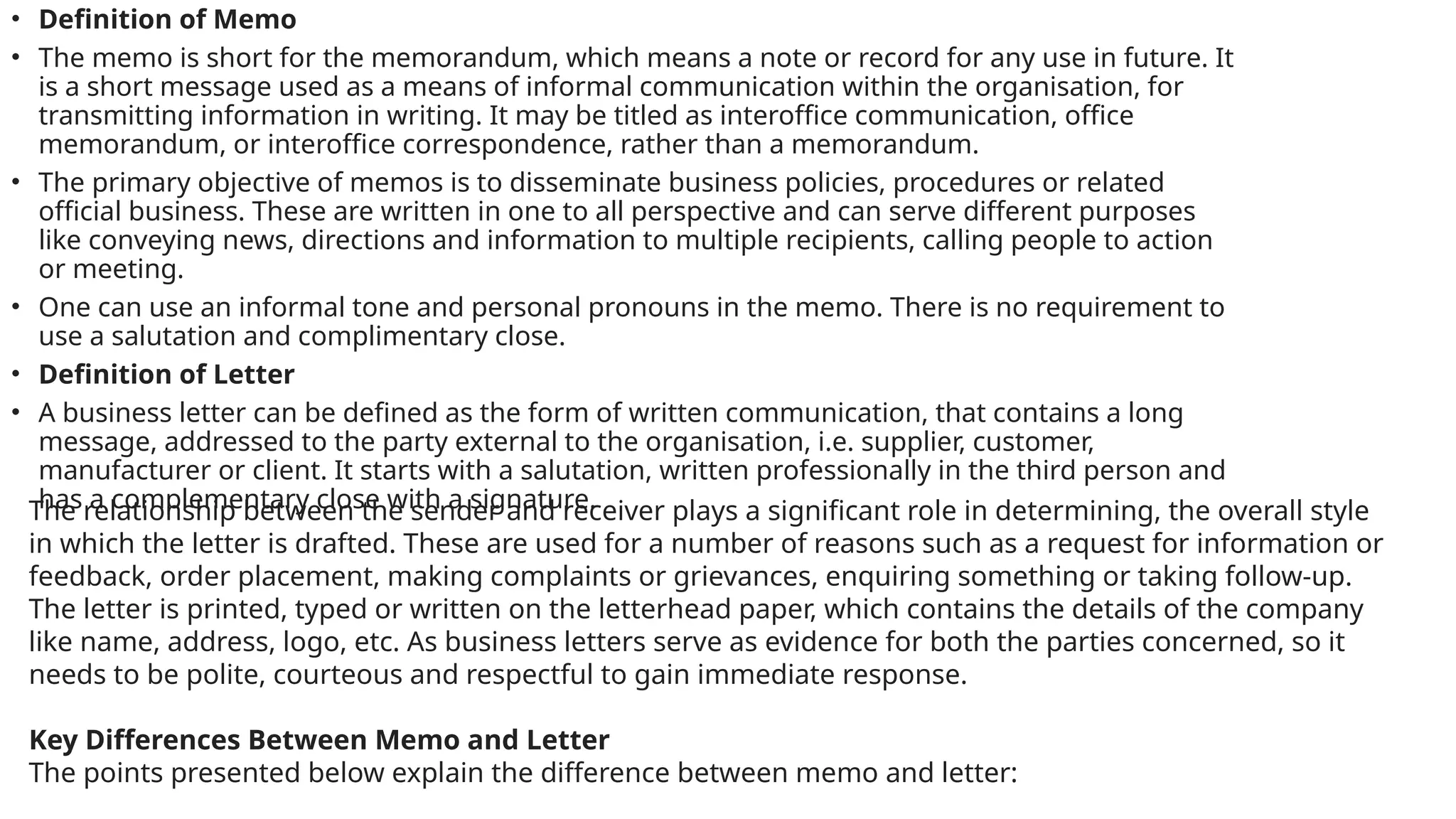
• Definition of Memo
• The memo is short for the memorandum, which means a note or record for any use in future. It
is a short message used as a means of informal communication within the organisation, for
transmitting information in writing. It may be titled as interoffice communication, office
memorandum, or interoffice correspondence, rather than a memorandum.
• The primary objective of memos is to disseminate business policies, procedures or related
official business. These are written in one to all perspective and can serve different purposes
like conveying news, directions and information to multiple recipients, calling people to action
or meeting.
• One can use an informal tone and personal pronouns in the memo. There is no requirement to
use a salutation and complimentary close.
• Definition of Letter
• A business letter can be defined as the form of written communication, that contains a long
message, addressed to the party external to the organisation, i.e. supplier, customer,
manufacturer or client. It starts with a salutation, written professionally in the third person and
has a complementary close with a signature.
The relationship between the sender and receiver plays a significant role in determining, the overall style
in which the letter is drafted. These are used for a number of reasons such as a request for information or
feedback, order placement, making complaints or grievances, enquiring something or taking follow-up.
The letter is printed, typed or written on the letterhead paper, which contains the details of the company
like name, address, logo, etc. As business letters serve as evidence for both the parties concerned, so it
needs to be polite, courteous and respectful to gain immediate response.
Key Differences Between Memo and Letter
The points presented below explain the difference between memo and letter:
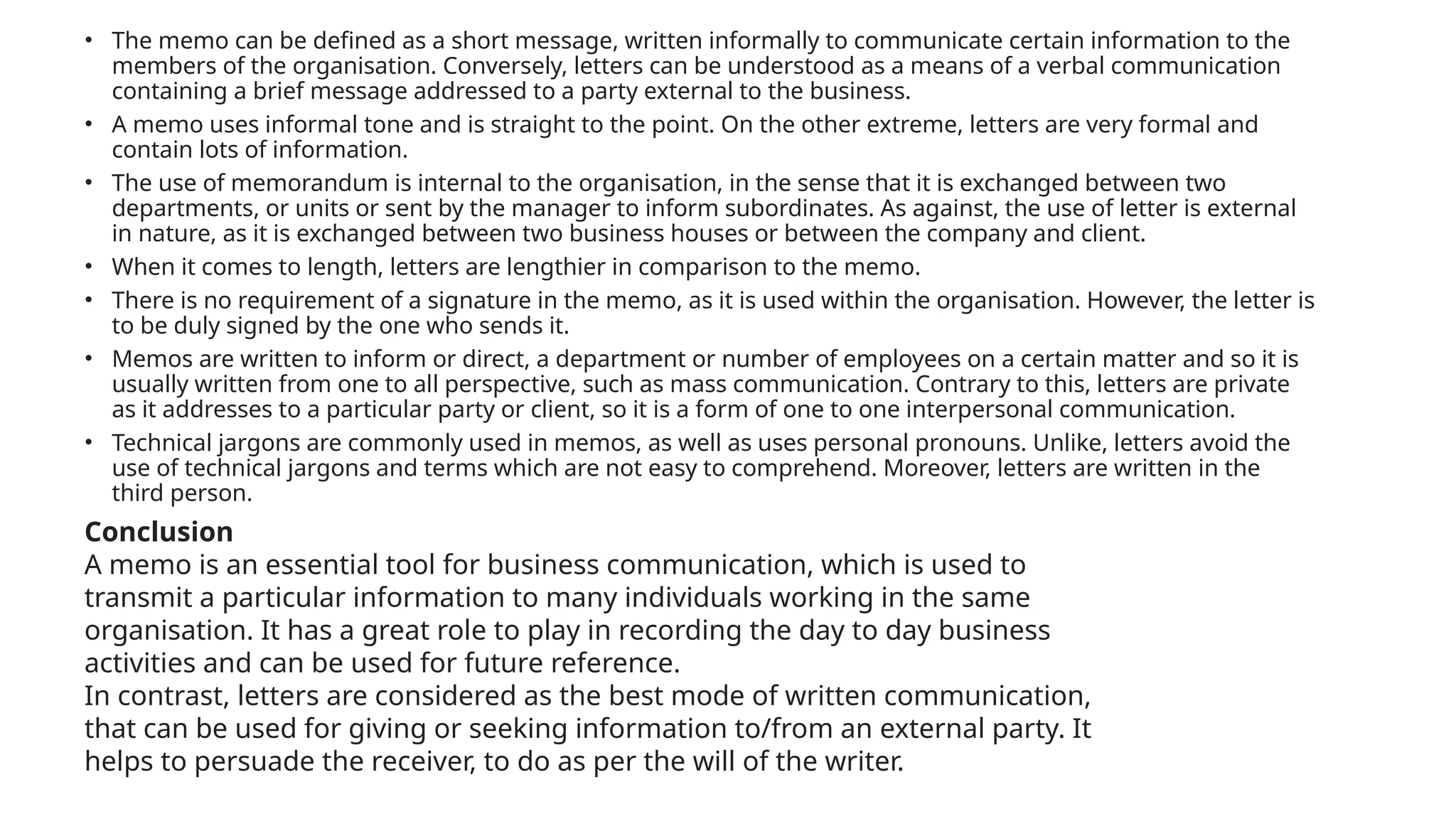
• The memo can be defined as a short message, written informally to communicate certain information to the
members of the organisation. Conversely, letters can be understood as a means of a verbal communication
containing a brief message addressed to a party external to the business.
• A memo uses informal tone and is straight to the point. On the other extreme, letters are very formal and
contain lots of information.
• The use of memorandum is internal to the organisation, in the sense that it is exchanged between two
departments, or units or sent by the manager to inform subordinates. As against, the use of letter is external
in nature, as it is exchanged between two business houses or between the company and client.
• When it comes to length, letters are lengthier in comparison to the memo.
• There is no requirement of a signature in the memo, as it is used within the organisation. However, the letter is
to be duly signed by the one who sends it.
• Memos are written to inform or direct, a department or number of employees on a certain matter and so it is
usually written from one to all perspective, such as mass communication. Contrary to this, letters are private
as it addresses to a particular party or client, so it is a form of one to one interpersonal communication.
• Technical jargons are commonly used in memos, as well as uses personal pronouns. Unlike, letters avoid the
use of technical jargons and terms which are not easy to comprehend. Moreover, letters are written in the
third person.
Conclusion
A memo is an essential tool for business communication, which is used to
transmit a particular information to many individuals working in the same
organisation. It has a great role to play in recording the day to day business
activities and can be used for future reference.
In contrast, letters are considered as the best mode of written communication,
that can be used for giving or seeking information to/from an external party. It
helps to persuade the receiver, to do as per the will of the writer.
Whether you’ve had an internal policy change you need to share or you’re spearheading a project that
investors need to know about, a memo is the best way to communicate valuable information within your
organization. Memos are a good way to disseminate such information to your colleagues, tenants,
volunteers, or other internal organization members.
When should you send a memo? How do you write a memo? We’ll answer these questions and give you
a step-by-step guide for creating a memo plus share lots of examples of memos.
What is a memo?
A memo, short for memorandum, is a way to inform a group of people about a specific problem,
solution, or event. A memo should be brief, straightforward, and easy to read. It informs recipients
and provides an action plan with specific next steps.
You may send a memo as a paper letter, fax, or PDF attached to an email. Although the widespread
use of email essentially replaced memos in many circumstances, memos are still helpful for some
important messages.
What is the purpose of a memo?
Memos are designed for official internal communications of a business or organization. They are
often sent to an entire organization but are also useful for informing a single department, team, or
smaller group of people. Memos disperse necessary information using a simple, easy-to-follow
format.
When to write a memo
You should write a memorandum when you need to relay official business items efficiently. The aim of
your memo should be to inform, bring attention to a problem, or answer a question. The following
purposes are suitable for a memo:
•broadcast internal changes
•disseminate news
•share an upcoming event
•update public safety guidelines
•raise awareness about an issue
•address a problem
•make a request
•share project updates
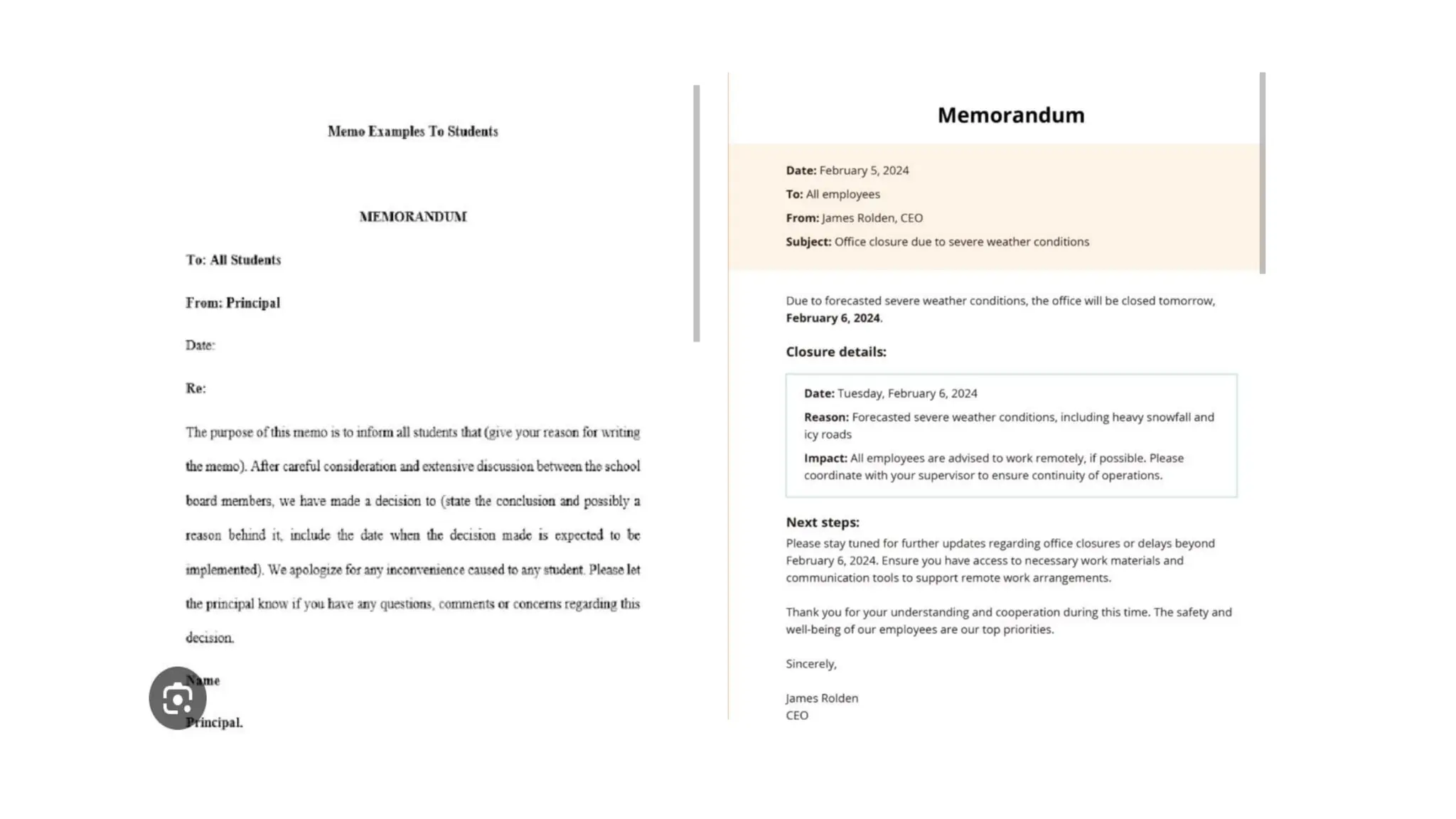
How to format a memo
If you are sending a memo via email, it should be formatted as a PDF. This retains the style
you’ve applied to the document. Traditionally memos use twelve-point font for the body and
fourteen- to sixteen-point font for the headings. Keep the font and design simple.
A memo should include the following.
• Heading
• To
• From
• Date
• Subject
• Opening statement
• Context
• Call to action and task statement
• Discussion
• Closing
• You also have the option to include attachments to support the message you are
conveying in your memo. If your memo is more than one page, you should have a
summary to wrap up your points.
Write a memo in 8 steps
• Memos should always be professional and polite—regardless of the topic you’re introducing.
Stay focused on the facts and actionable plans. You should not use emoji in business memos.
Keep it brief, direct, and clear and include only necessary information.
• 1 Heading
• The heading lists who is receiving the memo, who is sending the memo, the date the memo
was written, and the subject of the memo. You can view how to format this section below.
• To: [Recipients’ full names and job titles or department]
• From: [Your full name and job title]
• Date: [Today’s date]
• Subject: [What the memo is about]
• Since you addressed the recipients in the heading, there’s no need to include a greeting.
2 Opening statement
• This section can be between one and three sentences. The opening statement is where
you briefly state the purpose of your memo. Include only a summary of the most crucial
information in this section. Later you’ll be able to get into the details.
• Try starting with, “I’m writing to inform you . . .”
• 3
Context
• In three to ten sentences, provide context. Context is where you let people know what
you’re writing about, why you’re writing them, and any other critical information.
• This section may include the following:
• supporting evidence
• why your organization made the decision you’re discussing in the memo
• background information
• a problem statement
• how you found the problem
• important timing or dates
• other key points
Call to action and task statement
• This section can be either two to three sentences or a bullet-pointed list.
This is where you lay out the next steps for your recipients. Write about
what the recipient should do after they read the memo or how you plan to
solve the problem you’ve described.
• Try writing, “Please [task you’d like completed] by [due date]” or “I
appreciate your cooperation in this matter.”
• 5
Discussion
• The aim of this portion is to persuade the recipients to follow your
recommended actions. Lay out all of the details that support your ideas,
beginning with the most critical information. Give specific supporting
facts, ideas, and research that back up your memo, organizing the
information from strongest to weakest.
Closing
• The closing section is an opportunity to end your memo on a courteous note. We
recommend you share what you want your recipients to take action on one more
time here, as well. Generally, memos don’t include a farewell. But if you want to have
one, make sure to keep it brief.
7
Optional additions
• You can include a summary or attachments with your memo if you need to. You
should include a summary if your memo is more than one page. Summaries help
recipients more easily digest the information you’ve shared.
• You can place the summary right before your closing statement. A summary may list
key recommendations, a summation of important information, references, methods,
or resources you used. If the information in your memo needs further clarification,
you can place it within this section. Summaries can be a few sentences long or a
bullet-pointed list of key information.
• Your supplemental information should include any documentation you want to
share, such as graphs, lists, tables, or photos. If you choose to include attachments,
include a note about what you’ve attached below your closing.
• If you’re sending your memo via email, these additional attachments can be added
to your email. If you send your memo as a letter or fax, include these after the last
page of your memo document.
• 8 Revise
• Now that you’ve written your memo, it’s time to revise! Follow the steps below to ensure your
memo is as clear and concise as possible. Remember: the shorter, the better.
• Cut out any unnecessary material.
• Clarify your main points.
• Proofread for spelling, grammar, and punctuation mistakes.
• Check your facts and resources.
• Get feedback from a colleague before sending.
How is a memo different from an email?
Memos are typically more formal in tone and language than emails, which are most effective
when they’re short and to the point. In the future, the company may use your memo as an
official document that will be printed, disseminated as hard copies, or distributed
professionally to a large group of people in a readable format.
How is a memo different from a letter?
• Typically, letters are addressed to individuals outside of the
organization. They are meant for longer external messages
communicating a specific topic. These may be informal or
formal in tone.
How is a memo different from a press release?
• Memos are usually used for internal communications, while
press releases are intended for external communications. A
press release is understood to typically be a longer, more
detailed document than a memo.
How is a memo different from a circular?
• Circulars are for mass distribution. On the other hand,
memos are for a select group of people. Circulars typically
have multiple topics and calls to action. Memos should
address only one subject, briefly.
How is a memo different from minutes?
• Meeting minutes are official documents containing the
notes from a meeting. While a memo may refer to minutes
in its supplemental attachments, you should not use a
memo as a format for meeting minutes or vice versa.
Examples of memos
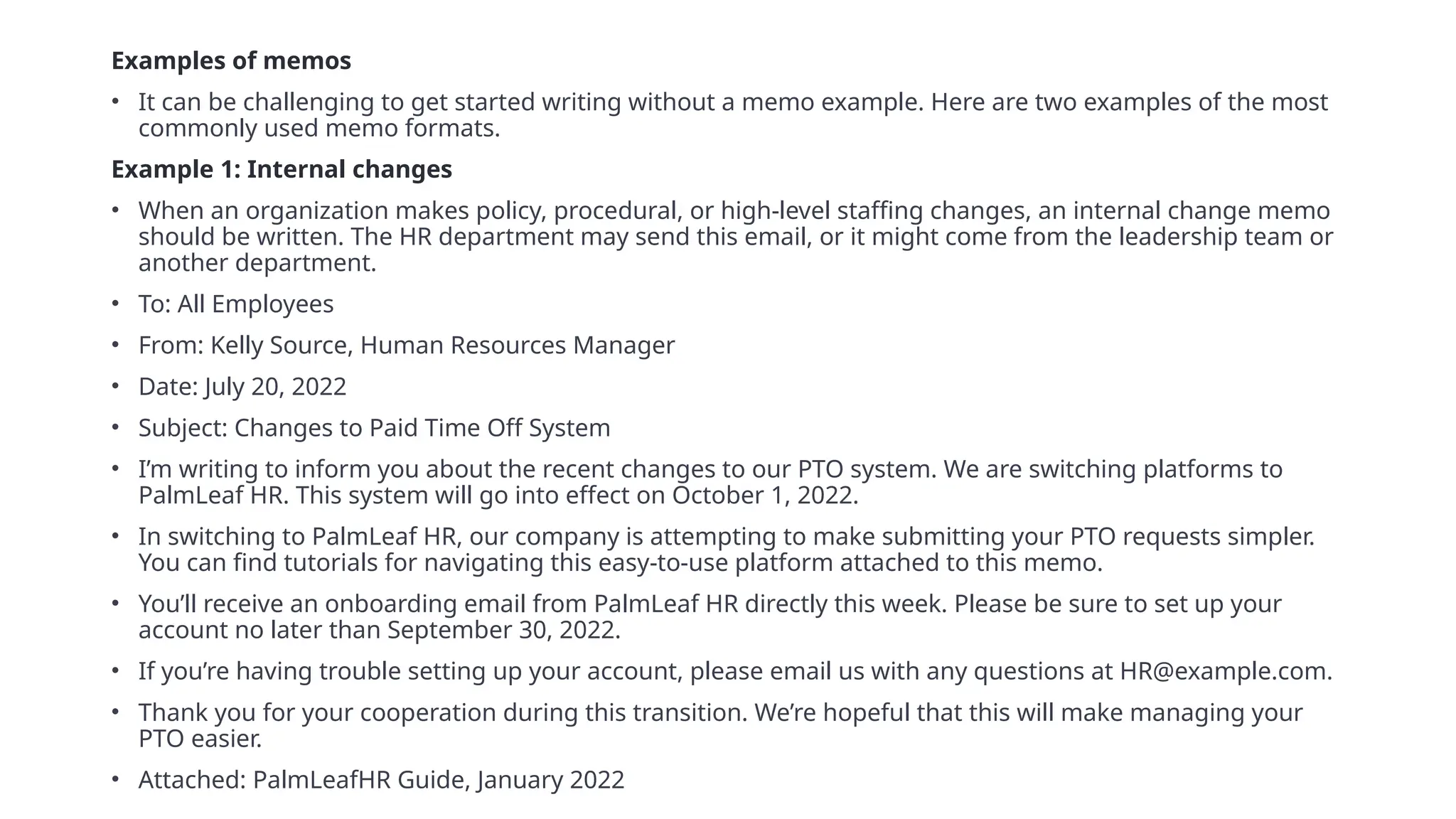
• It can be challenging to get started writing without a memo example. Here are two examples of the most
commonly used memo formats.
Example 1: Internal changes
• When an organization makes policy, procedural, or high-level staffing changes, an internal change memo
should be written. The HR department may send this email, or it might come from the leadership team or
another department.
• To: All Employees
• From: Kelly Source, Human Resources Manager
• Date: July 20, 2022
• Subject: Changes to Paid Time Off System
• I’m writing to inform you about the recent changes to our PTO system. We are switching platforms to
PalmLeaf HR. This system will go into effect on October 1, 2022.
• In switching to PalmLeaf HR, our company is attempting to make submitting your PTO requests simpler.
You can find tutorials for navigating this easy-to-use platform attached to this memo.
• You’ll receive an onboarding email from PalmLeaf HR directly this week. Please be sure to set up your
account no later than September 30, 2022.
• If you’re having trouble setting up your account, please email us with any questions at HR@example.com.
• Thank you for your cooperation during this transition. We’re hopeful that this will make managing your
PTO easier.
• Attached: PalmLeafHR Guide, January 2022
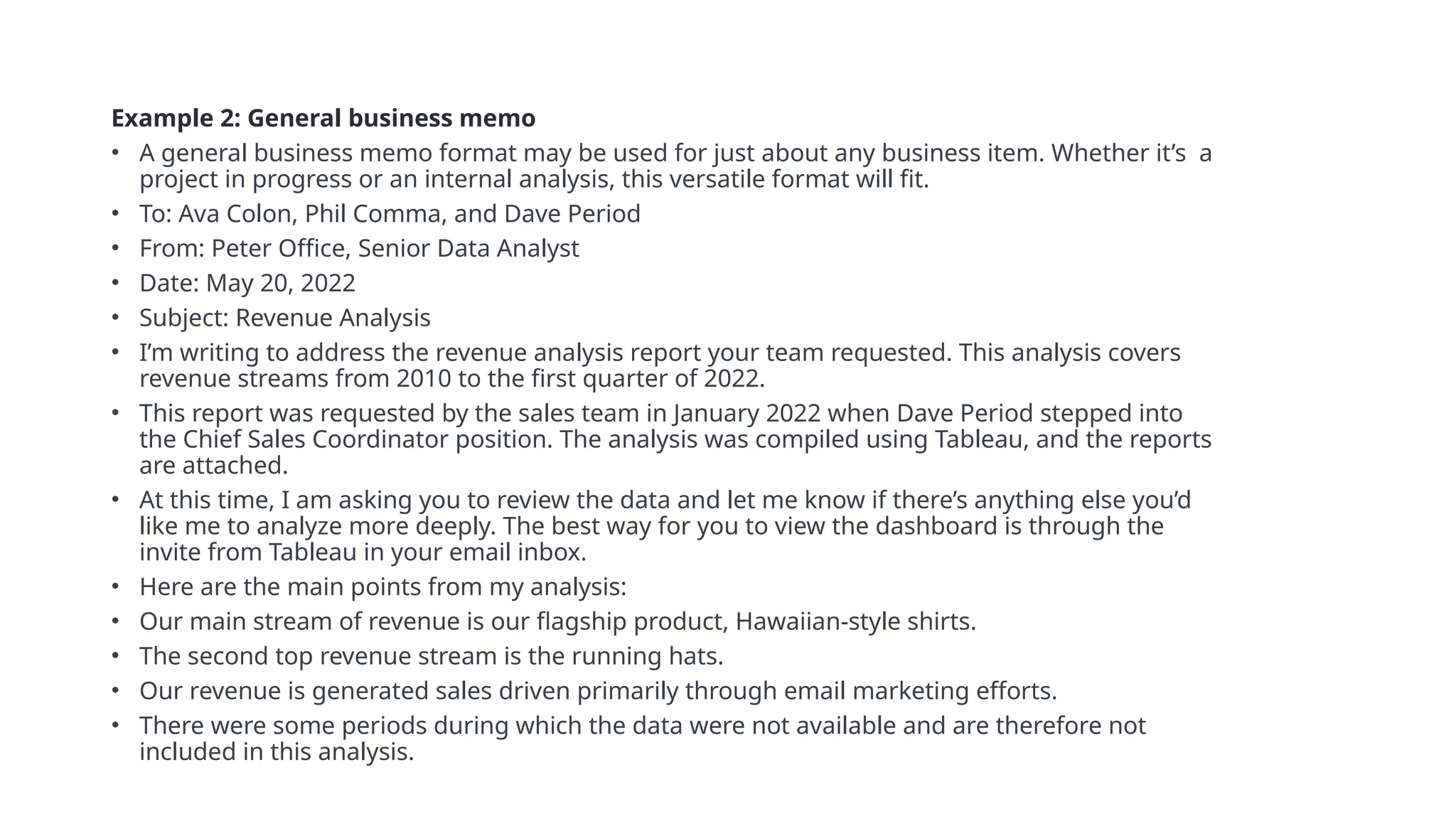
Example 2: General business memo
• A general business memo format may be used for just about any business item. Whether it’s a
project in progress or an internal analysis, this versatile format will fit.
• To: Ava Colon, Phil Comma, and Dave Period
• From: Peter Office, Senior Data Analyst
• Date: May 20, 2022
• Subject: Revenue Analysis
• I’m writing to address the revenue analysis report your team requested. This analysis covers
revenue streams from 2010 to the first quarter of 2022.
• This report was requested by the sales team in January 2022 when Dave Period stepped into
the Chief Sales Coordinator position. The analysis was compiled using Tableau, and the reports
are attached.
• At this time, I am asking you to review the data and let me know if there’s anything else you’d
like me to analyze more deeply. The best way for you to view the dashboard is through the
invite from Tableau in your email inbox.
• Here are the main points from my analysis:
• Our main stream of revenue is our flagship product, Hawaiian-style shirts.
• The second top revenue stream is the running hats.
• Our revenue is generated sales driven primarily through email marketing efforts.
• There were some periods during which the data were not available and are therefore not
included in this analysis.
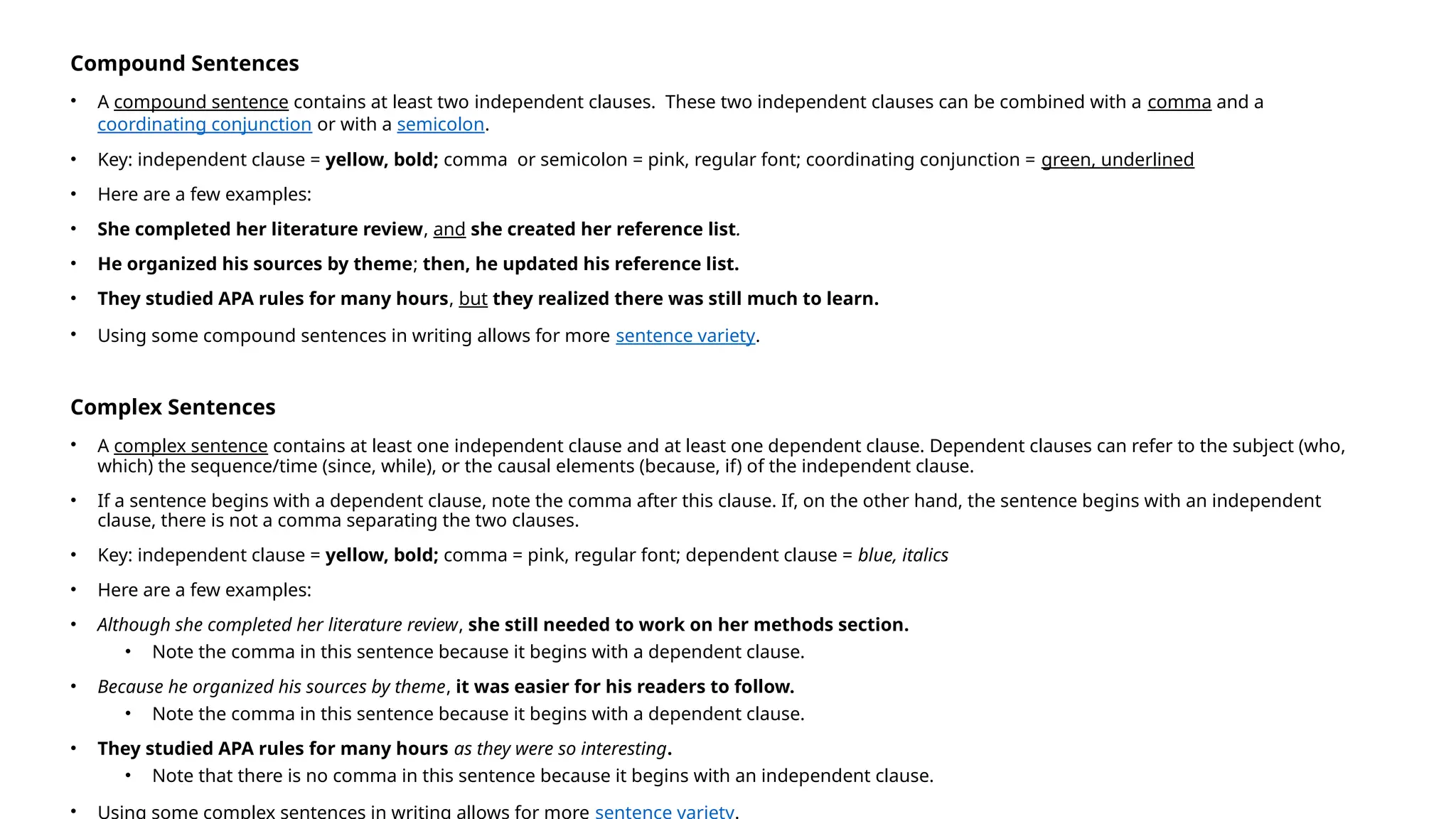
Compound Sentences
• A compound sentence contains at least two independent clauses. These two independent clauses can be combined with a comma and a
coordinating conjunction or with a semicolon.
• Key: independent clause = yellow, bold; comma or semicolon = pink, regular font; coordinating conjunction = green, underlined
• Here are a few examples:
• She completed her literature review, and she created her reference list.
• He organized his sources by theme; then, he updated his reference list.
• They studied APA rules for many hours, but they realized there was still much to learn.
• Using some compound sentences in writing allows for more sentence variety.
Complex Sentences
• A complex sentence contains at least one independent clause and at least one dependent clause. Dependent clauses can refer to the subject (who,
which) the sequence/time (since, while), or the causal elements (because, if) of the independent clause.
• If a sentence begins with a dependent clause, note the comma after this clause. If, on the other hand, the sentence begins with an independent
clause, there is not a comma separating the two clauses.
• Key: independent clause = yellow, bold; comma = pink, regular font; dependent clause = blue, italics
• Here are a few examples:
• Although she completed her literature review, she still needed to work on her methods section.
• Note the comma in this sentence because it begins with a dependent clause.
• Because he organized his sources by theme, it was easier for his readers to follow.
• Note the comma in this sentence because it begins with a dependent clause.
• They studied APA rules for many hours as they were so interesting.
• Note that there is no comma in this sentence because it begins with an independent clause.
• Using some complex sentences in writing allows for more sentence variety.
Compound-Complex Sentences
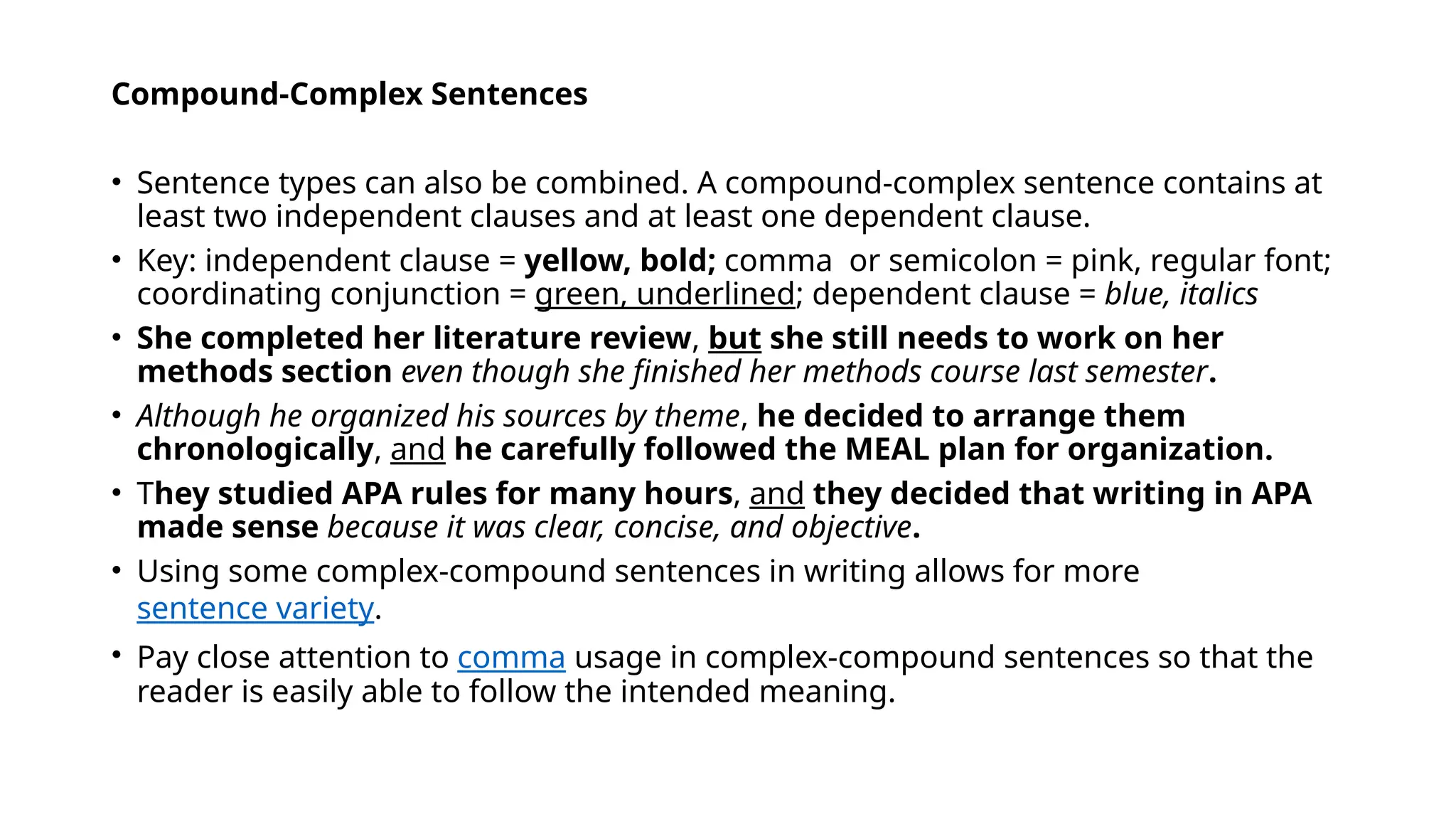
• Sentence types can also be combined. A compound-complex sentence contains at
least two independent clauses and at least one dependent clause.
• Key: independent clause = yellow, bold; comma or semicolon = pink, regular font;
coordinating conjunction = green, underlined; dependent clause = blue, italics
• She completed her literature review, but she still needs to work on her
methods section even though she finished her methods course last semester.
• Although he organized his sources by theme, he decided to arrange them
chronologically, and he carefully followed the MEAL plan for organization.
• They studied APA rules for many hours, and they decided that writing in APA
made sense because it was clear, concise, and objective.
• Using some complex-compound sentences in writing allows for more
sentence variety.
• Pay close attention to comma usage in complex-compound sentences so that the
reader is easily able to follow the intended meaning.
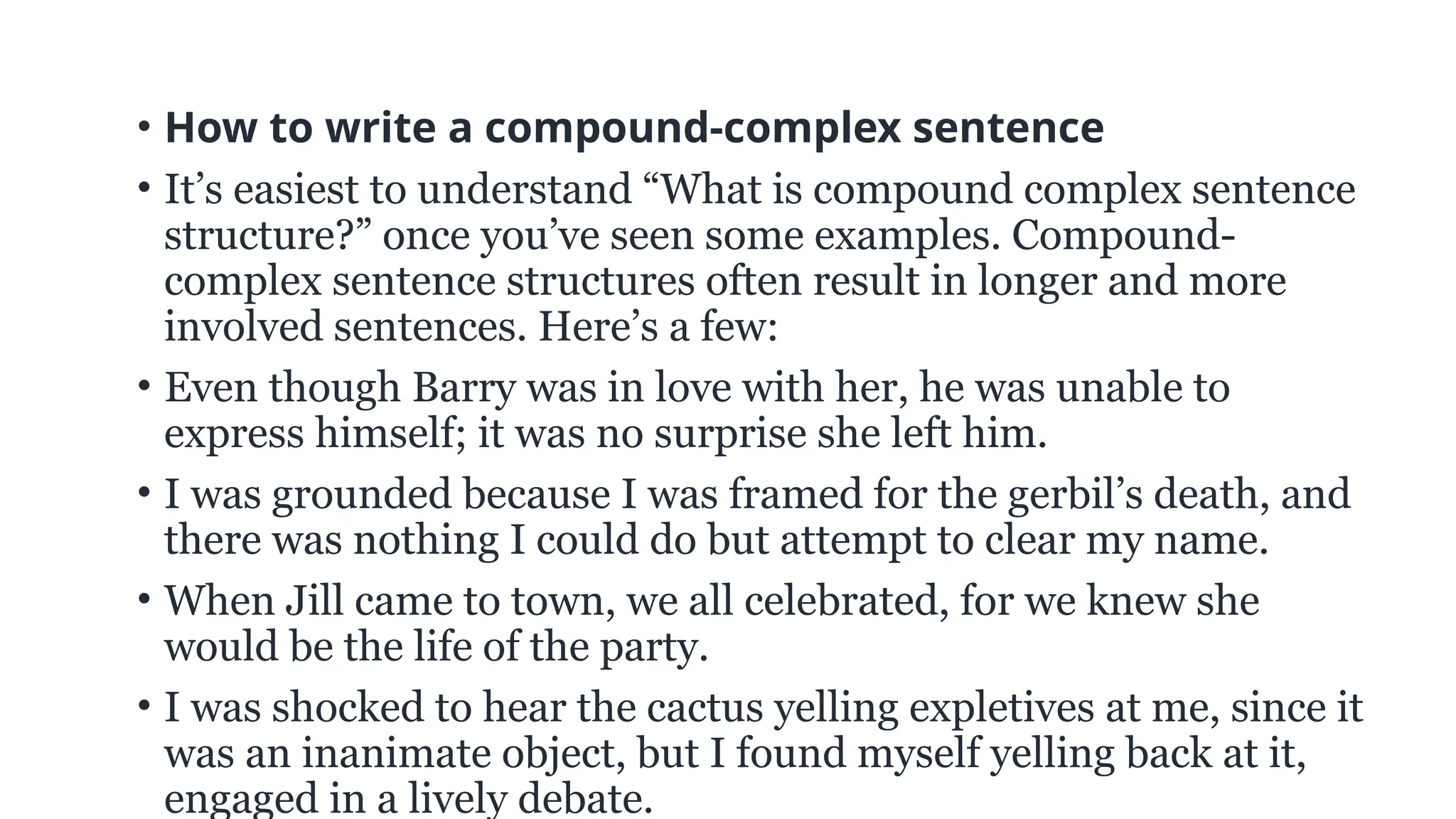
• How to write a compound-complex sentence
• It’s easiest to understand “What is compound complex sentence
structure?” once you’ve seen some examples. Compound-
complex sentence structures often result in longer and more
involved sentences. Here’s a few:
• Even though Barry was in love with her, he was unable to
express himself; it was no surprise she left him.
• I was grounded because I was framed for the gerbil’s death, and
there was nothing I could do but attempt to clear my name.
• When Jill came to town, we all celebrated, for we knew she
would be the life of the party.
• I was shocked to hear the cactus yelling expletives at me, since it
was an inanimate object, but I found myself yelling back at it,
engaged in a lively debate.
• What is sentence structure?
• Sentence structure is the order of all the parts in a sentence: subject, predicate, objects,
phrases, punctuation, etc. It deals a lot with independent and dependent clauses and how
they combine (explained below), the placement of words and phrases next to what they
modify, as well as the use of proper grammar.
• Basic parts of a sentence
• Every sentence requires at least a verb and a subject; a verb is an action, and a subject is
the noun that does the action.
• I am waiting.
• In this example, am waiting is the verb. The main verb is wait, but when we conjugate it in
the present continuous, we use the –ing form and add the auxiliary verb am. The subject
is I, the person who waits.
• The exception to this rule is imperative sentences (commands), which only need a verb. We
can assume the subject is the person the speaker is talking to.
• Stop!
• This single word is a complete sentence. The verb is stop, and no subject is necessary
because it’s a command.
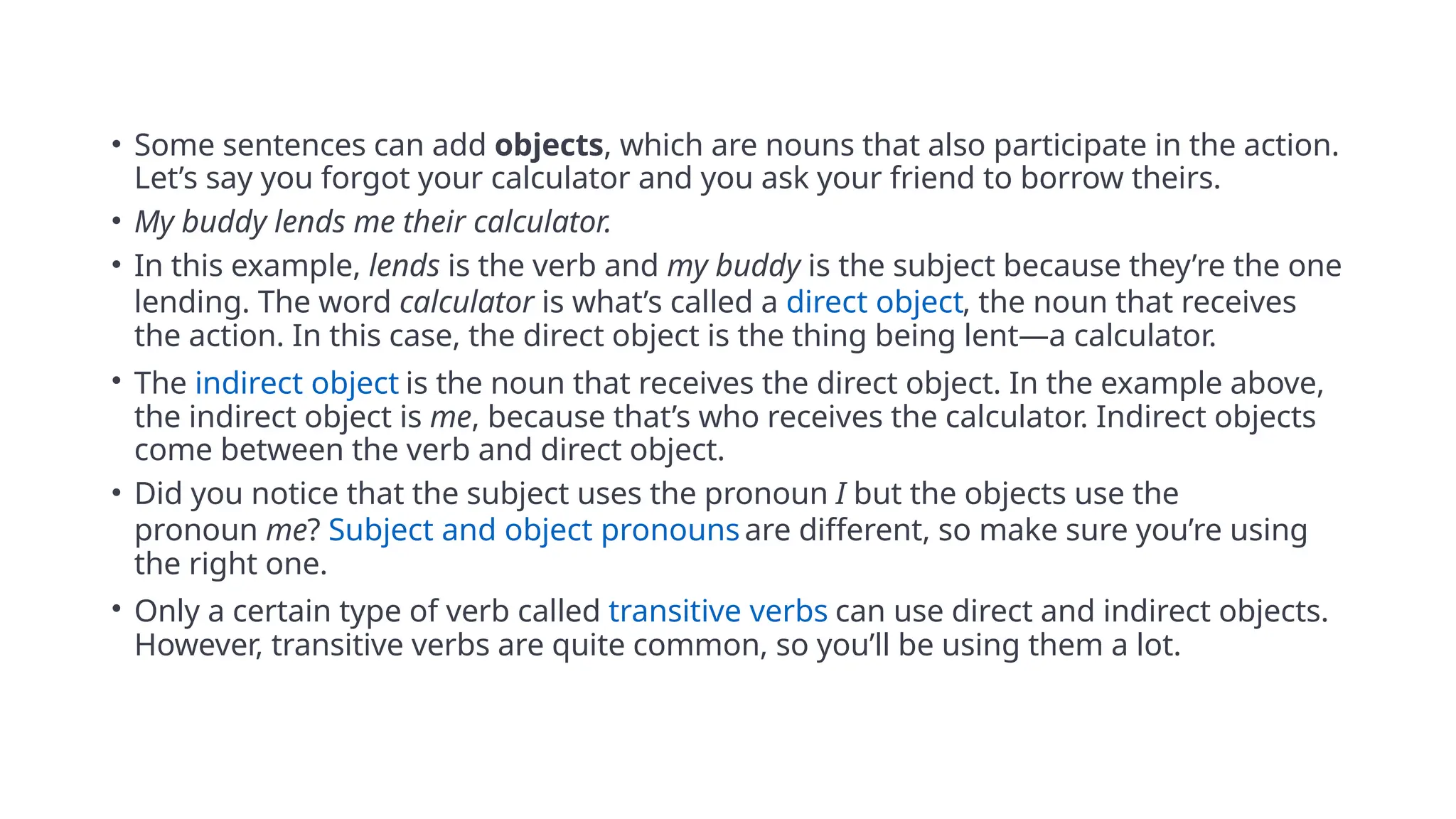
• Some sentences can add objects, which are nouns that also participate in the action.
Let’s say you forgot your calculator and you ask your friend to borrow theirs.
• My buddy lends me their calculator.
• In this example, lends is the verb and my buddy is the subject because they’re the one
lending. The word calculator is what’s called a direct object, the noun that receives
the action. In this case, the direct object is the thing being lent—a calculator.
• The indirect object is the noun that receives the direct object. In the example above,
the indirect object is me, because that’s who receives the calculator. Indirect objects
come between the verb and direct object.
• Did you notice that the subject uses the pronoun I but the objects use the
pronoun me? Subject and object pronouns are different, so make sure you’re using
the right one.
• Only a certain type of verb called transitive verbs can use direct and indirect objects.
However, transitive verbs are quite common, so you’ll be using them a lot.
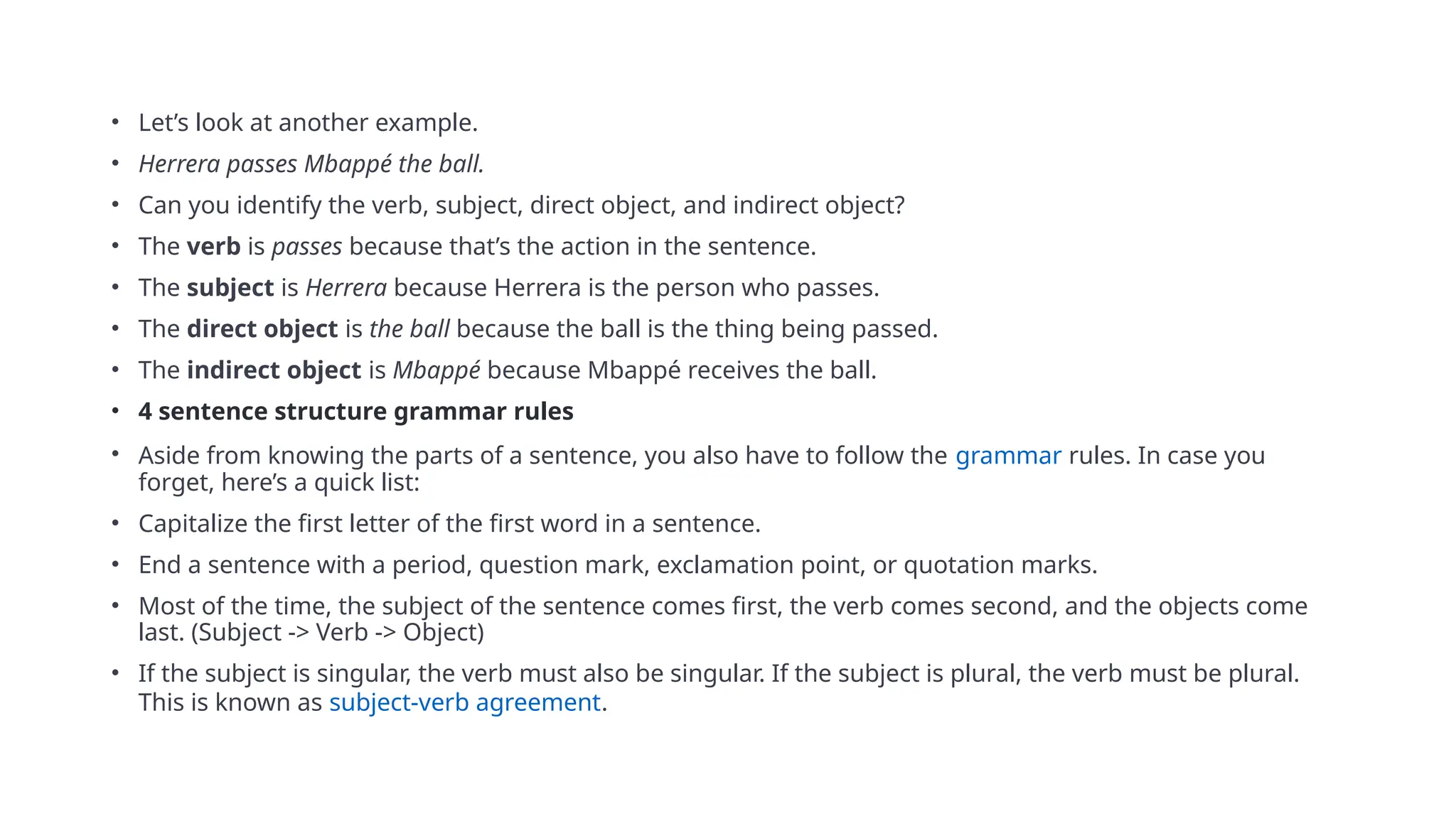
• Let’s look at another example.
• Herrera passes Mbappé the ball.
• Can you identify the verb, subject, direct object, and indirect object?
• The verb is passes because that’s the action in the sentence.
• The subject is Herrera because Herrera is the person who passes.
• The direct object is the ball because the ball is the thing being passed.
• The indirect object is Mbappé because Mbappé receives the ball.
• 4 sentence structure grammar rules
• Aside from knowing the parts of a sentence, you also have to follow the grammar rules. In case you
forget, here’s a quick list:
• Capitalize the first letter of the first word in a sentence.
• End a sentence with a period, question mark, exclamation point, or quotation marks.
• Most of the time, the subject of the sentence comes first, the verb comes second, and the objects come
last. (Subject -> Verb -> Object)
• If the subject is singular, the verb must also be singular. If the subject is plural, the verb must be plural.
This is known as subject-verb agreement.
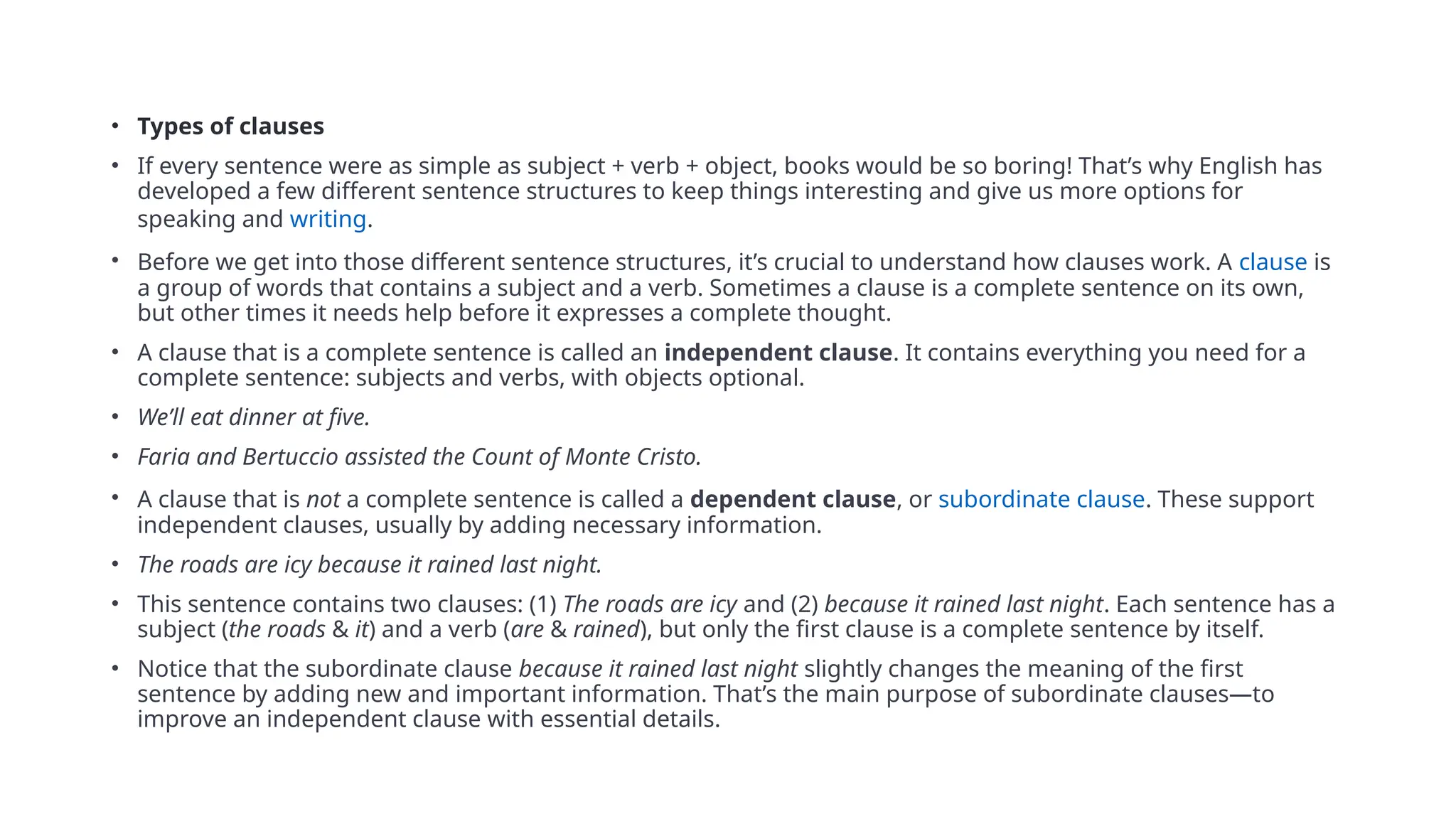
• Types of clauses
• If every sentence were as simple as subject + verb + object, books would be so boring! That’s why English has
developed a few different sentence structures to keep things interesting and give us more options for
speaking and writing.
• Before we get into those different sentence structures, it’s crucial to understand how clauses work. A clause is
a group of words that contains a subject and a verb. Sometimes a clause is a complete sentence on its own,
but other times it needs help before it expresses a complete thought.
• A clause that is a complete sentence is called an independent clause. It contains everything you need for a
complete sentence: subjects and verbs, with objects optional.
• We’ll eat dinner at five.
• Faria and Bertuccio assisted the Count of Monte Cristo.
• A clause that is not a complete sentence is called a dependent clause, or subordinate clause. These support
independent clauses, usually by adding necessary information.
• The roads are icy because it rained last night.
• This sentence contains two clauses: (1) The roads are icy and (2) because it rained last night. Each sentence has a
subject (the roads & it) and a verb (are & rained), but only the first clause is a complete sentence by itself.
• Notice that the subordinate clause because it rained last night slightly changes the meaning of the first
sentence by adding new and important information. That’s the main purpose of subordinate clauses—to
improve an independent clause with essential details.
• Although subordinate clauses have both subjects and verbs,
they cannot exist on their own. They contain special words
called subordinating conjunctions, which connect them to
independent clauses.
• Common subordinating conjunctions
include because, since, although, unless, and while, as well as
relative pronouns
like that, which, whatever, whenever, whoever, etc.
• If you see a subordinating conjunction, it means that group
of words is a subordinate clause. It helps to memorize them
so you can easily identify different clauses. You can find a
complete list of subordinating conjunctions here.
• 4 types of sentence structure
• Depending on how you combine clauses, you can create
four different types of sentence structure:
• Simple: 1 independent clause
• Compound: 2 or more independent clauses
• Complex:1 independent clause + 1 or more subordinate
clauses
• Compound-Complex: 2 or more independent clauses + 1 or
more subordinate clauses
• Simple sentences
• Simple sentences are pretty simple: just a single independent clause, no more, no less.
This includes subject and verbs, but can also include objects.
• “Life itself is the most wonderful fairy tale.”—Hans Christian Anderson
• “Real glory springs from the silent conquest of ourselves.”—Joseph P. Thompson
• Compound sentences
• A compound sentence joins together two or more independent clauses into a single
sentence. You can connect the independent clauses in two ways:
• Using a comma and a coordinating conjunction (for, and, nor, but, or, yet, and so, known
as FANBOYS) between the clauses.
• Using a semicolon between the clauses.
• “It may seem difficult at first, but everything is difficult at first.”—Miyamoto Musashi
• “Be yourself; everyone else is already taken.”—Oscar Wilde
• “We know they are lying, they know they are lying, they know we know they are lying, we know
they know we know they are lying, but they are still lying.”—Aleksandr Isayevich Solzhenitsyn
• Compound-complex sentences
• As the name suggests, compound-complex sentences combine
compound sentences with complex sentences. They require at
least two independent clauses and at least one subordinating
clause. To combine them, follow the specific grammar rules for
each; be sure you’re using your coordinating conjunctions and
subordinating conjunctions in the right places.
• “If you’re going to be crazy, you have to get paid for it, or else you’re
going to be locked up.”—Hunter S. Thompson
• “Don’t aim for success if you want it; just do what you love and believe
in, and it will come naturally.”—David Frost
• What Is a Phrase? – Meaning and Types
• A phrase is a part of a sentence which consists of a group of words that give more information
about the subject, action or event in a sentence. A phrase cannot stand on its own and will not
convey meaning if separated from the sentence. According to the kind of function it does, it can be
classified into various types and they include the following.
• Noun Phrase
• Verb Phrase
• Adverb/Adverbial Phrase
• Prepositional Phrase
• Adjective/Adjectival Phrase
• What Is a Clause? – Meaning and Types
• A clause is also a part of a sentence that consists of a subject and a verb, unlike phrases. They can
be divided into two main types depending on how they behave in a sentence. The different types of
clauses are:
• Main Clause or Independent Clause
• Subordinate Clause or Dependent Clause
• Examples of Phrases and Clauses
• To understand how phrases and clauses can be used, take a look at
the following sentences.
• Anu and Teena (noun phrase)
• Have been searching (verb phrase)
• Beside the trees (prepositional phrase)
• Extremely well (adverb phrase)
• The house on 6th
street (noun phrase)
• As soon as I reach the office (dependent or subordinate clause)
• I did not bring my umbrella. (independent clause)
• When the little boy saw his mom (dependent or subordinate clause)
• Collect your parcel from the courier office. (independent clause)
• Though we left home early (dependent or subordinate clause)
• Check Your Understanding of Phrases and
Clauses
Identify the phrases and clauses in the following
sentences and state which of them is a phrase and a clause.
• 1. I completed my project, but I was not satisfied with it.
• 2. Jacob knew about it; however he kept asking
everyone about it.
• 3. I was waiting at the park.
• 4. They all sang extremely well.
• 5. The girls in the black dresses are the ones who won
the competition last year.
• 6. In the meantime, I will help you with your domestic
chores.
• 7. Santana and Brittany are good dancers.
• 8. When we reach home, we will call you.
• 9. We were planning our summer vacation.
• 10. She finally agreed to come with us to the slumber
party.
Now, check your answers to find out if you identified the phrases
and clauses correctly.
1. I completed my project, / but I was not satisfied with it.
Clause / Clause
2. Jacob knew about it; / however he kept asking everyone about
it.
Clause / Clause
3. I was waiting / at the park.
Clause / Phrase
4. They all sang / extremely well.
Clause / Phrase
5. The girls in the black dresses are the ones / who won the
competition last year.
Clause / Clause
6. In the meantime, / I will help you with your domestic chores.
Phrase / Clause
7. Santana and Brittany are good dancers.
Clause
8. When we reach home, / we will call you.
Clause / Clause
9. We were planning our summer vacation.
Clause
10. She finally agreed to come with us / to the slumber party.
Clause / Clause
• What is an essay introduction?
• An introduction is the opening section of an essay, paper, or other written work. It
introduces the topic and provides background information, context, and an
overview of what the reader can expect from the rest of the work.1
The key is to be
concise and to the point, providing enough information to engage the reader
without delving into excessive detail.
• What to include in an essay introduction?
• The essay introduction is crucial as it sets the tone for the entire piece and
provides the reader with a roadmap of what to expect. Here are key elements to
include in your essay introduction:
• Hook: Start with an attention-grabbing statement or question to engage the
reader. This could be a surprising fact, a relevant quote, or a compelling
anecdote.
• Background information: Provide context and background information to help
the reader understand the topic. This can include historical information,
definitions of key terms, or an overview of the current state of affairs related to
your topic.
• Thesis statement: Clearly state your main argument or position on the topic.
Your thesis should be concise and specific, providing a clear direction for your
essay.
• How to create an essay structure?
• Before we get into how to write an essay introduction, we need to
know how it is structured. The structure of an essay is crucial for
organizing your thoughts and presenting them clearly and logically. It
is divided as follows:2
• Introduction: The introduction should grab the reader’s attention with
a hook, provide context, and include a thesis statement that presents
the main argument or purpose of the essay.
• Body: The body should consist of focused paragraphs that support
your thesis statement using evidence and analysis. Each paragraph
should concentrate on a single central idea or argument and provide
evidence, examples, or analysis to back it up.
• Conclusion: The conclusion should summarize the main points and
restate the thesis differently. End with a final statement that leaves a
lasting impression on the reader. Avoid new information or arguments.
• Step-by-step process for writing an essay introduction
• Here’s a step-by-step guide on how to write an essay introduction:
• Start with a Hook: Begin your introduction paragraph with an
attention-grabbing statement, question, quote, or anecdote related
to your topic. The hook should pique the reader’s interest and
encourage them to continue reading.
• Provide Background Information: This helps the reader understand
the relevance and importance of the topic.
• State Your Thesis Statement: The last sentence is the main
argument or point of your essay. It should be clear, concise, and
directly address the topic of your essay.
• Preview the Main Points: This gives the reader an idea of what to
expect and how you will support your thesis.
• Keep it Concise and Clear: Avoid going into too much detail or
including information not directly relevant to your topic.
• Revise: Revise your introduction after you’ve written the rest of your
essay to ensure it aligns with your final argument.
• How to write a hook for your essay?
• This is one of the key steps in how to write an essay introduction. Crafting a
compelling hook is vital because it sets the tone for your entire essay and
determines whether your readers will stay interested. A good hook draws the
reader in and sets the stage for the rest of your essay.
• Avoid Dry Fact: Instead of simply stating a bland fact, try to make it engaging and
relevant to your topic. For example, if you’re writing about the benefits of exercise,
you could start with a startling statistic like, “Did you know that regular exercise
can increase your lifespan by up to seven years?”
• Avoid Using a Dictionary Definition: While definitions can be informative, they’re
not always the most captivating way to start an essay. Instead, try to use a quote,
anecdote, or provocative question to pique the reader’s interest. For instance, if
you’re writing about freedom, you could begin with a quote from a famous
freedom fighter or philosopher.
• Do Not Just State a Fact That the Reader Already Knows: This ties back to the
first point—your hook should surprise or intrigue the reader. For Here’s an
introduction paragraph example, if you’re writing about climate change, you could
start with a thought-provoking statement like, “Despite overwhelming evidence,
many people still refuse to believe in the reality of climate change.”
• How to include background information?
• Including background information in the introduction section of your essay is important to provide
context and establish the relevance of your topic. When writing the background information, you can
follow these steps:
• Start with a General Statement: Begin with a general statement about the topic and gradually narrow it
down to your specific focus. For example, when discussing the impact of social media, you can begin by
making a broad statement about social media and its widespread use in today’s society, as follows: “Social
media has become an integral part of modern life, with billions of users worldwide.”
• Define Key Terms: Define any key terms or concepts that may be unfamiliar to your readers but are
essential for understanding your argument.
• Provide Relevant Statistics: Use statistics or facts to highlight the significance of the issue you’re
discussing. For instance, “According to a report by Statista, the number of social media users is expected
to reach 4.41 billion by 2025.”
• Discuss the Evolution: Mention previous research or studies that have been conducted on the topic,
especially those that are relevant to your argument. Mention key milestones or developments that have
shaped its current impact. You can also outline some of the major effects of social media. For example,
you can briefly describe how social media has evolved, including positives such as increased connectivity
and issues like cyberbullying and privacy concerns.
• Transition to Your Thesis: Use the background information to lead into your thesis statement, which
should clearly state the main argument or purpose of your essay. For example, “Given its pervasive
influence, it is crucial to examine the impact of social media on mental health.”
• How to write a thesis statement?
• A thesis statement is a concise summary of the main point or claim of an essay,
research paper, or other type of academic writing. It appears near the end of the
introduction. Here’s how to write a thesis statement:
• Identify the topic: Start by identifying the topic of your essay. For example, if your
essay is about the importance of exercise for overall health, your topic is “exercise.”
• State your position: Next, state your position or claim about the topic. This is the main
argument or point you want to make. For example, if you believe that regular exercise
is crucial for maintaining good health, your position could be: “Regular exercise is
essential for maintaining good health.”
• Support your position: Provide a brief overview of the reasons or evidence that
support your position. These will be the main points of your essay. For example, if
you’re writing an essay about the importance of exercise, you could mention the
physical health benefits, mental health benefits, and the role of exercise in disease
prevention.
• Make it specific: Ensure your thesis statement clearly states what you will discuss in
your essay. For example, instead of saying, “Exercise is good for you,” you could say,
“Regular exercise, including cardiovascular and strength training, can improve overall
health and reduce the risk of chronic diseases.
• Examples of essay introduction
• Here are examples of essay introductions for different types of essays:
• Argumentative Essay Introduction Example:
• Topic: Should the voting age be lowered to 16?
• “The question of whether the voting age should be lowered to 16 has sparked nationwide debate. While
some argue that 16-year-olds lack the requisite maturity and knowledge to make informed decisions,
others argue that doing so would imbue young people with agency and give them a voice in shaping their
future.”
• Expository Essay Introduction Example
• Topic: The benefits of regular exercise
• “In today’s fast-paced world, the importance of regular exercise cannot be overstated. From improving
physical health to boosting mental well-being, the benefits of exercise are numerous and far-reaching.
This essay will examine the various advantages of regular exercise and provide tips on incorporating it
into your daily routine.”
• Literary Analysis Essay Introduction Example
• Text: “To Kill a Mockingbird” by Harper Lee
• “Harper Lee’s novel, ‘To Kill a Mockingbird,’ is a timeless classic that explores themes of racism, injustice,
and morality in the American South. Through the eyes of young Scout Finch, the reader is taken on a
journey that challenges societal norms and forces characters to confront their prejudices. This essay will
analyze the novel’s use of symbolism, character development, and narrative structure to uncover its
deeper meaning and relevance to contemporary society.”
• Check and revise – Checklist for essay
introduction
• Engaging and Relevant First Sentence: The opening
sentence captures the reader’s attention and relates
directly to the topic.
• Background Information: Enough background
information is introduced to provide context for the
thesis statement.
• Definition of Important Terms: Key terms or concepts
that might be unfamiliar to the audience or are
central to the argument are defined.
• Clear Thesis Statement: The thesis statement
presents the main point or argument of the essay.
• Relevance to Main Body: Everything in the
introduction directly relates to and sets up the
discussion in the main body of the essay.
Key takeaways
Writing a strong introduction is crucial for setting the
tone and context of your essay. Here are the key
takeaways for how to write essay introduction:3
•Hook the Reader: Start with an engaging hook to
grab the reader’s attention. This could be a
compelling question, a surprising fact, a relevant
quote, or an anecdote.
•Provide Background: Give a brief overview of the
topic, setting the context and stage for the
discussion.
•Thesis Statement: State your thesis, which is the
main argument or point of your essay. It should be
concise, clear, and specific.
•Preview the Structure: Outline the main points or
arguments to help the reader understand the
organization of your essay.
•Keep it Concise: Avoid including unnecessary details
or information not directly related to your thesis.
•Revise and Edit: Revise your introduction to ensure
clarity, coherence, and relevance. Check for grammar
and spelling errors.
•Seek Feedback: Get feedback from peers or
instructors to improve your introduction further.
• What is Precis Writing?
• Precis Writing is a summary. It is an exercise of compression. A precis writing is
a gist of any passage in as few words as possible. A precis should mention all
important details of the original paragraph so that anyone who is reading it can
understand the idea of the original passage.
• Taking the above example forward, to describe the essential highlights and
events that take place in The Merchant of Venice, you will not add your own
thoughts and maintain the tone and expressions of the characters. You will also
avoid mentioning events that aren’t essential. This is how precis writing works.
You express or rewrite a paragraph or any type of writing and make it as
concise as possible without having to change the crux of the subject matter.
• In precis writing, you must be carefully objective and maintain the theme of the
passage without excluding the important points. Comprehend the passage
carefully to conclude about what is important in an article or a story. You might
take a while to read it the first time, but as you keep reading it, the later times
might just be an easy skim over the pages. Precis writing requires a very strong
understanding of the story/ text to convey the same message in a miniature
form.
• Precis Writing Format
• There are different ways of writing a format and hence
different formats. But the most important aspects needed to
include in a precis are common throughout all. Let’s check
this general format that’s mentioned below
Title of the Precis
Introduction of the Text (One-
Sentence)
Overview of Main Arguments of
the Passage
Brief Statement Concluding the
Precis
• Do’s and Don’ts of Precis Writing
• Here are some Do’s listed below which one can follow in
Precis Writing:
• ✔️Read all the text carefully and identify the main points.
Focus on the main points of the given text and it is best to
✔️
avoid adding any irrelevant information.
Write a concise summary of the text which reflects all the
✔️
main points of it.
• Don’ts to be followed in Precis Writing
• ❌ Avoid including your personal opinion
❌ Re-write or summarize the entire text
❌ Avoid adding any superfluous details
• How to Write a Precis?
• Owing to the repeatedly mentioned importance of keeping a precis
short, writing a precis requires you to carefully understand the
points that will provide the necessary highlights of the content. It
might sound easy, but comprehending a text and keeping its
theme intact requires strong skills and a lot of brainstorming. Here
are the steps that can easily help you compose a clear precis.
• Understand the Text/Narrative
• The main and the most crucial point is to read the text multiple
times. It is possible that you might have missed some point or not
have understood it. Reading it persistently can take you through
some overlooked points and explain certain points in a better
manner. After perusing the text a few times, you will easily connect
through the points and also form a mental outline of the content.
• Highlight and Divide the Text
• Courtesy: Tenor
• Divide the text into smaller parts and make sure you use a highlighter to
highlight the main details for further reference. Create an order of the
texts so that you line up each event and do not muddle up the points.
• Create a Mind Map
• Courtesy: Whimsical
• Before constructing your precis, have a rough outline or a map with all
the points you think are necessary. Read it and compare it to the text. You
might want to add/omit certain points to make it more clear. Make sure
your outline follows the order of the text.
• Writing your Precis
• Courtesy: Giphy
• Start constructing your precis and make sure you compress the text by
using shorter sentences and cutting out redundancy. Make sure you keep
a word count of your precis. It should be 1/4th of the main text. The four
main points to remember while constructing your precis are:
• Add a suitable title for your precis which is in line with the content.
• It should be written in the third person.
• The text should be in an indirect form.
• Use appropriate past tense.
• Review your Precis
• Courtesy: Giphy
• Reread your precis multiple times and check for errors or grammatical
mistakes. Compare it with the original text and check if both the
compositions exhibit the same themes and convey the exact message. In
the end, add the number of words used in your precis in a bracket.
• Qualities of a Good
Precis 🎯
• What are the parameters to
judge precis writing? The
following are some
attributes that describe a
good precis.
• 🎯 Accurate and Precise
🎯 Clear and coherent
🎯 Well connected
🎯 Original
🎯 A suitable title
Uses of Precis Writing
People often want to go through
the highlights of books, movies,
meetings, an article, reports, news,
etc. This is when precis writing
works to deliver the main points to
the audience without making any
modifications in the proportion,
tone, or theme of the content.
Precis writing plays an essential
role in the following areas:
•Precis writing can be used to
describe a chapter so that students
get the gist of the basics.
•Precis writing is also used in
companies for job descriptions,
meeting highlights, etc.
•The use of precis writing is also
seen in movies to describe the
main events or plot of the film.
•Precis writing is also used in
scientific reports and research to
give the gist of its content.
• Essential Rules for Good Precis Writing
• After understanding how to write a precis, let’s look at a few tips
that can help you ace your precis.
• ✏️Keep the text terse and up to the point.
Use shorter words. For example, use ‘because’ instead of
✏️
‘owing to’, use ‘although’ instead of ‘in spite of the fact that, etc.
Make sure your text is lucid to understand. Avoid using jargon
✏️
and complex sentences.
Retain the core of the text.
✏️
Your text should be a miniature reflection of the original text
✏️
and should state the correct facts and figures.
• Sample of Precis Writing
• Here is an example of precis writing with a solution:
• Sample 1
• “The internet has revolutionized the way we communicate and access
information. With the click of a button, we can connect with people
around the world, share ideas, and stay informed about current events.
This instant access to vast amounts of information has both positive and
negative implications. On the positive side, it allows for unprecedented
global connectivity and the democratization of knowledge. However, it
also raises concerns about privacy, misinformation, and the potential for
online abuse. As we navigate this digital age, it is essential to strike a
balance between the benefits and challenges posed by the internet.”
• Precis
• “The internet’s
transformative impact on
communication and
information retrieval is
evident. Instant global
connectivity and knowledge
democratization are positive
outcomes, yet concerns
arise regarding privacy,
misinformation, and online
abuse. Striking a balance
between the benefits and
challenges of the digital age
becomes crucial.”
Points to Avoid for Precis
Writing
Precis writing can be
complicated since you need
to cut down all points that
aren’t important. While
keeping the tips in mind,
avoid making the following
mistakes while writing a
precis.
•Do not elaborate a lot on a
single point.
•Do not use your own
interpretation, criticism, or
assumption about the text.
•Do not copy sentences from
the original text or use
abbreviations.
•Do not break the flow of
events and keep the text well
connected.
Presentation (3).pptx for English semester

Presentation (3).pptx for English semester

  • 2.
    STUDENT NAME: SAIRA YOUSAF ROLL#: 404 NOTES: ENGLISH SMESTER: SECOND (2ND ) PREPARED BY: ENGINEER SAIRA YOUSAF DISCIPLINE : Chemistry
  • 3.
  • 4.
    Paragraph Unity, Coherence,and Development • Menu • About the Writing Center • People • Writing Resources • English Language Support • FAQ • Writing at Wheaton • In each paragraph of an essay, one particular idea or topic is developed and explained. In order to successfully do so, however, it is essential that the paragraph be written in a unified and coherent manner. • A unified paragraph must follow the idea mentioned in the topic sentence and must not deviate from it. For a further explanation on topic sentences, see the Write Right on Topic Sentences.
  • 5.
    • A coherentparagraph has sentences that all logically follow each other; they are not isolated thoughts. Coherence can be achieved in several ways. First, using transitions helps connect ideas from one sentence to the next. For more on transitions, see the Write Right on Transitions. Second, ordering thoughts in numerical sequence helps to direct the reader from one point to the next. Third, structuring each paragraph according to one of the following patterns helps to organize sentences: general to particular; particular to general; whole to parts; question to answer; or effect to cause. • Remember that a paragraph should have enough sentences so that the main idea of the topic sentence is completely developed. Generalizations should be supported with examples or illustrations. Also, details and descriptions help the reader to understand what you mean. Don't ever assume that the reader can read your mind: be specific enough to develop your ideas thoroughly, but avoid repetition
  • 6.
    • An effectiveparagraph might look like this: • It is commonly recognized that dogs have an extreme antagonism toward cats. This enmity between these two species can be traced back to the time of the early Egyptian dynasties. Archaeologists in recent years have discovered Egyptian texts in which there are detailed accounts of canines brutally mauling felines. Today this type of cruelty between these two domestic pets can be witnessed in regions as close as your own neighborhood. For example, when dogs are walked by their masters (and they happen to catch sight of a stray cat), they will pull with all their strength on their leash until the master is forced to yield; the typical result is that a feline is chased up a tree. The hatred between dogs and cats has lasted for many centuries, so it is unlikely that this conflict will ever end.
  • 7.
    • This paragraphis effective for the following reasons: • The paragraph shows unity. All the sentences effectively relate back to the topic sentence at the beginning of the paragraph. • The paragraph shows coherence. There is a flow of thoughts and ideas among the sentences in this paragraph. There are good transitions employed in the paragraph. The writer also presents her sub-topics in an orderly fashion that the reader can follow easily. • The paragraph is developed. The writer gives herself enough space to develop the topic. She gives us at least two reasons to accept her argument and incorporates some examples in order to give those reasons more validity.
  • 8.
    Supporting Paragraphs • "Aparagraph is a sentence or group of sentences that develops a main idea. Paragraphs serve as the primary building blocks of essays, reports, memos, and other forms of written composition" (Hult and Huckin, The New Century Handbook, 103). • In essence, paragraphs control the design and structure of the written composition. Paragraphs in the middle of your composition develop the thesis statement and provide transition ideas between supporting details. • Paragraphs should be "unified, coherent, and adequately developed, while flowing from one to the next as smoothly as possible" (Hult and Huckin, The New Century Handbook, 103).
  • 9.
    • "A unifiedparagraph focuses on and develops a single main idea. This idea is typically captured in a single sentence, called a topic sentence. The other sentences in the paragraph, the supporting sentences, should elaborate on the topic sentence in a logical fashion (Hult and Huckin, The New Century Handbook, 104). • The supporting sentences, also called the body of the paragraph, are used to support, explain, illustrate, or provide evidence for the idea expressed in the topic sentence.
  • 10.
    Topic Sentence expressesa paragraph's main idea Body of the Paragraph develops the main idea expressed in the topic sentence
  • 11.
    The main characteristicsof a well- written paragraph Unity Is achieved by keeping details in the paragraph focused around the central idea.
  • 12.
    Coherence • Linking individualsentences within a paragraph should be done in a logical way; the paragraph itself should be connected with the rest of the composition by following the natural progression of thought. Use transitional words and phrases to ensure the smooth flow of thought
  • 13.
    Adequate Development • Eachparagraph should be long enough to develop in full the main idea expressed in the topic sentence.
  • 14.
    • A paragraphshould not introduce any other evidence or provide information that does not support the main idea; otherwise, the paragraph will lack unity and coherence. • Find logical subdivisions in your argument and organize them into unified paragraphs. • It is common to start a paragraph with a topic sentence and then let the rest of the sentences build details to support it. However, this is not by any means the only or the best pattern. The topic sentence can appear in any part of the paragraph or sometimes it can be implied.
  • 15.
    Topic sentences atthe beginning of a paragraph • In the following two paragraphs, the topic sentence appears at the beginning: • The environment the teacher creates in the classroom plays one of the most crucial roles in successful learning. This is true of any setting, whether the teaching occurs in a long academic program or in a tutoring situation. The teacher is a role model, a person students can trust, a guide, and a mentor. It is the responsibility of the teacher to create a low-anxiety environment in order to allow the students to enjoy the learning process. A good teacher tries to find out what works best with a particular learner or a group of learners and goes from there. What needs to come first in any learning situation is not a specific aspect or principle of methodology but the learners themselves. • From a Teaching Practicum Reflection Paper • Online education has become more popular than other forms of distance education because it offers learners a great deal of flexibility. Students have the freedom to work at their own pace, time, and chosen location. The flexibility of online learning makes it a very powerful tool that enhances learning, provides motivation for self-directed study, and, at the same time, increases convenience for learners with effective use of place and time. Online education is an excellent solution for those who consider learning to be a lifelong process. For adult learners, it provides the possibility to manage work, family, and other activities while still being able to take classes.
  • 16.
    From a studentresearch paper on Advantages and Limitations of Web-Based Instruction • "A topic sentence should, if possible, do four things: (1) provide a transition from a the preceding paragraph, (2) introduce the topic of the paragraph, (3) make a main point about this topic, and (4) suggest how the rest of the paragraph will develop this point" (Hult and Huckin, The New Century Handbook, 104).
  • 17.
    Suggestions for writingparagraphs • Avoid paragraphs that are either too long or too short • Develop a single idea in a paragraph • Use different patterns of paragraph development (narration, description, definition, example, comparison and contrast, analogy, cause and effect, or process) • Provide transitions between paragraphs to make your writing flow smoothly (refer to the section on Transitions)
  • 18.
    Reasons to starta new paragraph • Introduce a new idea • Emphasize an idea • Introduce a logical pause • Introduce a subtopic • Conclude the composition
  • 19.
    Difference Between Extensiveand Intensive Reading • Extensive means covering a substantial area and so, extensive reading refers to that type of reading in which students read and refer to large quantities of material, chosen by themselves. As against, intensive refers to in-depth or concentrated. Therefore, intensive reading means that type of reading in which the material has to be read carefully and thoroughly, to get specific details.
  • 20.
    • Reading isthe means to study something, wherein the reader looks at the words, symbol and characters of the material so as to comprehend its meaning. Extensive reading and Intensive Reading are the two common approaches to language learning. • Basically, an ideal reading program combines both the approaches, wherein intensive reading can be used to acquaint new language and extensive reading can be helpful in spreading awareness of that language. Let’s move further to know the difference between extensive and intensive reading.
  • 21.
    Content: Extensive VsIntensive Reading Comparison Chart Definition Key Differences Conclusion
  • 23.
    Involves Use of dictionary Helpfulin . Reading of a number of books on a similar concept or subject. No Developing reading fluency Definition of Extensive Reading Extensive Reading can be defined as a casual reading performed for pleasure or gaining general understanding on a topic when the students are engrossed in a book, magazine or newspaper. In this approach students read long texts and refer to various supporting study material, only to enjoy the reading and gaining a better understanding of the Reading of a book again and again to extract its literal meaning Yes Developing reading skills, vocabulary and grammatical knowledge.
  • 24.
    • That iswhy, for extensive reading, the readers look for easy, interesting and amusing books, so as to improve their reading fluency and speed as well. The text is comparatively simple, containing a few unfamiliar words. • The individual can select the book or material of his choice, on the topic that matches their interest. Further, there is no follow-up discussion to be held in the class for what the students have learnt during their reading. • Extensive Reading is just to encourage the habit of reading in students for pleasure and make them a voracious reader. Hence, it does not really matter as to whether the reader understands each word written in the text or not, to get the basic concept of the passage. • In addition to this, the extensive reading method gives an opportunity to the students to read lots of material, which they select for themselves according to their reading speed and capability.
  • 25.
    Definition of IntensiveReading • Intensive Reading can be understood as the reading method which requires intimate study of a text with the objective of getting its literary or linguistic meaning. The readers are supposed to read the text with concentration and due care, in detail, as it has certain learning aims and tasks. • Basically, it is the in-depth reading of a comparatively shorter piece of reading material, to gain complete knowledge from it. It aims at identifying the answers to the questions of reading comprehension. Moreover, it can be used for the purpose of skimming and scanning, and the concatenation of the sentences.
  • 26.
    involves an analysisof the text by the deconstruction of the sentences and looking over each word, phrase and collocation which is not understandable with an aim of extracting the essence and meaning of the text as much as possible and learn the grammar and syntax rules. Further, the goals of intensive reading include understanding the gist and subject matter of the text, improving grammar and vocabulary, and understanding the thought of the author behind the text. The main focus of the learner is on the language used, rather than the text Key Differences Between Extensive and Intensive Reading The main points of difference between extensive and intensive reading are explained below: 1.In extensive reading the reader reads multiple books, newspaper, magazines etc. to get a general understanding of the topic of their interest. Conversely, Intensive reading is concerned with classroom learning, wherein the student is compelled to read some text as many times as required to deeply understand the topic. 2.Extensive Reading is a supplementary reading which is concerned with decoding of the written material. On the other hand, intensive reading is comprehensive in nature, as it involves comprehension of the written text. 3.Extensive reading is reading for fun, entertainment and pleasure, as well as to gain a basic understanding of something. However, the primary focus of intensive reading is to understand the literal meaning of the text being read. 4.Extensive reading involves a reading of novels, journals, newspaper and magazines. As against,
  • 27.
    5-As the topicis chosen by the teacher in case of intensive reading, it may not be appropriate as per the student’s interest. On the contrary, in extensive reading, the students are free to choose the material they want to read. 6_ Extensive reading is concerned with reading different books and other study material based on a similar concept or idea. In contrast, intensive reading involves reading the given material, again and again, to understand it in full. . 7_In extensive reading, readers are not supposed to use a dictionary, as understanding each and every word contained in the material is not vital. As opposed, in intensive reading readers have to use the dictionary, to understand the meaning of every single word which is unfamiliar to them. 8_While extensive reading is important for improving the reading speed and fluency of the reader, intensive reading develops critical thinking, analytical skills in the reader, along with improving reading skills, vocabulary and grammatical knowledge Conclusion a nutshell, extensive reading is mainly used when an overall or superficial knowledge is required on a subject, as no focus is made on the detailed study. On the other hand, intensive reading is used where due attention is required, to learn specific details about the topic or subject under study.
  • 28.
    How to ReadFaster: 11 Ways to Increase Your Reading Speed • Do you have a lot of paperwork to get through with a deadline that continues to stalk you around every corner? Do you have a lot of reading to do? Do you simply just want to read at a faster rate, whether it be for your own personal reasons, or for work? • On average, an adult can read somewhere between 200 to 300 words per minute. With speed reading skills, you can read much faster—around 1500 words per minute.[1] Yes, that sounds impossible, but it’s true. • If you’re wondering how to read faster so you can get more done quickly, these speed-reading tips are for you
  • 29.
    • What IsSpeed Reading? • In order to understand how speed reading works, you first need to know how the reading process works inside a human’s brain.Thee Reading Process • The first step is for the eyes to look at a word. This “fixation” on every word takes around 0.25 seconds. • Next, you start moving your eyes to the following word. It takes 0.1 seconds for the brain to move from one word to the next. This is called “saccade.” • ADVERTISING Usually, you take in 4-5 words in your head, or a sentence, at once. After all the fixations and saccades, the brain goes over the entire phrase again in order to process the meaning. This takes around half a second. All in all, this means average people read 200 to 300 words in a minute.
  • 30.
    • Speeding upthe Process • The concept of speed reading is to speed up this process by at least 5 times. Since the saccade period cannot be shortened any further, speed reading emphasizes quicker fixations. • To accomplish this, scientists recommend that the reader skips the sub-vocalization: when the readers actually say the word in their mind, even when reading silently. • Basically, speed reading is the technique of only seeing the words instead of speaking them silently. • Do not confuse this with skimming. When a reader skims through a text, they skip the parts that their brain considers to be unnecessary. You may skip important information in this process, and skimming does not allow the brain to retain what has been read.
  • 31.
    Why Speed Read? Speedreading is not just quick, but it’s also effective. This skill saves a lot of of time without sacrificing information. Also, it has been proven to improve memory. The brain’s performance improves during speed reading, which allows the reader to remember more information than before[2] . ADVERTISING Since speed reading stabilizes the brain, the information is processed faster and more efficiently. Believe it or not, this technique leads to improved focus, too. As the brain receives a lot of information during speed reading, there is far less chance of distraction. The brain focuses solely on the job at hand. Since the brain is, after all, a muscle, the process of speed reading acts as an exercise. Just like the rest of your muscles, your brain needs exercise to grow stronger, too. A focused brain means improved logical thinking. As your brain gets used to receiving and organizing so much information so quickly, your thinking process will become faster. As soon as a problem is thrown at you, your brain will quickly put two and two together. You will be able to retrieve stored information, figure out correlations, and come up with new solutions, all within seconds! With a healthier brain, you can expect better things in other parts of your life, too. A boost in self-esteem is just one of them. As you begin to understand information at a faster pace, you will also begin to figure out more opportunities all around you. With the ability to deeply understand information in a shorter period of time, your confidence levels will quickly grow. Moreover, all the aforementioned benefits will relieve you of stress. With all these advantages, your emotional well-being will be healthier than ever. You’ll feel less stress
  • 32.
    11 Ways toHelp You Read Faster Here are 11 proven ways to help increase your reading speed. 1. Stop the Inner Monologue One’s inner monologue, also known as subvocalization, is an extremely common trait among readers. It is the process of speaking the words in your head as you read, and it is the biggest obstacle that gets in the way of you being able to increase your reading speed. If you’re hearing voices in your head when you’re reading, don’t fret. As long as it is your own voice, reading along with you, you’re fine. In fact, this is how teachers teach kids to read – say the words silently in your head as you read. Do you recall the instructions, “Read in your head, as I read the passage aloud”, that were said fairly often in the classrooms? That is one of the ways in which this habit of having an inner monologue was ingrained into you as a young reader. When you were initially taught to read, you were taught to sound out everything and read aloud. Once you were proficient enough at that, your teacher had you start saying the words in your head. This is how the habit originated, and most people continue reading this way. It does not adversely affect them in any way, until they start wanting to read at a faster pace. If you are seeking to increase your reading speed, this is the first thing you must learn to overcome. Why does this slow you down? The average reading speed is pretty much the same as the average talking speed. According to Forbes, the average adult reading speed is 300 words per minute.[3] The average talking speed is the same. Since most people are in the habit of saying the words aloud in their head as they read, they tend to read around the same pace as they talk. This means, your reading speed will only increase so much if you continue to keep up that inner monologue. If you want to continue to increase your
  • 33.
    To do this,you need to understand one thing: It’s unnecessary. You do not need to say every word in your head in order to understand the material you are reading. It was when you are younger, but now you are able to input the meaning from just seeing the words. Your brain still processes the information. For example, when you see a “YIELD” sign, do you actually stop to speak the word in your head? Of course not. You just look at it and process it automatically. This is what you need to be doing when you read your print material, such as books or paperwork. If you have a hard time attempting this, try reading with instrumental music playing in headphones or chew on some gum. A distraction will keep your brain less focused on subvocalization, though you will still look at the words and process them . Word–Chunking Word-chunking closely parallels with the idea of eliminating the inner monologue. This is the act of reading multiple words at once, and is the key to reading faster. All of these reading tips tie together, yet word-chunking is probably the most active tool to use when you work to increase your reading speed. person can take in several words at a time, even though we are trained – as mentioned with the inner monologue – to read each word at a time and not miss a single article. Using your peripheral vision is one way to make this step easier, but we will get to that in the next section. For now, focus on trying to read three words with one glance. Continue on down the page like that, taking note of how much faster you complete the entire page of text. You are still able to process and comprehend what you read, but spend far less time doing it.
  • 34.
    Now, take thatconcept one step further. Take a pencil and lightly draw two vertical, parallel lines down your page, separating the text into three sections. Start at the top left of the page as usual, and cover up everything below that line with your hand or a piece of paper. Focus on reading the text in each section as one thing. Chunk the words together, and read them at a glance as you would a road sign. Keep doing this down the page, moving the paper accordingly. You will notice that your speed was faster than before. Continue with this method until you feel comfortable enough to challenge yourself a bit more.
  • 35.
    3. Do NotReread the Words on the Page Before we move on to the peripheral vision part – that’s the real kicker – you’re going to want to make sure you break the habit of rereading the words on the page. If you watch the average person’s eyes as they read, you will notice they jump and flit about. They do not just flow evenly back and forth, as they should. This is because the average person – you do this, too – tends to backtrack over words they have already read. This is one thing that prevents you from being able to increase your reading speed. You most likely do this without even realizing that you are doing it, which makes it a bit of a tricky habit to break out of. The easiest way, even though you may feel a bit childish, is to use your finger or bookmark to guide you along. Keep your finger running back and forth across the page, without stopping or going back. Keep tracking the words as your finger continues to make its way down the text. When you get to the end, think about what you read. You did not go back over a single word (I hope!), and yet you still recall what you have read.
  • 36.
    ADVERTISING 4. Use PeripheralVision Congratulations! You’ve made it to the key step that really ties everything together. While this may not be the final step, it’s certainly a critical one. Use the techniques from everything above to view and comprehend several words at one time. Instead of chunking in smaller groups of words, try reading one line at a time. This involves looking at the center of the line, and using your peripheral vision to read the rest of it. Scan the page in this manner and, when you reach the bottom, you will find that you still understood what you read, but you did it in record time. 4. Use a Timer Congratulations! You’ve made it to the key step that really ties everything together. While this may not be the final step, it’s certainly a critical one. Use the techniques from everything above to view and comprehend several words at one time. Instead of chunking in smaller groups of words, try reading one line at a time. This involves looking at the center of the line, and using your peripheral vision to read the rest of it. Scan the page in this manner and, when you reach the bottom, you will find that you still understood what you read, but you did it in record time.
  • 37.
    6. Set aGoal Holding yourself accountable will better ensure you stick with your reading and your timer tests. Give yourself a goal of a certain number of pages to read each day/week/etc., and stick to it. When you reach it, treat yourself. Incentive never hurt anyone! 7. Read MORE The old adage, “Practice makes perfect,” is actually pretty darn accurate. Any professional, artist, musician, etc. practices their work regularly. A reader should be doing the same thing. The more you read, the more you will be better at it. The better you are at reading, the more you will increase your reading speed Theodore Roosevelt read one book before breakfast, and then three or four more in the evening. He also read papers and other such pamphlet-style reading material. I’m not sure how long these books were, but I am going to assume they were of average length. Use his obsession as fuel for your own goal. Use a Marker Do you find your vision slipping and sliding through the page as you read? Not a problem. Simply place an index card below each line, and slip it down as you read. This will ensure you stay at reading one line at a time, rather than flitting your eyes about and taking nothing in.
  • 38.
    Work on ImprovingYour Vocabulary Think about it: You’re reading along, and then you run into a word you don’t know. Do you skip it? Do you try to figure it out by context? Do you stop to look it up? Whichever course of action you take, you are slowing your time significantly, if not stopping it all together to go and look up the retarding word. If you work on improving your vocabulary, you will know more words. The more words you add to your repertoire, the faster you read. The faster you read, the more you can read. It may be self-evident, but it’s important. Skim the Main Points FIRST Finally, when you’re in a real time-crunch and need to get something read by yesterday, take a deep breath and calm down. Open the book, and take some time reading over all the main points. Read the table of contents. Read the subtitles. Read the captions under the diagrams. Get an overall feel for the chapter/section/etc.. Next, read the first paragraph of each main section. Read the last. Read the middle. Think this over in your head, and piece it together. 11. Read with a Purpose Do you have a goal before starting to read a book? Whether it’s to find out how a story goes, learn a new skill, or get some answers, keep that goal in your mind while reading. When you read with a clear goal or purpose, this pushes you to keep on reading. Especially when you’re reading a self-help book, having some background questions can help you get your answers or insights more quickly. Find out more about this in my article Reading With Purpose Can Change Your Life.
  • 39.
    Final Thoughts Start readingwhile employing the techniques we have just discussed. You’ll retain your information better, as well as your get your reading done faster. The next time you need to read something quickly, simply tell yourself to “Shut up and look at the page
  • 40.
    What Is SpeedReading? Speed reading is the process of rapidly recognizing and absorbing phrases or sentences on a page all at once, rather than identifying individual words. The amount of information that we process seems to be growing by the day, whether it's emails, reports and websites at work, or social media, books and magazines at home. We likely feel pressure to get through this information more quickly, so that we can "stay in the loop" and make informed decisions. Most people read at an average rate of 250 words per minute (wpm), though some are naturally quicker than others. But, the ability to speed read could mean that you double this rate. We'll now explore some of the skills that you can use to accelerate your reading. How to Speed Read All speed reading techniques have one thing in common: you avoid pronouncing and "hearing" each word in your head as you read it, a process known as as "sub-vocalization." Instead, you "skim" lines or groups of words, as you can understand words more quickly than you can say them. One way to stop yourself from sub-vocalizing is to focus on blocks of words rather than on individual ones. Do this by relaxing your face and "softening" or expanding your gaze on the page, so that you stop seeing words as single, distinct units. As you practice this, your eyes will skip faster across the page. Then, when you approach the end of a line, allow your peripheral vision to take your eye to the final set of words. This will help to stop pauses in your reading (often at full points), meaning that you scan across and down to the next line more quickly. Now let's look at three methods to boost your reading speed:
  • 41.
    . The PointerMethod Utah school teacher Evelyn Nielsen Wood was one of the pioneers of speed reading. In the 1950s, she claimed that she could read at up to 2,700 wpm if she swept a finger along the line as she read. This became known as the Pointer method, and is also sometimes called "hand pacing" or "meta guiding." Holding a card under each line and drawing it down the page as you read works just as well. 2. The Tracker-and-Pacer Method This is a variant of the Pointer method where you hold a pen, with its cap still on, and underline or track each line as you read it, keeping your eye above the tip of the pen. This will help to increase the pace at which you take in each line, and improve your focus on the words. Whether you actually underline the words is your choice. Try to spend no more than one second on each line and then increase your speed with each subsequent page. You will probably find that you retain very little information at first, but, as you train your brain and you become more comfortable with the technique, your comprehension should improve. 3. The Scanning (or Previewing) Method "Scanning" involves moving your eyes quickly down the page – often down the center – and identifying specific words and phrases as you go. These can be key sentences (often the first sentence of each paragraph), names, numbers, or trigger words and ideas. Learning to expand your peripheral vision can help with this. You won't read every word, but your eye will land on what is important to allow you to grasp the basic idea. It may be helpful to use a mind map® to organize the information you take in.
  • 42.
    How to ImproveYour Speed Reading Knowing the "how" and "when" of speed reading is only the first step to success. Here are some more tips to help you:  Avoid distractions. Create an environment where there are as few interruptions and distractions as possible, to allow you to focus fully on the words in front of you.  Go easy. Read an uncomplicated novel or a simple online article to get a feel for which technique is going to work best for you. Gauge how much you've remembered or understood, and set a timer to see how much faster you are now reading.  Cover words that you've already read. This helps you to stop your eyes flitting back to earlier words and slowing down your reading.  Know what you want from the text. This can be useful if you are using the skimming method, as it primes you to pay attention when you see relevant words, sentences or phrases. You can then slow down at these points, or circle them for emphasis, but otherwise move across the page quickly.  Benchmark your progress. This way you can tell whether your practice is paying off  Practice, practice, practice. You have to practice speed reading to get good at it. The more you train yourself, the more natural it will feel.
  • 43.
    Faulty reading habitsBy Muteeba Aslam.pptx
  • 49.
    B.A (Associate degreein Arts) English application pdf The application starts from below: ----------------------------------------------------------- •The Director General, Multi-National Company Lahore. Subject: Application for the post of ………………………………… Respected Sir, With due veneration, I have come to know through an advertisement that a few posts of ----------- are lying vacant under your control. I offer myself as one of the candidates for the said post. I am Youngman of age 28, having a stalwart physique at my credit. I take this opportunity to assure your that if a chance is given to me; I shall discharge my duties to the best zeal and efficiency. I assure you that I shall have no stone unturned to enhance the standard of your organization. My complete biodata, embodying my full particulars, academic achievements, and extracurricular activities is given below for your kind perusal and favorable consideration. Name: ------------------------------------------------
  • 50.
    • Father’s name: ------------------------------------- Dateof birth: --------------------------------------- Domicile: ------------------------------------------- Marital Status: ------------------------------------ Qualification: -------------------------------------- I passed my Matriculation from A.B. Boar, securing 1st Div. •I qualified for my Intermediate Examination from the same Boar, securing 1st Div. •I earned my Bachelor Degree from X.Y University, attaining 1st Div. •I did my Masters in ------------- from the same University. Extra-curricular Activities: I have been the editor of the magazine during my tenure at college.
  • 51.
    Experience: I have beenworking in the capacity of -------- in the well Reputed Organization for three years. I hope you will consider my application to the best of your approach. Yours Truly, X.Y.Z---------------------------------------------------------------
  • 52.
    Difference Between Skimmingand Scanning (With Table) Reading is a technical process of perceiving and understanding. It helps a person to improve the learning capacity and develop knowledge, improve understanding of the language and build vocabulary. Most of the people treat Reading as a hobby. Reading practices involve two important techniques; Skimming and Scanning. These two techniques have always been in practice and used by the people. We use these techniques unknowingly many times when we search for documents in a hurry or finding a piece of specific information. Skimming vs Scanning The main difference between Skimming and Scanning is that both are reading techniques but used for different purposes. Skimming is a process of reading to get a surface-level understanding of the concept. Whereas scanning is a reading method used to look for specific information.
  • 53.
    Parameter of ComparisonSkimming Scanning Objective A quick read through to get a bird’s eye view of the content. Thorough lookout for specific information. Purpose It gives an idea of what is a full text about It helps to find specific information in the text. Technique It includes reading, introduction, conclusion, headings and subheadings It is looking over the whole text to find particular information. Benefits A reader can read the maximum text in a limited period To find the required information Usage To decide whether to read fully or not which they are not familiar with. More concerned with the form of the word because they know what the are looking for
  • 54.
    The main differencebetween Skimming and Scanning is, the former is a quick read through to know what the plot is, while scanning is a method to investigate a particular context. Skimming gives the idea of what is a full text about and Scanning helps to find specific information in the text. Skimming includes reading the main parts quickly; introduction, conclusion, headings, and subheadings. While Scanning is looking over the whole text or a particular part to find specific information. Using the Skimming technique, a reader can read the maximum text in a limited period and Scanning is used to find required data. Skimming is a technique helps to know a lot of information in a shorter period while scanning gives limited but concrete information. How to use both skills in your reading 1. Effective reading with skimming When learning to skim, get yourself ready to move your eyes quickly through the pages. Skimming is not about placing your eyes wherever your attention is drawn to. The effective work of skimming does not require you to do that. You know that you don’t read every word but carefully pay attention to what forms the structure of that reading material. So what exactly are we talking about? Headings, bulleted lists, numbered lists, bold text, italic text… These are just some of them, though. Now here are some steps you should take if you do skimming:
  • 55.
     Look atthe table of contents if there is. It’s a fast way to figure out what’s going on.  The main headings are of the most essential, so don’t forget to read them. Remember that tables and charts have headings, too (e.g., U.S population by age and gender, Healthcare cost from 2010 2017, and Risks of environmental impacts). Some may miss the headings of tables and charts as a habit, so keep in mind they are there for some good reasons.  After reading the first sentences, scroll your eyes down to the last ones of each paragraph. Thes sentences can be the topic sentences that hold the main idea. This should not take you too much time as there’re only a few important words to follow. However, don’t hesitate to stop if you think something needs to be read entirely. Make sure you leave the paragraph and move to the next afte carefully skimming.  Attentively read the keywords. They can be nouns, dates, events, names, numbers,… These very single words or phrases that give details are worth considering. Questions about these kinds of information usually show up in the IELTS test.  Along with your skimming process, underline or highlight important words and phrases. It’s goo to use a marker or pencil (if you think you might want to erase the lines after that). This is also a preparation for scanning.  Remember it’s you who decide what rate of speed you want to skim. Of course, it’s not necessarily equal in every part. The situations may vary, it could be a slow-down when you skim through an unfamiliar word, for example. Sometimes, there are sentences that need more than one glance. As far as what we have agreed in the previous section, you only scan when you know what to scan. Th are some facts you want to find out. So what are the facts that you need? If you have questions and a looking for a specific answer, there are probably some keywords in the question.
  • 56.
    2. Effective readingwith scanning You can now leave out all the rest of the text as you’re in search of some specific question- related information. In case there’re not any given keywords, establish them. Choose a few words or phrases to search for. It’s your choice to look for one or more keywords at a time. Let’s see if you can practice these suggestions below:  Use a finger of your hand to scan, which is a helpful way to stay focused. The calmness of mind together with the strong physical image of your finger-pointing along the lines will provide you with confidence. You’re also sure of what you’ve scanned and what’s left to be scanned.  Repeat silently in your mind the keywords while scanning. You may think you’re sure of what you need, but keeping on telling yourself the wanted word or phrase can never be anything of disadvantages. Whether it’s a phone number, a person’s name, a location, a country… keep saying quietly that’s the destination.  When you come across a keyword while scanning, stop, and carefully read the surrounding text. If there’s anything serving your purposes, note them down to review later and see if this information needs noticing. The chances we find needed sentences and then lose them can happen without a warning. If we do not prepare for surprises, we’ll be surprisingly slower than planning.
  • 57.
    Types of essays Likeany form of writing, essays come in many different types. Sometimes the assignment dictate the type, as with admissions essays, and other times the thesis will determine it. Regardless, it helps to know what your options are, so here are some of the most common essay types: 1. Argumentative essay 2. Persuasive essay 3. Compare-and-contrast essay 4. Personal essay 5. Expository essay The essay writing process Writing the introduction The introduction sets the tone for your essay. It should grab the reader’s interest and inform them of what to expect. The introduction generally comprises 10–20% of the text.
  • 58.
    That idea isintroduced in a topic sentence. The topic sentence should generally lead on from th paragraph and introduce the point to be made in this paragraph. Transition words can be used t clear connections between sentences. After the topic sentence, present evidence such as data, examples, or quotes from relevant sou to interpret and explain the evidence, and show how it helps develop your overall argument. Writing the conclusion The conclusion is the final paragraph of an essay. It should generally take up no more than 10–1 text. A strong essay conclusion: Returns to your thesis Ties together your main points Shows why your argument matters A great conclusion should finish with a memorable or impactful sentence that leaves the reader strong final impression.
  • 59.
    Coherence When sentences, ideas,and details fit together clearly, readers can follow along easily, and the writing is coherent. The ideas tie together smoothly and clearly. To establish the links that readers need, you can use the methods listed here. Note that good writers use a combination of these methods. Do not rely on and overuse any single method – especially transitional words. Repetition of a Key Term or Phrase This helps to focus your ideas and to keep your reader on track. Example: The problem with contemporary art is that it is not easily understood by most people. Contemporary art is deliberately abstract, and that means it leaves the viewer wondering what she is looking at.
  • 60.
    Synonyms: Synonyms are wordsthat have essentially the same meaning, and they provide some variety in your word choices, helping the reader to stay focused on the idea being discussed. EXAMPLE Myths narrate sacred histories and explain sacred origins. These traditional narratives are, in short, a set of beliefs that are a very real force in the lives of the people who tell them.
  • 61.
    Pronouns This, that, these,those, he, she, it, they, and we are useful pronouns for referring back to something previously mentioned. Be sure, however, that what you are referring to is clear. EXAMPLE: When scientific experiments do not work out as expected, they are often considered failures until some other scientist tries them again. Those that work out better the second time around are the ones that promise the most rewards.
  • 62.
    Transitional Words There aremany words in English that cue our readers to relationships between sentences, joining sentences together. See below for a table of transitional words. There you'll find lists of words such as however, therefore, in addition, also, but, moreover, etc. Example: I like autumn, and yet autumn is a sad time of the year, too. The leaves turn bright shades of red and the weather is mild, but I can't help thinking ahead to the winter and the ice storms that will surely blow through here. In addition, that will be the season of chapped faces, too many layers of clothes to put on, and days when I'll have to shovel heaps of snow from my car's windshield. Note that transitional words have meaning and are not just used at beginnings of sentences. They can atur reader. It would be better if you didn’t use any transitional word rather than the wrong one. Furthermore you do not need a transitional word at the beginning of each sentence. Good writers rarely use them as they achieve coherence by using other techniques. Many students overuse transitional words. Your instructor will guide you as to what problems you may have with transitions.
  • 63.
    Sentence Patterns Sometimes, repeatedor parallel sentence patterns can help the reader follow along and keep ideas tied together. Example: (from a speech by President John TRANSITION WORDS: And so, my fellow Americans: ask not what your country can do for you--ask what you can do for your country. Addition again also and and then besides equally further(more) in addition (to...) indeed next in fact moreover too what is more finally
  • 64.
    compared with in compari son with inthe sam e way /manner similarly likewise again also Contrast besides but however in contrast instead conversely it may be the c ase that certainly also likewise naturally nevertheless of course on the contrar y on the other h and regardless granted like still whereas while yet although despite it is true that notwithstandi ng
  • 65.
    Enumeration first(ly) secondly etc. finally in the(first) place last to (begin) with more important on top of (that) next then Concession although it is true that it may appear regardless certainly granted that naturally it is true that I admit that of course it may be the case that Exemplification as (evidence of...) for example for instance thus to illustrate such as to show what (I mean) specifically let us (take the case of...)
  • 66.
    Inference if not, ... in(that) case otherwise that implies then Summary/Conclusion in all in brief to summarise in summary in shortin conclusion therefore In a nutshell on the whole to sum up basically Time and Sequence after (a while) afterwards at first at last at (the same time) while first , second, third... thereafter concurrently soon as soon as before (that time) finally in the end meanwhile next immediately next firstly , secondly, thirdly... in the future subsequently at that time since (then) so far then (up to) (then) later somewhat earlier shortly over the next (2 days) as long as last
  • 67.
    Result accordingly as a result consequently since asa consequence of... caused accordingly for that reason hence thus if...then... ...result(s) in ... contribute to In consequence then therefore the ( consequence ) of that is ... ...is due to... brought about by/because... lead to... Reformulation in other words rather Briefly put simply that is (to say) to put it more (simply) basically Replacement again alternatively (better) still on the other hand the alternative is... Transition as far as ... is concerned as for ... now to turn to... with regard to... Concerning...
  • 68.
    Difference Between Memoand Letter A memorandum or shortly known as a memo is a precise official note, used to inform, direct or advise the members within the same organisation. However, the business deals with a number of external parties such as customers, clients, suppliers, government agencies, manufacturers, societies, etc. for which a different tool of communication is used, called as a business letter. A letter refers to a brief message sent by the company to the person or entity ,which are outsiders.
  • 69.
    BASIS FOR COMPARISONMEMO LETTER Meaning Memo refers to a short message, written in an informal tone for interoffice circulation of the information. Letter are a type of verbal communication, that contains a compressed message, conveyed to the party external to the business. Nature Informal and Concise Formal and informative Exchanged between Departments, units or superior- subordinate within the organization. Two business houses or between the company and client. Length Short Comparatively long Signature Signature is not required in a memo. A letter is duly signed by the sender. Communication One to many One to one Content Use of technical jargon and personal pronoun is allowed.
  • 87.
    Difference Between Memoand Letter A memorandum or shortly known as a memo is a precise official note, used to inform, direct or advise the members within the same organisation. However, the business deals with a number of external parties such as customers, clients, suppliers, government agencies, manufacturers, societies, etc. for which a different tool of communication is used, called as a business letter. A letter refers to a brief message sent by the company to the person or entity, which are outsiders. Large corporations require an effective system for communication of information and messages, promptly, within and outside the organisation. In this context, the telephone is one of the easiest and convenient ways for instant communication, but when it comes to evidence, written modes are considered best. Written records include memos, notes, letters, circulars and orders, which are used by the organisation. The article presented to you attempts to shed light on the difference between memo and letter. Content: Memo Vs Letter 1.Comparison Chart 2.Definition 3.Key Differences 4.Conclusion
  • 88.
    BASIS FOR COMPARISONMEMO LETTER Meaning Memo refers to a short message, written in an informal tone for interoffice circulation of the information. Letter are a type of verbal communication, that contains a compressed message, conveyed to the party external to the business. Nature Informal and Concise Formal and informative Exchanged between Departments, units or superior-subordinate within the organization. Two business houses or between the company and client. Length Short Comparatively long Signature Signature is not required in a memo. A letter is duly signed by the sender. Communication One to many One to one Content Use of technical jargon and personal pronoun is allowed. Simple words are used and written in third person.
  • 89.
    • Definition ofMemo • The memo is short for the memorandum, which means a note or record for any use in future. It is a short message used as a means of informal communication within the organisation, for transmitting information in writing. It may be titled as interoffice communication, office memorandum, or interoffice correspondence, rather than a memorandum. • The primary objective of memos is to disseminate business policies, procedures or related official business. These are written in one to all perspective and can serve different purposes like conveying news, directions and information to multiple recipients, calling people to action or meeting. • One can use an informal tone and personal pronouns in the memo. There is no requirement to use a salutation and complimentary close. • Definition of Letter • A business letter can be defined as the form of written communication, that contains a long message, addressed to the party external to the organisation, i.e. supplier, customer, manufacturer or client. It starts with a salutation, written professionally in the third person and has a complementary close with a signature. The relationship between the sender and receiver plays a significant role in determining, the overall style in which the letter is drafted. These are used for a number of reasons such as a request for information or feedback, order placement, making complaints or grievances, enquiring something or taking follow-up. The letter is printed, typed or written on the letterhead paper, which contains the details of the company like name, address, logo, etc. As business letters serve as evidence for both the parties concerned, so it needs to be polite, courteous and respectful to gain immediate response. Key Differences Between Memo and Letter The points presented below explain the difference between memo and letter:
  • 90.
    • The memocan be defined as a short message, written informally to communicate certain information to the members of the organisation. Conversely, letters can be understood as a means of a verbal communication containing a brief message addressed to a party external to the business. • A memo uses informal tone and is straight to the point. On the other extreme, letters are very formal and contain lots of information. • The use of memorandum is internal to the organisation, in the sense that it is exchanged between two departments, or units or sent by the manager to inform subordinates. As against, the use of letter is external in nature, as it is exchanged between two business houses or between the company and client. • When it comes to length, letters are lengthier in comparison to the memo. • There is no requirement of a signature in the memo, as it is used within the organisation. However, the letter is to be duly signed by the one who sends it. • Memos are written to inform or direct, a department or number of employees on a certain matter and so it is usually written from one to all perspective, such as mass communication. Contrary to this, letters are private as it addresses to a particular party or client, so it is a form of one to one interpersonal communication. • Technical jargons are commonly used in memos, as well as uses personal pronouns. Unlike, letters avoid the use of technical jargons and terms which are not easy to comprehend. Moreover, letters are written in the third person. Conclusion A memo is an essential tool for business communication, which is used to transmit a particular information to many individuals working in the same organisation. It has a great role to play in recording the day to day business activities and can be used for future reference. In contrast, letters are considered as the best mode of written communication, that can be used for giving or seeking information to/from an external party. It helps to persuade the receiver, to do as per the will of the writer.
  • 92.
    Whether you’ve hadan internal policy change you need to share or you’re spearheading a project that investors need to know about, a memo is the best way to communicate valuable information within your organization. Memos are a good way to disseminate such information to your colleagues, tenants, volunteers, or other internal organization members. When should you send a memo? How do you write a memo? We’ll answer these questions and give you a step-by-step guide for creating a memo plus share lots of examples of memos. What is a memo? A memo, short for memorandum, is a way to inform a group of people about a specific problem, solution, or event. A memo should be brief, straightforward, and easy to read. It informs recipients and provides an action plan with specific next steps. You may send a memo as a paper letter, fax, or PDF attached to an email. Although the widespread use of email essentially replaced memos in many circumstances, memos are still helpful for some important messages. What is the purpose of a memo? Memos are designed for official internal communications of a business or organization. They are often sent to an entire organization but are also useful for informing a single department, team, or smaller group of people. Memos disperse necessary information using a simple, easy-to-follow format.
  • 93.
    When to writea memo You should write a memorandum when you need to relay official business items efficiently. The aim of your memo should be to inform, bring attention to a problem, or answer a question. The following purposes are suitable for a memo: •broadcast internal changes •disseminate news •share an upcoming event •update public safety guidelines •raise awareness about an issue •address a problem •make a request •share project updates How to format a memo If you are sending a memo via email, it should be formatted as a PDF. This retains the style you’ve applied to the document. Traditionally memos use twelve-point font for the body and fourteen- to sixteen-point font for the headings. Keep the font and design simple. A memo should include the following.
  • 94.
    • Heading • To •From • Date • Subject • Opening statement • Context • Call to action and task statement • Discussion • Closing • You also have the option to include attachments to support the message you are conveying in your memo. If your memo is more than one page, you should have a summary to wrap up your points.
  • 95.
    Write a memoin 8 steps • Memos should always be professional and polite—regardless of the topic you’re introducing. Stay focused on the facts and actionable plans. You should not use emoji in business memos. Keep it brief, direct, and clear and include only necessary information. • 1 Heading • The heading lists who is receiving the memo, who is sending the memo, the date the memo was written, and the subject of the memo. You can view how to format this section below. • To: [Recipients’ full names and job titles or department] • From: [Your full name and job title] • Date: [Today’s date] • Subject: [What the memo is about] • Since you addressed the recipients in the heading, there’s no need to include a greeting.
  • 96.
    2 Opening statement •This section can be between one and three sentences. The opening statement is where you briefly state the purpose of your memo. Include only a summary of the most crucial information in this section. Later you’ll be able to get into the details. • Try starting with, “I’m writing to inform you . . .” • 3 Context • In three to ten sentences, provide context. Context is where you let people know what you’re writing about, why you’re writing them, and any other critical information. • This section may include the following: • supporting evidence • why your organization made the decision you’re discussing in the memo • background information • a problem statement • how you found the problem • important timing or dates • other key points
  • 97.
    Call to actionand task statement • This section can be either two to three sentences or a bullet-pointed list. This is where you lay out the next steps for your recipients. Write about what the recipient should do after they read the memo or how you plan to solve the problem you’ve described. • Try writing, “Please [task you’d like completed] by [due date]” or “I appreciate your cooperation in this matter.” • 5 Discussion • The aim of this portion is to persuade the recipients to follow your recommended actions. Lay out all of the details that support your ideas, beginning with the most critical information. Give specific supporting facts, ideas, and research that back up your memo, organizing the information from strongest to weakest.
  • 98.
    Closing • The closingsection is an opportunity to end your memo on a courteous note. We recommend you share what you want your recipients to take action on one more time here, as well. Generally, memos don’t include a farewell. But if you want to have one, make sure to keep it brief. 7 Optional additions • You can include a summary or attachments with your memo if you need to. You should include a summary if your memo is more than one page. Summaries help recipients more easily digest the information you’ve shared. • You can place the summary right before your closing statement. A summary may list key recommendations, a summation of important information, references, methods, or resources you used. If the information in your memo needs further clarification, you can place it within this section. Summaries can be a few sentences long or a bullet-pointed list of key information. • Your supplemental information should include any documentation you want to share, such as graphs, lists, tables, or photos. If you choose to include attachments, include a note about what you’ve attached below your closing. • If you’re sending your memo via email, these additional attachments can be added to your email. If you send your memo as a letter or fax, include these after the last page of your memo document.
  • 99.
    • 8 Revise •Now that you’ve written your memo, it’s time to revise! Follow the steps below to ensure your memo is as clear and concise as possible. Remember: the shorter, the better. • Cut out any unnecessary material. • Clarify your main points. • Proofread for spelling, grammar, and punctuation mistakes. • Check your facts and resources. • Get feedback from a colleague before sending. How is a memo different from an email? Memos are typically more formal in tone and language than emails, which are most effective when they’re short and to the point. In the future, the company may use your memo as an official document that will be printed, disseminated as hard copies, or distributed professionally to a large group of people in a readable format.
  • 100.
    How is amemo different from a letter? • Typically, letters are addressed to individuals outside of the organization. They are meant for longer external messages communicating a specific topic. These may be informal or formal in tone. How is a memo different from a press release? • Memos are usually used for internal communications, while press releases are intended for external communications. A press release is understood to typically be a longer, more detailed document than a memo.
  • 101.
    How is amemo different from a circular? • Circulars are for mass distribution. On the other hand, memos are for a select group of people. Circulars typically have multiple topics and calls to action. Memos should address only one subject, briefly. How is a memo different from minutes? • Meeting minutes are official documents containing the notes from a meeting. While a memo may refer to minutes in its supplemental attachments, you should not use a memo as a format for meeting minutes or vice versa.
  • 102.
    Examples of memos •It can be challenging to get started writing without a memo example. Here are two examples of the most commonly used memo formats. Example 1: Internal changes • When an organization makes policy, procedural, or high-level staffing changes, an internal change memo should be written. The HR department may send this email, or it might come from the leadership team or another department. • To: All Employees • From: Kelly Source, Human Resources Manager • Date: July 20, 2022 • Subject: Changes to Paid Time Off System • I’m writing to inform you about the recent changes to our PTO system. We are switching platforms to PalmLeaf HR. This system will go into effect on October 1, 2022. • In switching to PalmLeaf HR, our company is attempting to make submitting your PTO requests simpler. You can find tutorials for navigating this easy-to-use platform attached to this memo. • You’ll receive an onboarding email from PalmLeaf HR directly this week. Please be sure to set up your account no later than September 30, 2022. • If you’re having trouble setting up your account, please email us with any questions at HR@example.com. • Thank you for your cooperation during this transition. We’re hopeful that this will make managing your PTO easier. • Attached: PalmLeafHR Guide, January 2022
  • 103.
    Example 2: Generalbusiness memo • A general business memo format may be used for just about any business item. Whether it’s a project in progress or an internal analysis, this versatile format will fit. • To: Ava Colon, Phil Comma, and Dave Period • From: Peter Office, Senior Data Analyst • Date: May 20, 2022 • Subject: Revenue Analysis • I’m writing to address the revenue analysis report your team requested. This analysis covers revenue streams from 2010 to the first quarter of 2022. • This report was requested by the sales team in January 2022 when Dave Period stepped into the Chief Sales Coordinator position. The analysis was compiled using Tableau, and the reports are attached. • At this time, I am asking you to review the data and let me know if there’s anything else you’d like me to analyze more deeply. The best way for you to view the dashboard is through the invite from Tableau in your email inbox. • Here are the main points from my analysis: • Our main stream of revenue is our flagship product, Hawaiian-style shirts. • The second top revenue stream is the running hats. • Our revenue is generated sales driven primarily through email marketing efforts. • There were some periods during which the data were not available and are therefore not included in this analysis.
  • 105.
    Compound Sentences • Acompound sentence contains at least two independent clauses. These two independent clauses can be combined with a comma and a coordinating conjunction or with a semicolon. • Key: independent clause = yellow, bold; comma or semicolon = pink, regular font; coordinating conjunction = green, underlined • Here are a few examples: • She completed her literature review, and she created her reference list. • He organized his sources by theme; then, he updated his reference list. • They studied APA rules for many hours, but they realized there was still much to learn. • Using some compound sentences in writing allows for more sentence variety. Complex Sentences • A complex sentence contains at least one independent clause and at least one dependent clause. Dependent clauses can refer to the subject (who, which) the sequence/time (since, while), or the causal elements (because, if) of the independent clause. • If a sentence begins with a dependent clause, note the comma after this clause. If, on the other hand, the sentence begins with an independent clause, there is not a comma separating the two clauses. • Key: independent clause = yellow, bold; comma = pink, regular font; dependent clause = blue, italics • Here are a few examples: • Although she completed her literature review, she still needed to work on her methods section. • Note the comma in this sentence because it begins with a dependent clause. • Because he organized his sources by theme, it was easier for his readers to follow. • Note the comma in this sentence because it begins with a dependent clause. • They studied APA rules for many hours as they were so interesting. • Note that there is no comma in this sentence because it begins with an independent clause. • Using some complex sentences in writing allows for more sentence variety.
  • 106.
    Compound-Complex Sentences • Sentencetypes can also be combined. A compound-complex sentence contains at least two independent clauses and at least one dependent clause. • Key: independent clause = yellow, bold; comma or semicolon = pink, regular font; coordinating conjunction = green, underlined; dependent clause = blue, italics • She completed her literature review, but she still needs to work on her methods section even though she finished her methods course last semester. • Although he organized his sources by theme, he decided to arrange them chronologically, and he carefully followed the MEAL plan for organization. • They studied APA rules for many hours, and they decided that writing in APA made sense because it was clear, concise, and objective. • Using some complex-compound sentences in writing allows for more sentence variety. • Pay close attention to comma usage in complex-compound sentences so that the reader is easily able to follow the intended meaning.
  • 107.
    • How towrite a compound-complex sentence • It’s easiest to understand “What is compound complex sentence structure?” once you’ve seen some examples. Compound- complex sentence structures often result in longer and more involved sentences. Here’s a few: • Even though Barry was in love with her, he was unable to express himself; it was no surprise she left him. • I was grounded because I was framed for the gerbil’s death, and there was nothing I could do but attempt to clear my name. • When Jill came to town, we all celebrated, for we knew she would be the life of the party. • I was shocked to hear the cactus yelling expletives at me, since it was an inanimate object, but I found myself yelling back at it, engaged in a lively debate.
  • 108.
    • What issentence structure? • Sentence structure is the order of all the parts in a sentence: subject, predicate, objects, phrases, punctuation, etc. It deals a lot with independent and dependent clauses and how they combine (explained below), the placement of words and phrases next to what they modify, as well as the use of proper grammar. • Basic parts of a sentence • Every sentence requires at least a verb and a subject; a verb is an action, and a subject is the noun that does the action. • I am waiting. • In this example, am waiting is the verb. The main verb is wait, but when we conjugate it in the present continuous, we use the –ing form and add the auxiliary verb am. The subject is I, the person who waits. • The exception to this rule is imperative sentences (commands), which only need a verb. We can assume the subject is the person the speaker is talking to. • Stop! • This single word is a complete sentence. The verb is stop, and no subject is necessary because it’s a command.
  • 109.
    • Some sentencescan add objects, which are nouns that also participate in the action. Let’s say you forgot your calculator and you ask your friend to borrow theirs. • My buddy lends me their calculator. • In this example, lends is the verb and my buddy is the subject because they’re the one lending. The word calculator is what’s called a direct object, the noun that receives the action. In this case, the direct object is the thing being lent—a calculator. • The indirect object is the noun that receives the direct object. In the example above, the indirect object is me, because that’s who receives the calculator. Indirect objects come between the verb and direct object. • Did you notice that the subject uses the pronoun I but the objects use the pronoun me? Subject and object pronouns are different, so make sure you’re using the right one. • Only a certain type of verb called transitive verbs can use direct and indirect objects. However, transitive verbs are quite common, so you’ll be using them a lot.
  • 110.
    • Let’s lookat another example. • Herrera passes Mbappé the ball. • Can you identify the verb, subject, direct object, and indirect object? • The verb is passes because that’s the action in the sentence. • The subject is Herrera because Herrera is the person who passes. • The direct object is the ball because the ball is the thing being passed. • The indirect object is Mbappé because Mbappé receives the ball. • 4 sentence structure grammar rules • Aside from knowing the parts of a sentence, you also have to follow the grammar rules. In case you forget, here’s a quick list: • Capitalize the first letter of the first word in a sentence. • End a sentence with a period, question mark, exclamation point, or quotation marks. • Most of the time, the subject of the sentence comes first, the verb comes second, and the objects come last. (Subject -> Verb -> Object) • If the subject is singular, the verb must also be singular. If the subject is plural, the verb must be plural. This is known as subject-verb agreement.
  • 111.
    • Types ofclauses • If every sentence were as simple as subject + verb + object, books would be so boring! That’s why English has developed a few different sentence structures to keep things interesting and give us more options for speaking and writing. • Before we get into those different sentence structures, it’s crucial to understand how clauses work. A clause is a group of words that contains a subject and a verb. Sometimes a clause is a complete sentence on its own, but other times it needs help before it expresses a complete thought. • A clause that is a complete sentence is called an independent clause. It contains everything you need for a complete sentence: subjects and verbs, with objects optional. • We’ll eat dinner at five. • Faria and Bertuccio assisted the Count of Monte Cristo. • A clause that is not a complete sentence is called a dependent clause, or subordinate clause. These support independent clauses, usually by adding necessary information. • The roads are icy because it rained last night. • This sentence contains two clauses: (1) The roads are icy and (2) because it rained last night. Each sentence has a subject (the roads & it) and a verb (are & rained), but only the first clause is a complete sentence by itself. • Notice that the subordinate clause because it rained last night slightly changes the meaning of the first sentence by adding new and important information. That’s the main purpose of subordinate clauses—to improve an independent clause with essential details.
  • 112.
    • Although subordinateclauses have both subjects and verbs, they cannot exist on their own. They contain special words called subordinating conjunctions, which connect them to independent clauses. • Common subordinating conjunctions include because, since, although, unless, and while, as well as relative pronouns like that, which, whatever, whenever, whoever, etc. • If you see a subordinating conjunction, it means that group of words is a subordinate clause. It helps to memorize them so you can easily identify different clauses. You can find a complete list of subordinating conjunctions here.
  • 113.
    • 4 typesof sentence structure • Depending on how you combine clauses, you can create four different types of sentence structure: • Simple: 1 independent clause • Compound: 2 or more independent clauses • Complex:1 independent clause + 1 or more subordinate clauses • Compound-Complex: 2 or more independent clauses + 1 or more subordinate clauses
  • 114.
    • Simple sentences •Simple sentences are pretty simple: just a single independent clause, no more, no less. This includes subject and verbs, but can also include objects. • “Life itself is the most wonderful fairy tale.”—Hans Christian Anderson • “Real glory springs from the silent conquest of ourselves.”—Joseph P. Thompson • Compound sentences • A compound sentence joins together two or more independent clauses into a single sentence. You can connect the independent clauses in two ways: • Using a comma and a coordinating conjunction (for, and, nor, but, or, yet, and so, known as FANBOYS) between the clauses. • Using a semicolon between the clauses. • “It may seem difficult at first, but everything is difficult at first.”—Miyamoto Musashi • “Be yourself; everyone else is already taken.”—Oscar Wilde • “We know they are lying, they know they are lying, they know we know they are lying, we know they know we know they are lying, but they are still lying.”—Aleksandr Isayevich Solzhenitsyn
  • 115.
    • Compound-complex sentences •As the name suggests, compound-complex sentences combine compound sentences with complex sentences. They require at least two independent clauses and at least one subordinating clause. To combine them, follow the specific grammar rules for each; be sure you’re using your coordinating conjunctions and subordinating conjunctions in the right places. • “If you’re going to be crazy, you have to get paid for it, or else you’re going to be locked up.”—Hunter S. Thompson • “Don’t aim for success if you want it; just do what you love and believe in, and it will come naturally.”—David Frost
  • 116.
    • What Isa Phrase? – Meaning and Types • A phrase is a part of a sentence which consists of a group of words that give more information about the subject, action or event in a sentence. A phrase cannot stand on its own and will not convey meaning if separated from the sentence. According to the kind of function it does, it can be classified into various types and they include the following. • Noun Phrase • Verb Phrase • Adverb/Adverbial Phrase • Prepositional Phrase • Adjective/Adjectival Phrase • What Is a Clause? – Meaning and Types • A clause is also a part of a sentence that consists of a subject and a verb, unlike phrases. They can be divided into two main types depending on how they behave in a sentence. The different types of clauses are: • Main Clause or Independent Clause • Subordinate Clause or Dependent Clause
  • 118.
    • Examples ofPhrases and Clauses • To understand how phrases and clauses can be used, take a look at the following sentences. • Anu and Teena (noun phrase) • Have been searching (verb phrase) • Beside the trees (prepositional phrase) • Extremely well (adverb phrase) • The house on 6th street (noun phrase) • As soon as I reach the office (dependent or subordinate clause) • I did not bring my umbrella. (independent clause) • When the little boy saw his mom (dependent or subordinate clause) • Collect your parcel from the courier office. (independent clause) • Though we left home early (dependent or subordinate clause)
  • 119.
    • Check YourUnderstanding of Phrases and Clauses Identify the phrases and clauses in the following sentences and state which of them is a phrase and a clause. • 1. I completed my project, but I was not satisfied with it. • 2. Jacob knew about it; however he kept asking everyone about it. • 3. I was waiting at the park. • 4. They all sang extremely well. • 5. The girls in the black dresses are the ones who won the competition last year. • 6. In the meantime, I will help you with your domestic chores. • 7. Santana and Brittany are good dancers. • 8. When we reach home, we will call you. • 9. We were planning our summer vacation. • 10. She finally agreed to come with us to the slumber party. Now, check your answers to find out if you identified the phrases and clauses correctly. 1. I completed my project, / but I was not satisfied with it. Clause / Clause 2. Jacob knew about it; / however he kept asking everyone about it. Clause / Clause 3. I was waiting / at the park. Clause / Phrase 4. They all sang / extremely well. Clause / Phrase 5. The girls in the black dresses are the ones / who won the competition last year. Clause / Clause 6. In the meantime, / I will help you with your domestic chores. Phrase / Clause 7. Santana and Brittany are good dancers. Clause 8. When we reach home, / we will call you. Clause / Clause 9. We were planning our summer vacation. Clause 10. She finally agreed to come with us / to the slumber party. Clause / Clause
  • 120.
    • What isan essay introduction? • An introduction is the opening section of an essay, paper, or other written work. It introduces the topic and provides background information, context, and an overview of what the reader can expect from the rest of the work.1 The key is to be concise and to the point, providing enough information to engage the reader without delving into excessive detail. • What to include in an essay introduction? • The essay introduction is crucial as it sets the tone for the entire piece and provides the reader with a roadmap of what to expect. Here are key elements to include in your essay introduction: • Hook: Start with an attention-grabbing statement or question to engage the reader. This could be a surprising fact, a relevant quote, or a compelling anecdote. • Background information: Provide context and background information to help the reader understand the topic. This can include historical information, definitions of key terms, or an overview of the current state of affairs related to your topic. • Thesis statement: Clearly state your main argument or position on the topic. Your thesis should be concise and specific, providing a clear direction for your essay.
  • 121.
    • How tocreate an essay structure? • Before we get into how to write an essay introduction, we need to know how it is structured. The structure of an essay is crucial for organizing your thoughts and presenting them clearly and logically. It is divided as follows:2 • Introduction: The introduction should grab the reader’s attention with a hook, provide context, and include a thesis statement that presents the main argument or purpose of the essay. • Body: The body should consist of focused paragraphs that support your thesis statement using evidence and analysis. Each paragraph should concentrate on a single central idea or argument and provide evidence, examples, or analysis to back it up. • Conclusion: The conclusion should summarize the main points and restate the thesis differently. End with a final statement that leaves a lasting impression on the reader. Avoid new information or arguments.
  • 122.
    • Step-by-step processfor writing an essay introduction • Here’s a step-by-step guide on how to write an essay introduction: • Start with a Hook: Begin your introduction paragraph with an attention-grabbing statement, question, quote, or anecdote related to your topic. The hook should pique the reader’s interest and encourage them to continue reading. • Provide Background Information: This helps the reader understand the relevance and importance of the topic. • State Your Thesis Statement: The last sentence is the main argument or point of your essay. It should be clear, concise, and directly address the topic of your essay. • Preview the Main Points: This gives the reader an idea of what to expect and how you will support your thesis. • Keep it Concise and Clear: Avoid going into too much detail or including information not directly relevant to your topic. • Revise: Revise your introduction after you’ve written the rest of your essay to ensure it aligns with your final argument.
  • 123.
    • How towrite a hook for your essay? • This is one of the key steps in how to write an essay introduction. Crafting a compelling hook is vital because it sets the tone for your entire essay and determines whether your readers will stay interested. A good hook draws the reader in and sets the stage for the rest of your essay. • Avoid Dry Fact: Instead of simply stating a bland fact, try to make it engaging and relevant to your topic. For example, if you’re writing about the benefits of exercise, you could start with a startling statistic like, “Did you know that regular exercise can increase your lifespan by up to seven years?” • Avoid Using a Dictionary Definition: While definitions can be informative, they’re not always the most captivating way to start an essay. Instead, try to use a quote, anecdote, or provocative question to pique the reader’s interest. For instance, if you’re writing about freedom, you could begin with a quote from a famous freedom fighter or philosopher. • Do Not Just State a Fact That the Reader Already Knows: This ties back to the first point—your hook should surprise or intrigue the reader. For Here’s an introduction paragraph example, if you’re writing about climate change, you could start with a thought-provoking statement like, “Despite overwhelming evidence, many people still refuse to believe in the reality of climate change.”
  • 124.
    • How toinclude background information? • Including background information in the introduction section of your essay is important to provide context and establish the relevance of your topic. When writing the background information, you can follow these steps: • Start with a General Statement: Begin with a general statement about the topic and gradually narrow it down to your specific focus. For example, when discussing the impact of social media, you can begin by making a broad statement about social media and its widespread use in today’s society, as follows: “Social media has become an integral part of modern life, with billions of users worldwide.” • Define Key Terms: Define any key terms or concepts that may be unfamiliar to your readers but are essential for understanding your argument. • Provide Relevant Statistics: Use statistics or facts to highlight the significance of the issue you’re discussing. For instance, “According to a report by Statista, the number of social media users is expected to reach 4.41 billion by 2025.” • Discuss the Evolution: Mention previous research or studies that have been conducted on the topic, especially those that are relevant to your argument. Mention key milestones or developments that have shaped its current impact. You can also outline some of the major effects of social media. For example, you can briefly describe how social media has evolved, including positives such as increased connectivity and issues like cyberbullying and privacy concerns. • Transition to Your Thesis: Use the background information to lead into your thesis statement, which should clearly state the main argument or purpose of your essay. For example, “Given its pervasive influence, it is crucial to examine the impact of social media on mental health.”
  • 125.
    • How towrite a thesis statement? • A thesis statement is a concise summary of the main point or claim of an essay, research paper, or other type of academic writing. It appears near the end of the introduction. Here’s how to write a thesis statement: • Identify the topic: Start by identifying the topic of your essay. For example, if your essay is about the importance of exercise for overall health, your topic is “exercise.” • State your position: Next, state your position or claim about the topic. This is the main argument or point you want to make. For example, if you believe that regular exercise is crucial for maintaining good health, your position could be: “Regular exercise is essential for maintaining good health.” • Support your position: Provide a brief overview of the reasons or evidence that support your position. These will be the main points of your essay. For example, if you’re writing an essay about the importance of exercise, you could mention the physical health benefits, mental health benefits, and the role of exercise in disease prevention. • Make it specific: Ensure your thesis statement clearly states what you will discuss in your essay. For example, instead of saying, “Exercise is good for you,” you could say, “Regular exercise, including cardiovascular and strength training, can improve overall health and reduce the risk of chronic diseases.
  • 126.
    • Examples ofessay introduction • Here are examples of essay introductions for different types of essays: • Argumentative Essay Introduction Example: • Topic: Should the voting age be lowered to 16? • “The question of whether the voting age should be lowered to 16 has sparked nationwide debate. While some argue that 16-year-olds lack the requisite maturity and knowledge to make informed decisions, others argue that doing so would imbue young people with agency and give them a voice in shaping their future.” • Expository Essay Introduction Example • Topic: The benefits of regular exercise • “In today’s fast-paced world, the importance of regular exercise cannot be overstated. From improving physical health to boosting mental well-being, the benefits of exercise are numerous and far-reaching. This essay will examine the various advantages of regular exercise and provide tips on incorporating it into your daily routine.” • Literary Analysis Essay Introduction Example • Text: “To Kill a Mockingbird” by Harper Lee • “Harper Lee’s novel, ‘To Kill a Mockingbird,’ is a timeless classic that explores themes of racism, injustice, and morality in the American South. Through the eyes of young Scout Finch, the reader is taken on a journey that challenges societal norms and forces characters to confront their prejudices. This essay will analyze the novel’s use of symbolism, character development, and narrative structure to uncover its deeper meaning and relevance to contemporary society.”
  • 127.
    • Check andrevise – Checklist for essay introduction • Engaging and Relevant First Sentence: The opening sentence captures the reader’s attention and relates directly to the topic. • Background Information: Enough background information is introduced to provide context for the thesis statement. • Definition of Important Terms: Key terms or concepts that might be unfamiliar to the audience or are central to the argument are defined. • Clear Thesis Statement: The thesis statement presents the main point or argument of the essay. • Relevance to Main Body: Everything in the introduction directly relates to and sets up the discussion in the main body of the essay. Key takeaways Writing a strong introduction is crucial for setting the tone and context of your essay. Here are the key takeaways for how to write essay introduction:3 •Hook the Reader: Start with an engaging hook to grab the reader’s attention. This could be a compelling question, a surprising fact, a relevant quote, or an anecdote. •Provide Background: Give a brief overview of the topic, setting the context and stage for the discussion. •Thesis Statement: State your thesis, which is the main argument or point of your essay. It should be concise, clear, and specific. •Preview the Structure: Outline the main points or arguments to help the reader understand the organization of your essay. •Keep it Concise: Avoid including unnecessary details or information not directly related to your thesis. •Revise and Edit: Revise your introduction to ensure clarity, coherence, and relevance. Check for grammar and spelling errors. •Seek Feedback: Get feedback from peers or instructors to improve your introduction further.
  • 128.
    • What isPrecis Writing? • Precis Writing is a summary. It is an exercise of compression. A precis writing is a gist of any passage in as few words as possible. A precis should mention all important details of the original paragraph so that anyone who is reading it can understand the idea of the original passage. • Taking the above example forward, to describe the essential highlights and events that take place in The Merchant of Venice, you will not add your own thoughts and maintain the tone and expressions of the characters. You will also avoid mentioning events that aren’t essential. This is how precis writing works. You express or rewrite a paragraph or any type of writing and make it as concise as possible without having to change the crux of the subject matter. • In precis writing, you must be carefully objective and maintain the theme of the passage without excluding the important points. Comprehend the passage carefully to conclude about what is important in an article or a story. You might take a while to read it the first time, but as you keep reading it, the later times might just be an easy skim over the pages. Precis writing requires a very strong understanding of the story/ text to convey the same message in a miniature form.
  • 129.
    • Precis WritingFormat • There are different ways of writing a format and hence different formats. But the most important aspects needed to include in a precis are common throughout all. Let’s check this general format that’s mentioned below Title of the Precis Introduction of the Text (One- Sentence) Overview of Main Arguments of the Passage Brief Statement Concluding the Precis
  • 130.
    • Do’s andDon’ts of Precis Writing • Here are some Do’s listed below which one can follow in Precis Writing: • ✔️Read all the text carefully and identify the main points. Focus on the main points of the given text and it is best to ✔️ avoid adding any irrelevant information. Write a concise summary of the text which reflects all the ✔️ main points of it. • Don’ts to be followed in Precis Writing • ❌ Avoid including your personal opinion ❌ Re-write or summarize the entire text ❌ Avoid adding any superfluous details
  • 131.
    • How toWrite a Precis? • Owing to the repeatedly mentioned importance of keeping a precis short, writing a precis requires you to carefully understand the points that will provide the necessary highlights of the content. It might sound easy, but comprehending a text and keeping its theme intact requires strong skills and a lot of brainstorming. Here are the steps that can easily help you compose a clear precis. • Understand the Text/Narrative • The main and the most crucial point is to read the text multiple times. It is possible that you might have missed some point or not have understood it. Reading it persistently can take you through some overlooked points and explain certain points in a better manner. After perusing the text a few times, you will easily connect through the points and also form a mental outline of the content.
  • 132.
    • Highlight andDivide the Text • Courtesy: Tenor • Divide the text into smaller parts and make sure you use a highlighter to highlight the main details for further reference. Create an order of the texts so that you line up each event and do not muddle up the points. • Create a Mind Map • Courtesy: Whimsical • Before constructing your precis, have a rough outline or a map with all the points you think are necessary. Read it and compare it to the text. You might want to add/omit certain points to make it more clear. Make sure your outline follows the order of the text.
  • 133.
    • Writing yourPrecis • Courtesy: Giphy • Start constructing your precis and make sure you compress the text by using shorter sentences and cutting out redundancy. Make sure you keep a word count of your precis. It should be 1/4th of the main text. The four main points to remember while constructing your precis are: • Add a suitable title for your precis which is in line with the content. • It should be written in the third person. • The text should be in an indirect form. • Use appropriate past tense. • Review your Precis • Courtesy: Giphy • Reread your precis multiple times and check for errors or grammatical mistakes. Compare it with the original text and check if both the compositions exhibit the same themes and convey the exact message. In the end, add the number of words used in your precis in a bracket.
  • 134.
    • Qualities ofa Good Precis 🎯 • What are the parameters to judge precis writing? The following are some attributes that describe a good precis. • 🎯 Accurate and Precise 🎯 Clear and coherent 🎯 Well connected 🎯 Original 🎯 A suitable title Uses of Precis Writing People often want to go through the highlights of books, movies, meetings, an article, reports, news, etc. This is when precis writing works to deliver the main points to the audience without making any modifications in the proportion, tone, or theme of the content. Precis writing plays an essential role in the following areas: •Precis writing can be used to describe a chapter so that students get the gist of the basics. •Precis writing is also used in companies for job descriptions, meeting highlights, etc. •The use of precis writing is also seen in movies to describe the main events or plot of the film. •Precis writing is also used in scientific reports and research to give the gist of its content.
  • 135.
    • Essential Rulesfor Good Precis Writing • After understanding how to write a precis, let’s look at a few tips that can help you ace your precis. • ✏️Keep the text terse and up to the point. Use shorter words. For example, use ‘because’ instead of ✏️ ‘owing to’, use ‘although’ instead of ‘in spite of the fact that, etc. Make sure your text is lucid to understand. Avoid using jargon ✏️ and complex sentences. Retain the core of the text. ✏️ Your text should be a miniature reflection of the original text ✏️ and should state the correct facts and figures.
  • 136.
    • Sample ofPrecis Writing • Here is an example of precis writing with a solution: • Sample 1 • “The internet has revolutionized the way we communicate and access information. With the click of a button, we can connect with people around the world, share ideas, and stay informed about current events. This instant access to vast amounts of information has both positive and negative implications. On the positive side, it allows for unprecedented global connectivity and the democratization of knowledge. However, it also raises concerns about privacy, misinformation, and the potential for online abuse. As we navigate this digital age, it is essential to strike a balance between the benefits and challenges posed by the internet.”
  • 137.
    • Precis • “Theinternet’s transformative impact on communication and information retrieval is evident. Instant global connectivity and knowledge democratization are positive outcomes, yet concerns arise regarding privacy, misinformation, and online abuse. Striking a balance between the benefits and challenges of the digital age becomes crucial.” Points to Avoid for Precis Writing Precis writing can be complicated since you need to cut down all points that aren’t important. While keeping the tips in mind, avoid making the following mistakes while writing a precis. •Do not elaborate a lot on a single point. •Do not use your own interpretation, criticism, or assumption about the text. •Do not copy sentences from the original text or use abbreviations. •Do not break the flow of events and keep the text well connected.