1
Lesson 45 – Language Forms and Functions
Knowing a language means being able to
communicate one’s ideas and opinions to others. A
foreign learner of a language may know the
linguistic rules of the language he is learning - in
your case, English - but unless he or she learns to
demonstrate or use this knowledge appropriately
the learner would not be considered fully
competent in the language that he / she is learning.
In today’s lesson - which is the last lesson of this
course - you shall learn about language forms &
how they are used to perform functions.
2
What is a language function ? A language
function, to put it very simply, is something
you want to do with language. The primary
function of language is to give factual
information and convey essential commands,
feelings and emotions. Have you ever asked
yourself the question what are people trying
to do when they speak? The aims of
speaking involve not only broad functions
such as conveying information, expressing
emotion, keeping in touch socially, and so
on…, but also more specific
3
purposes for which language can be used, such
as
Utterance Purpose
- Where the suitcase ? - to get information
- Open the window - make someone
do something.
- I’ll pay you next week - make a promise.
How many language functions there are we do
not know exactly. But we do know that there are
some language functions that are regularly
required for the purposes of normal
4
everyday communication. The following are
some very common language functions.
1. Requesting information: to ask, question,
request, inquire.
2. Giving information - to announce,
describe, explain, instruct, to summarize...
3. Establishing contact / interpersonal
relations - to greet, to welcome, to
introduce, take leave, bid farewell,
interrupt…
5
4. Responding to others’ behavior / actions /
statements - to apologize, deny, disagree,
often, thank, etc...
5. Expressing emotions / inclinations - fear,
happiness, shock, surprise, dislike, etc…
6. Influencing others’ behavior / actions – to
allow, blame, discourage, order, warn….
7. Judging / evaluating - to complain, compare,
criticize, disapprove, praise, etc…
6
To be competent in a language the learner
should know how its speakers use the
language in ways which cannot be predicted
from linguistic rules alone. It means that the
learner must be aware of the various
devices / structures / forms used by native
speakers and writers to knit their speech and
writing into a comprehensible whole. This is
done by using appropriate forms of the
language.
If somebody expresses an opinion and you
want to disagree with it, the first thought that
7
The next thing you will do is to decide the
language forms or structures that you will
use to show your disagreement. i.e. you will
decide what grammatical structures, what
vocabulary items what intonation patterns to
use.
There are a variety of forms to chose and
use. A great deal depends on the situation
and the person you are speaking to. For
instance, if the other person is a good friend,
you might say, ‘Shut up! It’s not true.”
8
But if it was your boss or somebody of a
higher rank or status than you, you might
say. ‘Excuse me, sir / madam, you may not
be quite right there.’
So when you speak who you are speaking
to will influence the language you will use.
Look at the following example. A part of a
conversation is provided. You have to see
what function is being performed by the
language used by the speaker (i.e. the
underlined words).
9
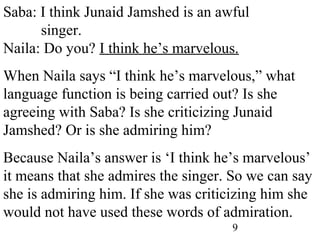
Saba: I think Junaid Jamshed is an awful
singer.
Naila: Do you? I think he’s marvelous.
When Naila says “I think he’s marvelous,” what
language function is being carried out? Is she
agreeing with Saba? Is she criticizing Junaid
Jamshed? Or is she admiring him?
Because Naila’s answer is ‘I think he’s marvelous’
it means that she admires the singer. So we can say
she is admiring him. If she was criticizing him she
would not have used these words of admiration.
10
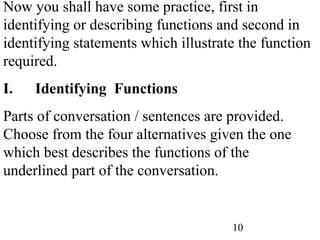
Now you shall have some practice, first in
identifying or describing functions and second in
identifying statements which illustrate the function
required.
I. Identifying Functions
Parts of conversation / sentences are provided.
Choose from the four alternatives given the one
which best describes the functions of the
underlined part of the conversation.
11
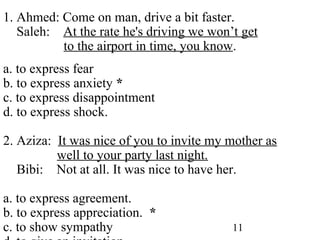
1. Ahmed: Come on man, drive a bit faster.
Saleh: At the rate he's driving we won’t get
to the airport in time, you know.
a. to express fear
b. to express anxiety *
c. to express disappointment
d. to express shock.
2. Aziza: It was nice of you to invite my mother as
well to your party last night.
Bibi: Not at all. It was nice to have her.
a. to express agreement.
b. to express appreciation. *
c. to show sympathy
12
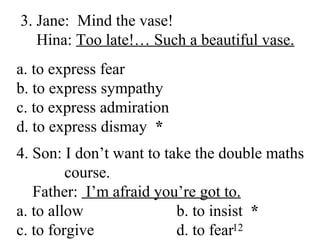
3. Jane: Mind the vase!
Hina: Too late!… Such a beautiful vase.
a. to express fear
b. to express sympathy
c. to express admiration
d. to express dismay *
4. Son: I don’t want to take the double maths
course.
Father: I’m afraid you’re got to.
a. to allow b. to insist *
c. to forgive d. to fear
13
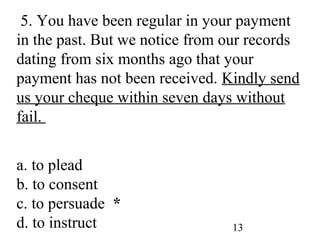
5. You have been regular in your payment
in the past. But we notice from our records
dating from six months ago that your
payment has not been received. Kindly send
us your cheque within seven days without
fail.
a. to plead
b. to consent
c. to persuade *
d. to instruct
14
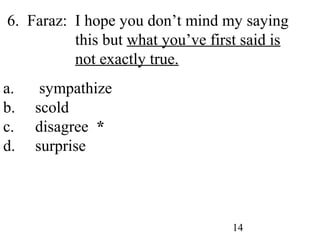
6. Faraz: I hope you don’t mind my saying
this but what you’ve first said is
not exactly true.
a. sympathize
b. scold
c. disagree *
d. surprise
15
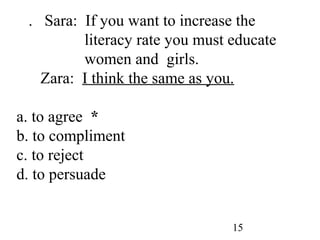
7. Sara: If you want to increase the
literacy rate you must educate
women and girls.
Zara: I think the same as you.
a. to agree *
b. to compliment
c. to reject
d. to persuade
16
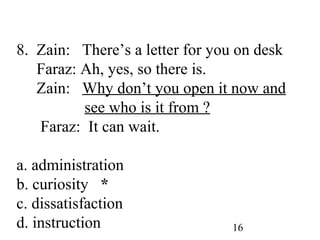
8. Zain: There’s a letter for you on desk
Faraz: Ah, yes, so there is.
Zain: Why don’t you open it now and
see who is it from ?
Faraz: It can wait.
a. administration
b. curiosity *
c. dissatisfaction
d. instruction
17
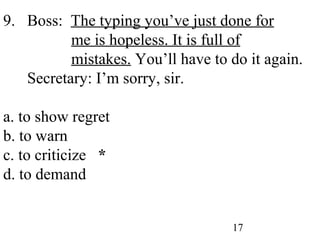
9. Boss: The typing you’ve just done for
me is hopeless. It is full of
mistakes. You’ll have to do it again.
Secretary: I’m sorry, sir.
a. to show regret
b. to warn
c. to criticize *
d. to demand
18
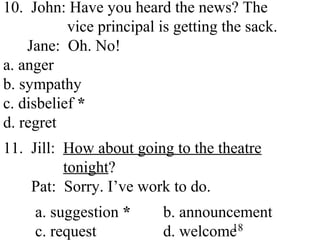
10. John: Have you heard the news? The
vice principal is getting the sack.
Jane: Oh. No!
a. anger
b. sympathy
c. disbelief *
d. regret
11. Jill: How about going to the theatre
tonight?
Pat: Sorry. I’ve work to do.
a. suggestion * b. announcement
c. request d. welcome
19
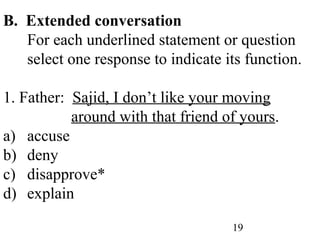
B. Extended conversation
For each underlined statement or question
select one response to indicate its function.
1. Father: Sajid, I don’t like your moving
around with that friend of yours.
a) accuse
b) deny
c) disapprove*
d) explain
20
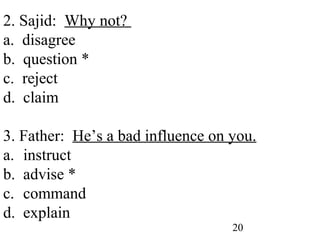
2. Sajid: Why not?
a. disagree
b. question *
c. reject
d. claim
3. Father: He’s a bad influence on you.
a. instruct
b. advise *
c. command
d. explain
21
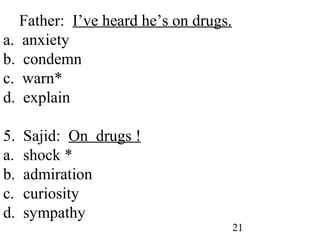
4. Father: I’ve heard he’s on drugs.
a. anxiety
b. condemn
c. warn*
d. explain
5. Sajid: On drugs !
a. shock *
b. admiration
c. curiosity
d. sympathy
22
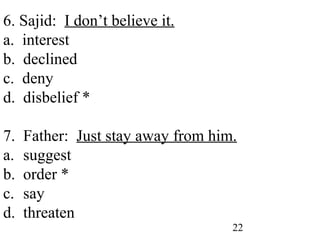
6. Sajid: I don’t believe it.
a. interest
b. declined
c. deny
d. disbelief *
7. Father: Just stay away from him.
a. suggest
b. order *
c. say
d. threaten
23
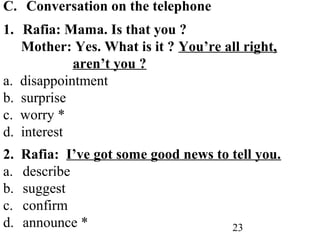
C. Conversation on the telephone
1. Rafia: Mama. Is that you ?
Mother: Yes. What is it ? You’re all right,
aren’t you ?
a. disappointment
b. surprise
c. worry *
d. interest
2. Rafia: I’ve got some good news to tell you.
a. describe
b. suggest
c. confirm
d. announce *
24
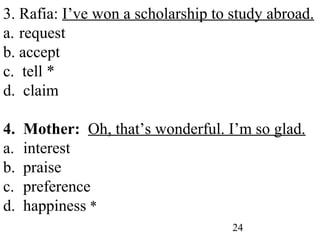
3. Rafia: I’ve won a scholarship to study abroad.
a. request
b. accept
c. tell *
d. claim
4. Mother: Oh, that’s wonderful. I’m so glad.
a. interest
b. praise
c. preference
d. happiness *
25
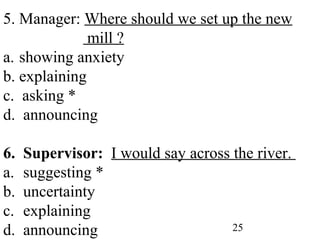
5. Manager: Where should we set up the new
mill ?
a. showing anxiety
b. explaining
c. asking *
d. announcing
6. Supervisor: I would say across the river.
a. suggesting *
b. uncertainty
c. explaining
d. announcing
26
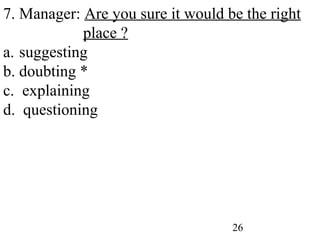
7. Manager: Are you sure it would be the right
place ?
a. suggesting
b. doubting *
c. explaining
d. questioning
27
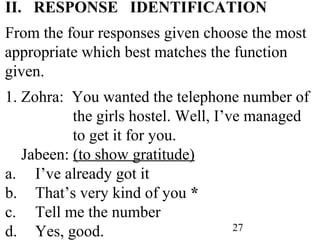
II. RESPONSE IDENTIFICATION
From the four responses given choose the most
appropriate which best matches the function
given.
1. Zohra: You wanted the telephone number of
the girls hostel. Well, I’ve managed
to get it for you.
Jabeen: (to show gratitude)
a. I’ve already got it
b. That’s very kind of you *
c. Tell me the number
d. Yes, good.
28
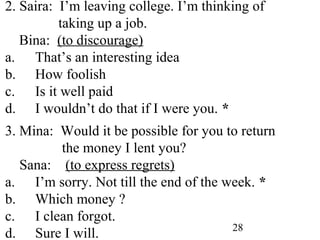
2. Saira: I’m leaving college. I’m thinking of
taking up a job.
Bina: (to discourage)
a. That’s an interesting idea
b. How foolish
c. Is it well paid
d. I wouldn’t do that if I were you. *
3. Mina: Would it be possible for you to return
the money I lent you?
Sana: (to express regrets)
a. I’m sorry. Not till the end of the week. *
b. Which money ?
c. I clean forgot.
d. Sure I will.
29
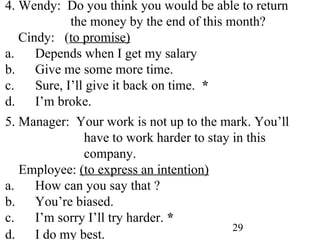
4. Wendy: Do you think you would be able to return
the money by the end of this month?
Cindy: (to promise)
a. Depends when I get my salary
b. Give me some more time.
c. Sure, I’ll give it back on time. *
d. I’m broke.
5. Manager: Your work is not up to the mark. You’ll
have to work harder to stay in this
company.
Employee: (to express an intention)
a. How can you say that ?
b. You’re biased.
c. I’m sorry I’ll try harder. *
d. I do my best.
30
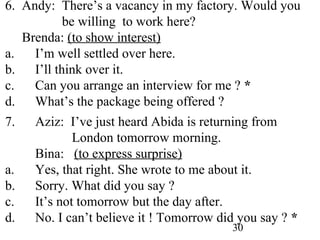
6. Andy: There’s a vacancy in my factory. Would you
be willing to work here?
Brenda: (to show interest)
a. I’m well settled over here.
b. I’ll think over it.
c. Can you arrange an interview for me ? *
d. What’s the package being offered ?
7. Aziz: I’ve just heard Abida is returning from
London tomorrow morning.
Bina: (to express surprise)
a. Yes, that right. She wrote to me about it.
b. Sorry. What did you say ?
c. It’s not tomorrow but the day after.
d. No. I can’t believe it ! Tomorrow did you say ? *
31
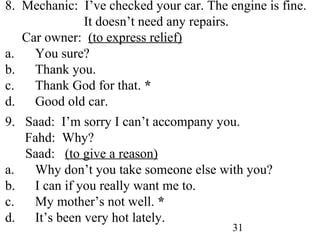
8. Mechanic: I’ve checked your car. The engine is fine.
It doesn’t need any repairs.
Car owner: (to express relief)
a. You sure?
b. Thank you.
c. Thank God for that. *
d. Good old car.
9. Saad: I’m sorry I can’t accompany you.
Fahd: Why?
Saad: (to give a reason)
a. Why don’t you take someone else with you?
b. I can if you really want me to.
c. My mother’s not well. *
d. It’s been very hot lately.
32
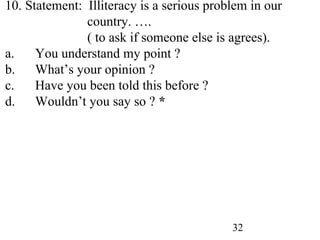
10. Statement: Illiteracy is a serious problem in our
country. ….
( to ask if someone else is agrees).
a. You understand my point ?
b. What’s your opinion ?
c. Have you been told this before ?
d. Wouldn’t you say so ? *
33
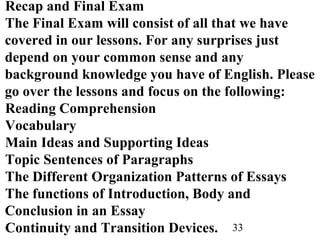
Recap and Final Exam
The Final Exam will consist of all that we have
covered in our lessons. For any surprises just
depend on your common sense and any
background knowledge you have of English. Please
go over the lessons and focus on the following:
Reading Comprehension
Vocabulary
Main Ideas and Supporting Ideas
Topic Sentences of Paragraphs
The Different Organization Patterns of Essays
The functions of Introduction, Body and
Conclusion in an Essay
Continuity and Transition Devices.
34
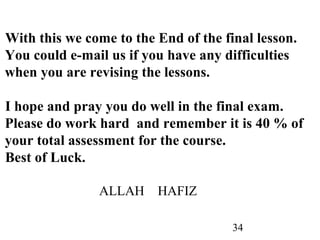
With this we come to the End of the final lesson.
You could e-mail us if you have any difficulties
when you are revising the lessons.
I hope and pray you do well in the final exam.
Please do work hard and remember it is 40 % of
your total assessment for the course.
Best of Luck.
ALLAH HAFIZ

ENG101- English Comprehension- Lecture 45

  • 1.
    1 Lesson 45 –Language Forms and Functions Knowing a language means being able to communicate one’s ideas and opinions to others. A foreign learner of a language may know the linguistic rules of the language he is learning - in your case, English - but unless he or she learns to demonstrate or use this knowledge appropriately the learner would not be considered fully competent in the language that he / she is learning. In today’s lesson - which is the last lesson of this course - you shall learn about language forms & how they are used to perform functions.
  • 2.
    2 What is alanguage function ? A language function, to put it very simply, is something you want to do with language. The primary function of language is to give factual information and convey essential commands, feelings and emotions. Have you ever asked yourself the question what are people trying to do when they speak? The aims of speaking involve not only broad functions such as conveying information, expressing emotion, keeping in touch socially, and so on…, but also more specific
  • 3.
    3 purposes for whichlanguage can be used, such as Utterance Purpose - Where the suitcase ? - to get information - Open the window - make someone do something. - I’ll pay you next week - make a promise. How many language functions there are we do not know exactly. But we do know that there are some language functions that are regularly required for the purposes of normal
  • 4.
    4 everyday communication. Thefollowing are some very common language functions. 1. Requesting information: to ask, question, request, inquire. 2. Giving information - to announce, describe, explain, instruct, to summarize... 3. Establishing contact / interpersonal relations - to greet, to welcome, to introduce, take leave, bid farewell, interrupt…
  • 5.
    5 4. Responding toothers’ behavior / actions / statements - to apologize, deny, disagree, often, thank, etc... 5. Expressing emotions / inclinations - fear, happiness, shock, surprise, dislike, etc… 6. Influencing others’ behavior / actions – to allow, blame, discourage, order, warn…. 7. Judging / evaluating - to complain, compare, criticize, disapprove, praise, etc…
  • 6.
    6 To be competentin a language the learner should know how its speakers use the language in ways which cannot be predicted from linguistic rules alone. It means that the learner must be aware of the various devices / structures / forms used by native speakers and writers to knit their speech and writing into a comprehensible whole. This is done by using appropriate forms of the language. If somebody expresses an opinion and you want to disagree with it, the first thought that
  • 7.
    7 The next thingyou will do is to decide the language forms or structures that you will use to show your disagreement. i.e. you will decide what grammatical structures, what vocabulary items what intonation patterns to use. There are a variety of forms to chose and use. A great deal depends on the situation and the person you are speaking to. For instance, if the other person is a good friend, you might say, ‘Shut up! It’s not true.”
  • 8.
    8 But if itwas your boss or somebody of a higher rank or status than you, you might say. ‘Excuse me, sir / madam, you may not be quite right there.’ So when you speak who you are speaking to will influence the language you will use. Look at the following example. A part of a conversation is provided. You have to see what function is being performed by the language used by the speaker (i.e. the underlined words).
  • 9.
    9 Saba: I thinkJunaid Jamshed is an awful singer. Naila: Do you? I think he’s marvelous. When Naila says “I think he’s marvelous,” what language function is being carried out? Is she agreeing with Saba? Is she criticizing Junaid Jamshed? Or is she admiring him? Because Naila’s answer is ‘I think he’s marvelous’ it means that she admires the singer. So we can say she is admiring him. If she was criticizing him she would not have used these words of admiration.
  • 10.
    10 Now you shallhave some practice, first in identifying or describing functions and second in identifying statements which illustrate the function required. I. Identifying Functions Parts of conversation / sentences are provided. Choose from the four alternatives given the one which best describes the functions of the underlined part of the conversation.
  • 11.
    11 1. Ahmed: Comeon man, drive a bit faster. Saleh: At the rate he's driving we won’t get to the airport in time, you know. a. to express fear b. to express anxiety * c. to express disappointment d. to express shock. 2. Aziza: It was nice of you to invite my mother as well to your party last night. Bibi: Not at all. It was nice to have her. a. to express agreement. b. to express appreciation. * c. to show sympathy
  • 12.
    12 3. Jane: Mindthe vase! Hina: Too late!… Such a beautiful vase. a. to express fear b. to express sympathy c. to express admiration d. to express dismay * 4. Son: I don’t want to take the double maths course. Father: I’m afraid you’re got to. a. to allow b. to insist * c. to forgive d. to fear
  • 13.
    13 5. You havebeen regular in your payment in the past. But we notice from our records dating from six months ago that your payment has not been received. Kindly send us your cheque within seven days without fail. a. to plead b. to consent c. to persuade * d. to instruct
  • 14.
    14 6. Faraz: Ihope you don’t mind my saying this but what you’ve first said is not exactly true. a. sympathize b. scold c. disagree * d. surprise
  • 15.
    15 7. Sara: Ifyou want to increase the literacy rate you must educate women and girls. Zara: I think the same as you. a. to agree * b. to compliment c. to reject d. to persuade
  • 16.
    16 8. Zain: There’sa letter for you on desk Faraz: Ah, yes, so there is. Zain: Why don’t you open it now and see who is it from ? Faraz: It can wait. a. administration b. curiosity * c. dissatisfaction d. instruction
  • 17.
    17 9. Boss: Thetyping you’ve just done for me is hopeless. It is full of mistakes. You’ll have to do it again. Secretary: I’m sorry, sir. a. to show regret b. to warn c. to criticize * d. to demand
  • 18.
    18 10. John: Haveyou heard the news? The vice principal is getting the sack. Jane: Oh. No! a. anger b. sympathy c. disbelief * d. regret 11. Jill: How about going to the theatre tonight? Pat: Sorry. I’ve work to do. a. suggestion * b. announcement c. request d. welcome
  • 19.
    19 B. Extended conversation Foreach underlined statement or question select one response to indicate its function. 1. Father: Sajid, I don’t like your moving around with that friend of yours. a) accuse b) deny c) disapprove* d) explain
  • 20.
    20 2. Sajid: Whynot? a. disagree b. question * c. reject d. claim 3. Father: He’s a bad influence on you. a. instruct b. advise * c. command d. explain
  • 21.
    21 4. Father: I’veheard he’s on drugs. a. anxiety b. condemn c. warn* d. explain 5. Sajid: On drugs ! a. shock * b. admiration c. curiosity d. sympathy
  • 22.
    22 6. Sajid: Idon’t believe it. a. interest b. declined c. deny d. disbelief * 7. Father: Just stay away from him. a. suggest b. order * c. say d. threaten
  • 23.
    23 C. Conversation onthe telephone 1. Rafia: Mama. Is that you ? Mother: Yes. What is it ? You’re all right, aren’t you ? a. disappointment b. surprise c. worry * d. interest 2. Rafia: I’ve got some good news to tell you. a. describe b. suggest c. confirm d. announce *
  • 24.
    24 3. Rafia: I’vewon a scholarship to study abroad. a. request b. accept c. tell * d. claim 4. Mother: Oh, that’s wonderful. I’m so glad. a. interest b. praise c. preference d. happiness *
  • 25.
    25 5. Manager: Whereshould we set up the new mill ? a. showing anxiety b. explaining c. asking * d. announcing 6. Supervisor: I would say across the river. a. suggesting * b. uncertainty c. explaining d. announcing
  • 26.
    26 7. Manager: Areyou sure it would be the right place ? a. suggesting b. doubting * c. explaining d. questioning
  • 27.
    27 II. RESPONSE IDENTIFICATION Fromthe four responses given choose the most appropriate which best matches the function given. 1. Zohra: You wanted the telephone number of the girls hostel. Well, I’ve managed to get it for you. Jabeen: (to show gratitude) a. I’ve already got it b. That’s very kind of you * c. Tell me the number d. Yes, good.
  • 28.
    28 2. Saira: I’mleaving college. I’m thinking of taking up a job. Bina: (to discourage) a. That’s an interesting idea b. How foolish c. Is it well paid d. I wouldn’t do that if I were you. * 3. Mina: Would it be possible for you to return the money I lent you? Sana: (to express regrets) a. I’m sorry. Not till the end of the week. * b. Which money ? c. I clean forgot. d. Sure I will.
  • 29.
    29 4. Wendy: Doyou think you would be able to return the money by the end of this month? Cindy: (to promise) a. Depends when I get my salary b. Give me some more time. c. Sure, I’ll give it back on time. * d. I’m broke. 5. Manager: Your work is not up to the mark. You’ll have to work harder to stay in this company. Employee: (to express an intention) a. How can you say that ? b. You’re biased. c. I’m sorry I’ll try harder. * d. I do my best.
  • 30.
    30 6. Andy: There’sa vacancy in my factory. Would you be willing to work here? Brenda: (to show interest) a. I’m well settled over here. b. I’ll think over it. c. Can you arrange an interview for me ? * d. What’s the package being offered ? 7. Aziz: I’ve just heard Abida is returning from London tomorrow morning. Bina: (to express surprise) a. Yes, that right. She wrote to me about it. b. Sorry. What did you say ? c. It’s not tomorrow but the day after. d. No. I can’t believe it ! Tomorrow did you say ? *
  • 31.
    31 8. Mechanic: I’vechecked your car. The engine is fine. It doesn’t need any repairs. Car owner: (to express relief) a. You sure? b. Thank you. c. Thank God for that. * d. Good old car. 9. Saad: I’m sorry I can’t accompany you. Fahd: Why? Saad: (to give a reason) a. Why don’t you take someone else with you? b. I can if you really want me to. c. My mother’s not well. * d. It’s been very hot lately.
  • 32.
    32 10. Statement: Illiteracyis a serious problem in our country. …. ( to ask if someone else is agrees). a. You understand my point ? b. What’s your opinion ? c. Have you been told this before ? d. Wouldn’t you say so ? *
  • 33.
    33 Recap and FinalExam The Final Exam will consist of all that we have covered in our lessons. For any surprises just depend on your common sense and any background knowledge you have of English. Please go over the lessons and focus on the following: Reading Comprehension Vocabulary Main Ideas and Supporting Ideas Topic Sentences of Paragraphs The Different Organization Patterns of Essays The functions of Introduction, Body and Conclusion in an Essay Continuity and Transition Devices.
  • 34.
    34 With this wecome to the End of the final lesson. You could e-mail us if you have any difficulties when you are revising the lessons. I hope and pray you do well in the final exam. Please do work hard and remember it is 40 % of your total assessment for the course. Best of Luck. ALLAH HAFIZ