Writing today is not a frill for the few, but an essential skill for the many. National Commission on Writing
To improve the teaching of writing. . .is also to improve the quality of thinking of school children. Judith Langer and Arthur Applebee
Writing is the most complex of human activities. Hilda Taba
My main points (for keeping it simple) Writing is complex. To teach it well, teachers must  clearly focus  on specific aspects of writing that they want students to work on Applying  any   rhetorical structure  to writing helps novice writers For daily writing, teachers get the most bang for the buck by  focusing on paragraphs For lengthier writing, spend 75% of available time creating an   outline
Things are simple that can be understood by looking at a single level with a single set of conceptual tools
Things are complex when we can’t understand them without shifting perceptual or conceptual levels.  Levels create complexity. We shift levels when we need to change tools: from a microscope to a sextant.
When we examine one level, we lose sight of other levels. When we examine a cell through a microscope, we cannot at the same time “see” elk populations shifting over decades.
Writing is (more or less) exactly as complex as the human mind
Focus on what? Ideas - Organization - Voice Word Choice - Empowerment Metaphor - Simile -Synecdoche Grammar - Spelling - Consistent Tense Fluency - Authenticity - Originality
Focus on what? The main distinction between novice and expert writers: Novices write what occurs to them in the order that it occurs to them Experts make writing decisions to accomplish rhetorical purposes Applying  any  rhetorical structure helps novice writers.  So choose a teaching focus that  keeps the ideas and content  of your subject at the forefront.
Your  focus should be on Teaching students to think accurately, precisely, clearly, and deeply about  your  discipline Developing the little habits that encourage success (spelling, paragraphing, outlining) Also: conciseness, active voice, parallelism
Conceptual Levels Ideas : Organization, Importance, Truth Style :  Conciseness, Clarity, Vividness, Precision, Beauty Correctness : Spelling, Punctuation, Grammar
When we examine individual sentences, we can proofread for grammatical errors:  the correctness. Or we can pay attention to the music and the rhythms and the figurative language:  the style. Or we can contemplate the meaning and accuracy of the thought:  the ideas. But few of us can do all these at the same time. (which is why it takes many drafts to get a piece of writing “right”) Awareness of the levels increases students’ perception of order –their  ability to focus
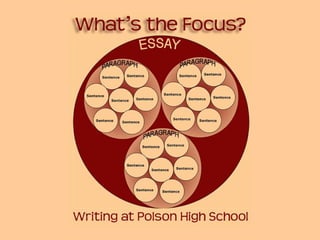
At the level of paragraphs, new issues emerge. Is the paragraph  unified?   Do all the sentences relate to a single main idea? Is the paragraph adequately  developed,  with enough detail to communicate and to persuade? Is the paragraph  coherent,  with sentences arranged in a plan the reader can follow? Paragraphs
At the level of essays or articles, all the simpler issues remain important, but  organization  becomes increasingly difficult. . . . . . much  more difficult. . . “ As length grows linearly, complexity expands exponentially.” Essays, Articles, Reports
Conceptual tools for focusing on different levels Ideas:   Style : Correctness: Outlining Paragraphing Proofreading
An original sentence, a step forward, is worth more than all the censures. Emerson Sentences The Basic Standards
SENTENCES Correctness: All words must be spelled right No run-ons or fragments Subjects agree with verbs Pronoun references are clear and in agreement Style: Conciseness Active Voice Parallelism Basic standards for sentences Someone who can consistently meet these standards has a sound understanding of the basics of writing English sentences. Students should be expected to meet these standards in every formal assignment.
Paragraphs Students should develop the  habit of writing in paragraphs . The expository paragraph with a topic sentence and detailed support is the basis of much academic and business writing. The Basic Standards
Paragraphs are ideal for daily writing Paragraphs are units of thought, making it easy to keep the focus on the content of your discipline Most of the hard work of learning to write can be accomplished with paragraph-level compositions: Having  an idea Staying  focused  on an idea Developing  an idea As well as all the lower-level issues of usage and correctness The brevity is manageable for students and for teachers, while the scope is sufficient to meet the three educational purposes for writing in all disciplines (For current purposes, think of a paragraph as containing at least 8 sentences)
Three purposes for writing Writing helps students  draw on relevant knowledge  and background to get ready for new learning  Writing helps students  consolidate and review  ideas and experiences Writing helps students reformulate and  extend  knowledge
Unity Do you have a main idea?  Can you state it in a single sentence?  Do you keep your eye on the ball: does every sentence in the paragraph relate directly to your main idea –stated in the topic sentence ? Basic standards for paragraphs
Development (most paragraphs contain a combination of these) Explanations Reasons Facts Statistics Description Definition Illustrations Anecdotes or narrative Comparisons/Contrasts Process analysis Analogy Cause and Effect Have you provided illustrations to make clear what you are thinking? Have you provided enough evidence to support your case? Have you provided enough detail to accomplish your purpose? Basic standards for paragraphs
Coherence Inverted pyramid Building to a climax Familiar to the unfamiliar General to particular Particular to general Chronological Spatial Basic standards for paragraphs
Using Paragraph Frames and Templates Paragraph frames provide clear models that allow students to practice applying rhetorical strategies to their writing: State your idea in one sentence. Write at least one sentence to explain the idea. Give an example. Discuss the example in more detail. Re-state your main point in different words.
“ Report” Paragraph Frame I also learned. . . . For example, I learned. . . . I learned a lot about. . . . The most interesting thing I learned was. . . http://www.flatheadreservation.org/images/phs/Paragraph_frame-report.pdf
“ Persuasive” Paragraph Frame I believe that. . . One reason is. . . For example. . . Another reason is. . . For example. . . Therefore, . . . Also, . . . http://www.flatheadreservation.org/images/phs/Paragraph_frame-persuasive.pdf
“ Reflective” Paragraph Frame Today we studied. . . I already knew. . . The main thing I learned was. . . I question. . . I still want to know. . . http://www.flatheadreservation.org/images/phs/Paragraph_frame-reflective.pdf
A filled in paragraph frame Main Idea:   Learning how to turn in homework assignments on time is one of the most valuable habits high school students can take with them into the working world.   Explanation:   Though employers may not assign homework in the traditional sense, many tasks must be completed by deadlines. The deadlines that students encounter in the classroom may be different that workplace deadlines but the importance of meeting those deadlines is the same.  Example B:   Accordingly, just as a student risks termination in the classroom if he/she fails to meet the deadline for a homework assignment, so, too, does that student risk termination in the workforce .   Example A:   In the classroom, students form a contract with the school when they enroll in a class. That contract requires that students complete the assignments set forth by the course's instructor in a specified time to receive a grade and credit for the course.  Completion of idea (or transition to next paragraph):   Developing good habits of turning in assignments in class now, as current students, will aid your performance and position as future participants in the working world.
Template for incorporating a quote [Sentence 1: Transition from previous paragraph]  Thoreau, however, is not necessarily interested in actually living in nature to the extent that he would be camping out.  [Sentence 2: Lead-in to the quote]   He writes about building his house, and the fact that it protected him from the elements.   [Sentence 3: Includes quote]  “I began to occupy my house on the 4th of July,” he says, “as soon as it was boarded and roofed, for the boards were carefully feather-edged and lapped, so that it was perfectly impervious to rain . . . .”  [Sentence 4: Tells why you include this quote]  As you can see, he was careful in the way he constructed his house, and he did wish to be protected from the elements when necessary.  [Sentence 5: Adds more information to strengthen the support]  It is also interesting that he did not actually move to the woods until this house was ready for him to live in.  [Sentence 6: Reminder of how this relates to your main idea]  So it is apparent that while he loved nature, he wasn’t living in a cave, or even a tent.
Template for a coordinate paragraph [Topic Sentence]  My apartment is disorderly around midterms because I am stressed.   [First illustration]  Books are stacked up on tables, on top of cabinets, and even on the floor wherever I last read them or set them before bedtime at 2 a.m.  [Second Illustration]   Also,  the kitchen table generally has notebook paper, pens, clips, and used staples spread across it, leftovers from the papers I’ve been writing or the notes I’ve been recopying to meet last-minute deadlines or to study for tests.  [Third Illustration]  My bed remains unmade each morning as I dash out of the house barely in time to make it to class after only a few hours sleep.  [Fourth Illustration]  The kitchen sink is half full of dishes when I wake up because by the time I get to bed I’m too sleepy to wash them.  [Strongest illustration]   Worst of all,  the trash is lined up in three or four bags next to the kitchen door because it can’t be my priority
Outlines To write an outline, a writer needs to focus on the  highest level*  of writing:  Ideas, Organization and Truth The Basic Standards (There may be higher levels, but they go beyond the scope of high school teaching: think  Koran ,  Bible ,  Analects of Confucius , etc)
SENTENCES Spelling No run-ons or fragments Subjects and verbs agree Pronoun references clear Conciseness Active Voice Parallelism PARAGRAPHS Unity Development Coherence ESSAYS & ARTICLES Organization “ As length grows linearly, complexity expands exponentially.” Jon Franklin
Organization is the main problem in lengthy writing. Outlines are the solution. “ Every writer of any merit at all during the last five hundred years of English history outlined virtually everything he wrote. . . Jon Franklin
Helps organize ideas Presents material in a logical form Shows the relationships among ideas Constructs an ordered overview For many classroom purposes, a  good outline  is enough Why create an outline?
In a  good  outline.  . . The title suggests the scope and subject of the paper The thesis focuses on the subject, not the writer No placeholders are used (such as “introduction,” “body,” or “conclusion”) Each major paragraph is represented by one sentence
Every item is a single, complete sentence Every sentence states a single idea Every sentence makes a concrete assertion about the subject No airy abstractions No statements of the author’s plan No questions In a  good  outline. . .
Increasing efficiency and productivity It’s more effective to require multiple drafts of outlines (which a teacher can read quickly) than it is to try to explain to a student what went wrong in a longish essay. The more demanding teachers are of quality outlines, the more engaged students need to be in hard thinking, which is the only effective learning strategy…
Graphic organizers are often better  than Roman numerals Constructing a Thesis  PDF
Steps to writing an outline Gather the information Group the information into clusters that “go together” Give the clusters names –topic sentences Pick three or four clusters that “go together” Make a generalization that is true for all of them–a “thesis statement”
Test and revise the thesis It’s crucial not to rush through this stage.  Test and revise  the thesis. These are minimal test questions: Contestable – proposes an argument with which people could reasonably disagree Provocative – takes a stand that matters, that’s nontrivial Coverable – can be discussed in enough detail in a paper of the assigned length Specific and focused   –supports  a point without discussing “everything in the world about …”  Supportable   – asserts a conclusion based on evidence and reason
Mike’s recommendations for Minimum Writing Standards Ideas :  Follows an intelligent outline Style :   Paragraphs are sufficiently developed Paragraphs are unified Paragraphs follow a coherent plan Conciseness Active Voice Parallelism Correctness :  No fragments or run-ons Subjects agree with verbs Pronoun references are clear and correct All words are spelled correctly
“ Every student should write 3 hours per week…” National Commission on Writing Defense Offense In a typical week getting ready for a Friday game, a basketball team might practice these skills: Footwork  Man-to-man defense  Zone defense  Screening out  Rebounding  Half-court trap  Full-court press  Defending out-of-bounds plays  Defending the screen  Getting to loose balls  Help side defense  Talking to each other  Shooting  Passing  Rebounding  Dribbling  Free throw shooting  Set Plays  Out-of-bounds plays  Breaking the half-court trap  Breaking the full-court press  Setting screens  Pick and roll  Splitting gaps
 
 
Words are sacred. They deserve respect. If you get the right ones, in the right order, you can nudge the world a little. Tim Stoppard

Basic Writing Standards for PHS

  • 1.
  • 2.
    Writing today isnot a frill for the few, but an essential skill for the many. National Commission on Writing
  • 3.
    To improve theteaching of writing. . .is also to improve the quality of thinking of school children. Judith Langer and Arthur Applebee
  • 4.
    Writing is themost complex of human activities. Hilda Taba
  • 5.
    My main points(for keeping it simple) Writing is complex. To teach it well, teachers must clearly focus on specific aspects of writing that they want students to work on Applying any rhetorical structure to writing helps novice writers For daily writing, teachers get the most bang for the buck by focusing on paragraphs For lengthier writing, spend 75% of available time creating an outline
  • 6.
    Things are simplethat can be understood by looking at a single level with a single set of conceptual tools
  • 7.
    Things are complexwhen we can’t understand them without shifting perceptual or conceptual levels. Levels create complexity. We shift levels when we need to change tools: from a microscope to a sextant.
  • 8.
    When we examineone level, we lose sight of other levels. When we examine a cell through a microscope, we cannot at the same time “see” elk populations shifting over decades.
  • 9.
    Writing is (moreor less) exactly as complex as the human mind
  • 10.
    Focus on what?Ideas - Organization - Voice Word Choice - Empowerment Metaphor - Simile -Synecdoche Grammar - Spelling - Consistent Tense Fluency - Authenticity - Originality
  • 11.
    Focus on what?The main distinction between novice and expert writers: Novices write what occurs to them in the order that it occurs to them Experts make writing decisions to accomplish rhetorical purposes Applying any rhetorical structure helps novice writers. So choose a teaching focus that keeps the ideas and content of your subject at the forefront.
  • 12.
    Your focusshould be on Teaching students to think accurately, precisely, clearly, and deeply about your discipline Developing the little habits that encourage success (spelling, paragraphing, outlining) Also: conciseness, active voice, parallelism
  • 13.
    Conceptual Levels Ideas: Organization, Importance, Truth Style : Conciseness, Clarity, Vividness, Precision, Beauty Correctness : Spelling, Punctuation, Grammar
  • 14.
    When we examineindividual sentences, we can proofread for grammatical errors: the correctness. Or we can pay attention to the music and the rhythms and the figurative language: the style. Or we can contemplate the meaning and accuracy of the thought: the ideas. But few of us can do all these at the same time. (which is why it takes many drafts to get a piece of writing “right”) Awareness of the levels increases students’ perception of order –their ability to focus
  • 15.
    At the levelof paragraphs, new issues emerge. Is the paragraph unified? Do all the sentences relate to a single main idea? Is the paragraph adequately developed, with enough detail to communicate and to persuade? Is the paragraph coherent, with sentences arranged in a plan the reader can follow? Paragraphs
  • 16.
    At the levelof essays or articles, all the simpler issues remain important, but organization becomes increasingly difficult. . . . . . much more difficult. . . “ As length grows linearly, complexity expands exponentially.” Essays, Articles, Reports
  • 17.
    Conceptual tools forfocusing on different levels Ideas: Style : Correctness: Outlining Paragraphing Proofreading
  • 18.
    An original sentence,a step forward, is worth more than all the censures. Emerson Sentences The Basic Standards
  • 19.
    SENTENCES Correctness: Allwords must be spelled right No run-ons or fragments Subjects agree with verbs Pronoun references are clear and in agreement Style: Conciseness Active Voice Parallelism Basic standards for sentences Someone who can consistently meet these standards has a sound understanding of the basics of writing English sentences. Students should be expected to meet these standards in every formal assignment.
  • 20.
    Paragraphs Students shoulddevelop the habit of writing in paragraphs . The expository paragraph with a topic sentence and detailed support is the basis of much academic and business writing. The Basic Standards
  • 21.
    Paragraphs are idealfor daily writing Paragraphs are units of thought, making it easy to keep the focus on the content of your discipline Most of the hard work of learning to write can be accomplished with paragraph-level compositions: Having an idea Staying focused on an idea Developing an idea As well as all the lower-level issues of usage and correctness The brevity is manageable for students and for teachers, while the scope is sufficient to meet the three educational purposes for writing in all disciplines (For current purposes, think of a paragraph as containing at least 8 sentences)
  • 22.
    Three purposes forwriting Writing helps students draw on relevant knowledge and background to get ready for new learning Writing helps students consolidate and review ideas and experiences Writing helps students reformulate and extend knowledge
  • 23.
    Unity Do youhave a main idea? Can you state it in a single sentence? Do you keep your eye on the ball: does every sentence in the paragraph relate directly to your main idea –stated in the topic sentence ? Basic standards for paragraphs
  • 24.
    Development (most paragraphscontain a combination of these) Explanations Reasons Facts Statistics Description Definition Illustrations Anecdotes or narrative Comparisons/Contrasts Process analysis Analogy Cause and Effect Have you provided illustrations to make clear what you are thinking? Have you provided enough evidence to support your case? Have you provided enough detail to accomplish your purpose? Basic standards for paragraphs
  • 25.
    Coherence Inverted pyramidBuilding to a climax Familiar to the unfamiliar General to particular Particular to general Chronological Spatial Basic standards for paragraphs
  • 26.
    Using Paragraph Framesand Templates Paragraph frames provide clear models that allow students to practice applying rhetorical strategies to their writing: State your idea in one sentence. Write at least one sentence to explain the idea. Give an example. Discuss the example in more detail. Re-state your main point in different words.
  • 27.
    “ Report” ParagraphFrame I also learned. . . . For example, I learned. . . . I learned a lot about. . . . The most interesting thing I learned was. . . http://www.flatheadreservation.org/images/phs/Paragraph_frame-report.pdf
  • 28.
    “ Persuasive” ParagraphFrame I believe that. . . One reason is. . . For example. . . Another reason is. . . For example. . . Therefore, . . . Also, . . . http://www.flatheadreservation.org/images/phs/Paragraph_frame-persuasive.pdf
  • 29.
    “ Reflective” ParagraphFrame Today we studied. . . I already knew. . . The main thing I learned was. . . I question. . . I still want to know. . . http://www.flatheadreservation.org/images/phs/Paragraph_frame-reflective.pdf
  • 30.
    A filled inparagraph frame Main Idea: Learning how to turn in homework assignments on time is one of the most valuable habits high school students can take with them into the working world. Explanation: Though employers may not assign homework in the traditional sense, many tasks must be completed by deadlines. The deadlines that students encounter in the classroom may be different that workplace deadlines but the importance of meeting those deadlines is the same. Example B: Accordingly, just as a student risks termination in the classroom if he/she fails to meet the deadline for a homework assignment, so, too, does that student risk termination in the workforce . Example A: In the classroom, students form a contract with the school when they enroll in a class. That contract requires that students complete the assignments set forth by the course's instructor in a specified time to receive a grade and credit for the course. Completion of idea (or transition to next paragraph): Developing good habits of turning in assignments in class now, as current students, will aid your performance and position as future participants in the working world.
  • 31.
    Template for incorporatinga quote [Sentence 1: Transition from previous paragraph] Thoreau, however, is not necessarily interested in actually living in nature to the extent that he would be camping out. [Sentence 2: Lead-in to the quote] He writes about building his house, and the fact that it protected him from the elements. [Sentence 3: Includes quote] “I began to occupy my house on the 4th of July,” he says, “as soon as it was boarded and roofed, for the boards were carefully feather-edged and lapped, so that it was perfectly impervious to rain . . . .” [Sentence 4: Tells why you include this quote] As you can see, he was careful in the way he constructed his house, and he did wish to be protected from the elements when necessary. [Sentence 5: Adds more information to strengthen the support] It is also interesting that he did not actually move to the woods until this house was ready for him to live in. [Sentence 6: Reminder of how this relates to your main idea] So it is apparent that while he loved nature, he wasn’t living in a cave, or even a tent.
  • 32.
    Template for acoordinate paragraph [Topic Sentence] My apartment is disorderly around midterms because I am stressed. [First illustration] Books are stacked up on tables, on top of cabinets, and even on the floor wherever I last read them or set them before bedtime at 2 a.m. [Second Illustration] Also, the kitchen table generally has notebook paper, pens, clips, and used staples spread across it, leftovers from the papers I’ve been writing or the notes I’ve been recopying to meet last-minute deadlines or to study for tests. [Third Illustration] My bed remains unmade each morning as I dash out of the house barely in time to make it to class after only a few hours sleep. [Fourth Illustration] The kitchen sink is half full of dishes when I wake up because by the time I get to bed I’m too sleepy to wash them. [Strongest illustration] Worst of all, the trash is lined up in three or four bags next to the kitchen door because it can’t be my priority
  • 33.
    Outlines To writean outline, a writer needs to focus on the highest level* of writing: Ideas, Organization and Truth The Basic Standards (There may be higher levels, but they go beyond the scope of high school teaching: think Koran , Bible , Analects of Confucius , etc)
  • 34.
    SENTENCES Spelling Norun-ons or fragments Subjects and verbs agree Pronoun references clear Conciseness Active Voice Parallelism PARAGRAPHS Unity Development Coherence ESSAYS & ARTICLES Organization “ As length grows linearly, complexity expands exponentially.” Jon Franklin
  • 35.
    Organization is themain problem in lengthy writing. Outlines are the solution. “ Every writer of any merit at all during the last five hundred years of English history outlined virtually everything he wrote. . . Jon Franklin
  • 36.
    Helps organize ideasPresents material in a logical form Shows the relationships among ideas Constructs an ordered overview For many classroom purposes, a good outline is enough Why create an outline?
  • 37.
    In a good outline. . . The title suggests the scope and subject of the paper The thesis focuses on the subject, not the writer No placeholders are used (such as “introduction,” “body,” or “conclusion”) Each major paragraph is represented by one sentence
  • 38.
    Every item isa single, complete sentence Every sentence states a single idea Every sentence makes a concrete assertion about the subject No airy abstractions No statements of the author’s plan No questions In a good outline. . .
  • 39.
    Increasing efficiency andproductivity It’s more effective to require multiple drafts of outlines (which a teacher can read quickly) than it is to try to explain to a student what went wrong in a longish essay. The more demanding teachers are of quality outlines, the more engaged students need to be in hard thinking, which is the only effective learning strategy…
  • 40.
    Graphic organizers areoften better than Roman numerals Constructing a Thesis PDF
  • 41.
    Steps to writingan outline Gather the information Group the information into clusters that “go together” Give the clusters names –topic sentences Pick three or four clusters that “go together” Make a generalization that is true for all of them–a “thesis statement”
  • 42.
    Test and revisethe thesis It’s crucial not to rush through this stage. Test and revise the thesis. These are minimal test questions: Contestable – proposes an argument with which people could reasonably disagree Provocative – takes a stand that matters, that’s nontrivial Coverable – can be discussed in enough detail in a paper of the assigned length Specific and focused –supports a point without discussing “everything in the world about …” Supportable – asserts a conclusion based on evidence and reason
  • 43.
    Mike’s recommendations forMinimum Writing Standards Ideas : Follows an intelligent outline Style : Paragraphs are sufficiently developed Paragraphs are unified Paragraphs follow a coherent plan Conciseness Active Voice Parallelism Correctness : No fragments or run-ons Subjects agree with verbs Pronoun references are clear and correct All words are spelled correctly
  • 44.
    “ Every studentshould write 3 hours per week…” National Commission on Writing Defense Offense In a typical week getting ready for a Friday game, a basketball team might practice these skills: Footwork Man-to-man defense Zone defense Screening out Rebounding Half-court trap Full-court press Defending out-of-bounds plays Defending the screen Getting to loose balls Help side defense Talking to each other Shooting Passing Rebounding Dribbling Free throw shooting Set Plays Out-of-bounds plays Breaking the half-court trap Breaking the full-court press Setting screens Pick and roll Splitting gaps
  • 45.
  • 46.
  • 47.
    Words are sacred.They deserve respect. If you get the right ones, in the right order, you can nudge the world a little. Tim Stoppard