ENG 101
Lesson -33
2
Lesson – 33 (Essay Writing)
In the past few lessons we have looked at
paragraph writing. Now we shall move
forward and look at longer pieces of writing
which consist of several paragraphs. The
problems we considered in sentence and
paragraph writing are also the fundamental
problems of longer composition – the same
problems of unity, coherence, and emphasis.
While some topics can be treated in a single
paragraph others require more elaborate
development. In longer compositions we
3
find problems of arrangement. A longer
composition, such as an essay, divides itself
usually into a number of parts. In what order
shall we present them? How much emphasis
should be given to each fact? These are some
of the problems faced in essay writing.
Now a lot depends on the purpose of your
writing. If you are writing primarily to give
information, then you need to be as exact as
possible in the interest of clear, logical
presentation of facts. If you are writing to
describe something, or to create an image or a
4
picture then you shall perhaps put less
emphasis upon accurate measurement and
more upon suggestive and revealing details.
If you are writing to tell a story, you will
have to decide upon the point of highest
interest and arrange your material carefully to
give your reader the feeling or illusion of
taking part in the action.
Writing an essay is not more difficult than
writing a paragraph. There is only one
difference – of length. The principles of
5
organization are the same for both: so if you can
write a good paragraph, you can also write a
good essay.
Process of Writing
Writing usually takes place in steps or stages.
There are five stages or steps in the writing
process. (1) Getting ideas: brainstorming,
clustering & free writing (2) making brief
outline (3) writing the 1st draft (4) revising (5)
proof reading
6
.
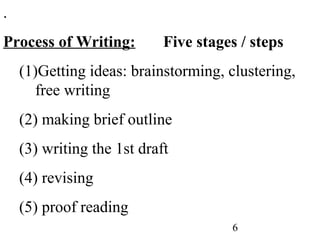
Process of Writing: Five stages / steps
(1)Getting ideas: brainstorming, clustering,
free writing
(2) making brief outline
(3) writing the 1st draft
(4) revising
(5) proof reading
7
Step I: Getting Ideas: Primarily from
reading, talking to people, listening to talk
shows, TV programs on current issues etc.
(a) Brainstorming – For ideas
jot down points or ideas and their details as
they come to your mind. Just write them
down without putting them in any special
order. Try to accumulate as many details as
you can think of. This is one strategy of
beginning an essay. The other strategy is
8
(b) Clustering: here you begin by writing
your subject or topic in the center of a
blank sheet of paper. Then as ideas come
into your mind you put them down in boxes
or circles around the subject or topic. You
will now see a sample of clustering.
(c) Free writing, this is also a very useful
technique. Here you just write down
whatever comes into your mind about the
topic. Continue writing for sometime
without stopping to worry about grammar
or spellings etc.
9
CLUSTERING
daughter shouts Babaji
noisy neighbors loud music
stereo TV
something needs to be done
dogs bark loudly
Children play hide &seek
10
II. Step Two: Prepare a rough outline. This
is going to be the backbone or skeleton on
which the rest of the writing will be built.
It shows at a glance the point of the
paragraph and the support for that point. It
will help you to see if you need to do more
writing to clarify your main point or its
support. You shall learn how to write an
outline in your next lesson. Here I will just
show an example of an outline.
11
Example of an outline.
Biography of a celebrated man
a) Friends and enemies
b) school fellows - pranks, conversations
c) offices held, distinguished figures
d) relatives - accounts of his acts of
humanity and virtues
12
(iii) Third step: Writing the 1st draft. The
purpose here is to develop the context of
your document. So be ready to put in
additional thoughts and details that didn’t
come to your mind earlier. Don’t spend
time correcting words or sentences that you
may decide to remove later on.
(iv) Fourth step: Revising. This is the most
important part of writing - a practice our
students are not encouraged to develop.
13
Revising means that you rewrite, build
upon what has been written to make it
better. It is at this stage that you get rid of
unnecessary material, improve on what
you are going to retain. A typical revision
means writing on two or more drafts. Here
you insert details left out, put in transition
words which would make smoother
reading. If you are working on a word
processor take out a hard copy so that you
can see your entire document at one time.
14
(v) Step Five: Proof reading. This is the
final stage in the writing process. It means
checking carefully for spelling, grammar,
punctuation and other errors. Use your
dictionary for this purpose. Proof reading
is often hard work and students want to
avoid proofing. If proofing is done
carefully, it will ensure that your written
work looks as good as possible.
15
There is no single correct way of writing
English. Good writing depends on a set of
specific writing skills. Three skills are involved
in writing.
(i) Skill of communication i.e. putting your ideas
across to the reader.
(ii) Skill of organizing your idea in the shape of
sentences and paragraphs.
(iii) Stylistic - achieving the right level of
formality i.e. appropriate tone.
16
Writing is a form of problem solving. The writer
has two tasks before him (a) the task of
generating ideas and (b) of composing those
ideas into some sort of shape in other words
giving structure to those ideas.
All writing, whether journalistic or academic (a
report, an essay, an assignment, a term paper, a
project) has structure. There is first the
introduction, second the main body in which the
ideas are developed and third the conclusion.
17
I The Introduction
1. The introduction is concerned with the topic
or subject of writing. In the introductory
paragraph you will state the problem / the issue
in a few general statements to attract your
reader’s attention and a thesis statement to say
how you intend to treat the topic / issue of your
essay. The thesis statement is just like the topic
sentence in a paragraph.
18
Try to catch the readers’ attention so that
they would want to continue reading. This
can be done in a number of ways:
- by posing a question
- Using an apt quotation
- a dialogue
- a striking description or image
- making a controversial statement
- developing a historical perspective /
background
- making an appeal for action / change
*
19
II The Main Body
The second part of the essay is the main body
where you develop the main idea with the help
of examples and details. This part consists of
more than one paragraph. Each paragraph
develops a subdivision of your topic. So the
number of paragraphs will vary with the number
of subdivisions. Moreover, you can organize the
ideas by chronological order or by way of
importance just as you did for a single
paragraph.
20
III The Conclusion
In the third and last part of the essay you
draw your conclusion. There are many
ways of ending your composition. You
should create a feeling of finale / fina:li
This may take the form of a summary or
review of the main points discussed in the
body of the essay. Here you may even
propose recommendations.
21
I.
II
III
General Statement
Thesis Statement
Introduction
Topic sentence
Supporting evidence
Concluding sentence
Topic sentence
Supporting evidence
Concluding sentence
Topic sentence
Supporting evidence
Concluding sentence
Main Body
Restatement /
Summary / opinion
Recommendation
Conclusion
Essay
22
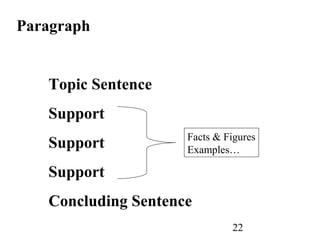
Paragraph
Topic Sentence
Support
Support
Support
Concluding Sentence
Facts & Figures
Examples…
23
In essay writing paragraphs are written and
designed to serve as part of a longer
composition. In a skillfully written essay each
paragraph has its own proper place, just as each
word has its proper place in a coherent,
emphatic sentence. And just as there is a
problem of transition from one sentence to
another within the paragraph, so there is some
problem when dealing with a group of
paragraphs. So you can see that writing an essay
is essentially the same as writing a paragraph.
The difference is of length.
24
Lesson Review
Check your understanding of the material
presented in this lesson.
1. Writing is a skill that can be learned with
practice. T / F?
2. An effective paragraph is one that
a. makes a point
b. Provides specific support
c. * makes a point and provides specific
support
d. none of the above.
25
Lesson Review
Check your understanding of the material
presented in this lesson.
1. Writing is a skill that can be learned with
practice. T/F?
2. An effective paragraph is one that
a. makes a point
b. Provides specific support
c. makes a point and provides specific
support
d. none of the above.
26
3. The sentence that states the main idea of a
paragraph is called the topic sentence. T / F
4. Prewriting strategies can help a writer
find
a. a good angle / to write about.
b. a good main point to make about the
topic.
c. enough details to support the main
point
d. * all of the above.
27
3. The sentence that states the main idea of a
paragraph is called the topic sentence. T/F
4. Prewriting strategies can help a writer
find
a. a good angle / to write about.
b. a good main point to make about the
topic.
c. enough details to support the main
point
d. all of the above.
28
5. In the early stage of the writing process,
you should not be concerned with spelling,
punctuation or grammar. T / F
6. A brief plan of the paragraph / or
composition is known as an outline. T / F
7. Your first concern when you start writing
should be
a. spelling
b. * content
c. grammar
d. punctuation
29
5. In the early stage of the writing process,
you should not be concerned with spelling,
punctuation or grammar. T / F
6. A brief plan of the paragraph / or
composition is known as an outline. T / F
7. Your first concern when you start writing
should be
a. spelling
b. content
c. grammar
d. punctuation
30
8. Two common ways of organizing a paragraph
are using a chronological order and order of
importance. T / F
9. The words first, next, then, also, another,
and finally are known as signal words. They are
also called transition words. T / F
10. The purpose of proof reading is to check for
errors in
a. grammar
b. punctuation
c. usage and spelling
d. * all of the above
31
8. Two common ways of organizing a paragraph
are using a chronological order and order of
importance. T / F
9. The words first, next, then, also, another,
and finally are known as signal words. They are
also called transition words. T / F
10. The purpose of proof reading is to check for
errors in
a. grammar
b. punctuation
c. usage and spelling
d. all of the above

ENG101- English Comprehension- Lecture 33

  • 1.
  • 2.
    2 Lesson – 33(Essay Writing) In the past few lessons we have looked at paragraph writing. Now we shall move forward and look at longer pieces of writing which consist of several paragraphs. The problems we considered in sentence and paragraph writing are also the fundamental problems of longer composition – the same problems of unity, coherence, and emphasis. While some topics can be treated in a single paragraph others require more elaborate development. In longer compositions we
  • 3.
    3 find problems ofarrangement. A longer composition, such as an essay, divides itself usually into a number of parts. In what order shall we present them? How much emphasis should be given to each fact? These are some of the problems faced in essay writing. Now a lot depends on the purpose of your writing. If you are writing primarily to give information, then you need to be as exact as possible in the interest of clear, logical presentation of facts. If you are writing to describe something, or to create an image or a
  • 4.
    4 picture then youshall perhaps put less emphasis upon accurate measurement and more upon suggestive and revealing details. If you are writing to tell a story, you will have to decide upon the point of highest interest and arrange your material carefully to give your reader the feeling or illusion of taking part in the action. Writing an essay is not more difficult than writing a paragraph. There is only one difference – of length. The principles of
  • 5.
    5 organization are thesame for both: so if you can write a good paragraph, you can also write a good essay. Process of Writing Writing usually takes place in steps or stages. There are five stages or steps in the writing process. (1) Getting ideas: brainstorming, clustering & free writing (2) making brief outline (3) writing the 1st draft (4) revising (5) proof reading
  • 6.
    6 . Process of Writing:Five stages / steps (1)Getting ideas: brainstorming, clustering, free writing (2) making brief outline (3) writing the 1st draft (4) revising (5) proof reading
  • 7.
    7 Step I: GettingIdeas: Primarily from reading, talking to people, listening to talk shows, TV programs on current issues etc. (a) Brainstorming – For ideas jot down points or ideas and their details as they come to your mind. Just write them down without putting them in any special order. Try to accumulate as many details as you can think of. This is one strategy of beginning an essay. The other strategy is
  • 8.
    8 (b) Clustering: hereyou begin by writing your subject or topic in the center of a blank sheet of paper. Then as ideas come into your mind you put them down in boxes or circles around the subject or topic. You will now see a sample of clustering. (c) Free writing, this is also a very useful technique. Here you just write down whatever comes into your mind about the topic. Continue writing for sometime without stopping to worry about grammar or spellings etc.
  • 9.
    9 CLUSTERING daughter shouts Babaji noisyneighbors loud music stereo TV something needs to be done dogs bark loudly Children play hide &seek
  • 10.
    10 II. Step Two:Prepare a rough outline. This is going to be the backbone or skeleton on which the rest of the writing will be built. It shows at a glance the point of the paragraph and the support for that point. It will help you to see if you need to do more writing to clarify your main point or its support. You shall learn how to write an outline in your next lesson. Here I will just show an example of an outline.
  • 11.
    11 Example of anoutline. Biography of a celebrated man a) Friends and enemies b) school fellows - pranks, conversations c) offices held, distinguished figures d) relatives - accounts of his acts of humanity and virtues
  • 12.
    12 (iii) Third step:Writing the 1st draft. The purpose here is to develop the context of your document. So be ready to put in additional thoughts and details that didn’t come to your mind earlier. Don’t spend time correcting words or sentences that you may decide to remove later on. (iv) Fourth step: Revising. This is the most important part of writing - a practice our students are not encouraged to develop.
  • 13.
    13 Revising means thatyou rewrite, build upon what has been written to make it better. It is at this stage that you get rid of unnecessary material, improve on what you are going to retain. A typical revision means writing on two or more drafts. Here you insert details left out, put in transition words which would make smoother reading. If you are working on a word processor take out a hard copy so that you can see your entire document at one time.
  • 14.
    14 (v) Step Five:Proof reading. This is the final stage in the writing process. It means checking carefully for spelling, grammar, punctuation and other errors. Use your dictionary for this purpose. Proof reading is often hard work and students want to avoid proofing. If proofing is done carefully, it will ensure that your written work looks as good as possible.
  • 15.
    15 There is nosingle correct way of writing English. Good writing depends on a set of specific writing skills. Three skills are involved in writing. (i) Skill of communication i.e. putting your ideas across to the reader. (ii) Skill of organizing your idea in the shape of sentences and paragraphs. (iii) Stylistic - achieving the right level of formality i.e. appropriate tone.
  • 16.
    16 Writing is aform of problem solving. The writer has two tasks before him (a) the task of generating ideas and (b) of composing those ideas into some sort of shape in other words giving structure to those ideas. All writing, whether journalistic or academic (a report, an essay, an assignment, a term paper, a project) has structure. There is first the introduction, second the main body in which the ideas are developed and third the conclusion.
  • 17.
    17 I The Introduction 1.The introduction is concerned with the topic or subject of writing. In the introductory paragraph you will state the problem / the issue in a few general statements to attract your reader’s attention and a thesis statement to say how you intend to treat the topic / issue of your essay. The thesis statement is just like the topic sentence in a paragraph.
  • 18.
    18 Try to catchthe readers’ attention so that they would want to continue reading. This can be done in a number of ways: - by posing a question - Using an apt quotation - a dialogue - a striking description or image - making a controversial statement - developing a historical perspective / background - making an appeal for action / change *
  • 19.
    19 II The MainBody The second part of the essay is the main body where you develop the main idea with the help of examples and details. This part consists of more than one paragraph. Each paragraph develops a subdivision of your topic. So the number of paragraphs will vary with the number of subdivisions. Moreover, you can organize the ideas by chronological order or by way of importance just as you did for a single paragraph.
  • 20.
    20 III The Conclusion Inthe third and last part of the essay you draw your conclusion. There are many ways of ending your composition. You should create a feeling of finale / fina:li This may take the form of a summary or review of the main points discussed in the body of the essay. Here you may even propose recommendations.
  • 21.
    21 I. II III General Statement Thesis Statement Introduction Topicsentence Supporting evidence Concluding sentence Topic sentence Supporting evidence Concluding sentence Topic sentence Supporting evidence Concluding sentence Main Body Restatement / Summary / opinion Recommendation Conclusion Essay
  • 22.
  • 23.
    23 In essay writingparagraphs are written and designed to serve as part of a longer composition. In a skillfully written essay each paragraph has its own proper place, just as each word has its proper place in a coherent, emphatic sentence. And just as there is a problem of transition from one sentence to another within the paragraph, so there is some problem when dealing with a group of paragraphs. So you can see that writing an essay is essentially the same as writing a paragraph. The difference is of length.
  • 24.
    24 Lesson Review Check yourunderstanding of the material presented in this lesson. 1. Writing is a skill that can be learned with practice. T / F? 2. An effective paragraph is one that a. makes a point b. Provides specific support c. * makes a point and provides specific support d. none of the above.
  • 25.
    25 Lesson Review Check yourunderstanding of the material presented in this lesson. 1. Writing is a skill that can be learned with practice. T/F? 2. An effective paragraph is one that a. makes a point b. Provides specific support c. makes a point and provides specific support d. none of the above.
  • 26.
    26 3. The sentencethat states the main idea of a paragraph is called the topic sentence. T / F 4. Prewriting strategies can help a writer find a. a good angle / to write about. b. a good main point to make about the topic. c. enough details to support the main point d. * all of the above.
  • 27.
    27 3. The sentencethat states the main idea of a paragraph is called the topic sentence. T/F 4. Prewriting strategies can help a writer find a. a good angle / to write about. b. a good main point to make about the topic. c. enough details to support the main point d. all of the above.
  • 28.
    28 5. In theearly stage of the writing process, you should not be concerned with spelling, punctuation or grammar. T / F 6. A brief plan of the paragraph / or composition is known as an outline. T / F 7. Your first concern when you start writing should be a. spelling b. * content c. grammar d. punctuation
  • 29.
    29 5. In theearly stage of the writing process, you should not be concerned with spelling, punctuation or grammar. T / F 6. A brief plan of the paragraph / or composition is known as an outline. T / F 7. Your first concern when you start writing should be a. spelling b. content c. grammar d. punctuation
  • 30.
    30 8. Two commonways of organizing a paragraph are using a chronological order and order of importance. T / F 9. The words first, next, then, also, another, and finally are known as signal words. They are also called transition words. T / F 10. The purpose of proof reading is to check for errors in a. grammar b. punctuation c. usage and spelling d. * all of the above
  • 31.
    31 8. Two commonways of organizing a paragraph are using a chronological order and order of importance. T / F 9. The words first, next, then, also, another, and finally are known as signal words. They are also called transition words. T / F 10. The purpose of proof reading is to check for errors in a. grammar b. punctuation c. usage and spelling d. all of the above