Prepared by:
RACHELLE M. GUEVARRA
MAED-English
To be aware of how sounds are
formed, how words are stressed, and
what intonation patterns exist
To become an intelligible speaker in
English
To improve our own comprehension
of spoken English
Why teach pronunciation?
Symbols/ letters used
to help us work out the
pronunciation of words
“phonemic script”
What are Phonemic Symbols?
Some letters have more than one sound
Sometimes letters are not pronounced
at all
The same sound may be represented by
different letters
Sometimes syllables indicated by the
spelling are not pronounced at all
Why use Phonemic Symbols?
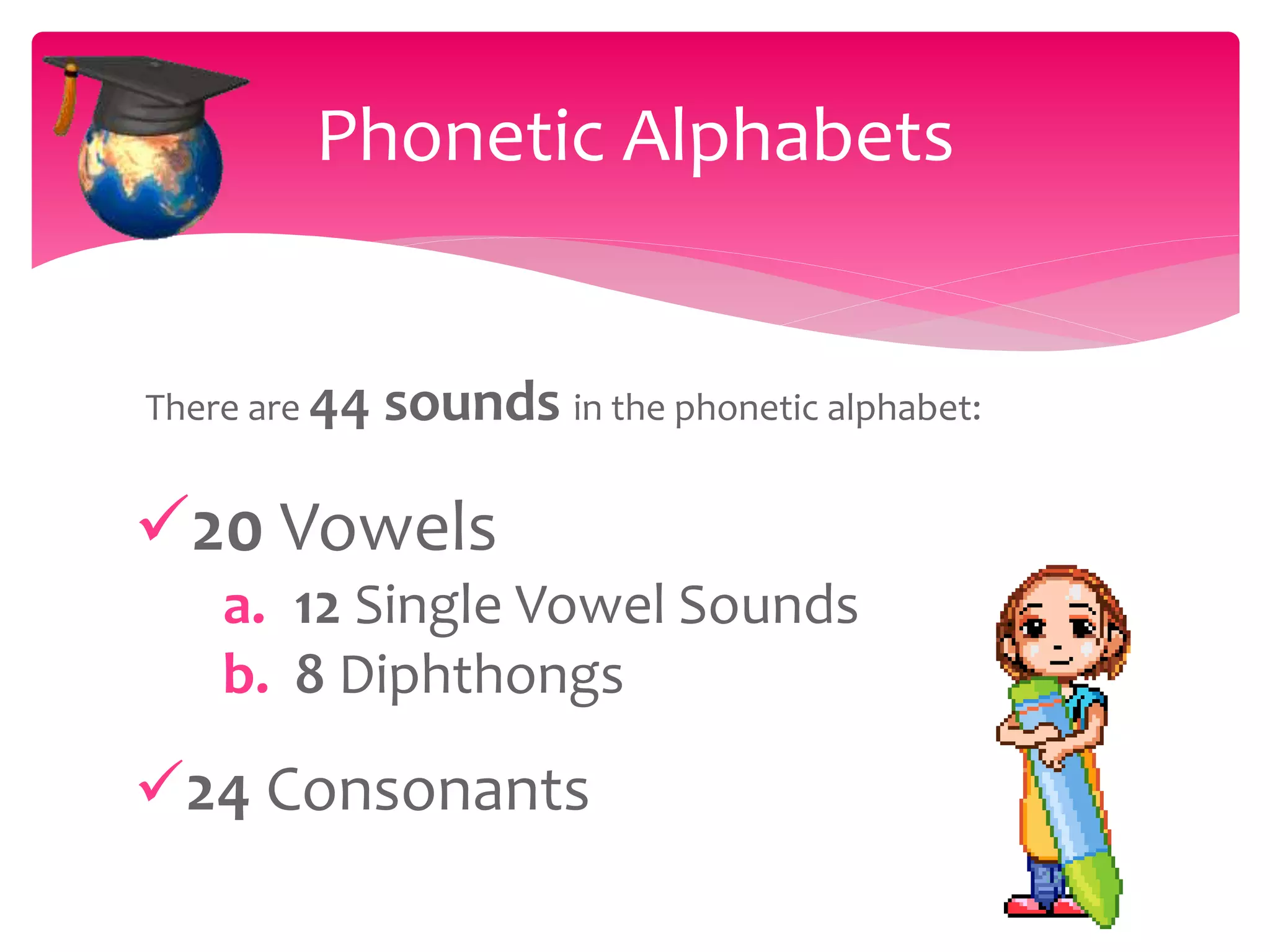
There are 44 sounds in the phonetic alphabet:
20 Vowels
a. 12 Single Vowel Sounds
b. 8 Diphthongs
24 Consonants
Phonetic Alphabets
The word diphthong comes from the Latin
word “diphthongus” and the Greek word
“diphthongos” meaning “having two sounds”
A single sound produced when two vowels
(one dominant in duration and stress, and one
reduced in duration and stress), are paired
together in the sequence.
(Linda I. House: Introductory Phonetics and Phonology)
What is a DIPHTHONG?
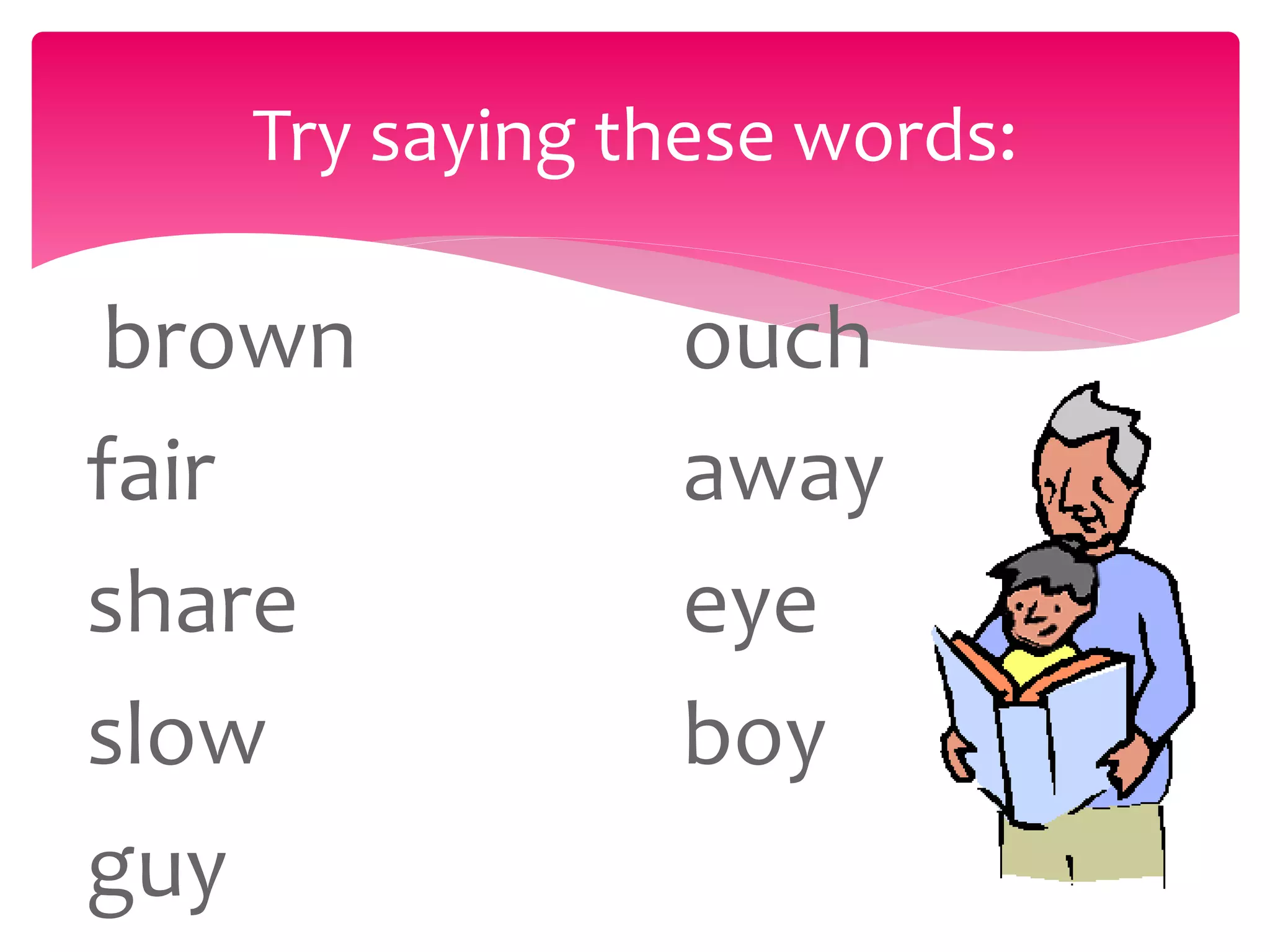
brown
fair
share
slow
guy
ouch
away
eye
boy
Try saying these words:
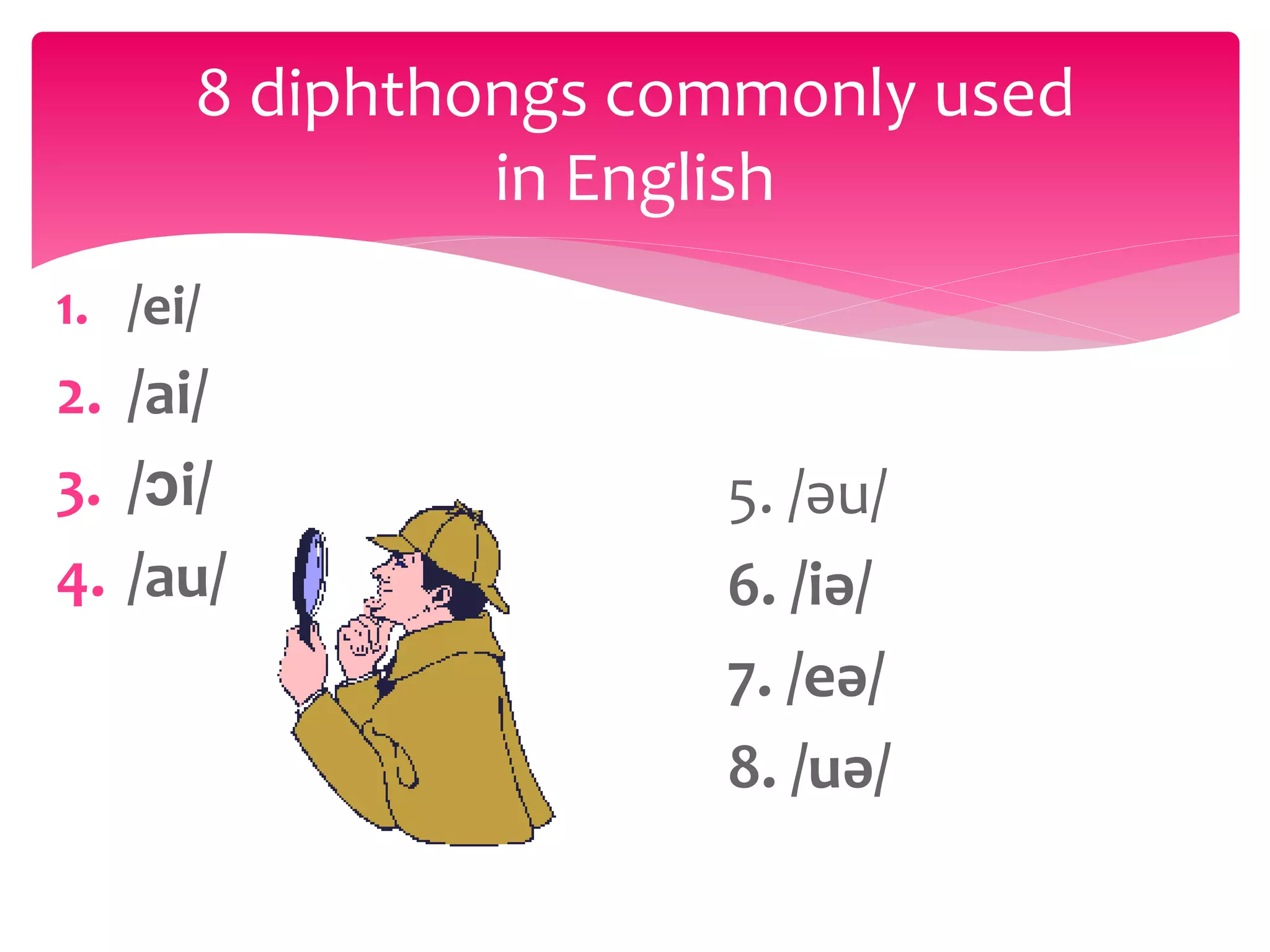
1. /ei/
2. /ai/
3. /ɔi/
4. /au/
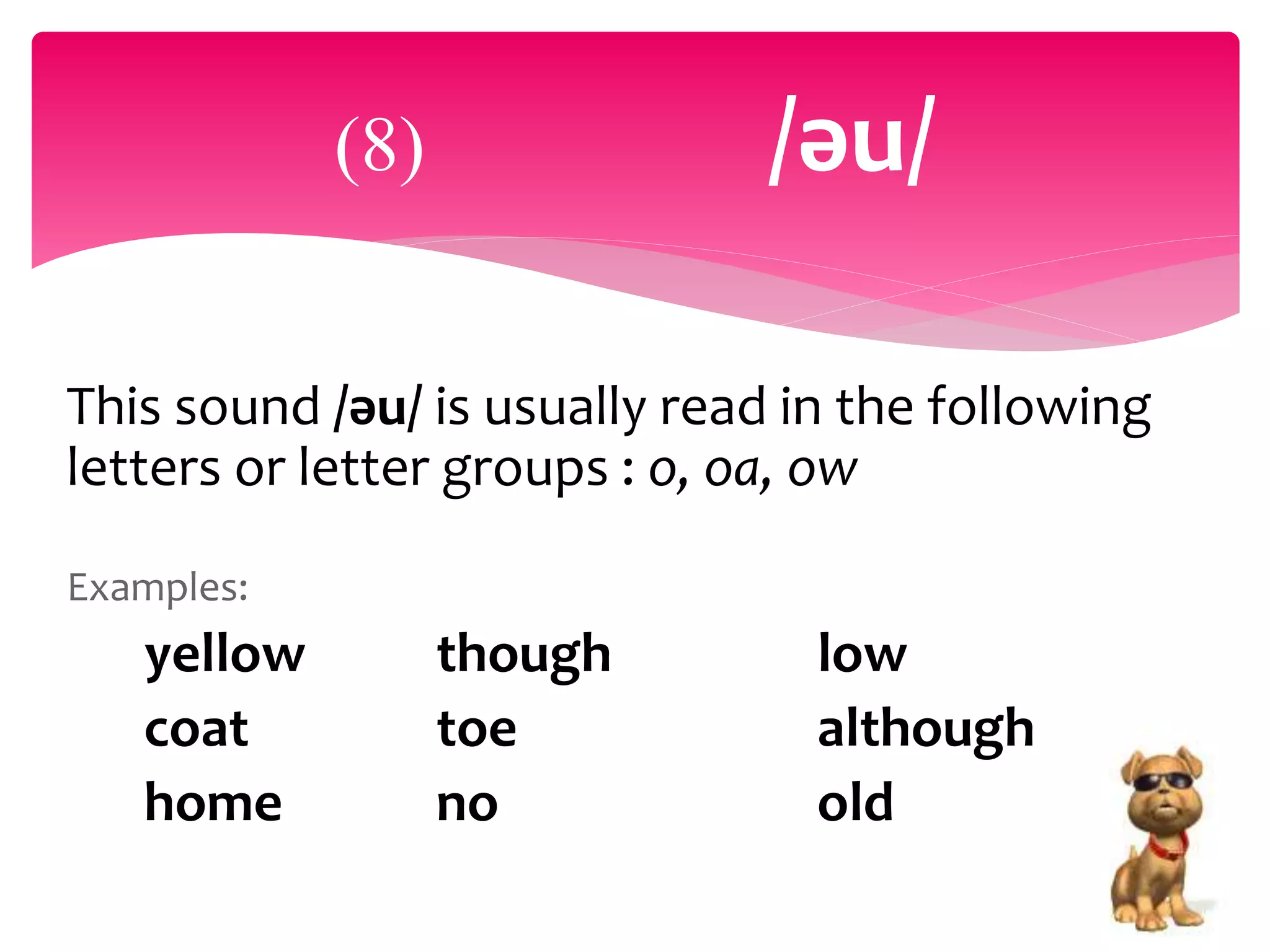
5. /әu/
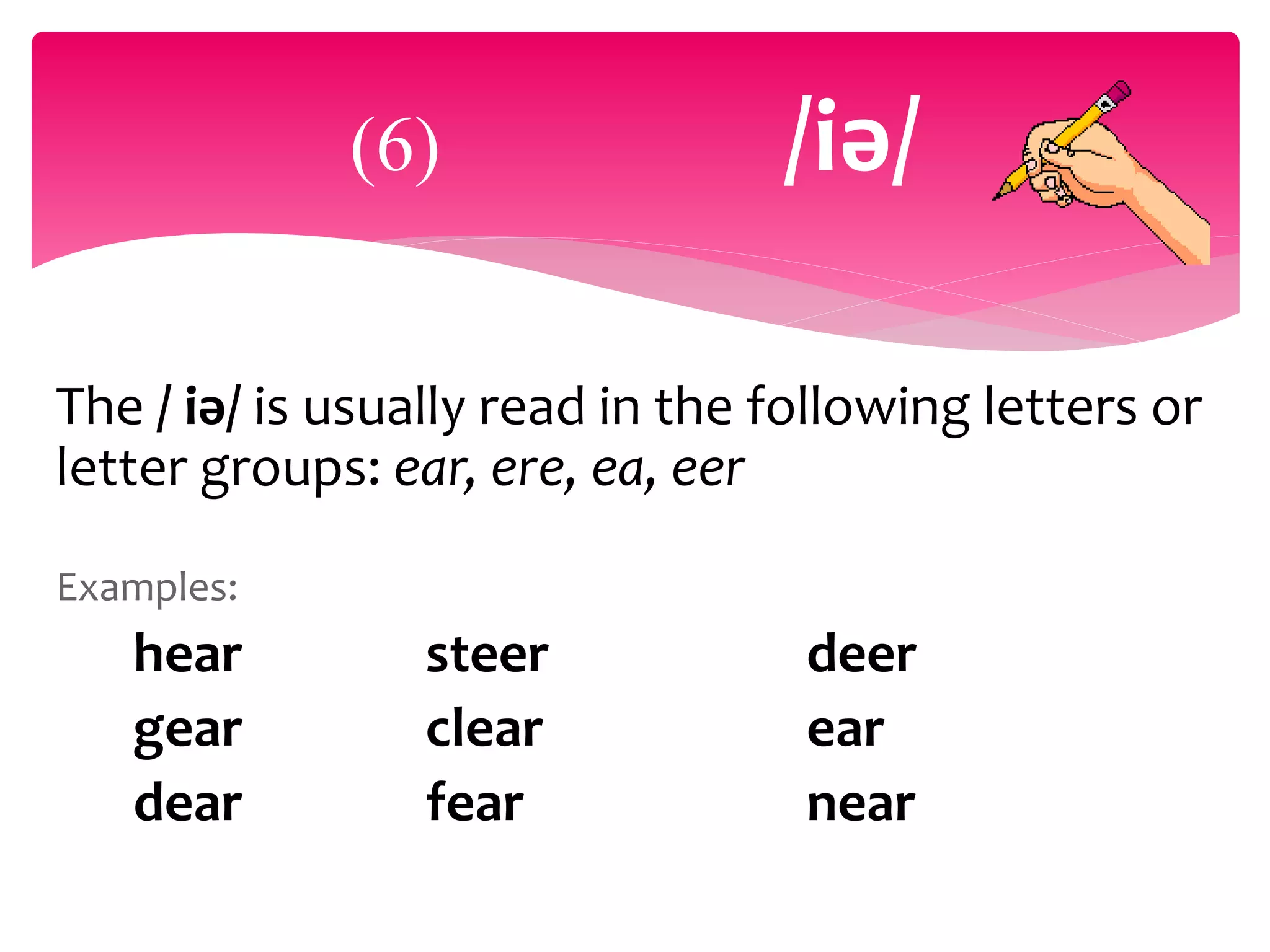
6. /iә/
7. /eә/
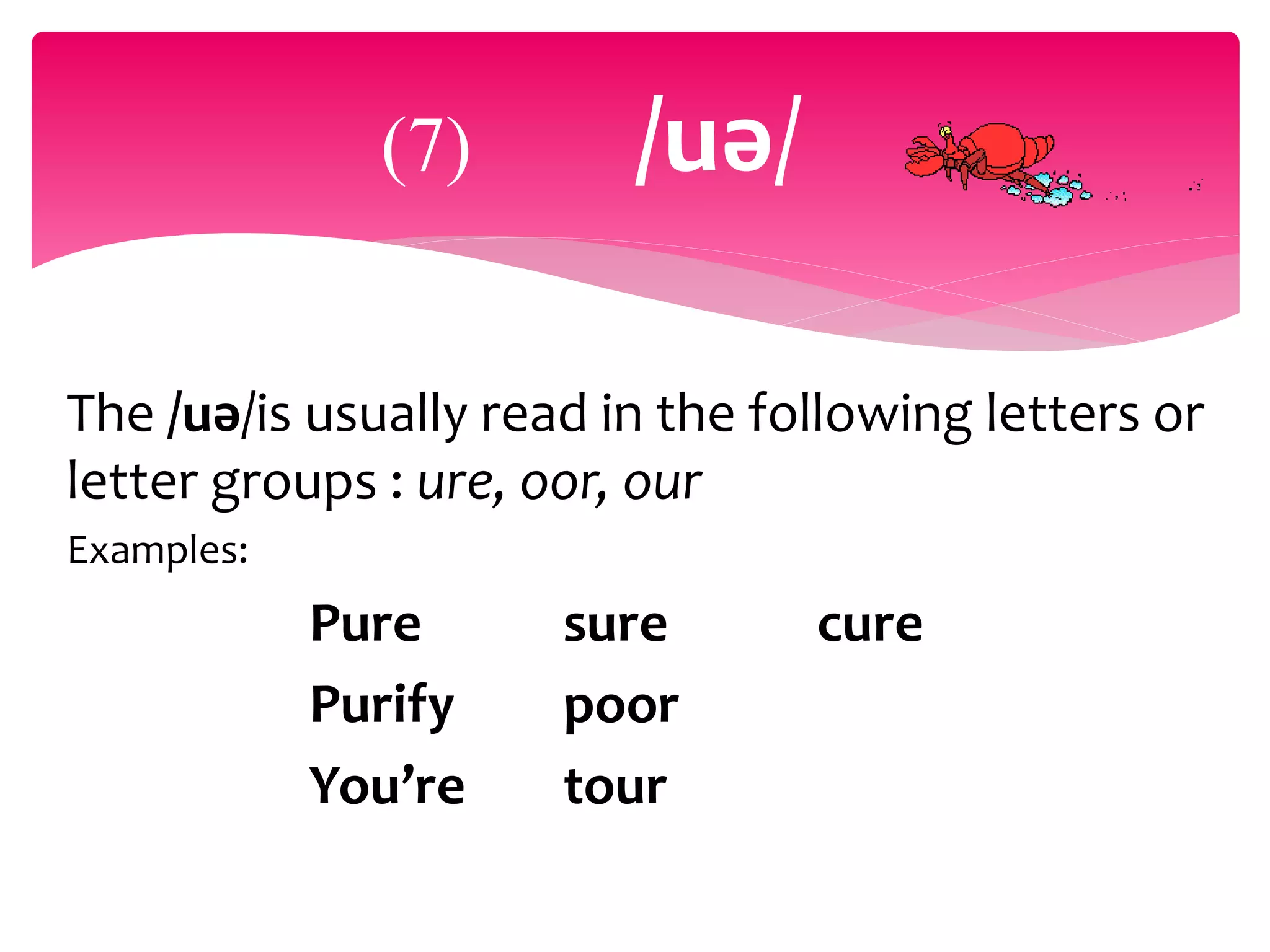
8. /uә/
8 diphthongs commonly used
in English
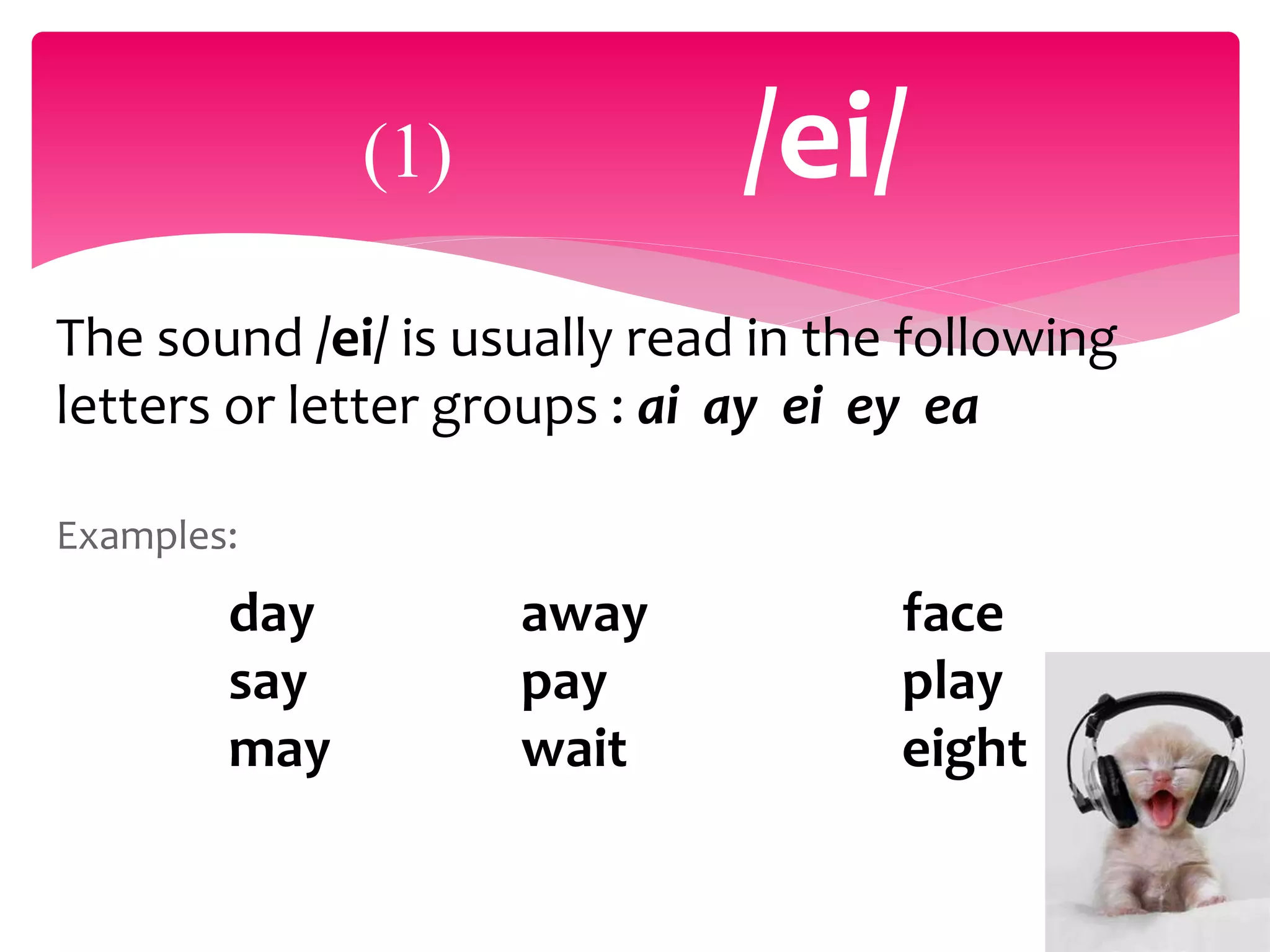
The sound /ei/ is usually read in the following
letters or letter groups : ai ay ei ey ea
Examples:
(1) /ei/
day away face
say pay play
may wait eight
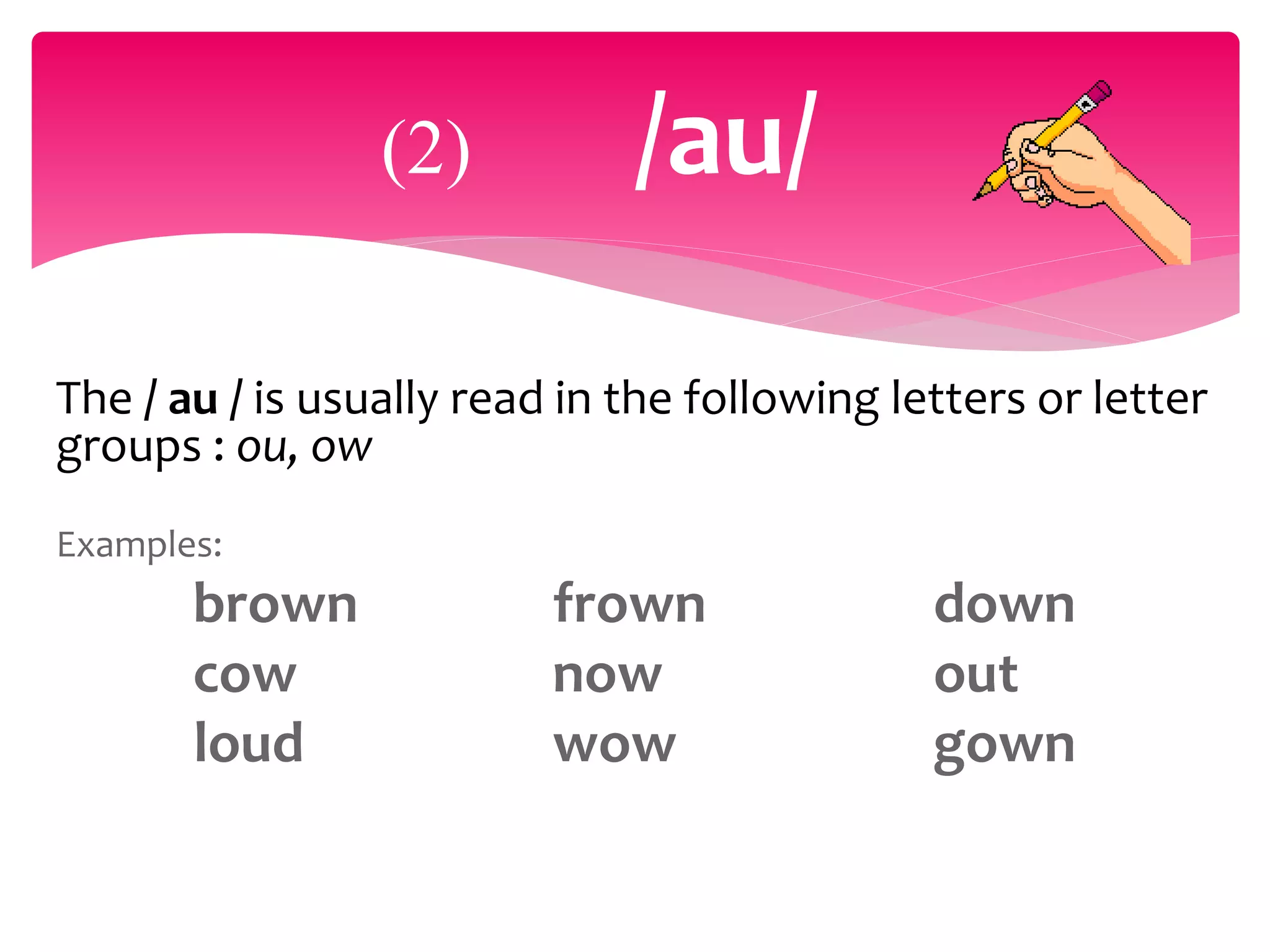
The / au / is usually read in the following letters or letter
groups : ou, ow
Examples:
brown frown down
cow now out
loud wow gown
(2) /au/
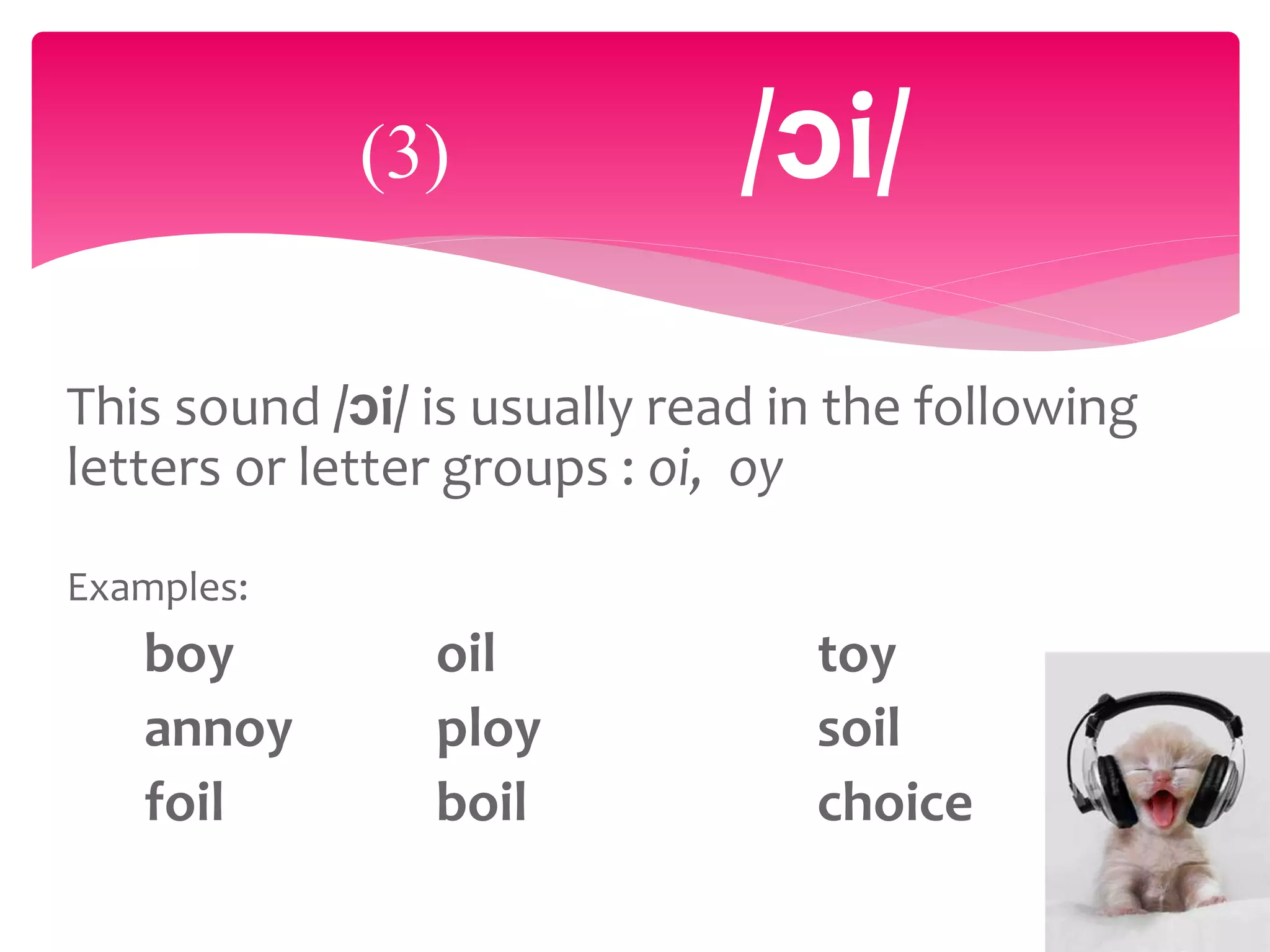
This sound /ɔi/ is usually read in the following
letters or letter groups : oi, oy
Examples:
boy oil toy
annoy ploy soil
foil boil choice
(3) /ɔi/
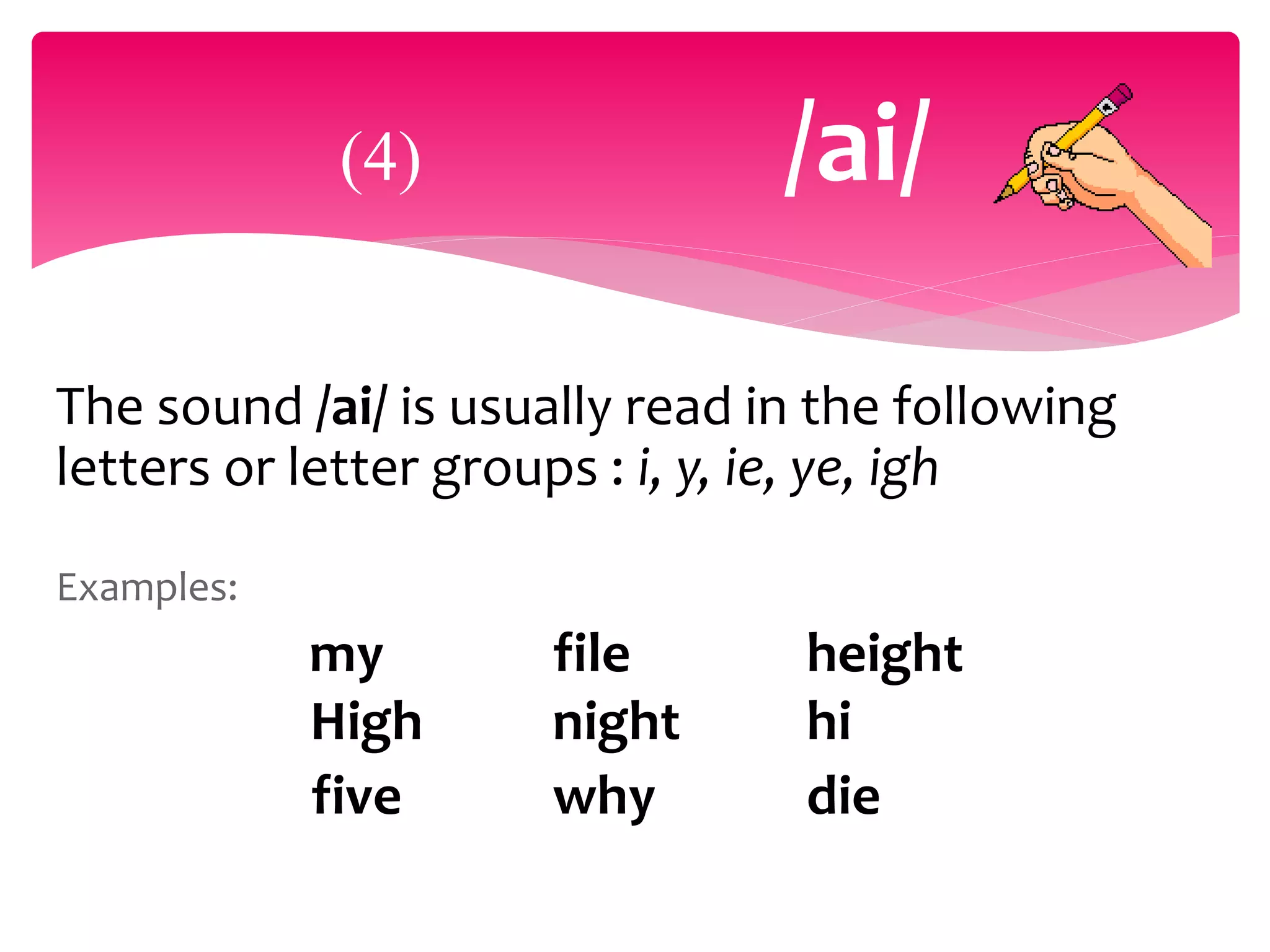
The sound /ai/ is usually read in the following
letters or letter groups : i, y, ie, ye, igh
Examples:
my file height
High night hi
five why die
(4) /ai/
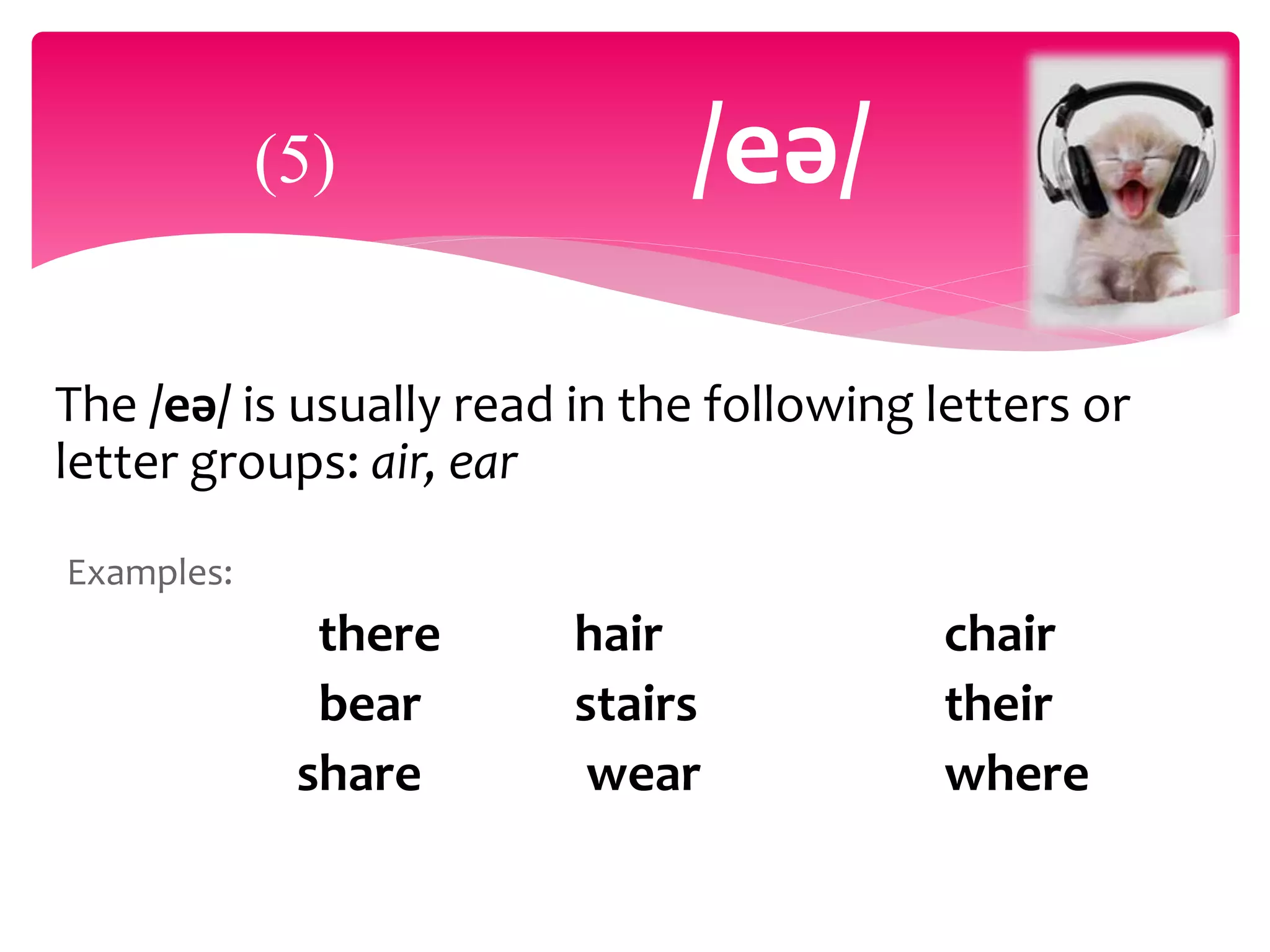
The /eә/ is usually read in the following letters or
letter groups: air, ear
Examples:
there hair chair
bear stairs their
share wear where
(5) /eә/
The / iә/ is usually read in the following letters or
letter groups: ear, ere, ea, eer
Examples:
hear steer deer
gear clear ear
dear fear near
(6) /iә/
The /uә/is usually read in the following letters or
letter groups : ure, oor, our
Examples:
Pure sure cure
Purify poor
You’re tour
(7) /uә/
This sound /әu/ is usually read in the following
letters or letter groups : o, oa, ow
Examples:
yellow though low
coat toe although
home no old
(8) /әu/
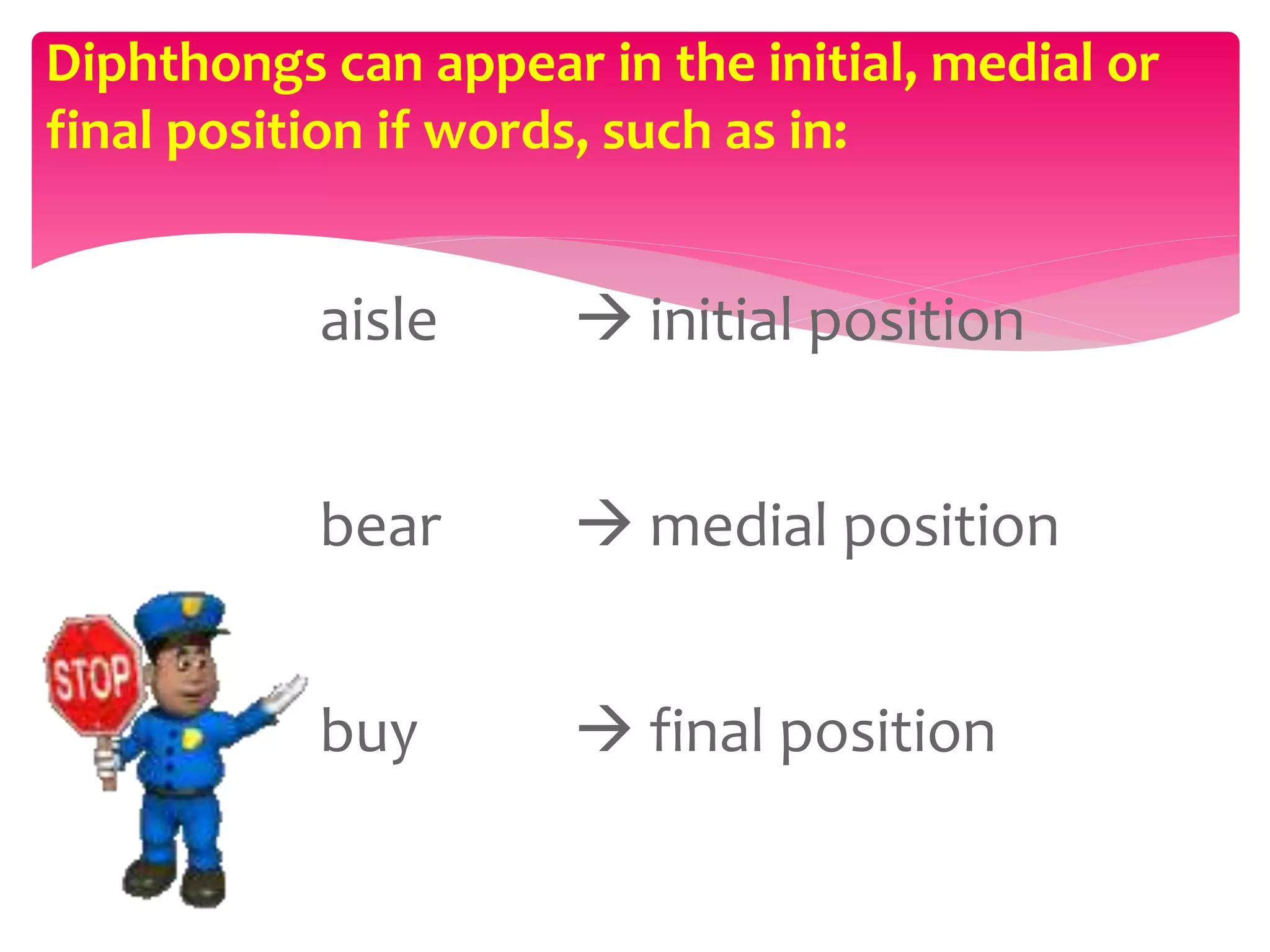
aisle  initial position
bear  medial position
buy  final position
Diphthongs can appear in the initial, medial or
final position if words, such as in:
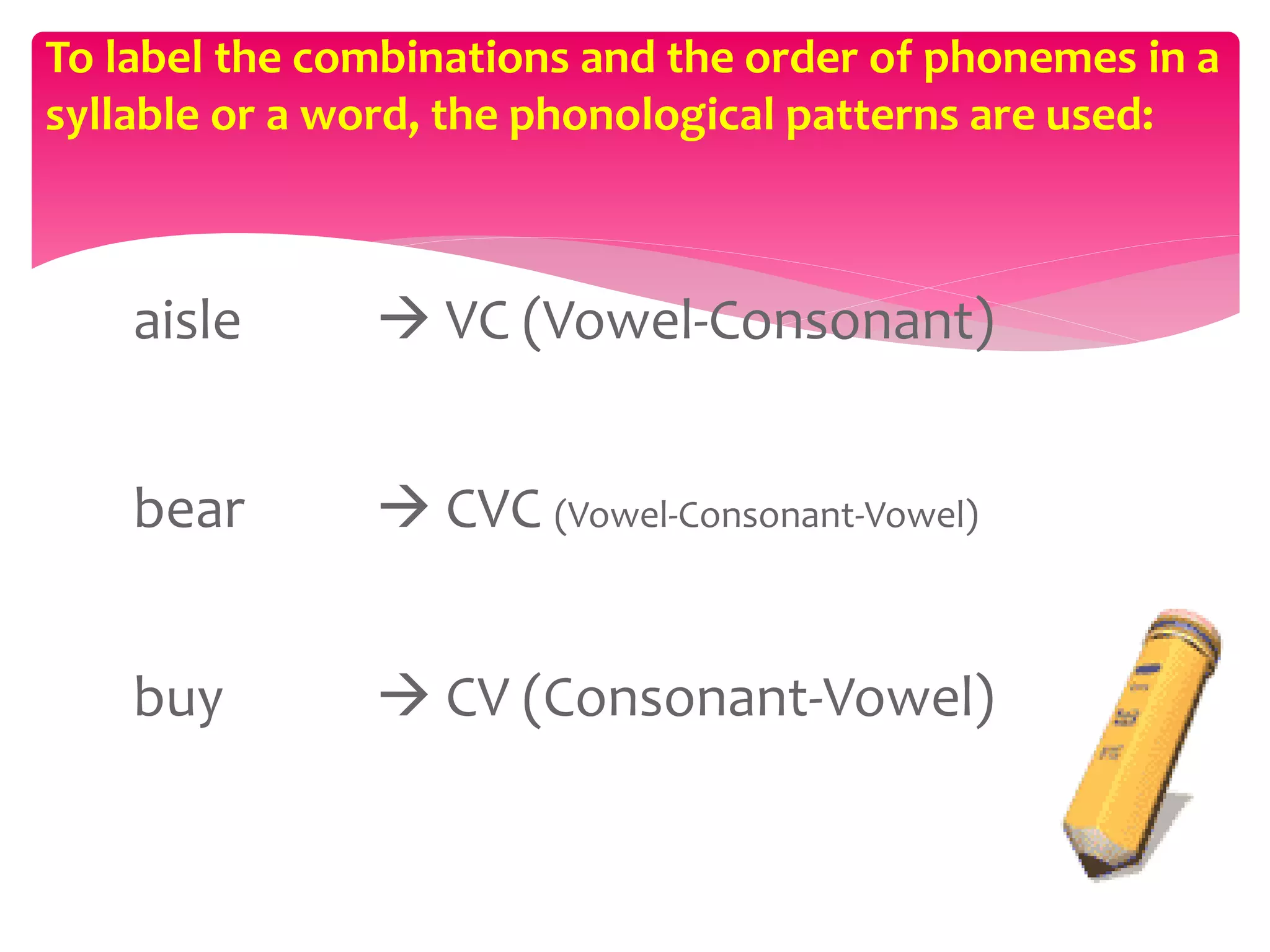
aisle  VC (Vowel-Consonant)
bear  CVC (Vowel-Consonant-Vowel)
buy  CV (Consonant-Vowel)
To label the combinations and the order of phonemes in a
syllable or a word, the phonological patterns are used:
The most misunderstood but most
common vowel sound in English
“reduced vowels”
Vowels changed in quality when they are
reduced. The reduced vowel (unstressed)
tends to be not only very short, but also
very unclear, producing an obscure sound
that is hard to identify.
Schwa /∂/
 A schwa is the ‘uh’ sound in a unstressed syllable.
 Its precise quality varies depending on the adjacent
consonants
 The word schwa is from the Hebrew word shva – ‘eh’ /
absence of vowel patterns
 Also called the murmur vowel, the indeterminate vowel,
the neutral vowel, the obscure vowel and the natural
vowel
 Proper use of schwa helps speakers adopt and maintain
English sentence stress
Schwa /∂/
 Certain grammatical words called function words can
have two different pronunciations in spoken English
A. Citation form
Pronunciation used when the word is spoken alone or
out of context
Used in a dictionary transcription
B. Reduced form
Pronunciation used when used within a sentence
The secondary transcription
Schwa in function words
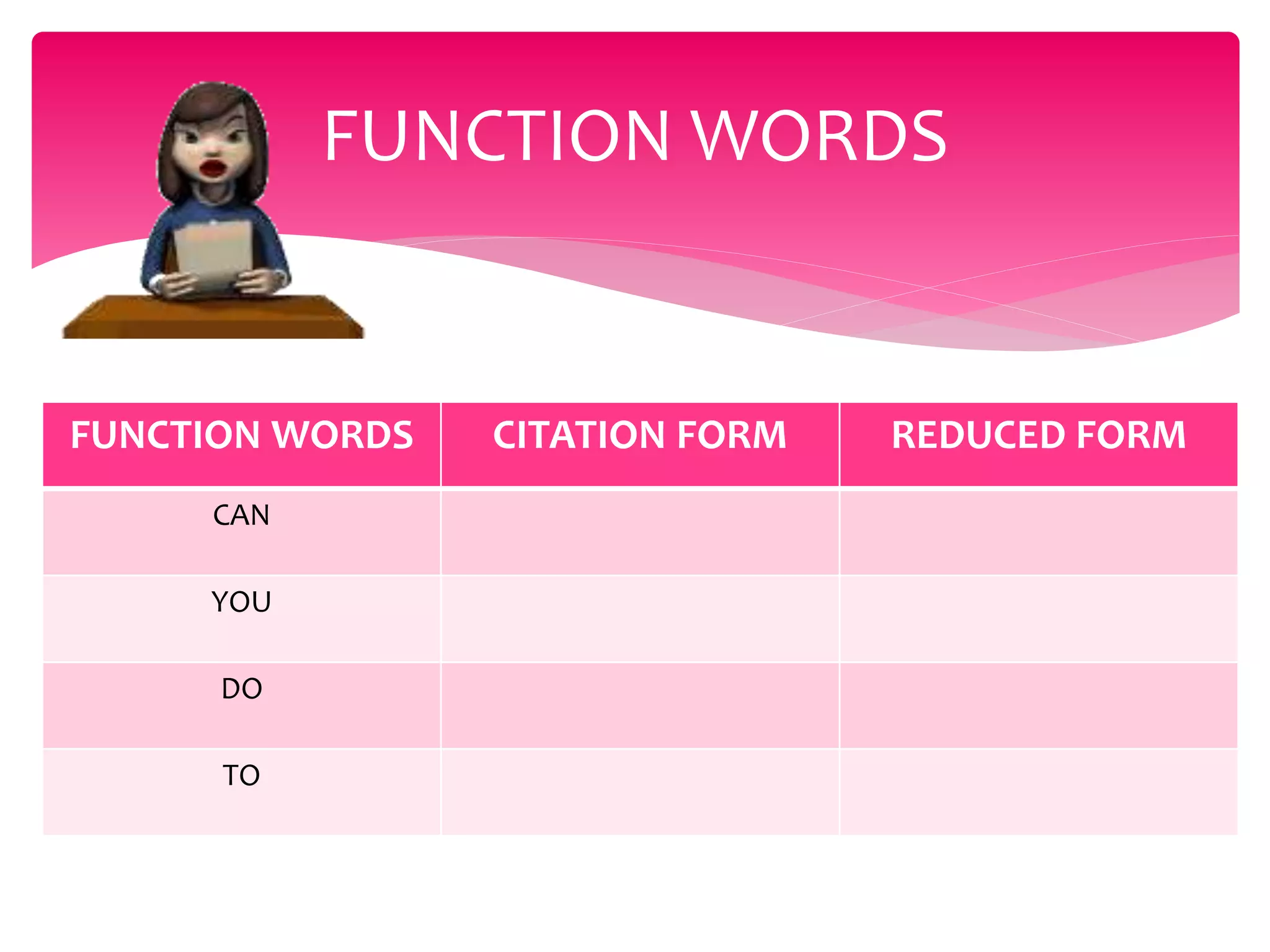
FUNCTION WORDS
FUNCTION WORDS CITATION FORM REDUCED FORM
CAN
YOU
DO
TO
official
occasion
event
fatigue
Try reading this!
1.amazing
2.tenacious
3.replacate
4.different
5.camera
Try saying these words:
1. chocolate
2. Separate
3. Memory
4. Pencil
5. Alone
6. Syringe
7. Taken
8. About
Try reading this!
chocolate choclat
Separate seprate
Memory memry
Pencil pencol
Alone ulone
Syringe suringe
Taken takin
About ubout
Try reading this!
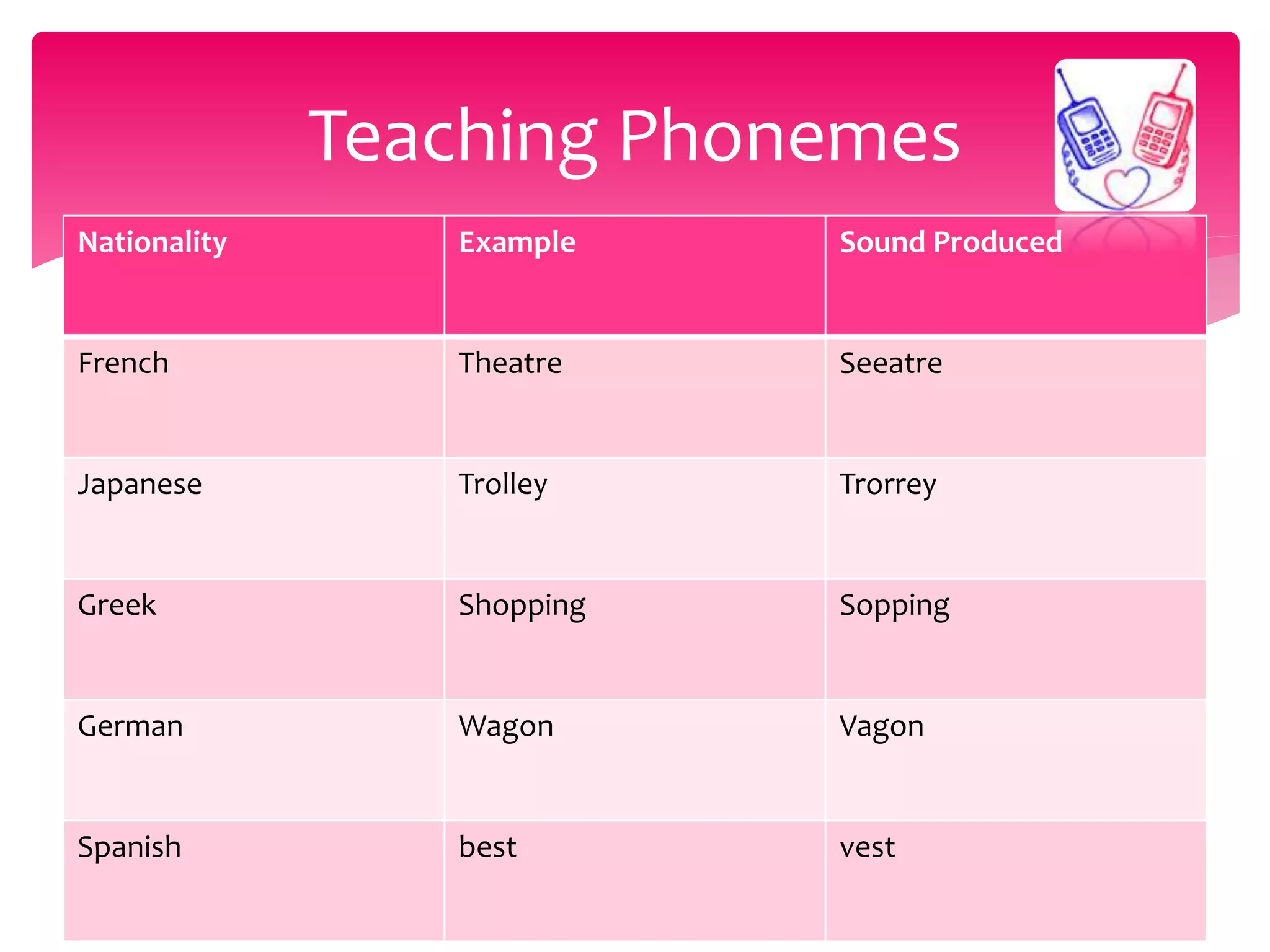
Nationality Example Sound Produced
French Theatre Seeatre
Japanese Trolley Trorrey
Greek Shopping Sopping
German Wagon Vagon
Spanish best vest
Teaching Phonemes
 Depending on where they are from,
non-native speakers may have
problems with certain sounds.
 Being aware of this commonly
confused sounds helps us identify the
cause of student’s comprehension/
intelligibility problems.
Remember:
 While it is important for a teacher to be
clear and articulate, the best idea is to
stay loyal to your own pronunciation.
 Your students need to be aware that a
variety of accents exist in the world and
not every English speaker will speak the
way you do.
Remember:
Thank you 

How to teach pronunciation

  • 1.
    Prepared by: RACHELLE M.GUEVARRA MAED-English
  • 13.
    To be awareof how sounds are formed, how words are stressed, and what intonation patterns exist To become an intelligible speaker in English To improve our own comprehension of spoken English Why teach pronunciation?
  • 14.
    Symbols/ letters used tohelp us work out the pronunciation of words “phonemic script” What are Phonemic Symbols?
  • 15.
    Some letters havemore than one sound Sometimes letters are not pronounced at all The same sound may be represented by different letters Sometimes syllables indicated by the spelling are not pronounced at all Why use Phonemic Symbols?
  • 16.
    There are 44sounds in the phonetic alphabet: 20 Vowels a. 12 Single Vowel Sounds b. 8 Diphthongs 24 Consonants Phonetic Alphabets
  • 17.
    The word diphthongcomes from the Latin word “diphthongus” and the Greek word “diphthongos” meaning “having two sounds” A single sound produced when two vowels (one dominant in duration and stress, and one reduced in duration and stress), are paired together in the sequence. (Linda I. House: Introductory Phonetics and Phonology) What is a DIPHTHONG?
  • 18.
  • 19.
    1. /ei/ 2. /ai/ 3./ɔi/ 4. /au/ 5. /әu/ 6. /iә/ 7. /eә/ 8. /uә/ 8 diphthongs commonly used in English
  • 20.
    The sound /ei/is usually read in the following letters or letter groups : ai ay ei ey ea Examples: (1) /ei/ day away face say pay play may wait eight
  • 21.
    The / au/ is usually read in the following letters or letter groups : ou, ow Examples: brown frown down cow now out loud wow gown (2) /au/
  • 22.
    This sound /ɔi/is usually read in the following letters or letter groups : oi, oy Examples: boy oil toy annoy ploy soil foil boil choice (3) /ɔi/
  • 23.
    The sound /ai/is usually read in the following letters or letter groups : i, y, ie, ye, igh Examples: my file height High night hi five why die (4) /ai/
  • 24.
    The /eә/ isusually read in the following letters or letter groups: air, ear Examples: there hair chair bear stairs their share wear where (5) /eә/
  • 25.
    The / iә/is usually read in the following letters or letter groups: ear, ere, ea, eer Examples: hear steer deer gear clear ear dear fear near (6) /iә/
  • 26.
    The /uә/is usuallyread in the following letters or letter groups : ure, oor, our Examples: Pure sure cure Purify poor You’re tour (7) /uә/
  • 27.
    This sound /әu/is usually read in the following letters or letter groups : o, oa, ow Examples: yellow though low coat toe although home no old (8) /әu/
  • 28.
    aisle  initialposition bear  medial position buy  final position Diphthongs can appear in the initial, medial or final position if words, such as in:
  • 29.
    aisle  VC(Vowel-Consonant) bear  CVC (Vowel-Consonant-Vowel) buy  CV (Consonant-Vowel) To label the combinations and the order of phonemes in a syllable or a word, the phonological patterns are used:
  • 30.
    The most misunderstoodbut most common vowel sound in English “reduced vowels” Vowels changed in quality when they are reduced. The reduced vowel (unstressed) tends to be not only very short, but also very unclear, producing an obscure sound that is hard to identify. Schwa /∂/
  • 31.
     A schwais the ‘uh’ sound in a unstressed syllable.  Its precise quality varies depending on the adjacent consonants  The word schwa is from the Hebrew word shva – ‘eh’ / absence of vowel patterns  Also called the murmur vowel, the indeterminate vowel, the neutral vowel, the obscure vowel and the natural vowel  Proper use of schwa helps speakers adopt and maintain English sentence stress Schwa /∂/
  • 32.
     Certain grammaticalwords called function words can have two different pronunciations in spoken English A. Citation form Pronunciation used when the word is spoken alone or out of context Used in a dictionary transcription B. Reduced form Pronunciation used when used within a sentence The secondary transcription Schwa in function words
  • 33.
    FUNCTION WORDS FUNCTION WORDSCITATION FORM REDUCED FORM CAN YOU DO TO
  • 34.
  • 35.
  • 36.
    1. chocolate 2. Separate 3.Memory 4. Pencil 5. Alone 6. Syringe 7. Taken 8. About Try reading this!
  • 37.
    chocolate choclat Separate seprate Memorymemry Pencil pencol Alone ulone Syringe suringe Taken takin About ubout Try reading this!
  • 38.
    Nationality Example SoundProduced French Theatre Seeatre Japanese Trolley Trorrey Greek Shopping Sopping German Wagon Vagon Spanish best vest Teaching Phonemes
  • 39.
     Depending onwhere they are from, non-native speakers may have problems with certain sounds.  Being aware of this commonly confused sounds helps us identify the cause of student’s comprehension/ intelligibility problems. Remember:
  • 40.
     While itis important for a teacher to be clear and articulate, the best idea is to stay loyal to your own pronunciation.  Your students need to be aware that a variety of accents exist in the world and not every English speaker will speak the way you do. Remember:
  • 41.

Editor's Notes

  • #14 So why do we really need to teach pronunciation among our students? What do you think? So according to a particular reference, there are 3 aims or objectives in teaching pronunciation to students.
  • #17 Phonology relies on phonetic information for its practice Both phonetics and phonology are related, dependent fields for studying aspects of language
  • #18 To help us in teaching or even learning pronunciation of words, we used this what we call, phonemic symbols, What are phonemic symbols? By definition, ,,,,
  • #21 In other words, diphthongs is a single sound produced when two vowels are paired together. “double sounds”
  • #34 This sound is considered to be the most misunderstood yet most common sound in english. – its hard to study since we don’t represent it in writing You have to use clues about stress and syllable structure to Every vowel, may say the schwa sound figure out where to put it Refered to as the lazy vowel- we hardly open mouths Schwa does not have an exact and standard pronunciation
  • #35 So simply speaking, a schwa is… its precise quality… In Hebrew writing, shva, is a vowel diacritic that can be written under letters to indicate ‘eh’ sound. Or to some, as absence of vowel Before people started calling it ‘schwa’ in english around 1895, it had a lot of nicknames.
  • #36 We all know that english spelling is rarely a good guide to pronunciation, right? (question) One big reason for this is the prevalence of the schwa in the spoken language. That’s why dictionaries and other written guides to pronunciation make use of a special symbols to represent schwa sound. Function words are reduced when the word is used within a sentence and not if the word is spoken in isolation. The purpose of reduced pronunciations is to help function words fall into the background of speech, while content words gain emphasis.
  • #40 Delete syllable
  • #41 Delete syllable