LESSON
PLAN
Subject : English (as a Foreign Language)
Grade : 3
English Level : Basic
Materials : Songs & the ‘fill-in-the-gasp’ task
Content : Vocabulary and cultural customs
related to the animals in the farm.
GOALS OBJECTIVES
Students will be able to:
Increase vocabulary related to
animals in the farm.
Acquire an interest of every part in
farm.
Interact with other children and
carry out better teamwork.
After learning and practice this lesson
plan, students will: Acquire listening
strategies. Write new words related to
the farm and translate into their
language. Pronounce correctly these
words. Make sentences using the new
words learned.
ANTICIPATORY SET
(10 minutes before lesson)
Introduce them the topic through questions that
they will be able to answer based on their own
experience about a farm :
 Have you ever visited a farm?
 What animals did you see?
 What's your favorite farm animal?
 How does it sounds?
ACTIVITIES & REQUIRED SET
 Pre – Listening : Old MacDonald (twice)(3 min.)
 Fill in the gaps (listen the song again)(5 min.)
 Peer Correcting (write the words in the board)(10 min.)
 Sing the song together(5 min.)
 Look for the song’s vocabulary (10 min.)
 Observe the spelling and the pronunciation of each word.
(during the correction of the fill in the gasps)(10 min)
DIRECT INSTRUCTIONS
We share out the lyrics of the song. We give them some
time to see the pictures and read the text. Then, we
explain them that: We are going to listen ‘Old MacDonald
had a Farm’. We ask them to be really attentive to the rhythm
because we will sing it all together. Once the song has been listened, they
will realize that there are some words that don’t appear in the lyrics. We
will tell them that an old Macdonald has lost them and they have to help
him finding these words. If not, we won’t sing the song later because we
won’t have the whole song. When they have completed the song, we ask
them to exchange their photocopies with a mate. They try to correct the
lyrics all together. One of each pair will be the spokes person. In case of
errors: the teacher tries to get students to self-correct.
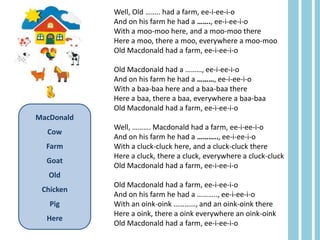
Well, Old …….. had a farm, ee-i-ee-i-o
And on his farm he had a ……., ee-i-ee-i-o
With a moo-moo here, and a moo-moo there
Here a moo, there a moo, everywhere a moo-moo
Old Macdonald had a farm, ee-i-ee-i-o
Old Macdonald had a ………, ee-i-ee-i-o
And on his farm he had a ………, ee-i-ee-i-o
With a baa-baa here and a baa-baa there
Here a baa, there a baa, everywhere a baa-baa
Old Macdonald had a farm, ee-i-ee-i-o
Well, ………. Macdonald had a farm, ee-i-ee-i-o
And on his farm he had a ……….., ee-i-ee-i-o
With a cluck-cluck here, and a cluck-cluck there
Here a cluck, there a cluck, everywhere a cluck-cluck
Old Macdonald had a farm, ee-i-ee-i-o
And on his farm he had a ……….., ee-i-ee-i-o
With an oink-oink …………, and an oink-oink there
Here a oink, there a oink everywhere an oink-oink
Old Macdonald had a farm, ee-i-ee-i-o
MacDonald
Cow
Farm
Goat
Old
Chicken
Pig
Here
SKILLS
• The four skill (listening, writing, reading and
speaking) are developed with these activities.
STRATEGIES
• Listening for specific information
• Following instructions
• Memorizing (the rhythm of the song, the
vocabulary, the meaning of the words)
• Using visual clues as aids to meaning
Pronunciation
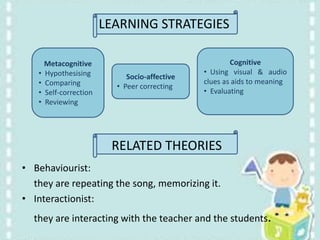
LEARNING STRATEGIES
RELATED THEORIES
• Behaviourist:
they are repeating the song, memorizing it.
• Interactionist:
they are interacting with the teacher and the students.
Metacognitive
• Hypothesising
• Comparing
• Self-correction
• Reviewing
Cognitive
• Using visual & audio
clues as aids to meaning
• Evaluating
Socio-affective
• Peer correcting
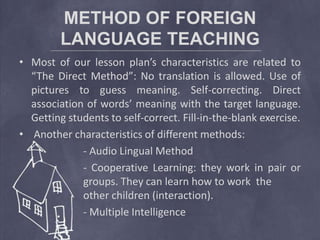
METHOD OF FOREIGN
LANGUAGE TEACHING
• Most of our lesson plan’s characteristics are related to
“The Direct Method”: No translation is allowed. Use of
pictures to guess meaning. Self-correcting. Direct
association of words’ meaning with the target language.
Getting students to self-correct. Fill-in-the-blank exercise.
• Another characteristics of different methods:
- Audio Lingual Method
- Cooperative Learning: they work in pair or
groups. They can learn how to work the
other children (interaction).
- Multiple Intelligence
ASSESMENT AND FOLLOW UP
We will carry out a Formative Assessment
throughout the Lesson Plan. Some aspects that
will be worth, the student…
- is motivated
- participates in the task
- understand the task
- interacts with other students
- presents their job in a organized way

Listening Skill Lesson Plan

  • 1.
  • 2.
    Subject : English(as a Foreign Language) Grade : 3 English Level : Basic Materials : Songs & the ‘fill-in-the-gasp’ task Content : Vocabulary and cultural customs related to the animals in the farm.
  • 3.
    GOALS OBJECTIVES Students willbe able to: Increase vocabulary related to animals in the farm. Acquire an interest of every part in farm. Interact with other children and carry out better teamwork. After learning and practice this lesson plan, students will: Acquire listening strategies. Write new words related to the farm and translate into their language. Pronounce correctly these words. Make sentences using the new words learned.
  • 4.
    ANTICIPATORY SET (10 minutesbefore lesson) Introduce them the topic through questions that they will be able to answer based on their own experience about a farm :  Have you ever visited a farm?  What animals did you see?  What's your favorite farm animal?  How does it sounds?
  • 5.
    ACTIVITIES & REQUIREDSET  Pre – Listening : Old MacDonald (twice)(3 min.)  Fill in the gaps (listen the song again)(5 min.)  Peer Correcting (write the words in the board)(10 min.)  Sing the song together(5 min.)  Look for the song’s vocabulary (10 min.)  Observe the spelling and the pronunciation of each word. (during the correction of the fill in the gasps)(10 min)
  • 6.
    DIRECT INSTRUCTIONS We shareout the lyrics of the song. We give them some time to see the pictures and read the text. Then, we explain them that: We are going to listen ‘Old MacDonald had a Farm’. We ask them to be really attentive to the rhythm because we will sing it all together. Once the song has been listened, they will realize that there are some words that don’t appear in the lyrics. We will tell them that an old Macdonald has lost them and they have to help him finding these words. If not, we won’t sing the song later because we won’t have the whole song. When they have completed the song, we ask them to exchange their photocopies with a mate. They try to correct the lyrics all together. One of each pair will be the spokes person. In case of errors: the teacher tries to get students to self-correct.
  • 7.
    Well, Old ……..had a farm, ee-i-ee-i-o And on his farm he had a ……., ee-i-ee-i-o With a moo-moo here, and a moo-moo there Here a moo, there a moo, everywhere a moo-moo Old Macdonald had a farm, ee-i-ee-i-o Old Macdonald had a ………, ee-i-ee-i-o And on his farm he had a ………, ee-i-ee-i-o With a baa-baa here and a baa-baa there Here a baa, there a baa, everywhere a baa-baa Old Macdonald had a farm, ee-i-ee-i-o Well, ………. Macdonald had a farm, ee-i-ee-i-o And on his farm he had a ……….., ee-i-ee-i-o With a cluck-cluck here, and a cluck-cluck there Here a cluck, there a cluck, everywhere a cluck-cluck Old Macdonald had a farm, ee-i-ee-i-o Old Macdonald had a farm, ee-i-ee-i-o And on his farm he had a ……….., ee-i-ee-i-o With an oink-oink …………, and an oink-oink there Here a oink, there a oink everywhere an oink-oink Old Macdonald had a farm, ee-i-ee-i-o MacDonald Cow Farm Goat Old Chicken Pig Here
  • 8.
    SKILLS • The fourskill (listening, writing, reading and speaking) are developed with these activities. STRATEGIES • Listening for specific information • Following instructions • Memorizing (the rhythm of the song, the vocabulary, the meaning of the words) • Using visual clues as aids to meaning Pronunciation
  • 9.
    LEARNING STRATEGIES RELATED THEORIES •Behaviourist: they are repeating the song, memorizing it. • Interactionist: they are interacting with the teacher and the students. Metacognitive • Hypothesising • Comparing • Self-correction • Reviewing Cognitive • Using visual & audio clues as aids to meaning • Evaluating Socio-affective • Peer correcting
  • 10.
    METHOD OF FOREIGN LANGUAGETEACHING • Most of our lesson plan’s characteristics are related to “The Direct Method”: No translation is allowed. Use of pictures to guess meaning. Self-correcting. Direct association of words’ meaning with the target language. Getting students to self-correct. Fill-in-the-blank exercise. • Another characteristics of different methods: - Audio Lingual Method - Cooperative Learning: they work in pair or groups. They can learn how to work the other children (interaction). - Multiple Intelligence
  • 11.
    ASSESMENT AND FOLLOWUP We will carry out a Formative Assessment throughout the Lesson Plan. Some aspects that will be worth, the student… - is motivated - participates in the task - understand the task - interacts with other students - presents their job in a organized way