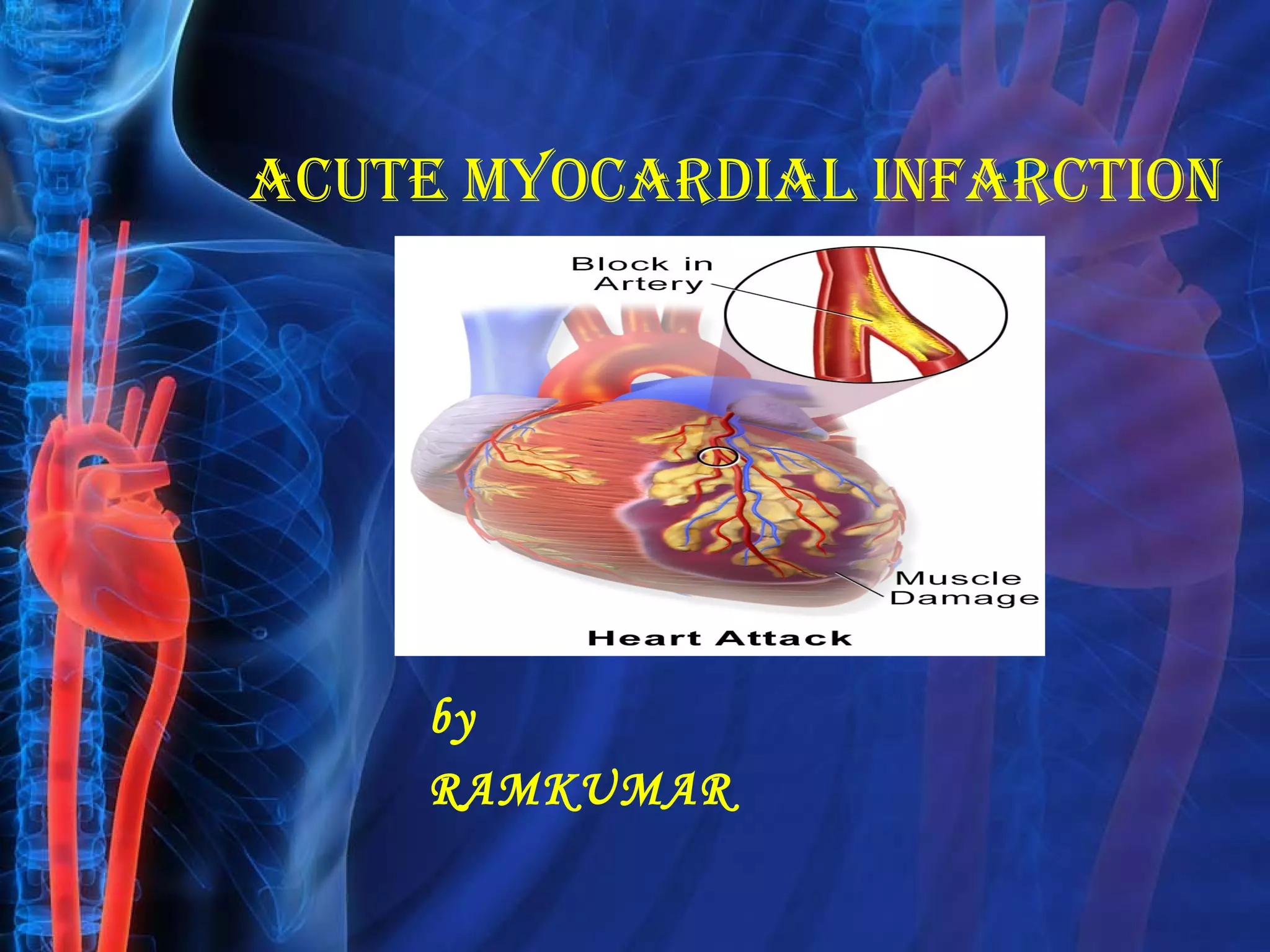
Acute MyocArdiAl infArction
by
RAMKUMAR
Definition
• Otherwise know as heart attack
• An MI occurs when there is a diminished
blood supply to the heart which leads to
myocardial cell damage and ischemia.
• Contractile function stops in the necrotic
areas of the heart.
• Ischemia usually occurs due to blockage
of the coronary vessels.
Definition cont.
• This blockage is often the result of
thrombus that is superimposed on an
ulcerated or unstable atherosclerotic
plaque formation in the coronary artery.
• MI’s are described by the area of
occurrence.
• Anterior, Inferior, Lateral or Posterior.
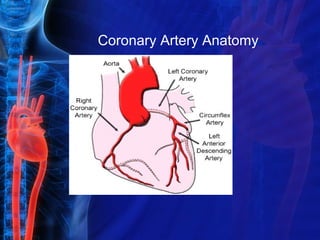
Coronary Artery Anatomy
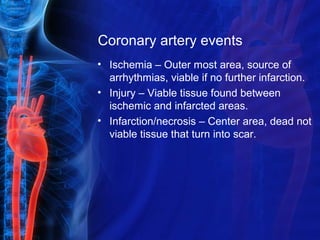
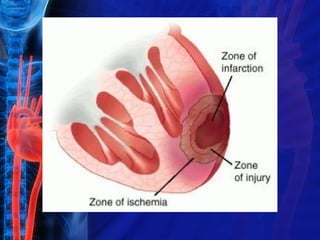
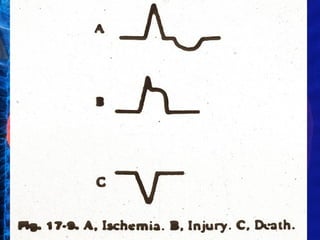
Coronary artery events
• Ischemia – Outer most area, source of
arrhythmias, viable if no further infarction.
• Injury – Viable tissue found between
ischemic and infarcted areas.
• Infarction/necrosis – Center area, dead not
viable tissue that turn into scar.
MI Classifications
• MI’s can be subcategorized by anatomy
and clinical diagnostic information.
Anatomic
• Transmural and Subendocardial
Diagnostic
• ST elevations (STEMI) and non ST
elevations (NSTEMI).
Risk Factors
• The presence of any risk factor is
associated with doubling the risk of an MI.
Non Modifiable
• Age
• Gender
• Family history
Risk Factors
Modifiable
• Smoking
• Diabetes Control
• Hypertension
• Hyperlipidemia
• Obesity
• Physical Inactivity
Pathophysiology
• Ischemia develops when there is an
increased demand for oxygen or a
decreased supply of oxygen.
• Ischemia can develop within 10 seconds and
if it lasts longer than 20 minutes, irreversible
cell and tissue death occurs.
• Myocardial cell death begins at the
endocardium. The area most distal to the
arterial blood supply.
Pathophysiology
• As vessel occlusion continues cell death
spreads to the myocardium and eventually
to the epicardium.
• Severity of the MI depends on three
factors.
• Level of occlusion
• Length of time of occlusion
• Presence or absence of collateral
circulation
Symptoms:
• Pain is the cardinal symptom of an
MI
• Anxiety and fear of impending
death
• Nausea and vomiting
• Breathlessness
• Collapse/syncope
Chest Pain
• The most common initial
manifestation is chest pain or
discomfort.
• This is not relieved by rest,
position change or nitrate
administration.
• Pain is described by heaviness,
pressure, fullness and crushing
sensation.
• Not everyone experiences this
sensation.
Cardiovascular Changes
• Initially the BP and pulse may be elevated.
• Later, BP will drop due to decreased
cardiac output.
• Urine output will decrease
• Lung sounds will change to crackles
• Jugular veins may become distended and
have obvious pulsations.
DIAGNOSTICS:
• Electrocardiogram (ECG)
• Blood test (Cardiac enzymes)
• Echocardiogram
• Nuclear scan
• Chest radiographs
• Coronary angiography
• Exercise stress test.
• Cardiac computerized tomography (CT)
or magnetic resonance imaging (MRI).
Diagnostics
• After collecting patient health history, a
series of EKG’s should be taken to rule out
or confirm MI.
• 12 lead EKG’s can help to distinguish
between ST-elevation MI’s and Non-ST-
elevation MI’s.
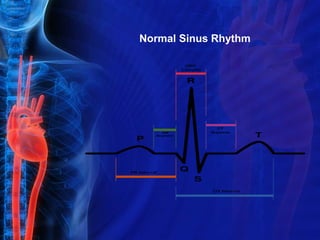
Normal Sinus Rhythm
Angina:
Stable
• Chest pain caused by the build up of
lactic acid and irritation to the
myocardial nerve fibers.
• Chest pain caused by the 4 E’s.
• Pain is usually relieved with rest, pain
meds and nitrates.
Variable/Prinzmetal/Spasm
• Transient ischemia that occurs
unpredictably and almost always at rest.
• Pain is caused by vasospasm of the
arteries.
• ST segment elevations will be noted.
Unstable
• Chest pain at rest or with exercise and
tends to last greater than 15 minutes.
• This results in reversible myocardial
ischemia but is a sign that an infarct is
soon to come.
• EKG will reveal ST segment depression
and T wave inversion.
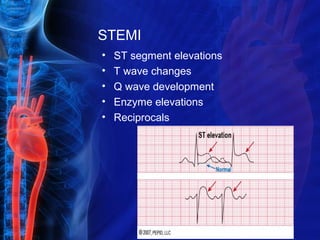
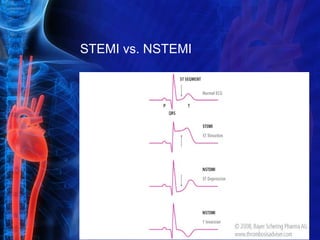
STEMI
• ST segment elevations
• T wave changes
• Q wave development
• Enzyme elevations
• Reciprocals
NSTEMI
• ST segment depressions
• T wave changes
• No Q wave development
• Mild enzyme elevations
• No reciprocals
STEMI vs. NSTEMI
Phases of a STEMI
• Hyperacute Phase
• Occurs within the first few hours of MI
onset.
• Leads facing the infarcted surface: ST
segment elevation.
• Leads facing the uninjured surface: ST
segment depression (reciprocals)
• T waves become tall, widened and
might be taller than the R wave.
Phases of a STEMI
• Fully Evolved Phase
• Q wave development
• ST elevation
• T waves start to become inverted in
leads facing the injury.
Phases of a STEMI
• Resolution phase
• Weeks after there will be a gradual
return of ST segments to baseline.
• T waves will gradually return to normal
but are the last to change back.
Serum Cardiac Markers
• Myocardial cells produce certain proteins
and enzymes associated with cellular
functions.
• When cell death occurs, these cellular
enzymes are released into the blood
stream.
• CPK and troponin
CPK
• Creatine Phosphokinase
• Begin to rise 3 to 12 hours after acute MI.
• Peak in 24 hours
• Return to normal in 2 to 3 days
Troponin
• Myocardial muscle protein released into
circulation after injury.
• These are highly specific indicators of MI.
• Troponin rises quickly like CK but will
continue to stay elevated for 2 weeks.
• Myoglobin-lacks cardiac specificity.
Treatment Options
• The immediate goal for any acute MI is to
restore normal coronary blood flow to
vessels and salvage myocardium.
• There are a variety of medical and
medicinal therapies to treat an MI.
General Treatment for the MI
patient
• Morphine
• Oxygen
• Nitroglycerin
• Aspirin
Fibrinolytic Therapy
• Indicated for patients with STEMI MI’s.
• Should be given within 12 hours of
symptom onset.
• Fibrinolytics will break down clots found
within the vessles
• Contraindications: post op surgical
patients, history of hemorrhagic stroke,
ulcer disease, pregnancy, ect.
Cardiac Catheterization
• A diagnostic angiography which includes
angioplasty and possible stenting.
• Performed by an interventional cardiologist
with a cardiac surgeon on stand by.
• Percutaneous procedure through the
femoral or brachial artery.
Cardiac Catheterization
• Upon arrival to the cath lab all actue MI
patients will receive:
• A bolus dose of plavix
• IV Integrelin
• Heparin dose either subcu or IV drip
• Angiomax : a DTI may be substituted
for heparin and integrelin.
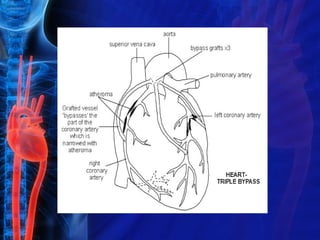
Coronary artery bypass graft
• Surgical treatment where saphenous vein
is harvested from the lower leg and used
to bypass the occluded vessels.
Long Term Care
• Smoking Cessation and lifestyle
modifications.
• Aspirin, Beta Blockers and Clopidogrel will
be indefinite.
• Lipid lowering medication along with diet
modifications.
Complications
Vascular Complications
• Recurrent ischemia
• Recurrent infarction
Mechanical Complications
• Left ventricular free wall rupture
• Ventricular septal rupture
• Papillary muscle rupture with
acute mitral regurgitation
COMPLICATION:
Myocardial Complications
• Diastolic dysfunction
• Systolic dysfunction
• Congestive heart failure
• Hypotension/cardiogenic shock
• Right ventricular infarction
• Ventricular cavity dilation
• Aneurysm formation (true, false)
References
• Bolooki, H.M.& Askari, A. (Published August 8 2010).
Acute Myocardial Infarction. Retrieved from
http://www.clevelandclinicmeded.com/medicalpubs/disea
semanagement/cardiology/acute-myocardial-
infarction/#s0050
• Lewis, S., Heitkemper, M., & Dirksen, S. (2004). Medical
surgical nursing assessment and management of clinical
problems. St. Louis, MO: Mosby.
• McCance, K.L., Huether, S.E., Brashers, V.L.& Rote,
N.S. (2010). Pathophysiology the biological basis for
disease in adults and children. Maryland Heights, MO:
Mosby Elsevier.

Myocardial infarction

  • 1.
  • 2.
    Definition • Otherwise knowas heart attack • An MI occurs when there is a diminished blood supply to the heart which leads to myocardial cell damage and ischemia. • Contractile function stops in the necrotic areas of the heart. • Ischemia usually occurs due to blockage of the coronary vessels.
  • 3.
    Definition cont. • Thisblockage is often the result of thrombus that is superimposed on an ulcerated or unstable atherosclerotic plaque formation in the coronary artery. • MI’s are described by the area of occurrence. • Anterior, Inferior, Lateral or Posterior.
  • 4.
  • 5.
    Coronary artery events •Ischemia – Outer most area, source of arrhythmias, viable if no further infarction. • Injury – Viable tissue found between ischemic and infarcted areas. • Infarction/necrosis – Center area, dead not viable tissue that turn into scar.
  • 8.
    MI Classifications • MI’scan be subcategorized by anatomy and clinical diagnostic information. Anatomic • Transmural and Subendocardial Diagnostic • ST elevations (STEMI) and non ST elevations (NSTEMI).
  • 9.
    Risk Factors • Thepresence of any risk factor is associated with doubling the risk of an MI. Non Modifiable • Age • Gender • Family history
  • 10.
    Risk Factors Modifiable • Smoking •Diabetes Control • Hypertension • Hyperlipidemia • Obesity • Physical Inactivity
  • 11.
    Pathophysiology • Ischemia developswhen there is an increased demand for oxygen or a decreased supply of oxygen. • Ischemia can develop within 10 seconds and if it lasts longer than 20 minutes, irreversible cell and tissue death occurs. • Myocardial cell death begins at the endocardium. The area most distal to the arterial blood supply.
  • 12.
    Pathophysiology • As vesselocclusion continues cell death spreads to the myocardium and eventually to the epicardium. • Severity of the MI depends on three factors. • Level of occlusion • Length of time of occlusion • Presence or absence of collateral circulation
  • 13.
    Symptoms: • Pain isthe cardinal symptom of an MI • Anxiety and fear of impending death • Nausea and vomiting • Breathlessness • Collapse/syncope
  • 14.
    Chest Pain • Themost common initial manifestation is chest pain or discomfort. • This is not relieved by rest, position change or nitrate administration. • Pain is described by heaviness, pressure, fullness and crushing sensation. • Not everyone experiences this sensation.
  • 15.
    Cardiovascular Changes • Initiallythe BP and pulse may be elevated. • Later, BP will drop due to decreased cardiac output. • Urine output will decrease • Lung sounds will change to crackles • Jugular veins may become distended and have obvious pulsations.
  • 16.
    DIAGNOSTICS: • Electrocardiogram (ECG) •Blood test (Cardiac enzymes) • Echocardiogram • Nuclear scan • Chest radiographs • Coronary angiography • Exercise stress test. • Cardiac computerized tomography (CT) or magnetic resonance imaging (MRI).
  • 17.
    Diagnostics • After collectingpatient health history, a series of EKG’s should be taken to rule out or confirm MI. • 12 lead EKG’s can help to distinguish between ST-elevation MI’s and Non-ST- elevation MI’s.
  • 18.
  • 19.
    Angina: Stable • Chest paincaused by the build up of lactic acid and irritation to the myocardial nerve fibers. • Chest pain caused by the 4 E’s. • Pain is usually relieved with rest, pain meds and nitrates.
  • 20.
    Variable/Prinzmetal/Spasm • Transient ischemiathat occurs unpredictably and almost always at rest. • Pain is caused by vasospasm of the arteries. • ST segment elevations will be noted.
  • 21.
    Unstable • Chest painat rest or with exercise and tends to last greater than 15 minutes. • This results in reversible myocardial ischemia but is a sign that an infarct is soon to come. • EKG will reveal ST segment depression and T wave inversion.
  • 22.
    STEMI • ST segmentelevations • T wave changes • Q wave development • Enzyme elevations • Reciprocals
  • 23.
    NSTEMI • ST segmentdepressions • T wave changes • No Q wave development • Mild enzyme elevations • No reciprocals
  • 24.
  • 25.
    Phases of aSTEMI • Hyperacute Phase • Occurs within the first few hours of MI onset. • Leads facing the infarcted surface: ST segment elevation. • Leads facing the uninjured surface: ST segment depression (reciprocals) • T waves become tall, widened and might be taller than the R wave.
  • 26.
    Phases of aSTEMI • Fully Evolved Phase • Q wave development • ST elevation • T waves start to become inverted in leads facing the injury.
  • 27.
    Phases of aSTEMI • Resolution phase • Weeks after there will be a gradual return of ST segments to baseline. • T waves will gradually return to normal but are the last to change back.
  • 28.
    Serum Cardiac Markers •Myocardial cells produce certain proteins and enzymes associated with cellular functions. • When cell death occurs, these cellular enzymes are released into the blood stream. • CPK and troponin
  • 29.
    CPK • Creatine Phosphokinase •Begin to rise 3 to 12 hours after acute MI. • Peak in 24 hours • Return to normal in 2 to 3 days
  • 30.
    Troponin • Myocardial muscleprotein released into circulation after injury. • These are highly specific indicators of MI. • Troponin rises quickly like CK but will continue to stay elevated for 2 weeks. • Myoglobin-lacks cardiac specificity.
  • 31.
    Treatment Options • Theimmediate goal for any acute MI is to restore normal coronary blood flow to vessels and salvage myocardium. • There are a variety of medical and medicinal therapies to treat an MI.
  • 32.
    General Treatment forthe MI patient • Morphine • Oxygen • Nitroglycerin • Aspirin
  • 33.
    Fibrinolytic Therapy • Indicatedfor patients with STEMI MI’s. • Should be given within 12 hours of symptom onset. • Fibrinolytics will break down clots found within the vessles • Contraindications: post op surgical patients, history of hemorrhagic stroke, ulcer disease, pregnancy, ect.
  • 34.
    Cardiac Catheterization • Adiagnostic angiography which includes angioplasty and possible stenting. • Performed by an interventional cardiologist with a cardiac surgeon on stand by. • Percutaneous procedure through the femoral or brachial artery.
  • 35.
    Cardiac Catheterization • Uponarrival to the cath lab all actue MI patients will receive: • A bolus dose of plavix • IV Integrelin • Heparin dose either subcu or IV drip • Angiomax : a DTI may be substituted for heparin and integrelin.
  • 36.
    Coronary artery bypassgraft • Surgical treatment where saphenous vein is harvested from the lower leg and used to bypass the occluded vessels.
  • 38.
    Long Term Care •Smoking Cessation and lifestyle modifications. • Aspirin, Beta Blockers and Clopidogrel will be indefinite. • Lipid lowering medication along with diet modifications.
  • 39.
    Complications Vascular Complications • Recurrentischemia • Recurrent infarction Mechanical Complications • Left ventricular free wall rupture • Ventricular septal rupture • Papillary muscle rupture with acute mitral regurgitation
  • 40.
    COMPLICATION: Myocardial Complications • Diastolicdysfunction • Systolic dysfunction • Congestive heart failure • Hypotension/cardiogenic shock • Right ventricular infarction • Ventricular cavity dilation • Aneurysm formation (true, false)
  • 41.
    References • Bolooki, H.M.&Askari, A. (Published August 8 2010). Acute Myocardial Infarction. Retrieved from http://www.clevelandclinicmeded.com/medicalpubs/disea semanagement/cardiology/acute-myocardial- infarction/#s0050 • Lewis, S., Heitkemper, M., & Dirksen, S. (2004). Medical surgical nursing assessment and management of clinical problems. St. Louis, MO: Mosby. • McCance, K.L., Huether, S.E., Brashers, V.L.& Rote, N.S. (2010). Pathophysiology the biological basis for disease in adults and children. Maryland Heights, MO: Mosby Elsevier.