Identification data
Name of the teacher -
Name of the student teacher -
Subject -
Name of the topic -
Method of teaching -
A-V aids -
Date and Time -
Venue -
Learner -
Previous experience -
Title of the course -
Duration -
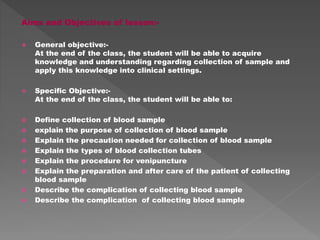
Aims and Objectives of lesson:-
 General objective:-
At the end of the class, the student will be able to acquire
knowledge and understanding regarding collection of sample and
apply this knowledge into clinical settings.
 Specific Objective:-
At the end of the class, the student will be able to:
 Define collection of blood sample
 explain the purpose of collection of blood sample
 Explain the precaution needed for collection of blood sample
 Explain the types of blood collection tubes
 Explain the procedure for venipuncture
 Explain the preparation and after care of the patient of collecting
blood sample
 Describe the complication of collecting blood sample
n
o
Specific
objective
ti
m
e
content Teachers
activity
Learners
activity
Evaluati
on
1
Define
collection of
blood
sample.
1
mi
n
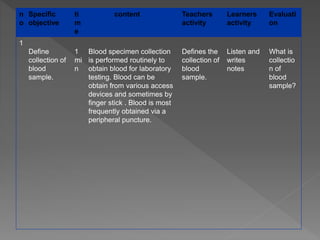
Blood specimen collection
is performed routinely to
obtain blood for laboratory
testing. Blood can be
obtain from various access
devices and sometimes by
finger stick . Blood is most
frequently obtained via a
peripheral puncture.
Defines the
collection of
blood
sample.
Listen and
writes
notes
What is
collectio
n of
blood
sample?
n
o
Specific
objective
ti
m
e
content Teachers
activity
Learners
activity
Evaluati
on
2
Explain the
purposes of
collection of
blood
sample
3
0
se
c
Blood is usually drawn and
collected in order to
perform a variety of
laboratory tests.
Specimens are often sent
to help diagnose condition
such as electrolyte
imbalances to screen for
risk factors like high
cholesterol levels and to
monitor the effects of
treatments and
medications.
Explains
the
purposes of
collection of
blood
sample
Listen and
writes
notes
What is
the
purpose
of
collectio
n of
blood
sample
n
o
Specific
objective
ti
m
e
content Teachers
activity
Learners
activity
Evaluati
on
3
Explain the
precaution
needed for
collection of
blood
sample
2
mi
n
• Avoid using syringe, use
vacuum tube blood –
collection devices instead
• do not use a needle when
withdrawing blood from a
peripheral intravenous line
or from a central venous
access device. Using a
needle-less system allows
the blood to be drawn
directly into specimen
containers
• do not use an exposed
needle to inject blood into
specimen containers or
vacuum tubes
• when drawing blood, the
health care professional
should follow universal
precaution .
Explains
the
precautions
needed for
collection of
blood
sample
Listen and
writes
notes
What are
the
precauti
ons for
collectio
n of
blood
sample?
n
o
Specific
objective
ti
m
e
content Teachers
activity
Learners
activity
Evaluati
on
4
Explain the
types of
blood
collection
tubes
3
mi
n
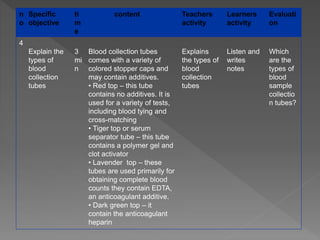
Blood collection tubes
comes with a variety of
colored stopper caps and
may contain additives.
• Red top – this tube
contains no additives. It is
used for a variety of tests,
including blood tying and
cross-matching
• Tiger top or serum
separator tube – this tube
contains a polymer gel and
clot activator
• Lavender top – these
tubes are used primarily for
obtaining complete blood
counts they contain EDTA,
an anticoagulant additive.
• Dark green top – it
contain the anticoagulant
heparin
Explains
the types of
blood
collection
tubes
Listen and
writes
notes
Which
are the
types of
blood
sample
collectio
n tubes?
n
o
Specific
Objective
ti
m
e
content Teachers
activity
Learners
activity
Evaluati
on
5
Explain the
procedure
for
venipunctur
e
3
mi
n
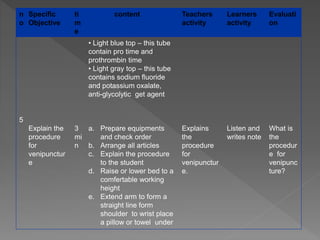
• Light blue top – this tube
contain pro time and
prothrombin time
• Light gray top – this tube
contains sodium fluoride
and potassium oxalate,
anti-glycolytic get agent
a. Prepare equipments
and check order
b. Arrange all articles
c. Explain the procedure
to the student
d. Raise or lower bed to a
comfertable working
height
e. Extend arm to form a
straight line form
shoulder to wrist place
a pillow or towel under
Explains
the
procedure
for
venipunctur
e.
Listen and
writes note
What is
the
procedur
e for
venipunc
ture?
n
o
Specific
objective
ti
m
e
content Teachers
activity
Learners
activity
Evaluati
on
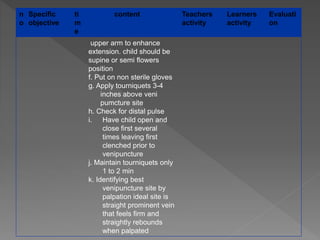
upper arm to enhance
extension. child should be
supine or semi flowers
position
f. Put on non sterile gloves
g. Apply tourniquets 3-4
inches above veni
pumcture site
h. Check for distal pulse
i. Have child open and
close first several
times leaving first
clenched prior to
venipuncture
j. Maintain tourniquets only
1 to 2 min
k. Identifying best
venipuncture site by
palpation ideal site is
straight prominent vein
that feels firm and
straightly rebounds
when palpated
n
o
Specific
objective
ti
m
e
content Teachers
activity
Learners
activity
Evaluati
on
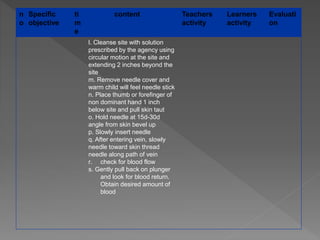
l. Cleanse site with solution
prescribed by the agency using
circular motion at the site and
extending 2 inches beyond the
site
m. Remove needle cover and
warm child will feel needle stick
n. Place thumb or forefinger of
non dominant hand 1 inch
below site and pull skin taut
o. Hold needle at 15d-30d
angle from skin bevel up
p. Slowly insert needle
q. After entering vein, slowly
needle toward skin thread
needle along path of vein
r. check for blood flow
s. Gently pull back on plunger
and look for blood return.
Obtain desired amount of
blood
n
o
Specific
objective
ti
m
e
content Teachers
activity
Learners
activity
Evaluati
on
6 Explain the
preparation
and after
care of the
patient for
collecting
blood
sample
2
mi
n
Preparation:-
The patient should be
instructed about what blood
test have been ordered and
why. Explain the procedure
and what the patient can
expect. Ask the patient if
any one has had trouble
drawing blood from him or
her in the past. Ask the
patient what position would
be most comfortable for
them when drawing the
specimen.
After care:-
After obtaining the ordered
specimens remove the
needle from the vein and
discard into a puncture
proof container. Pressure
should be applied to the
site for about a minute.
Explains
the
preparation
and after
care of the
patient for
collecting
blood
sample
Listen and
writes note
Which
are the
preparati
on and
after
care of
the
patient
for
collectin
g blood
sample ?
n
o
Specific
objective
ti
m
e
content Teachers
activity
Learners
activity
Evaluatio
n
After applying pressure,
inspect the site for any
sings of bleeding or
hematoma. Apply a
bandage to the site. The
specimen containers
should then be labeled and
sent to the laboratory.
Make sure the patient is
comfortable and is not
experiencing any adverse
effect before allowing them
to get up.
n
o
Specific
objective
ti
m
e
content Teachers
activity
Learners
activity
Evaluati
on
7 Describe
the
complicat
ion of
collecting
blood
sample
3
0
se
c
Hematoma formation
Hemolysis
Haemoconcentration
Excessive bleeding
Describes
the
complicati
on of
collecting
blood
sample
Listen and
writes note
What are
the
complicati
ons of
blood
sample
collection
?

Lesson plan on blood collection

  • 2.
    Identification data Name ofthe teacher - Name of the student teacher - Subject - Name of the topic - Method of teaching - A-V aids - Date and Time - Venue - Learner - Previous experience - Title of the course - Duration -
  • 3.
    Aims and Objectivesof lesson:-  General objective:- At the end of the class, the student will be able to acquire knowledge and understanding regarding collection of sample and apply this knowledge into clinical settings.  Specific Objective:- At the end of the class, the student will be able to:  Define collection of blood sample  explain the purpose of collection of blood sample  Explain the precaution needed for collection of blood sample  Explain the types of blood collection tubes  Explain the procedure for venipuncture  Explain the preparation and after care of the patient of collecting blood sample  Describe the complication of collecting blood sample  Describe the complication of collecting blood sample
  • 4.
    n o Specific objective ti m e content Teachers activity Learners activity Evaluati on 1 Define collection of blood sample. 1 mi n Bloodspecimen collection is performed routinely to obtain blood for laboratory testing. Blood can be obtain from various access devices and sometimes by finger stick . Blood is most frequently obtained via a peripheral puncture. Defines the collection of blood sample. Listen and writes notes What is collectio n of blood sample?
  • 5.
    n o Specific objective ti m e content Teachers activity Learners activity Evaluati on 2 Explain the purposesof collection of blood sample 3 0 se c Blood is usually drawn and collected in order to perform a variety of laboratory tests. Specimens are often sent to help diagnose condition such as electrolyte imbalances to screen for risk factors like high cholesterol levels and to monitor the effects of treatments and medications. Explains the purposes of collection of blood sample Listen and writes notes What is the purpose of collectio n of blood sample
  • 6.
    n o Specific objective ti m e content Teachers activity Learners activity Evaluati on 3 Explain the precaution neededfor collection of blood sample 2 mi n • Avoid using syringe, use vacuum tube blood – collection devices instead • do not use a needle when withdrawing blood from a peripheral intravenous line or from a central venous access device. Using a needle-less system allows the blood to be drawn directly into specimen containers • do not use an exposed needle to inject blood into specimen containers or vacuum tubes • when drawing blood, the health care professional should follow universal precaution . Explains the precautions needed for collection of blood sample Listen and writes notes What are the precauti ons for collectio n of blood sample?
  • 7.
    n o Specific objective ti m e content Teachers activity Learners activity Evaluati on 4 Explain the typesof blood collection tubes 3 mi n Blood collection tubes comes with a variety of colored stopper caps and may contain additives. • Red top – this tube contains no additives. It is used for a variety of tests, including blood tying and cross-matching • Tiger top or serum separator tube – this tube contains a polymer gel and clot activator • Lavender top – these tubes are used primarily for obtaining complete blood counts they contain EDTA, an anticoagulant additive. • Dark green top – it contain the anticoagulant heparin Explains the types of blood collection tubes Listen and writes notes Which are the types of blood sample collectio n tubes?
  • 8.
    n o Specific Objective ti m e content Teachers activity Learners activity Evaluati on 5 Explain the procedure for venipunctur e 3 mi n •Light blue top – this tube contain pro time and prothrombin time • Light gray top – this tube contains sodium fluoride and potassium oxalate, anti-glycolytic get agent a. Prepare equipments and check order b. Arrange all articles c. Explain the procedure to the student d. Raise or lower bed to a comfertable working height e. Extend arm to form a straight line form shoulder to wrist place a pillow or towel under Explains the procedure for venipunctur e. Listen and writes note What is the procedur e for venipunc ture?
  • 9.
    n o Specific objective ti m e content Teachers activity Learners activity Evaluati on upper armto enhance extension. child should be supine or semi flowers position f. Put on non sterile gloves g. Apply tourniquets 3-4 inches above veni pumcture site h. Check for distal pulse i. Have child open and close first several times leaving first clenched prior to venipuncture j. Maintain tourniquets only 1 to 2 min k. Identifying best venipuncture site by palpation ideal site is straight prominent vein that feels firm and straightly rebounds when palpated
  • 10.
    n o Specific objective ti m e content Teachers activity Learners activity Evaluati on l. Cleansesite with solution prescribed by the agency using circular motion at the site and extending 2 inches beyond the site m. Remove needle cover and warm child will feel needle stick n. Place thumb or forefinger of non dominant hand 1 inch below site and pull skin taut o. Hold needle at 15d-30d angle from skin bevel up p. Slowly insert needle q. After entering vein, slowly needle toward skin thread needle along path of vein r. check for blood flow s. Gently pull back on plunger and look for blood return. Obtain desired amount of blood
  • 11.
    n o Specific objective ti m e content Teachers activity Learners activity Evaluati on 6 Explainthe preparation and after care of the patient for collecting blood sample 2 mi n Preparation:- The patient should be instructed about what blood test have been ordered and why. Explain the procedure and what the patient can expect. Ask the patient if any one has had trouble drawing blood from him or her in the past. Ask the patient what position would be most comfortable for them when drawing the specimen. After care:- After obtaining the ordered specimens remove the needle from the vein and discard into a puncture proof container. Pressure should be applied to the site for about a minute. Explains the preparation and after care of the patient for collecting blood sample Listen and writes note Which are the preparati on and after care of the patient for collectin g blood sample ?
  • 12.
    n o Specific objective ti m e content Teachers activity Learners activity Evaluatio n After applyingpressure, inspect the site for any sings of bleeding or hematoma. Apply a bandage to the site. The specimen containers should then be labeled and sent to the laboratory. Make sure the patient is comfortable and is not experiencing any adverse effect before allowing them to get up.
  • 13.
    n o Specific objective ti m e content Teachers activity Learners activity Evaluati on 7 Describe the complicat ionof collecting blood sample 3 0 se c Hematoma formation Hemolysis Haemoconcentration Excessive bleeding Describes the complicati on of collecting blood sample Listen and writes note What are the complicati ons of blood sample collection ?