Lesson Plan:
Importance and How to Prepare
‘’All training activities, either in the
classroom or in the field need to be
well planned in order to bring the
desirable changes among the
participant’’
Lesson Plan:
Importance and How to Prepare
Diabetic Association Medical College, Faridpur, Bangladesh
Dr. Akhiruzzaman
Assistant Professor and Head of Community Medicine and
Public Health Department
Objectives
At the end of the presentation the participants
will be able to-
define lesson and lesson plan
mention the importance of lesson plan
state the advantages of lesson plan
list the content of a lesson plan
use lesson plan in own lessons
What is Lesson?
Amount of teaching providing in one setting
Time allocation needed
What is Plan?
• A blue print for taking action
• Deciding something in advance before
the actual event occur
What Is Lesson Plan?
An ideal schedule for the teacher to
conduct a teaching program correctly in a
relevant way.
A guide for the teacher which helps to
cover topics comprehensively with proper
sequence of points and without missing
anything
Key words for lesson plan
• Teaching amount
• Single setting
• Fixed time
• Proper sequence
• Without missing any content
Lesson Planning: Why?
To decide- what to do, when to do & how
to do during a lesson
It is an schedule for a teacher to conduct a
teaching program
Standardization and Uniformity of the
session conduction even when the teacher
is different
Advantages of Lesson Plan
Documentation of every session
Structured planning helps the teacher to
conduct the session effectively
Help the students to understand what they
are going to learn
Learning outcomes can be measured
Advantages of Lesson Plan Cont…
Aim of the lesson is identified and
maintained
Lesson material can be selected & arranged
Appropriate instructional method is
selected
Time management can be done best
Systematic approach of lesson
planning
First defining the ends or objectives to be
realized
Then choose the methods or means of
achieving them
Guide for planning a lesson
There are six basic steps
Step-1
State as precisely as possible what the
student learn (Objectives)
Step-2
Identify the purpose of learning what the
student is expected to learn in the lesson
Purpose:
• Personal growth
• Future use
Step-3
Think of what prior learning is required
Step-4
Design the sequence of learning within the
lesson content
Step-5
Identify the method of instruction and
instructional material which can best achieve
each of the steps in the sequence
Step-5 cont….
Methods of instruction:
1. Lecture
2. Small group teaching
• Tutorial
• Bedside teaching
• Practical/demonstration class
Instructional/teaching material:
• Text book
• OHP
• PowerPoint presentation
• Black/white board
• Model/dummy
• Patient/simulated patient
Step-5 cont….
Step-6
Plan for assessment of the students during/end
of the lesson
• Ask a question (In lecture)
• Ask a student to examine the patient
(Bedside teaching)
• Let other student check (Practical class)
Contents of a lesson plan
1) Topic
2) Place, Date & Duration
3) Learning objectives
4) Purpose of learning the topic
5) Pre-requisite knowledge/Pre test
6) List of contents & it’s organization
7) Methods of Instruction
8) Teaching materials (audio-visual aids) to be used
9) Concurrent evaluation or Feedback from students
10) Review & summary
11) Reference: Resource material Resource personnel
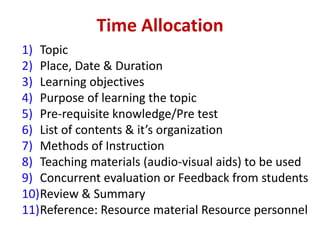
Time Allocation
1) Topic
2) Place, Date & Duration
3) Learning objectives
4) Purpose of learning the topic
5) Pre-requisite knowledge/Pre test
6) List of contents & it’s organization
7) Methods of Instruction
8) Teaching materials (audio-visual aids) to be used
9) Concurrent evaluation or Feedback from students
10)Review & Summary
11)Reference: Resource material Resource personnel
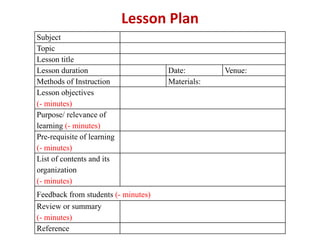
Lesson Plan
Subject
Topic
Lesson title
Lesson duration Date: Venue:
Methods of Instruction Materials:
Lesson objectives
(- minutes)
Purpose/ relevance of
learning (- minutes)
Pre-requisite of learning
(- minutes)
List of contents and its
organization
(- minutes)
Feedback from students (- minutes)
Review or summary
(- minutes)
Reference
Example (Lesson plan for Community
Medicine Lecture class)
Lesson Plan (Food and Nutrition, Lesson-1)
1. Topic: Xerophthalmia
2.1. Date: 13.08.2023
2.2. Duration: 1 hour
2.3. Place: Lecture gallery-3, BSMMC
3. Objective: (4 minutes)
At the end of the session students will be able
to-
• define xerophthalmia
• enumerate the sign symptoms of vitamin-A
deficiency
• describe the treatment of xerophthalmia
• describe the preventive measure of
xerophthalmia
• enlist the complication of hypervitaminosis-A
4. Purpose/ relevance of learning: (6 minutes)
Students will able to link this knowledge in
clinical case detection either in hospital or
in field based training
5. Pre-requisite of learning: (10 minutes)
Structure of eye ball, Lacrimation process,
6. List of contents and its organization: (25 minutes)
• Definition of xerophthalmia (2 minutes)
It is a medical condition in which the eye fails to
produce tears.
• Occular manifestation of vitamin-A deficiency
(10 minutes)
• Extra occular manifestation (3 minutes)
• Treatment of xerophthalmia (5 minutes)
• Prevention of vitamin-A deficiency (3 minutes)
• Toxicity due to excess intake of vitamin-A (2
minutes)
7. Methods of Instruction: Lecture class
8. Teaching materials (audio-visual aids) to be used:
• Power Point Presentation with relevant picture
• Poster
• White board
9. Concurrent evaluation or Feedback from students:
(10 minutes)
• Random questions to the students
10. Review or summary: (5 minutes)
• Summary or review according to objectives
11. Reference: Park’s text book, Websites
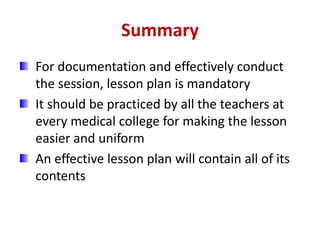
Summary
For documentation and effectively conduct
the session, lesson plan is mandatory
It should be practiced by all the teachers at
every medical college for making the lesson
easier and uniform
An effective lesson plan will contain all of its
contents
THANK YOU
Teaching is an art, every teacher
is an artist and lesson plan is the
blue print for this creative work

Lesson Plan: Importance and How to Prepare.pptx

  • 1.
  • 2.
    ‘’All training activities,either in the classroom or in the field need to be well planned in order to bring the desirable changes among the participant’’
  • 3.
    Lesson Plan: Importance andHow to Prepare Diabetic Association Medical College, Faridpur, Bangladesh Dr. Akhiruzzaman Assistant Professor and Head of Community Medicine and Public Health Department
  • 4.
    Objectives At the endof the presentation the participants will be able to- define lesson and lesson plan mention the importance of lesson plan state the advantages of lesson plan list the content of a lesson plan use lesson plan in own lessons
  • 5.
    What is Lesson? Amountof teaching providing in one setting Time allocation needed
  • 6.
    What is Plan? •A blue print for taking action • Deciding something in advance before the actual event occur
  • 7.
    What Is LessonPlan? An ideal schedule for the teacher to conduct a teaching program correctly in a relevant way. A guide for the teacher which helps to cover topics comprehensively with proper sequence of points and without missing anything
  • 8.
    Key words forlesson plan • Teaching amount • Single setting • Fixed time • Proper sequence • Without missing any content
  • 9.
    Lesson Planning: Why? Todecide- what to do, when to do & how to do during a lesson It is an schedule for a teacher to conduct a teaching program Standardization and Uniformity of the session conduction even when the teacher is different
  • 10.
    Advantages of LessonPlan Documentation of every session Structured planning helps the teacher to conduct the session effectively Help the students to understand what they are going to learn Learning outcomes can be measured
  • 11.
    Advantages of LessonPlan Cont… Aim of the lesson is identified and maintained Lesson material can be selected & arranged Appropriate instructional method is selected Time management can be done best
  • 13.
    Systematic approach oflesson planning First defining the ends or objectives to be realized Then choose the methods or means of achieving them
  • 14.
    Guide for planninga lesson There are six basic steps
  • 15.
    Step-1 State as preciselyas possible what the student learn (Objectives)
  • 16.
    Step-2 Identify the purposeof learning what the student is expected to learn in the lesson Purpose: • Personal growth • Future use
  • 17.
    Step-3 Think of whatprior learning is required
  • 18.
    Step-4 Design the sequenceof learning within the lesson content
  • 19.
    Step-5 Identify the methodof instruction and instructional material which can best achieve each of the steps in the sequence
  • 20.
    Step-5 cont…. Methods ofinstruction: 1. Lecture 2. Small group teaching • Tutorial • Bedside teaching • Practical/demonstration class
  • 21.
    Instructional/teaching material: • Textbook • OHP • PowerPoint presentation • Black/white board • Model/dummy • Patient/simulated patient Step-5 cont….
  • 22.
    Step-6 Plan for assessmentof the students during/end of the lesson • Ask a question (In lecture) • Ask a student to examine the patient (Bedside teaching) • Let other student check (Practical class)
  • 23.
    Contents of alesson plan 1) Topic 2) Place, Date & Duration 3) Learning objectives 4) Purpose of learning the topic 5) Pre-requisite knowledge/Pre test 6) List of contents & it’s organization 7) Methods of Instruction 8) Teaching materials (audio-visual aids) to be used 9) Concurrent evaluation or Feedback from students 10) Review & summary 11) Reference: Resource material Resource personnel
  • 24.
    Time Allocation 1) Topic 2)Place, Date & Duration 3) Learning objectives 4) Purpose of learning the topic 5) Pre-requisite knowledge/Pre test 6) List of contents & it’s organization 7) Methods of Instruction 8) Teaching materials (audio-visual aids) to be used 9) Concurrent evaluation or Feedback from students 10)Review & Summary 11)Reference: Resource material Resource personnel
  • 25.
    Lesson Plan Subject Topic Lesson title Lessonduration Date: Venue: Methods of Instruction Materials: Lesson objectives (- minutes) Purpose/ relevance of learning (- minutes) Pre-requisite of learning (- minutes) List of contents and its organization (- minutes) Feedback from students (- minutes) Review or summary (- minutes) Reference
  • 26.
    Example (Lesson planfor Community Medicine Lecture class)
  • 27.
    Lesson Plan (Foodand Nutrition, Lesson-1) 1. Topic: Xerophthalmia 2.1. Date: 13.08.2023 2.2. Duration: 1 hour 2.3. Place: Lecture gallery-3, BSMMC
  • 28.
    3. Objective: (4minutes) At the end of the session students will be able to- • define xerophthalmia • enumerate the sign symptoms of vitamin-A deficiency • describe the treatment of xerophthalmia • describe the preventive measure of xerophthalmia • enlist the complication of hypervitaminosis-A
  • 29.
    4. Purpose/ relevanceof learning: (6 minutes) Students will able to link this knowledge in clinical case detection either in hospital or in field based training 5. Pre-requisite of learning: (10 minutes) Structure of eye ball, Lacrimation process,
  • 30.
    6. List ofcontents and its organization: (25 minutes) • Definition of xerophthalmia (2 minutes) It is a medical condition in which the eye fails to produce tears. • Occular manifestation of vitamin-A deficiency (10 minutes) • Extra occular manifestation (3 minutes) • Treatment of xerophthalmia (5 minutes) • Prevention of vitamin-A deficiency (3 minutes) • Toxicity due to excess intake of vitamin-A (2 minutes)
  • 31.
    7. Methods ofInstruction: Lecture class 8. Teaching materials (audio-visual aids) to be used: • Power Point Presentation with relevant picture • Poster • White board 9. Concurrent evaluation or Feedback from students: (10 minutes) • Random questions to the students 10. Review or summary: (5 minutes) • Summary or review according to objectives 11. Reference: Park’s text book, Websites
  • 32.
    Summary For documentation andeffectively conduct the session, lesson plan is mandatory It should be practiced by all the teachers at every medical college for making the lesson easier and uniform An effective lesson plan will contain all of its contents
  • 33.
    THANK YOU Teaching isan art, every teacher is an artist and lesson plan is the blue print for this creative work