Writing a lesson plan
Dr. Manali Sinharay
Assistant Professor
Department of Biochemistry,
CALCUTTA NATIONAL MEDICAL
COLLEGE
At the end of the session the
participants will be able to-
Define Lesson plan
Enlist the advantages of Lesson plan
List elements of Lesson plan
Develop a lesson plan appropriate to the
objectives and teaching learning method
What?
A detailed plan drawn up by a teacher
covering the content and sequence of a
lesson, in which learning will flow.
Smallest unit of educational
experiences and activities provided to
the learners
Mapping of Lesson plan-
Content- what not to tell
Audiovisual aid – to be used
judiciously
Time- how to finish it
Why?
If you fail to plan, you are planning
to fail
Benjamin Franklin
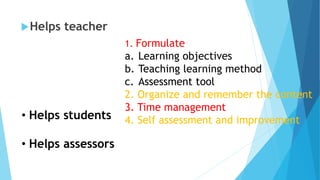
Helps teacher
1. Formulate
a. Learning objectives
b. Teaching learning method
c. Assessment tool
2. Organize and remember the content
3. Time management
4. Self assessment and improvement
• Helps students
• Helps assessors
How?
1. Anticipatory set
2. Learning objective
3.Standards/expectations
4. Body of lesson
5. Check understanding and Guided practice practice
6. Closure
7. Independent
practice
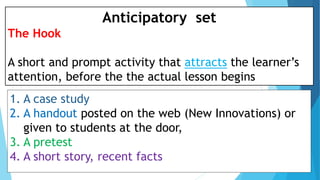
Anticipatory set
The Hook
A short and prompt activity that attracts the learner’s
attention, before the the actual lesson begins
1. A case study
2. A handout posted on the web (New Innovations) or
given to students at the door,
3. A pretest
4. A short story, recent facts
DR. LUDWIG
GUTTMAN
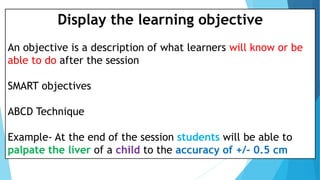
Display the learning objective
An objective is a description of what learners will know or be
able to do after the session
SMART objectives
ABCD Technique
Example- At the end of the session students will be able to
palpate the liver of a child to the accuracy of +/- 0.5 cm
Describe the
Expectations/Standard
Core- A competency that is necessary in order
to complete the requirements of the subject
(traditional must know)
Non core- A competency that is optional
inorder to complete the requirements of the
subject (traditional good to know/desirable to
know)
CORE
NON CORE
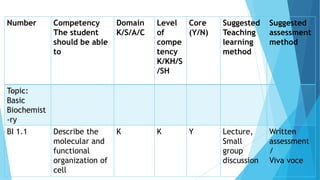
Number Competency
The student
should be able
to
Domain
K/S/A/C
Level
of
compe
tency
K/KH/S
/SH
Core
(Y/N)
Suggested
Teaching
learning
method
Suggested
assessment
method
Topic:
Basic
Biochemist
-ry
BI 1.1 Describe the
molecular and
functional
organization of
cell
K K Y Lecture,
Small
group
discussion
Written
assessment
/
Viva voce
Body of teaching with input
The concepts or skills the faculty will impart to the learners : “
The Body of the Lesson”
• The right teaching learning method according to the set
objectives
• Appropriate study tools
• Time management
Objectives Domain Method of Teaching
Epidemiology
Malarial parasite
Clinical features
Knowledge Lecture: Power
point, videos
Bed side teaching
Laboratory diagnosis Skill Practical lab: draw
blood/make
smear/stain/microsc
opy(DOAP
Taking history
Educating on prevention
Attitude/Communica
tion
Role play/Field Trip
Bed side teaching
Example: Choosing Teaching Learning Method (TLM) for a
competency
KSAC model
Competency: Diagnose a case of Malaria
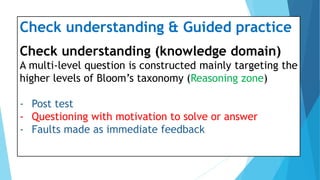
Check understanding & Guided practice
Check understanding (knowledge domain)
A multi-level question is constructed mainly targeting the
higher levels of Bloom’s taxonomy (Reasoning zone)
- Post test
- Questioning with motivation to solve or answer
- Faults made as immediate feedback
Guided practice
Include guided practice where the faculty leads learners
through the steps necessary to perform the skill
Use the trimodal approach – heard/ seen/do
Total re-teaching may be required
Gives the teacher immediate feedback as to the student
understanding and adjust teaching as needed.
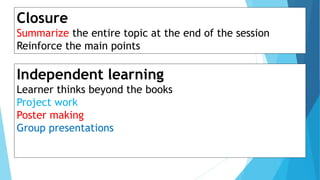
Closure
Summarize the entire topic at the end of the session
Reinforce the main points
Independent learning
Learner thinks beyond the books
Project work
Poster making
Group presentations
1.ANTICIPATORY
SET
2.Learning
objectives
3.Expectation
s/
Standard
7.Independent
practice
6.Closure
4.Body of
Lesson-
Method
Material
Time
5.Check
understanding &
Guided practice
Model lesson plan
• Name of lecturer- Date-
• Class- MBBS 1st year. Time-
• No. of students-250 Subject-
Biochemistry
• Domain- Cognitive Level- Knows
How.
• Competency BI 16.5 -Describe the biochemical role of
vitamins in the body and explain the manifestations of
their deficiencies
General objective- At the end of the session, learner should be
able to describe biochemical role of Vitamin D in the body and
explain the manisfestation of deficiency of Vitamin D.
Specific objective- At the end of the session, learner should be
able to-
1. List important sources, the recommended dietary allowance(RDA
) and reference range of Vitamin D.
2. Describe the metabolism (synthesis and activation) of Vitamin D.
3. Explain the biochemical functions of Vitamin D.
4. Enumerate the causes and effects and treatment of deficiency of
Vitamin D in children and adults.
Set induction- start with a case of rickets with clinical
manifestations
SLO Content Method & Material Duration
1 List few sources, the RDA and
reference range of Vitamin D.
Lecture-Narration & Power
point
Small group discussion
5 mins
2 Describe the metabolism
(synthesis and activation) of
Vitamin D.
Lecture-Explanation &
Power point
Small group discussion
10 mins
3 Explain the biochemical
functions of Vitamin D.
Lecture-Discussion &
Power point
Small group discussion
15 mins
4 Enumerate the causes and
effects and treatment of
deficiency of Vitamin D in
children and adults.
Case study presentation &
Power point
20 mins
Body of lesson:
Check understanding - Multiple choice questions
Independent practice-Poster- Vitamin D deficiency
causes Rickets by 5 teams(50 students in each
group)-Self directed learning
Closure- Summary of the class
Group Task
Each group need to write a lesson plan appropriate
to the objectives and teaching learning method
based on the competency provided to
them(Proforma provided for you) –Time limit 10
mins
Name of lecturer- Date-
Class- Time-
No. of students-250 Subject-
Domain- Level-
Competency
• Learning objectives-
• Set induction-
• Body of lesson-
• Check understanding/Guided practice
• Closure
• Independent practice
LESSON PLAN
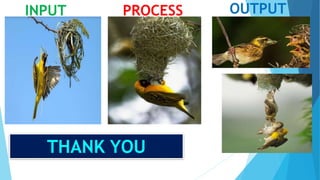
INPUT OUTPUT
PROCESS
THANK YOU

lesson plan

  • 1.
    Writing a lessonplan Dr. Manali Sinharay Assistant Professor Department of Biochemistry, CALCUTTA NATIONAL MEDICAL COLLEGE
  • 2.
    At the endof the session the participants will be able to- Define Lesson plan Enlist the advantages of Lesson plan List elements of Lesson plan Develop a lesson plan appropriate to the objectives and teaching learning method
  • 5.
    What? A detailed plandrawn up by a teacher covering the content and sequence of a lesson, in which learning will flow. Smallest unit of educational experiences and activities provided to the learners
  • 6.
    Mapping of Lessonplan- Content- what not to tell Audiovisual aid – to be used judiciously Time- how to finish it
  • 7.
    Why? If you failto plan, you are planning to fail Benjamin Franklin
  • 8.
    Helps teacher 1. Formulate a.Learning objectives b. Teaching learning method c. Assessment tool 2. Organize and remember the content 3. Time management 4. Self assessment and improvement • Helps students • Helps assessors
  • 9.
    How? 1. Anticipatory set 2.Learning objective 3.Standards/expectations 4. Body of lesson 5. Check understanding and Guided practice practice 6. Closure 7. Independent practice
  • 10.
    Anticipatory set The Hook Ashort and prompt activity that attracts the learner’s attention, before the the actual lesson begins 1. A case study 2. A handout posted on the web (New Innovations) or given to students at the door, 3. A pretest 4. A short story, recent facts
  • 11.
  • 12.
    Display the learningobjective An objective is a description of what learners will know or be able to do after the session SMART objectives ABCD Technique Example- At the end of the session students will be able to palpate the liver of a child to the accuracy of +/- 0.5 cm
  • 13.
    Describe the Expectations/Standard Core- Acompetency that is necessary in order to complete the requirements of the subject (traditional must know) Non core- A competency that is optional inorder to complete the requirements of the subject (traditional good to know/desirable to know) CORE NON CORE
  • 14.
    Number Competency The student shouldbe able to Domain K/S/A/C Level of compe tency K/KH/S /SH Core (Y/N) Suggested Teaching learning method Suggested assessment method Topic: Basic Biochemist -ry BI 1.1 Describe the molecular and functional organization of cell K K Y Lecture, Small group discussion Written assessment / Viva voce
  • 15.
    Body of teachingwith input The concepts or skills the faculty will impart to the learners : “ The Body of the Lesson” • The right teaching learning method according to the set objectives • Appropriate study tools • Time management
  • 16.
    Objectives Domain Methodof Teaching Epidemiology Malarial parasite Clinical features Knowledge Lecture: Power point, videos Bed side teaching Laboratory diagnosis Skill Practical lab: draw blood/make smear/stain/microsc opy(DOAP Taking history Educating on prevention Attitude/Communica tion Role play/Field Trip Bed side teaching Example: Choosing Teaching Learning Method (TLM) for a competency KSAC model Competency: Diagnose a case of Malaria
  • 17.
    Check understanding &Guided practice Check understanding (knowledge domain) A multi-level question is constructed mainly targeting the higher levels of Bloom’s taxonomy (Reasoning zone) - Post test - Questioning with motivation to solve or answer - Faults made as immediate feedback
  • 18.
    Guided practice Include guidedpractice where the faculty leads learners through the steps necessary to perform the skill Use the trimodal approach – heard/ seen/do Total re-teaching may be required Gives the teacher immediate feedback as to the student understanding and adjust teaching as needed.
  • 19.
    Closure Summarize the entiretopic at the end of the session Reinforce the main points Independent learning Learner thinks beyond the books Project work Poster making Group presentations
  • 21.
  • 22.
    Model lesson plan •Name of lecturer- Date- • Class- MBBS 1st year. Time- • No. of students-250 Subject- Biochemistry • Domain- Cognitive Level- Knows How. • Competency BI 16.5 -Describe the biochemical role of vitamins in the body and explain the manifestations of their deficiencies
  • 23.
    General objective- Atthe end of the session, learner should be able to describe biochemical role of Vitamin D in the body and explain the manisfestation of deficiency of Vitamin D. Specific objective- At the end of the session, learner should be able to- 1. List important sources, the recommended dietary allowance(RDA ) and reference range of Vitamin D. 2. Describe the metabolism (synthesis and activation) of Vitamin D. 3. Explain the biochemical functions of Vitamin D. 4. Enumerate the causes and effects and treatment of deficiency of Vitamin D in children and adults.
  • 24.
    Set induction- startwith a case of rickets with clinical manifestations SLO Content Method & Material Duration 1 List few sources, the RDA and reference range of Vitamin D. Lecture-Narration & Power point Small group discussion 5 mins 2 Describe the metabolism (synthesis and activation) of Vitamin D. Lecture-Explanation & Power point Small group discussion 10 mins 3 Explain the biochemical functions of Vitamin D. Lecture-Discussion & Power point Small group discussion 15 mins 4 Enumerate the causes and effects and treatment of deficiency of Vitamin D in children and adults. Case study presentation & Power point 20 mins Body of lesson:
  • 25.
    Check understanding -Multiple choice questions Independent practice-Poster- Vitamin D deficiency causes Rickets by 5 teams(50 students in each group)-Self directed learning Closure- Summary of the class
  • 26.
    Group Task Each groupneed to write a lesson plan appropriate to the objectives and teaching learning method based on the competency provided to them(Proforma provided for you) –Time limit 10 mins
  • 27.
    Name of lecturer-Date- Class- Time- No. of students-250 Subject- Domain- Level- Competency • Learning objectives- • Set induction- • Body of lesson- • Check understanding/Guided practice • Closure • Independent practice LESSON PLAN
  • 28.

Editor's Notes

  • #2 A very good afternoon-observer ???, participants, fellow faculties
  • #3 Learning objectives-we will accomplish through this session What?Why?How? Participants have already been assigned a competency-written the objectives, teaching learning methods
  • #4 Planning usually takes a backseat when we prepare for a class or we don’t’ plan in the proper way- we just mug up ourselves,deliver the lecture, demonstration or bed side clinics without assessing whether we have achieved our set objectives-we even don’t set set our ojectives and let the student’s know those. We need to motivate ourselves-
  • #5 We need to prioritize planning each lesson more than delivering them- Very few of us are inborn good teachers, most of us just need to be enthusiastic teachers and give our efforts to make teaching interesting and engaging-our students will respond positively –good vibes in the session Bad vibes- rethink and improvise by extensive planning Rome was not built in a day-how can we build ourselves as good teachers-without assessing, improving and extensive planning
  • #6 To be kept prepared by teachers- not only the content but also the sequence(how?) deliver the lesson Basic life support class-what, why needed, when needed, how(steps)-students will then do under supervision on the mannequin
  • #7 Lesson plans are the "maps" of what we want to accomplish during a class period Contents – whether they belong to core/non core competency, previously called as must know ,good to know or desirable AV aid-explain something-chalk and talk, mannequins, simulation devices Time- Puncuality, more time for questions, final thoughts, finish on time
  • #8 Benjamin Franklin-
  • #9 Teacher: organised thought process, self confidence, feedback and scope of improvement, time bound , bringing innovative methods of teaching ,archiving for future use. Vital for the growth as a teacher. Students: generates interest and better flow of thought Assessors: to make the assessment questions if we archive them Our target is not to cover the syllabus,rather, to uncover it, so that the student can discover it.
  • #10 Dr. Hunter ,in 1976 published an article which said that no matter what the teacher’s style, subject matter, grade level ,or quality of students, a properly taught lesson contains seven key elements: Elements of lesson plan-The backbone consists of-hook, set objectives, core/non core competency, content, check understanding, summary, adult learners-self directed learning
  • #11 Keep the students hooked-A good start always boosts the flow of teaching
  • #13 Specific, measurable, attainable, relevant and time specific Audience(who will do),behaviour(what),condition,degree
  • #14 Even followed during setting questions
  • #16 Classroom teaching, Skill lab/DOAP, Bed side teaching, Field trips, Students projects, Self directed learning Power point, Chalk and talk, handouts, flip charts, manequins, wet lab equipments, simulation devices Puncuality,20 mins attention span-divide into chunks, pace alteration, finish on time, leave time at end for final thoughts, conclusions, questions and feedback
  • #18 Bloom’s taxonomy
  • #19 Intravenous canulation-always under the guidance-part of the lesson-not assessment
  • #20 Final thoughts Encourage creativity, impose team making
  • #22 Learning objective, content(t.l methods), check understanding with proper closure and some independent practice work-don’t forget to add the hook Aim is not to cover the syllabus, but rather uncover it
  • #29 Input-All the teaching aids or study tools you need for your learners Process- Delivering your lesson with the right teaching learning method and beautifully crafting your time Output- Desired outcome according to the objectives set by you Output-Desired outcome according to the objectives set by you, And don’t’forget add the hook-so that the learners are hooked to the class.