Lesson 3:
Relationship
Building
Mama’s Subs
Relationship Building
• Mastering relationship building involves six
steps:
1. Establishing rapport
2. Interacting positively with customers
3. Identifying customers’ needs
4. Making the customer feel valued
5. Maintaining ongoing relationships
6. Handling different types of customers
Relationship Building
• By the end of this lesson you should know:
• How to effectively establish rapport with your
customers
• How to create and maintain positive
interactions with customers
• How to identify what customer’s needs are
• What you can do to make a customer feel
valuable
• How to maintain ongoing relationships with
customers
• How to handle different types of customers
Step 1: Establishing
Rapport
• Establishing rapport begins the moment you
start communication with your customers
• How you establish rapport depends on your
customer interactions
• It also depends on who your customers are,
what they expect from Mama’s Subs, and how
Mama’s Subs can enhance customers’ lives
Establishing Rapport
• Be friendly
• Treat customers with a warm, welcoming attitude
• No matter who your customers are, everyone appreciates someone
who is friendly
• When you smile and offer a friendly greeting, you put your
customers at ease
• You show them from the start that you are approachable and
willing to help
• Be interested
• Being interested means listening when customers respond to you
• It also means responding accordingly to what the customers have
to say
• When listening to customers, think of ways to brighten up their
day; it is an effective way to show you are interested
Establishing Rapport
• Be considerate
• Being considerate means showing kindly awareness or
regard for customers’ feelings
• For example, if a customer is having a bad day, you
should respond to them by saying, “I’m sorry to hear
you’re having a bad day. What can I do to make it
better?”
• Even if you cannot personally understand or relate to
what the customer is saying, you can be considerate in
your response
• Be trustful
• The best way to demonstrate that you can be trusted is
by being honest and ethical in everything that you do
• Being trustful also includes treating people with dignity
and respect
Establishing Rapport
• Find common ground
• When you listen to your customers’ statements and
responses, try to find something you have in common
• To a customer who is having a bad day, you might
respond by saying: “I’m sorry to hear that you are having
a bad day. I had one of those days yesterday.”
• The customer will appreciate that you can relate to their
experience
• Even if you did not have a similar experience, you can
find other ways to relate
• Empathize with the customer, ask questions, show interest
• Complimenting a customer on something they are
wearing is also a good way to find common ground
• E.g., “I like your watch, sir.”
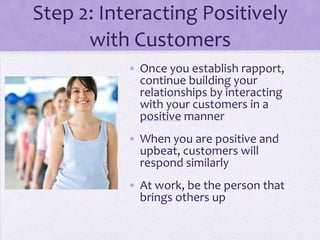
Step 2: Interacting Positively
with Customers
• Once you establish rapport,
continue building your
relationships by interacting
with your customers in a
positive manner
• When you are positive and
upbeat, customers will
respond similarly
• At work, be the person that
brings others up
Interacting Positively
with Customers
• Be helpful
• Show your customers that you care
• Do something to make your customers feel good about
themselves
• Set a personal goal to help someone every day
• Even when a customer does not directly ask for help, if
they seem like they need assistance, offer it to them
• Be committed
• When you commit yourself to your customers and to
Mama’s Subs, you will look for ways to make things
better
• No matter what you do on your shift, strive to do your
best
• Give your customers your all
• Customers will respond positively to a hard worker
Interacting Positively
with Customers
• Be a problem solver
• Be part of the solution rather than the problem
• Look for answers when customers have problems
• Don’t merely focus on what is wrong, do something about it
• People who focus on problems complain; people who focus
on solutions find ways to make things better
• Be credible
• This means being knowledgeable about the products at
Mama’s Subs
• Customers appreciate employees who are knowledgeable
• Learn everything you can about the food and services we
offer here at Mama’s Subs
• If you need additional knowledge, ask your manager for help
Interacting Positively
with Customers
• Believe in your products
• You need to believe in the food and services we sell
at Mama’s Subs
• Otherwise, you will not come off as sincere
• Believing that our products will help improve the
lives of our customers e.g., by helping a busy
mother save time by purchasing quality food for
their children) is crucial for doing the right thing for
them
• It does not matter whether you make the subs, take
the orders, or check customers out; truly believing
in our products will help you promote yourself, the
products, and Mama’s Subs in a positive and sincere
manner
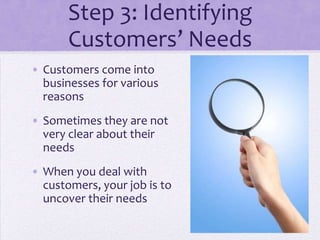
Step 3: Identifying
Customers’ Needs
• Customers come into
businesses for various
reasons
• Sometimes they are not
very clear about their
needs
• When you deal with
customers, your job is to
uncover their needs
Identifying Customers’
Needs
• Ask questions
• In lesson 2, you learned about open and closed
questions
• For a review, click here to return to lesson 2:
http://www.slideshare.net/nikiwild3/lesson-2-
effective-communication-33164675
• Use open questions to get the customer talking
• Questions that begin with “what”, “why”, and “how”
encourage customers to talk
• Used closed questions to clarify answers to open
questions
• These include questions that begin with “who”,
“would”, “how”, and “where”
• Notice that “how” can be used for either open or
closed questions
Identifying Customers’
Needs
• Summarize customers’ needs
• After you have asked enough questions to determine a
customer’s needs, summarize your understanding of what
they have told you
• Start your summarization with, “From what I understand…”
• If your understanding is incorrect, ask more open and closed
questions until you get it right
• Recommend appropriate solutions
• Make sure that your recommendations are based on what
the customer told you
• Refer to things that the customer said when making
recommendations
• EX: “Our lighter options at Mama’s Subs are perfect if you’re
trying to lead a healthier lifestyle. They are low calorie, low
fat, and we use whole grain bread bread.”
Identifying Customers’
Needs
• Handle objections
• This can be accomplished by using the
suggestions in lesson 2 about dealing with
customers who say no
• Link to lesson 2:
http://www.slideshare.net/nikiwild3/lesson-2-
effective-communication-33164675
• Listen to their objection, acknowledge it, follow
up with a question, consider the customer’s
answer, and respond appropriately
Step 4: Making the
Customer Feel Valued
• When you make customers feel valued, you
are on your way to building strong
relationships
• At Mama’s Subs, we strive to make the
customer feel important and valued
Making the Customer
Feel Valued
• Go out of your way for customers
• Do what you can to help customers
• Try to give customers more than what they ask for
• When a customer asks a questions, give them more than a one-word
answer
• Help those customers who do not openly ask for help but need it
• When you go out of your way for customers, they notice
• Validate customers’ decisions
• No matter what type of sub, side item, drink, or deal the customer decides
on, validate their choice
• For example, when a customer picks a certain sub, respond with something
like, “Good choice. That sub is one of my favorites.”
• Instill positive feelings
• Never make a customer feel bad about their decision
• Always encourage the customer and make them feel good about their
decisions
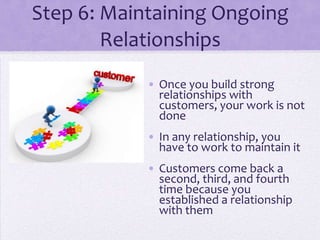
Step 6: Maintaining Ongoing
Relationships
• Once you build strong
relationships with
customers, your work is not
done
• In any relationship, you
have to work to maintain it
• Customers come back a
second, third, and fourth
time because you
established a relationship
with them
Maintaining Ongoing
Relationships
• Remember your customers
• Nothing makes a customer feel more valued than being
remembered
• Acknowledge your repeat customers by saying
something to show you remember them
• EX: “Welcome back to Mama’s Subs, ma’am!”
• Customers who do repeat business at Mama’s Subs
appreciate being recognized
• Learn customers’ names
• When customers come into Mama’s Subs repeatedly,
make it a point to learn their names
• Addressing the customer by their name will let them
know they are important to you and the restaurant
Maintaining Ongoing
Relationships
• Remember something about your customers
• Everyone appreciates an employee with a good
memory
• It shows your customers that you value your
relationship with them
• EX: “Hi, Mrs. Johnston! Hope everything’s going
well with your new house.”
• Learn your customer’s preferences
• If you deal with customer’s repeatedly, get to know
what they like
• If you have too many customers to remember each
ones’ tastes, you could start a card or computer file
and note your customers’ preferences
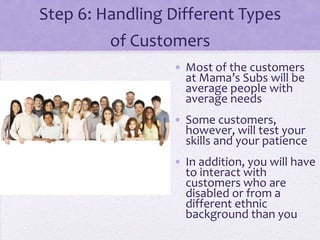
Step 6: Handling Different Types
of Customers
• Most of the customers
at Mama’s Subs will be
average people with
average needs
• Some customers,
however, will test your
skills and your patience
• In addition, you will have
to interact with
customers who are
disabled or from a
different ethnic
background than you
Handling Different Types
of Customers
• The pushy, obnoxious customer
• Maintain a professional demeanor
• Speak softly and control your voice inflection
• Remain calm
• Do not take their behavior personally
• The timid, indecisive customer
• Help draw these customers out and get them to talk more
• Ask open questions
• Listen closely to their responses and guide them to give you
an answer about their decision
• Be sensitive to these kinds of customers
• Help them feel more relaxed an comfortable
• Do not be pushy or use a forceful tone
Handling Different Types
of Customers
• The overly friendly, flirty customer
• Keep your end of the conversation on business
• These customers can be difficult to handle because they do
not see their behavior as inappropriate
• It is up to you to control the conversation
• The culturally different customer
• We live in a society that incorporates many cultures and
customs
• Yet people often do not know how to talk or act in the
presence of a person with a different background
• Displaying kindness, smiling, and being honest translate
across cultures
• Try to make yourself aware of different cultures by
researching them
Handling Different Types
of Customers
• People with disabilities
• Treat them like you would anyone else
• Make eye contact and speak in your normal
tone and pace of speech
• As you continue with the customer, if you
notice that you need to slow down, speak up,
or enunciate more, do so
• Treat them with the same dignity and respect
you would anyone else

Lesson 3: Relationship Building

  • 1.
  • 2.
    Relationship Building • Masteringrelationship building involves six steps: 1. Establishing rapport 2. Interacting positively with customers 3. Identifying customers’ needs 4. Making the customer feel valued 5. Maintaining ongoing relationships 6. Handling different types of customers
  • 3.
    Relationship Building • Bythe end of this lesson you should know: • How to effectively establish rapport with your customers • How to create and maintain positive interactions with customers • How to identify what customer’s needs are • What you can do to make a customer feel valuable • How to maintain ongoing relationships with customers • How to handle different types of customers
  • 4.
    Step 1: Establishing Rapport •Establishing rapport begins the moment you start communication with your customers • How you establish rapport depends on your customer interactions • It also depends on who your customers are, what they expect from Mama’s Subs, and how Mama’s Subs can enhance customers’ lives
  • 5.
    Establishing Rapport • Befriendly • Treat customers with a warm, welcoming attitude • No matter who your customers are, everyone appreciates someone who is friendly • When you smile and offer a friendly greeting, you put your customers at ease • You show them from the start that you are approachable and willing to help • Be interested • Being interested means listening when customers respond to you • It also means responding accordingly to what the customers have to say • When listening to customers, think of ways to brighten up their day; it is an effective way to show you are interested
  • 6.
    Establishing Rapport • Beconsiderate • Being considerate means showing kindly awareness or regard for customers’ feelings • For example, if a customer is having a bad day, you should respond to them by saying, “I’m sorry to hear you’re having a bad day. What can I do to make it better?” • Even if you cannot personally understand or relate to what the customer is saying, you can be considerate in your response • Be trustful • The best way to demonstrate that you can be trusted is by being honest and ethical in everything that you do • Being trustful also includes treating people with dignity and respect
  • 7.
    Establishing Rapport • Findcommon ground • When you listen to your customers’ statements and responses, try to find something you have in common • To a customer who is having a bad day, you might respond by saying: “I’m sorry to hear that you are having a bad day. I had one of those days yesterday.” • The customer will appreciate that you can relate to their experience • Even if you did not have a similar experience, you can find other ways to relate • Empathize with the customer, ask questions, show interest • Complimenting a customer on something they are wearing is also a good way to find common ground • E.g., “I like your watch, sir.”
  • 8.
    Step 2: InteractingPositively with Customers • Once you establish rapport, continue building your relationships by interacting with your customers in a positive manner • When you are positive and upbeat, customers will respond similarly • At work, be the person that brings others up
  • 9.
    Interacting Positively with Customers •Be helpful • Show your customers that you care • Do something to make your customers feel good about themselves • Set a personal goal to help someone every day • Even when a customer does not directly ask for help, if they seem like they need assistance, offer it to them • Be committed • When you commit yourself to your customers and to Mama’s Subs, you will look for ways to make things better • No matter what you do on your shift, strive to do your best • Give your customers your all • Customers will respond positively to a hard worker
  • 10.
    Interacting Positively with Customers •Be a problem solver • Be part of the solution rather than the problem • Look for answers when customers have problems • Don’t merely focus on what is wrong, do something about it • People who focus on problems complain; people who focus on solutions find ways to make things better • Be credible • This means being knowledgeable about the products at Mama’s Subs • Customers appreciate employees who are knowledgeable • Learn everything you can about the food and services we offer here at Mama’s Subs • If you need additional knowledge, ask your manager for help
  • 11.
    Interacting Positively with Customers •Believe in your products • You need to believe in the food and services we sell at Mama’s Subs • Otherwise, you will not come off as sincere • Believing that our products will help improve the lives of our customers e.g., by helping a busy mother save time by purchasing quality food for their children) is crucial for doing the right thing for them • It does not matter whether you make the subs, take the orders, or check customers out; truly believing in our products will help you promote yourself, the products, and Mama’s Subs in a positive and sincere manner
  • 12.
    Step 3: Identifying Customers’Needs • Customers come into businesses for various reasons • Sometimes they are not very clear about their needs • When you deal with customers, your job is to uncover their needs
  • 13.
    Identifying Customers’ Needs • Askquestions • In lesson 2, you learned about open and closed questions • For a review, click here to return to lesson 2: http://www.slideshare.net/nikiwild3/lesson-2- effective-communication-33164675 • Use open questions to get the customer talking • Questions that begin with “what”, “why”, and “how” encourage customers to talk • Used closed questions to clarify answers to open questions • These include questions that begin with “who”, “would”, “how”, and “where” • Notice that “how” can be used for either open or closed questions
  • 14.
    Identifying Customers’ Needs • Summarizecustomers’ needs • After you have asked enough questions to determine a customer’s needs, summarize your understanding of what they have told you • Start your summarization with, “From what I understand…” • If your understanding is incorrect, ask more open and closed questions until you get it right • Recommend appropriate solutions • Make sure that your recommendations are based on what the customer told you • Refer to things that the customer said when making recommendations • EX: “Our lighter options at Mama’s Subs are perfect if you’re trying to lead a healthier lifestyle. They are low calorie, low fat, and we use whole grain bread bread.”
  • 15.
    Identifying Customers’ Needs • Handleobjections • This can be accomplished by using the suggestions in lesson 2 about dealing with customers who say no • Link to lesson 2: http://www.slideshare.net/nikiwild3/lesson-2- effective-communication-33164675 • Listen to their objection, acknowledge it, follow up with a question, consider the customer’s answer, and respond appropriately
  • 16.
    Step 4: Makingthe Customer Feel Valued • When you make customers feel valued, you are on your way to building strong relationships • At Mama’s Subs, we strive to make the customer feel important and valued
  • 17.
    Making the Customer FeelValued • Go out of your way for customers • Do what you can to help customers • Try to give customers more than what they ask for • When a customer asks a questions, give them more than a one-word answer • Help those customers who do not openly ask for help but need it • When you go out of your way for customers, they notice • Validate customers’ decisions • No matter what type of sub, side item, drink, or deal the customer decides on, validate their choice • For example, when a customer picks a certain sub, respond with something like, “Good choice. That sub is one of my favorites.” • Instill positive feelings • Never make a customer feel bad about their decision • Always encourage the customer and make them feel good about their decisions
  • 18.
    Step 6: MaintainingOngoing Relationships • Once you build strong relationships with customers, your work is not done • In any relationship, you have to work to maintain it • Customers come back a second, third, and fourth time because you established a relationship with them
  • 19.
    Maintaining Ongoing Relationships • Rememberyour customers • Nothing makes a customer feel more valued than being remembered • Acknowledge your repeat customers by saying something to show you remember them • EX: “Welcome back to Mama’s Subs, ma’am!” • Customers who do repeat business at Mama’s Subs appreciate being recognized • Learn customers’ names • When customers come into Mama’s Subs repeatedly, make it a point to learn their names • Addressing the customer by their name will let them know they are important to you and the restaurant
  • 20.
    Maintaining Ongoing Relationships • Remembersomething about your customers • Everyone appreciates an employee with a good memory • It shows your customers that you value your relationship with them • EX: “Hi, Mrs. Johnston! Hope everything’s going well with your new house.” • Learn your customer’s preferences • If you deal with customer’s repeatedly, get to know what they like • If you have too many customers to remember each ones’ tastes, you could start a card or computer file and note your customers’ preferences
  • 21.
    Step 6: HandlingDifferent Types of Customers • Most of the customers at Mama’s Subs will be average people with average needs • Some customers, however, will test your skills and your patience • In addition, you will have to interact with customers who are disabled or from a different ethnic background than you
  • 22.
    Handling Different Types ofCustomers • The pushy, obnoxious customer • Maintain a professional demeanor • Speak softly and control your voice inflection • Remain calm • Do not take their behavior personally • The timid, indecisive customer • Help draw these customers out and get them to talk more • Ask open questions • Listen closely to their responses and guide them to give you an answer about their decision • Be sensitive to these kinds of customers • Help them feel more relaxed an comfortable • Do not be pushy or use a forceful tone
  • 23.
    Handling Different Types ofCustomers • The overly friendly, flirty customer • Keep your end of the conversation on business • These customers can be difficult to handle because they do not see their behavior as inappropriate • It is up to you to control the conversation • The culturally different customer • We live in a society that incorporates many cultures and customs • Yet people often do not know how to talk or act in the presence of a person with a different background • Displaying kindness, smiling, and being honest translate across cultures • Try to make yourself aware of different cultures by researching them
  • 24.
    Handling Different Types ofCustomers • People with disabilities • Treat them like you would anyone else • Make eye contact and speak in your normal tone and pace of speech • As you continue with the customer, if you notice that you need to slow down, speak up, or enunciate more, do so • Treat them with the same dignity and respect you would anyone else