13-1McGraw-Hill/Irwin Copyright © 2009 by The McGraw-Hill Companies, Inc. All rights reserved.
13-2
Closing Begins the
Relationship
Chapter
13
13-3
When Should I Pop the Question?
 Closing is the process of helping people make a
decision that will benefit them
 There are no magic phrases and techniques to use in
closing a sale
 Close when the prospect is in the conviction stage of
the mental buying process
13-4
Reading Buying Signals
 A buying signal is anything that a prospect says or
does to indicate that he is ready to buy
 Asking questions
 Asking another person’s opinion
 Relaxing and becoming friendly
 Pulling out a purchase order form
 Carefully examining merchandise
13-5
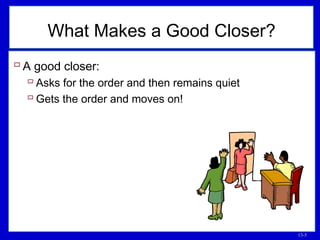
What Makes a Good Closer?
 A good closer:
 Asks for the order and then remains quiet
 Gets the order and moves on!
13-6
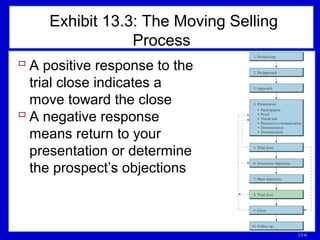
Exhibit 13.3: The Moving Selling
Process
 A positive response to the
trial close indicates a
move toward the close
 A negative response
means return to your
presentation or determine
the prospect’s objections
13-7
How Many Times Should You Close?
 You must be able to use multiple closes
 Three closes is a minimum
 You will learn how without being pushy
13-8
Closing Under Fire
 The first “no” from the prospect isn’t necessarily an
absolute refusal to buy
13-9
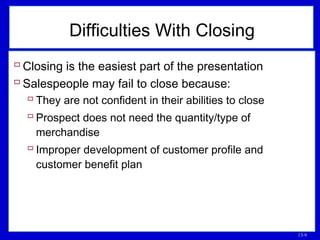
Difficulties With Closing
 Closing is the easiest part of the presentation
 Salespeople may fail to close because:
 They are not confident in their abilities to close
 Prospect does not need the quantity/type of
merchandise
 Improper development of customer profile and
customer benefit plan
13-10
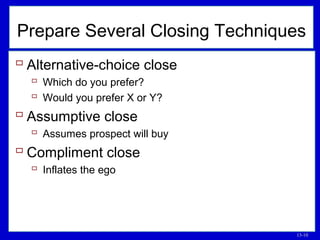
 Alternative-choice close
 Which do you prefer?
 Would you prefer X or Y?
 Assumptive close
 Assumes prospect will buy
 Compliment close
 Inflates the ego
Prepare Several Closing Techniques
13-11
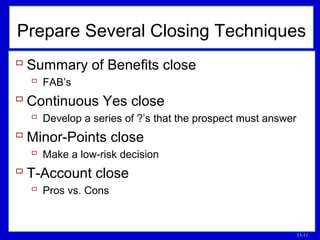
 Summary of Benefits close
 FAB’s
 Continuous Yes close
 Develop a series of ?’s that the prospect must answer
 Minor-Points close
 Make a low-risk decision
 T-Account close
 Pros vs. Cons
Prepare Several Closing Techniques
13-12
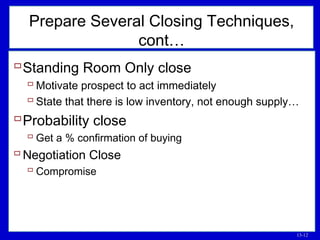
Prepare Several Closing Techniques,
cont…
Standing Room Only close
 Motivate prospect to act immediately
 State that there is low inventory, not enough supply…
Probability close
 Get a % confirmation of buying
Negotiation Close
 Compromise
13-13
Example: The Alternative-Choice Close
 “Would you prefer the Xerox 6200 or 6400 copier?”
 Study this question – it assumes:
 The customer has a desire to buy one of the copiers
 The customer will buy
 It allows the customer a preference
 It provides a choice between products, not between a product
and nothing
 By presenting a choice, you receive a “yes” decision or
uncover objections
13-14
“Would you prefer the Xerox 6200 or
6400 copier?”
 “I’m not sure,” says the customer (still in the desire
stage)
 Continue with your FABs
13-15
 If you see the customer likes both 6200 and 6400 and
appears indecisive, you can ask:
 “Is there something you are unsure of?”
 This question probes to find out why your prospect is
not ready to choose
“Would you prefer the Xerox 6200 or
6400 copier?”
13-16
Prepare a Multiple-Close Sequence
 Different closing techniques work best for certain
situations
 Multiple closes incorporate techniques for overcoming
objections
13-17
Prepare a Multiple-Close Sequence,
cont…
 Keeping several closes ready puts you in a better
position to close.
 For Example:
 Begin with a summary close.
 If the buyer says no, rephrase the objection;
then use an alternative-choice close.
 If the buyer says no again and does not give a reason,
you could use the five-question sequence method for
overcoming objections.
13-18
Research Reinforces These Sales Success
Strategies
 Common salesperson mistakes resulting in unsuccessful
sales calls
 Tells instead of sells, doesn’t ask enough questions
 Over-controls the call, asks too many closed-end questions
 Doesn’t respond to customer needs with benefits
 Doesn’t recognize needs, gives benefits prematurely
 Doesn’t recognize or handle negative attitudes effectively
 Makes weak closing statements, or doesn’t recognize when or
how to close
13-19
Keys to Improved Selling
 Ask questions to gather information and uncover needs
 Recognize when a customer has a real need
 State how the benefits of the product or service can satisfy the
need
 Recognize and handle negative customer attitudes promptly
and directly
 Use a benefit summary and an action plan requiring
commitment when closing
13-20
The Business Proposition and the Close
 For some salespeople, the discussion of the business
proposition provides an excellent opportunity to close.
 Use a Visual Aid to Close
 Visual aids work well for both discussing the business
proposition and closing.
13-21
Closing Begins the Relationship
 When you make a sale for the first time, you change
the person or organization from a prospect to a
customer.
13-22
There are Eleven Closing Techniques in
This Chapter, Each:
 Is different
 Can be used with other closing techniques
 Helps you be a better communicator
 Helps you better serve others
13-23
Which Closing Technique Should I Use?
 To answer that question you should first:
 Determine your approach
 Create your presentation, then
 Determine how best to close
13-24
 Ideally, the salesperson should wait for signs that the
person is in the conviction stage because a buyer in
this stage typically:
 Has a strong conviction that you can be trusted
 Feels the product will fulfill needs or solve problems
 Will reveal real concerns due to trust
Getting Ready to Close
13-25
If You Close and Receive an Objection,
What Should You Do?
 Find out what the objection is
13-26
After You Find Out What the Objection Is and
Answer It, What Should You Do Next?
 Ask a trial close to determine if you have overcome
the objection
13-27
If You Have Closed, Had an Objection Arise and Effectively
Handled the Objection, What Should You Do Next?
 Close again!
 This is why you need a multiple-closing
sequence
13-28
 Know that you cannot always sell everyone
 Don’t take buyer’s denial personally
 Be courteous and cheerful
 Leave the door open
When You Do Not Make the Sale

Chapter 13 Closing the Call

  • 1.
    13-1McGraw-Hill/Irwin Copyright ©2009 by The McGraw-Hill Companies, Inc. All rights reserved.
  • 2.
  • 3.
    13-3 When Should IPop the Question?  Closing is the process of helping people make a decision that will benefit them  There are no magic phrases and techniques to use in closing a sale  Close when the prospect is in the conviction stage of the mental buying process
  • 4.
    13-4 Reading Buying Signals A buying signal is anything that a prospect says or does to indicate that he is ready to buy  Asking questions  Asking another person’s opinion  Relaxing and becoming friendly  Pulling out a purchase order form  Carefully examining merchandise
  • 5.
    13-5 What Makes aGood Closer?  A good closer:  Asks for the order and then remains quiet  Gets the order and moves on!
  • 6.
    13-6 Exhibit 13.3: TheMoving Selling Process  A positive response to the trial close indicates a move toward the close  A negative response means return to your presentation or determine the prospect’s objections
  • 7.
    13-7 How Many TimesShould You Close?  You must be able to use multiple closes  Three closes is a minimum  You will learn how without being pushy
  • 8.
    13-8 Closing Under Fire The first “no” from the prospect isn’t necessarily an absolute refusal to buy
  • 9.
    13-9 Difficulties With Closing Closing is the easiest part of the presentation  Salespeople may fail to close because:  They are not confident in their abilities to close  Prospect does not need the quantity/type of merchandise  Improper development of customer profile and customer benefit plan
  • 10.
    13-10  Alternative-choice close Which do you prefer?  Would you prefer X or Y?  Assumptive close  Assumes prospect will buy  Compliment close  Inflates the ego Prepare Several Closing Techniques
  • 11.
    13-11  Summary ofBenefits close  FAB’s  Continuous Yes close  Develop a series of ?’s that the prospect must answer  Minor-Points close  Make a low-risk decision  T-Account close  Pros vs. Cons Prepare Several Closing Techniques
  • 12.
    13-12 Prepare Several ClosingTechniques, cont… Standing Room Only close  Motivate prospect to act immediately  State that there is low inventory, not enough supply… Probability close  Get a % confirmation of buying Negotiation Close  Compromise
  • 13.
    13-13 Example: The Alternative-ChoiceClose  “Would you prefer the Xerox 6200 or 6400 copier?”  Study this question – it assumes:  The customer has a desire to buy one of the copiers  The customer will buy  It allows the customer a preference  It provides a choice between products, not between a product and nothing  By presenting a choice, you receive a “yes” decision or uncover objections
  • 14.
    13-14 “Would you preferthe Xerox 6200 or 6400 copier?”  “I’m not sure,” says the customer (still in the desire stage)  Continue with your FABs
  • 15.
    13-15  If yousee the customer likes both 6200 and 6400 and appears indecisive, you can ask:  “Is there something you are unsure of?”  This question probes to find out why your prospect is not ready to choose “Would you prefer the Xerox 6200 or 6400 copier?”
  • 16.
    13-16 Prepare a Multiple-CloseSequence  Different closing techniques work best for certain situations  Multiple closes incorporate techniques for overcoming objections
  • 17.
    13-17 Prepare a Multiple-CloseSequence, cont…  Keeping several closes ready puts you in a better position to close.  For Example:  Begin with a summary close.  If the buyer says no, rephrase the objection; then use an alternative-choice close.  If the buyer says no again and does not give a reason, you could use the five-question sequence method for overcoming objections.
  • 18.
    13-18 Research Reinforces TheseSales Success Strategies  Common salesperson mistakes resulting in unsuccessful sales calls  Tells instead of sells, doesn’t ask enough questions  Over-controls the call, asks too many closed-end questions  Doesn’t respond to customer needs with benefits  Doesn’t recognize needs, gives benefits prematurely  Doesn’t recognize or handle negative attitudes effectively  Makes weak closing statements, or doesn’t recognize when or how to close
  • 19.
    13-19 Keys to ImprovedSelling  Ask questions to gather information and uncover needs  Recognize when a customer has a real need  State how the benefits of the product or service can satisfy the need  Recognize and handle negative customer attitudes promptly and directly  Use a benefit summary and an action plan requiring commitment when closing
  • 20.
    13-20 The Business Propositionand the Close  For some salespeople, the discussion of the business proposition provides an excellent opportunity to close.  Use a Visual Aid to Close  Visual aids work well for both discussing the business proposition and closing.
  • 21.
    13-21 Closing Begins theRelationship  When you make a sale for the first time, you change the person or organization from a prospect to a customer.
  • 22.
    13-22 There are ElevenClosing Techniques in This Chapter, Each:  Is different  Can be used with other closing techniques  Helps you be a better communicator  Helps you better serve others
  • 23.
    13-23 Which Closing TechniqueShould I Use?  To answer that question you should first:  Determine your approach  Create your presentation, then  Determine how best to close
  • 24.
    13-24  Ideally, thesalesperson should wait for signs that the person is in the conviction stage because a buyer in this stage typically:  Has a strong conviction that you can be trusted  Feels the product will fulfill needs or solve problems  Will reveal real concerns due to trust Getting Ready to Close
  • 25.
    13-25 If You Closeand Receive an Objection, What Should You Do?  Find out what the objection is
  • 26.
    13-26 After You FindOut What the Objection Is and Answer It, What Should You Do Next?  Ask a trial close to determine if you have overcome the objection
  • 27.
    13-27 If You HaveClosed, Had an Objection Arise and Effectively Handled the Objection, What Should You Do Next?  Close again!  This is why you need a multiple-closing sequence
  • 28.
    13-28  Know thatyou cannot always sell everyone  Don’t take buyer’s denial personally  Be courteous and cheerful  Leave the door open When You Do Not Make the Sale