Curriculum Design,
Development and Models:
Planning for student learning
Curriculum
Design
refers to the structure or organization of the
curriculum, and curriculum development
includes the planning, implementation, and
evaluation processes of the curriculum.
CURRICULUM DESIGN
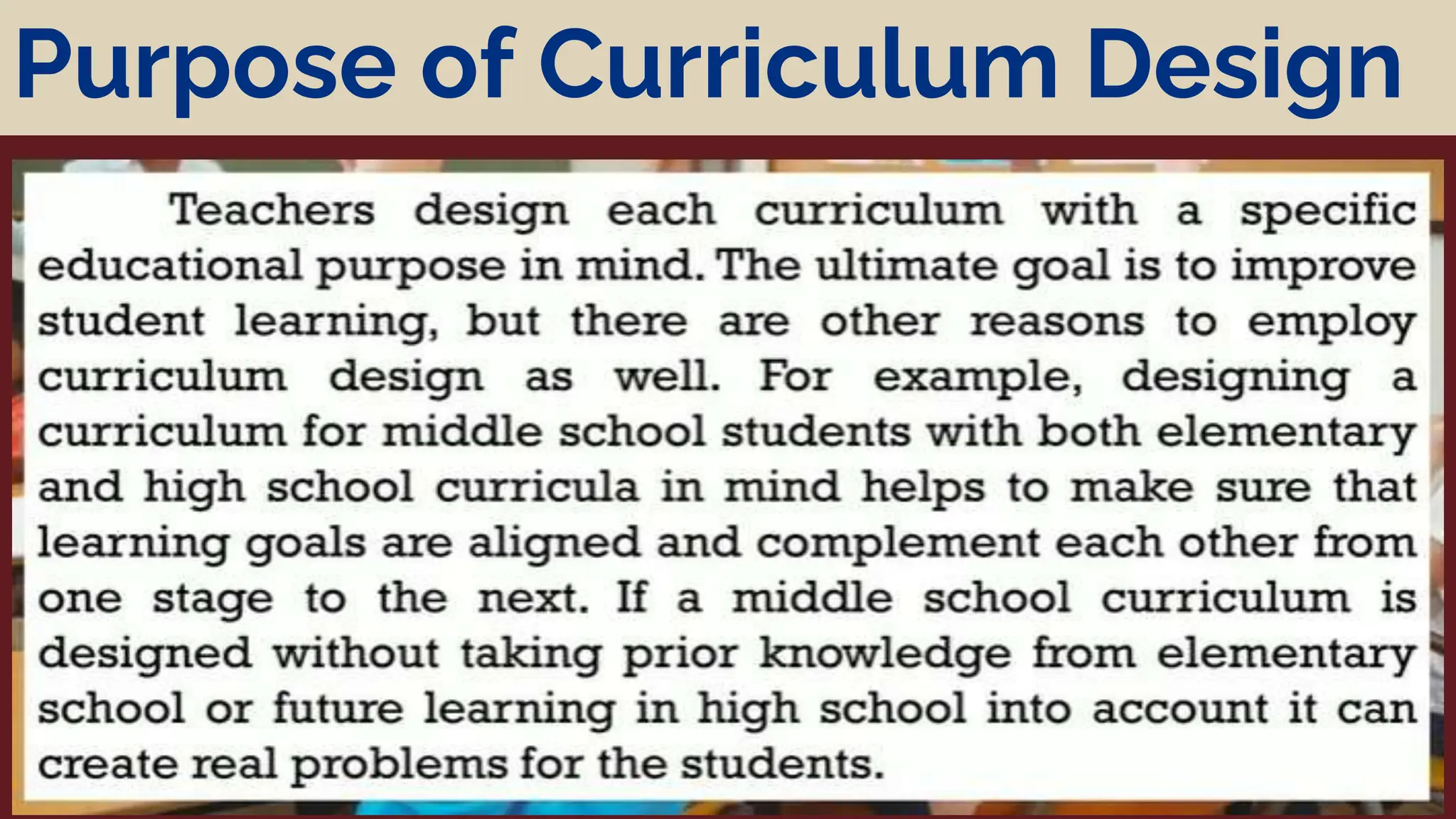
Purpose of Curriculum Design
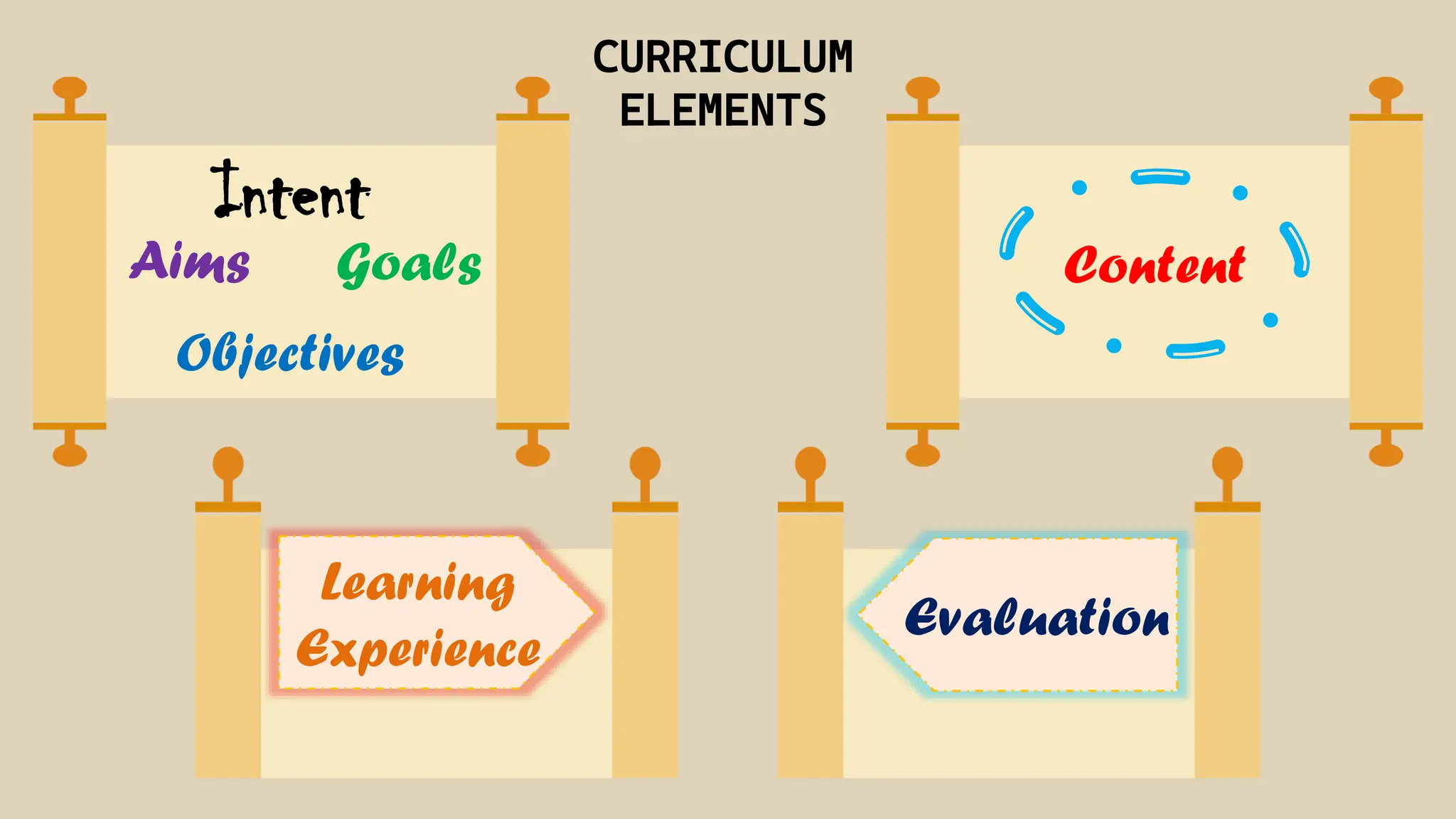
Intent
Aims Goals
Objectives
Content
Learning
Experience
Evaluation
CURRICULUM
ELEMENTS
TYPES OF
CURRICULUM DESIGN
Subject-Centered
Curriculum
Design
TYPES OF
CURRICULUM DESIGN
Learner-Centered
Curriculum
Designs
TYPES OF
CURRICULUM DESIGN
Problem-Centered
Curriculum
Designs
Subject-Centered
Curriculum Design
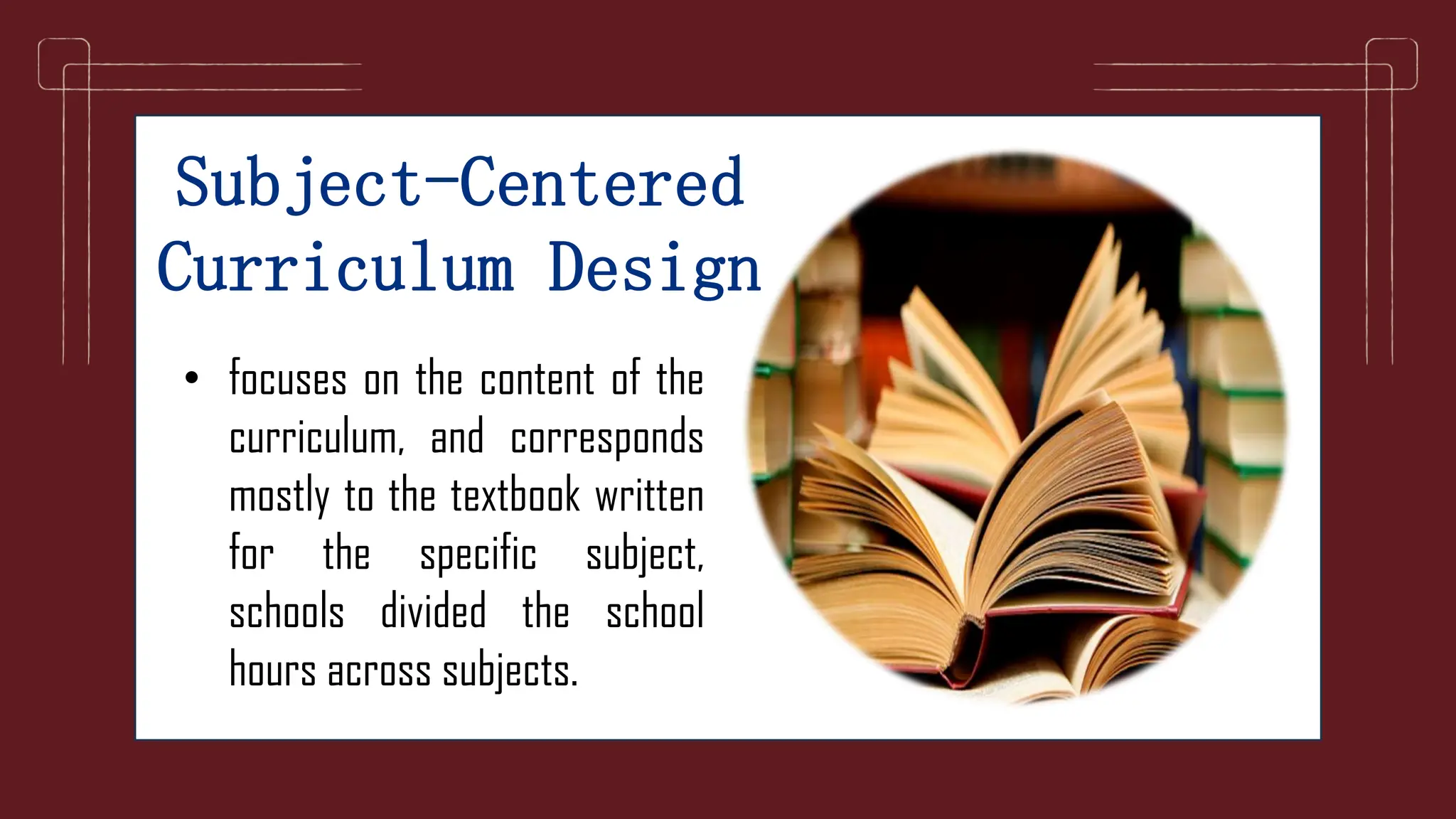
• focuses on the content of the
curriculum, and corresponds
mostly to the textbook written
for the specific subject,
schools divided the school
hours across subjects.
Subject-Centered Curriculum Design
1. Subject Design- the oldest and most
familiar, easy to deliver, has
complementary books, written, and
available support instructional materials
but learning is so compartmentalized,
forgets about student’s natural
tendencies, interests, and experiences.
Subject-Centered Curriculum Design
2. Discipline Design- related to the
subject design but focuses on
academic discipline, often used in
college.
Subject-Centered Curriculum Design
3. Broad Fields/Integrated Design- in the
broad fields/integrated curriculum design,
two, three, or more subjects are unified into
one broad course of study. This
organization is a system of combining and
regrouping subjects that are related to the
curriculum.
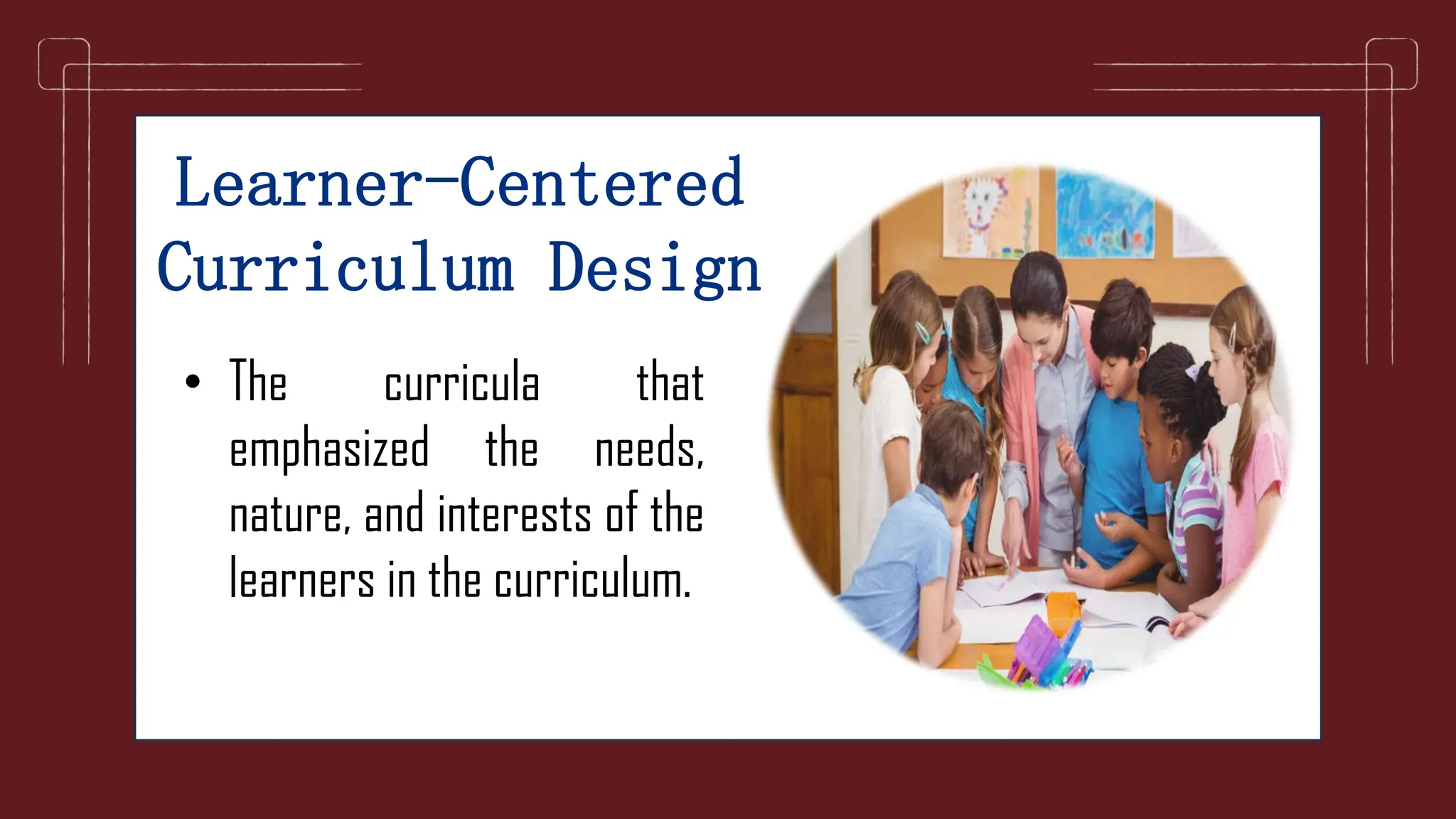
Learner-Centered
Curriculum Design
• The curricula that
emphasized the needs,
nature, and interests of the
learners in the curriculum.
Learner-Centered Curriculum Design
1. Child-centered Design- influence of John
Dewey, Rousseau, Pestalozzi, and
Froebel, anchored on the needs and
interest of the child who engages with
his/her environment, learning by doing.
Learner-Centered Curriculum Design
2. Experience-centered Design- the child
remains to be the focus but believes that
the interests and needs of the learners
cannot be pre-planned, the experiences
of the learners become the starting point
of the curriculum, and the learners are
made to choose from various activities
that the teacher provides.
Learner-Centered Curriculum Design
3. Humanistic Design- by Abraham Maslow
and Carl Rogers, stress the development
of positive self-concept and interpersonal
skills.
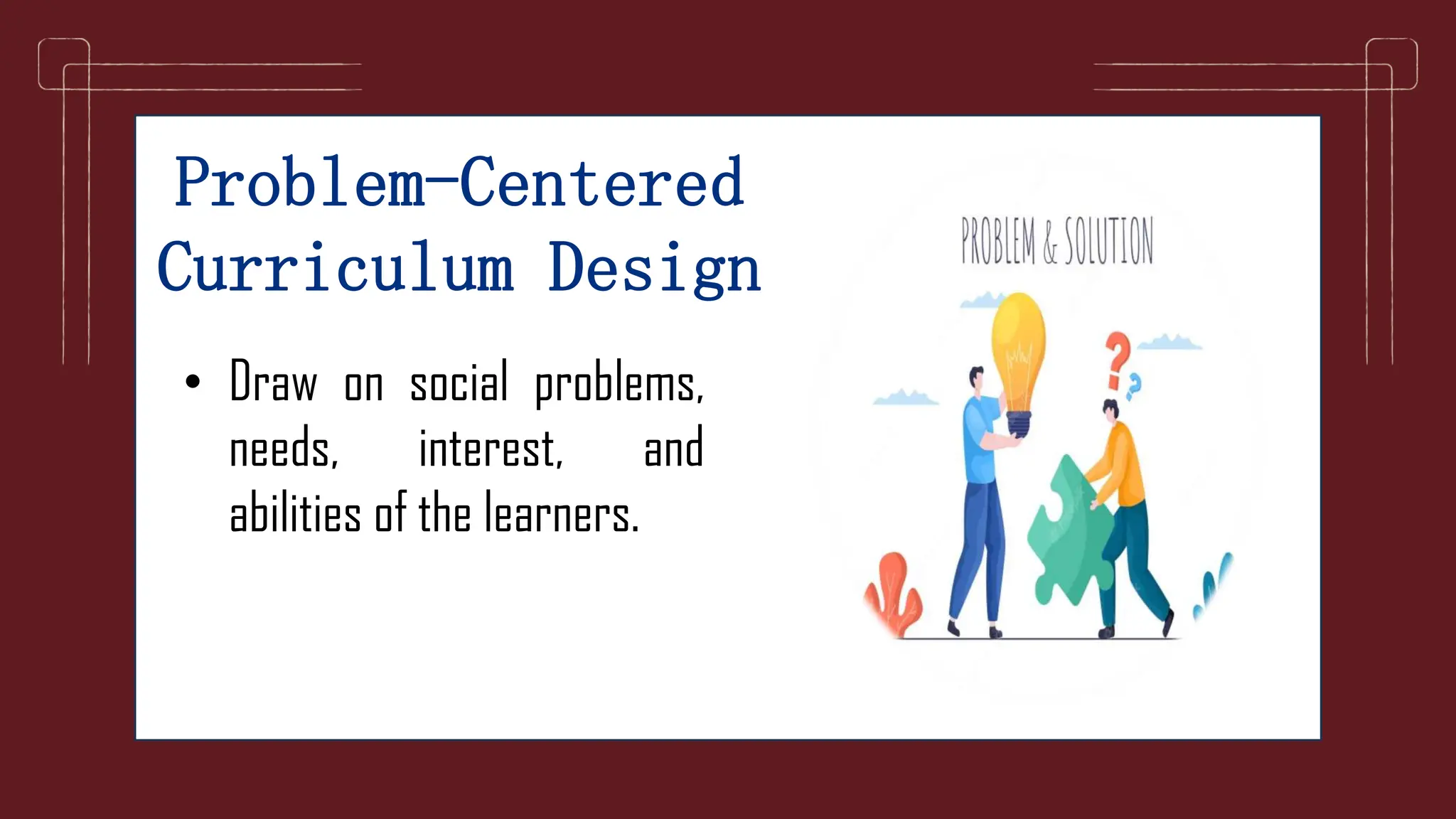
Problem-Centered
Curriculum Design
• Draw on social problems,
needs, interest, and
abilities of the learners.
Problem-Centered Curriculum Design
1. Life-situation Design- allows the students
to clarify their views of various problem
areas, uses past and present
experiences of learners to analyze the
basic areas of living.
Problem-Centered Curriculum Design
2. Core Design- centers on general
education, and the problems are based
on common human activities.
1. Teacher Cathy believes that new respect for the
child is fundamental in the curriculum. Thus, all
activities in the classroom are geared towards the
development of the child- the center of the
educational process. To which approach in the
curriculum does Teacher Cathy adhere?
A. Learner-centered
B. Problem-centered
C. Subject-centered
D. Pragmatic
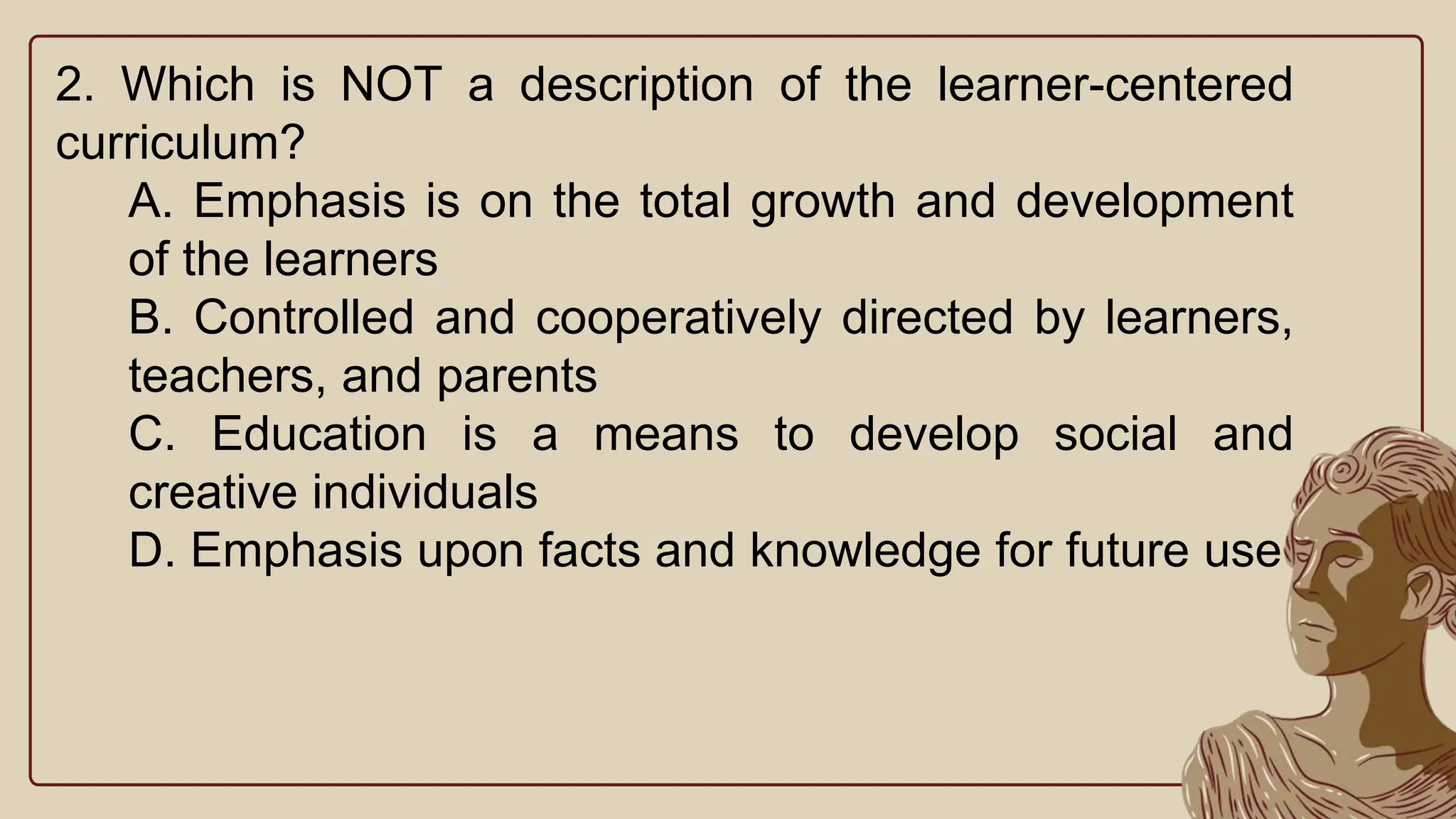
2. Which is NOT a description of the learner-centered
curriculum?
A. Emphasis is on the total growth and development
of the learners
B. Controlled and cooperatively directed by learners,
teachers, and parents
C. Education is a means to develop social and
creative individuals
D. Emphasis upon facts and knowledge for future use
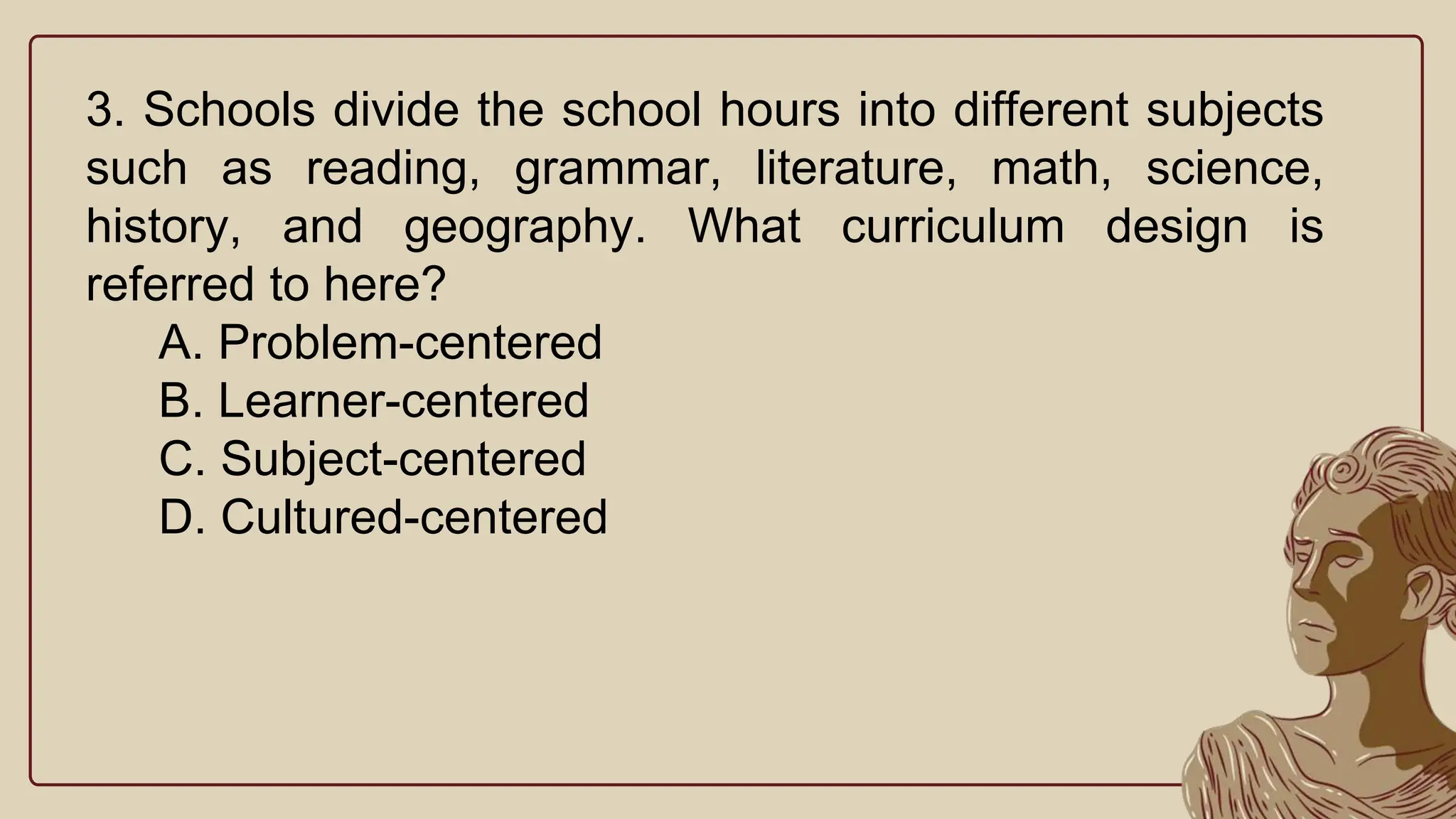
3. Schools divide the school hours into different subjects
such as reading, grammar, literature, math, science,
history, and geography. What curriculum design is
referred to here?
A. Problem-centered
B. Learner-centered
C. Subject-centered
D. Cultured-centered
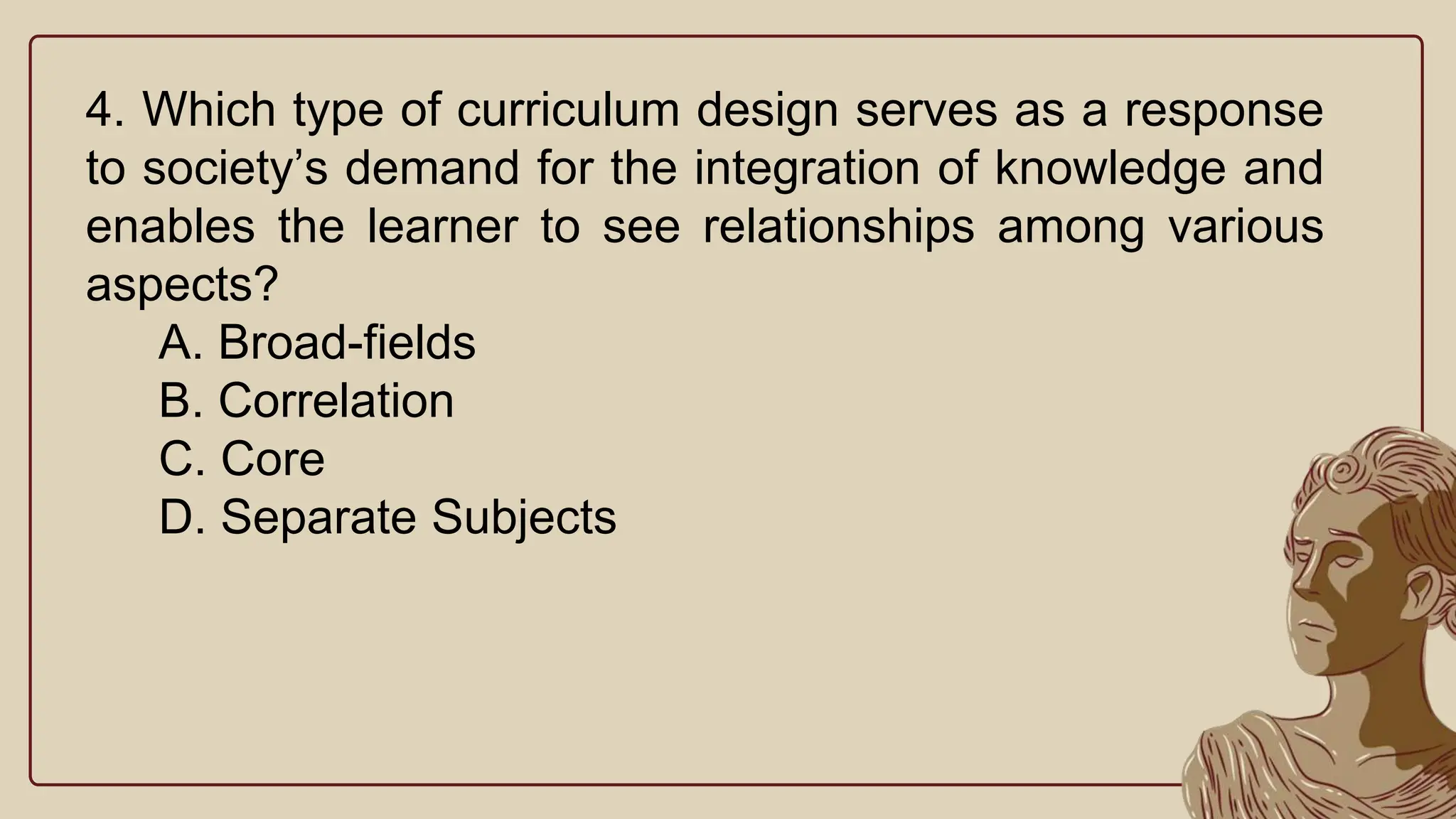
4. Which type of curriculum design serves as a response
to society’s demand for the integration of knowledge and
enables the learner to see relationships among various
aspects?
A. Broad-fields
B. Correlation
C. Core
D. Separate Subjects
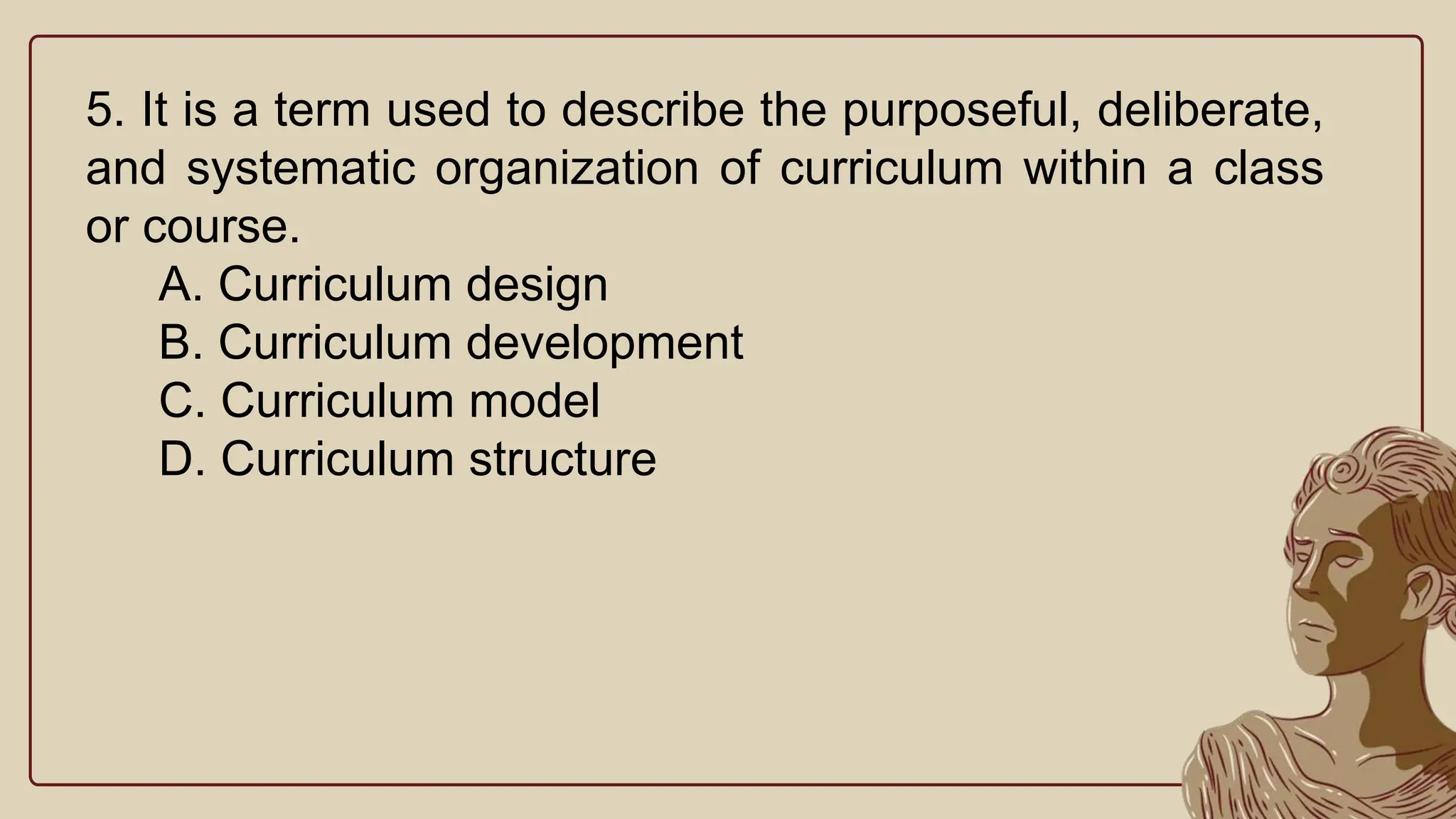
5. It is a term used to describe the purposeful, deliberate,
and systematic organization of curriculum within a class
or course.
A. Curriculum design
B. Curriculum development
C. Curriculum model
D. Curriculum structure
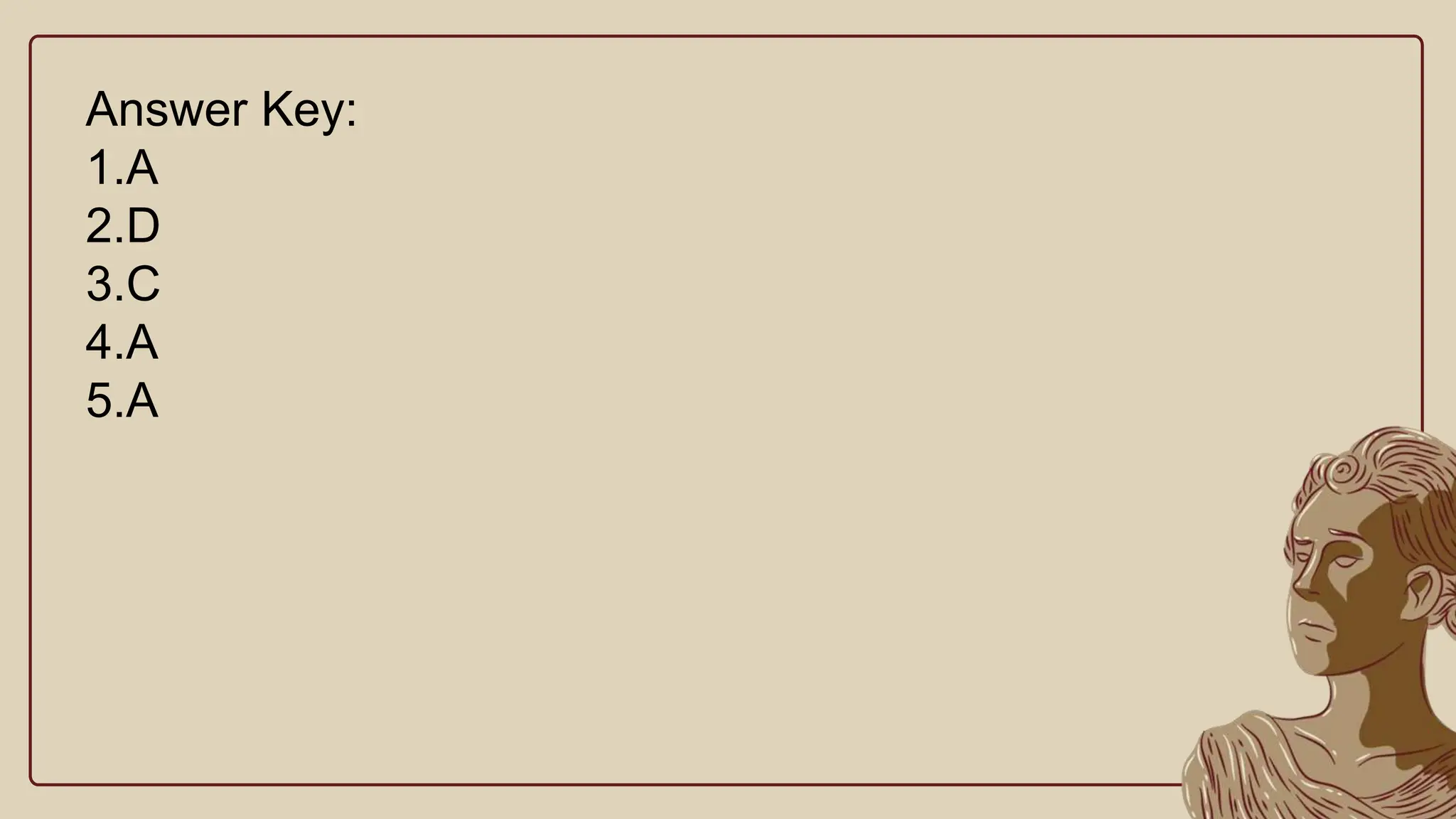
Answer Key:
1.A
2.D
3.C
4.A
5.A

CURRICULUM DESIGN( Types of curriculum).pptx