
ANIMAL TISSUES
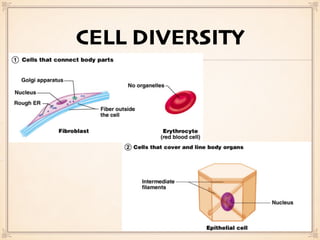
CELL DIVERSITY
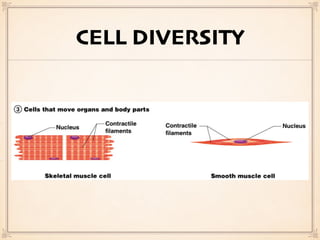
CELL DIVERSITY
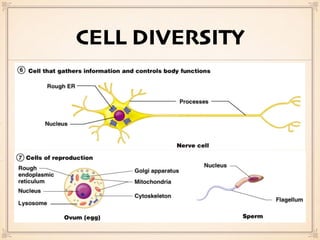
CELL DIVERSITY
CELL DIVERSITY
BODY TISSUES
Tissue
Groups of cells with similar structure and function
Four primary types
Epithelial
Connective
Muscular
Nervous
EPITHELIAL TISSUES
EPITHELIAL TISSUES
Location
Body coverings
Body linings
Glandular tissue
EPITHELIAL TISSUES
Characteristics
Cells fit closely together
The lower surface is bound by a basement
membrane
Avascular (have no blood supply)
Regenerate easily if well nourished
CLASSIFICATION OF EPITHELIUM
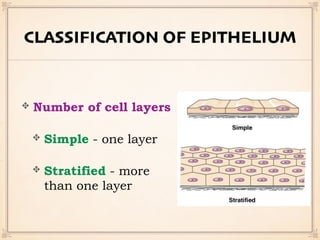
Number of cell layers
Simple - one layer
Stratified - more
than one layer
CLASSIFICATION OF EPITHELIUM
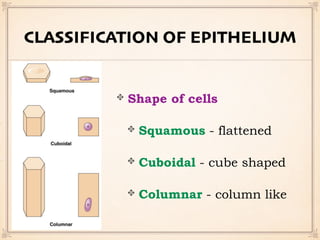
Shape of cells
Squamous - flattened
Cuboidal - cube shaped
Columnar - column like
SIMPLE EPITHELIUM
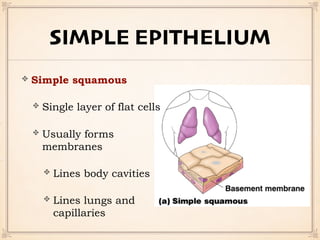
Simple squamous
Single layer of flat cells
Usually forms
membranes
Lines body cavities
Lines lungs and
capillaries
SIMPLE EPITHELIUM
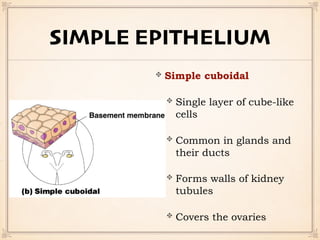
Simple cuboidal
Single layer of cube-like
cells
Common in glands and
their ducts
Forms walls of kidney
tubules
Covers the ovaries
SIMPLE EPITHELIUM
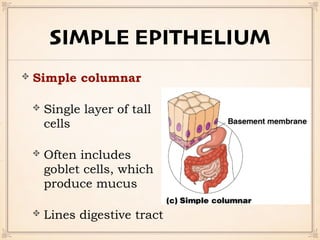
Simple columnar
Single layer of tall
cells
Often includes
goblet cells, which
produce mucus
Lines digestive tract
SIMPLE EPITHELIUM
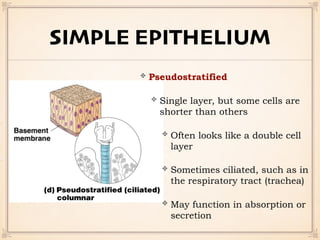
Pseudostratified
Single layer, but some cells are
shorter than others
Often looks like a double cell
layer
Sometimes ciliated, such as in
the respiratory tract (trachea)
May function in absorption or
secretion
STRATIFIED EPITHELIUM
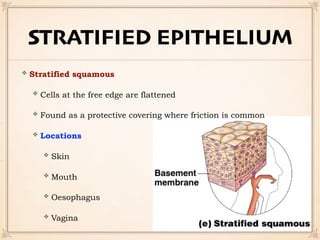
Stratified squamous
Cells at the free edge are flattened
Found as a protective covering where friction is common
Locations
Skin
Mouth
Oesophagus
Vagina
STRATIFIED EPITHELIUM
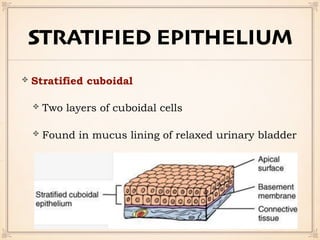
Stratified cuboidal
Two layers of cuboidal cells
Found in mucus lining of relaxed urinary bladder
STRATIFIED EPITHELIUM
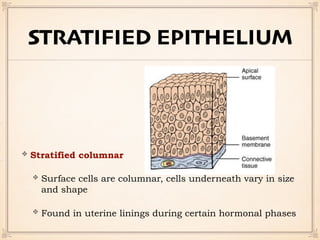
Stratified columnar
Surface cells are columnar, cells underneath vary in size
and shape
Found in uterine linings during certain hormonal phases
STRATIFIED EPITHELIUM
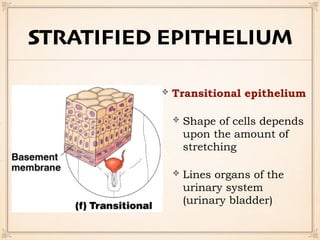
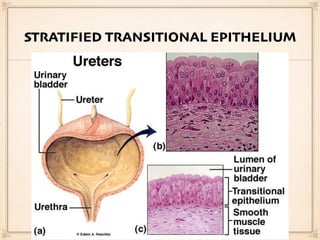
Transitional epithelium
Shape of cells depends
upon the amount of
stretching
Lines organs of the
urinary system
(urinary bladder)
STRATIFIED TRANSITIONAL EPITHELIUM
GLANDULAR EPITHELIUM
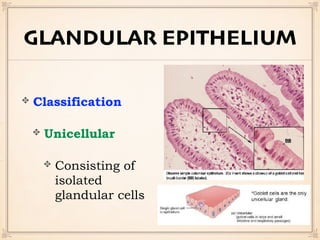
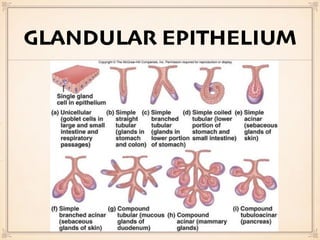
Gland – one or more cells that secretes a particular product
Two major gland types
Endocrine gland
Ductless
Secretions are hormones
Exocrine gland
Empty through ducts to the epithelial surface
Include sweat and oil glands
Classification
Unicellular
Consisting of
isolated
glandular cells
GLANDULAR EPITHELIUM
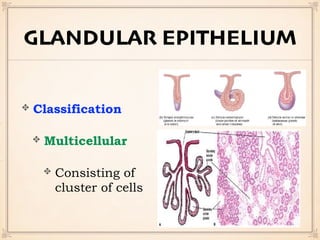
Classification
Multicellular
Consisting of
cluster of cells
GLANDULAR EPITHELIUM
CONNECTIVE TISSUES
CONNECTIVE TISSUE
Found everywhere in the body
Includes the most abundant and widely distributed
tissues
Functions
Binds body tissues together
Supports the body
Provides protection
CONNECTIVE TISSUE CHARACTERISTICS
Variations in blood supply
Some tissue types are well vascularized
Some have poor blood supply or are avascular
(cartilage)
Extracellular matrix
Non-living material that surrounds living cells
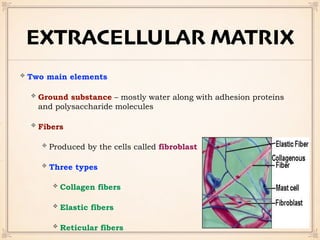
EXTRACELLULAR MATRIX
Two main elements
Ground substance – mostly water along with adhesion proteins
and polysaccharide molecules
Fibers
Produced by the cells called fibroblast
Three types
Collagen fibers
Elastic fibers
Reticular fibers
CONNECTIVE TISSUE TYPES
Bone (Osseous Tissue)
Composed of:
Bone cells in lacunae
(cavities)
Hard matrix of calcium salts
Large numbers of collagen
fibers
Used to protect and support the
body
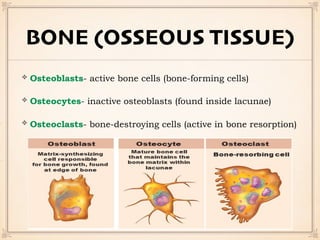
BONE (OSSEOUS TISSUE)
Osteoblasts- active bone cells (bone-forming cells)
Osteocytes- inactive osteoblasts (found inside lacunae)
Osteoclasts- bone-destroying cells (active in bone resorption)
CONNECTIVE TISSUE TYPES
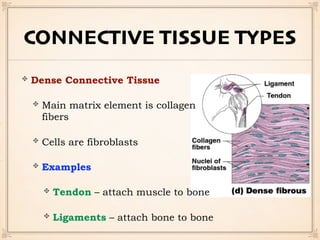
Dense Connective Tissue
Main matrix element is collagen
fibers
Cells are fibroblasts
Examples
Tendon – attach muscle to bone
Ligaments – attach bone to bone
CONNECTIVE TISSUE TYPES
Hyaline Cartilage
Most common cartilage
Composed of
Abundant collagen fibers
Rubbery matrix
Entire fetal skeleton is hyaline cartilage, nose,
trachea, rib ends, joint surfaces
CONNECTIVE TISSUE TYPES
Elastic Cartilage
Provides elasticity
Examples
Supports the external ear
Eustachian or auditory tube
Larynx
Epiglottis
CONNECTIVE TISSUE TYPES
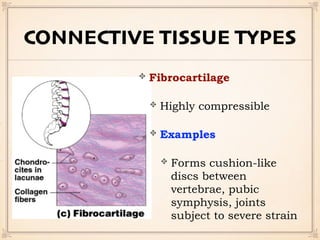
Fibrocartilage
Highly compressible
Examples
Forms cushion-like
discs between
vertebrae, pubic
symphysis, joints
subject to severe strain
CONNECTIVE TISSUE TYPES
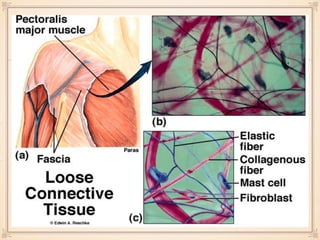
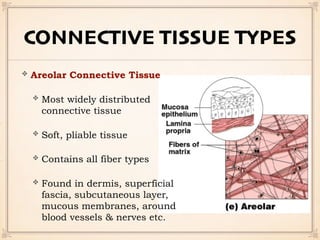
Areolar Connective Tissue
Most widely distributed
connective tissue
Soft, pliable tissue
Contains all fiber types
Found in dermis, superficial
fascia, subcutaneous layer,
mucous membranes, around
blood vessels & nerves etc.
CONNECTIVE TISSUE TYPES
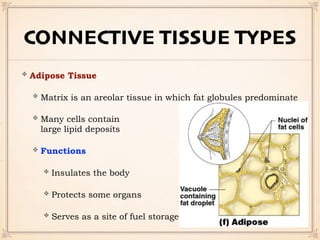
Adipose Tissue
Matrix is an areolar tissue in which fat globules predominate
Many cells contain 

large lipid deposits
Functions
Insulates the body
Protects some organs
Serves as a site of fuel storage
CONNECTIVE TISSUE TYPES
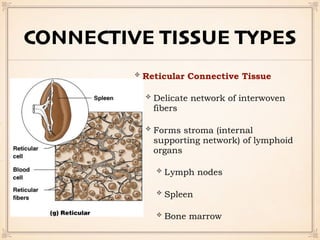
Reticular Connective Tissue
Delicate network of interwoven
fibers
Forms stroma (internal
supporting network) of lymphoid
organs
Lymph nodes
Spleen
Bone marrow
CONNECTIVE TISSUE TYPES
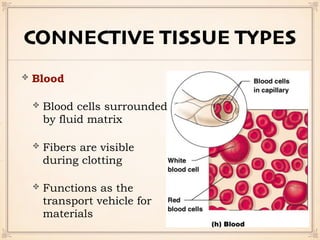
Blood
Blood cells surrounded
by fluid matrix
Fibers are visible
during clotting
Functions as the
transport vehicle for
materials
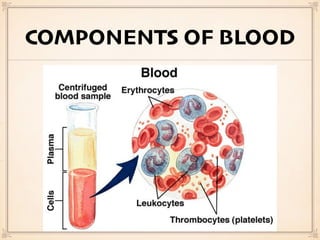
COMPONENTS OF BLOOD
TYPES OF BLOOD CELLS
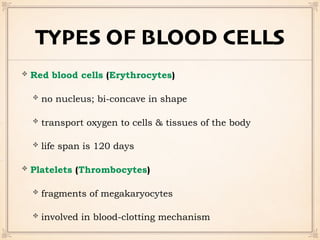
Red blood cells (Erythrocytes)
no nucleus; bi-concave in shape
transport oxygen to cells & tissues of the body
life span is 120 days
Platelets (Thrombocytes)
fragments of megakaryocytes
involved in blood-clotting mechanism
TYPES OF BLOOD CELLS
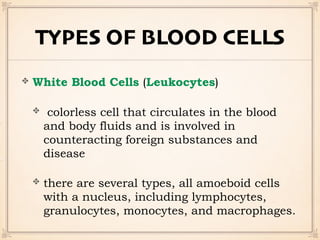
White Blood Cells (Leukocytes)
colorless cell that circulates in the blood
and body fluids and is involved in
counteracting foreign substances and
disease
there are several types, all amoeboid cells
with a nucleus, including lymphocytes,
granulocytes, monocytes, and macrophages.
TYPES OF LEUKOCYTES
Granulocytes (contains granules in cytoplasm)
Neutrophils
Eosinophils
Basophils
Agranulocytes (no granules in cytoplasm)
Monocytes
Lymphocytes (B and T)
GRANULOCYTES
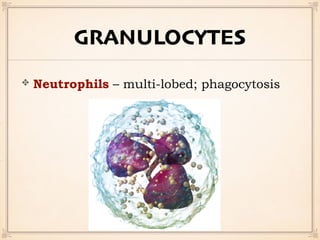
Neutrophils – multi-lobed; phagocytosis
GRANULOCYTES
Eosinophils – bi-lobed; allergic reactions &
parasitic infections
GRANULOCYTES
Basophils – inflammatory reactions
AGRANULOCYTES
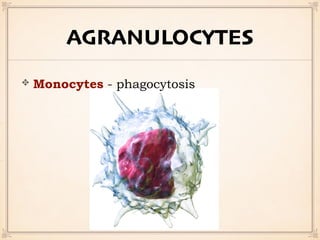
Monocytes - phagocytosis
AGRANULOCYTES
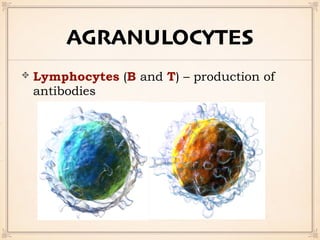
Lymphocytes (B and T) – production of
antibodies
OVERALL FUNCTIONS OF BLOOD
Circulates materials around the body
(gases, nutrients, & hormones)
Maintains homeostasis by controlling body
temperature and pH of body fluids
Protection through phagocytosis &
antibody production
MUSCLE TISSUES
MUSCLE TISSUE
Function is to produce movement
Three types
Skeletal muscle
Cardiac muscle
Smooth muscle
TYPES OF MUSCLE TISSUE
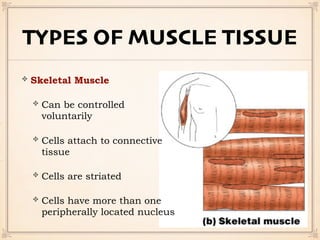
Skeletal Muscle
Can be controlled
voluntarily
Cells attach to connective
tissue
Cells are striated
Cells have more than one
peripherally located nucleus
TYPES OF MUSCLE TISSUE
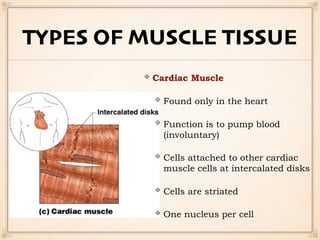
Cardiac Muscle
Found only in the heart
Function is to pump blood
(involuntary)
Cells attached to other cardiac
muscle cells at intercalated disks
Cells are striated
One nucleus per cell
TYPES OF MUSCLE TISSUE
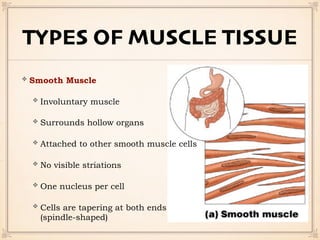
Smooth Muscle
Involuntary muscle
Surrounds hollow organs
Attached to other smooth muscle cells
No visible striations
One nucleus per cell
Cells are tapering at both ends
(spindle-shaped)
NERVOUS TISSUES
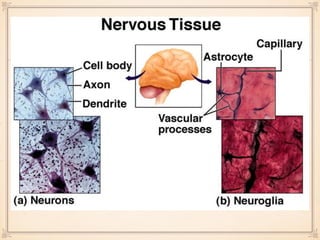
NERVOUS TISSUE
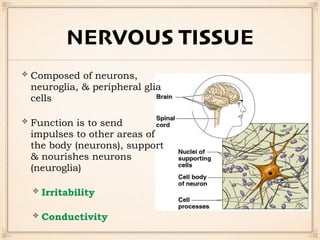
Composed of neurons,
neuroglia, & peripheral glia
cells
Function is to send
impulses to other areas of
the body (neurons), support
& nourishes neurons
(neuroglia)
Irritability
Conductivity
THANK YOU!!!! 💚

Animal tissues