Animal Tissues
Animal Tissues Epithelial Tissues Connective Tissues Muscular Tissues Nervous Tissue Vascular Tissues Supporting Tissues
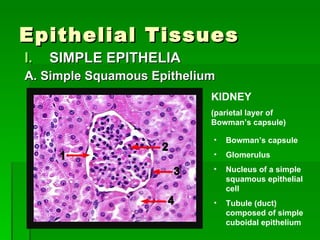
Epithelial Tissues SIMPLE EPITHELIA A. Simple Squamous Epithelium Bowman’s capsule Glomerulus Nucleus of a simple squamous epithelial cell   Tubule (duct) composed of simple cuboidal epithelium   KIDNEY  (parietal layer of Bowman’s capsule)
Description: Friction-reducing slick, single  layer of flattened cells. Common Locations: Lining of the blood  and lymph vessels, heart; air  sacs of lungs; peritoneum Function: Diffusion; filtration; secretion of  lubricants
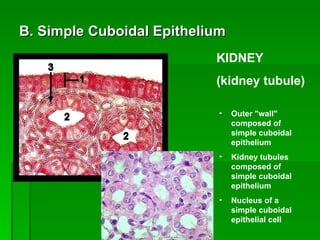
B. Simple Cuboidal Epithelium Outer "wall" composed of simple cuboidal epithelium   Kidney tubules composed of simple cuboidal epithelium   Nucleus of a simple cuboidal epithelial cell   KIDNEY (kidney tubule)
Description: single layer of squarish cells. Common Locations: ducts, secretory part  of small glands; retina; kidney  tubules; ovaries, testes,  bronchioles Function: secretion, absorption
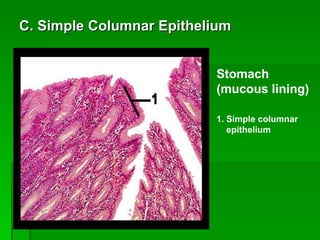
C. Simple Columnar Epithelium Stomach (mucous lining) 1. Simple columnar  epithelium
Description: single layer of tall cells; free  surface have many cilia, mucus- secreting glandular cells,  microvilli Common Locations: glands, ducts; gut;  parts of uterus’ small bronchi Function: secretion; absorption; ciliated  types move substances
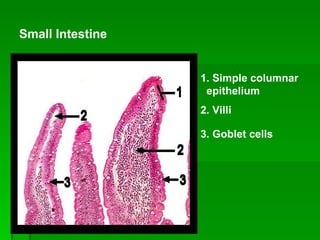
1. Simple columnar  epithelium   2. Villi   3. Goblet cells   Small Intestine
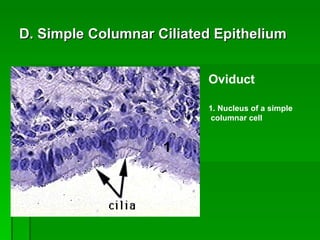
D. Simple Columnar Ciliated Epithelium 1 Oviduct 1. Nucleus of a simple  columnar cell
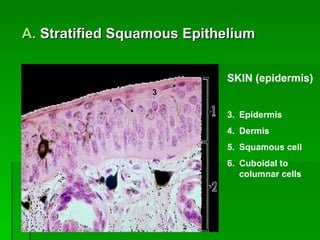
II. STRATIFIED EPITHELIA Stratified epithelial tissues are named by the shape of their outer most cell layers (i.e. squamous, cuboidal or columnar).  In stratified squamous epithelium, the outer most layer is comprised of scale like or flattened cells that serve to protect the underlying tissues in areas subject to abrasion.   Although the surface cells are squamous, note that the deeper or basal layers are composed of cuboidal and columnar cells.  These basal layers are mitotically active and produce the cells of the more superficial layers.
Stratified Squamous Epithelium SKIN (epidermis) Epidermis Dermis Squamous cell Cuboidal to columnar cells 3 4
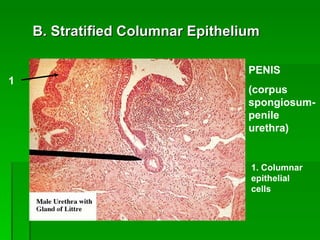
B. Stratified Columnar Epithelium 1 1. Columnar epithelial cells PENIS (corpus spongiosum-penile urethra)
Connective Tissue Proper Loose (Areolar) Connective Tissue Dense Connective Tissue a. Dense Irregular b. Dense Regular
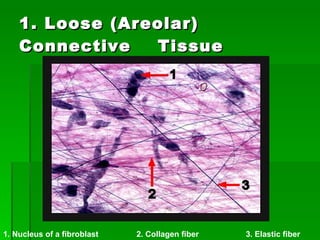
1. Loose (Areolar) Connective  Tissue 1. Nucleus of a fibroblast   2. Collagen fiber   3. Elastic fiber
Description: fibers, fibroblasts, other cells  loosely arranged in extensive  ground substance Common Locations: beneath skin and most  epithelia Function: elasticity, diffusion
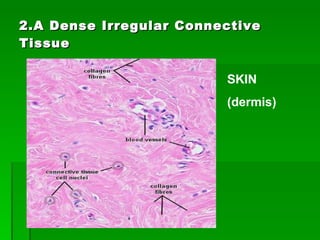
2.A Dense Irregular Connective Tissue SKIN  (dermis)
Description: collagen fibers, fibroblasts  occupy most of the ground  substance Common Locations: in skin and in capsules  around some organs Function: structural support
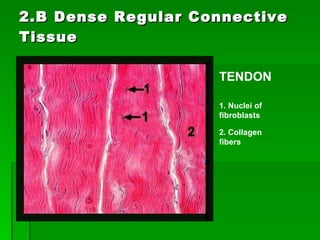
2.B Dense Regular Connective Tissue 1. Nuclei of fibroblasts   2. Collagen fibers   TENDON
Description: collagen fibers bundled in  parallel, long rows of fibroblasts,  little ground substance Common Locations: tendons, ligaments Function: strength, elasticity
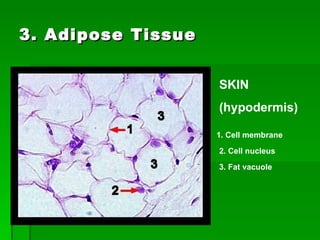
3. Adipose Tissue 1. Cell membrane 2. Cell nucleus 3. Fat vacuole SKIN (hypodermis)
Description: large, tightly packed fat cells  occupying most of the ground  substance Common Locations: under the skin, around  the heart and kidneys Function: energy storage, insulation,  padding
Supporting Tissues Cartilage a. Hyaline b. Elastic c. Fibrocartilage Bone
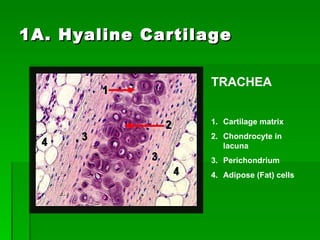
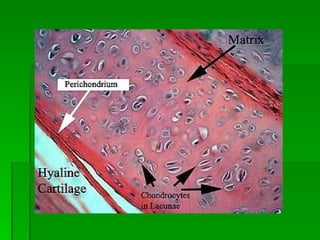
Type: Cartilage Description: chondrocytes inside pliable,  solid ground substance Common Locations: nose, ends of long  bones, airways, skeleton of  cartilaginous fish, vertebrate  embryo Function: support, flexion, low-friction  surface for joint movements.
1A. Hyaline Cartilage Cartilage matrix Chondrocyte in lacuna Perichondrium Adipose (Fat) cells TRACHEA
 
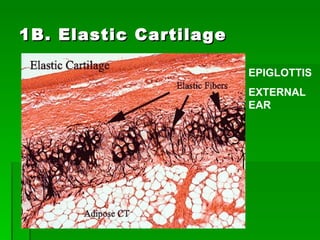
1B. Elastic Cartilage EPIGLOTTIS EXTERNAL EAR
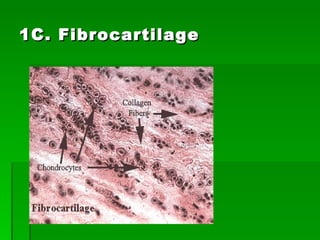
1C. Fibrocartilage
Type: Bone tissue Description: collagen fibers, osteocytes  occupying, extensive calcium- hardened ground substance Common Locations: bones of all vertebrate  skeletons Function: movement, support, protection
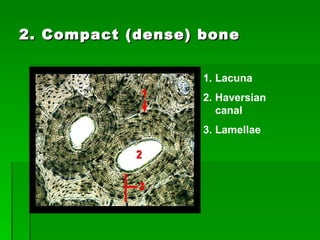
2. Compact (dense) bone Lacuna Haversian canal Lamellae
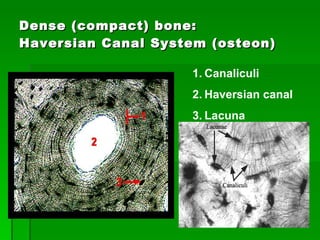
Dense (compact) bone:  Haversian Canal System (osteon) Canaliculi Haversian canal Lacuna
Muscular Tissue Skeletal or Striated Voluntary Muscle Cardiac or Striated Involuntary Muscle Smooth or Visceral Non-striated Muscle
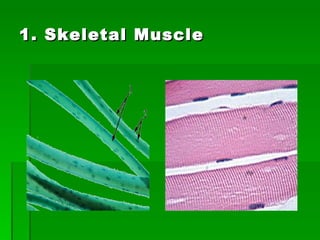
1. Skeletal Muscle
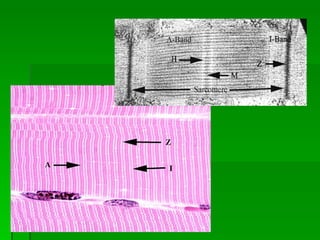
Description: bundles of cylindrical, long,  striated contractile cells; many  mitochondria; often reflex- activated but can be consciously  controlled Common Locations: partner of skeletal  bones, against which it exerts  great force Function: locomotion, posture; head, limb  movements
 
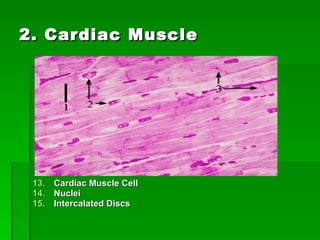
2. Cardiac Muscle Cardiac Muscle Cell  Nuclei  Intercalated Discs
Description: unevenly striated, fused- together cylindrical cells that  contract as a unit owing to  signals at gap junctions between  them Common Locations: heart wall Function: pump blood forcefully through  circulatory system
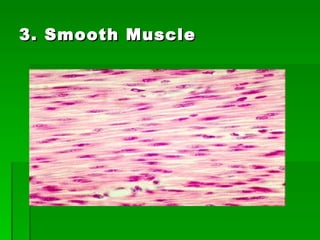
3. Smooth Muscle
Description: contractile cells tapered at  both ends; not striated  Common Locations: walls of arteries,  sphincters, stomach, intestines,  urinary bladder, many other soft  internal organs Function: controlled constriction; motility  (as in gut); arterial blood flow
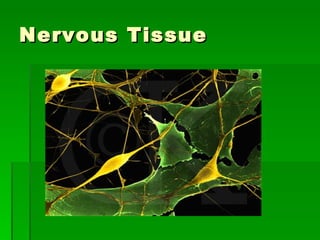
Nervous Tissue
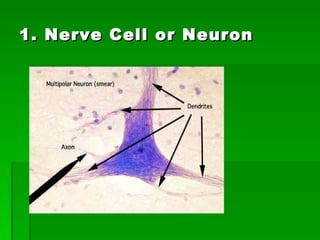
1. Nerve Cell or Neuron
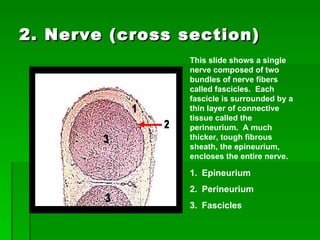
2. Nerve (cross section) This slide shows a single nerve composed of two bundles of nerve fibers called fascicles.  Each fascicle is surrounded by a thin layer of connective tissue called the perineurium.  A much thicker, tough fibrous sheath, the epineurium, encloses the entire nerve.    Epineurium Perineurium Fascicles
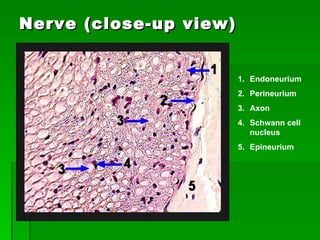
Nerve (close-up view) Endoneurium Perineurium Axon Schwann cell nucleus Epineurium
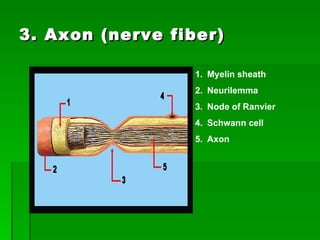
3. Axon (nerve fiber) Myelin sheath Neurilemma Node of Ranvier Schwann cell Axon
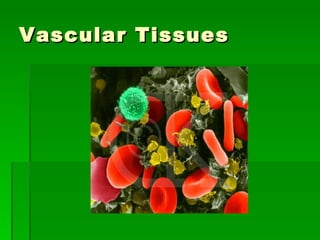
Vascular Tissues
Vascular or Circulating Tissues BLOOD and LYMPH Functions  1. to distribute oxygen, nutritive substances, and hormones to all parts of the body 2. to remove waste substances and toxins consist of plasma (fluid intercellular substance or matrix); cells or corpuscles (red and white)
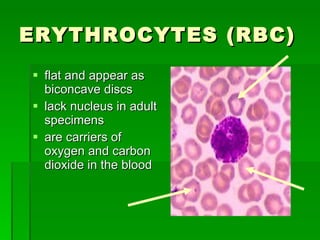
ERYTHROCYTES (RBC) flat and appear as biconcave discs lack nucleus in adult specimens are carriers of oxygen and carbon dioxide in the blood
LEUCOCYTES (WBC) lack color in the fresh true cells with true nuclei 2 groups: non-granular leucocytes or agranulocytes = lack cytoplasmic granules granular leucocytes or granulocytes = with cytoplasmic granules
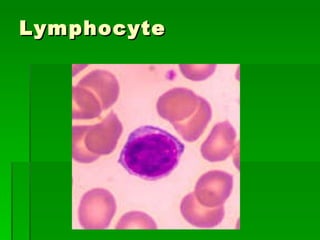
AGRANULOCYTES LYMPHOCYTES spherical cells; either similar in size or slightly larger than erythrocytes large nucleus (w/c stains deep blue) is surrounded by a very scanty cytoplasm are carriers of antibodies; play an important role in the mechanism of immunity comprise 20-25% of leucocytes
Lymphocyte
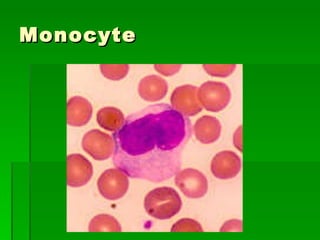
2.  MONOCYTES much bigger than lymphocytes nucleus is indented, kidney-shaped or horseshoe-shaped cytoplasm is more abundant than that of lymphocytes ingest bacteria and debris particles comprise 3-8% of the leucocytes
Monocyte
GRANULOCYTES based on morphology and stainability of cytoplasmic granules, these are classified into: Acidophils or eosinophils Basophils Heterophils or neutrophils
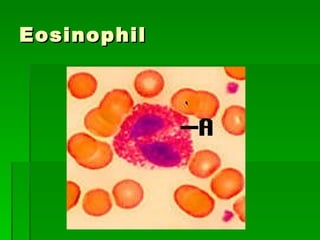
Acidophils or eosinophils spherical in shape cytoplasmic granules stain bright red with acid dyes nucleus usually has two oval lobes connected by a thin chromatin thread are not phagocytic but are associated with certain parasitic and allergic diseases; has detoxifying role (remove and absorb histamine) Comprise 2-4% of leucocytes
Eosinophil
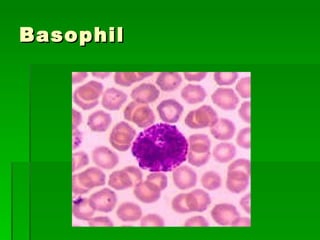
BASOPHILS difficult to find in human blood because they comprise only 0.5 – 1% of leucocytes believed to be mast cells transported by the blood to other parts of the body which elaborate or secrete histamine and heparin
Basophil
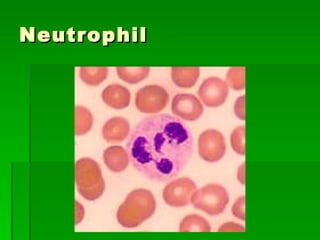
Neutrophils spherical cells with cytoplasm not strongly acidic or basic in its reaction with fine cytoplasmic granules that stain light pink or pale lavender nucleus is elongated, bent or twisted body consisting of 3-5 rounded or angular lobes connected by thin fine chromatin threads are phagocytic (kill and digest bacteria) comprise 60-75% of leucocytes
Neutrophil
References General Zoology Laboratory Manual, Biology Dept., Univ. of San Carlos A/P Lab: A website for Human Anatomy and Physiology http://bioweb.uwlax.edu/APlab/Index.htm Bell, Allen. 1999. Anatomy 503 – Human Histology  http://faculty.une.edu/com/abell/histo/histolab2.htm Ross, M., Romwell, L., and Kaye, G. 1995. Histology: A Text and Atlas. Williams and Wilkins, USA. zoesanchez/zool1L/2008

Animal tissues

  • 1.
  • 2.
    Animal Tissues EpithelialTissues Connective Tissues Muscular Tissues Nervous Tissue Vascular Tissues Supporting Tissues
  • 3.
    Epithelial Tissues SIMPLEEPITHELIA A. Simple Squamous Epithelium Bowman’s capsule Glomerulus Nucleus of a simple squamous epithelial cell Tubule (duct) composed of simple cuboidal epithelium KIDNEY (parietal layer of Bowman’s capsule)
  • 4.
    Description: Friction-reducing slick,single layer of flattened cells. Common Locations: Lining of the blood and lymph vessels, heart; air sacs of lungs; peritoneum Function: Diffusion; filtration; secretion of lubricants
  • 5.
    B. Simple CuboidalEpithelium Outer "wall" composed of simple cuboidal epithelium Kidney tubules composed of simple cuboidal epithelium Nucleus of a simple cuboidal epithelial cell KIDNEY (kidney tubule)
  • 6.
    Description: single layerof squarish cells. Common Locations: ducts, secretory part of small glands; retina; kidney tubules; ovaries, testes, bronchioles Function: secretion, absorption
  • 7.
    C. Simple ColumnarEpithelium Stomach (mucous lining) 1. Simple columnar epithelium
  • 8.
    Description: single layerof tall cells; free surface have many cilia, mucus- secreting glandular cells, microvilli Common Locations: glands, ducts; gut; parts of uterus’ small bronchi Function: secretion; absorption; ciliated types move substances
  • 9.
    1. Simple columnar epithelium 2. Villi 3. Goblet cells Small Intestine
  • 10.
    D. Simple ColumnarCiliated Epithelium 1 Oviduct 1. Nucleus of a simple columnar cell
  • 11.
    II. STRATIFIED EPITHELIAStratified epithelial tissues are named by the shape of their outer most cell layers (i.e. squamous, cuboidal or columnar). In stratified squamous epithelium, the outer most layer is comprised of scale like or flattened cells that serve to protect the underlying tissues in areas subject to abrasion.  Although the surface cells are squamous, note that the deeper or basal layers are composed of cuboidal and columnar cells.  These basal layers are mitotically active and produce the cells of the more superficial layers.
  • 12.
    Stratified Squamous EpitheliumSKIN (epidermis) Epidermis Dermis Squamous cell Cuboidal to columnar cells 3 4
  • 13.
    B. Stratified ColumnarEpithelium 1 1. Columnar epithelial cells PENIS (corpus spongiosum-penile urethra)
  • 14.
    Connective Tissue ProperLoose (Areolar) Connective Tissue Dense Connective Tissue a. Dense Irregular b. Dense Regular
  • 15.
    1. Loose (Areolar)Connective Tissue 1. Nucleus of a fibroblast 2. Collagen fiber 3. Elastic fiber
  • 16.
    Description: fibers, fibroblasts,other cells loosely arranged in extensive ground substance Common Locations: beneath skin and most epithelia Function: elasticity, diffusion
  • 17.
    2.A Dense IrregularConnective Tissue SKIN (dermis)
  • 18.
    Description: collagen fibers,fibroblasts occupy most of the ground substance Common Locations: in skin and in capsules around some organs Function: structural support
  • 19.
    2.B Dense RegularConnective Tissue 1. Nuclei of fibroblasts 2. Collagen fibers TENDON
  • 20.
    Description: collagen fibersbundled in parallel, long rows of fibroblasts, little ground substance Common Locations: tendons, ligaments Function: strength, elasticity
  • 21.
    3. Adipose Tissue1. Cell membrane 2. Cell nucleus 3. Fat vacuole SKIN (hypodermis)
  • 22.
    Description: large, tightlypacked fat cells occupying most of the ground substance Common Locations: under the skin, around the heart and kidneys Function: energy storage, insulation, padding
  • 23.
    Supporting Tissues Cartilagea. Hyaline b. Elastic c. Fibrocartilage Bone
  • 24.
    Type: Cartilage Description:chondrocytes inside pliable, solid ground substance Common Locations: nose, ends of long bones, airways, skeleton of cartilaginous fish, vertebrate embryo Function: support, flexion, low-friction surface for joint movements.
  • 25.
    1A. Hyaline CartilageCartilage matrix Chondrocyte in lacuna Perichondrium Adipose (Fat) cells TRACHEA
  • 26.
  • 27.
    1B. Elastic CartilageEPIGLOTTIS EXTERNAL EAR
  • 28.
  • 29.
    Type: Bone tissueDescription: collagen fibers, osteocytes occupying, extensive calcium- hardened ground substance Common Locations: bones of all vertebrate skeletons Function: movement, support, protection
  • 30.
    2. Compact (dense)bone Lacuna Haversian canal Lamellae
  • 31.
    Dense (compact) bone: Haversian Canal System (osteon) Canaliculi Haversian canal Lacuna
  • 32.
    Muscular Tissue Skeletalor Striated Voluntary Muscle Cardiac or Striated Involuntary Muscle Smooth or Visceral Non-striated Muscle
  • 33.
  • 34.
    Description: bundles ofcylindrical, long, striated contractile cells; many mitochondria; often reflex- activated but can be consciously controlled Common Locations: partner of skeletal bones, against which it exerts great force Function: locomotion, posture; head, limb movements
  • 35.
  • 36.
    2. Cardiac MuscleCardiac Muscle Cell Nuclei Intercalated Discs
  • 37.
    Description: unevenly striated,fused- together cylindrical cells that contract as a unit owing to signals at gap junctions between them Common Locations: heart wall Function: pump blood forcefully through circulatory system
  • 38.
  • 39.
    Description: contractile cellstapered at both ends; not striated Common Locations: walls of arteries, sphincters, stomach, intestines, urinary bladder, many other soft internal organs Function: controlled constriction; motility (as in gut); arterial blood flow
  • 40.
  • 41.
    1. Nerve Cellor Neuron
  • 42.
    2. Nerve (crosssection) This slide shows a single nerve composed of two bundles of nerve fibers called fascicles.  Each fascicle is surrounded by a thin layer of connective tissue called the perineurium.  A much thicker, tough fibrous sheath, the epineurium, encloses the entire nerve.  Epineurium Perineurium Fascicles
  • 43.
    Nerve (close-up view)Endoneurium Perineurium Axon Schwann cell nucleus Epineurium
  • 44.
    3. Axon (nervefiber) Myelin sheath Neurilemma Node of Ranvier Schwann cell Axon
  • 45.
  • 46.
    Vascular or CirculatingTissues BLOOD and LYMPH Functions 1. to distribute oxygen, nutritive substances, and hormones to all parts of the body 2. to remove waste substances and toxins consist of plasma (fluid intercellular substance or matrix); cells or corpuscles (red and white)
  • 47.
    ERYTHROCYTES (RBC) flatand appear as biconcave discs lack nucleus in adult specimens are carriers of oxygen and carbon dioxide in the blood
  • 48.
    LEUCOCYTES (WBC) lackcolor in the fresh true cells with true nuclei 2 groups: non-granular leucocytes or agranulocytes = lack cytoplasmic granules granular leucocytes or granulocytes = with cytoplasmic granules
  • 49.
    AGRANULOCYTES LYMPHOCYTES sphericalcells; either similar in size or slightly larger than erythrocytes large nucleus (w/c stains deep blue) is surrounded by a very scanty cytoplasm are carriers of antibodies; play an important role in the mechanism of immunity comprise 20-25% of leucocytes
  • 50.
  • 51.
    2. MONOCYTESmuch bigger than lymphocytes nucleus is indented, kidney-shaped or horseshoe-shaped cytoplasm is more abundant than that of lymphocytes ingest bacteria and debris particles comprise 3-8% of the leucocytes
  • 52.
  • 53.
    GRANULOCYTES based onmorphology and stainability of cytoplasmic granules, these are classified into: Acidophils or eosinophils Basophils Heterophils or neutrophils
  • 54.
    Acidophils or eosinophilsspherical in shape cytoplasmic granules stain bright red with acid dyes nucleus usually has two oval lobes connected by a thin chromatin thread are not phagocytic but are associated with certain parasitic and allergic diseases; has detoxifying role (remove and absorb histamine) Comprise 2-4% of leucocytes
  • 55.
  • 56.
    BASOPHILS difficult tofind in human blood because they comprise only 0.5 – 1% of leucocytes believed to be mast cells transported by the blood to other parts of the body which elaborate or secrete histamine and heparin
  • 57.
  • 58.
    Neutrophils spherical cellswith cytoplasm not strongly acidic or basic in its reaction with fine cytoplasmic granules that stain light pink or pale lavender nucleus is elongated, bent or twisted body consisting of 3-5 rounded or angular lobes connected by thin fine chromatin threads are phagocytic (kill and digest bacteria) comprise 60-75% of leucocytes
  • 59.
  • 60.
    References General ZoologyLaboratory Manual, Biology Dept., Univ. of San Carlos A/P Lab: A website for Human Anatomy and Physiology http://bioweb.uwlax.edu/APlab/Index.htm Bell, Allen. 1999. Anatomy 503 – Human Histology http://faculty.une.edu/com/abell/histo/histolab2.htm Ross, M., Romwell, L., and Kaye, G. 1995. Histology: A Text and Atlas. Williams and Wilkins, USA. zoesanchez/zool1L/2008

Editor's Notes