GENERAL PHYSICS 2
THIRD QUARTER:
COMPILATION OF LESSONS
ELECTRIC
CHARGE AND
METHODS OF
CHARGING
Nature of Electric
Charge
Elementary Charge
Methods of Charging
Electric
Charge
• Electric charge is a fundamental
property of matter that causes it
to experience a force when
placed in an electric field or near
other charged objects.
• Symbol: q
• SI Unit: coulomb (C)
• Measured using instruments
such as electrometers
Nature of
Electric
Charge
There are two types of electric
charge:
• Positive charge (+) –
associated with protons
• Negative charge (–) –
associated with electrons
Neutrons have no charge.
Interaction of
Charges
Like charges repel each other.
(+) repels (+)
(–) repels (–)
Unlike charges attract each other.
This behavior is fundamental to all
electrical phenomena.
(+) attracts (–)
Law of
Conservation
of Charge
Electric charge cannot be created or
destroyed.
It can only be transferred from one
object to another.
The total charge of an isolated system
remains constant.
Charging an object means redistributing
existing charges, not creating new ones
Quantization
of Charge
Electric charge exists in discrete
amounts.
All charges are integer multiples of
the elementary charge
q = ne
where:
q = total charge
n = integer
e = elementary charge
Elementary Charge
The elementary
charge is the
smallest unit of
free charge.
e = 1.602 × 10⁻¹⁹
C
Charges of
Subatomic
Particles
Electron: −1.602 × 10⁻¹⁹ C
Proton: +1.602 × 10⁻¹⁹ C
Neutron: 0
• Objects become charged due to
gain or loss of electrons
• Protons do not move during
ordinary charging processes
because they are tightly bound in
the nucleus
Neutral and
Charged
Objects
Neutral Object
• Equal number of protons and
electrons
• Net charge = 0
Negatively Charged Object
• Gains extra electrons
• Net charge is negative
Positively Charged Object
• Loses electrons
• Net charge is positive
Methods of
Charging
Objects can be charged by:
• Friction
• Conduction
• Induction
Charging by
Friction
(Rubbing)
Charging by friction occurs when two
different neutral materials are rubbed
together, causing electrons to transfer
from one material to the other.
• One object loses electrons →
becomes positively charged
• The other object gains electrons →
becomes negatively charged
Examples of
Charging by
Friction
• Rubbing a balloon on hair
• Rubbing a plastic comb on dry hair
Common in static electricity.
Key Points
•Occurs mostly with
insulators
•Both objects become
charged
•Common in everyday
static electricity
Charging by
Conduction
(Contact)
• Charging by conduction occurs
when a charged object directly
touches a neutral object, allowing
electrons to transfer.
• Electrons flow between objects
• The neutral object becomes
charged with the same type of
charge as the charged object
Charging by
Conduction
(Contact)
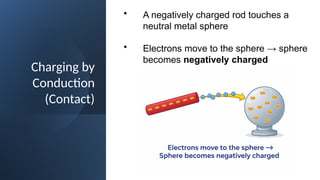
• A negatively charged rod touches a
neutral metal sphere
• Electrons move to the sphere → sphere
becomes negatively charged
Key Points
•Requires direct
contact
•Common in
conductors
•Final charge is shared
between objects
Charging by
Induction
Charging by induction
occurs when an object
becomes charged without
direct contact with a
charged object.
Steps in
Charging by
Induction
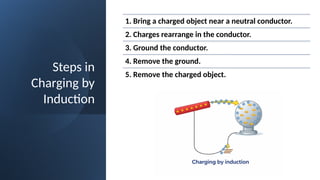
1. Bring a charged object near a neutral conductor.
2. Charges rearrange in the conductor.
3. Ground the conductor.
4. Remove the ground.
5. Remove the charged object.
Key Points
• No contact required
• Object acquires a charge
opposite to the inducing
charge
• Involves charge separation
and grounding
Comparison
of Charging
Methods
Friction: contact,
opposite charges
Conduction: contact,
same charges
Induction: no contact,
opposite charges
Summary
Electric charge is a fundamental property of
matter.
Charges are positive or negative.
Electric charge is conserved and quantized.
Elementary charge is 1.602 × 10⁻¹⁹ C.
Objects are charged by friction, conduction, or
induction.
CONDUCTORS
AND
INSULATORS
• Electricity involves the movement of
electric charges, mainly electrons.
Whether electric charges can move
easily or not depends on the type of
material.
Materials are therefore classified as
conductors, insulators, and
sometimes semiconductors based on
their ability to allow charge flow.
CONDUCTORS
• A conductor is a material that allows
electric charges (electrons) to move freely
through it.
• In conductors, outer (valence) electrons are
loosely bound to their atoms.
• These electrons become free electrons,
able to move when an electric field is
applied.
• Because of this, electric current can flow
easily.
EXAMPLES OF
CONDUCTORS
Metals (most common conductors):
• Copper
• Aluminum
• Silver
• Gold
• Iron
Other conductors:
• Saltwater
• Human body (contains water and ions)
• Graphite (carbon)
Conductors in
Daily Life
•Wires and cables → transmit
electricity
•Appliance components
•Lightning rods
•Grounding systems for safety
Electrical
Properties of
Conductors
• Low electrical resistance
• High electrical
conductivity
Conductivity depends on:
• Material type
• Temperature (higher
temperature → higher
resistance in metals)
INSULATORS
• An insulator is a material that
does NOT allow electric
charges to move freely.
• Electrons are tightly bound to
their atoms.
• There are no free electrons
available for current flow.
• Even when an electric field is
applied, electrons remain in
place.
EXAMPLES OF
INSULATORS
• Rubber
• Plastic
• Glass
• Wood (dry)
• Air
• Paper
• Ceramic
INSULATORS
IN DAILY LIFE
•Wire coverings (plastic or
rubber)
•Handles of electrical tools
•Electrical poles and
spacers
•Protective gloves and mats
Behavior of
Insulators
When
Charged
• Charges do not move freely
• Excess charge remains
localized at the point where
it is placed
• Used in:
–Electrostatic experiments
–Charge storage on surfaces
Electrical
Properties of
Insulators
• Very high resistance
• Very low conductivity
• Prevents unwanted
current flow
COULOMB’S LAW AND
ELECTRIC FORCE
1. Electric
Force
Electric force is the attractive or repulsive force
between two electrically charged objects.
Like charges repel each other
Unlike charges attract each other
The force acts along the line joining the two
charges
It is a non-contact force (acts even at a
distance)
Nature of
Electric
Force
• Can be attractive or
repulsive
• Acts in vacuum and in
materials
• One of the fundamental
forces of nature
• Much stronger than
gravitational force at the
atomic level
2. Coulomb’s Law
Statement of Coulomb’s Law
The magnitude of the electric force between two-
point charges is:
• Directly proportional to the product of the
charges
• Inversely proportional to the square of the
distance between them
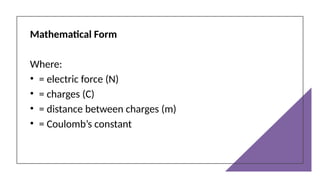
Mathematical Form
Where:
• = electric force (N)
• = charges (C)
• = distance between charges (m)
• = Coulomb’s constant
Important Notes
• Charges must be treated as point charges
• Distance is measured center to center
• The formula gives magnitude only, not direction
• Valid for stationary charges
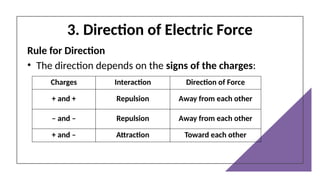
3. Direction of Electric Force
Rule for Direction
• The direction depends on the signs of the charges:
Charges Interaction Direction of Force
+ and + Repulsion Away from each other
– and – Repulsion Away from each other
+ and – Attraction Toward each other
Direction on a Charge
• The force on a charge is always along the line connecting the charges
• Each charge experiences a force of equal magnitude but opposite direction
(Newton’s Third Law)
Example
• If a positive charge is placed near a negative charge:
• The force on the positive charge is toward the negative charge
• The force on the negative charge is toward the positive charge
4. Vector Nature of Electric Force
• Electric force is a vector quantity
It has:
• Magnitude (from Coulomb’s Law)
• Direction (attractive or repulsive)
5. Net Electric Force
(Superposition Principle)
Principle of Superposition
• When more than two charges are present:
• The net electric force on a charge is the vector
sum of all individual electric forces acting on it.
ELECTRIC FIELD
1. Definition of Electric Field
An electric field is the
region of space around a
charged object where
another charged object
experiences an electric
force.
If you place a small charge
in this region and it feels a
force, an electric field
exists there.
Operational (Mathematical) Definition
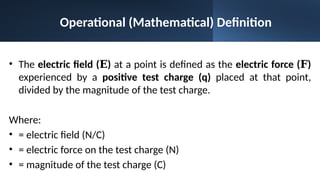
• The electric field ( )
𝐄 at a point is defined as the electric force ( )
𝐅
experienced by a positive test charge (q) placed at that point,
divided by the magnitude of the test charge.
Where:
• = electric field (N/C)
• = electric force on the test charge (N)
• = magnitude of the test charge (C)
Operational (Mathematical) Definition
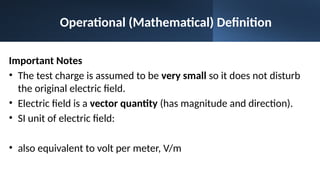
Important Notes
• The test charge is assumed to be very small so it does not disturb
the original electric field.
• Electric field is a vector quantity (has magnitude and direction).
• SI unit of electric field:
• also equivalent to volt per meter, V/m
2. Direction of Electric Field
Definition of Direction
• The direction of the electric field at a point is defined as the direction of the force
experienced by a positive test charge placed at that point.
Direction Rules
• Electric field points AWAY from positive charges
• Electric field points TOWARD negative charges
• Near a positive charge → arrows point outward
• Near a negative charge → arrows point inward
Key Reminder
• Even if the actual charge placed is negative, the electric field direction is always
defined using a positive test charge.
3. Electric Field Due to a Point Charge
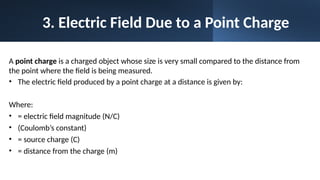
A point charge is a charged object whose size is very small compared to the distance from
the point where the field is being measured.
• The electric field produced by a point charge at a distance is given by:
Where:
• = electric field magnitude (N/C)
• (Coulomb’s constant)
• = source charge (C)
• = distance from the charge (m)
Direction of Electric Field Due to a Point Charge
• If Q is positive → field points radially outward
• If Q is negative → field points radially inward
Key Characteristics
• Electric field strength decreases as distance increases
• Field lines are symmetrical around the point charge
• Field lines never intersect
4. Electric Field Lines
Electric field lines are imaginary lines used to represent electric
fields.
Properties of Electric Field Lines
• Field lines start from positive charges and end on negative charges
• The direction of the field is tangent to the line at any point
• The density of lines represents field strength
– Closer lines → stronger field
– Farther apart → weaker field
• Field lines never cross
5. Electric Field Between Opposite Charges (Electric Dipole)
An arrangement of equal and opposite charges placed close
together is called an electric dipole.
Electric Field Pattern
• Field lines originate from the positive charge
• Field lines terminate at the negative charge
• Lines curve, showing the combined influence of both charges
Characteristics of the Electric Field
• The field is strongest between the charges
• Field direction is from positive to negative
• The field is non-uniform (strength varies with
position)
ELECTRIC FLUX AND
GAUSS’S LAW
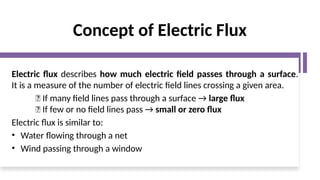
Concept of Electric Flux
Electric flux describes how much electric field passes through a surface.
It is a measure of the number of electric field lines crossing a given area.
🔹 If many field lines pass through a surface → large flux
🔹 If few or no field lines pass → small or zero flux
Electric flux is similar to:
• Water flowing through a net
• Wind passing through a window
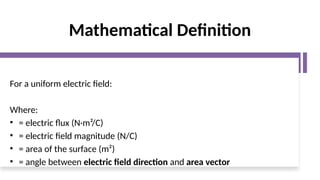
Mathematical Definition
For a uniform electric field:
Where:
• = electric flux (N·m²/C)
• = electric field magnitude (N/C)
• = area of the surface (m²)
• = angle between electric field direction and area vector
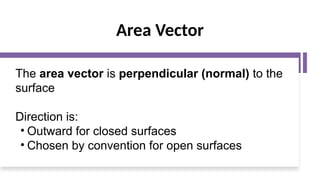
Area Vector
The area vector is perpendicular (normal) to the
surface
Direction is:
• Outward for closed surfaces
• Chosen by convention for open surfaces
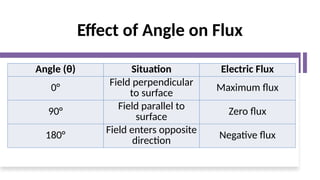
Effect of Angle on Flux
Angle (θ) Situation Electric Flux
0° Field perpendicular
to surface
Maximum flux
90° Field parallel to
surface
Zero flux
180° Field enters opposite
direction
Negative flux
Special Cases
1.Surface perpendicular to field
2.Surface parallel to field
3.Non-uniform electric field
Flux is found by integration:
What is an Enclosed (Closed) Surface?
•The net electric flux through any closed (enclosed) surface is equal to
the total charge enclosed divided by the permittivity of free space.
Where:
means integration over a closed surface
= electric field
= outward area vector
= net charge inside the surface
Electric Field Between Parallel Plates
Two large, parallel conducting plates:
• One positively charged
• One negatively charged
• Plates are very close compared to their size
Using Gauss’s Law:
Where:
= surface charge density (C/m²)
🔹 Field is:
• Uniform
• Directed from positive to negative plate
• Independent of distance between plates (ideal case)
Electric Potential Difference
V = Ed
Where:
= potential difference (V)
= separation between plates
ELECTRIC POTENTIAL
AND ELECTRIC
POTENTIAL ENERGY
Electric Potential Energy (U)
Electric potential energy
is the energy possessed
by a charged particle
due to its position in an
electric field.
It arises from electric
forces, similar to how
gravitational potential
energy arises from
gravity.
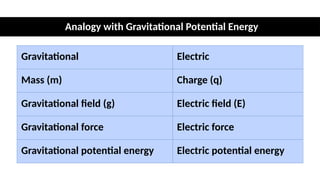
Analogy with Gravitational Potential Energy
Gravitational Electric
Mass (m) Charge (q)
Gravitational field (g) Electric field (E)
Gravitational force Electric force
Gravitational potential energy Electric potential energy
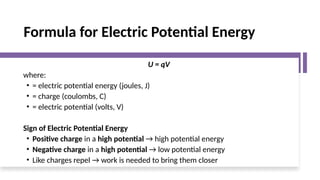
Formula for Electric Potential Energy
U = qV
where:
• = electric potential energy (joules, J)
• = charge (coulombs, C)
• = electric potential (volts, V)
Sign of Electric Potential Energy
• Positive charge in a high potential → high potential energy
• Negative charge in a high potential → low potential energy
• Like charges repel → work is needed to bring them closer
Electric Potential (V)
Electric potential at a point is the electric potential
energy per unit charge.
B. SI Unit
• Volt (V)
Electric Potential (V)
• It describes how much energy a unit
positive charge has at a point in an electric
field.
• It is a scalar quantity (has magnitude only).
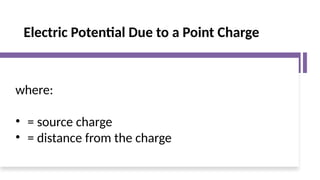
Electric Potential Due to a Point Charge
where:
• = source charge
• = distance from the charge
Relationship Between Electric Field and Electric
Potential
A. Conceptual Relationship
• Electric field points in the direction of decreasing
electric potential.
• Charges naturally move from higher potential to
lower potential.

Electric_Charge_and_Methods_of_Charging.pptx

  • 1.
    GENERAL PHYSICS 2 THIRDQUARTER: COMPILATION OF LESSONS
  • 2.
    ELECTRIC CHARGE AND METHODS OF CHARGING Natureof Electric Charge Elementary Charge Methods of Charging
  • 3.
    Electric Charge • Electric chargeis a fundamental property of matter that causes it to experience a force when placed in an electric field or near other charged objects. • Symbol: q • SI Unit: coulomb (C) • Measured using instruments such as electrometers
  • 4.
    Nature of Electric Charge There aretwo types of electric charge: • Positive charge (+) – associated with protons • Negative charge (–) – associated with electrons Neutrons have no charge.
  • 5.
    Interaction of Charges Like chargesrepel each other. (+) repels (+) (–) repels (–) Unlike charges attract each other. This behavior is fundamental to all electrical phenomena. (+) attracts (–)
  • 6.
    Law of Conservation of Charge Electriccharge cannot be created or destroyed. It can only be transferred from one object to another. The total charge of an isolated system remains constant. Charging an object means redistributing existing charges, not creating new ones
  • 7.
    Quantization of Charge Electric chargeexists in discrete amounts. All charges are integer multiples of the elementary charge q = ne where: q = total charge n = integer e = elementary charge
  • 8.
    Elementary Charge The elementary chargeis the smallest unit of free charge. e = 1.602 × 10⁻¹⁹ C
  • 9.
    Charges of Subatomic Particles Electron: −1.602× 10⁻¹⁹ C Proton: +1.602 × 10⁻¹⁹ C Neutron: 0 • Objects become charged due to gain or loss of electrons • Protons do not move during ordinary charging processes because they are tightly bound in the nucleus
  • 10.
    Neutral and Charged Objects Neutral Object •Equal number of protons and electrons • Net charge = 0 Negatively Charged Object • Gains extra electrons • Net charge is negative Positively Charged Object • Loses electrons • Net charge is positive
  • 11.
    Methods of Charging Objects canbe charged by: • Friction • Conduction • Induction
  • 12.
    Charging by Friction (Rubbing) Charging byfriction occurs when two different neutral materials are rubbed together, causing electrons to transfer from one material to the other. • One object loses electrons → becomes positively charged • The other object gains electrons → becomes negatively charged
  • 13.
    Examples of Charging by Friction •Rubbing a balloon on hair • Rubbing a plastic comb on dry hair Common in static electricity.
  • 14.
    Key Points •Occurs mostlywith insulators •Both objects become charged •Common in everyday static electricity
  • 15.
    Charging by Conduction (Contact) • Chargingby conduction occurs when a charged object directly touches a neutral object, allowing electrons to transfer. • Electrons flow between objects • The neutral object becomes charged with the same type of charge as the charged object
  • 16.
    Charging by Conduction (Contact) • Anegatively charged rod touches a neutral metal sphere • Electrons move to the sphere → sphere becomes negatively charged
  • 17.
    Key Points •Requires direct contact •Commonin conductors •Final charge is shared between objects
  • 18.
    Charging by Induction Charging byinduction occurs when an object becomes charged without direct contact with a charged object.
  • 19.
    Steps in Charging by Induction 1.Bring a charged object near a neutral conductor. 2. Charges rearrange in the conductor. 3. Ground the conductor. 4. Remove the ground. 5. Remove the charged object.
  • 20.
    Key Points • Nocontact required • Object acquires a charge opposite to the inducing charge • Involves charge separation and grounding
  • 21.
    Comparison of Charging Methods Friction: contact, oppositecharges Conduction: contact, same charges Induction: no contact, opposite charges
  • 22.
    Summary Electric charge isa fundamental property of matter. Charges are positive or negative. Electric charge is conserved and quantized. Elementary charge is 1.602 × 10⁻¹⁹ C. Objects are charged by friction, conduction, or induction.
  • 23.
    CONDUCTORS AND INSULATORS • Electricity involvesthe movement of electric charges, mainly electrons. Whether electric charges can move easily or not depends on the type of material. Materials are therefore classified as conductors, insulators, and sometimes semiconductors based on their ability to allow charge flow.
  • 24.
    CONDUCTORS • A conductoris a material that allows electric charges (electrons) to move freely through it. • In conductors, outer (valence) electrons are loosely bound to their atoms. • These electrons become free electrons, able to move when an electric field is applied. • Because of this, electric current can flow easily.
  • 25.
    EXAMPLES OF CONDUCTORS Metals (mostcommon conductors): • Copper • Aluminum • Silver • Gold • Iron Other conductors: • Saltwater • Human body (contains water and ions) • Graphite (carbon)
  • 26.
    Conductors in Daily Life •Wiresand cables → transmit electricity •Appliance components •Lightning rods •Grounding systems for safety
  • 27.
    Electrical Properties of Conductors • Lowelectrical resistance • High electrical conductivity Conductivity depends on: • Material type • Temperature (higher temperature → higher resistance in metals)
  • 28.
    INSULATORS • An insulatoris a material that does NOT allow electric charges to move freely. • Electrons are tightly bound to their atoms. • There are no free electrons available for current flow. • Even when an electric field is applied, electrons remain in place.
  • 29.
    EXAMPLES OF INSULATORS • Rubber •Plastic • Glass • Wood (dry) • Air • Paper • Ceramic
  • 30.
    INSULATORS IN DAILY LIFE •Wirecoverings (plastic or rubber) •Handles of electrical tools •Electrical poles and spacers •Protective gloves and mats
  • 31.
    Behavior of Insulators When Charged • Chargesdo not move freely • Excess charge remains localized at the point where it is placed • Used in: –Electrostatic experiments –Charge storage on surfaces
  • 32.
    Electrical Properties of Insulators • Veryhigh resistance • Very low conductivity • Prevents unwanted current flow
  • 33.
  • 34.
    1. Electric Force Electric forceis the attractive or repulsive force between two electrically charged objects. Like charges repel each other Unlike charges attract each other The force acts along the line joining the two charges It is a non-contact force (acts even at a distance)
  • 35.
    Nature of Electric Force • Canbe attractive or repulsive • Acts in vacuum and in materials • One of the fundamental forces of nature • Much stronger than gravitational force at the atomic level
  • 36.
    2. Coulomb’s Law Statementof Coulomb’s Law The magnitude of the electric force between two- point charges is: • Directly proportional to the product of the charges • Inversely proportional to the square of the distance between them
  • 37.
    Mathematical Form Where: • =electric force (N) • = charges (C) • = distance between charges (m) • = Coulomb’s constant
  • 38.
    Important Notes • Chargesmust be treated as point charges • Distance is measured center to center • The formula gives magnitude only, not direction • Valid for stationary charges
  • 39.
    3. Direction ofElectric Force Rule for Direction • The direction depends on the signs of the charges: Charges Interaction Direction of Force + and + Repulsion Away from each other – and – Repulsion Away from each other + and – Attraction Toward each other
  • 40.
    Direction on aCharge • The force on a charge is always along the line connecting the charges • Each charge experiences a force of equal magnitude but opposite direction (Newton’s Third Law) Example • If a positive charge is placed near a negative charge: • The force on the positive charge is toward the negative charge • The force on the negative charge is toward the positive charge
  • 41.
    4. Vector Natureof Electric Force • Electric force is a vector quantity It has: • Magnitude (from Coulomb’s Law) • Direction (attractive or repulsive)
  • 42.
    5. Net ElectricForce (Superposition Principle) Principle of Superposition • When more than two charges are present: • The net electric force on a charge is the vector sum of all individual electric forces acting on it.
  • 43.
  • 44.
    1. Definition ofElectric Field An electric field is the region of space around a charged object where another charged object experiences an electric force. If you place a small charge in this region and it feels a force, an electric field exists there.
  • 45.
    Operational (Mathematical) Definition •The electric field ( ) 𝐄 at a point is defined as the electric force ( ) 𝐅 experienced by a positive test charge (q) placed at that point, divided by the magnitude of the test charge. Where: • = electric field (N/C) • = electric force on the test charge (N) • = magnitude of the test charge (C)
  • 46.
    Operational (Mathematical) Definition ImportantNotes • The test charge is assumed to be very small so it does not disturb the original electric field. • Electric field is a vector quantity (has magnitude and direction). • SI unit of electric field: • also equivalent to volt per meter, V/m
  • 47.
    2. Direction ofElectric Field Definition of Direction • The direction of the electric field at a point is defined as the direction of the force experienced by a positive test charge placed at that point. Direction Rules • Electric field points AWAY from positive charges • Electric field points TOWARD negative charges • Near a positive charge → arrows point outward • Near a negative charge → arrows point inward Key Reminder • Even if the actual charge placed is negative, the electric field direction is always defined using a positive test charge.
  • 48.
    3. Electric FieldDue to a Point Charge A point charge is a charged object whose size is very small compared to the distance from the point where the field is being measured. • The electric field produced by a point charge at a distance is given by: Where: • = electric field magnitude (N/C) • (Coulomb’s constant) • = source charge (C) • = distance from the charge (m)
  • 49.
    Direction of ElectricField Due to a Point Charge • If Q is positive → field points radially outward • If Q is negative → field points radially inward Key Characteristics • Electric field strength decreases as distance increases • Field lines are symmetrical around the point charge • Field lines never intersect
  • 50.
    4. Electric FieldLines Electric field lines are imaginary lines used to represent electric fields. Properties of Electric Field Lines • Field lines start from positive charges and end on negative charges • The direction of the field is tangent to the line at any point • The density of lines represents field strength – Closer lines → stronger field – Farther apart → weaker field • Field lines never cross
  • 51.
    5. Electric FieldBetween Opposite Charges (Electric Dipole) An arrangement of equal and opposite charges placed close together is called an electric dipole. Electric Field Pattern • Field lines originate from the positive charge • Field lines terminate at the negative charge • Lines curve, showing the combined influence of both charges
  • 52.
    Characteristics of theElectric Field • The field is strongest between the charges • Field direction is from positive to negative • The field is non-uniform (strength varies with position)
  • 53.
  • 54.
    Concept of ElectricFlux Electric flux describes how much electric field passes through a surface. It is a measure of the number of electric field lines crossing a given area. 🔹 If many field lines pass through a surface → large flux 🔹 If few or no field lines pass → small or zero flux Electric flux is similar to: • Water flowing through a net • Wind passing through a window
  • 55.
    Mathematical Definition For auniform electric field: Where: • = electric flux (N·m²/C) • = electric field magnitude (N/C) • = area of the surface (m²) • = angle between electric field direction and area vector
  • 56.
    Area Vector The areavector is perpendicular (normal) to the surface Direction is: • Outward for closed surfaces • Chosen by convention for open surfaces
  • 57.
    Effect of Angleon Flux Angle (θ) Situation Electric Flux 0° Field perpendicular to surface Maximum flux 90° Field parallel to surface Zero flux 180° Field enters opposite direction Negative flux
  • 58.
    Special Cases 1.Surface perpendicularto field 2.Surface parallel to field 3.Non-uniform electric field Flux is found by integration:
  • 59.
    What is anEnclosed (Closed) Surface? •The net electric flux through any closed (enclosed) surface is equal to the total charge enclosed divided by the permittivity of free space. Where: means integration over a closed surface = electric field = outward area vector = net charge inside the surface
  • 60.
    Electric Field BetweenParallel Plates Two large, parallel conducting plates: • One positively charged • One negatively charged • Plates are very close compared to their size Using Gauss’s Law: Where: = surface charge density (C/m²) 🔹 Field is: • Uniform • Directed from positive to negative plate • Independent of distance between plates (ideal case)
  • 61.
    Electric Potential Difference V= Ed Where: = potential difference (V) = separation between plates
  • 62.
  • 63.
    Electric Potential Energy(U) Electric potential energy is the energy possessed by a charged particle due to its position in an electric field. It arises from electric forces, similar to how gravitational potential energy arises from gravity.
  • 64.
    Analogy with GravitationalPotential Energy Gravitational Electric Mass (m) Charge (q) Gravitational field (g) Electric field (E) Gravitational force Electric force Gravitational potential energy Electric potential energy
  • 65.
    Formula for ElectricPotential Energy U = qV where: • = electric potential energy (joules, J) • = charge (coulombs, C) • = electric potential (volts, V) Sign of Electric Potential Energy • Positive charge in a high potential → high potential energy • Negative charge in a high potential → low potential energy • Like charges repel → work is needed to bring them closer
  • 66.
    Electric Potential (V) Electricpotential at a point is the electric potential energy per unit charge. B. SI Unit • Volt (V)
  • 67.
    Electric Potential (V) •It describes how much energy a unit positive charge has at a point in an electric field. • It is a scalar quantity (has magnitude only).
  • 68.
    Electric Potential Dueto a Point Charge where: • = source charge • = distance from the charge
  • 69.
    Relationship Between ElectricField and Electric Potential A. Conceptual Relationship • Electric field points in the direction of decreasing electric potential. • Charges naturally move from higher potential to lower potential.