Theory of Automata
        &
Formal Languages
BOOKS
Theory of computer Science: K.L.P.Mishra &

  N.Chandrasekharan

Intro to Automata theory, Formal languages and
  computation:          Ullman,Hopcroft
                             Motwani

Elements of theory of computation Lewis &
                           papadimitrou
Syllabus
Introduction
Deterministic and non deterministic Finite
  Automata, Regular Expression,Two way
  finite automata,Finite automata with
  output,properties of regular sets,pumping
  lemma, closure properties,Myhill nerode
  theorem
Context free Grammar: Derivation trees,
 Simplification forms
Pushdown automata: Def, Relationship
 between PDA and context free
 language,Properties, decision
 algorithms
Turing Machines: Turing machine
 model,Modification of turing
 machines,Church’s
 thesis,Undecidability,Recursive and
 recursively enumerable languages Post
 correspondence problems recursive
 functions
Chomsky Hierarchy: Regular grammars,
 unrestricted grammar, context sensitive
 language, relationship among
 languages
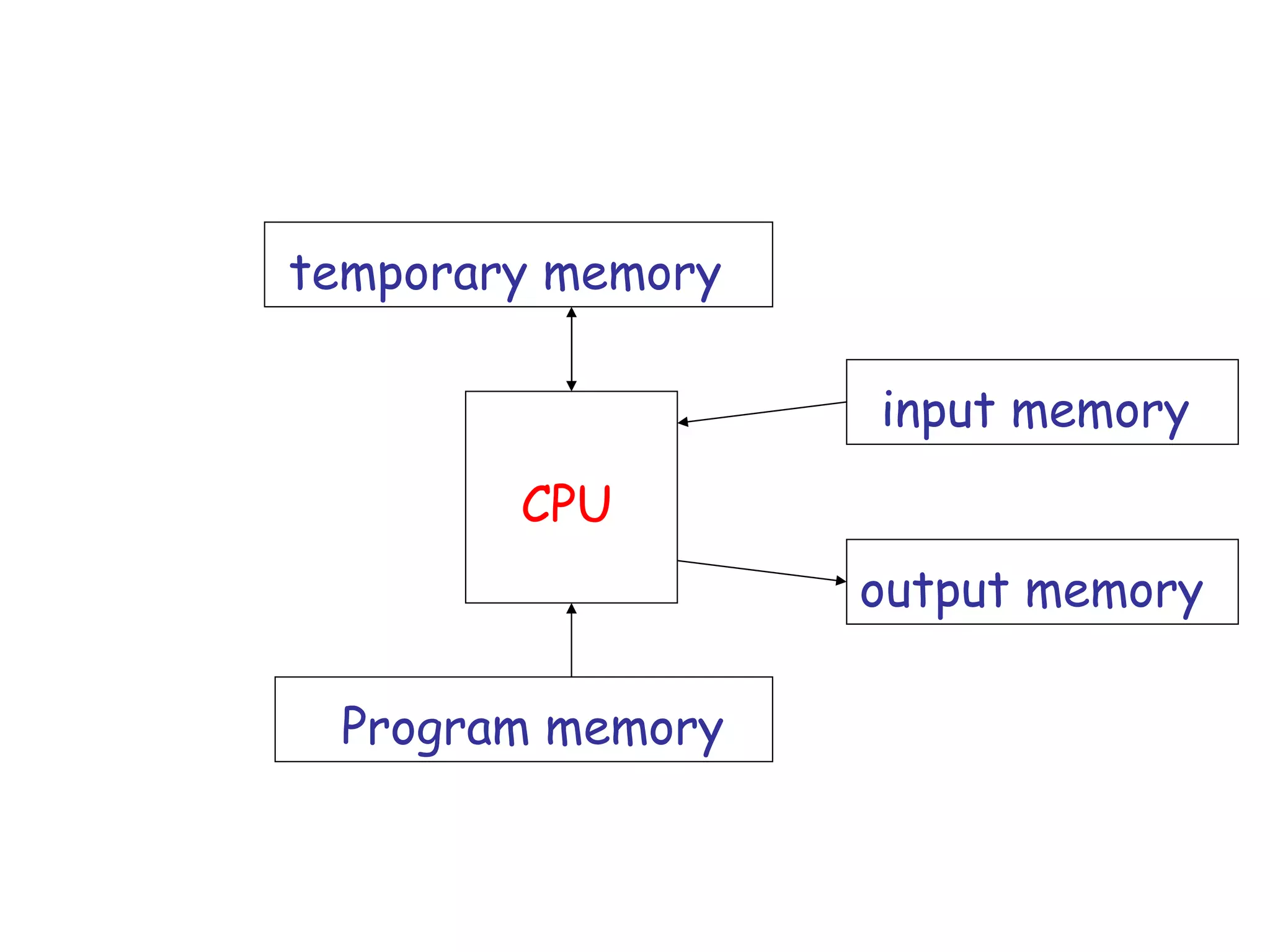
temporary memory

                   input memory
        CPU
                   output memory

 Program memory
3
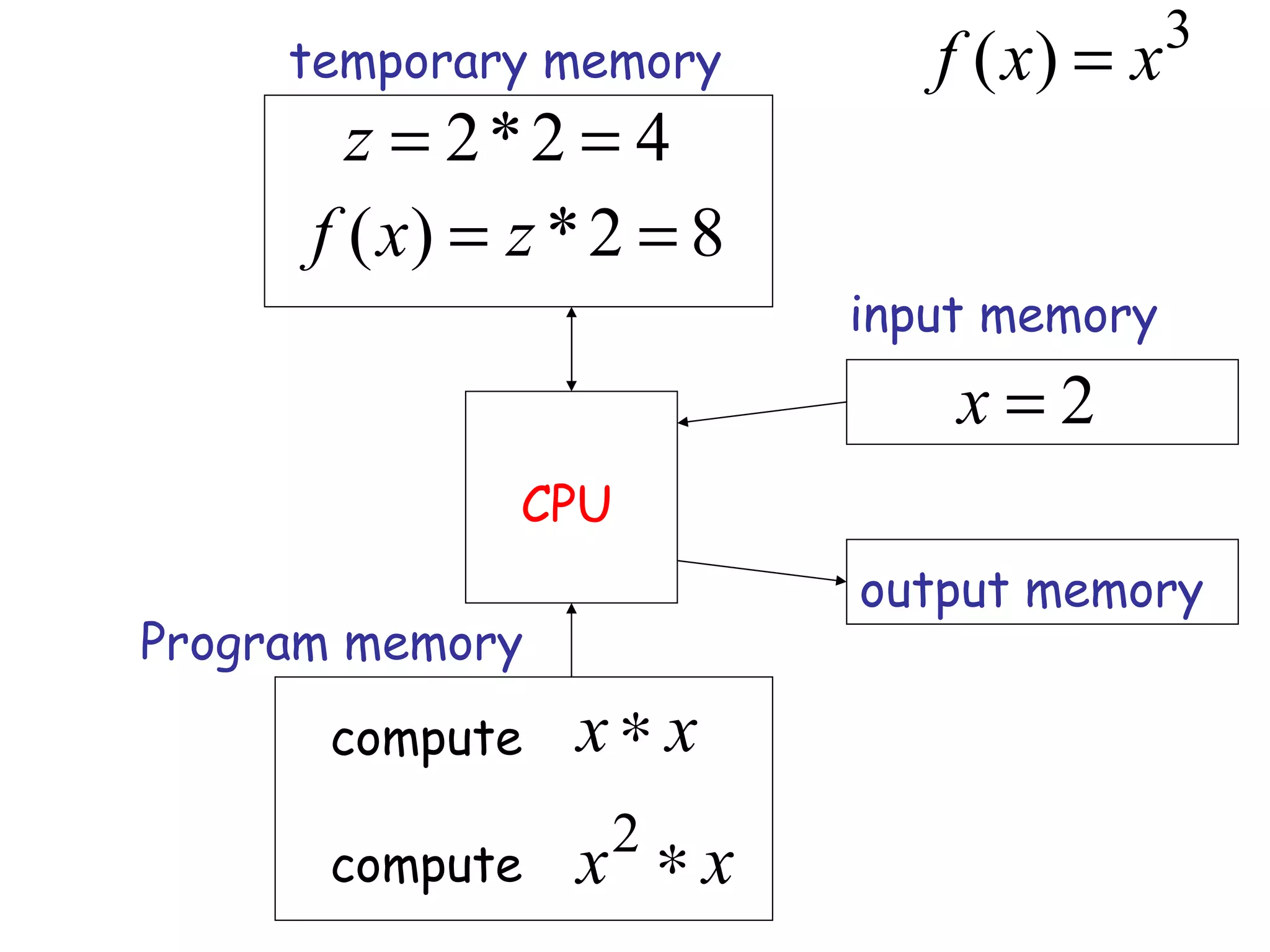
     temporary memory         f ( x) = x
        z = 2*2 = 4
      f ( x) = z * 2 = 8
                           input memory
                               x=2
               CPU
                           output memory
Program memory
      compute    x∗x
                   2
      compute    x ∗x
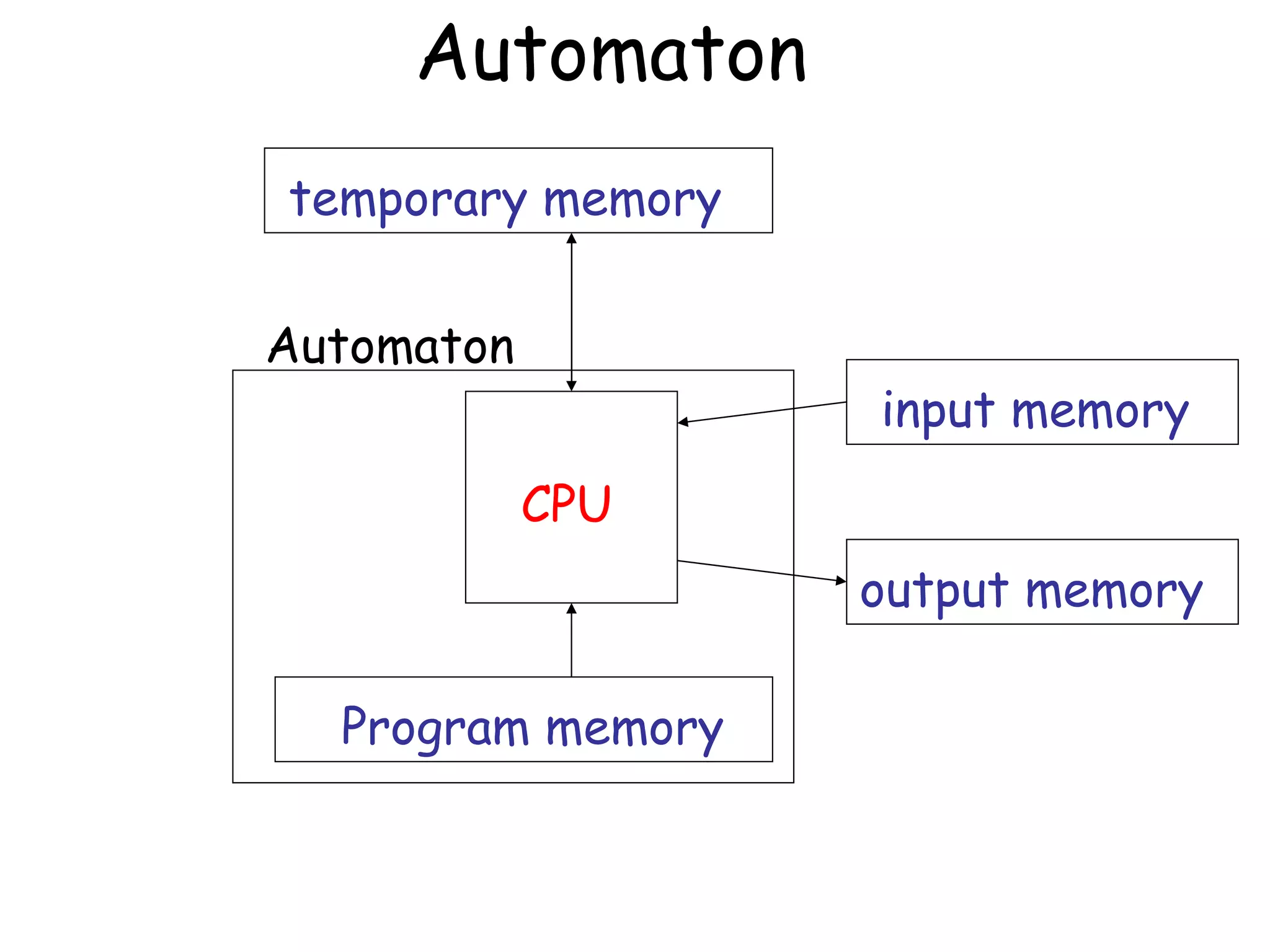
Automaton
temporary memory

Automaton
                   input memory
            CPU
                   output memory

  Program memory
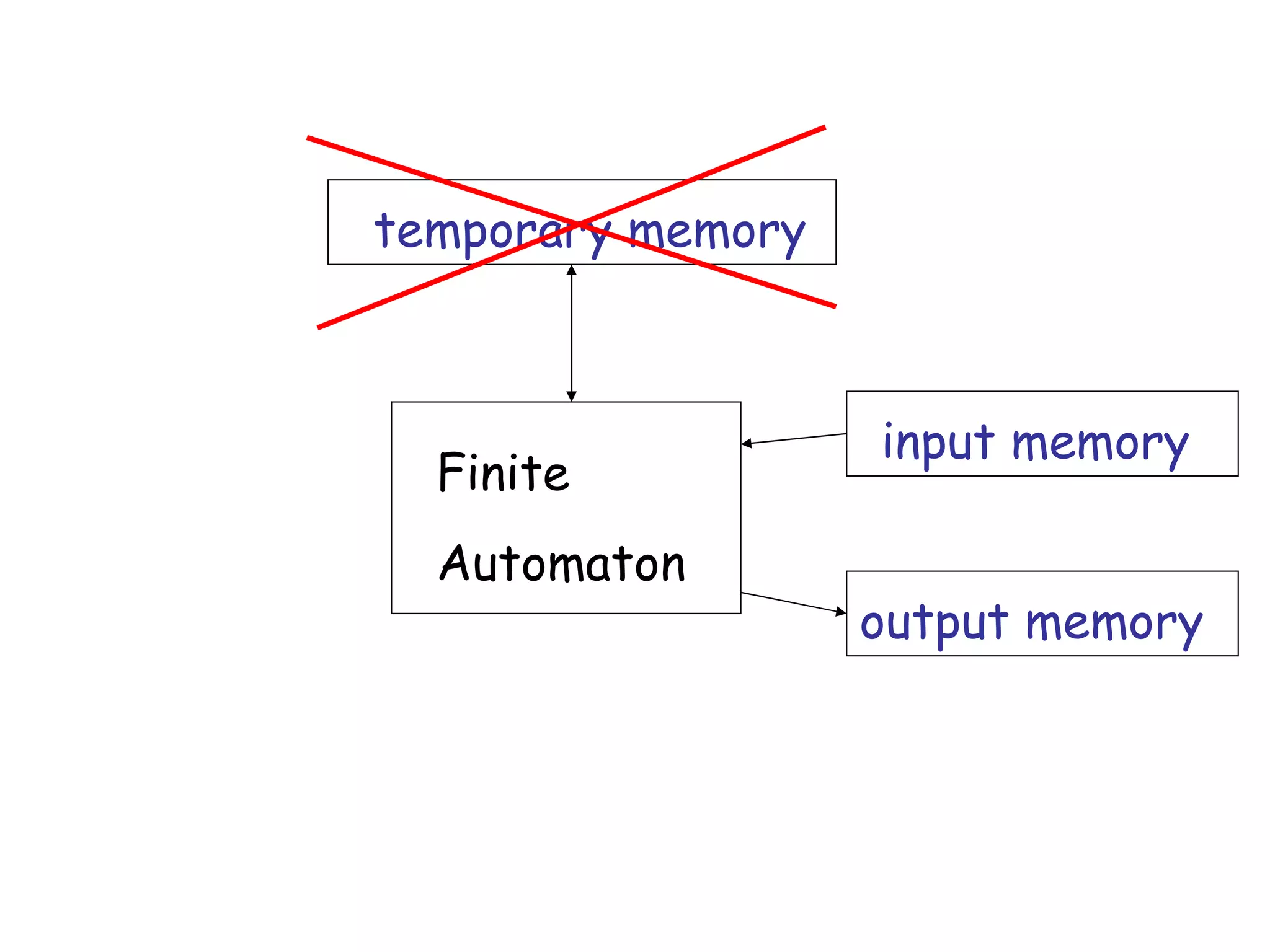
temporary memory


                   input memory
  Finite
  Automaton
                   output memory
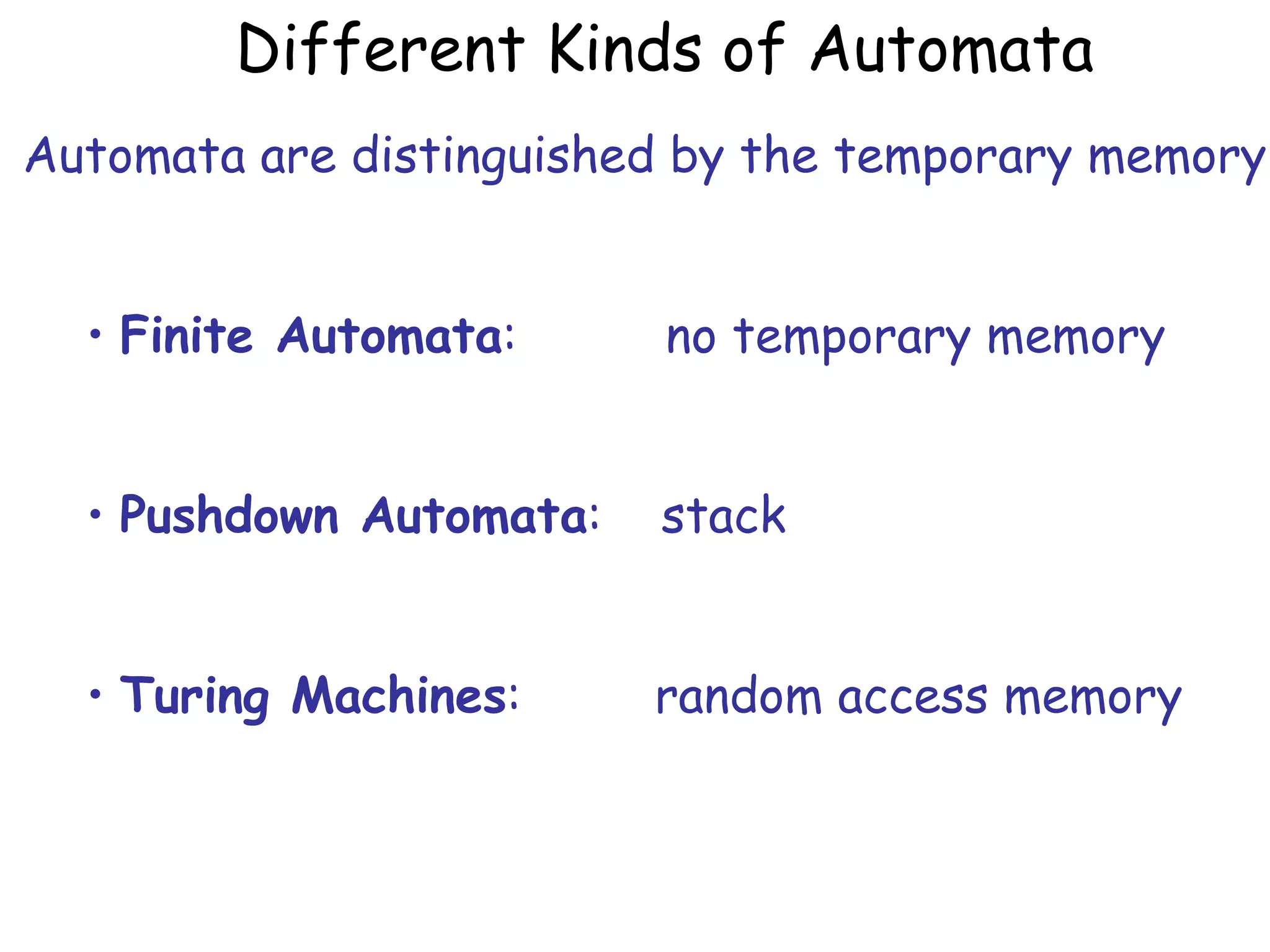
Different Kinds of Automata
Automata are distinguished by the temporary memory


  • Finite Automata:     no temporary memory


  • Pushdown Automata:   stack


  • Turing Machines:     random access memory
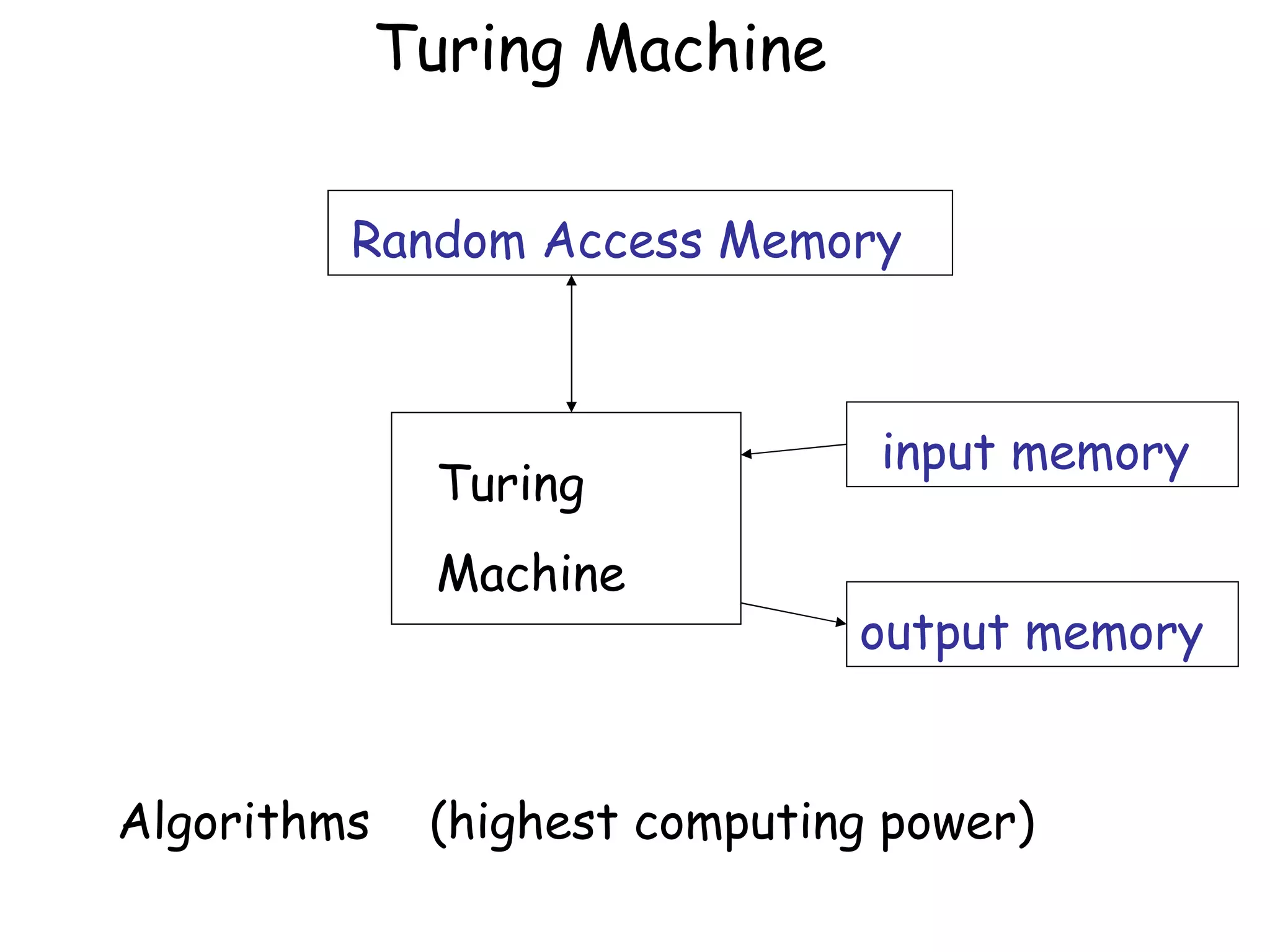
Turing Machine

         Random Access Memory


                                input memory
              Turing
              Machine
                               output memory


Algorithms    (highest computing power)
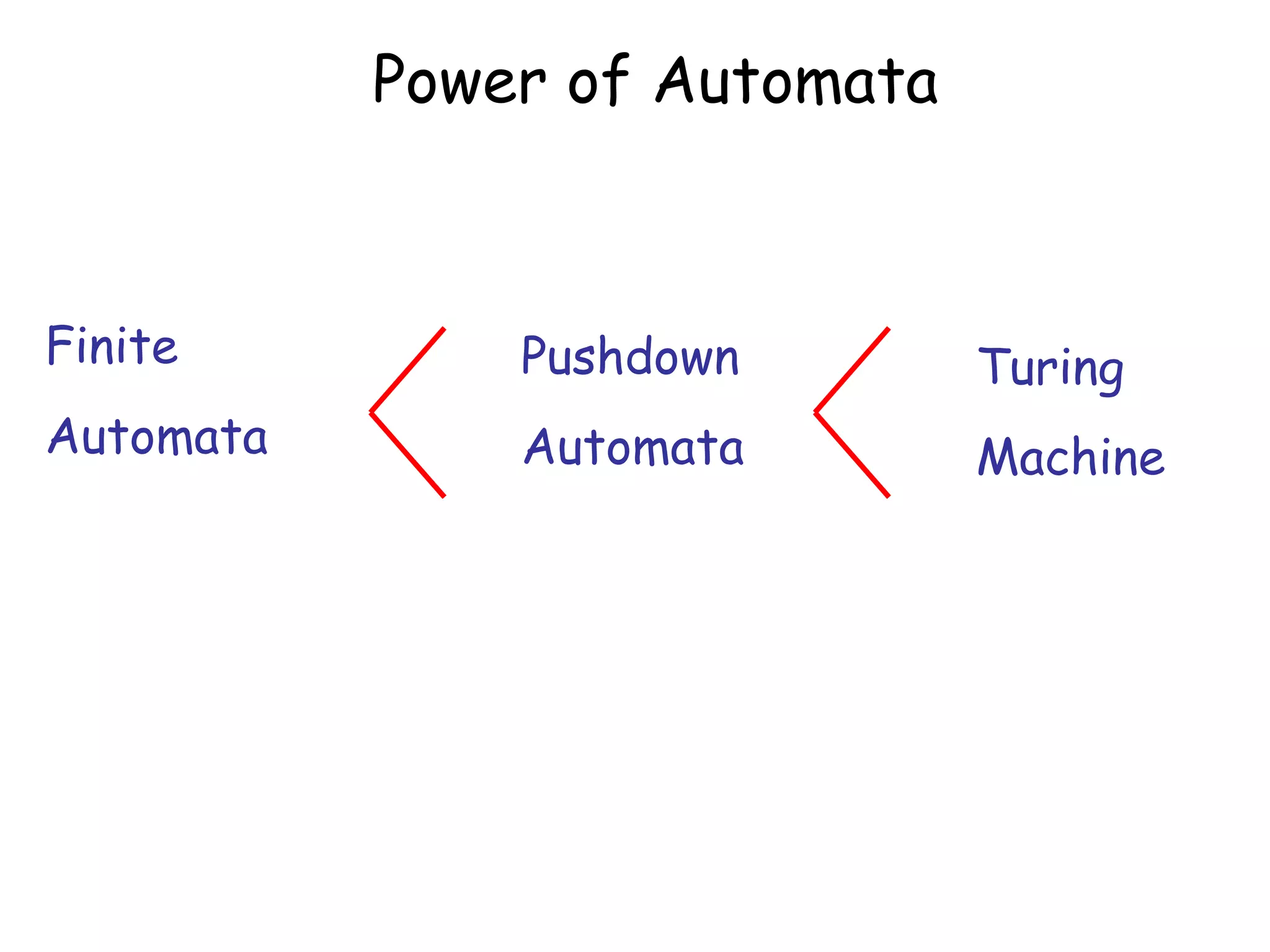
Power of Automata


Finite         Pushdown        Turing
Automata       Automata        Machine
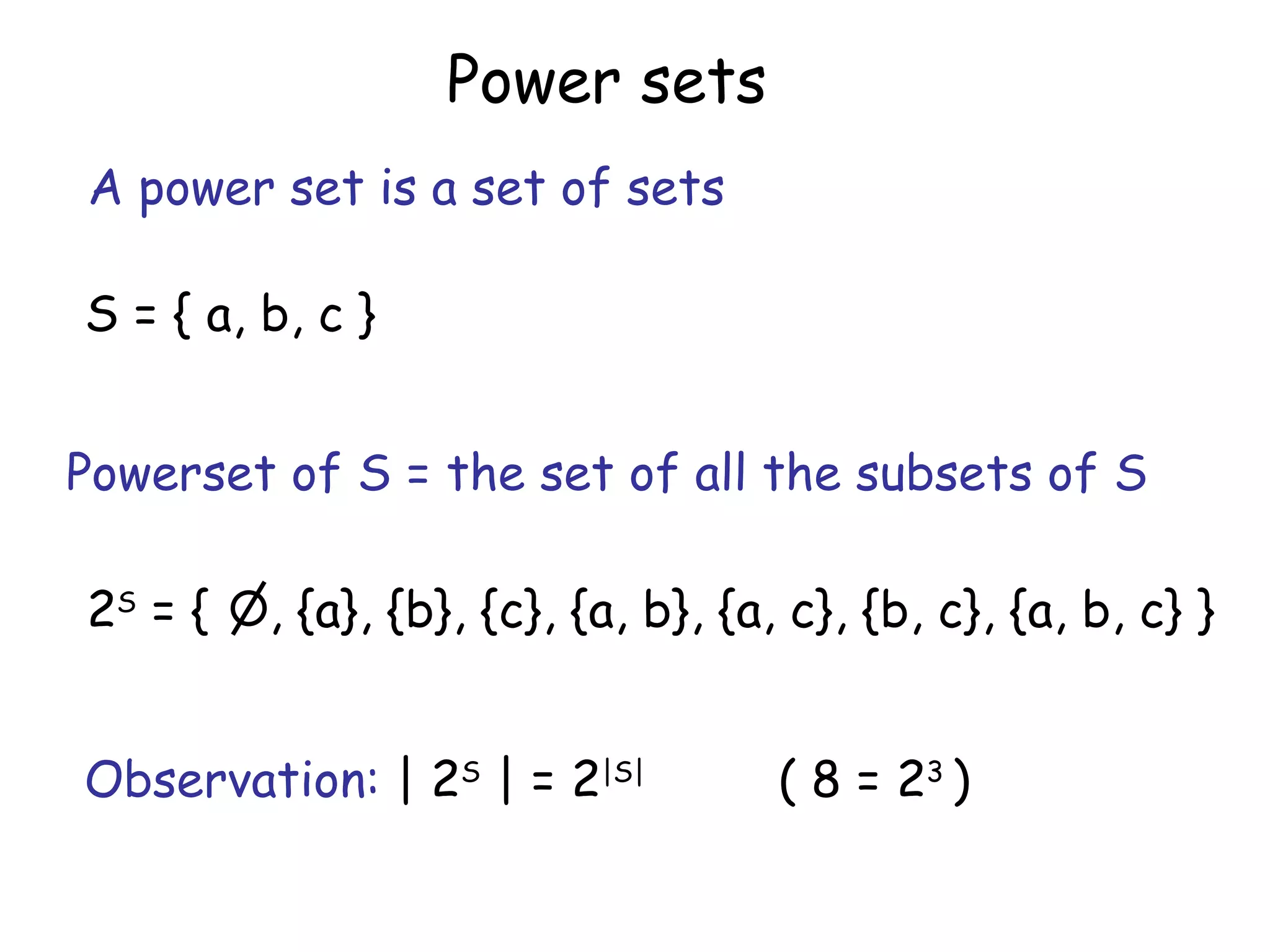
Power sets
A power set is a set of sets

S = { a, b, c }


Powerset of S = the set of all the subsets of S

2S = {   , {a}, {b}, {c}, {a, b}, {a, c}, {b, c}, {a, b, c} }


Observation: | 2S | = 2|S|          ( 8 = 23 )
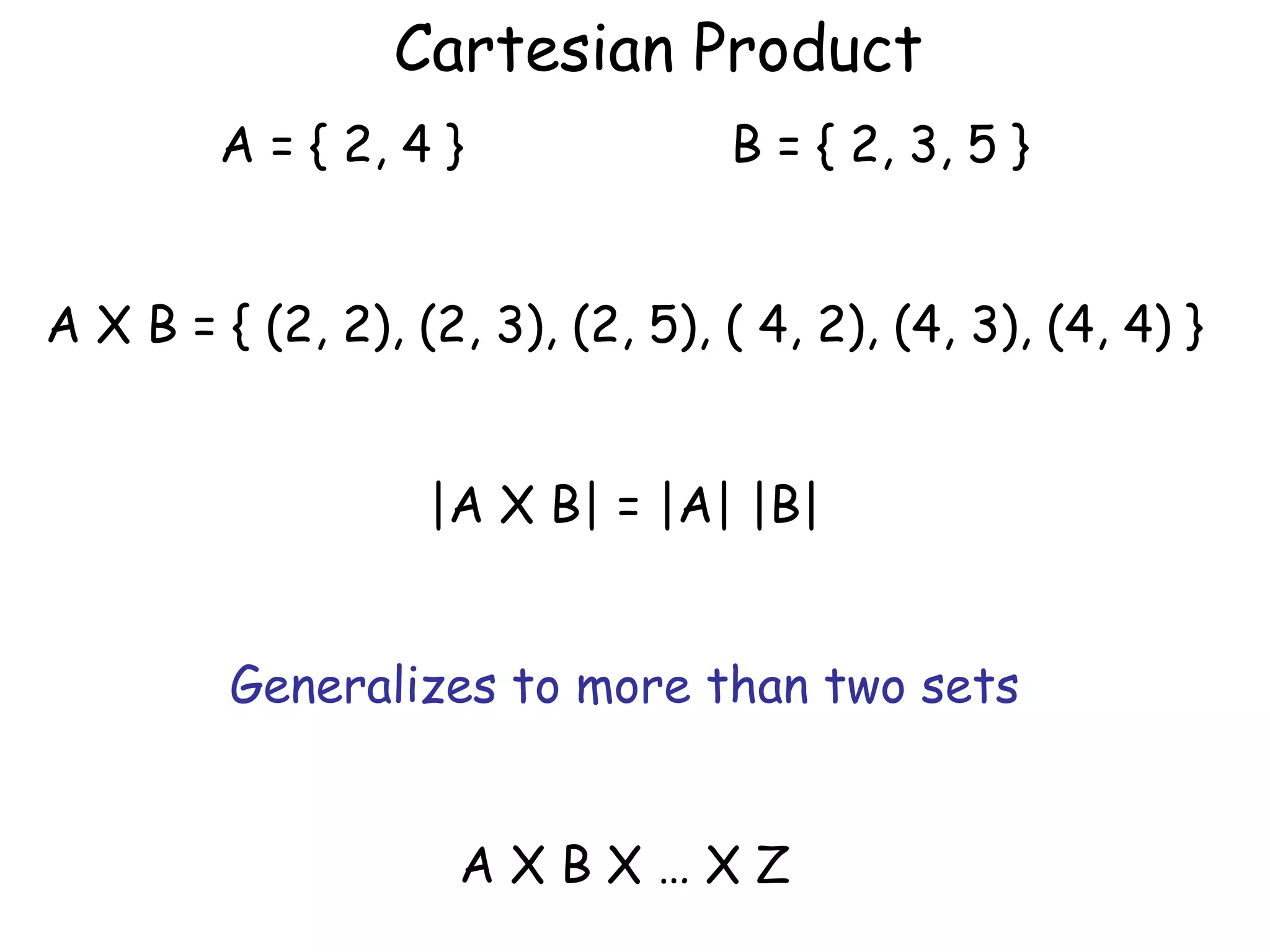
Cartesian Product
        A = { 2, 4 }              B = { 2, 3, 5 }


A X B = { (2, 2), (2, 3), (2, 5), ( 4, 2), (4, 3), (4, 4) }


                   |A X B| = |A| |B|


         Generalizes to more than two sets


                     AXBX…XZ
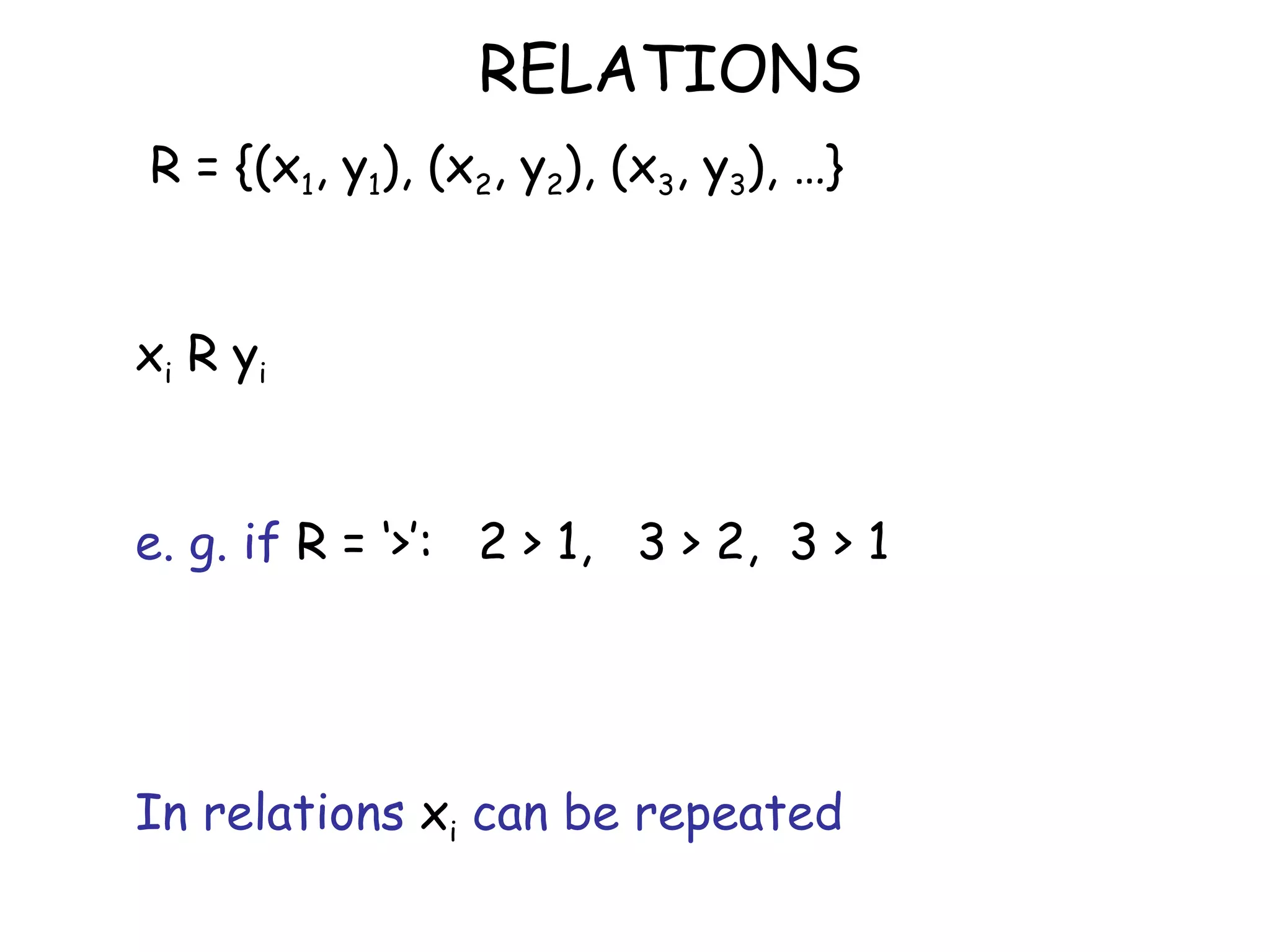
RELATIONS
R = {(x1, y1), (x2, y2), (x3, y3), …}


xi R yi


e. g. if R = ‘>’: 2 > 1, 3 > 2, 3 > 1


In relations xi can be repeated
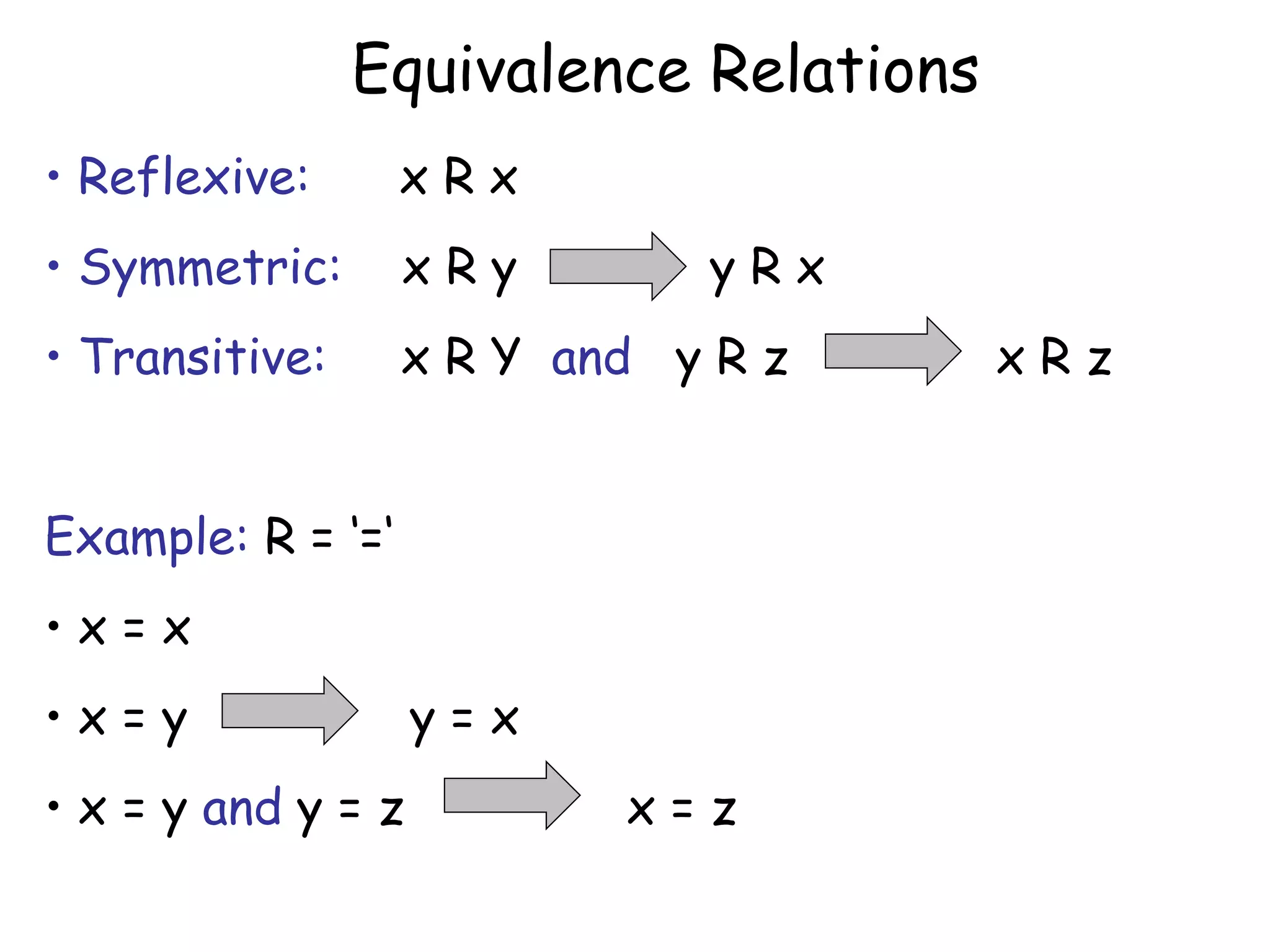
Equivalence Relations
• Reflexive:       xRx
• Symmetric:       xRy        yRx
• Transitive:      x R Y and y R z      xRz


Example: R = ‘=‘
•x=x
•x=y                y=x
• x = y and y = z          x=z
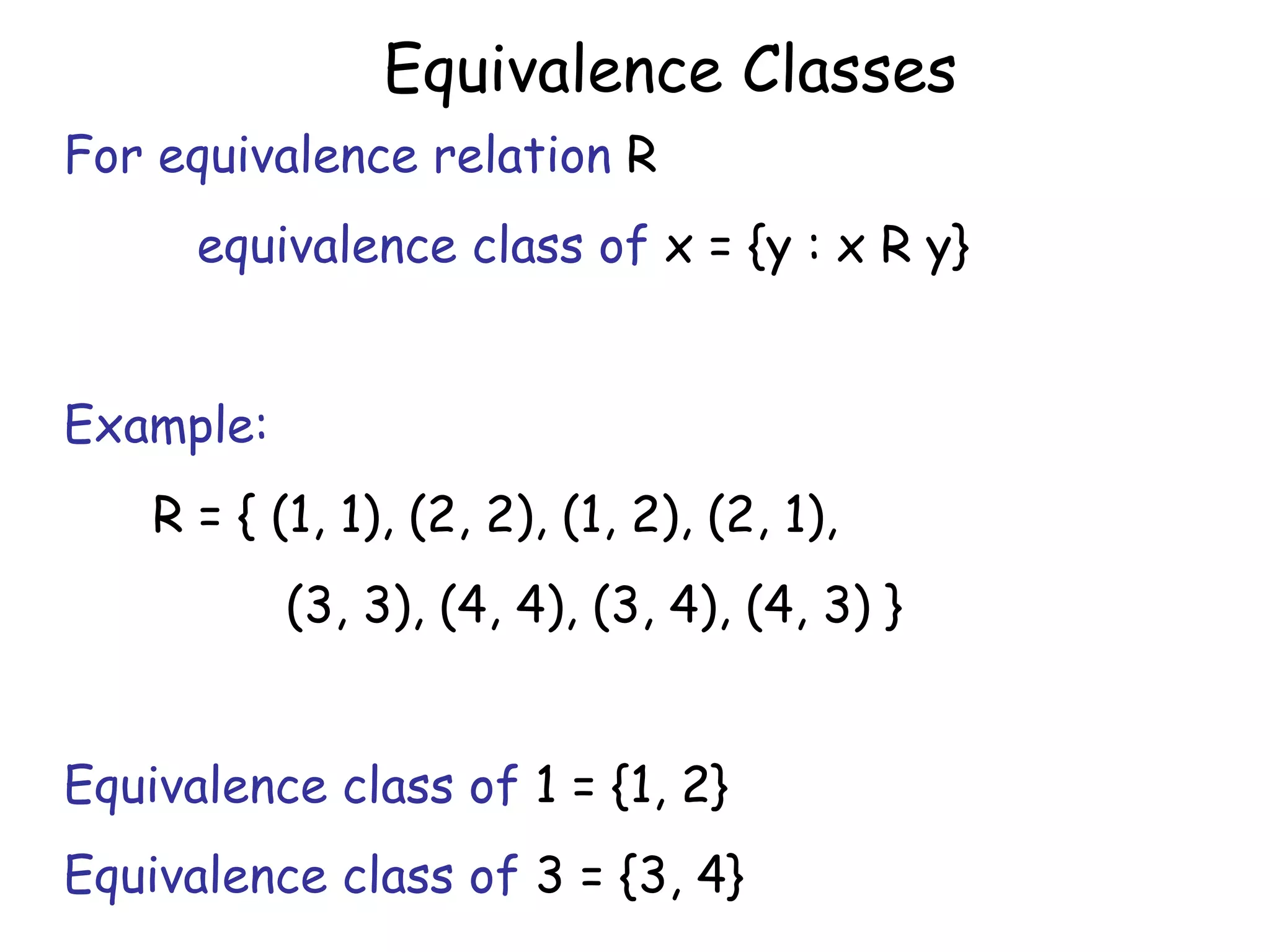
Equivalence Classes
For equivalence relation R
      equivalence class of x = {y : x R y}


Example:
    R = { (1, 1), (2, 2), (1, 2), (2, 1),
           (3, 3), (4, 4), (3, 4), (4, 3) }


Equivalence class of 1 = {1, 2}
Equivalence class of 3 = {3, 4}
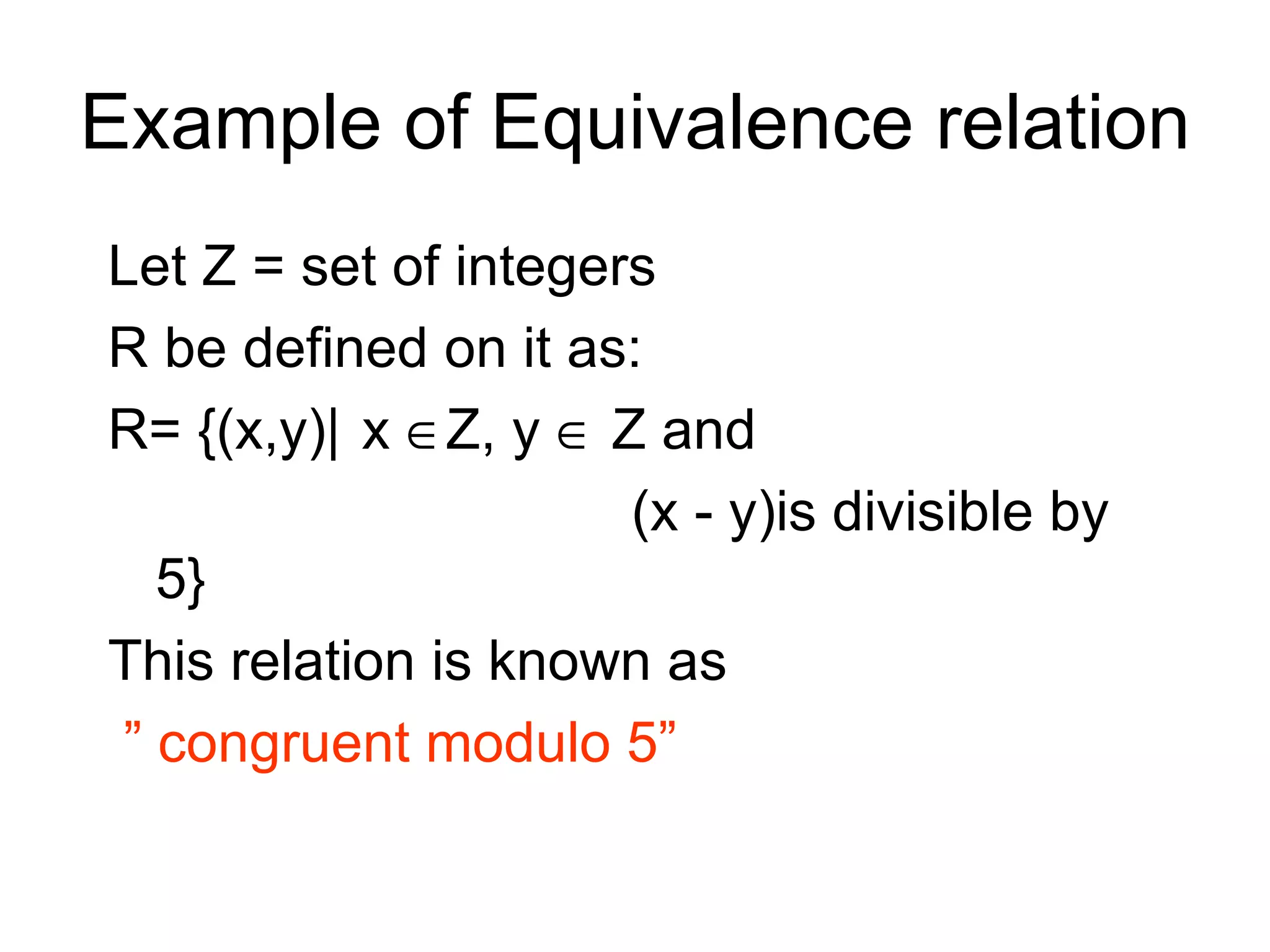
Example of Equivalence relation
Let Z = set of integers
R be defined on it as:
R= {(x,y)| x ∈Z, y ∈ Z and
                      (x - y)is divisible by
  5}
This relation is known as
” congruent modulo 5”
The equivalence classes are
[0]R= {…-10, -5, 0, 5,10,…}
[1]R = {…..,-9, -4, 1, 6, 11, 16….}
[2]R= {….-8, -3,2,7,12,17…..}
[3]R = {….-7, -2, 3, 8 ,13,…}
[4]R = {….-6,-1,4,9,14,19,….}
Z/R ={[0]R, [1]R, [2]R, [3]R, [4]R}
PROOF TECHNIQUES

• Proof by induction


• Proof by contradiction
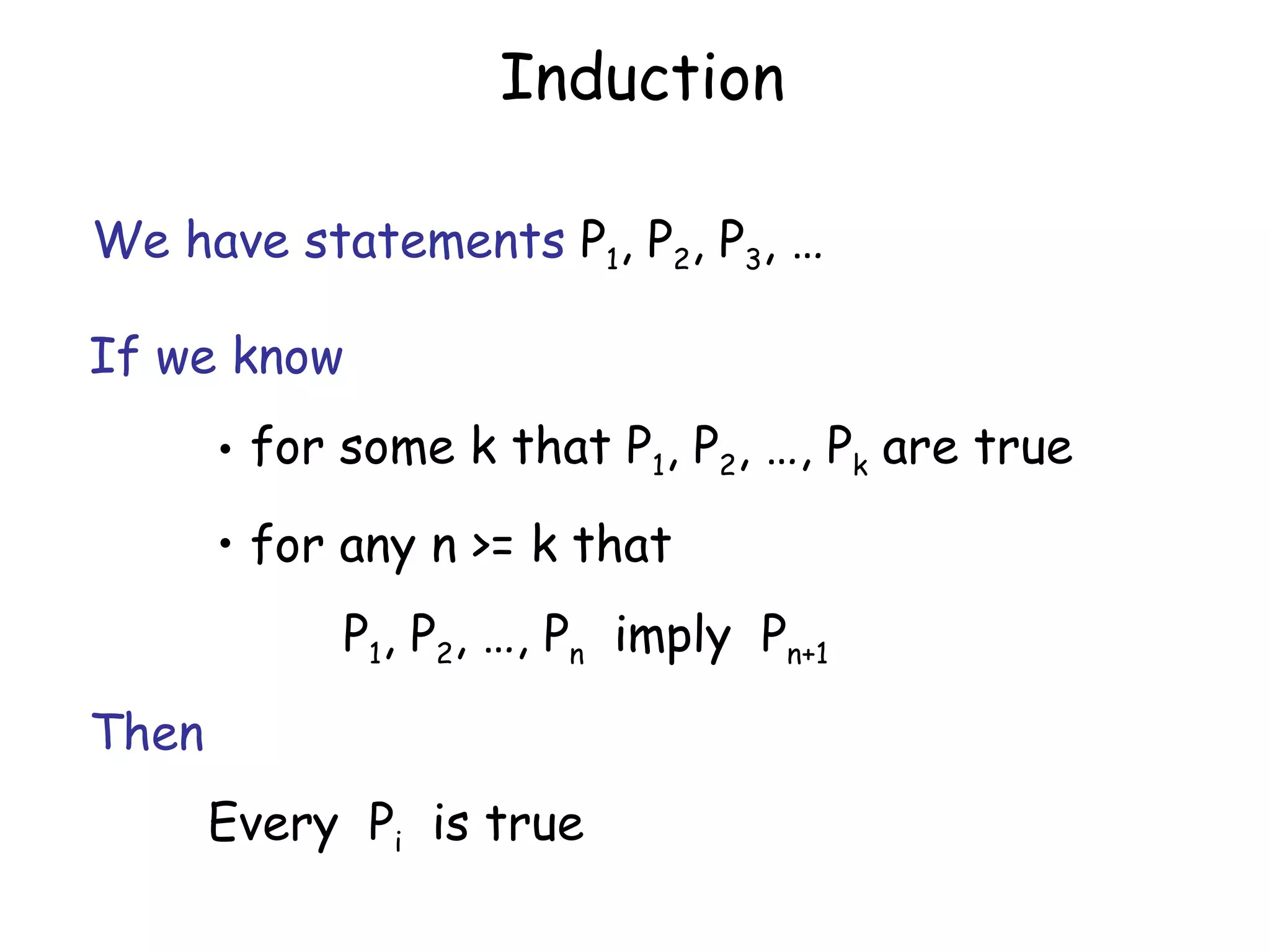
Induction

We have statements P1, P2, P3, …

If we know
       • for some k that P1, P2, …, Pk are true
       • for any n >= k that
            P1, P2, …, Pn imply Pn+1
Then
       Every Pi is true
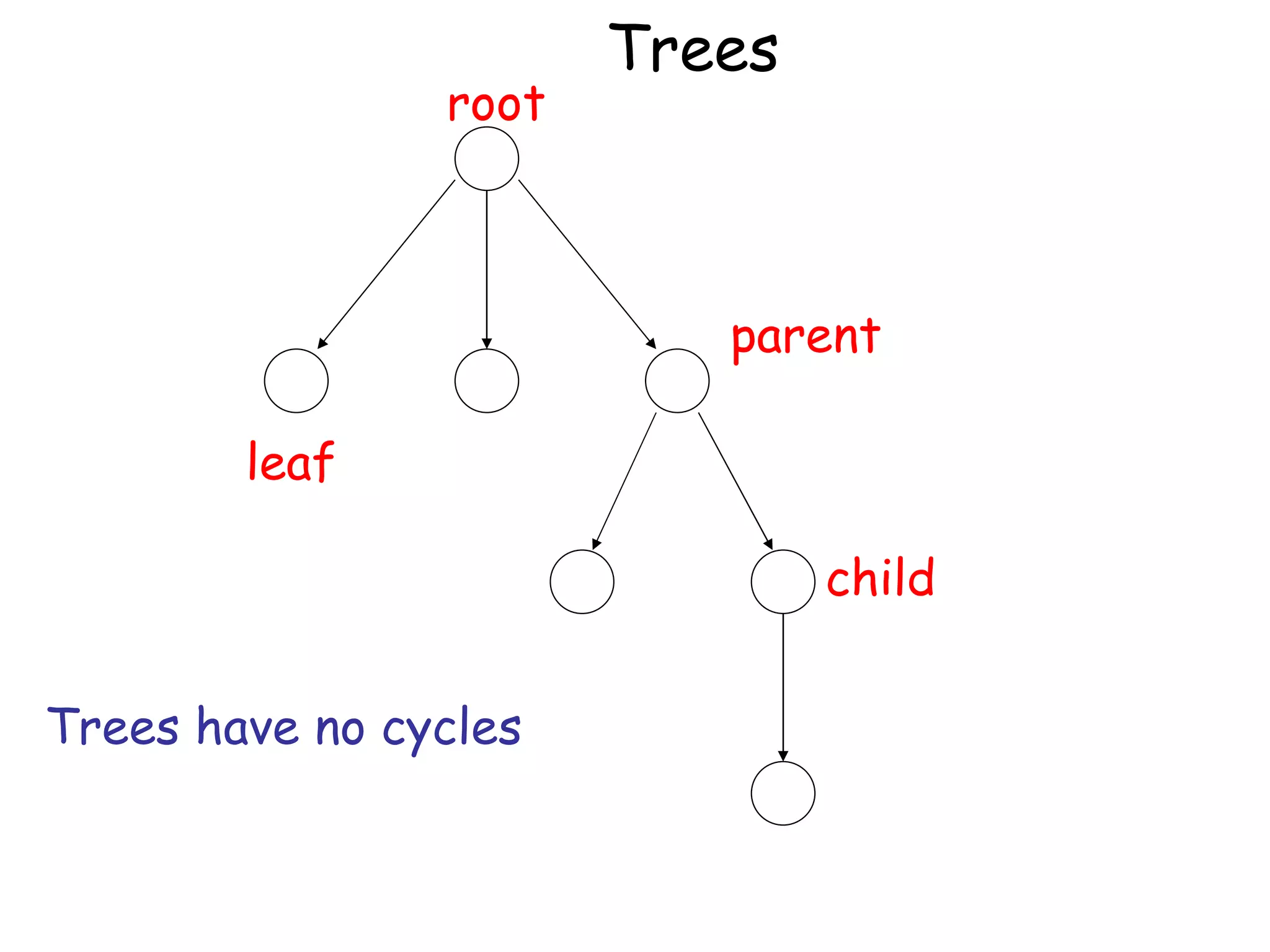
Trees
                root


                          parent

        leaf

                               child


Trees have no cycles
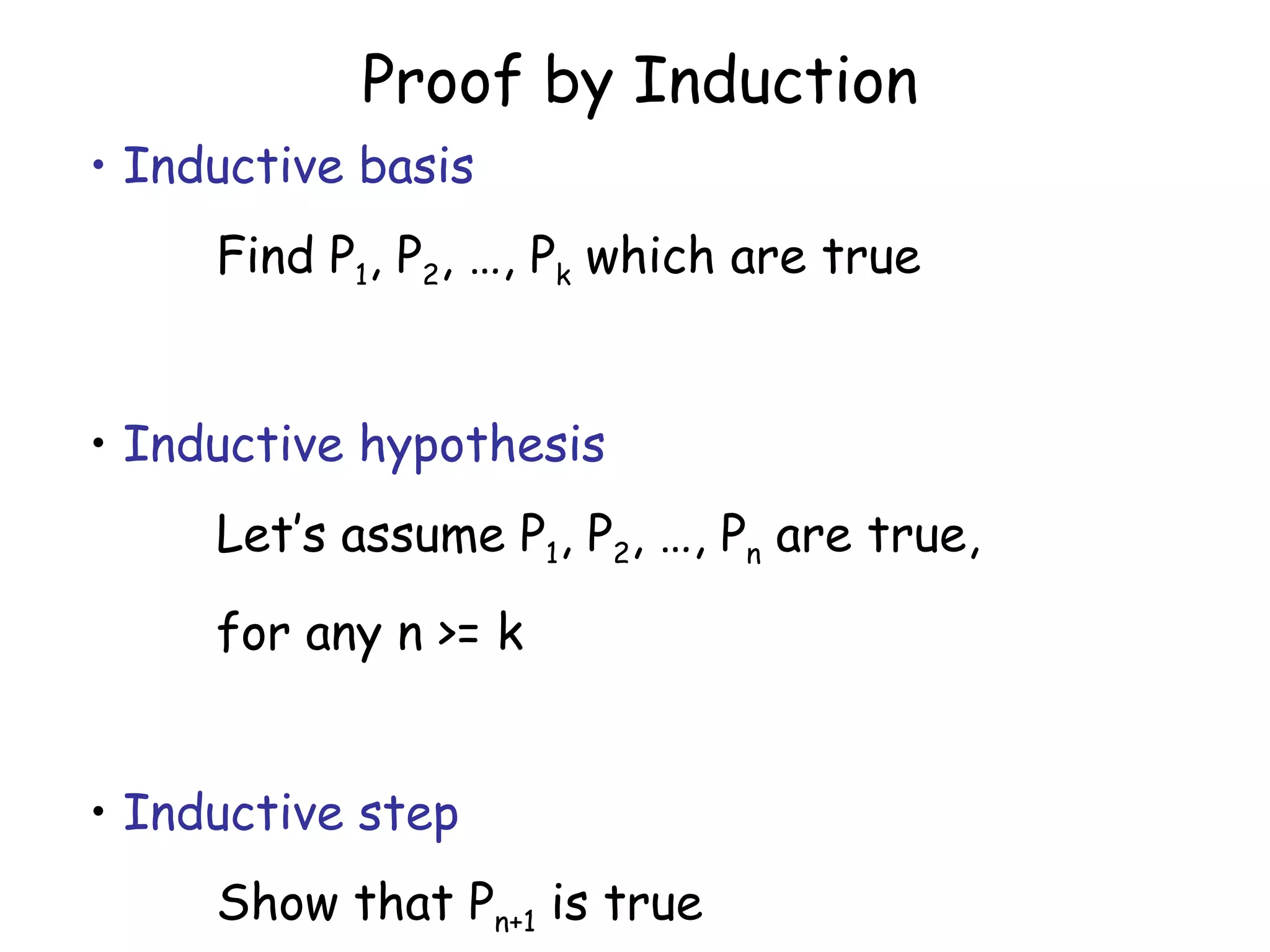
Proof by Induction
• Inductive basis
     Find P1, P2, …, Pk which are true


• Inductive hypothesis
     Let’s assume P1, P2, …, Pn are true,
     for any n >= k


• Inductive step
     Show that Pn+1 is true
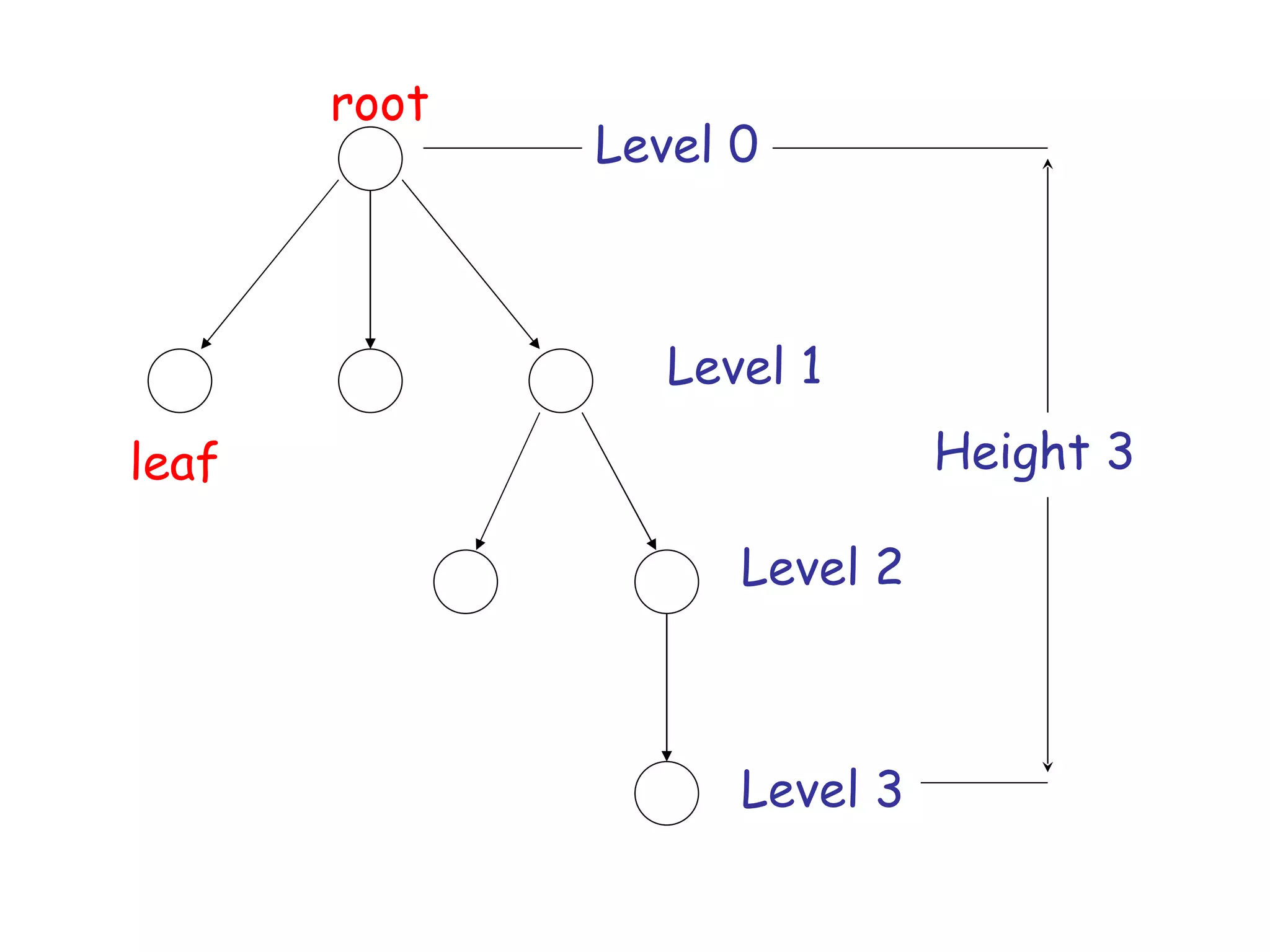
root
              Level 0


                 Level 1
leaf                          Height 3

                    Level 2


                    Level 3
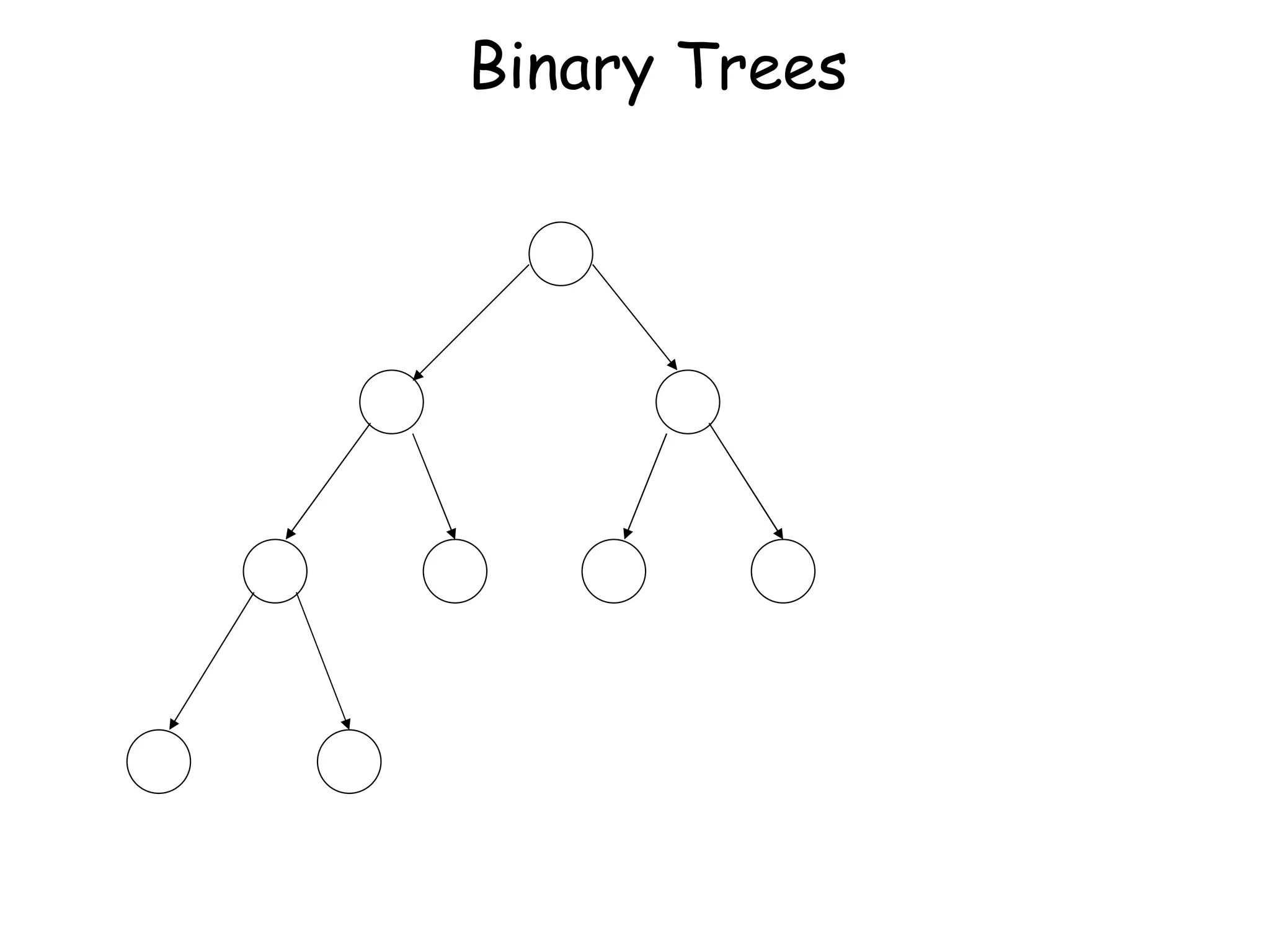
Binary Trees
Example
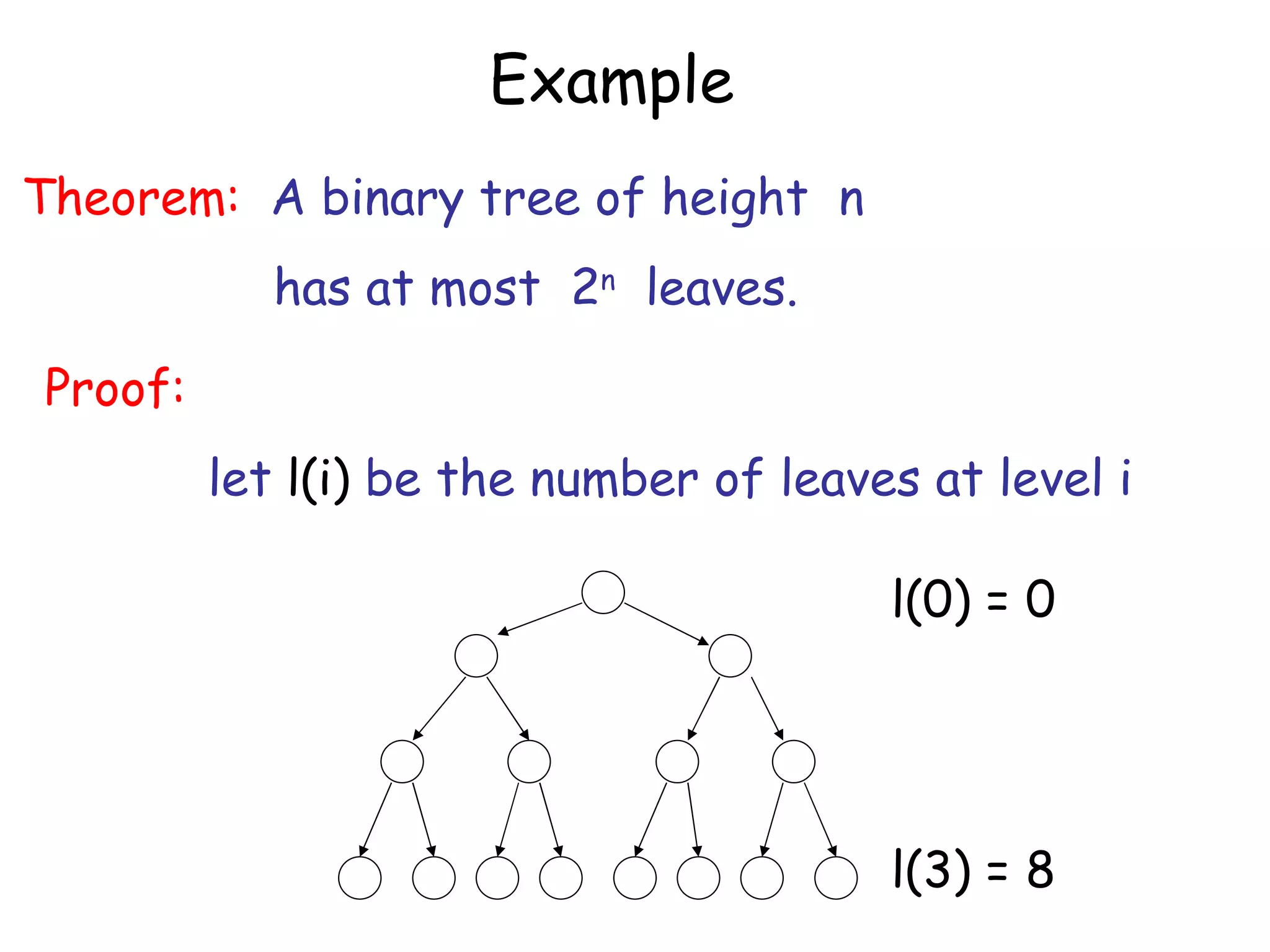
Theorem: A binary tree of height n
            has at most 2n leaves.

Proof:
         let l(i) be the number of leaves at level i

                                        l(0) = 0


                                        l(3) = 8
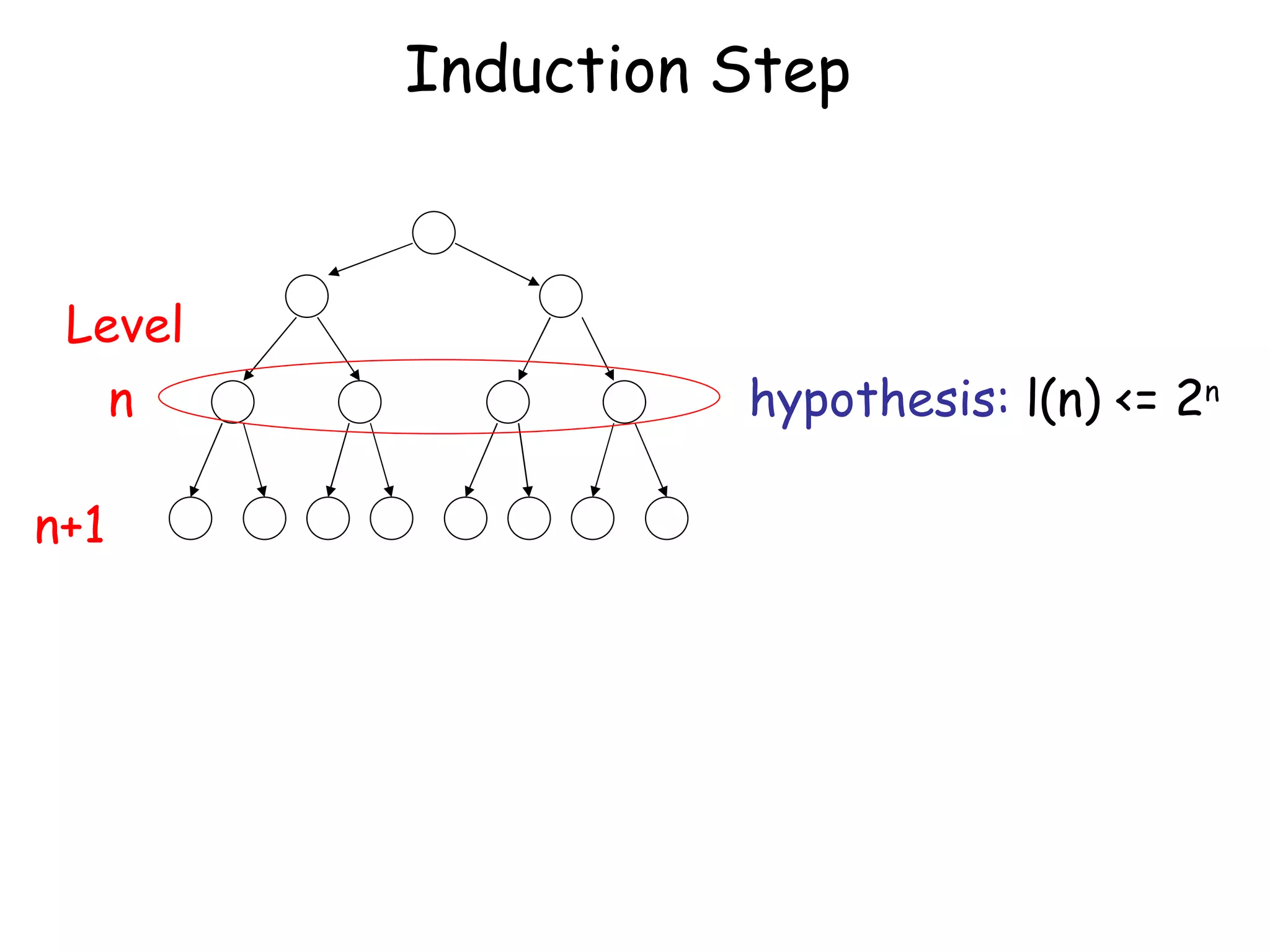
Induction Step


 Level
   n               hypothesis: l(n) <= 2n

n+1
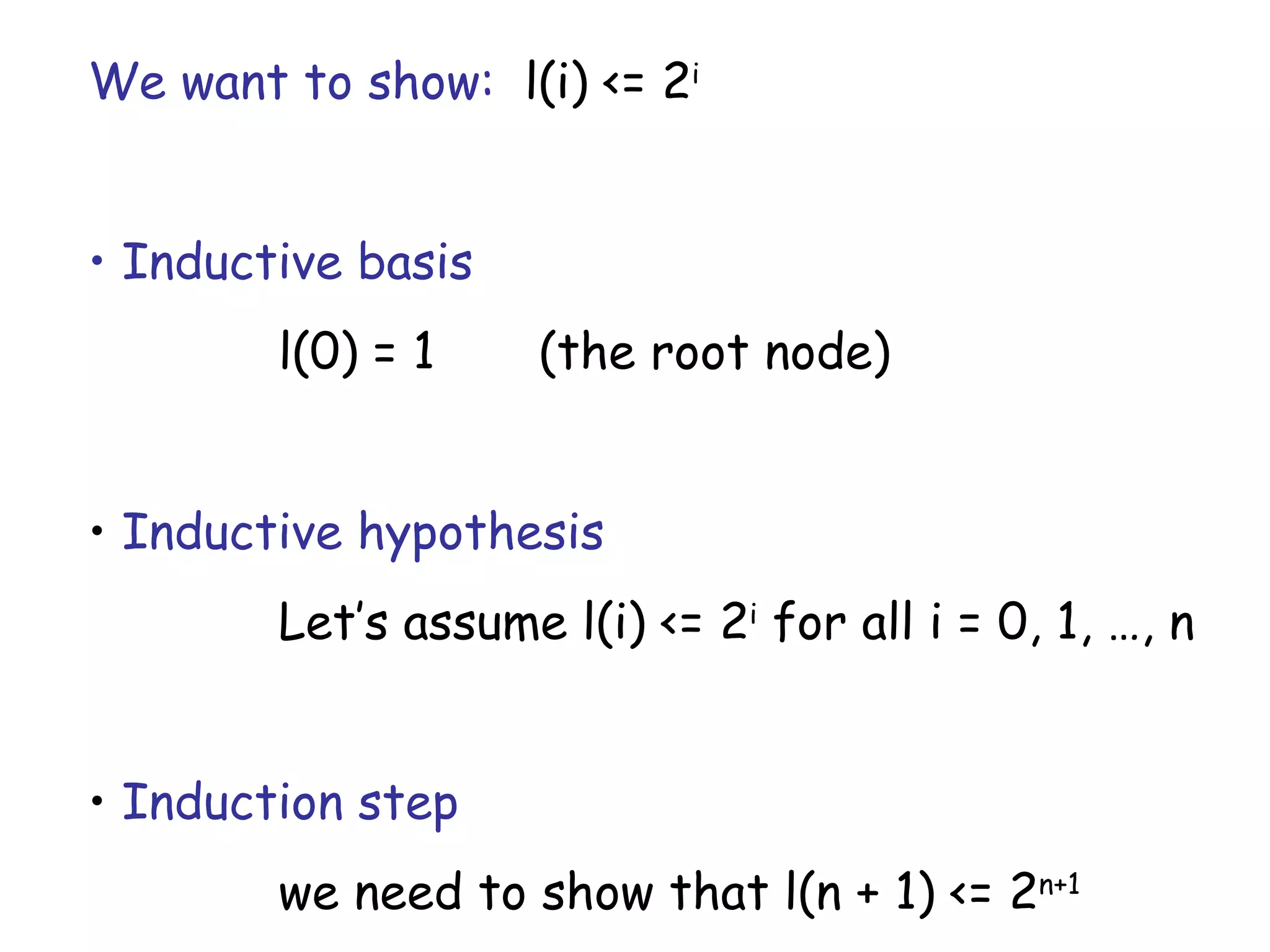
We want to show: l(i) <= 2i


• Inductive basis
        l(0) = 1     (the root node)


• Inductive hypothesis
        Let’s assume l(i) <= 2i for all i = 0, 1, …, n


• Induction step
        we need to show that l(n + 1) <= 2n+1
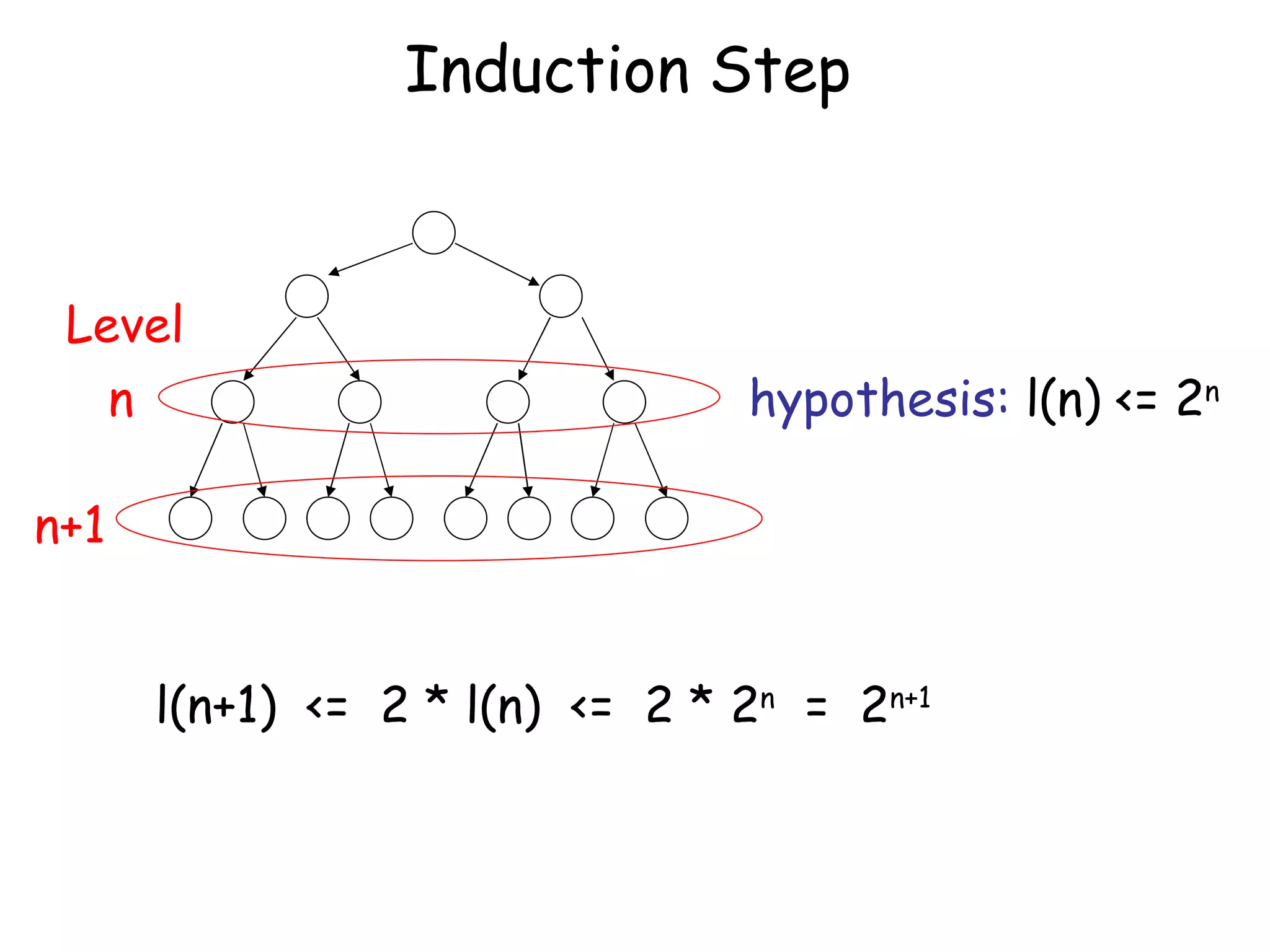
Induction Step


 Level
   n                            hypothesis: l(n) <= 2n

n+1


      l(n+1) <= 2 * l(n) <= 2 * 2n = 2n+1
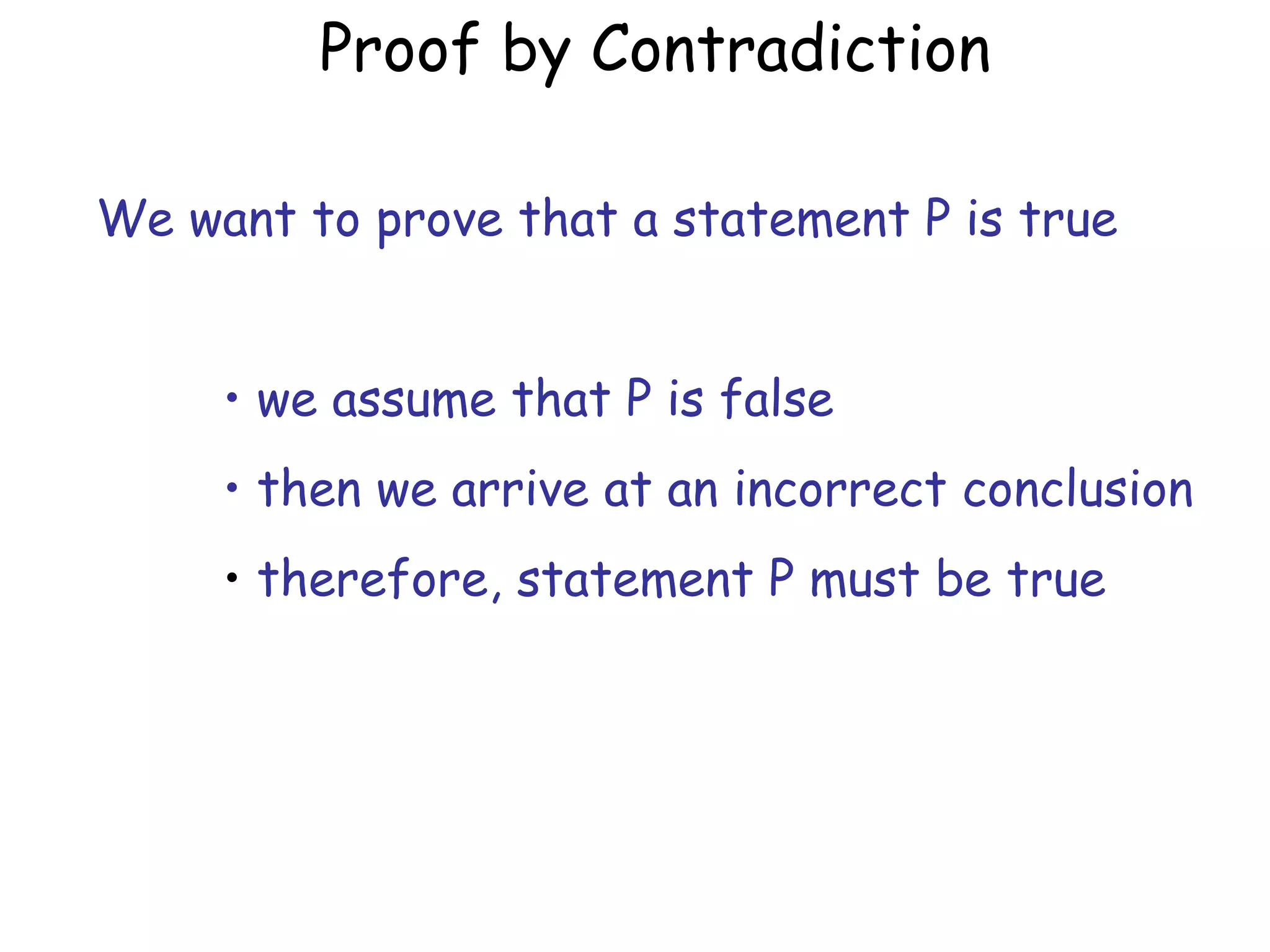
Proof by Contradiction

We want to prove that a statement P is true


     • we assume that P is false
     • then we arrive at an incorrect conclusion
     • therefore, statement P must be true
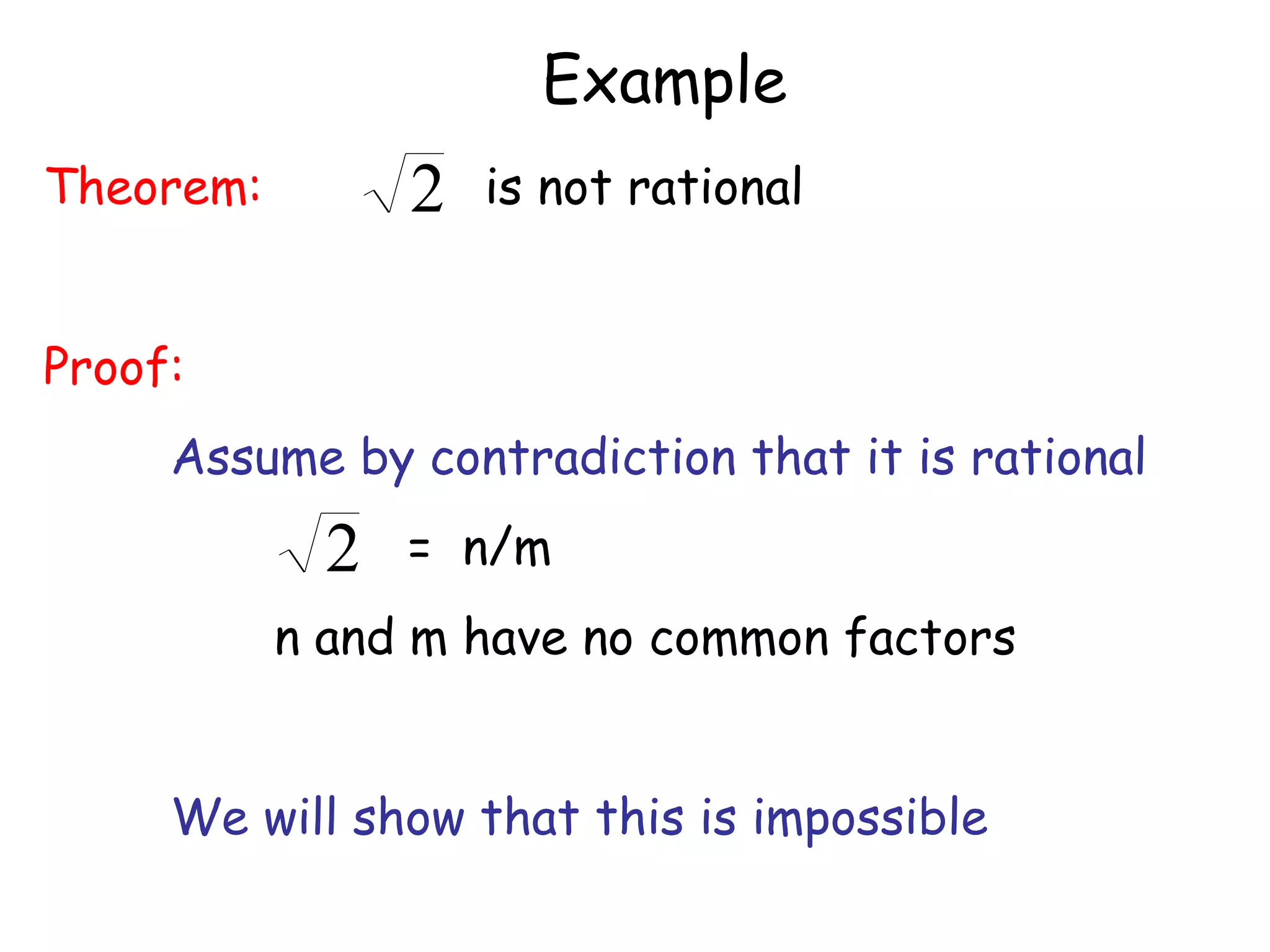
Example
Theorem:         2   is not rational


Proof:
     Assume by contradiction that it is rational
             2   = n/m
           n and m have no common factors


     We will show that this is impossible
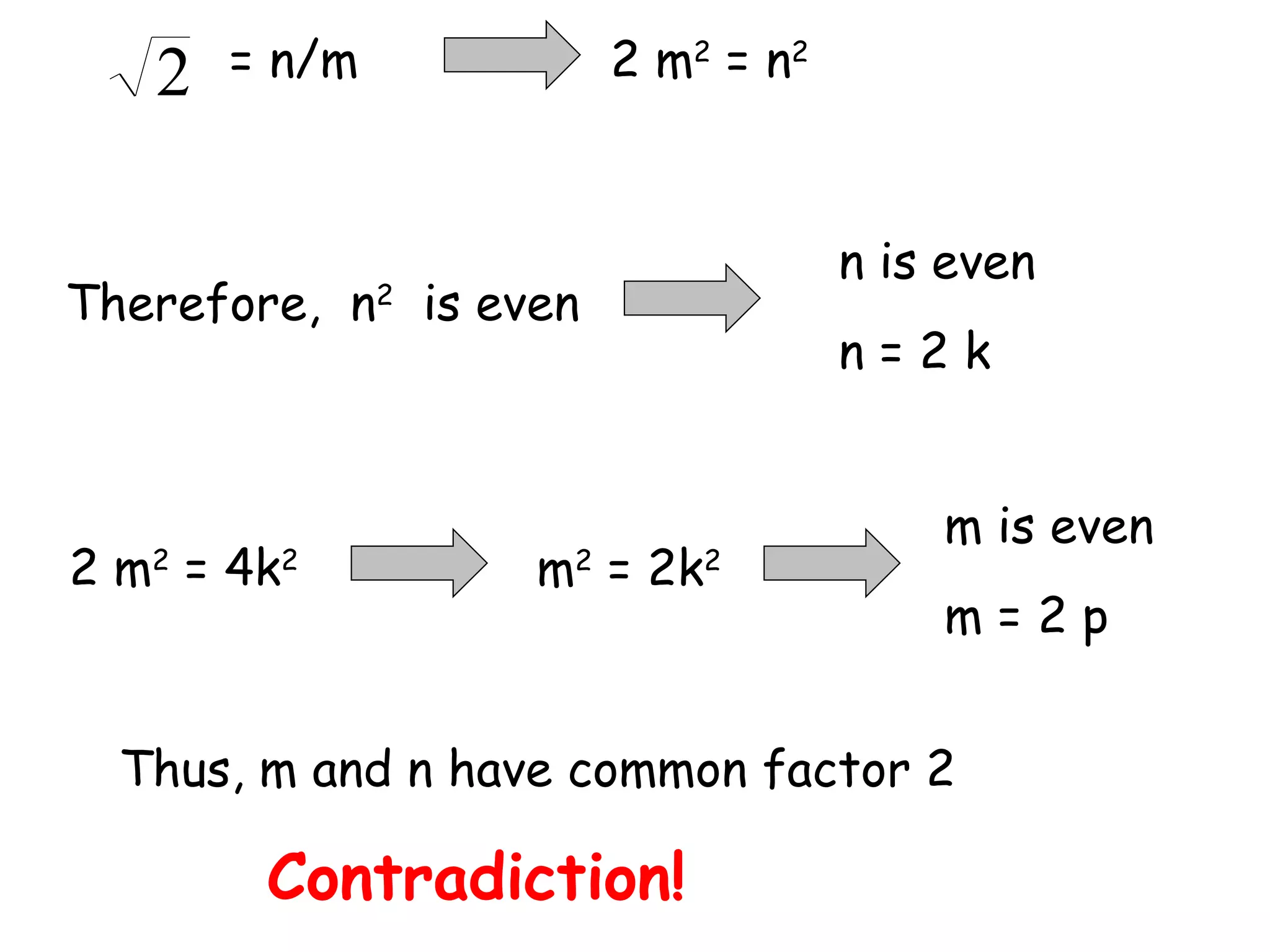
2   = n/m            2 m2 = n2


                                    n is even
Therefore, n2 is even
                                    n=2k


                                        m is even
2 m2 = 4k2         m2 = 2k2
                                        m=2p


  Thus, m and n have common factor 2

        Contradiction!
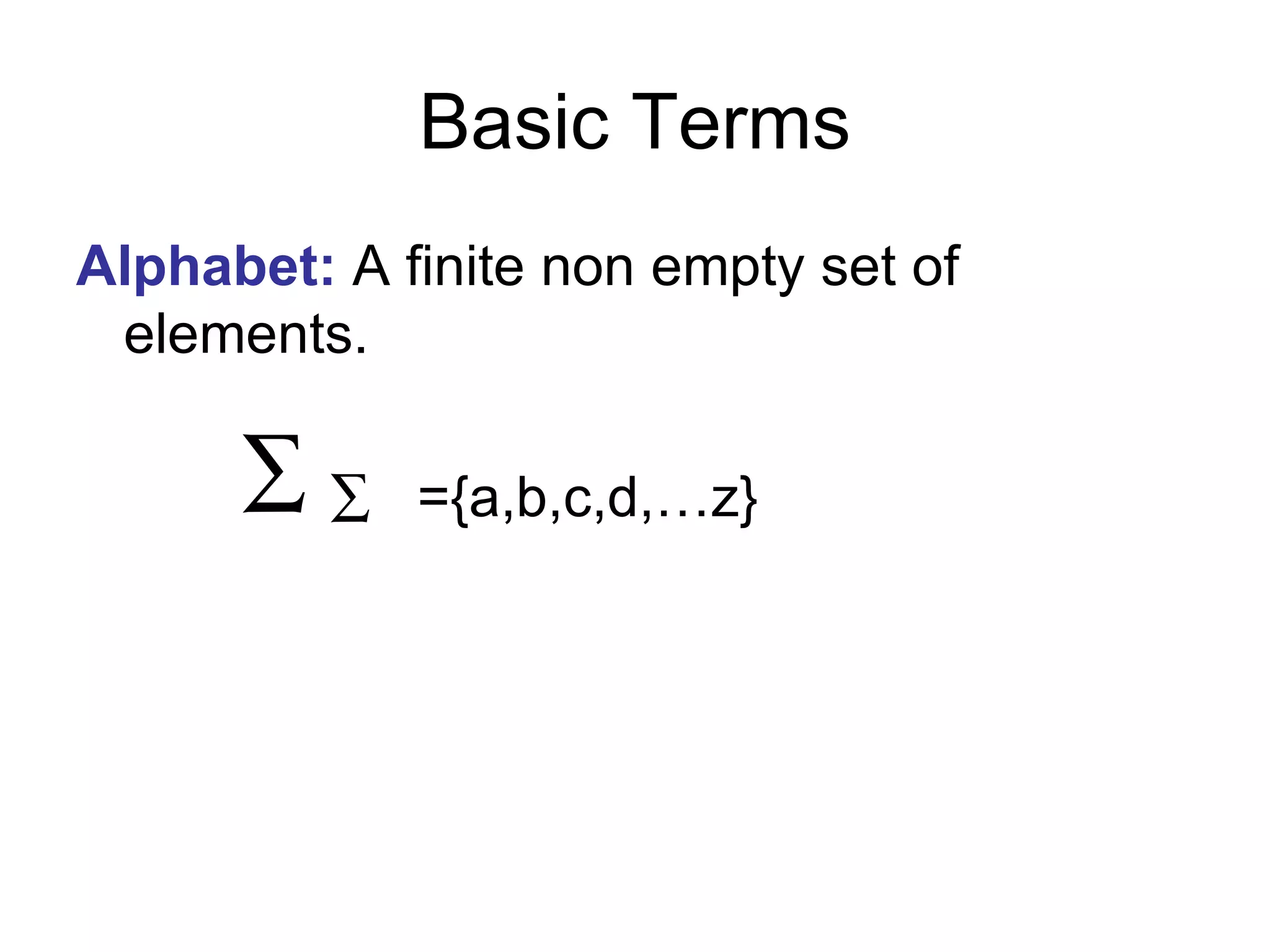
Basic Terms
Alphabet: A finite non empty set of
 elements.

      ∑∑     ={a,b,c,d,…z}
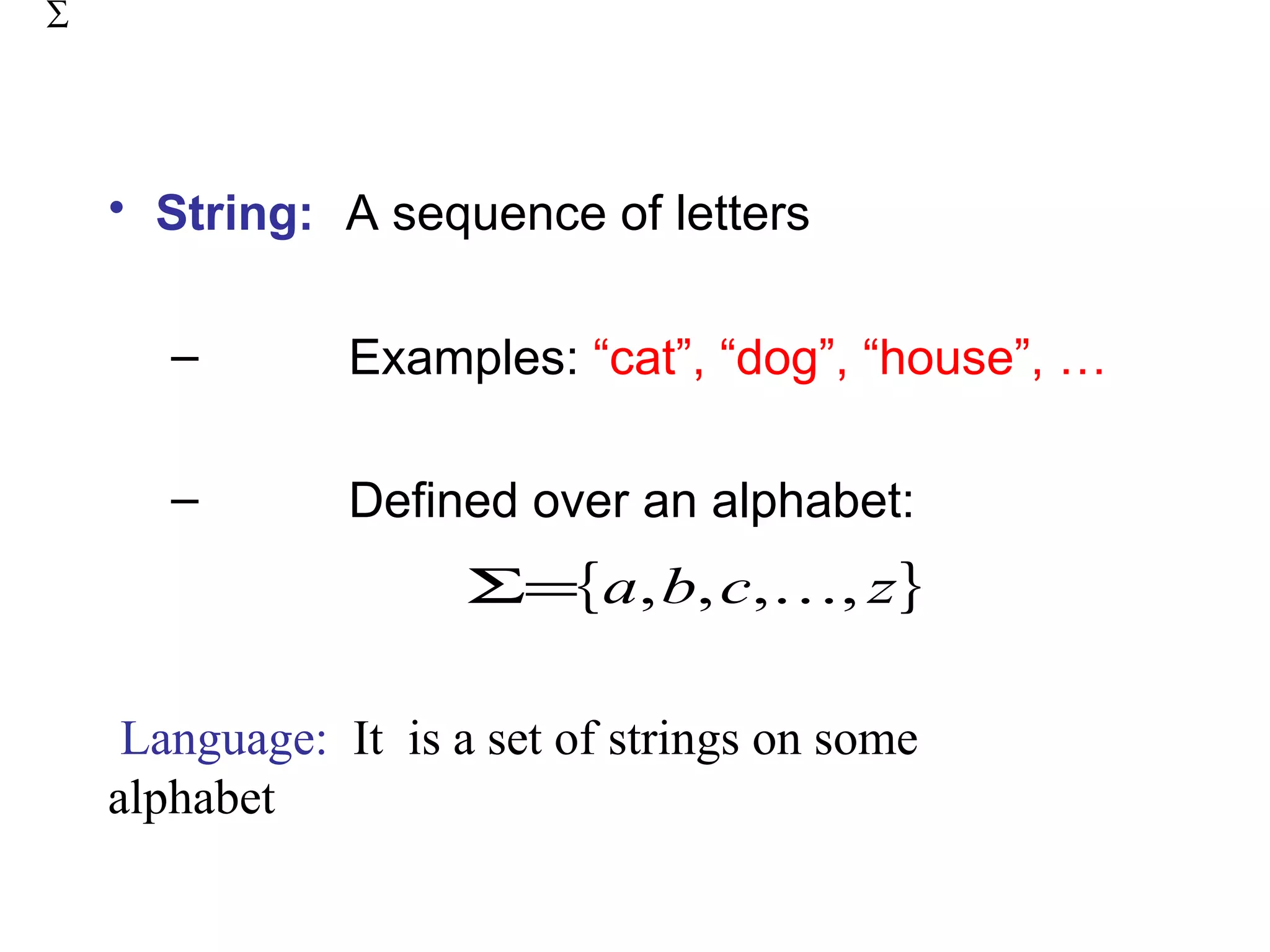
∑


    • String: A sequence of letters

       –        Examples: “cat”, “dog”, “house”, …

       –        Defined over an alphabet:
                      Σ={a, b, c,, z}

     Language: It is a set of strings on some
    alphabet
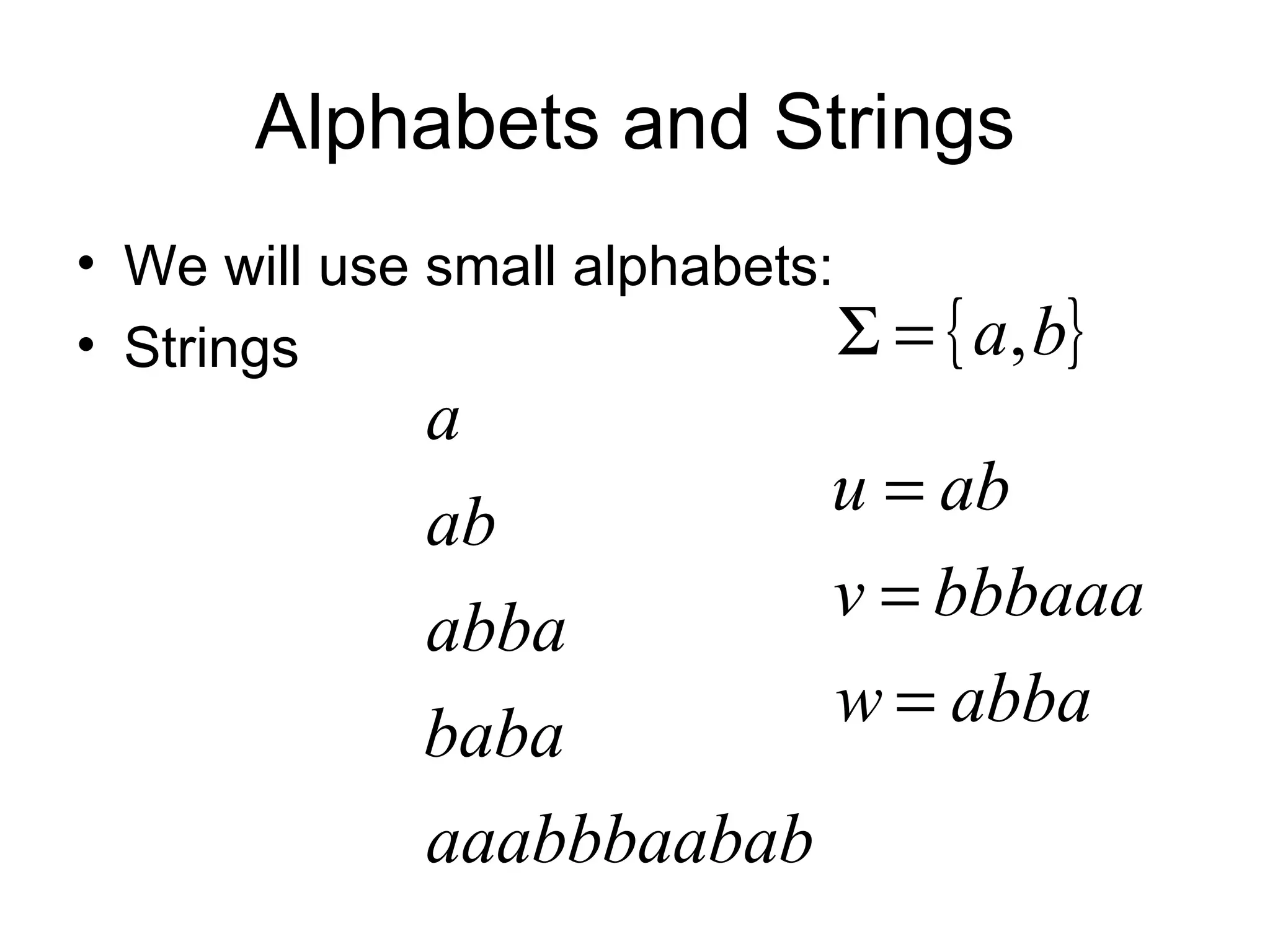
Alphabets and Strings
• We will use small alphabets:
• Strings                      Σ = { a, b}
              a
                          u = ab
              ab
                          v = bbbaaa
              abba
                          w = abba
              baba
              aaabbbaabab
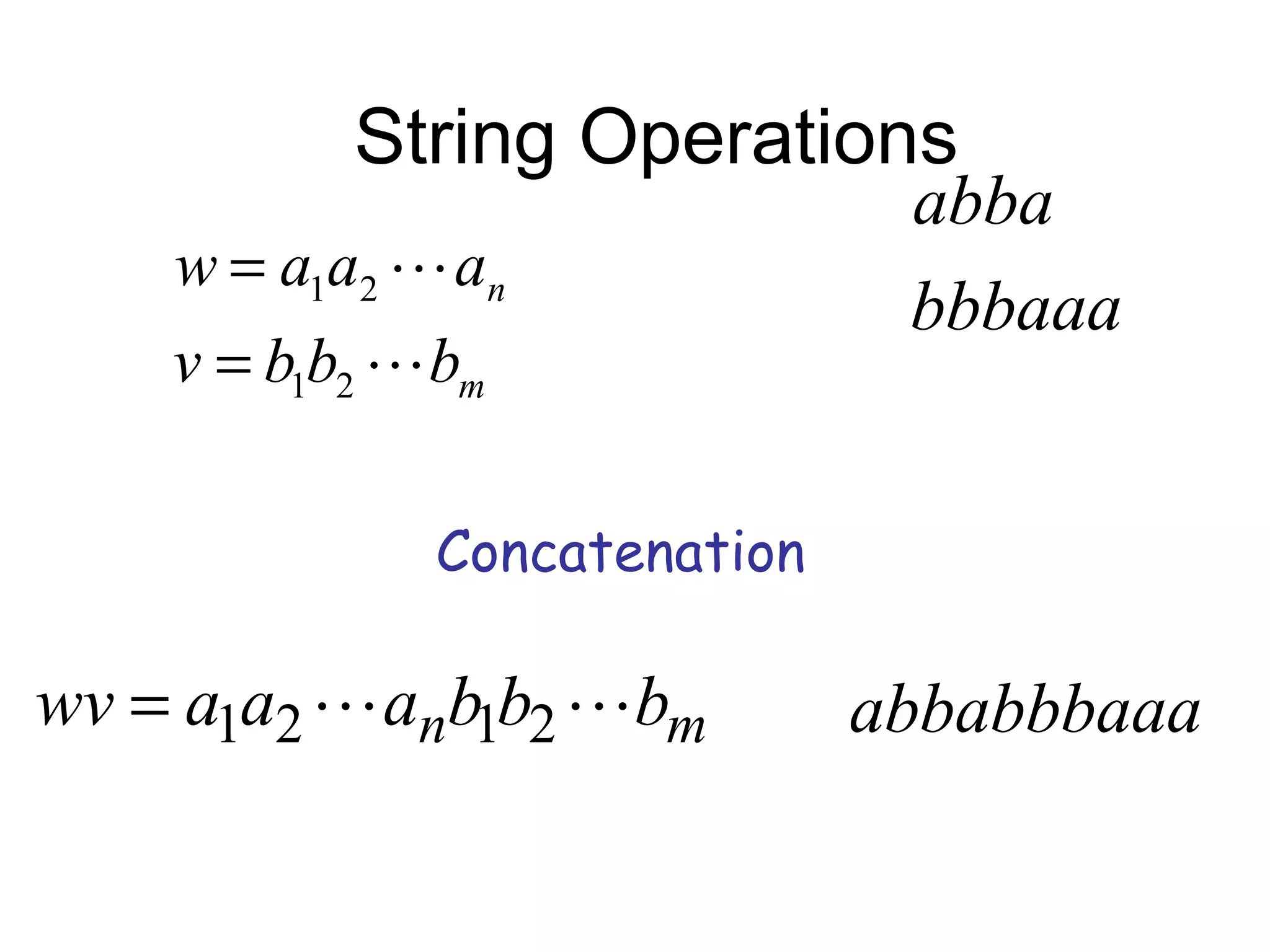
String Operations
                               abba
    w = a1a2  an
                               bbbaaa
    v = b1b2  bm

              Concatenation

wv = a1a2  anb1b2 bm        abbabbbaaa
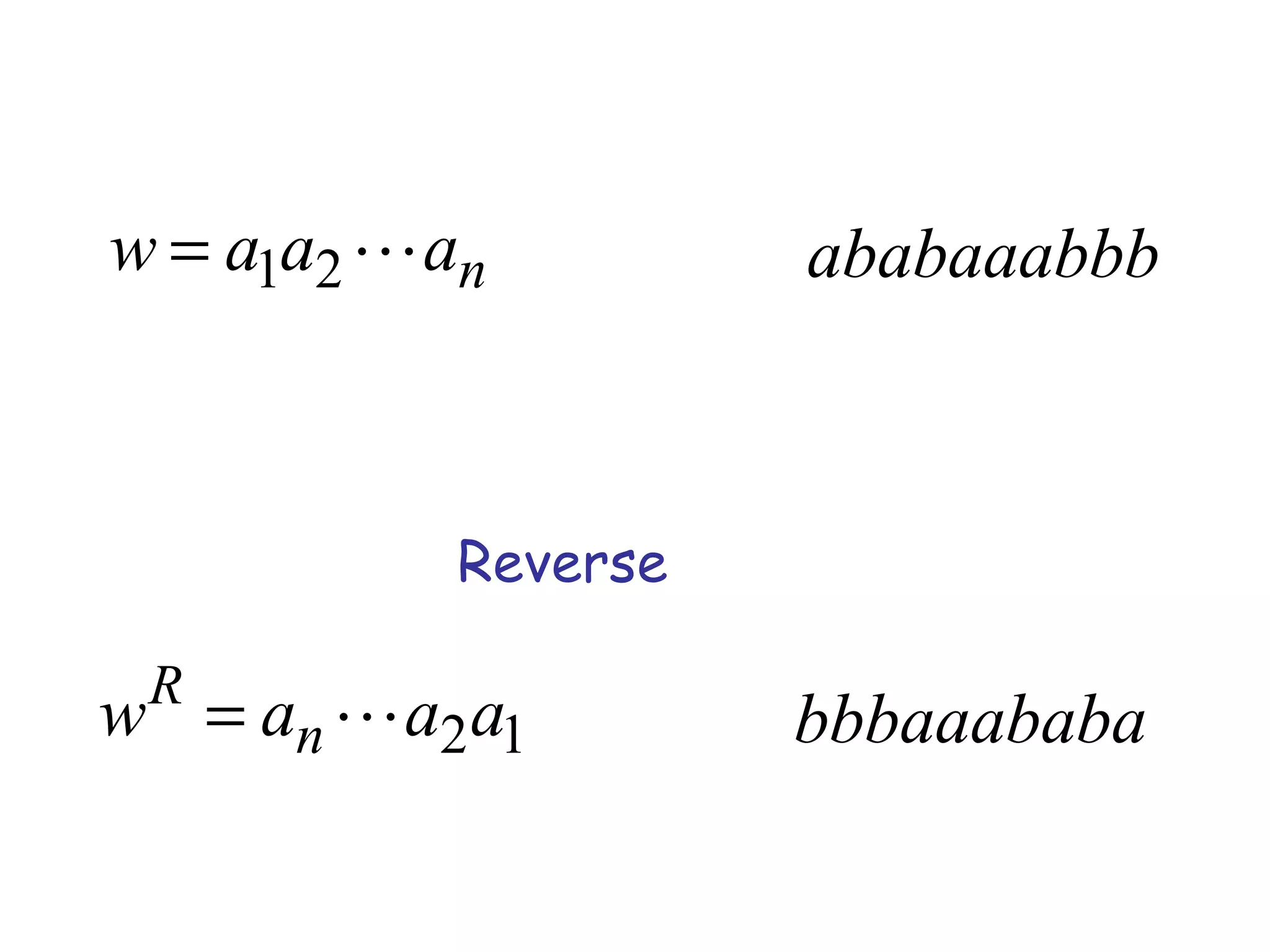
w = a1a2  an        ababaaabbb


           Reverse

 R
w = an  a2 a1       bbbaaababa
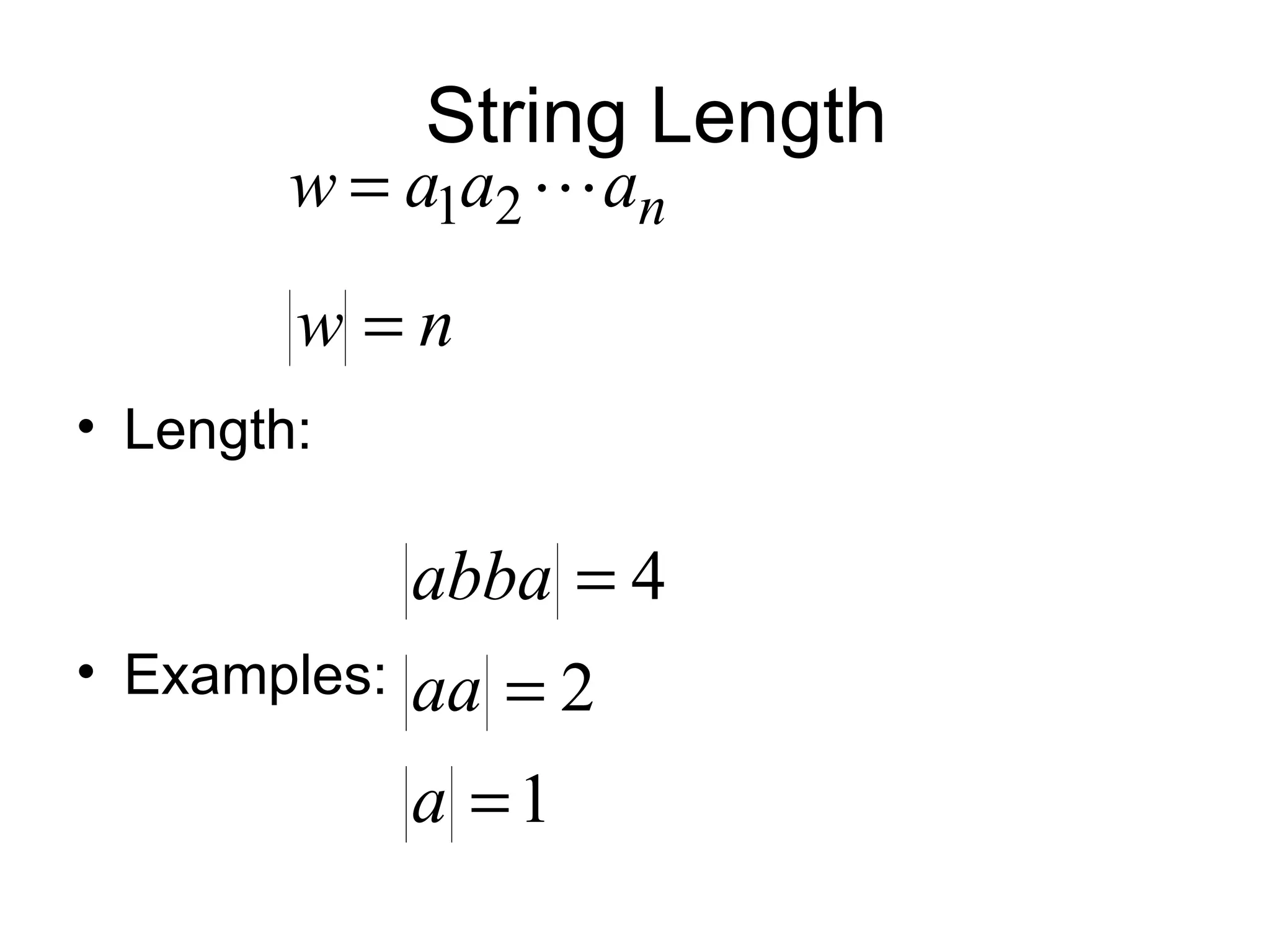
String Length
        w = a1a2  an
        w =n
• Length:

              abba = 4
• Examples:   aa = 2
              a =1
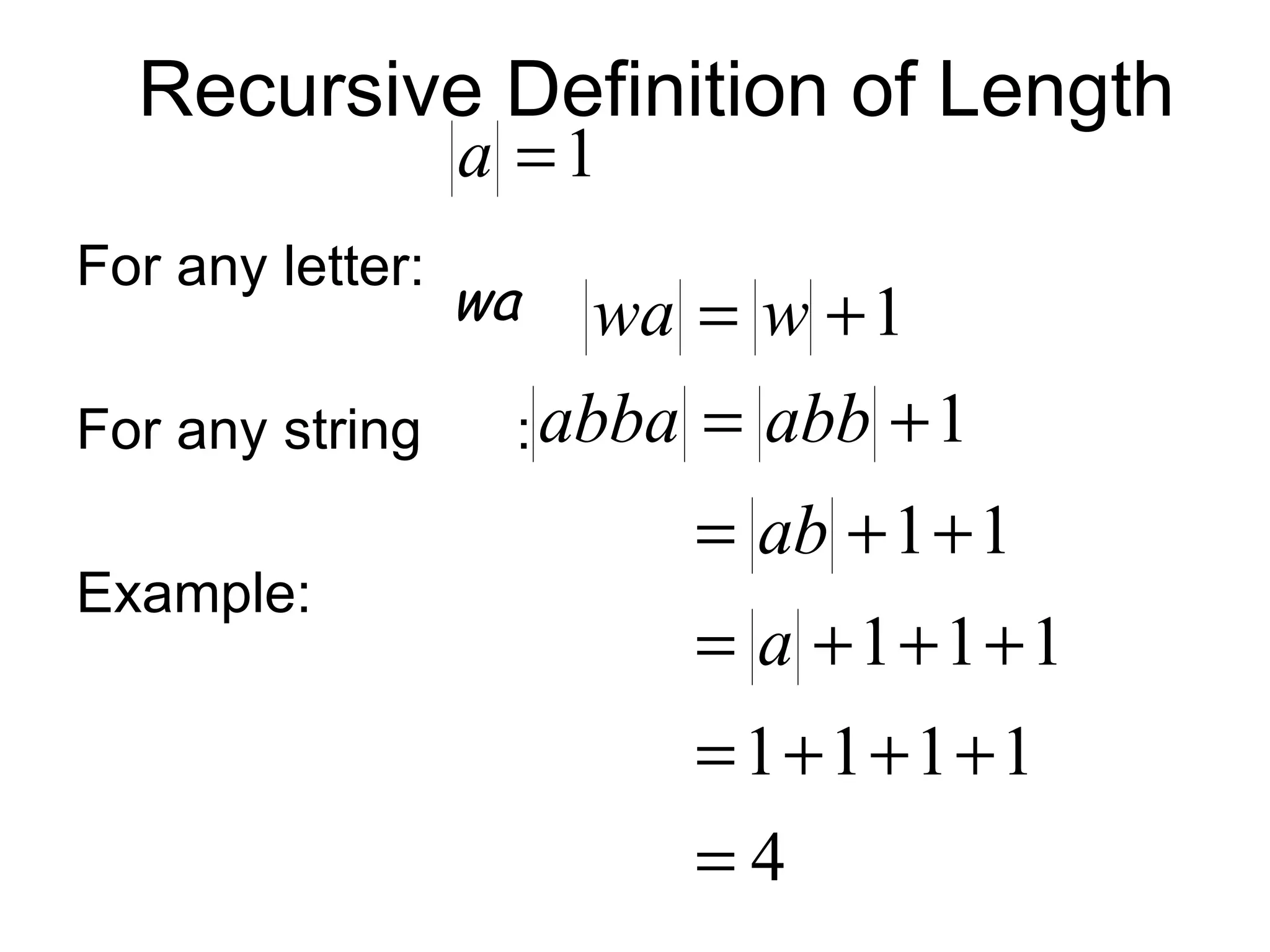
Recursive Definition of Length
                  a =1
For any letter:
                  wa   wa = w + 1
For any string     : abba   = abb + 1
                            = ab + 1 + 1
Example:
                            = a +1+1+1
                            = 1+1+1+1
                            =4
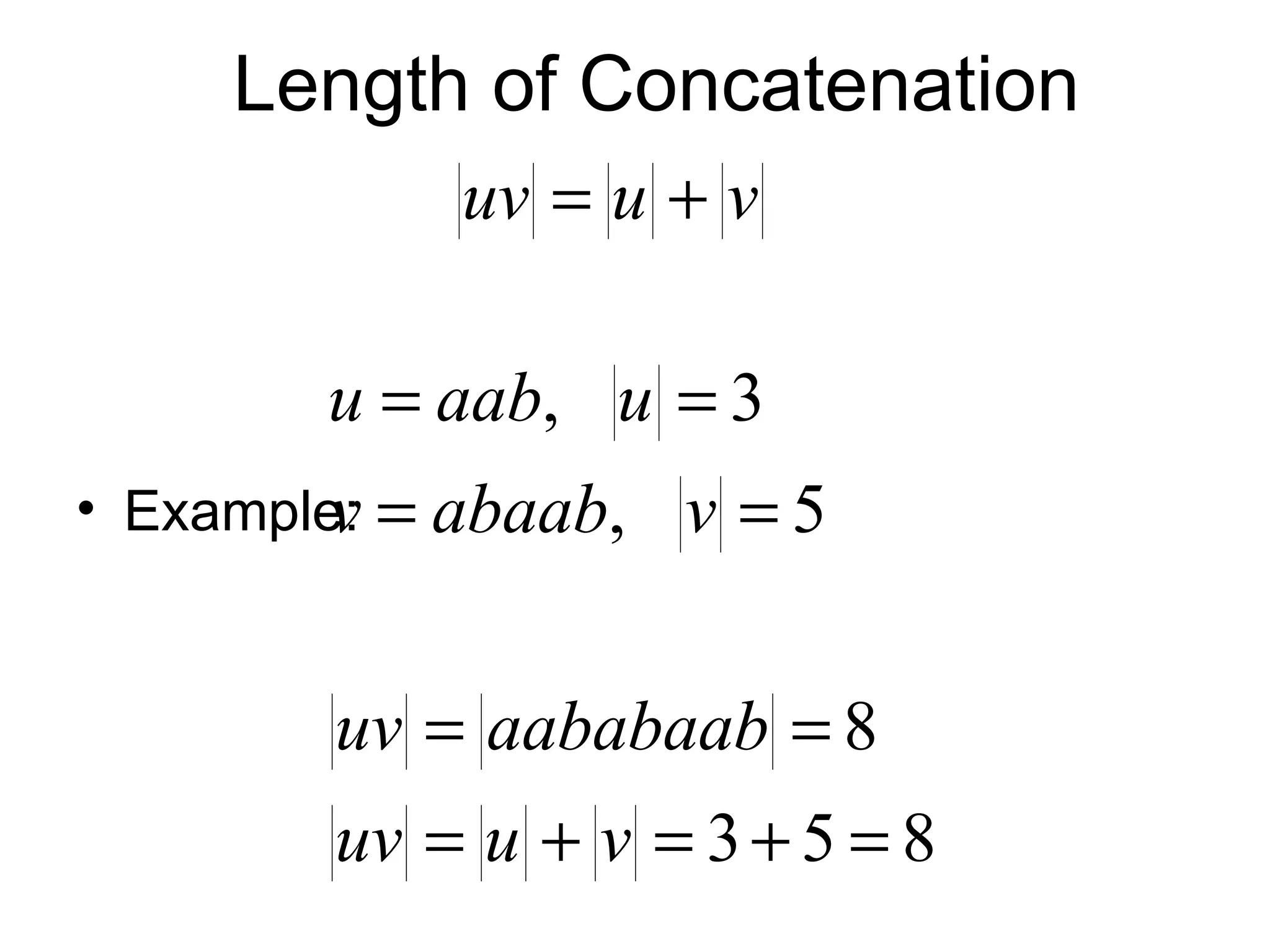
Length of Concatenation
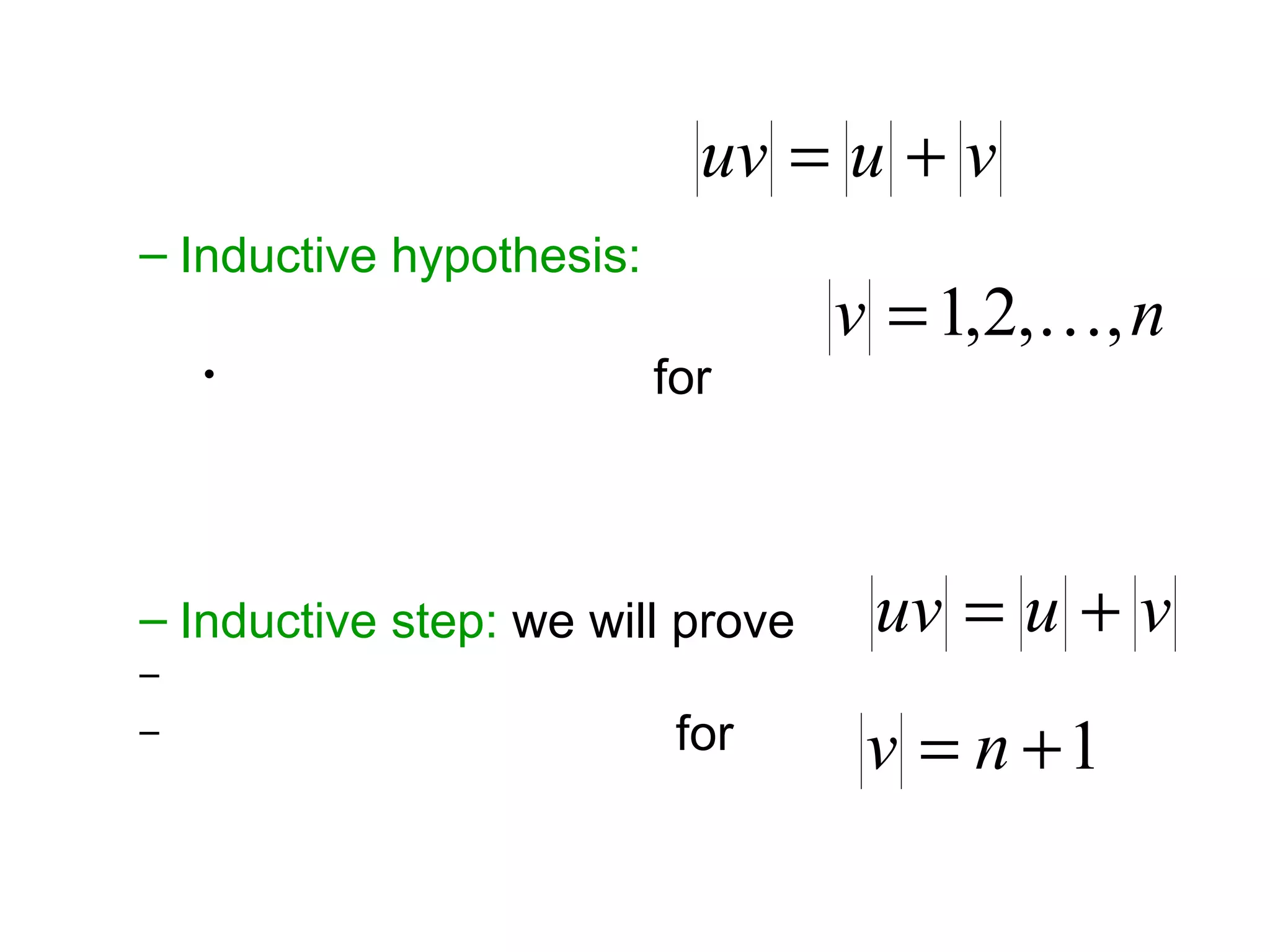
             uv = u + v

        u = aab, u = 3
• Example: = abaab,
         v            v =5


        uv = aababaab = 8
        uv = u + v = 3 + 5 = 8
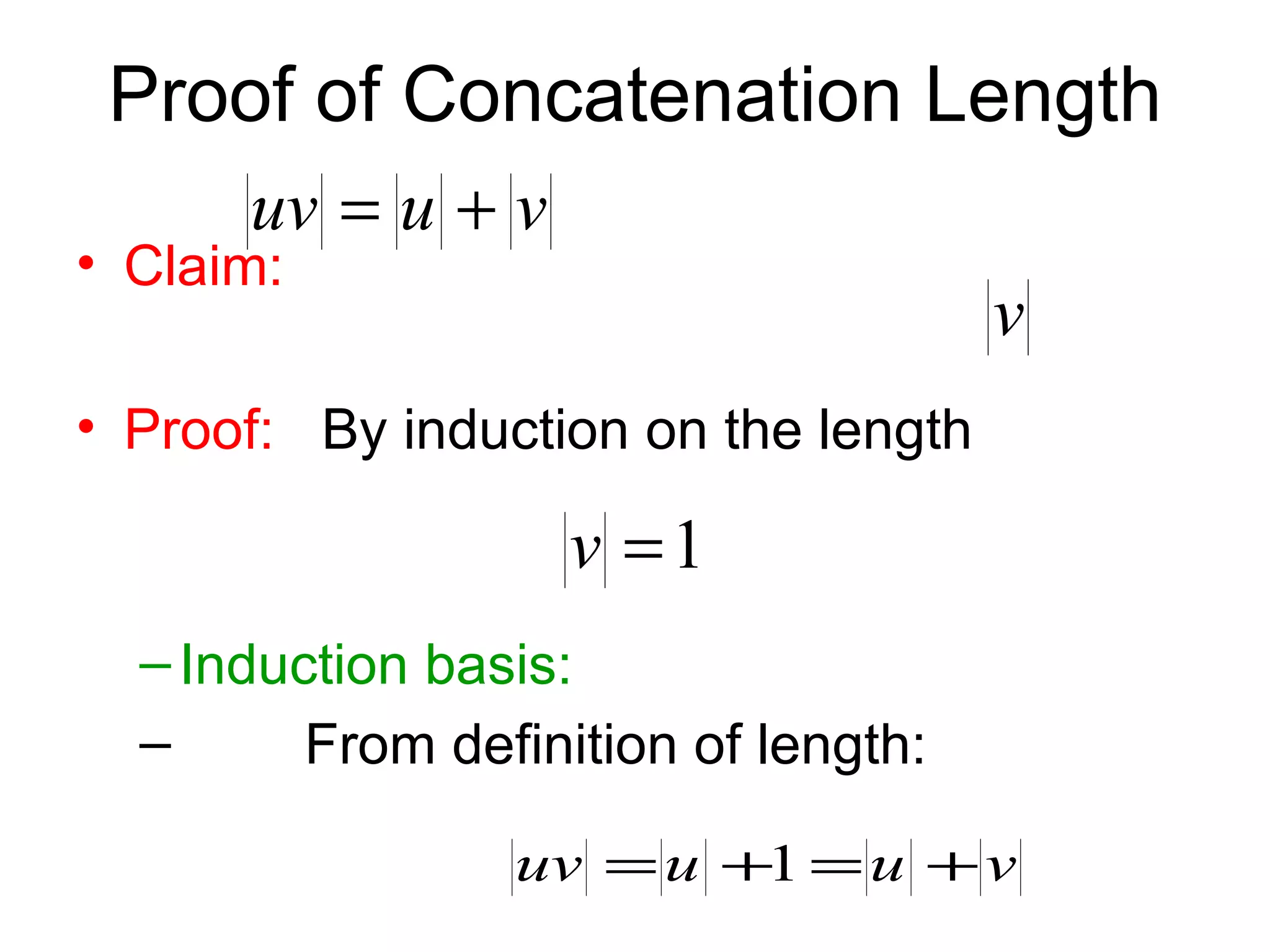
Proof of Concatenation Length
      uv = u + v
• Claim:
                                      v
• Proof: By induction on the length

                    v =1
  – Induction basis:
  –      From definition of length:

                 uv = u +1 = u + v
uv = u + v
– Inductive hypothesis:
                                  v = 1,2,, n
    •                     for


– Inductive step: we will prove    uv = u + v
–
–                          for     v = n +1
Inductive Step
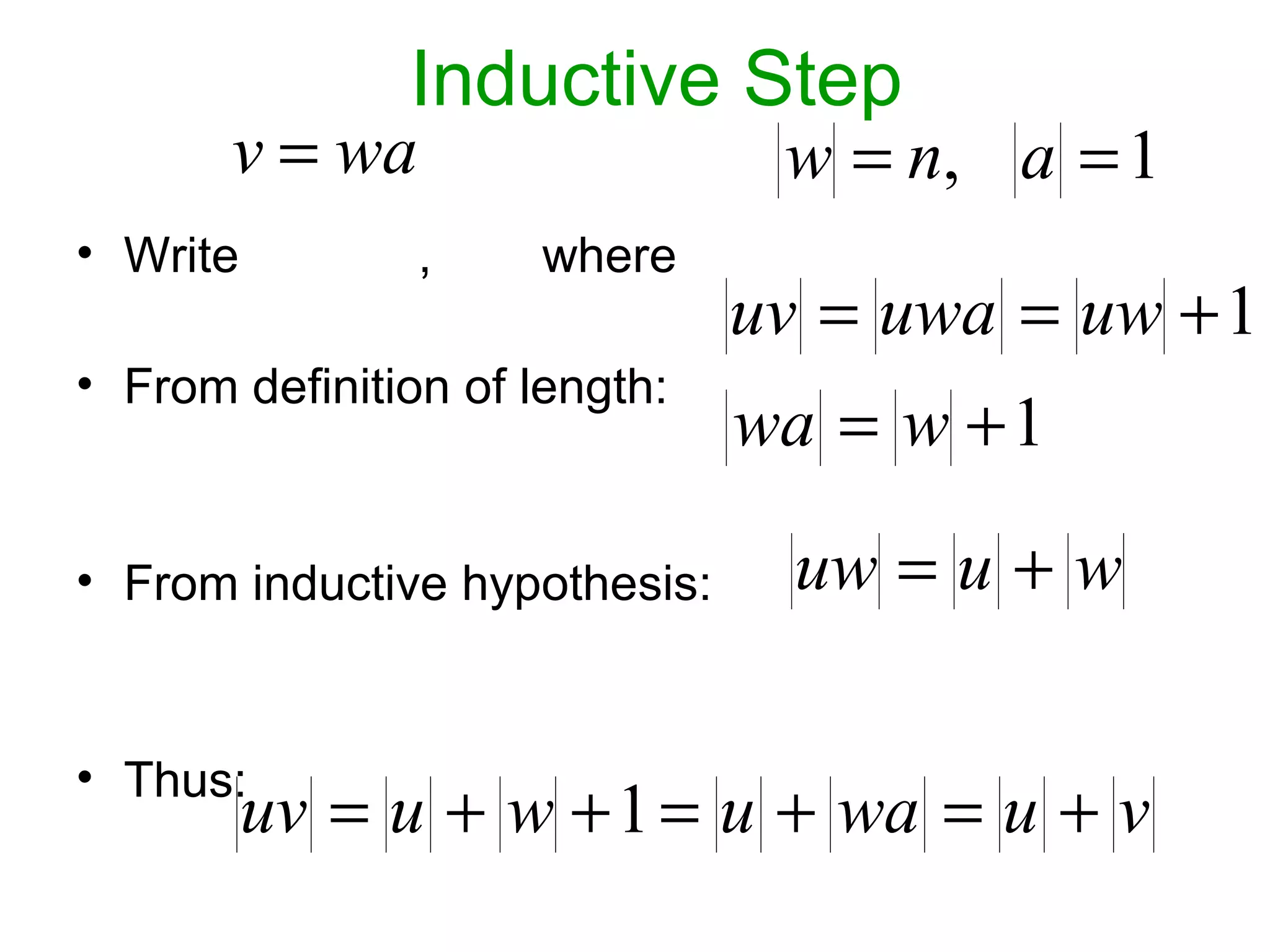
       v = wa                   w = n, a = 1
• Write         ,     where
                               uv = uwa = uw + 1
• From definition of length:
                               wa = w + 1

• From inductive hypothesis:     uw = u + w

• Thus:
          uv = u + w + 1 = u + wa = u + v
Empty String
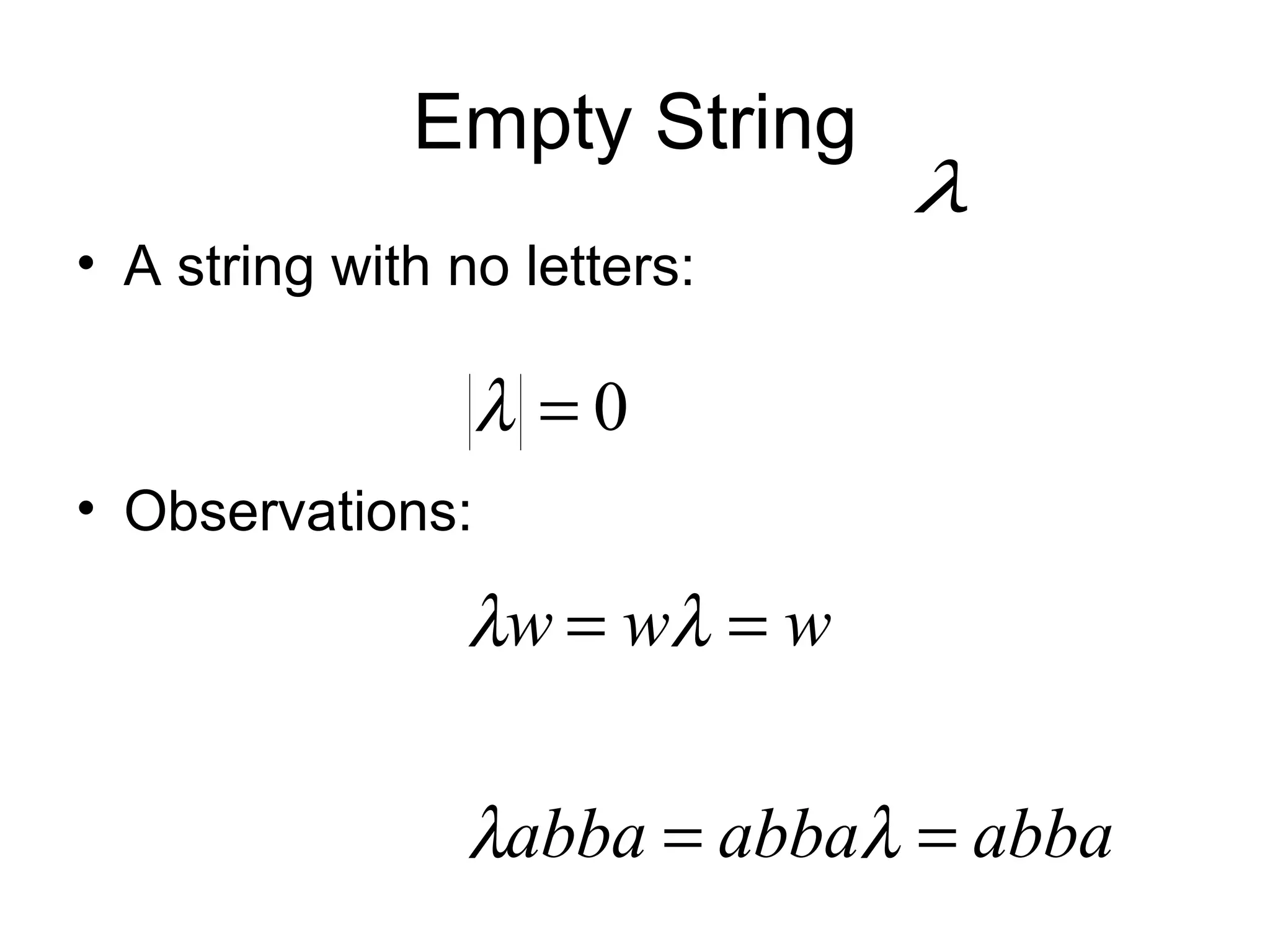
                               λ
• A string with no letters:

                  λ =0
• Observations:

                 λw = wλ = w

                 λabba = abbaλ = abba
Substring
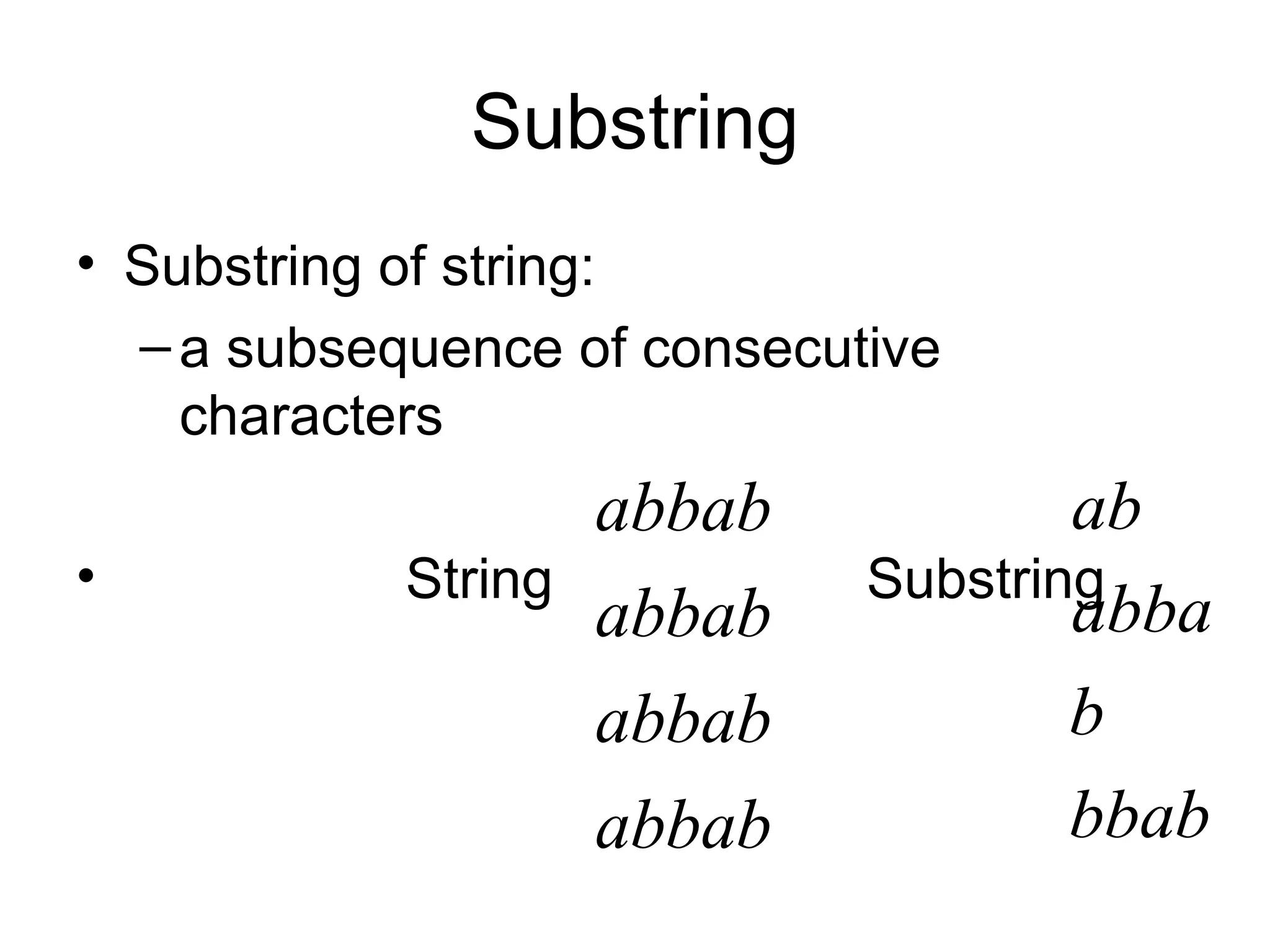
• Substring of string:
  – a subsequence of consecutive
    characters
                   abbab             ab
•           String           Substring
                   abbab             abba
                   abbab             b
                   abbab             bbab
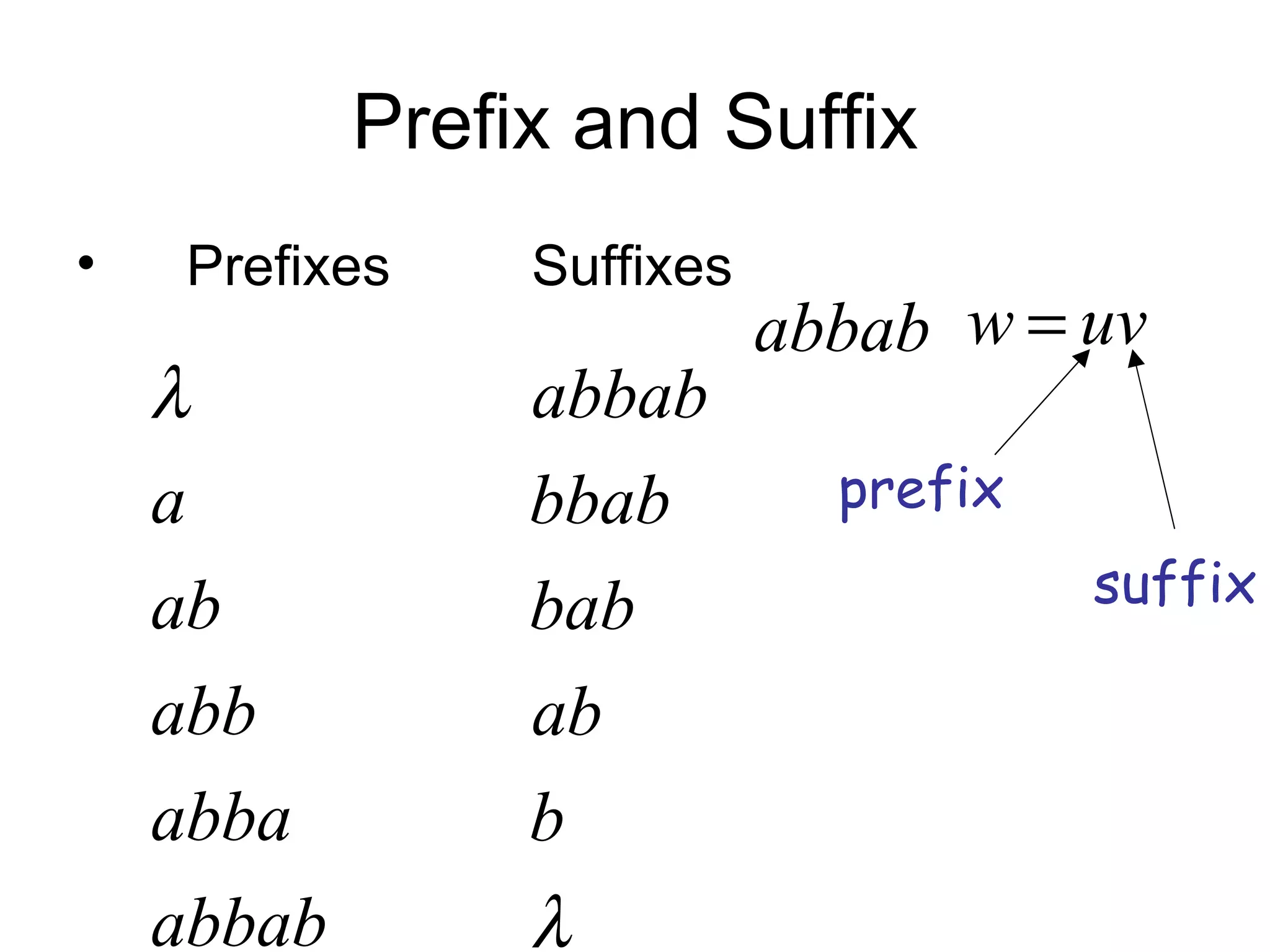
Prefix and Suffix
•    Prefixes    Suffixes
                            abbab w = uv
    λ            abbab
    a            bbab         prefix

    ab           bab                   suffix

    abb          ab
    abba         b
    abbab        λ
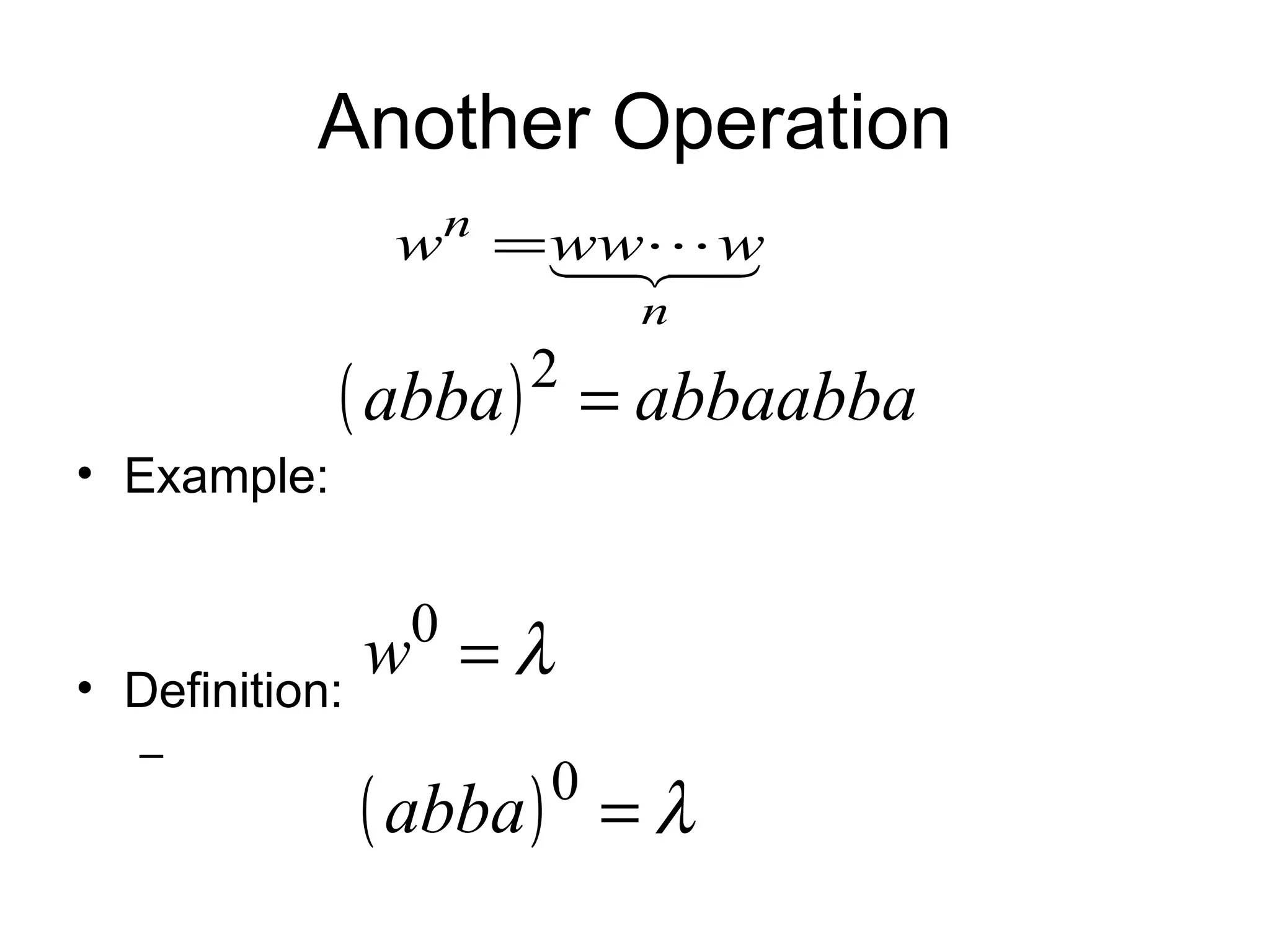
Another Operation
              wn = ww w
                   
                    
                       n

             ( abba ) = abbaabba
                   2
• Example:


               0
•   Definition:
                w =λ
    –
             ( abba ) = λ
                   0
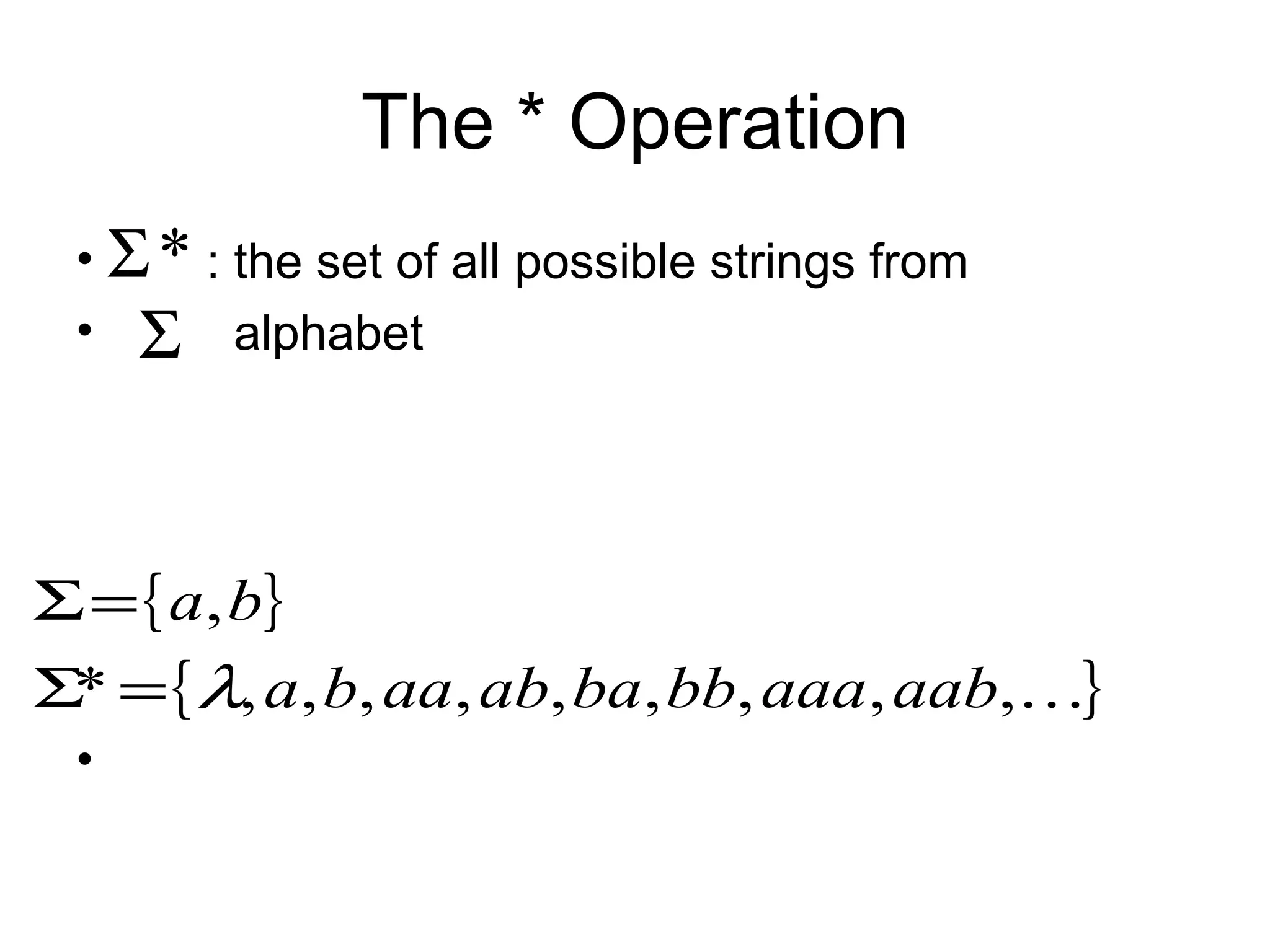
The * Operation
 • Σ * : the set of all possible strings from
 • Σ alphabet


Σ = { a, b}
Σ* = { λ, a, b, aa, ab, ba, bb, aaa, aab,}
 •
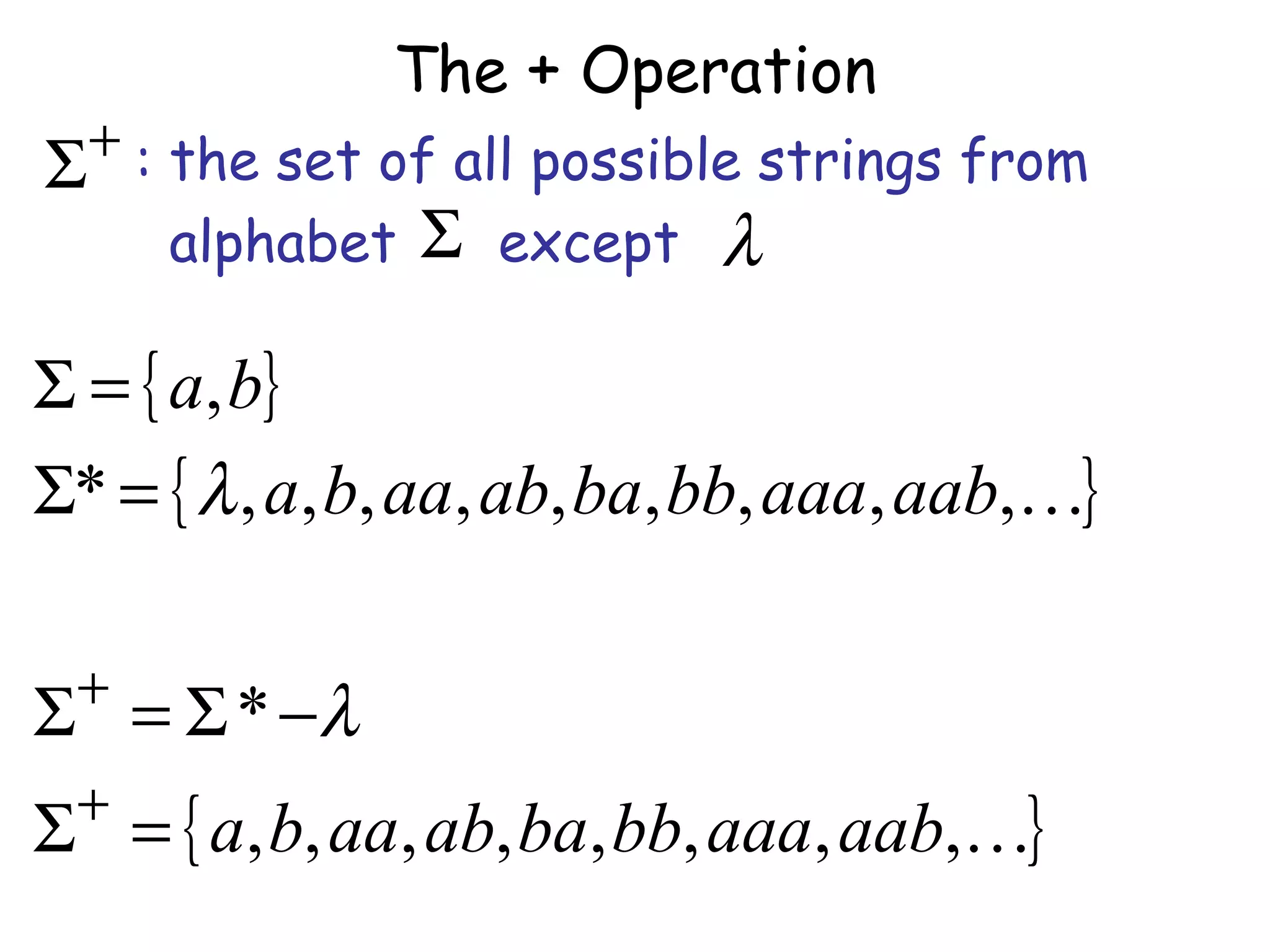
The + Operation
  + : the set of all possible strings from
Σ
      alphabet Σ except λ

Σ = { a, b}
Σ* = { λ , a, b, aa, ab, ba, bb, aaa, aab,}

 +
Σ = Σ * −λ
 +
Σ = { a, b, aa, ab, ba, bb, aaa, aab,}
Language

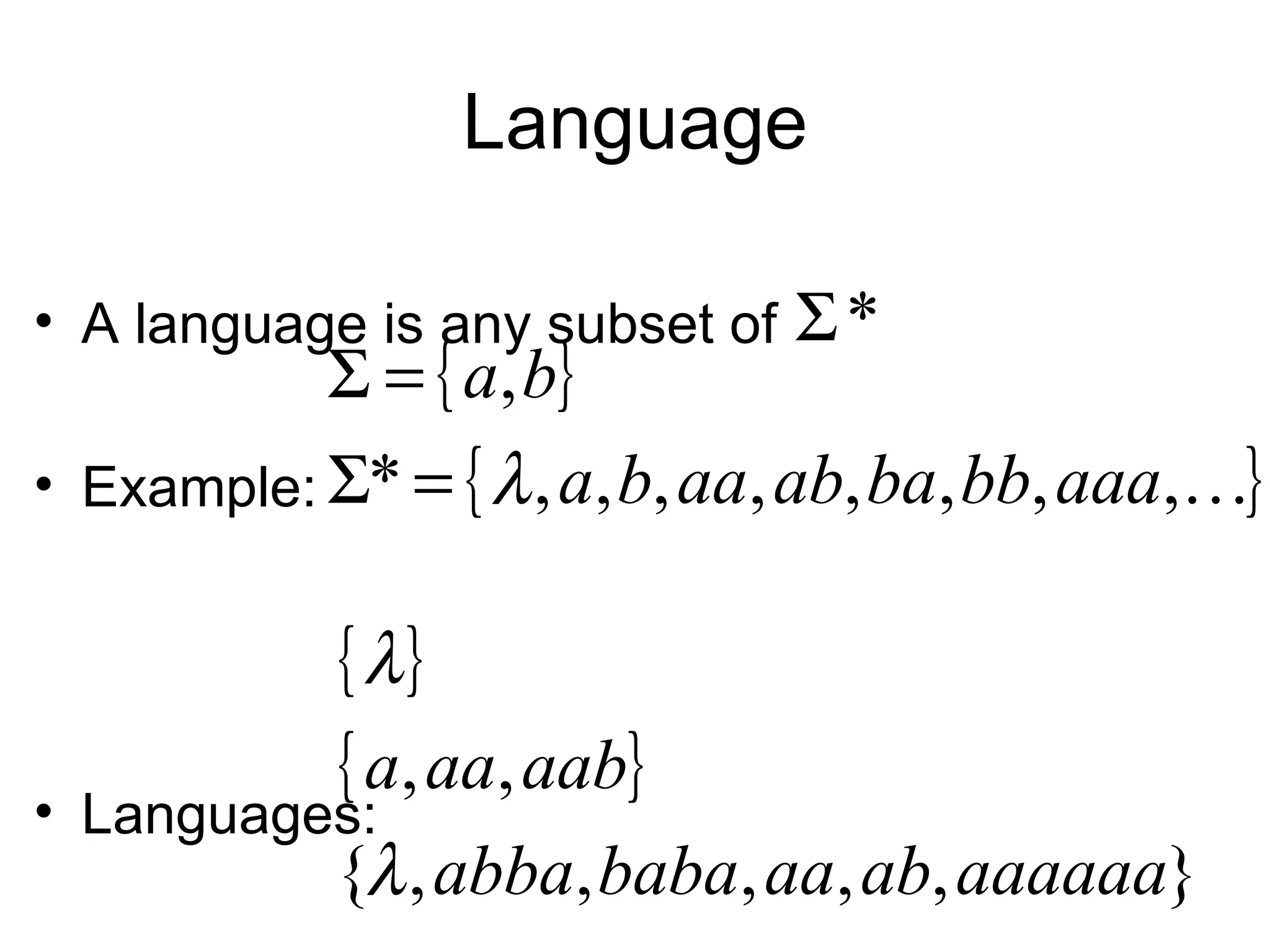
• A language is any subset of   Σ*
           Σ = { a, b}
• Example: Σ* = { λ , a, b, aa, ab, ba, bb, aaa,}


            { λ}
            { a, aa, aab}
• Languages:
            {λ , abba, baba, aa, ab, aaaaaa}
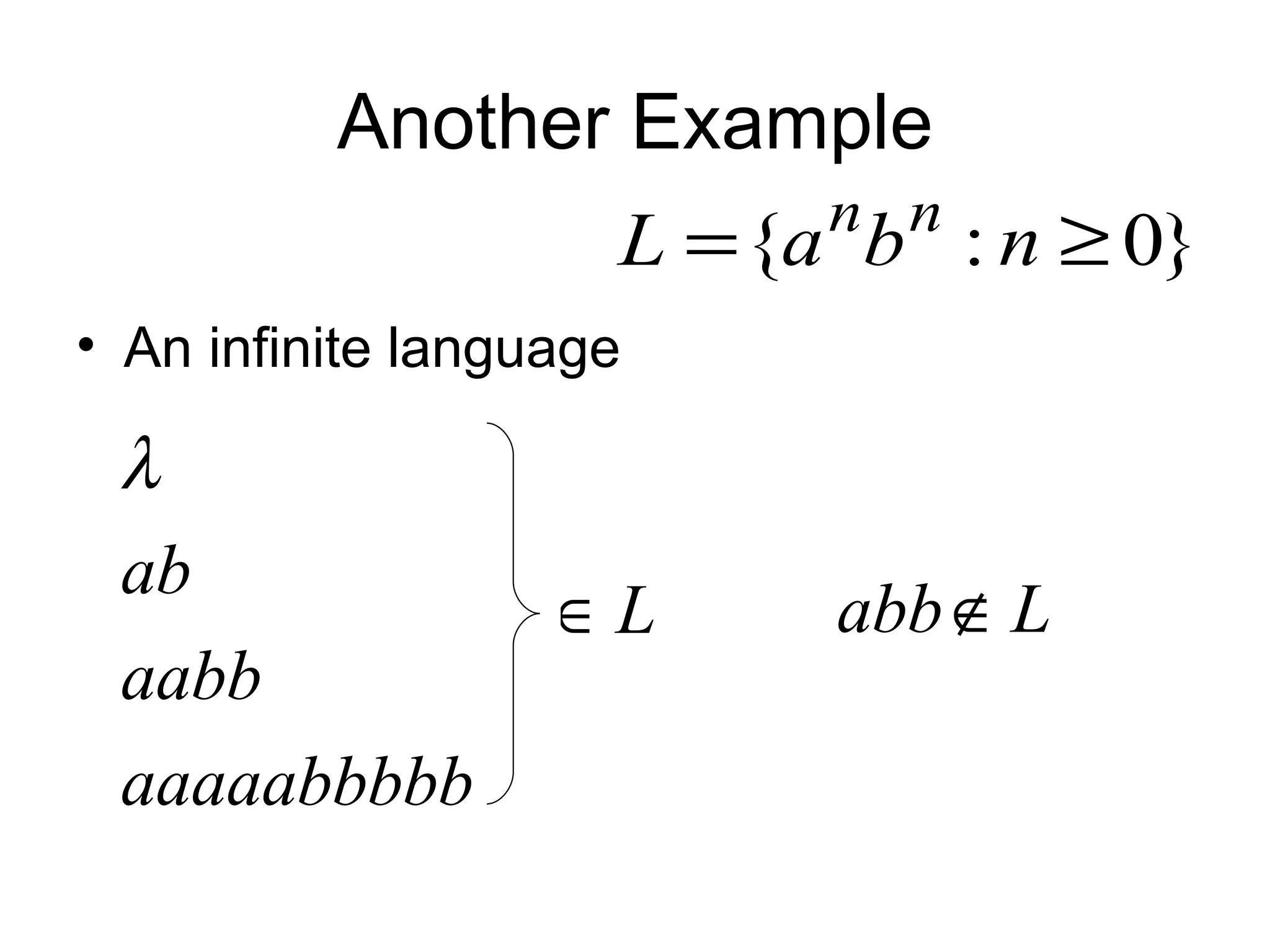
Another Example
                       n n
                 L = {a b : n ≥ 0}
• An infinite language

 λ
 ab
                   ∈L    abb ∉ L
 aabb
 aaaaabbbbb
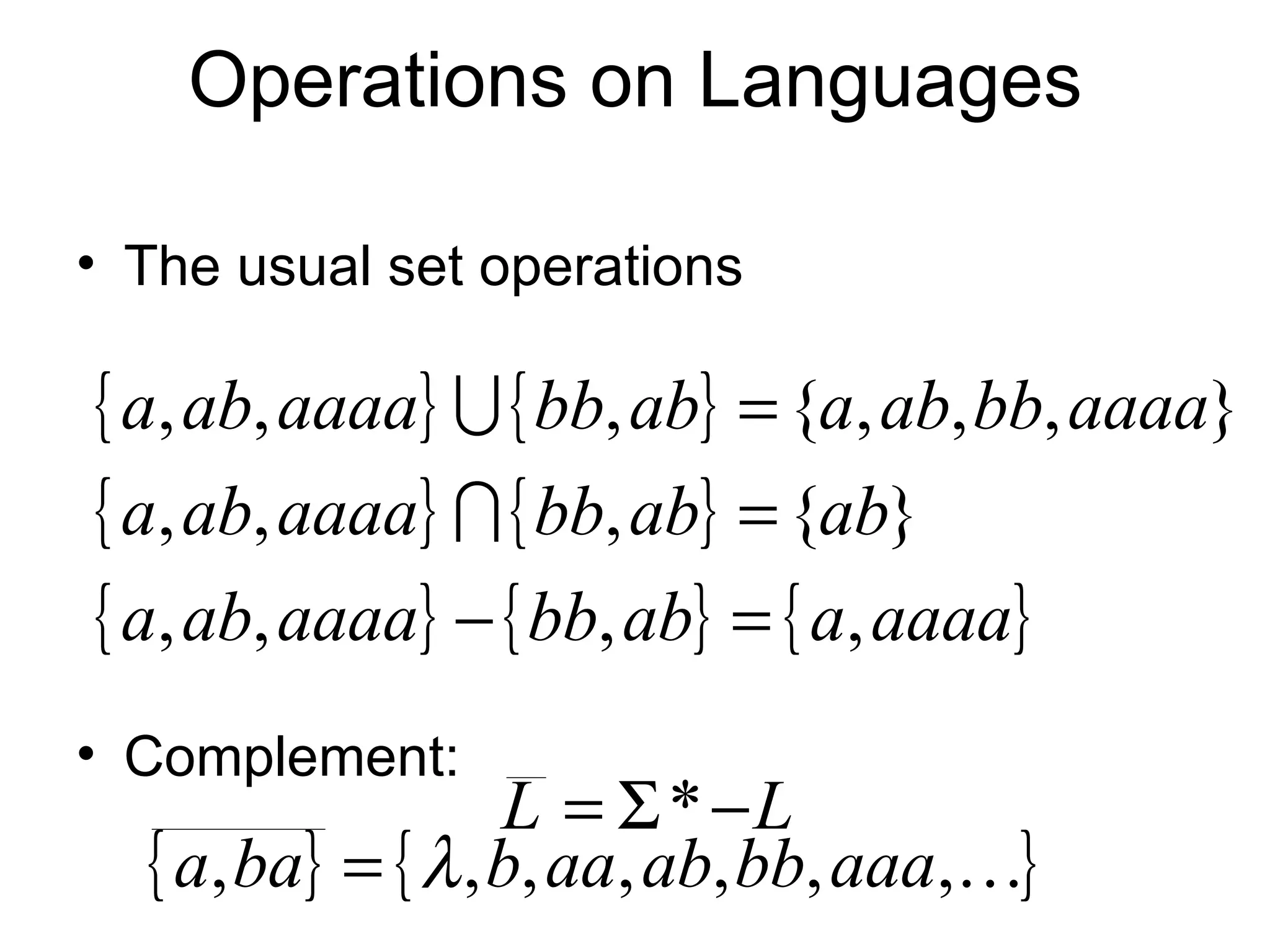
Operations on Languages

• The usual set operations

{ a, ab, aaaa}  { bb, ab} = {a, ab, bb, aaaa}
{ a, ab, aaaa}  { bb, ab} = {ab}
{ a, ab, aaaa} − { bb, ab} = { a, aaaa}
• Complement:
                   L = Σ * −L
  { a, ba} = { λ , b, aa, ab, bb, aaa,}
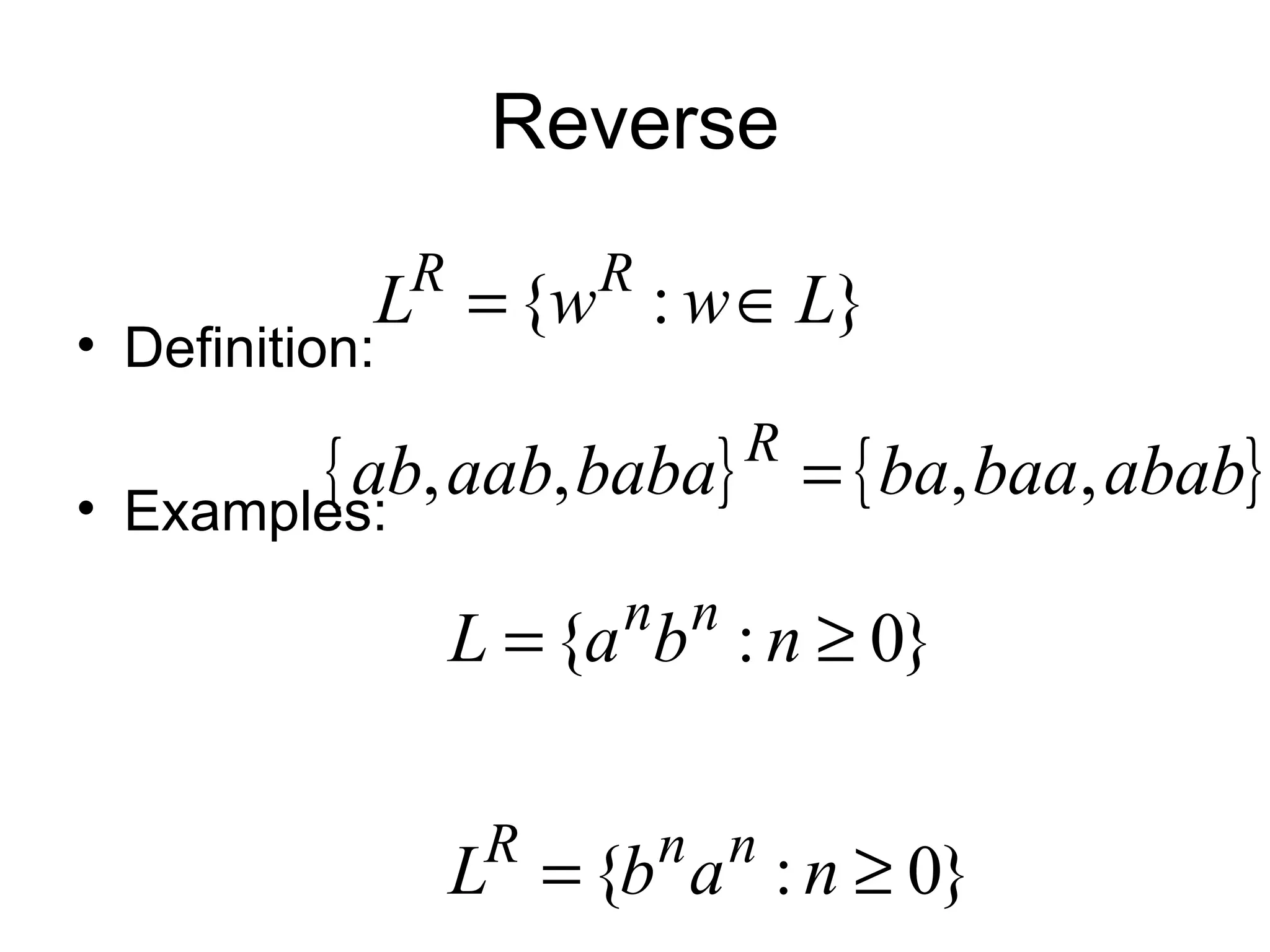
Reverse
                R        R
             L = {w : w ∈ L}
• Definition:

•
          { ab, aab, baba} = { ba, baa, abab}
    Examples:
                                R

                          n n
                    L = {a b : n ≥ 0}

                     R       n n
                    L = {b a : n ≥ 0}
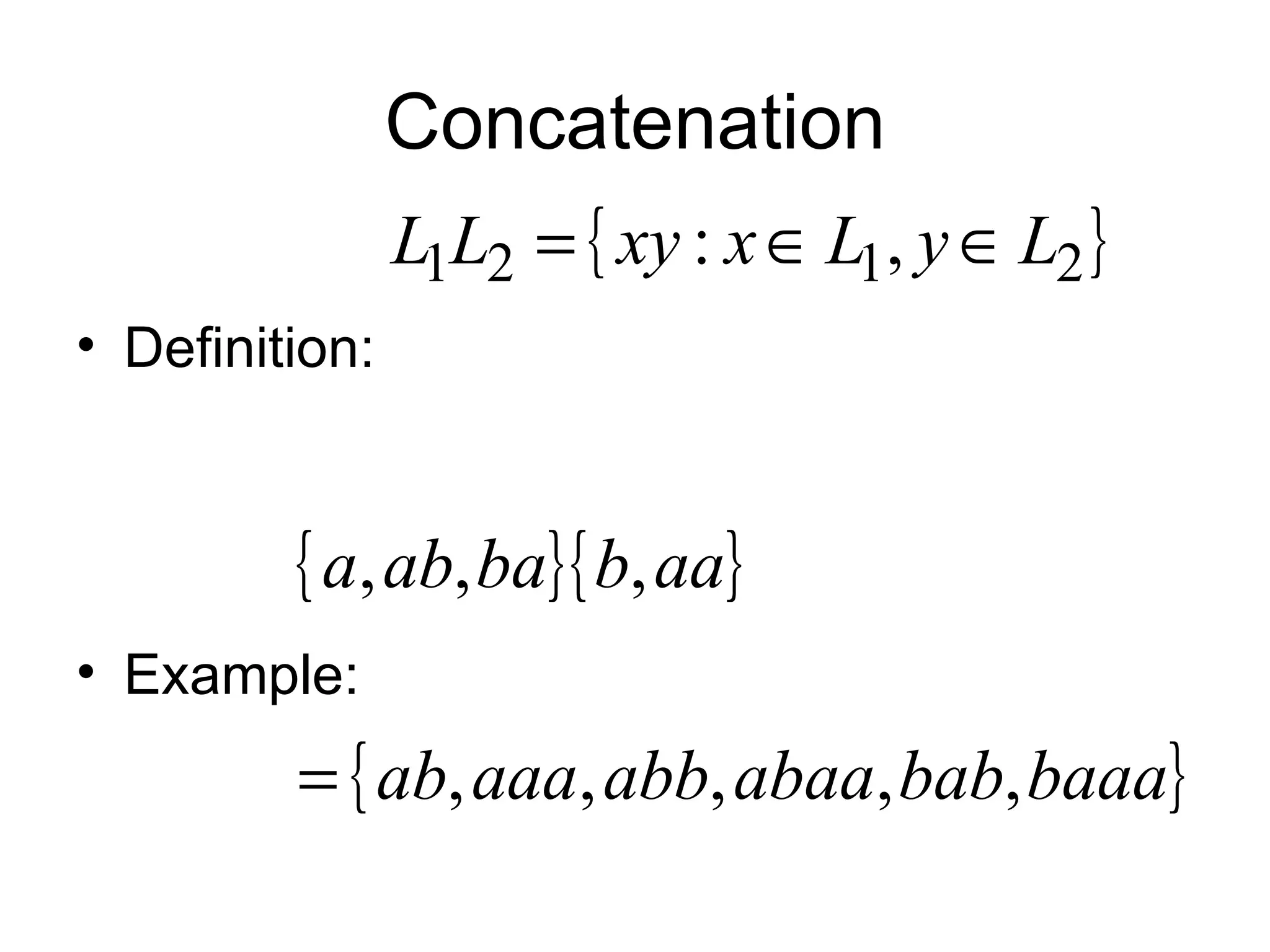
Concatenation
                L1L2 = { xy : x ∈ L1, y ∈ L2 }
• Definition:


         { a, ab, ba}{ b, aa}
• Example:
         = { ab, aaa, abb, abaa, bab, baaa}
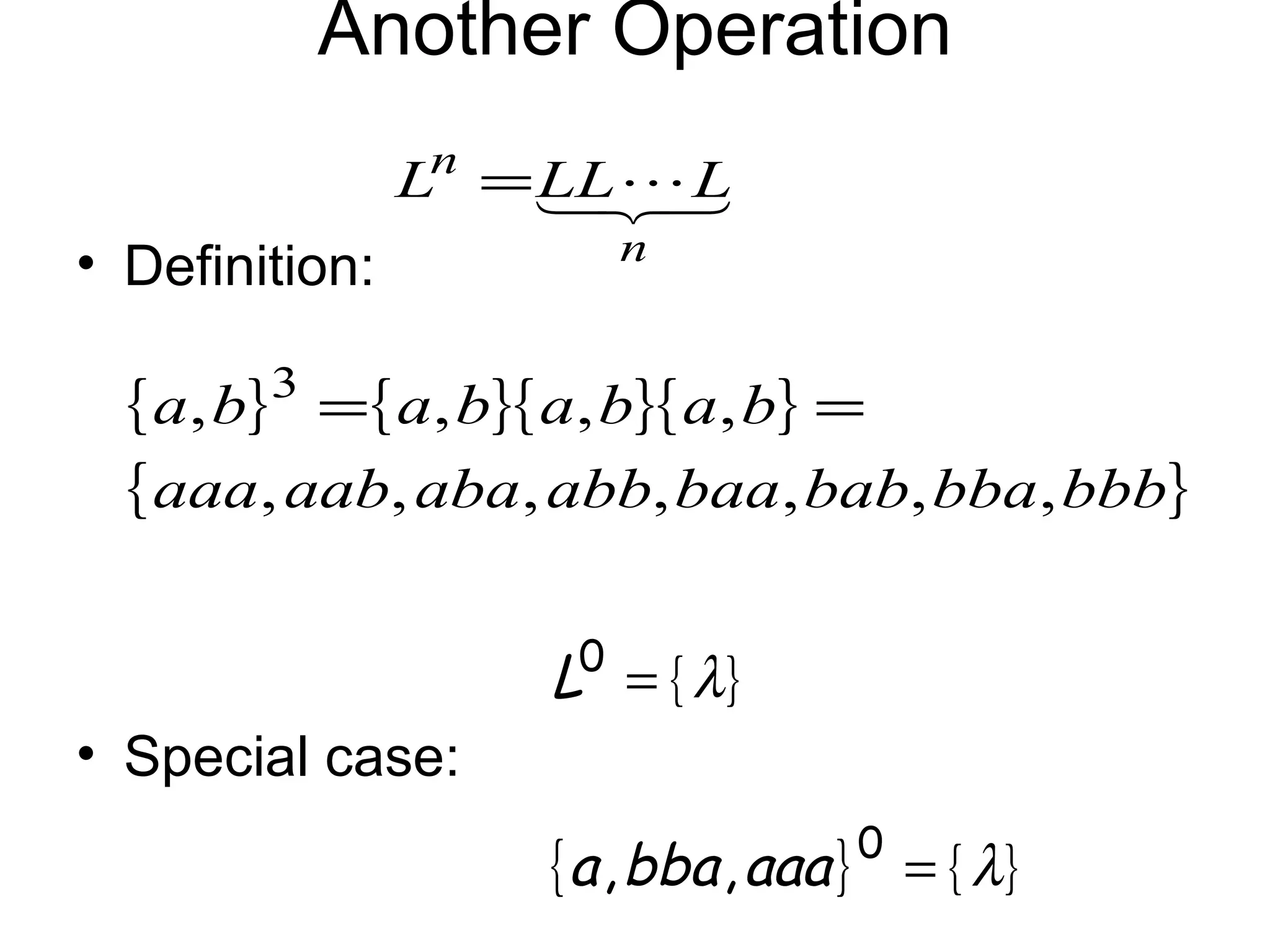
Another Operation
                Ln = 
                     LL  L
                        n
• Definition:

  { a, b}3 ={ a, b}{ a, b}{ a, b} =
  { aaa, aab, aba, abb, baa, bab, bba, bbb}

                     L0 = { λ}
• Special case:
                                    0
                     { a , bba , aaa } = { λ}
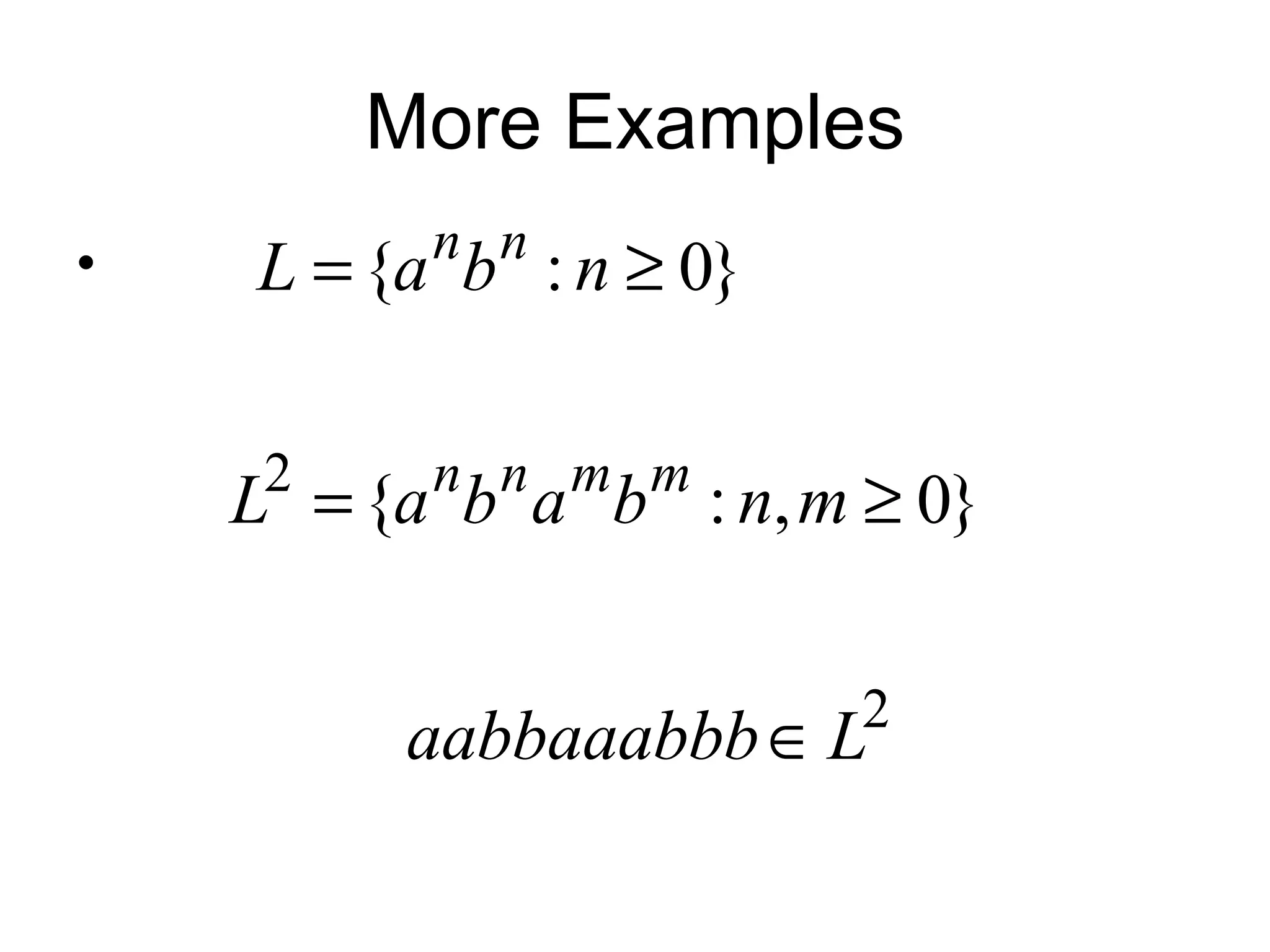
More Examples
          n n
•   L = {a b : n ≥ 0}

     2    n n m m
    L = {a b a b : n, m ≥ 0}

                        2
         aabbaaabbb ∈ L
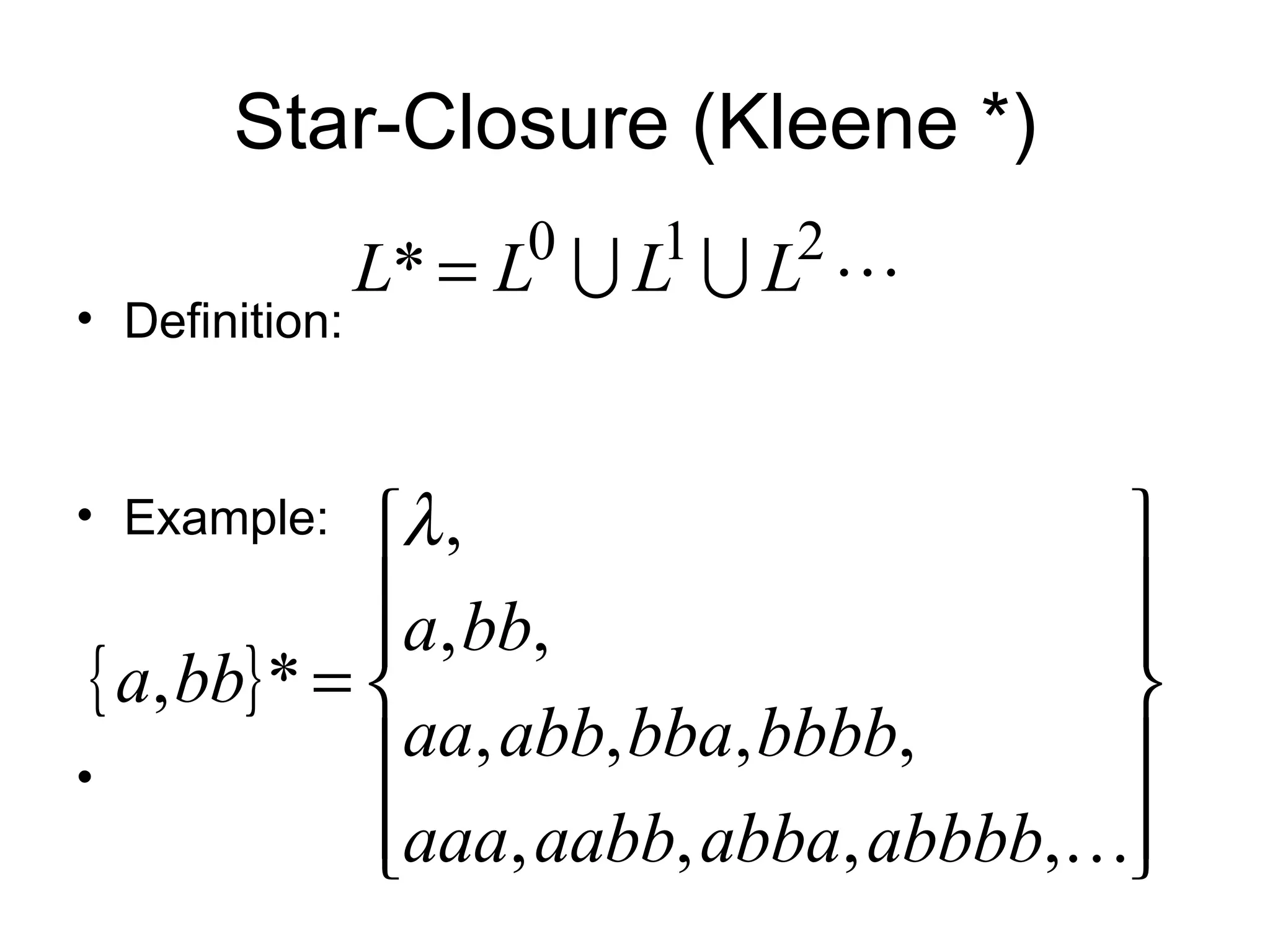
Star-Closure (Kleene *)
                     0   1   2
                L* = L  L  L 
• Definition:


• Example:    λ ,                     
              a, bb,                  
                                      
 { a, bb} * =                         
               aa, abb, bba, bbbb,    
•
              aaa, aabb, abba, abbbb,
                                      
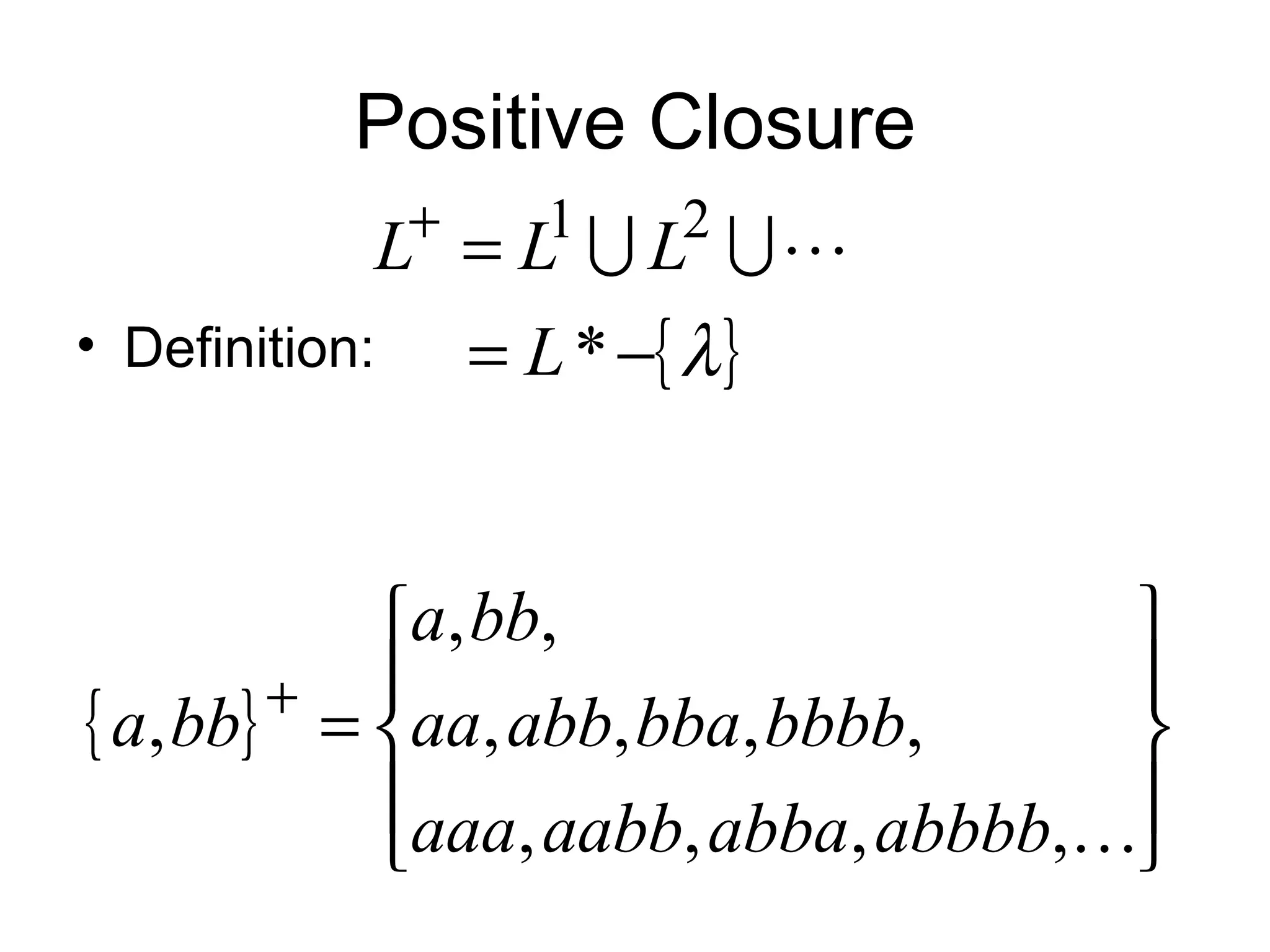
Positive Closure
           +    1    2
             L = L  L 
• Definition:  = L * −{ λ }


           a, bb,                  
        +                          
{ a, bb} = aa, abb, bba, bbbb,     
           aaa, aabb, abba, abbbb,
                                   
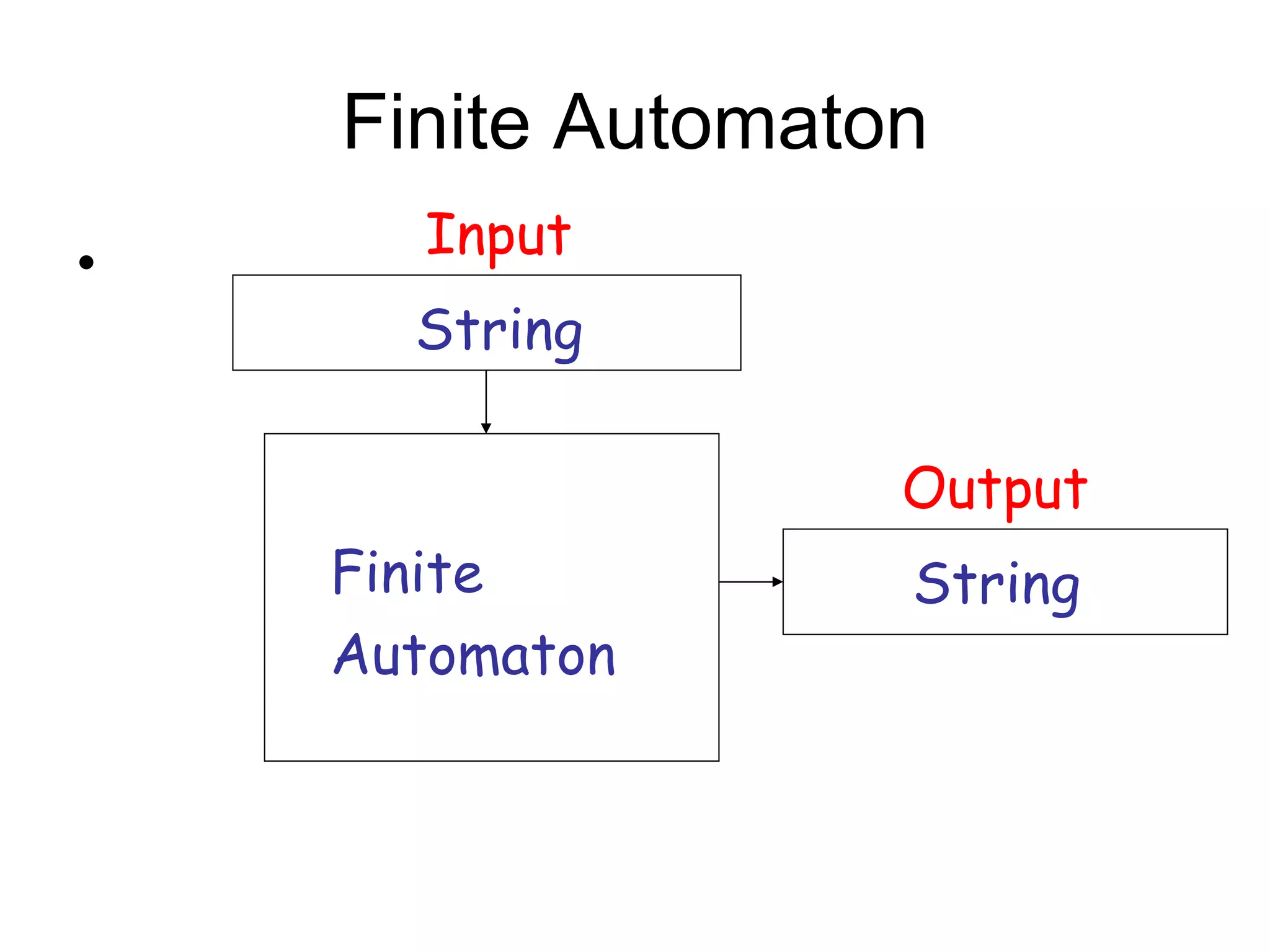
Finite Automaton
      Input
•
      String

                   Output
    Finite         String
    Automaton

Finite automata intro

  • 1.
    Theory of Automata & Formal Languages
  • 2.
    BOOKS Theory of computerScience: K.L.P.Mishra & N.Chandrasekharan Intro to Automata theory, Formal languages and computation: Ullman,Hopcroft Motwani Elements of theory of computation Lewis & papadimitrou
  • 3.
    Syllabus Introduction Deterministic and nondeterministic Finite Automata, Regular Expression,Two way finite automata,Finite automata with output,properties of regular sets,pumping lemma, closure properties,Myhill nerode theorem
  • 4.
    Context free Grammar:Derivation trees, Simplification forms Pushdown automata: Def, Relationship between PDA and context free language,Properties, decision algorithms Turing Machines: Turing machine model,Modification of turing machines,Church’s thesis,Undecidability,Recursive and recursively enumerable languages Post correspondence problems recursive functions
  • 5.
    Chomsky Hierarchy: Regulargrammars, unrestricted grammar, context sensitive language, relationship among languages
  • 6.
    temporary memory input memory CPU output memory Program memory
  • 7.
    3 temporary memory f ( x) = x z = 2*2 = 4 f ( x) = z * 2 = 8 input memory x=2 CPU output memory Program memory compute x∗x 2 compute x ∗x
  • 8.
    Automaton temporary memory Automaton input memory CPU output memory Program memory
  • 9.
    temporary memory input memory Finite Automaton output memory
  • 10.
    Different Kinds ofAutomata Automata are distinguished by the temporary memory • Finite Automata: no temporary memory • Pushdown Automata: stack • Turing Machines: random access memory
  • 11.
    Turing Machine Random Access Memory input memory Turing Machine output memory Algorithms (highest computing power)
  • 12.
    Power of Automata Finite Pushdown Turing Automata Automata Machine
  • 13.
    Power sets A powerset is a set of sets S = { a, b, c } Powerset of S = the set of all the subsets of S 2S = { , {a}, {b}, {c}, {a, b}, {a, c}, {b, c}, {a, b, c} } Observation: | 2S | = 2|S| ( 8 = 23 )
  • 14.
    Cartesian Product A = { 2, 4 } B = { 2, 3, 5 } A X B = { (2, 2), (2, 3), (2, 5), ( 4, 2), (4, 3), (4, 4) } |A X B| = |A| |B| Generalizes to more than two sets AXBX…XZ
  • 15.
    RELATIONS R = {(x1,y1), (x2, y2), (x3, y3), …} xi R yi e. g. if R = ‘>’: 2 > 1, 3 > 2, 3 > 1 In relations xi can be repeated
  • 16.
    Equivalence Relations • Reflexive: xRx • Symmetric: xRy yRx • Transitive: x R Y and y R z xRz Example: R = ‘=‘ •x=x •x=y y=x • x = y and y = z x=z
  • 17.
    Equivalence Classes For equivalencerelation R equivalence class of x = {y : x R y} Example: R = { (1, 1), (2, 2), (1, 2), (2, 1), (3, 3), (4, 4), (3, 4), (4, 3) } Equivalence class of 1 = {1, 2} Equivalence class of 3 = {3, 4}
  • 18.
    Example of Equivalencerelation Let Z = set of integers R be defined on it as: R= {(x,y)| x ∈Z, y ∈ Z and (x - y)is divisible by 5} This relation is known as ” congruent modulo 5”
  • 19.
    The equivalence classesare [0]R= {…-10, -5, 0, 5,10,…} [1]R = {…..,-9, -4, 1, 6, 11, 16….} [2]R= {….-8, -3,2,7,12,17…..} [3]R = {….-7, -2, 3, 8 ,13,…} [4]R = {….-6,-1,4,9,14,19,….} Z/R ={[0]R, [1]R, [2]R, [3]R, [4]R}
  • 20.
    PROOF TECHNIQUES • Proofby induction • Proof by contradiction
  • 21.
    Induction We have statementsP1, P2, P3, … If we know • for some k that P1, P2, …, Pk are true • for any n >= k that P1, P2, …, Pn imply Pn+1 Then Every Pi is true
  • 22.
    Trees root parent leaf child Trees have no cycles
  • 23.
    Proof by Induction •Inductive basis Find P1, P2, …, Pk which are true • Inductive hypothesis Let’s assume P1, P2, …, Pn are true, for any n >= k • Inductive step Show that Pn+1 is true
  • 24.
    root Level 0 Level 1 leaf Height 3 Level 2 Level 3
  • 25.
  • 26.
    Example Theorem: A binarytree of height n has at most 2n leaves. Proof: let l(i) be the number of leaves at level i l(0) = 0 l(3) = 8
  • 27.
    Induction Step Level n hypothesis: l(n) <= 2n n+1
  • 28.
    We want toshow: l(i) <= 2i • Inductive basis l(0) = 1 (the root node) • Inductive hypothesis Let’s assume l(i) <= 2i for all i = 0, 1, …, n • Induction step we need to show that l(n + 1) <= 2n+1
  • 29.
    Induction Step Level n hypothesis: l(n) <= 2n n+1 l(n+1) <= 2 * l(n) <= 2 * 2n = 2n+1
  • 30.
    Proof by Contradiction Wewant to prove that a statement P is true • we assume that P is false • then we arrive at an incorrect conclusion • therefore, statement P must be true
  • 31.
    Example Theorem: 2 is not rational Proof: Assume by contradiction that it is rational 2 = n/m n and m have no common factors We will show that this is impossible
  • 32.
    2 = n/m 2 m2 = n2 n is even Therefore, n2 is even n=2k m is even 2 m2 = 4k2 m2 = 2k2 m=2p Thus, m and n have common factor 2 Contradiction!
  • 33.
    Basic Terms Alphabet: Afinite non empty set of elements. ∑∑ ={a,b,c,d,…z}
  • 34.
    • String: A sequence of letters – Examples: “cat”, “dog”, “house”, … – Defined over an alphabet: Σ={a, b, c,, z} Language: It is a set of strings on some alphabet
  • 35.
    Alphabets and Strings •We will use small alphabets: • Strings Σ = { a, b} a u = ab ab v = bbbaaa abba w = abba baba aaabbbaabab
  • 36.
    String Operations abba w = a1a2  an bbbaaa v = b1b2  bm Concatenation wv = a1a2  anb1b2 bm abbabbbaaa
  • 37.
    w = a1a2 an ababaaabbb Reverse R w = an  a2 a1 bbbaaababa
  • 38.
    String Length w = a1a2  an w =n • Length: abba = 4 • Examples: aa = 2 a =1
  • 39.
    Recursive Definition ofLength a =1 For any letter: wa wa = w + 1 For any string : abba = abb + 1 = ab + 1 + 1 Example: = a +1+1+1 = 1+1+1+1 =4
  • 40.
    Length of Concatenation uv = u + v u = aab, u = 3 • Example: = abaab, v v =5 uv = aababaab = 8 uv = u + v = 3 + 5 = 8
  • 41.
    Proof of ConcatenationLength uv = u + v • Claim: v • Proof: By induction on the length v =1 – Induction basis: – From definition of length: uv = u +1 = u + v
  • 42.
    uv = u+ v – Inductive hypothesis: v = 1,2,, n • for – Inductive step: we will prove uv = u + v – – for v = n +1
  • 43.
    Inductive Step v = wa w = n, a = 1 • Write , where uv = uwa = uw + 1 • From definition of length: wa = w + 1 • From inductive hypothesis: uw = u + w • Thus: uv = u + w + 1 = u + wa = u + v
  • 44.
    Empty String λ • A string with no letters: λ =0 • Observations: λw = wλ = w λabba = abbaλ = abba
  • 45.
    Substring • Substring ofstring: – a subsequence of consecutive characters abbab ab • String Substring abbab abba abbab b abbab bbab
  • 46.
    Prefix and Suffix • Prefixes Suffixes abbab w = uv λ abbab a bbab prefix ab bab suffix abb ab abba b abbab λ
  • 47.
    Another Operation wn = ww w    n ( abba ) = abbaabba 2 • Example: 0 • Definition: w =λ – ( abba ) = λ 0
  • 48.
    The * Operation • Σ * : the set of all possible strings from • Σ alphabet Σ = { a, b} Σ* = { λ, a, b, aa, ab, ba, bb, aaa, aab,} •
  • 49.
    The + Operation + : the set of all possible strings from Σ alphabet Σ except λ Σ = { a, b} Σ* = { λ , a, b, aa, ab, ba, bb, aaa, aab,} + Σ = Σ * −λ + Σ = { a, b, aa, ab, ba, bb, aaa, aab,}
  • 50.
    Language • A languageis any subset of Σ* Σ = { a, b} • Example: Σ* = { λ , a, b, aa, ab, ba, bb, aaa,} { λ} { a, aa, aab} • Languages: {λ , abba, baba, aa, ab, aaaaaa}
  • 51.
    Another Example n n L = {a b : n ≥ 0} • An infinite language λ ab ∈L abb ∉ L aabb aaaaabbbbb
  • 52.
    Operations on Languages •The usual set operations { a, ab, aaaa}  { bb, ab} = {a, ab, bb, aaaa} { a, ab, aaaa}  { bb, ab} = {ab} { a, ab, aaaa} − { bb, ab} = { a, aaaa} • Complement: L = Σ * −L { a, ba} = { λ , b, aa, ab, bb, aaa,}
  • 53.
    Reverse R R L = {w : w ∈ L} • Definition: • { ab, aab, baba} = { ba, baa, abab} Examples: R n n L = {a b : n ≥ 0} R n n L = {b a : n ≥ 0}
  • 54.
    Concatenation L1L2 = { xy : x ∈ L1, y ∈ L2 } • Definition: { a, ab, ba}{ b, aa} • Example: = { ab, aaa, abb, abaa, bab, baaa}
  • 55.
    Another Operation Ln =  LL  L n • Definition: { a, b}3 ={ a, b}{ a, b}{ a, b} = { aaa, aab, aba, abb, baa, bab, bba, bbb} L0 = { λ} • Special case: 0 { a , bba , aaa } = { λ}
  • 56.
    More Examples n n • L = {a b : n ≥ 0} 2 n n m m L = {a b a b : n, m ≥ 0} 2 aabbaaabbb ∈ L
  • 57.
    Star-Closure (Kleene *) 0 1 2 L* = L  L  L  • Definition: • Example: λ ,  a, bb,    { a, bb} * =    aa, abb, bba, bbbb,  • aaa, aabb, abba, abbbb,  
  • 58.
    Positive Closure + 1 2 L = L  L  • Definition: = L * −{ λ } a, bb,  +   { a, bb} = aa, abb, bba, bbbb,  aaa, aabb, abba, abbbb,  
  • 59.
    Finite Automaton Input • String Output Finite String Automaton