1
RECAP Lecture 7
FA of EVEN EVEN, FA corresponding to finite
languages(using both methods), Transition
graphs.
2
Recap Definition of TG continued …
Definition: A Transition graph (TG), is a
collection of the followings
1)Finite number of states, at least one of which
is start state and some (maybe none) final
states.
2)Finite set of input letters (Σ) from which input
strings are formed.
3)Finite set of transitions that show how to go
from one state to another based on reading
specified substrings of input letters, possibly
even the null string (Λ).
3
Note
It is to be noted that in TG there may exist more
than one paths for certain string, while there
may not exist any path for certain string as well.
If there exists at least one path for a certain
string, starting from initial state and ending in a
final state, the string is supposed to be accepted
by the TG, otherwise the string is supposed to
be rejected. Obviously collection of accepted
strings is the language accepted by the TG.
4
Example
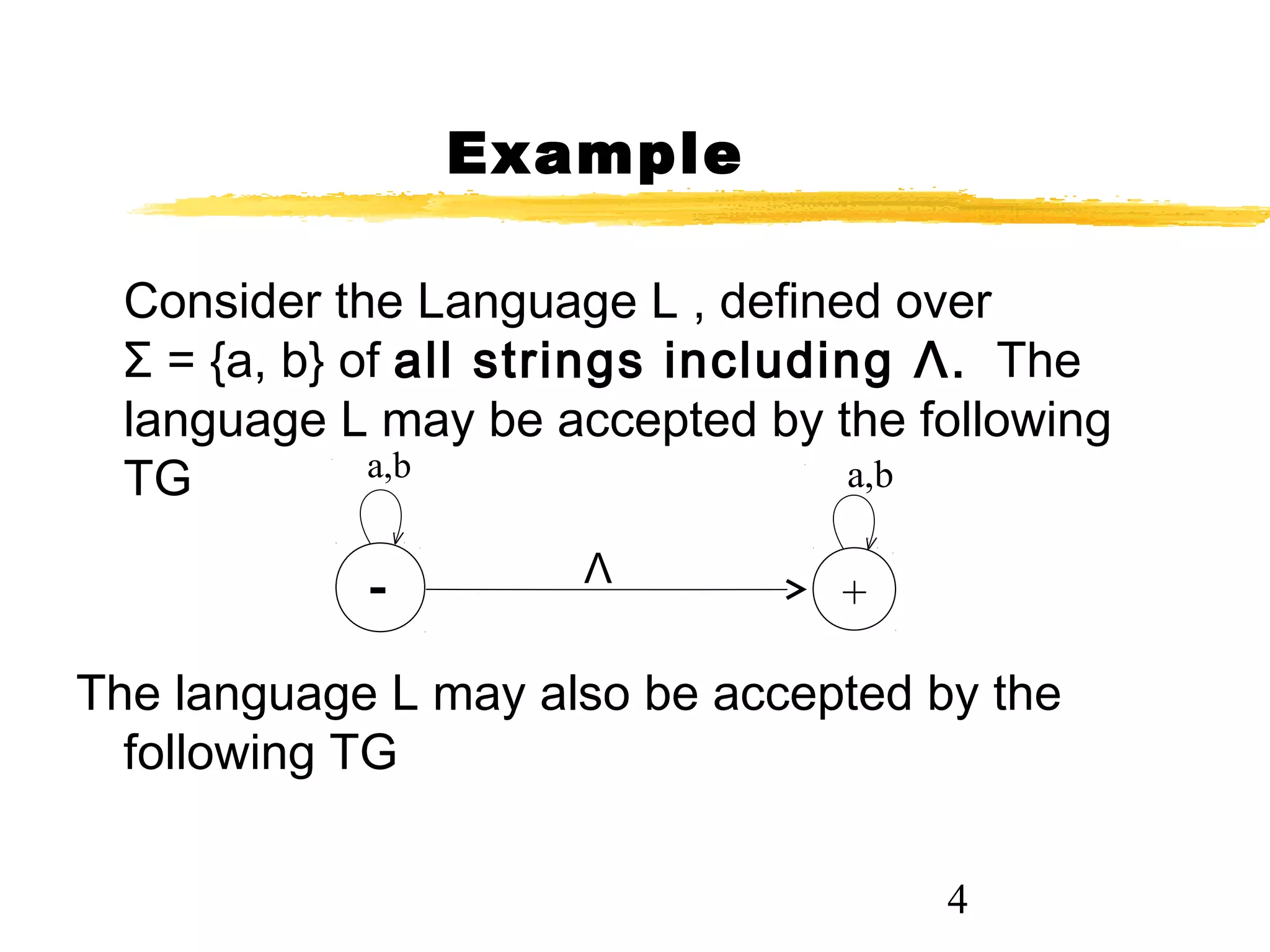
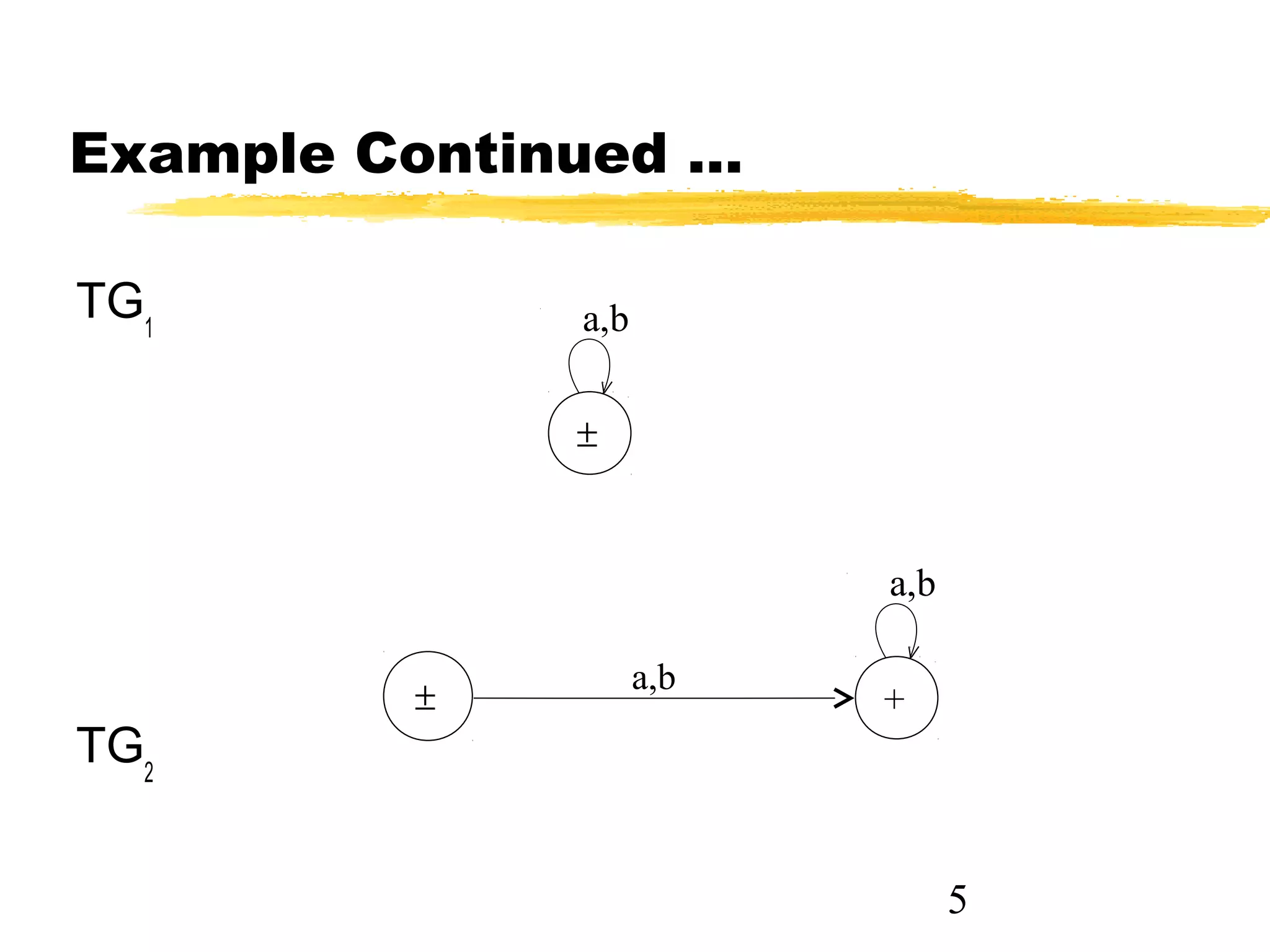
Consider the Language L , defined over
Σ = {a, b} of all strings including Λ. The
language L may be accepted by the following
TG
The language L may also be accepted by the
following TG
a,b
+
Λ
a,b
-
5
Example Continued …
TG1
TG2
a,b
±
a,b
+±
a,b
6
Example
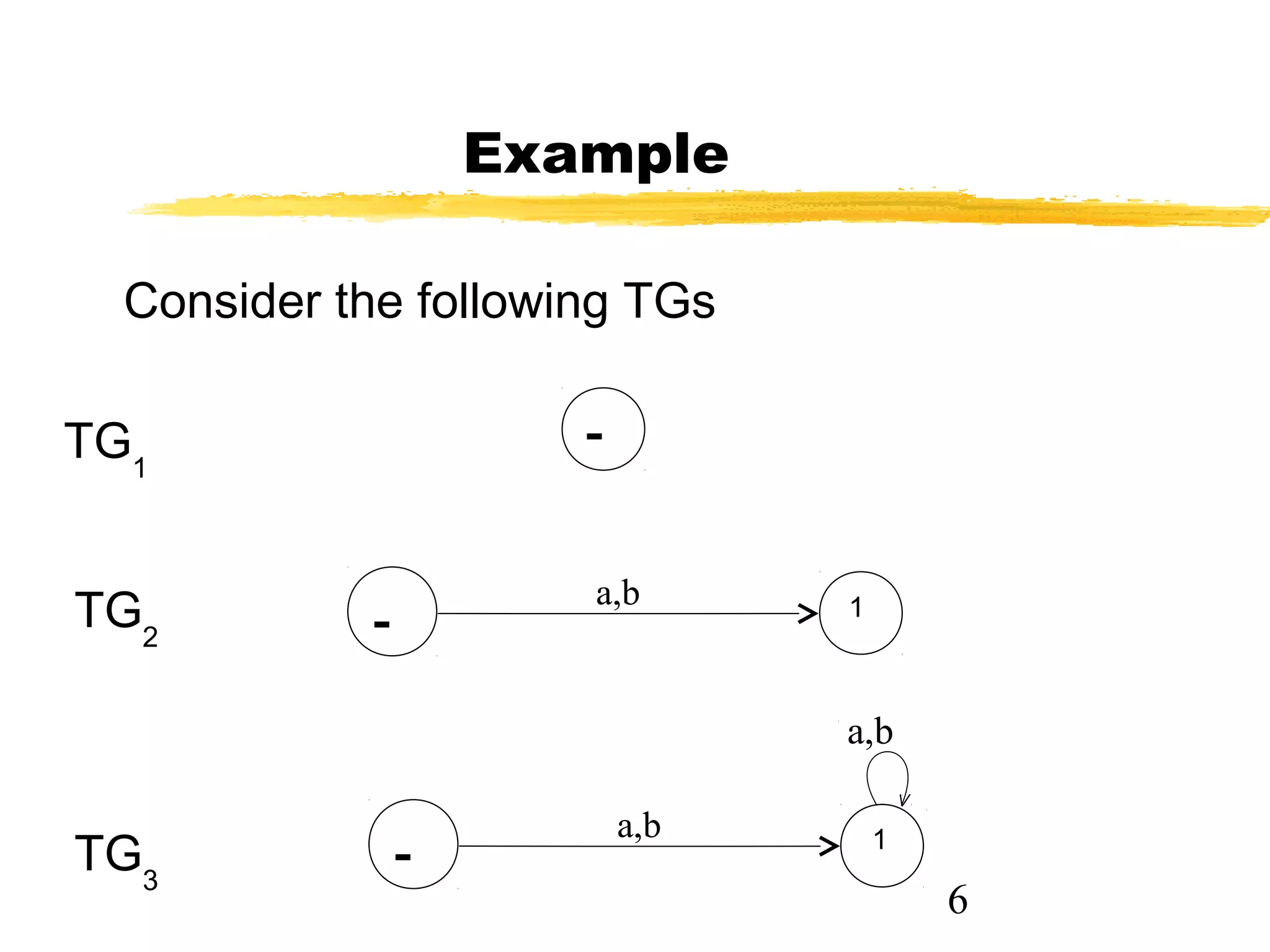
Consider the following TGs
-
-
a,b
-
a,b
a,b
TG3
TG2
TG1
1
1
7
Example Continued …
It may be observed that in the first TG, no
transition has been shown. Hence this TG does
not accept any string, defined over any
alphabet. In TG2
there are transitions for a and b
at initial state but there is no transition at state 1.
This TG still does not accept any string. In TG3
there are transitions at both initial state and
state 1, but it does not accept any string.
8
Example Continued …
Thus none of TG1
, TG2
andTG3
accepts any string,
i.e. these TGs accept empty language. It may
be noted that TG1
and TG2
are TGs but not FA,
while TG3
is both TG and FA as well.
It may be noted that every FA is a TG as well, but
the converse may not be true, i.e. every TG may
not be an FA.
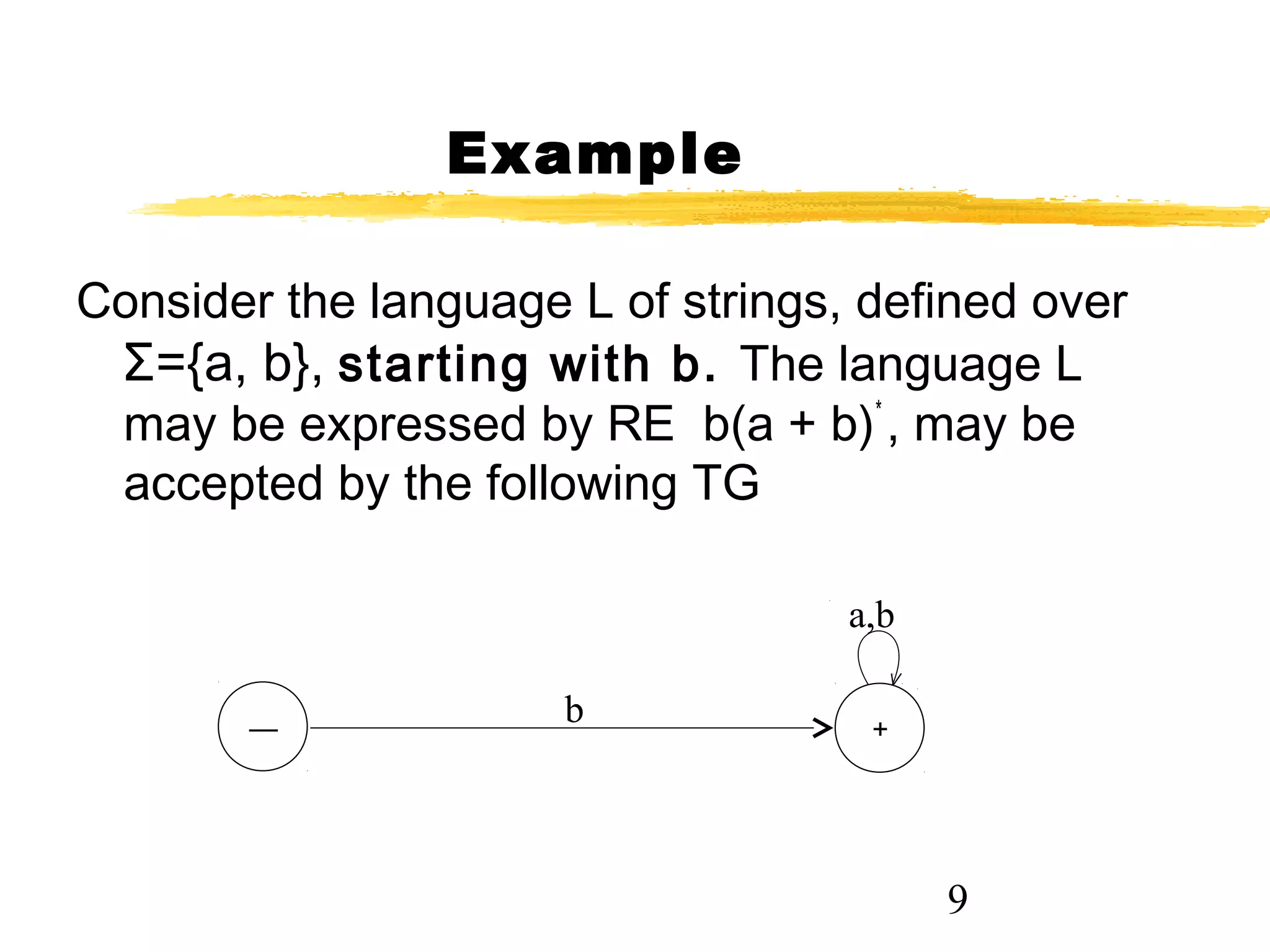
9
Example
Consider the language L of strings, defined over
Σ={a, b}, starting with b. The language L
may be expressed by RE b(a + b)*
, may be
accepted by the following TG
b–– +
a,b
10
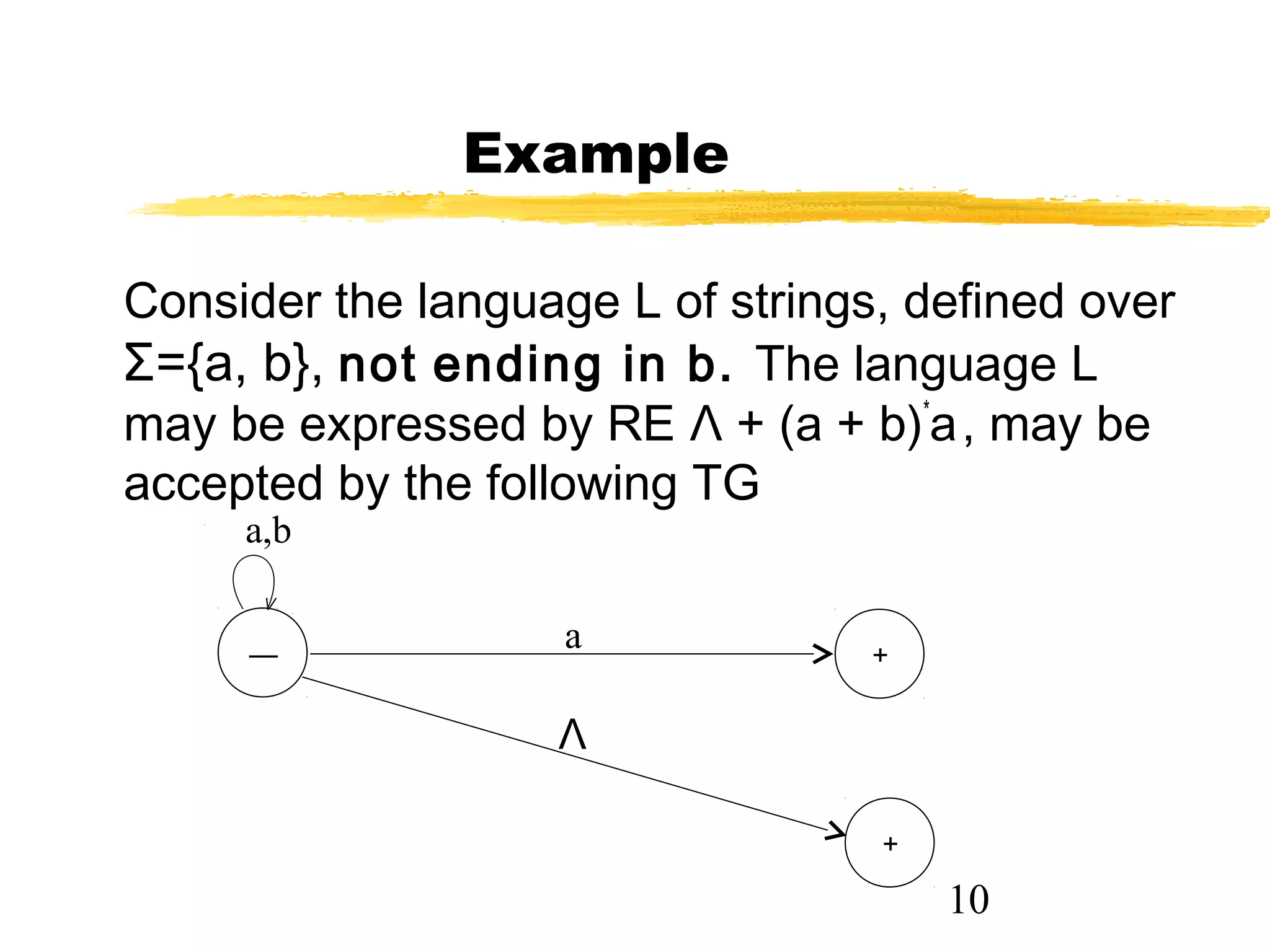
Example
Consider the language L of strings, defined over
Σ={a, b}, not ending in b. The language L
may be expressed by RE Λ + (a + b)*
a, may be
accepted by the following TG
a–– +
a,b
+
Λ
11
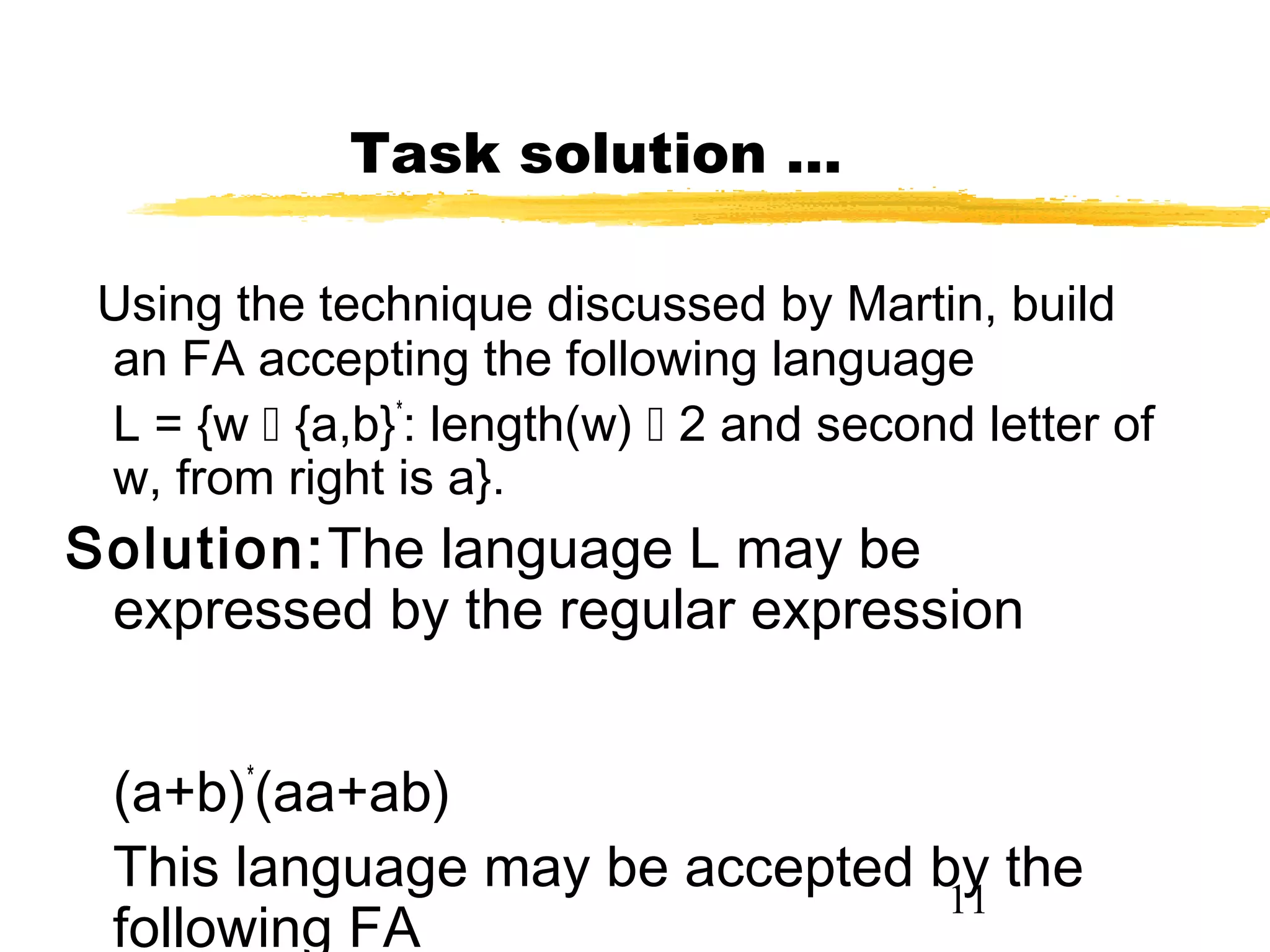
Task solution …
Using the technique discussed by Martin, build
an FA accepting the following language
L = {w  {a,b}*
: length(w)  2 and second letter of
w, from right is a}.
Solution:The language L may be
expressed by the regular expression
(a+b)*
(aa+ab)
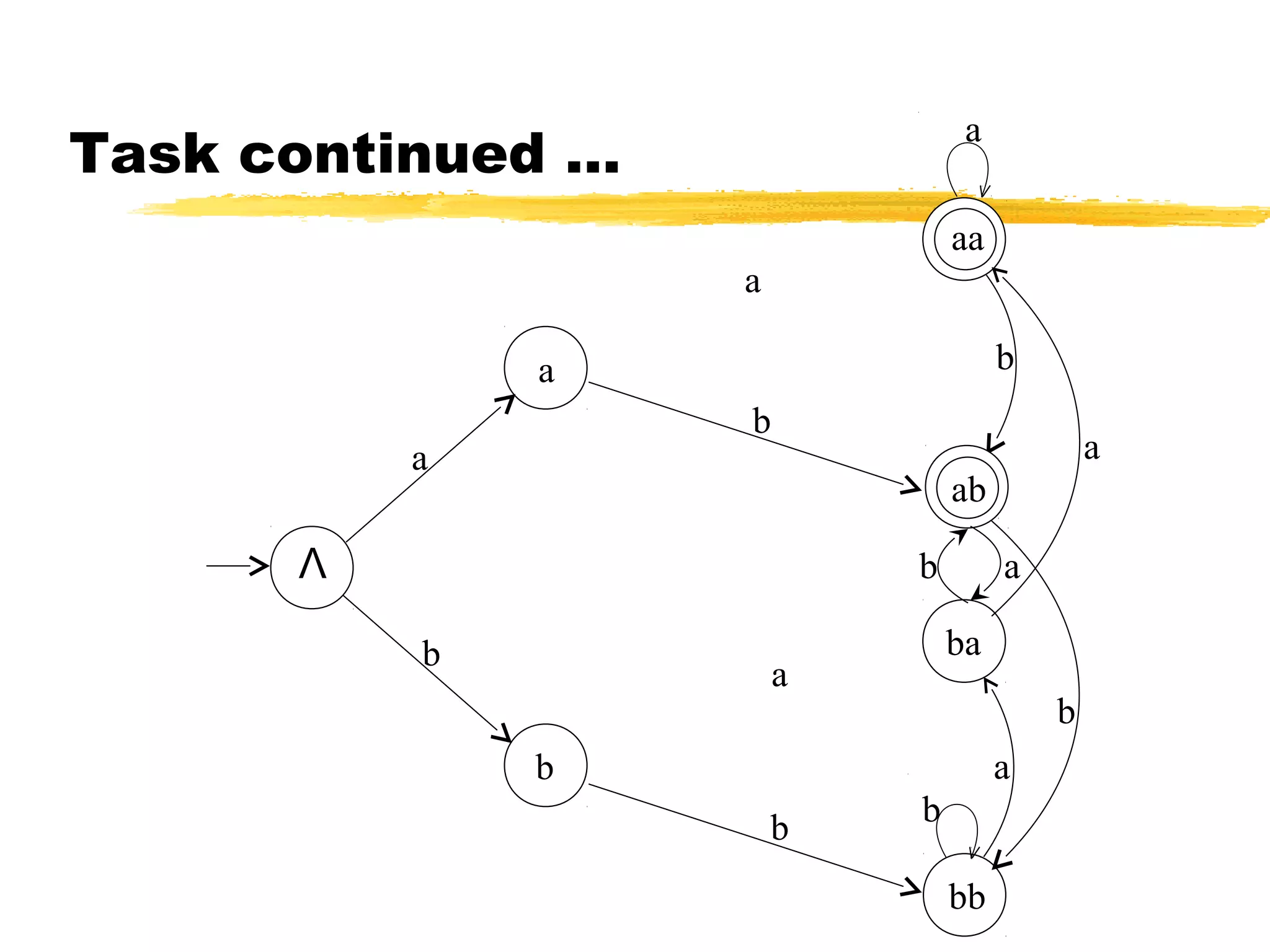
This language may be accepted by the
following FA
12
Task continued …
a
a
b
a
b
Λ
a
ba
a
a
b
b
b
b
ab
ab
ba
bb
aa
13
Task solution …
Using the technique discussed by Martin, build
an FA accepting the following language
L = {w  {a,b}*
: w neither ends in ab nor in ba}.
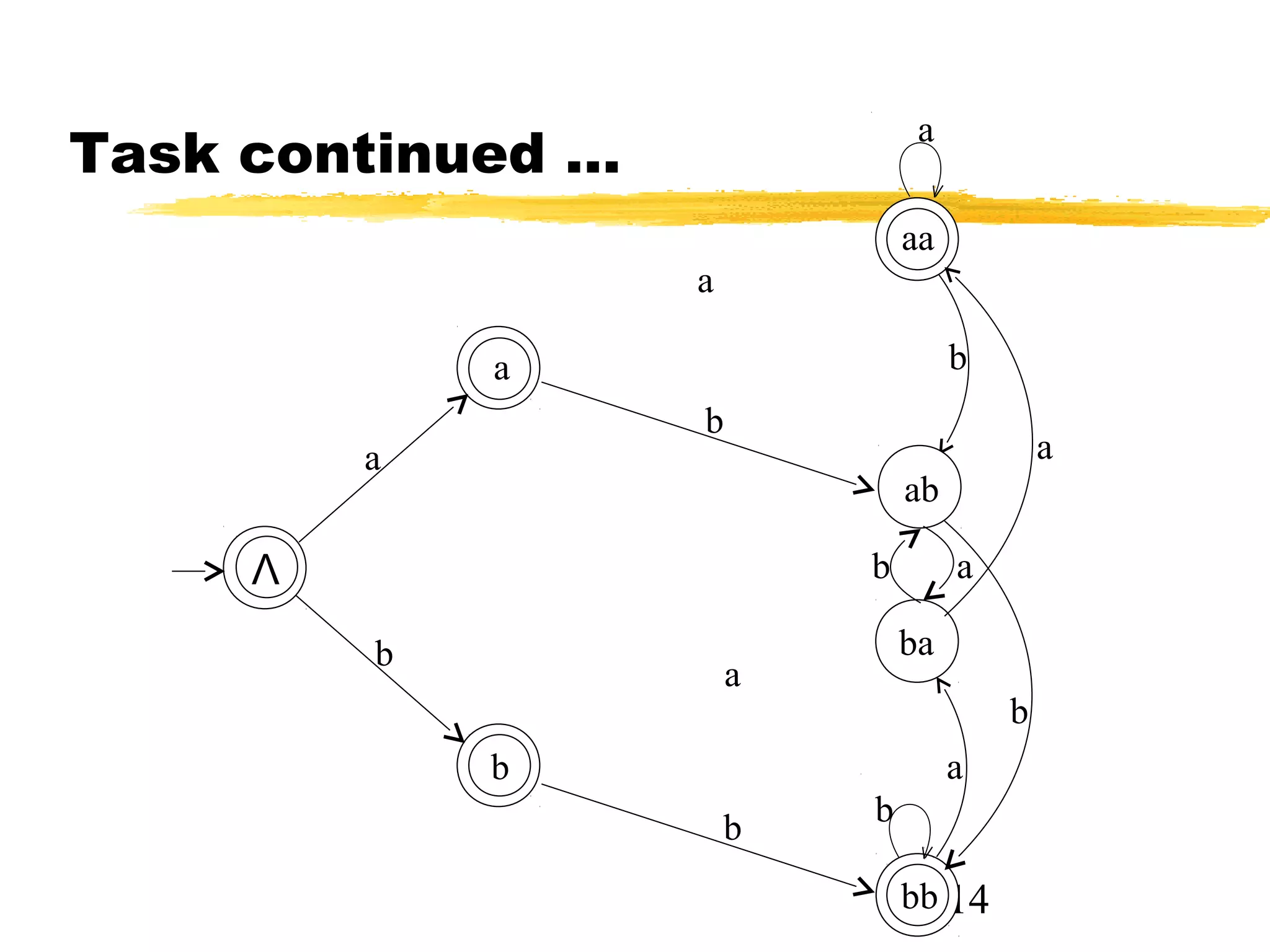
Solution:The language L may be expressed by
the regular expression
Λ + a + b + (a+b)*
(aa+bb)
This language may be accepted by the following
FA
14
Task continued …
a
a
b
a
a
b
a
a
b
b
b
b
ab
ab
ba
b
a
Λ
bb
aa
15
TASK
Build a TG accepting the language of strings,
defined over Σ={a, b}, ending in b.
16
Example
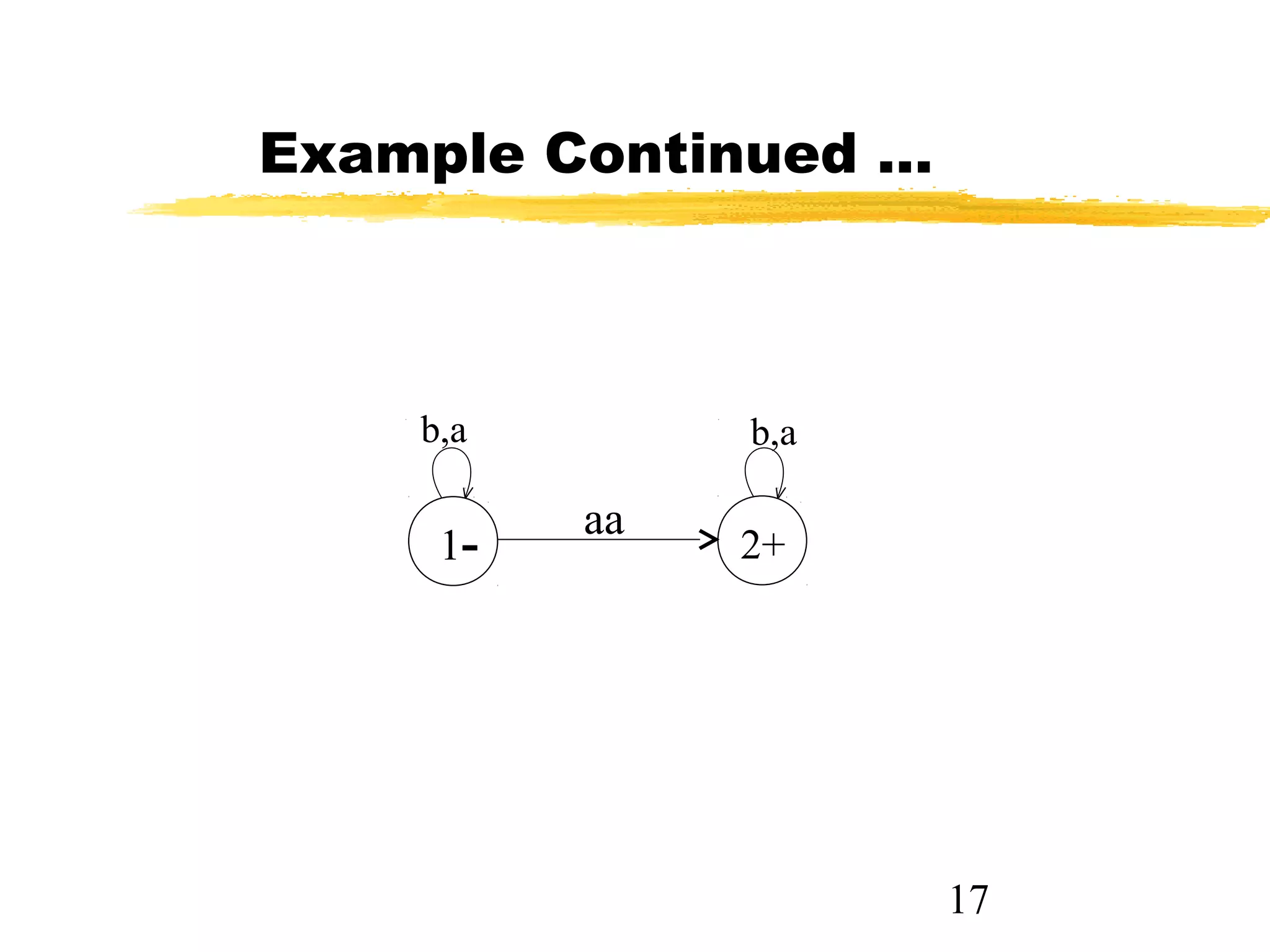
Consider the Language L of strings,
defined over Σ = {a, b}, containing
double a.
The language L may be expressed by the
following regular expression
(a+b)*
(aa) (a+b)*
.
This language may be accepted by the
following TG
17
Example Continued …
b,a
1- 2+
b,a
aa
18
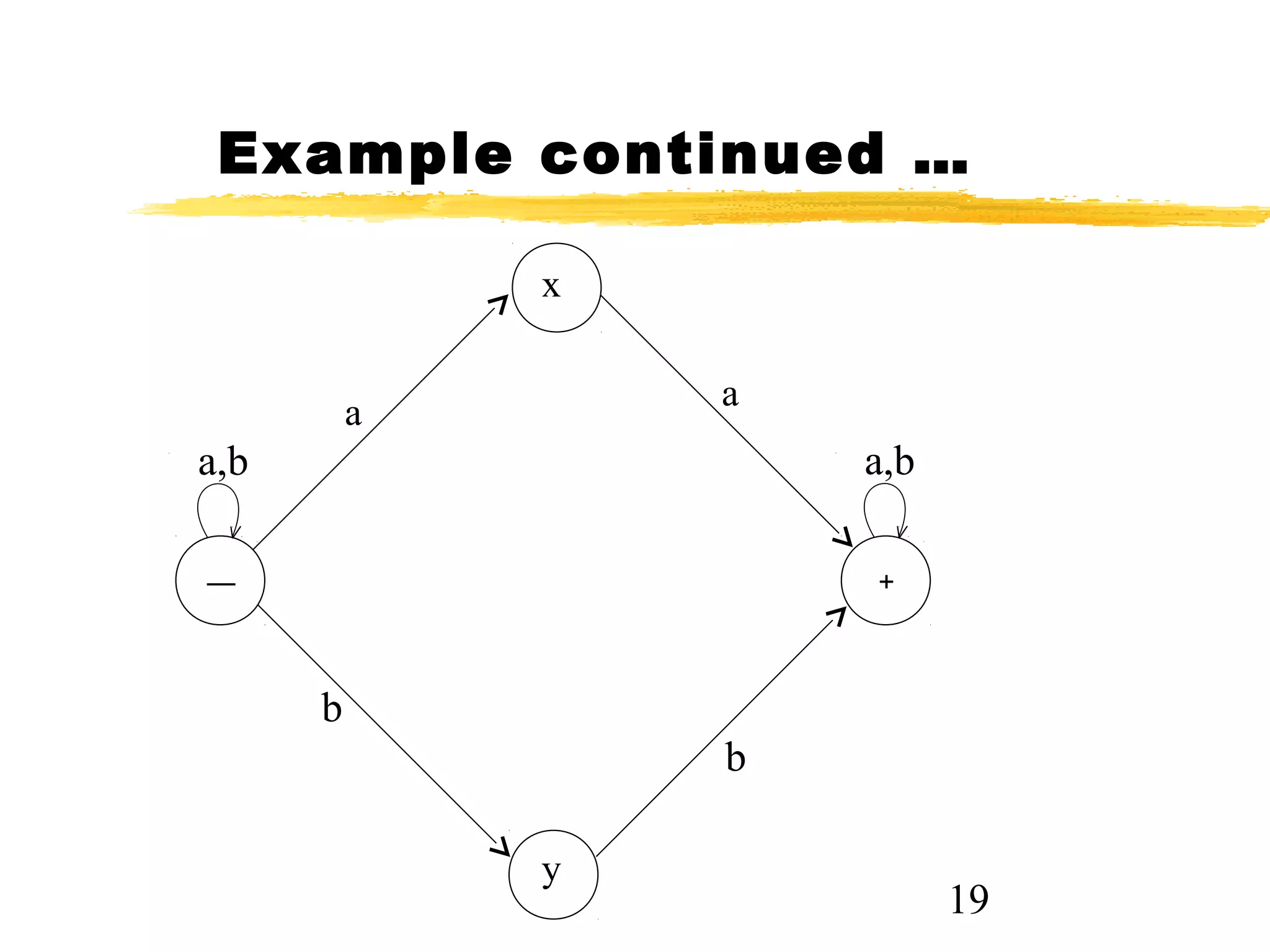
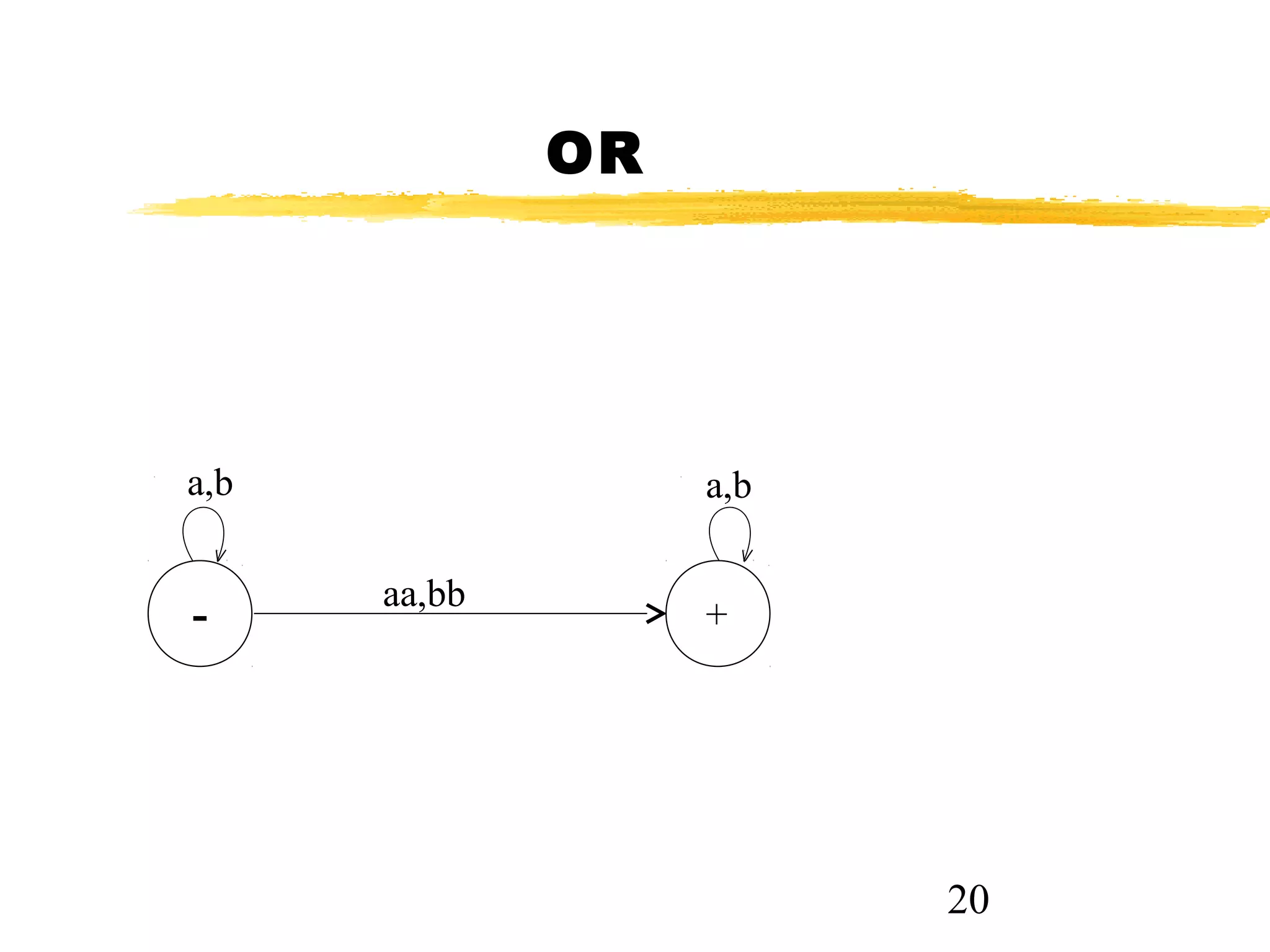
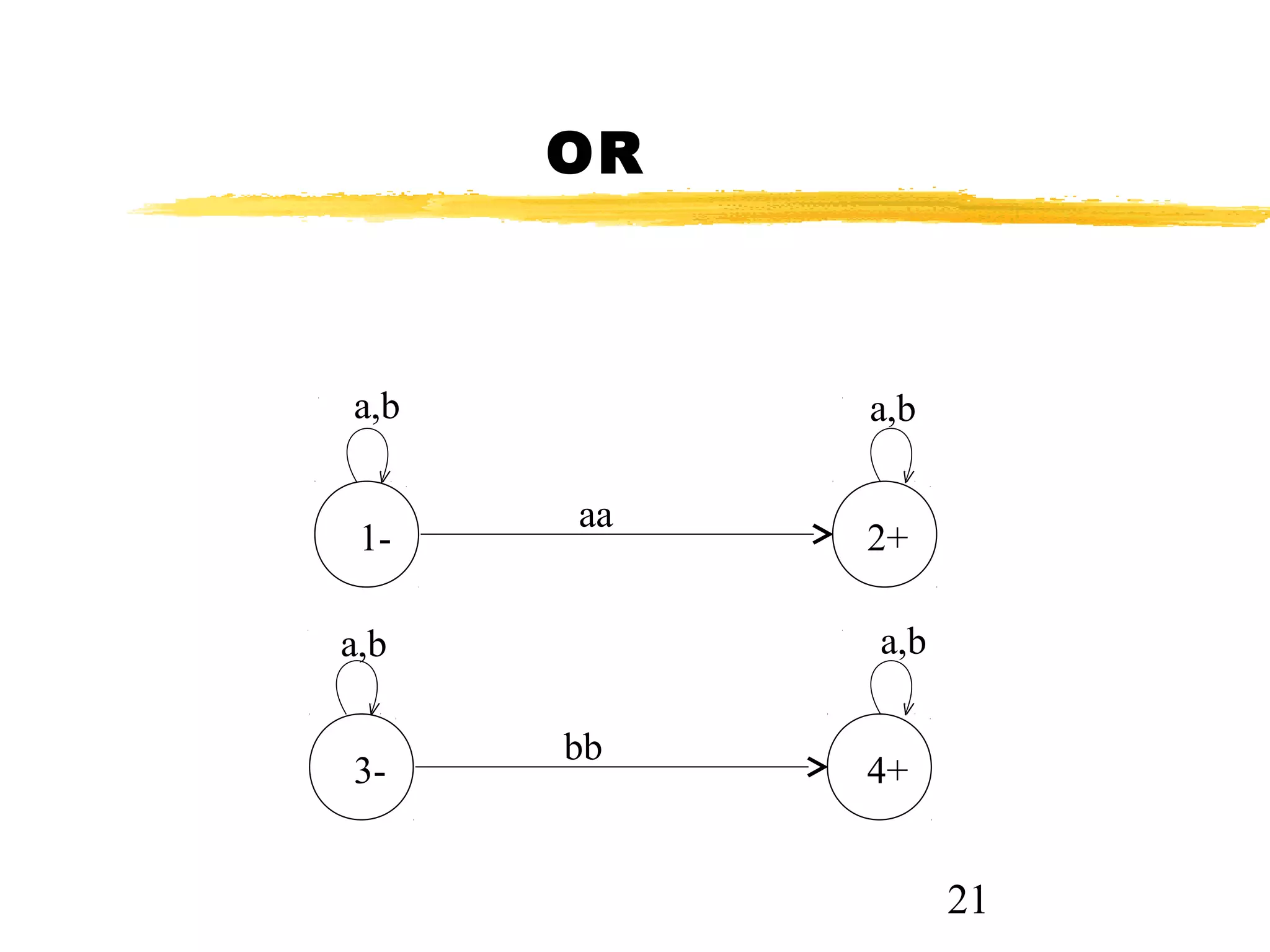
Example
Consider the language L of strings, defined over
Σ={a, b}, having double a or double b.
The language L can be expressed by RE
(a+b)*
(aa + bb) (a+b)*.
The above language may also be expressed by
the following TGs.
19
a
b
a
b
a,b
–– +
x
y
a,b
Example continued …
20
OR
aa,bb
a,ba,b
+-
21
OR
aa
a,ba,b
2+1-
bb
a,ba,b
4+3-
22
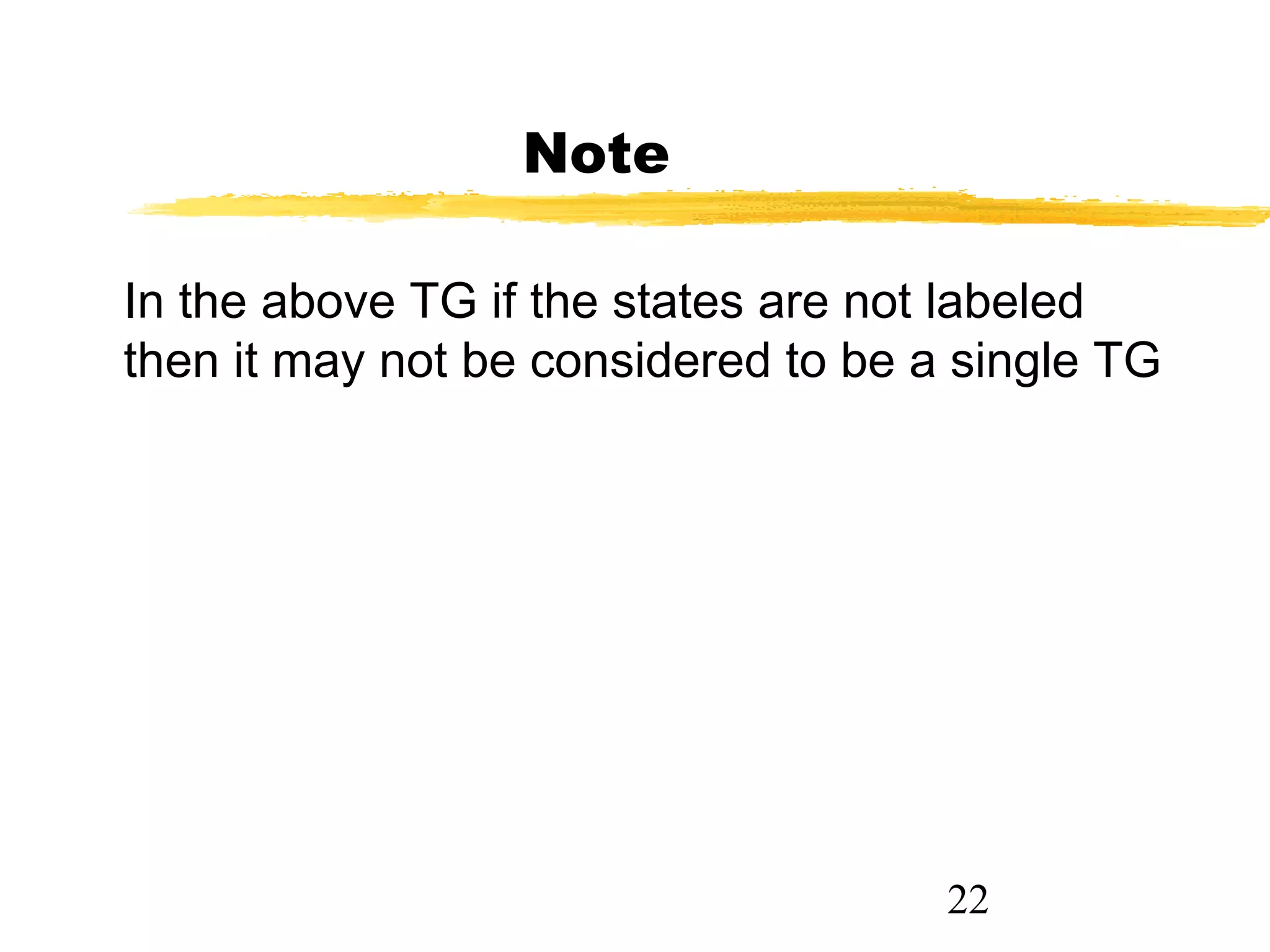
Note
In the above TG if the states are not labeled
then it may not be considered to be a single TG
23
Summing Up
TG definition, Examples:accepting all
strings, accepting none, starting with b,
not ending in b, containing aa,
containing aa or bb

Lesson 08

  • 1.
    1 RECAP Lecture 7 FAof EVEN EVEN, FA corresponding to finite languages(using both methods), Transition graphs.
  • 2.
    2 Recap Definition ofTG continued … Definition: A Transition graph (TG), is a collection of the followings 1)Finite number of states, at least one of which is start state and some (maybe none) final states. 2)Finite set of input letters (Σ) from which input strings are formed. 3)Finite set of transitions that show how to go from one state to another based on reading specified substrings of input letters, possibly even the null string (Λ).
  • 3.
    3 Note It is tobe noted that in TG there may exist more than one paths for certain string, while there may not exist any path for certain string as well. If there exists at least one path for a certain string, starting from initial state and ending in a final state, the string is supposed to be accepted by the TG, otherwise the string is supposed to be rejected. Obviously collection of accepted strings is the language accepted by the TG.
  • 4.
    4 Example Consider the LanguageL , defined over Σ = {a, b} of all strings including Λ. The language L may be accepted by the following TG The language L may also be accepted by the following TG a,b + Λ a,b -
  • 5.
  • 6.
    6 Example Consider the followingTGs - - a,b - a,b a,b TG3 TG2 TG1 1 1
  • 7.
    7 Example Continued … Itmay be observed that in the first TG, no transition has been shown. Hence this TG does not accept any string, defined over any alphabet. In TG2 there are transitions for a and b at initial state but there is no transition at state 1. This TG still does not accept any string. In TG3 there are transitions at both initial state and state 1, but it does not accept any string.
  • 8.
    8 Example Continued … Thusnone of TG1 , TG2 andTG3 accepts any string, i.e. these TGs accept empty language. It may be noted that TG1 and TG2 are TGs but not FA, while TG3 is both TG and FA as well. It may be noted that every FA is a TG as well, but the converse may not be true, i.e. every TG may not be an FA.
  • 9.
    9 Example Consider the languageL of strings, defined over Σ={a, b}, starting with b. The language L may be expressed by RE b(a + b)* , may be accepted by the following TG b–– + a,b
  • 10.
    10 Example Consider the languageL of strings, defined over Σ={a, b}, not ending in b. The language L may be expressed by RE Λ + (a + b)* a, may be accepted by the following TG a–– + a,b + Λ
  • 11.
    11 Task solution … Usingthe technique discussed by Martin, build an FA accepting the following language L = {w  {a,b}* : length(w)  2 and second letter of w, from right is a}. Solution:The language L may be expressed by the regular expression (a+b)* (aa+ab) This language may be accepted by the following FA
  • 12.
  • 13.
    13 Task solution … Usingthe technique discussed by Martin, build an FA accepting the following language L = {w  {a,b}* : w neither ends in ab nor in ba}. Solution:The language L may be expressed by the regular expression Λ + a + b + (a+b)* (aa+bb) This language may be accepted by the following FA
  • 14.
  • 15.
    15 TASK Build a TGaccepting the language of strings, defined over Σ={a, b}, ending in b.
  • 16.
    16 Example Consider the LanguageL of strings, defined over Σ = {a, b}, containing double a. The language L may be expressed by the following regular expression (a+b)* (aa) (a+b)* . This language may be accepted by the following TG
  • 17.
  • 18.
    18 Example Consider the languageL of strings, defined over Σ={a, b}, having double a or double b. The language L can be expressed by RE (a+b)* (aa + bb) (a+b)*. The above language may also be expressed by the following TGs.
  • 19.
  • 20.
  • 21.
  • 22.
    22 Note In the aboveTG if the states are not labeled then it may not be considered to be a single TG
  • 23.
    23 Summing Up TG definition,Examples:accepting all strings, accepting none, starting with b, not ending in b, containing aa, containing aa or bb