1
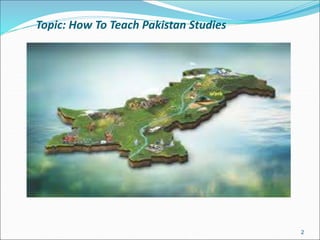
Topic: How To Teach Pakistan Studies
2
LESSON PLANNING
For a successful and effective teaching planning is the first
and the most important step.
A lesson plan is a blueprint of your lesson that includes
learning goals and the educational elements students need
to master the learning outcomes.
Lesson plans are vital to address concepts properly and
facilitate the efficient flow of learning.
A lesson plan provides structure and helps the teacher to
create a more conducive environment for teaching and
learning.
ď‚— Goods define lesson plan as :
“Outline of the important points of a lesson arranged in the
order in which they are to be presented to students by the
teacher.”
3
ď‚— The teacher should know before
ď‚— What to teach ? and
ď‚— How to teach ?
ď‚— He should have the clear aim of the lesson before him
and should plan accordingly.
He should know how he should introduce and present
the lesson and the A.V aids he will make use of it.
He should also know how to evaluate the lesson in the
light of the aim set.
4
A lesson plan, in the word of Laster B.,
“is actually a plan of action.
It, therefore includes the working philosophy of the
teacher, his knowledge of philosophy, his information
about and understanding of his pupils, his
comprehension of the objectives of education, his
knowledge of the material to be taught, and his abilities
to utilize effective materials.”
5
ADVANTAGES OF LESSON PLANNING
ď‚— It keeps the teacher to be systematic and orderly in the
treatment of the subject matter.
ď‚— He proceeds on well-thought of and definite lines and
does not follow haphazard and thoughtless teaching.
ď‚— The teacher sets forth with some definite aims in view
and is conscious of the interest, attitudes, etc., that he
is to develop in the students through certain activities
or some other means.
6
Planning a lesson give confidence and self-
reliance to the teacher which is of great value for
successful teaching.
It saves time. Because the lesson is correlated
with the social and physical environments of the
students, their interest is maintained
throughout the lesson.
ď‚— A lesson plan is the instructor's road map of
what students need to learn ? and how it will
be done effectively during the class time.
7
Lesson Planning
ď‚— Lesson Planning Steps
ď‚— 4 PPPP
ď‚— Preparation
ď‚— Presentation
ď‚— Practice
ď‚— Production / Evaluation
8
ď‚— STEPS INVOLVED IN LESSON PLANNING
HERBARTIAN STEPS
ď‚— 1. Preparation or Introduction
ď‚— 2. Presentation
ď‚— 3. Comparison or Association
ď‚— 4. Generalization
ď‚— 5. Application
ď‚— 6. Recapitulation
9
ď‚— 1.Preparation:
The teacher must prepare the students to receive new
knowledge.
Knowledge is to be linked with the previous knowledge of
the students.
Preparation in fact, means the exploration of the pupil’s
knowledge, which leads to the aim of the lesson.
Teacher’s skill lies in leading the pupils to see that their
knowledge is incomplete and that to conquer lies before
them.
10
ď‚— This can be done:
 •By testing of the previous knowledge of pupils and
introducing the lesson with an explanation.
 •By asking questions that may reveal their ignorance,
arouse interest and curiosity to learn the new matter.
 •Through the use of chart, maps or pictures.
 •Through skillful conversation. It should be noted that
this step should not in any case take more than five
minutes.
11
ď‚— 2.Presentation :
ď‚— In the presentation step , the pupils must get some
new ideas and pupil should be the active participant
in the teaching – learning process.
ď‚— The teacher should try to introduce everything from
the learner. A sort of heuristic attitude should prevail
the whole teaching.
12
ď‚— Questioning should form an important device of this
step. Other aids should also be used to make the
lesson more interesting and comprehensive. Black
board summary should be developed along with.
13
ď‚— 3.Comparison or Association :
ď‚— Some examples are given to the students and they are
asked to observe carefully and compare them with other
set of the examples and facts. This step is important where
some definition or some generalization is to be induced
from the students
14
ď‚— 4.Generalization :
ď‚— In this step the aim of the lesson is achieved. This step
involves reflective thinking because the whole knowledge
learnt in preparation is to be systematized which leads to
generalization , formulae, rules etc., through comparison or
association. This step completes the enquiry by providing
the answer to the problem with which it began. Thus , the
students get a new knowledge which is ready for me.
15
ď‚— 5.Application :
ď‚— At this stage , the students make use of the
acquired knowledge in familiar and un familiar
situations. In this way , the new knowledge gained
by the pupils will become permanent in the minds
of the students and will not fade from
consciousness soon.
16
ď‚— 6.Recapitulation :
ď‚— This is the last step. The understanding and
comprehension of the subject-matter taught by the
teacher can be tested by putting some suitable questions
on the topics to the students. This will also help the
teacher to find out whether his method of teaching is
effective and successful or not.
17

Pak Study Lesson Planning.ppt

  • 1.
  • 2.
    Topic: How ToTeach Pakistan Studies 2
  • 3.
    LESSON PLANNING For asuccessful and effective teaching planning is the first and the most important step. A lesson plan is a blueprint of your lesson that includes learning goals and the educational elements students need to master the learning outcomes. Lesson plans are vital to address concepts properly and facilitate the efficient flow of learning. A lesson plan provides structure and helps the teacher to create a more conducive environment for teaching and learning.  Goods define lesson plan as : “Outline of the important points of a lesson arranged in the order in which they are to be presented to students by the teacher.” 3
  • 4.
    ď‚— The teachershould know before ď‚— What to teach ? and ď‚— How to teach ? ď‚— He should have the clear aim of the lesson before him and should plan accordingly. He should know how he should introduce and present the lesson and the A.V aids he will make use of it. He should also know how to evaluate the lesson in the light of the aim set. 4
  • 5.
    A lesson plan,in the word of Laster B., “is actually a plan of action. It, therefore includes the working philosophy of the teacher, his knowledge of philosophy, his information about and understanding of his pupils, his comprehension of the objectives of education, his knowledge of the material to be taught, and his abilities to utilize effective materials.” 5
  • 6.
    ADVANTAGES OF LESSONPLANNING ď‚— It keeps the teacher to be systematic and orderly in the treatment of the subject matter. ď‚— He proceeds on well-thought of and definite lines and does not follow haphazard and thoughtless teaching. ď‚— The teacher sets forth with some definite aims in view and is conscious of the interest, attitudes, etc., that he is to develop in the students through certain activities or some other means. 6
  • 7.
    Planning a lessongive confidence and self- reliance to the teacher which is of great value for successful teaching. It saves time. Because the lesson is correlated with the social and physical environments of the students, their interest is maintained throughout the lesson. ď‚— A lesson plan is the instructor's road map of what students need to learn ? and how it will be done effectively during the class time. 7
  • 8.
    Lesson Planning ď‚— LessonPlanning Steps ď‚— 4 PPPP ď‚— Preparation ď‚— Presentation ď‚— Practice ď‚— Production / Evaluation 8
  • 9.
    ď‚— STEPS INVOLVEDIN LESSON PLANNING HERBARTIAN STEPS ď‚— 1. Preparation or Introduction ď‚— 2. Presentation ď‚— 3. Comparison or Association ď‚— 4. Generalization ď‚— 5. Application ď‚— 6. Recapitulation 9
  • 10.
     1.Preparation: The teachermust prepare the students to receive new knowledge. Knowledge is to be linked with the previous knowledge of the students. Preparation in fact, means the exploration of the pupil’s knowledge, which leads to the aim of the lesson. Teacher’s skill lies in leading the pupils to see that their knowledge is incomplete and that to conquer lies before them. 10
  • 11.
     This canbe done:  •By testing of the previous knowledge of pupils and introducing the lesson with an explanation.  •By asking questions that may reveal their ignorance, arouse interest and curiosity to learn the new matter.  •Through the use of chart, maps or pictures.  •Through skillful conversation. It should be noted that this step should not in any case take more than five minutes. 11
  • 12.
     2.Presentation : In the presentation step , the pupils must get some new ideas and pupil should be the active participant in the teaching – learning process.  The teacher should try to introduce everything from the learner. A sort of heuristic attitude should prevail the whole teaching. 12
  • 13.
    ď‚— Questioning shouldform an important device of this step. Other aids should also be used to make the lesson more interesting and comprehensive. Black board summary should be developed along with. 13
  • 14.
    ď‚— 3.Comparison orAssociation : ď‚— Some examples are given to the students and they are asked to observe carefully and compare them with other set of the examples and facts. This step is important where some definition or some generalization is to be induced from the students 14
  • 15.
    ď‚— 4.Generalization : ď‚—In this step the aim of the lesson is achieved. This step involves reflective thinking because the whole knowledge learnt in preparation is to be systematized which leads to generalization , formulae, rules etc., through comparison or association. This step completes the enquiry by providing the answer to the problem with which it began. Thus , the students get a new knowledge which is ready for me. 15
  • 16.
    ď‚— 5.Application : ď‚—At this stage , the students make use of the acquired knowledge in familiar and un familiar situations. In this way , the new knowledge gained by the pupils will become permanent in the minds of the students and will not fade from consciousness soon. 16
  • 17.
    ď‚— 6.Recapitulation : ď‚—This is the last step. The understanding and comprehension of the subject-matter taught by the teacher can be tested by putting some suitable questions on the topics to the students. This will also help the teacher to find out whether his method of teaching is effective and successful or not. 17