Basic Business Statistics, 10e © 2006 Prentice-Hall, Inc. Chap 1-1
Chapter 1
Introduction and Data Collection
Basic Business Statistics
10th
Edition
Basic Business Statistics, 10e ©
2006 Prentice-Hall, Inc.. Chap 1-2
Learning Objectives
In this chapter you learn:
 How Statistics is used in business
 The sources of data used in business
 The types of data used in business
Basic Business Statistics, 10e ©
2006 Prentice-Hall, Inc.. Chap 1-3
Basic Concepts of Statistics
Statistics is concerned with:
 Processing and analyzing data
 Collecting, presenting, and transforming
data to assist decision makers
Basic Business Statistics, 10e ©
2006 Prentice-Hall, Inc.. Chap 1-4
Key Definitions
 A population (universe) is the collection of all
members of a group
 A sample is a portion of the population
selected for analysis
 A parameter is a numerical measure that
describes a characteristic of a population
 A statistic is a numerical measure that
describes a characteristic of a sample
Basic Business Statistics, 10e ©
2006 Prentice-Hall, Inc.. Chap 1-5
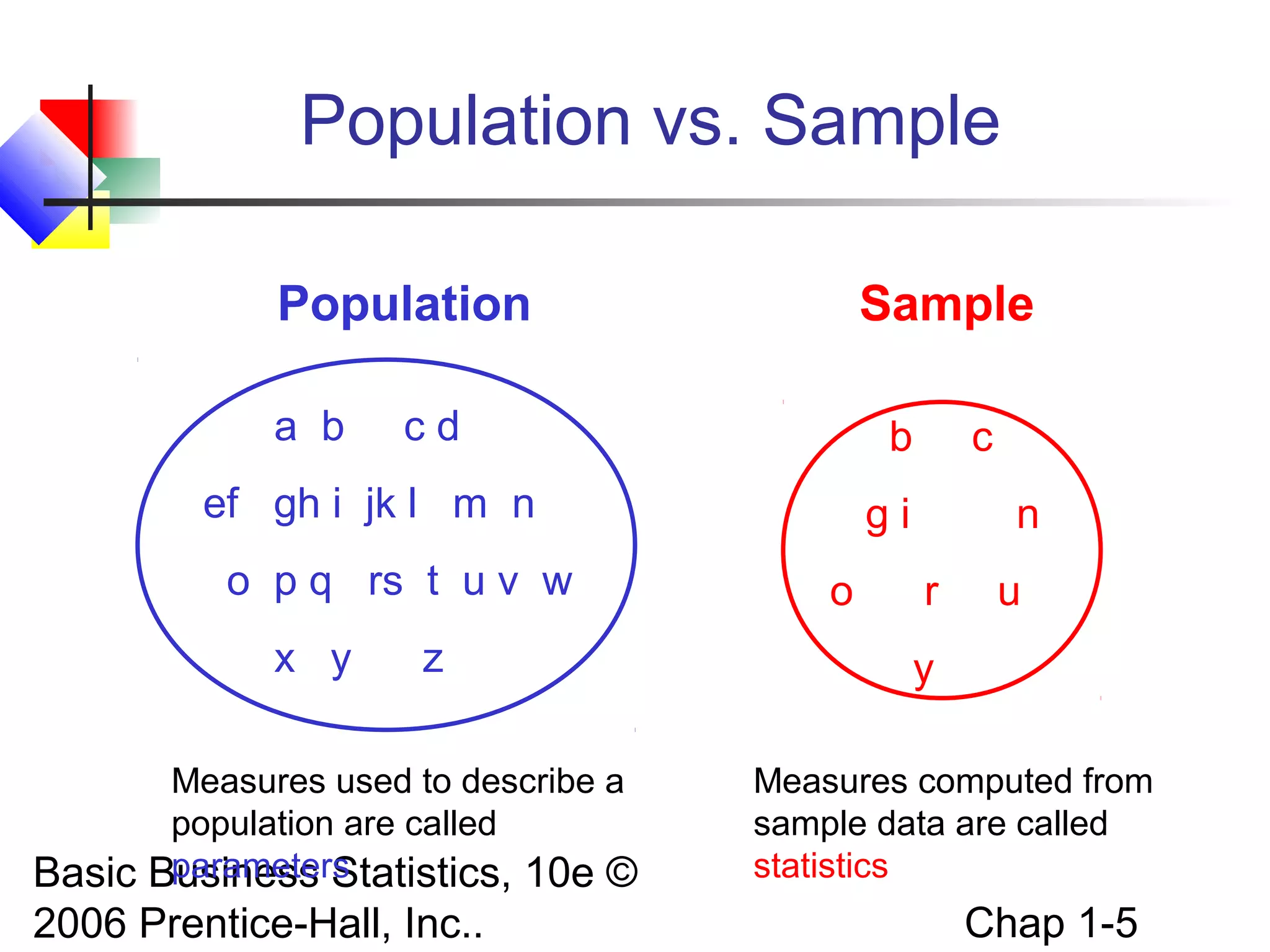
Population vs. Sample
a b c d
ef gh i jk l m n
o p q rs t u v w
x y z
Population Sample
b c
g i n
o r u
y
Measures used to describe a
population are called
parameters
Measures computed from
sample data are called
statistics
Basic Business Statistics, 10e ©
2006 Prentice-Hall, Inc.. Chap 1-6
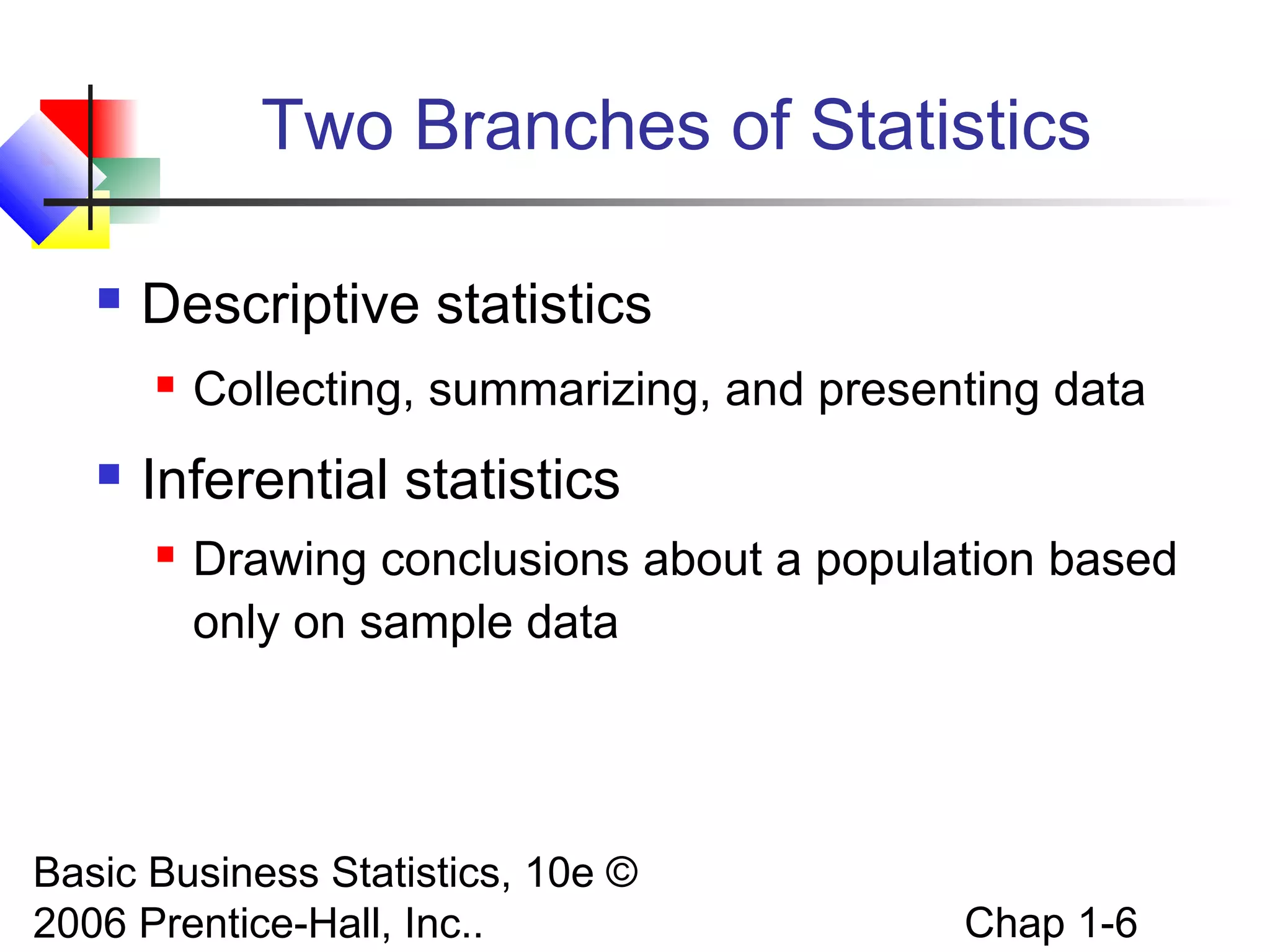
Two Branches of Statistics
 Descriptive statistics
 Collecting, summarizing, and presenting data
 Inferential statistics
 Drawing conclusions about a population based
only on sample data
Basic Business Statistics, 10e ©
2006 Prentice-Hall, Inc.. Chap 1-7
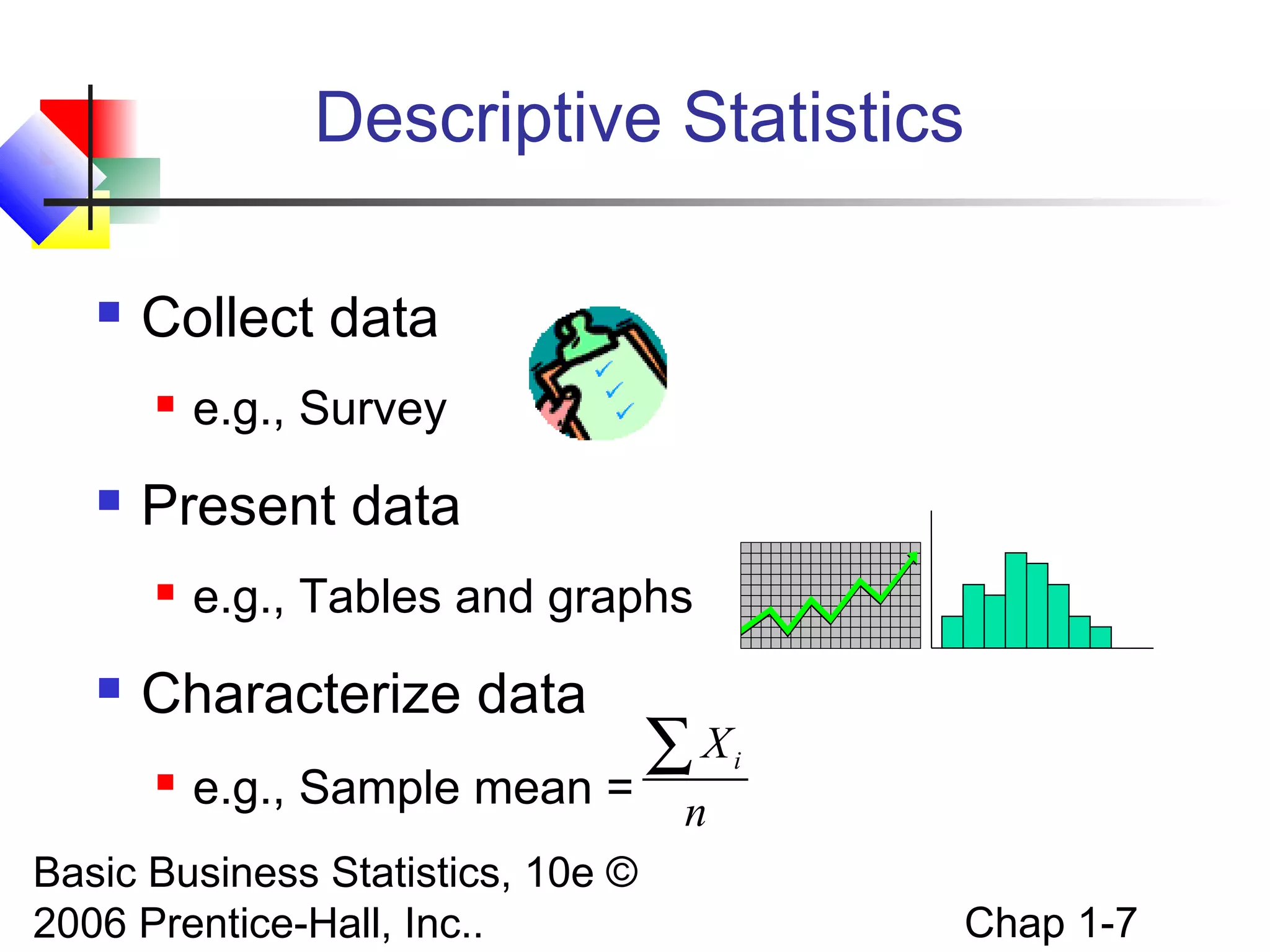
Descriptive Statistics
 Collect data
 e.g., Survey
 Present data
 e.g., Tables and graphs
 Characterize data
 e.g., Sample mean =
iX
n
∑
Basic Business Statistics, 10e ©
2006 Prentice-Hall, Inc.. Chap 1-8
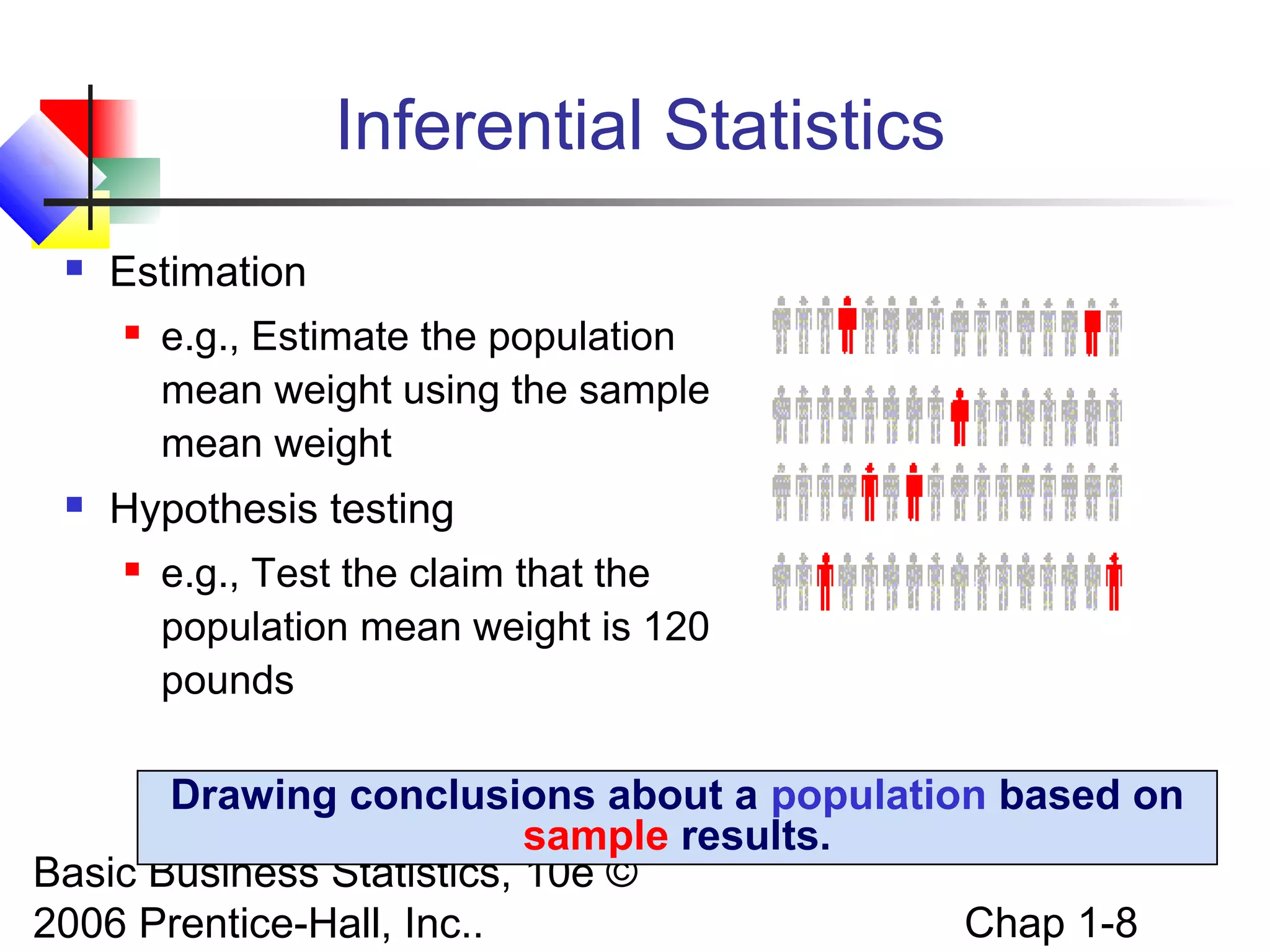
Inferential Statistics
 Estimation
 e.g., Estimate the population
mean weight using the sample
mean weight
 Hypothesis testing
 e.g., Test the claim that the
population mean weight is 120
pounds
Drawing conclusions about a population based on
sample results.
Basic Business Statistics, 10e ©
2006 Prentice-Hall, Inc.. Chap 1-9
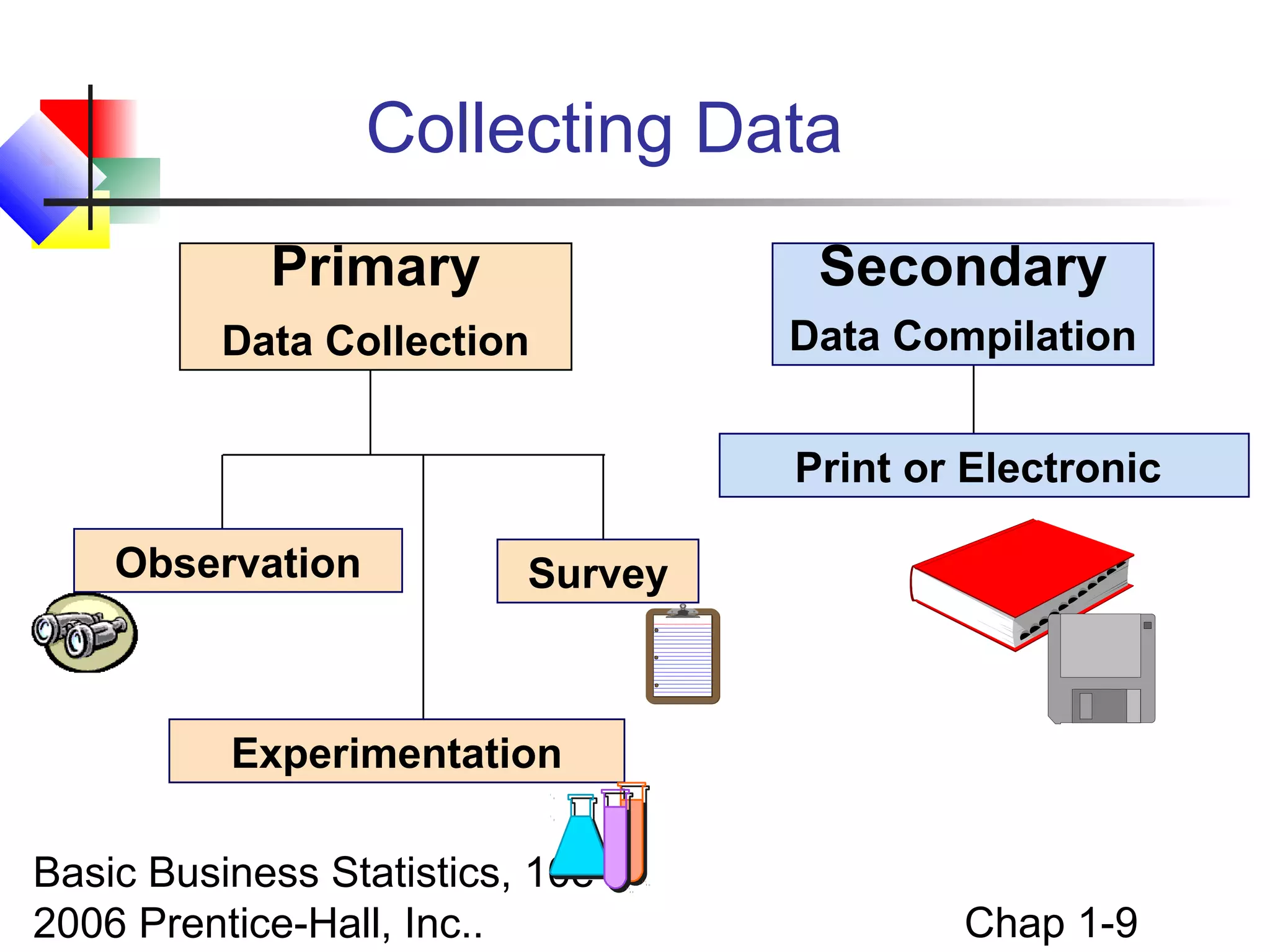
Collecting Data
Secondary
Data Compilation
Observation
Experimentation
Print or Electronic
Survey
Primary
Data Collection
Basic Business Statistics, 10e ©
2006 Prentice-Hall, Inc.. Chap 1-10
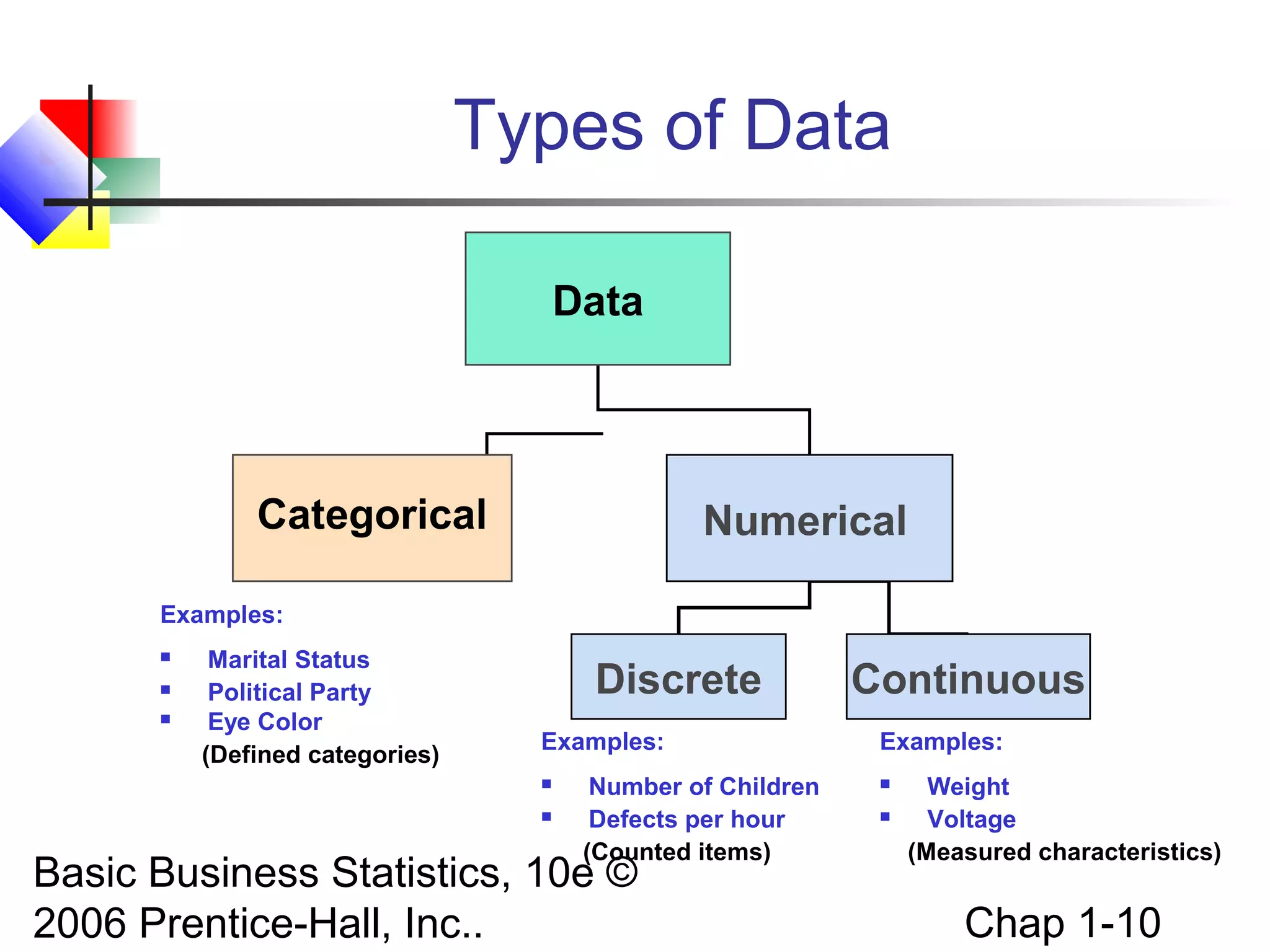
Types of Data
Data
Categorical Numerical
Discrete Continuous
Examples:
 Marital Status
 Political Party
 Eye Color
(Defined categories)
Examples:
 Number of Children
 Defects per hour
(Counted items)
Examples:
 Weight
 Voltage
(Measured characteristics)
Basic Business Statistics, 10e ©
2006 Prentice-Hall, Inc..
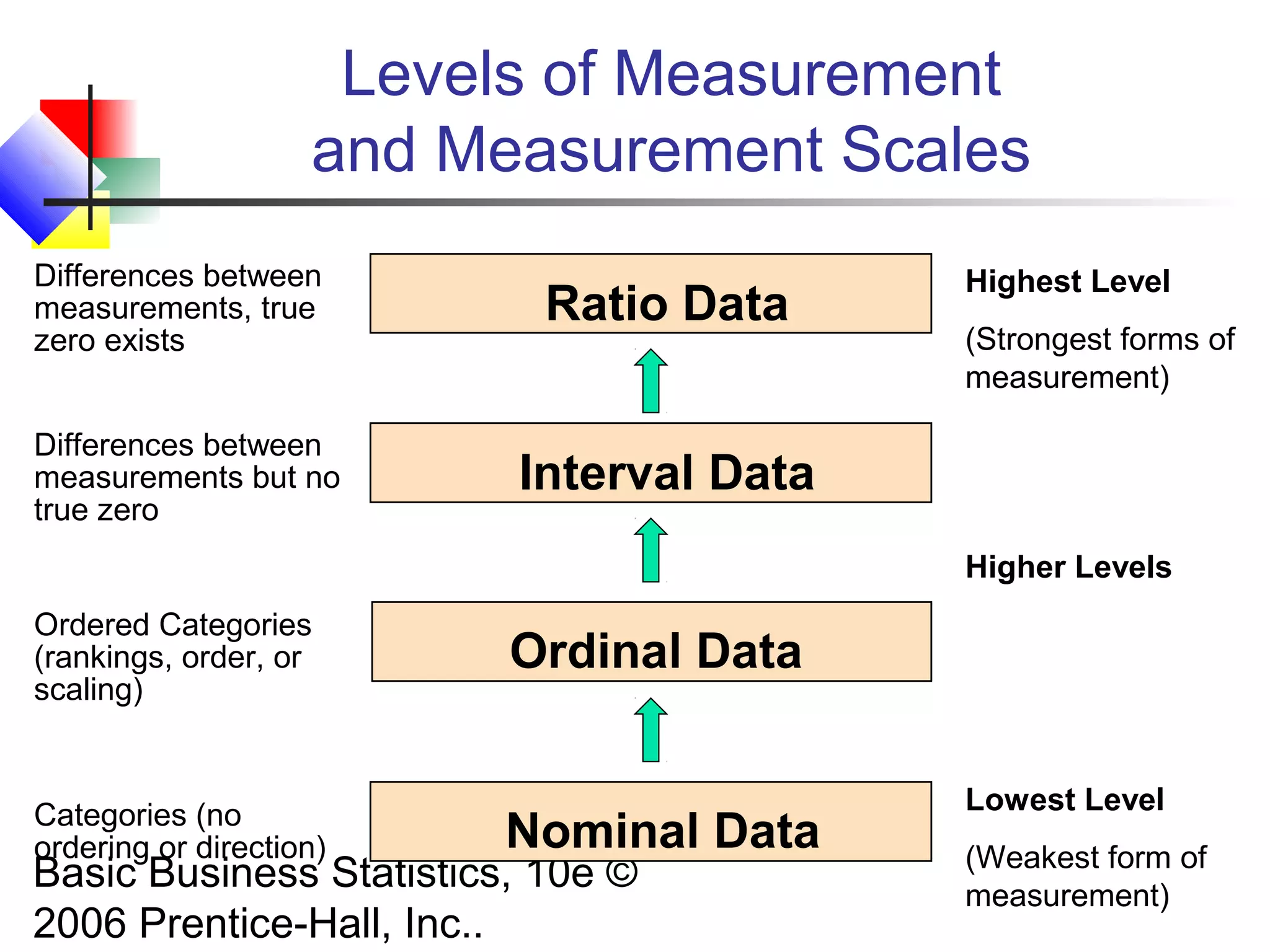
Levels of Measurement
and Measurement Scales
Interval Data
Ordinal Data
Nominal Data
Highest Level
(Strongest forms of
measurement)
Higher Levels
Lowest Level
(Weakest form of
measurement)
Categories (no
ordering or direction)
Ordered Categories
(rankings, order, or
scaling)
Differences between
measurements but no
true zero
Ratio Data
Differences between
measurements, true
zero exists
Basic Business Statistics, 10e ©
2006 Prentice-Hall, Inc..
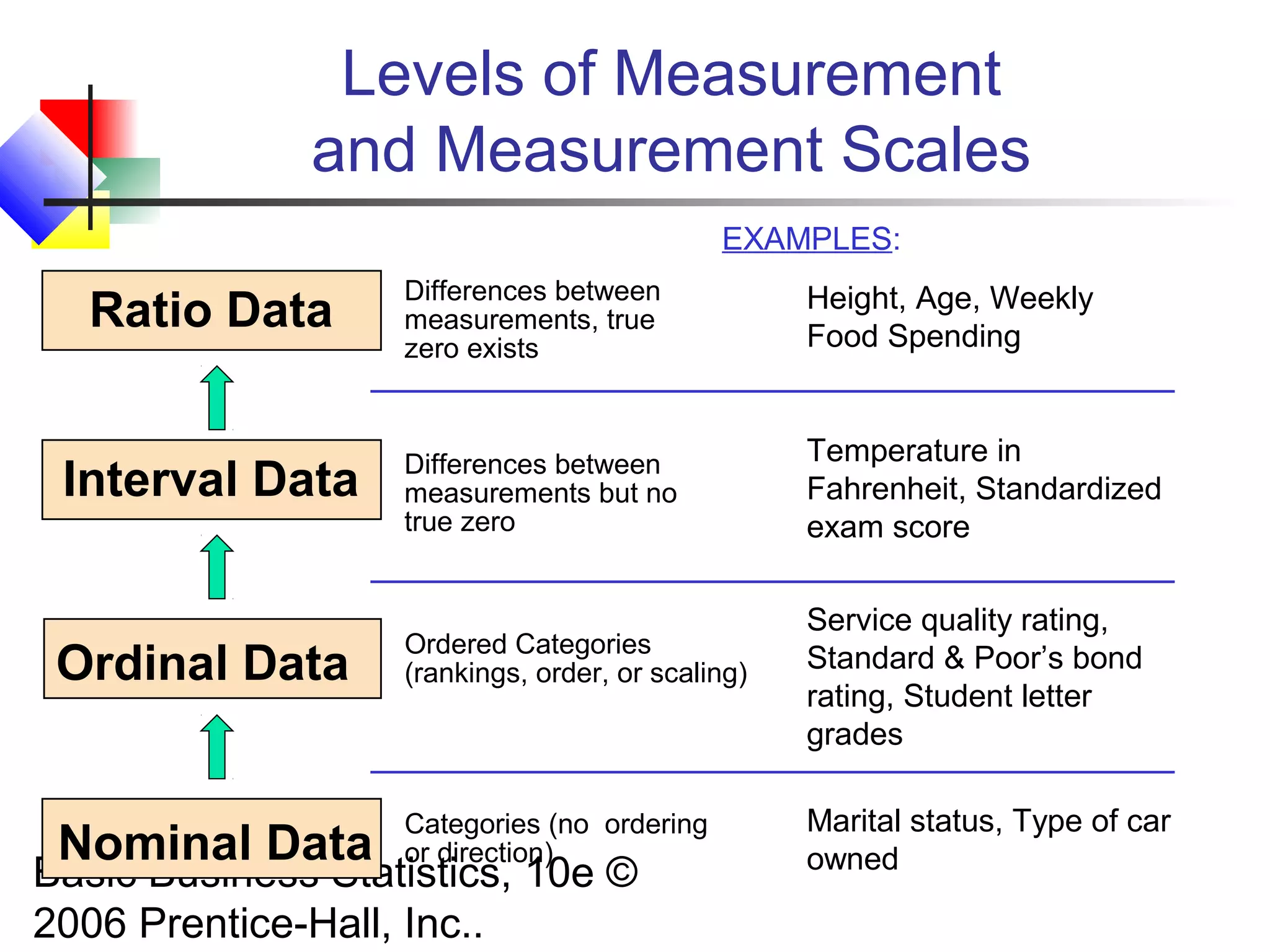
Levels of Measurement
and Measurement Scales
Interval Data
Ordinal Data
Nominal Data
Height, Age, Weekly
Food Spending
Service quality rating,
Standard & Poor’s bond
rating, Student letter
grades
Marital status, Type of car
owned
Ratio Data
Temperature in
Fahrenheit, Standardized
exam score
Categories (no ordering
or direction)
Ordered Categories
(rankings, order, or scaling)
Differences between
measurements but no
true zero
Differences between
measurements, true
zero exists
EXAMPLES:
Basic Business Statistics, 10e ©
2006 Prentice-Hall, Inc.. Chap 1-13
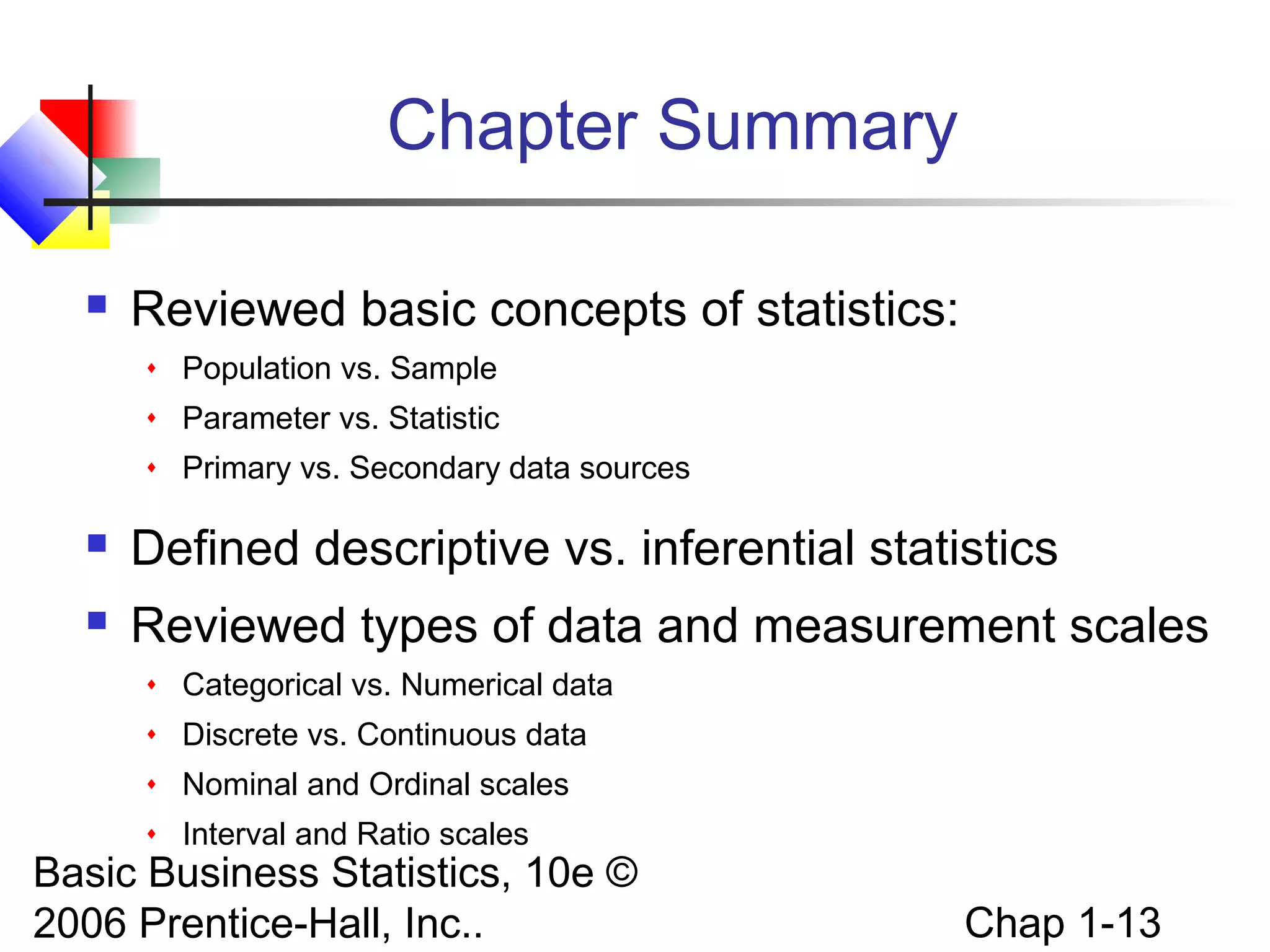
Chapter Summary
 Reviewed basic concepts of statistics:
♦ Population vs. Sample
♦ Parameter vs. Statistic
♦ Primary vs. Secondary data sources
 Defined descriptive vs. inferential statistics
 Reviewed types of data and measurement scales
♦ Categorical vs. Numerical data
♦ Discrete vs. Continuous data
♦ Nominal and Ordinal scales
♦ Interval and Ratio scales

Introduction to statistics 1

  • 1.
    Basic Business Statistics,10e © 2006 Prentice-Hall, Inc. Chap 1-1 Chapter 1 Introduction and Data Collection Basic Business Statistics 10th Edition
  • 2.
    Basic Business Statistics,10e © 2006 Prentice-Hall, Inc.. Chap 1-2 Learning Objectives In this chapter you learn:  How Statistics is used in business  The sources of data used in business  The types of data used in business
  • 3.
    Basic Business Statistics,10e © 2006 Prentice-Hall, Inc.. Chap 1-3 Basic Concepts of Statistics Statistics is concerned with:  Processing and analyzing data  Collecting, presenting, and transforming data to assist decision makers
  • 4.
    Basic Business Statistics,10e © 2006 Prentice-Hall, Inc.. Chap 1-4 Key Definitions  A population (universe) is the collection of all members of a group  A sample is a portion of the population selected for analysis  A parameter is a numerical measure that describes a characteristic of a population  A statistic is a numerical measure that describes a characteristic of a sample
  • 5.
    Basic Business Statistics,10e © 2006 Prentice-Hall, Inc.. Chap 1-5 Population vs. Sample a b c d ef gh i jk l m n o p q rs t u v w x y z Population Sample b c g i n o r u y Measures used to describe a population are called parameters Measures computed from sample data are called statistics
  • 6.
    Basic Business Statistics,10e © 2006 Prentice-Hall, Inc.. Chap 1-6 Two Branches of Statistics  Descriptive statistics  Collecting, summarizing, and presenting data  Inferential statistics  Drawing conclusions about a population based only on sample data
  • 7.
    Basic Business Statistics,10e © 2006 Prentice-Hall, Inc.. Chap 1-7 Descriptive Statistics  Collect data  e.g., Survey  Present data  e.g., Tables and graphs  Characterize data  e.g., Sample mean = iX n ∑
  • 8.
    Basic Business Statistics,10e © 2006 Prentice-Hall, Inc.. Chap 1-8 Inferential Statistics  Estimation  e.g., Estimate the population mean weight using the sample mean weight  Hypothesis testing  e.g., Test the claim that the population mean weight is 120 pounds Drawing conclusions about a population based on sample results.
  • 9.
    Basic Business Statistics,10e © 2006 Prentice-Hall, Inc.. Chap 1-9 Collecting Data Secondary Data Compilation Observation Experimentation Print or Electronic Survey Primary Data Collection
  • 10.
    Basic Business Statistics,10e © 2006 Prentice-Hall, Inc.. Chap 1-10 Types of Data Data Categorical Numerical Discrete Continuous Examples:  Marital Status  Political Party  Eye Color (Defined categories) Examples:  Number of Children  Defects per hour (Counted items) Examples:  Weight  Voltage (Measured characteristics)
  • 11.
    Basic Business Statistics,10e © 2006 Prentice-Hall, Inc.. Levels of Measurement and Measurement Scales Interval Data Ordinal Data Nominal Data Highest Level (Strongest forms of measurement) Higher Levels Lowest Level (Weakest form of measurement) Categories (no ordering or direction) Ordered Categories (rankings, order, or scaling) Differences between measurements but no true zero Ratio Data Differences between measurements, true zero exists
  • 12.
    Basic Business Statistics,10e © 2006 Prentice-Hall, Inc.. Levels of Measurement and Measurement Scales Interval Data Ordinal Data Nominal Data Height, Age, Weekly Food Spending Service quality rating, Standard & Poor’s bond rating, Student letter grades Marital status, Type of car owned Ratio Data Temperature in Fahrenheit, Standardized exam score Categories (no ordering or direction) Ordered Categories (rankings, order, or scaling) Differences between measurements but no true zero Differences between measurements, true zero exists EXAMPLES:
  • 13.
    Basic Business Statistics,10e © 2006 Prentice-Hall, Inc.. Chap 1-13 Chapter Summary  Reviewed basic concepts of statistics: ♦ Population vs. Sample ♦ Parameter vs. Statistic ♦ Primary vs. Secondary data sources  Defined descriptive vs. inferential statistics  Reviewed types of data and measurement scales ♦ Categorical vs. Numerical data ♦ Discrete vs. Continuous data ♦ Nominal and Ordinal scales ♦ Interval and Ratio scales