Solution Manual for Elementary Statistics, 7th
Edition, Ron Larson, Betsy Farber download
http://testbankbell.com/product/solution-manual-for-elementary-
statistics-7th-edition-ron-larson-betsy-farber/
Find test banks or solution manuals at testbankbell.com today!
We have selected some products that you may be interested in
Click the link to download now or visit testbankbell.com
for more options!.
Test Bank for Elementary Statistics, 7th Edition, Ron
Larson, Betsy Farber
http://testbankbell.com/product/test-bank-for-elementary-
statistics-7th-edition-ron-larson-betsy-farber/
Solution Manual for Elementary Statistics: Picturing the
World 5th edition Ron Larson
http://testbankbell.com/product/solution-manual-for-elementary-
statistics-picturing-the-world-5th-edition-ron-larson/
Elementary Statistics 6th Edition Larson Test Bank
http://testbankbell.com/product/elementary-statistics-6th-edition-
larson-test-bank/
Test Bank for Essentials of the Legal Environment, 3rd
Edition: Miller
http://testbankbell.com/product/test-bank-for-essentials-of-the-legal-
environment-3rd-edition-miller/
Test Bank for Instruction of Students with Severe
Disabilities, 7/E 7th Edition : 0137075464
http://testbankbell.com/product/test-bank-for-instruction-of-students-
with-severe-disabilities-7-e-7th-edition-0137075464/
Solution Manual for VHDL for Engineers Kenneth L. Short
http://testbankbell.com/product/solution-manual-for-vhdl-for-
engineers-kenneth-l-short/
Introduction to Management Accounting Horngren 16th
Edition Solutions Manual
http://testbankbell.com/product/introduction-to-management-accounting-
horngren-16th-edition-solutions-manual/
Test Bank for Macroeconomics, 6th Canadian Edition,
Stephen D. Williamson
http://testbankbell.com/product/test-bank-for-macroeconomics-6th-
canadian-edition-stephen-d-williamson/
Understanding Basic Statistics 6th Edition Brase Test Bank
http://testbankbell.com/product/understanding-basic-statistics-6th-
edition-brase-test-bank/
Test Bank For Principles of Genetics, 6th edition: D.
Peter Snustad
http://testbankbell.com/product/test-bank-for-principles-of-
genetics-6th-edition-d-peter-snustad/
Copyright © 2019 Pearson Education, Inc.
Elementary Statistics, 7th
Full chapter download at: https://testbankbell.com/product/solution-manual-for-elementary-
statistics-7th-edition-ron-larson-betsy-farber/
1. The population consists of the responses of all ninth to twelfth graders in the United States. The
sample consists of the responses of the 1501 ninth to twelfth graders in the survey. The sample
data set consists of 1215 ninth to twelfth graders who said leaders today are more concerned
with their own agenda than with achieving the overall goals of the organization they serve and
286 ninth to twelfth graders who did not say that.
2a. Population parameter, because the total spent on employees’ salaries, $5,150,694, is based on
the entire company.
b. Sample statistic, because 43% is based on a subset of the population.
3a. The population consists of the responses of all U.S. adults, and the sample consists of the
responses of the 1000 U.S. adults in the study.
b. The part of this study that represents the descriptive branch of statistics involves the statement
“three out of four adults will consult with their physician or pharmacist and only 8% visit a
medication- specific website [when they have a question about their medication].”
c. A possible inference drawn from the study is that most adults consult with their
physician or pharmacist when they have a question about their medication.
1. A sample is a subset of a population.
2. It is usually impractical (too expensive and/or time consuming) to obtain all the population data.
3. A parameter is a numerical description of a population characteristic. A statistic is a
numerical description of a sample characteristic.
4. The two main branches of statistics are descriptive statistics and inferential statistics.
5. False. A statistic is a numerical measure that describes a sample characteristic.
6. True
7. True
8. False. Inferential statistics involves using a sample to draw conclusions about a population.
9. False. A population is the collection of all outcomes, responses, measurements, or counts that
are of interest.
Copyright © 2019 Pearson Education, Inc.
CHAPTER 1 Ň INTRODUCTION TO STATISTICS
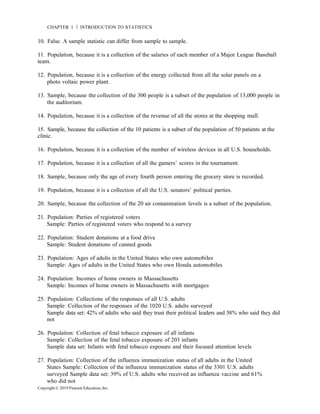
10. False. A sample statistic can differ from sample to sample.
11. Population, because it is a collection of the salaries of each member of a Major League Baseball
team.
12. Population, because it is a collection of the energy collected from all the solar panels on a
photo voltaic power plant.
13. Sample, because the collection of the 300 people is a subset of the population of 13,000 people in
the auditorium.
14. Population, because it is a collection of the revenue of all the stores at the shopping mall.
15. Sample, because the collection of the 10 patients is a subset of the population of 50 patients at the
clinic.
16. Population, because it is a collection of the number of wireless devices in all U.S. households.
17. Population, because it is a collection of all the gamers’ scores in the tournament.
18. Sample, because only the age of every fourth person entering the grocery store is recorded.
19. Population, because it is a collection of all the U.S. senators’ political parties.
20. Sample, because the collection of the 20 air contamination levels is a subset of the population.
21. Population: Parties of registered voters
Sample: Parties of registered voters who respond to a survey
22. Population: Student donations at a food drive
Sample: Student donations of canned goods
23. Population: Ages of adults in the United States who own automobiles
Sample: Ages of adults in the United States who own Honda automobiles
24. Population: Incomes of home owners in Massachusetts
Sample: Incomes of home owners in Massachusetts with mortgages
25. Population: Collections of the responses of all U.S. adults
Sample: Collection of the responses of the 1020 U.S. adults surveyed
Sample data set: 42% of adults who said they trust their political leaders and 58% who said they did
not
26. Population: Collection of fetal tobacco exposure of all infants
Sample: Collection of the fetal tobacco exposure of 203 infants
Sample data set: Infants with fetal tobacco exposure and their focused attention levels
27. Population: Collection of the influenza immunization status of all adults in the United
States Sample: Collection of the influenza immunization status of the 3301 U.S. adults
surveyed Sample data set: 39% of U.S. adults who received an influenza vaccine and 61%
who did not
Copyright © 2019 Pearson Education, Inc.
CHAPTER 1 Ň INTRODUCTION TO STATISTICS
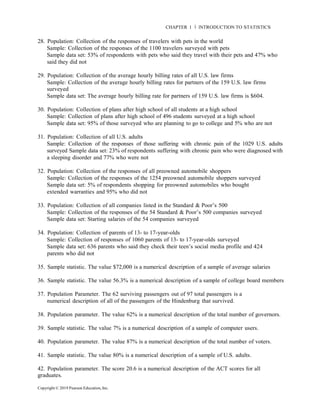
28. Population: Collection of the responses of travelers with pets in the world
Sample: Collection of the responses of the 1100 travelers surveyed with pets
Sample data set: 53% of respondents with pets who said they travel with their pets and 47% who
said they did not
29. Population: Collection of the average hourly billing rates of all U.S. law firms
Sample: Collection of the average hourly billing rates for partners of the 159 U.S. law firms
surveyed
Sample data set: The average hourly billing rate for partners of 159 U.S. law firms is $604.
30. Population: Collection of plans after high school of all students at a high school
Sample: Collection of plans after high school of 496 students surveyed at a high school
Sample data set: 95% of those surveyed who are planning to go to college and 5% who are not
31. Population: Collection of all U.S. adults
Sample: Collection of the responses of those suffering with chronic pain of the 1029 U.S. adults
surveyed Sample data set: 23% of respondents suffering with chronic pain who were diagnosed with
a sleeping disorder and 77% who were not
32. Population: Collection of the responses of all preowned automobile shoppers
Sample: Collection of the responses of the 1254 preowned automobile shoppers surveyed
Sample data set: 5% of respondents shopping for preowned automobiles who bought
extended warranties and 95% who did not
33. Population: Collection of all companies listed in the Standard & Poor’s 500
Sample: Collection of the responses of the 54 Standard & Poor’s 500 companies surveyed
Sample data set: Starting salaries of the 54 companies surveyed
34. Population: Collection of parents of 13- to 17-year-olds
Sample: Collection of responses of 1060 parents of 13- to 17-year-olds surveyed
Sample data set: 636 parents who said they check their teen’s social media profile and 424
parents who did not
35. Sample statistic. The value $72,000 is a numerical description of a sample of average salaries
36. Sample statistic. The value 56.3% is a numerical description of a sample of college board members
37. Population Parameter. The 62 surviving passengers out of 97 total passengers is a
numerical description of all of the passengers of the Hindenburg that survived.
38. Population parameter. The value 62% is a numerical description of the total number of governors.
39. Sample statistic. The value 7% is a numerical description of a sample of computer users.
40. Population parameter. The value 87% is a numerical description of the total number of voters.
41. Sample statistic. The value 80% is a numerical description of a sample of U.S. adults.
42. Population parameter. The score 20.6 is a numerical description of the ACT scores for all
graduates.
Copyright © 2019 Pearson Education, Inc.
CHAPTER 1 Ň INTRODUCTION TO STATISTICS
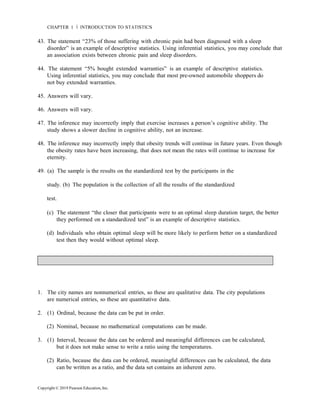
43. The statement “23% of those suffering with chronic pain had been diagnosed with a sleep
disorder” is an example of descriptive statistics. Using inferential statistics, you may conclude that
an association exists between chronic pain and sleep disorders.
44. The statement “5% bought extended warranties” is an example of descriptive statistics.
Using inferential statistics, you may conclude that most pre-owned automobile shoppers do
not buy extended warranties.
45. Answers will vary.
46. Answers will vary.
47. The inference may incorrectly imply that exercise increases a person’s cognitive ability. The
study shows a slower decline in cognitive ability, not an increase.
48. The inference may incorrectly imply that obesity trends will continue in future years. Even though
the obesity rates have been increasing, that does not mean the rates will continue to increase for
eternity.
49. (a) The sample is the results on the standardized test by the participants in the
study. (b) The population is the collection of all the results of the standardized
test.
(c) The statement “the closer that participants were to an optimal sleep duration target, the better
they performed on a standardized test” is an example of descriptive statistics.
(d) Individuals who obtain optimal sleep will be more likely to perform better on a standardized
test then they would without optimal sleep.
1. The city names are nonnumerical entries, so these are qualitative data. The city populations
are numerical entries, so these are quantitative data.
2. (1) Ordinal, because the data can be put in order.
(2) Nominal, because no mathematical computations can be made.
3. (1) Interval, because the data can be ordered and meaningful differences can be calculated,
but it does not make sense to write a ratio using the temperatures.
(2) Ratio, because the data can be ordered, meaningful differences can be calculated, the data
can be written as a ratio, and the data set contains an inherent zero.
Copyright © 2019 Pearson Education, Inc.
CHAPTER 1 Ň INTRODUCTION TO STATISTICS
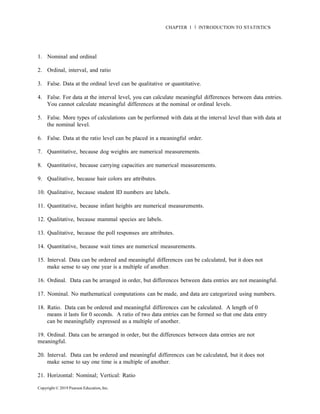
1. Nominal and ordinal
2. Ordinal, interval, and ratio
3. False. Data at the ordinal level can be qualitative or quantitative.
4. False. For data at the interval level, you can calculate meaningful differences between data entries.
You cannot calculate meaningful differences at the nominal or ordinal levels.
5. False. More types of calculations can be performed with data at the interval level than with data at
the nominal level.
6. False. Data at the ratio level can be placed in a meaningful order.
7. Quantitative, because dog weights are numerical measurements.
8. Quantitative, because carrying capacities are numerical measurements.
9. Qualitative, because hair colors are attributes.
10. Qualitative, because student ID numbers are labels.
11. Quantitative, because infant heights are numerical measurements.
12. Qualitative, because mammal species are labels.
13. Qualitative, because the poll responses are attributes.
14. Quantitative, because wait times are numerical measurements.
15. Interval. Data can be ordered and meaningful differences can be calculated, but it does not
make sense to say one year is a multiple of another.
16. Ordinal. Data can be arranged in order, but differences between data entries are not meaningful.
17. Nominal. No mathematical computations can be made, and data are categorized using numbers.
18. Ratio. Data can be ordered and meaningful differences can be calculated. A length of 0
means it lasts for 0 seconds. A ratio of two data entries can be formed so that one data entry
can be meaningfully expressed as a multiple of another.
19. Ordinal. Data can be arranged in order, but the differences between data entries are not
meaningful.
20. Interval. Data can be ordered and meaningful differences can be calculated, but it does not
make sense to say one time is a multiple of another.
21. Horizontal: Nominal; Vertical: Ratio
Copyright © 2019 Pearson Education, Inc.
CHAPTER 1 Ň INTRODUCTION TO STATISTICS
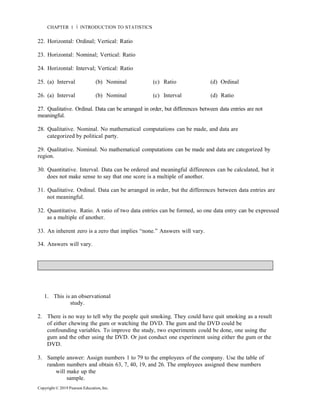
22. Horizontal: Ordinal; Vertical: Ratio
23. Horizontal: Nominal; Vertical: Ratio
24. Horizontal: Interval; Vertical: Ratio
25. (a) Interval (b) Nominal (c) Ratio (d) Ordinal
26. (a) Interval (b) Nominal (c) Interval (d) Ratio
27. Qualitative. Ordinal. Data can be arranged in order, but differences between data entries are not
meaningful.
28. Qualitative. Nominal. No mathematical computations can be made, and data are
categorized by political party.
29. Qualitative. Nominal. No mathematical computations can be made and data are categorized by
region.
30. Quantitative. Interval. Data can be ordered and meaningful differences can be calculated, but it
does not make sense to say that one score is a multiple of another.
31. Qualitative. Ordinal. Data can be arranged in order, but the differences between data entries are
not meaningful.
32. Quantitative. Ratio. A ratio of two data entries can be formed, so one data entry can be expressed
as a multiple of another.
33. An inherent zero is a zero that implies “none.” Answers will vary.
34. Answers will vary.
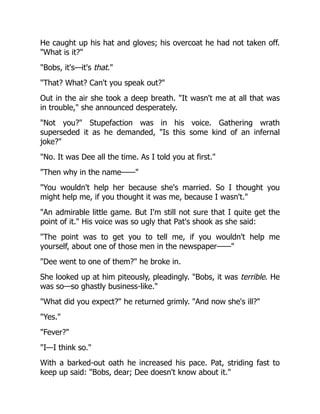
1. This is an observational
study.
2. There is no way to tell why the people quit smoking. They could have quit smoking as a result
of either chewing the gum or watching the DVD. The gum and the DVD could be
confounding variables. To improve the study, two experiments could be done, one using the
gum and the other using the DVD. Or just conduct one experiment using either the gum or the
DVD.
3. Sample answer: Assign numbers 1 to 79 to the employees of the company. Use the table of
random numbers and obtain 63, 7, 40, 19, and 26. The employees assigned these numbers
will make up the
sample.
Copyright © 2019 Pearson Education, Inc.
4. (1) The sample was selected by using the students in a randomly chosen class. This is
cluster sampling.
Random documents with unrelated
content Scribd suggests to you:
He caught up his hat and gloves; his overcoat he had not taken off.
"What is it?"
"Bobs, it's—it's that."
"That? What? Can't you speak out?"
Out in the air she took a deep breath. "It wasn't me at all that was
in trouble," she announced desperately.
"Not you?" Stupefaction was in his voice. Gathering wrath
superseded it as he demanded, "Is this some kind of an infernal
joke?"
"No. It was Dee all the time. As I told you at first."
"Then why in the name——"
"You wouldn't help her because she's married. So I thought you
might help me, if you thought it was me, because I wasn't."
"An admirable little game. But I'm still not sure that I quite get the
point of it." His voice was so ugly that Pat's shook as she said:
"The point was to get you to tell me, if you wouldn't help me
yourself, about one of those men in the newspaper——"
"Dee went to one of them?" he broke in.
She looked up at him piteously, pleadingly. "Bobs, it was terrible. He
was so—so ghastly business-like."
"What did you expect?" he returned grimly. "And now she's ill?"
"Yes."
"Fever?"
"I—I think so."
With a barked-out oath he increased his pace. Pat, striding fast to
keep up said: "Bobs, dear; Dee doesn't know about it."
"About what?"
"About my pretending that I was the one. It was my own notion."
"Then you will tell her," he ordained with chill command, "as soon as
she is well enough to hear it. If she gets well enough," he added.
"If? Bobs! You don't think there's any real danger——"
"Of course there is danger. What do you think fever means in such a
case? You take things into your own hands, perpetrate a piece of
criminal folly——"
"Bobs! I couldn't have stopped her."
"You could have told me the truth and let me handle the situation.
She would never have dared if she knew that I knew. Now, if Dee
dies——"
"Don't, Bobs!"
"It will be your lie that killed her."
For once the reckless soul of Pat shrunk back upon itself in awed
remorse. "You've never spoken to me that way in your life," she
whimpered.
"I've never felt toward you before as I feel now."
"I'm sorry, Bobs. But I had to do it. I'd do it again to save Dee."
"Save her? Aid her in a cowardly shirking of her first duty as a
woman and a wife. It is bad enough to find you lying to me. But to
find her a coward and a slacker——"
"You're more angry at her than you are at me, aren't you?" said Pat,
in wonder and some resentment. She did not like to have anyone
else put before her even for indignation.
He made no reply, but turned in at the gateway to the James
ground. As they passed under the portico she stole a glance at his
face. It had, by the magic of his will, become calm, cheerful, self-
possessed, exorcised of all wrath and dismay, the face of the
confident, confidence-inspiring physician going on his duty of aid.
Pat marvelled and admired.
For her it was a long and thought-haunted half hour before he
emerged from Dee's room.
"Is it bad?" she whispered, striving to read his expression.
"No. A slight nervous shock. Nothing more."
"Oh, Bobs! I could cry with thankfulness."
"Save your tears," he advised, "for those on whom they might make
an impression."
"You don't like me much, do you?" she sighed. "Did you tell Dee
about my trick?"
"Haven't I made it clear that you are to make that explanation?"
"What if I don't choose to?"
"I think you will. Whether you like it or not."
Pat said with slow malice: "Shall I tell her that you asked me to
marry you?"
"Why not?"
"Oh, very well!" She could think of nothing more effective to say.
He took his coat and hat from the chair upon which he had tossed
them.
"Bobs."
He turned at the door, eyeing her with an uncompromising regard.
"Don't look at me in that poisonous way. Say you're sorry, or I'm
sorry, or something."
He did not move but seemed to be considering. When he spoke his
voice shook her with its gravity: "It is not going to be easy to forgive
you, Pat."
"How about Dee?" she shot at him.
"That is between Dee and myself. She at least did not lie to me."
Pat flamed with a sense of unmerited injuries. "Oh, you go to hell!"
she muttered. But her eyes were wondering and frightened after he
left her. Dee's voice calling gave her something else to think about.
She ran upstairs.
"What were you and Bobs quarrelling about?" demanded the patient.
"Nothing."
"You were. Was it about me? Is he very bitter against me?"
"I'll tell you to-morrow. You must go to sleep now."
"There's something back of this." Dee jumped from her bed and set
her back to the door. "You won't leave this room till you tell me."
"Get back into bed," implored the alarmed Pat. "I'll tell you. Truly I
will."
"Tell, then."
Pat related the tale of the stratagem with increasing relish in the
unfolding of the drama. "Pretty clever of little Pat, what?"
"I'm sorry you had to lie to Bobs, though."
"I've kept the best of it. When I told him, Bobs asked me to marry
him."
"Asked you?"
"Yes. Isn't that a scream!" Between nervousness and exaltation of
her diplomatic powers Pat burst into laughter.
"And you laugh?"
The mirth died on her lips. "Don't you think it's fun——"
"You—dirty—little—beast."
"What did I do?" faltered the younger sister. "Why pick on me? I did
it all for you anyway, and I think it's pretty rotten, if you ask me, to
——"
"You didn't laugh at Bobs for me."
"I didn't laugh at him at all. I was too paralysed."
"If you had I hope he'd have killed you. I would."
A monstrous conjecture rose in Pat's excited brain. "He isn't the
man, is he? It isn't Bobs that you're crazy about, and the other man
just a bluff? It couldn't be."
"Why couldn't it?"
"Dee! It isn't."
"No; it isn't. But there's no reason why it couldn't be with any
woman who had heart and sense enough to know him for what he
is. He's the best and finest person I've ever known. And when he
does the biggest and noblest thing a man could do and offers his
name and honour to shield a little heartless fool, he gets laughed
at."
"But it wasn't any of it true," cried Pat feebly. "Don't you see what a
difference that makes?"
"No. He thought it was true."
"Oh, very well! I guess I'm pretty rotten. But I'm just as fond of
Bobs as you are, Dee Fentriss. Only, the idea of marrying him—well,
it's a scream. That's all; a simple scream."
"Oh, do get out of here," said Dee wearily. She slumped down into
her bed and drew the covers up.
"Good-night," said Pat, and made her exit.
Before the hall mirror she paused to contemplate herself. "There you
are, Pattie-pat," she remarked, with the little triple jerk of the head
that set her shaggy locks rippling over her ears and neck. "You still
look pretty good to me. But if this family was running a popularity
contest with peanuts for ballots, you wouldn't get one shuck. Lord-
ee! I wish Cary Scott was here for just one minute! I need moral
support."
CHAPTER XXIII
Spring was turbulent in the sap of young trees and the blood of
young humans when Mary Delia James rolled along Fifth Avenue in
the quietly elegant limousine provided for her special use by a
correctly generous husband. Nothing about her suggested
participation in the turbulence of the season. Rather, life with that
most unvernal young man, T. Jameson James, would have served to
allay any tendencies toward ebullience which she might otherwise
have exhibited. She gave the impression of a cool impassivity.
The car had just turned into a side street when her languid
expression livened. She signalled to her chauffeur, leaned out of the
window and called:
"Cary! Cary Scott!"
The object of the summons turned in mid-crossing and came back,
his eyes shining with pleasure.
"Dee! It is good to see you again. How's James?"
"All right, thank you. What do you mean by turning up and not
letting us know?"
"Unexpected," he explained. "I hardly had time to find it out before I
was here."
"The telegraph, that useful invention, is still operating. Get in; we're
blocking traffic. You're dining and spending the night with us, of
course."
"If I stay over," he answered dubiously. "I don't know yet. Tell me
about the family."
"As usual. We're all flourishing in true Fentriss style."
"Pat? And Mr. Fentriss? And the Brownings?"
"Separated. No; I don't mean Fred and Con," she amended, laughing
at the dismay in his face. "Dad and the Brownings. Fred's sticking to
business and to Con; they've got a cottage over beyond the Club;
addition in June, not to the cottage, to the family. Pat's running
Holiday Knoll like a veteran, though just now she's in Boston. She'll
be sunk in desolation when she finds you've been here and she's
missed you."
"Perhaps I'll be back again when she returns," he said carelessly, but
his words belied his inward resolution so to arrange his schedule that
he would run no risk of the peace-destroying encounter. As a minor
determination, he decided to accept Dee's invitation for the night,
since it involved no danger of seeing Pat.
"Yes; Pat's quite doing her job," continued Dee. "It's good for her to
have the responsibility. But she's still a queer, restless, morbid kid.
You saw a lot of her at one time, Cary. I always thought you had a
steadying influence on her. What's the matter with Pat, do you
think?"
"The fever of the age, perhaps."
"Oh, we've all got that. But Pat's temperature is particularly high.
She rushes from one whirl to another, playing Billy-old-hell with Mark
Denby one week, and Emslie Selfridge another, and Selden Thorpe,
a third, and what does she get out of it? Not even excitement, or
else she's a little liar. She's beaten it now because she says she's
bored to suicide with this place."
"And you yourself, Dee? How is it with you?"
"Oh, I've everything I want," she said restlessly.
"Everything should include happiness; I'm glad."
"What's that? Don't know—yeh." Her voice was hard. "Please stop
looking at me like a solemn owl, as if you were probing for
symptoms. Bobs does all that I need in that line."
"Osterhout? How is he?"
"Go and see him. He needs stirring up. You are coming to us to-
night, aren't you?"
"Only too charmed. What's this place?" he asked, as the car drew to
the curb.
"My tailor's. Will you wait for me?"
"Heavens, no!" he laughed. "I'm nearly forty now. Can't spare the
time."
"Then account for yourself before you go. What brings you here so
suddenly and without any announcement?"
"A peculiar mission."
"Private, for a guess. Not hooked, are you, Cary?"
"Nothing of that nature. It's private, but not secret, from you. In
fact, you may be able to help me."
"I? In what possible way?"
"I want to find Stanley Wollaston."
At the name a slow colour rose in Dee's cheeks until it tinged even
the broadly and beautifully modelled forehead. "He's gone away. To
Richmond. I can give you his address."
"Good! I've some important news for him. There's no reason why
you shouldn't know it. His aunt in England has died and left him the
estate. Stan's lean days are over."
The rich hue ebbed out of Dee's face. "He'll go back, then," she
mused. At once she recovered herself. "I am glad," she said.
"I knew you would be," he answered. But he thought with pity: "She
still loves him"; and, with uneasiness, "and still sees him." He
continued: "He'll be going back within a month at the latest. I'll go
on to-morrow to find him."
He got out, bared his head, and helped her to alight.
"At seven o'clock then," she said. "Shall I get some people in? Who
do you want to see?"
"No one else in the world," he answered with such conviction that
she smiled up at him.
"You are a dear, Cary. I can't tell you how much we've missed you.
Pat almost went into mourning."
She did not see his expression change, ever so slightly, as he turned
away. Business of his own kept Scott busy most of the afternoon.
When he reached the club he found Jameson James waiting to
motor him out. James was amiable in his stiff and carefully
measured way.
Scott went to his room immediately upon their arrival, bathed,
dressed, drank the preliminary cocktail which Dee had mixed with
her own hands and sent up to him, and had started to go downstairs
when he stopped, his breath piling up, as it were, in his throat from
an emotion half dismay, half rapture. The unforgettable, luscious
huskiness of a voice floated up from below.
"Dee; where are you? Do come and hook this last hook for me. I
can't get the dam' thing to stay."
He took a step forward. Pat looked up. "Oh, Mist-er Scott!" she
crowed. "It's too flawless to see you again. I thought you were
never coming back."
CHAPTER XXIV
He walked back with her to Holiday Knoll after dinner. Pat's face was
thoughtful, moody. As they paced in silence he studied it intently,
with passionate longings, with passionate misgivings. Out of a
reverie she spoke.
"I've never missed anyone in my life as I've missed you. You were
right."
"About what, Pat?"
"That day you took me to Philadelphia. You said I'd miss you more
than I thought. D'you remember, I told you then what I thought
about it. 'Oh, well, I'll miss him for a few days and then—pouf!'"
There followed the impatient, boyish wriggle and hunch of the lithe
shoulders. "'It'll be all over.' It wasn't all over."
"For me it has never been over. Not for a single minute."
"Have you wanted me so much?" Beneath the conscious coquetry
there was a more wistful note.
"Oh, God, Pat!" His voice sounded thick and rough. "There has been
no colour or savour, no music or fragrance in life without you."
"Why did you go away?" she demanded accusingly.
"You know, I had to go."
"Why did you come back?"
"Not to see you. I didn't want to see you. Dee told me that you were
away."
"She told me you were here. I'd phoned over about some clothes.
So I just thought I'd like to see you again. Don't scowl at me. You
look as if you think I ought not to have come."
"No; you oughtn't."
"Are you sorry I did?"
He looked away from her into the wind-swept night.
"Are you angry because I did?"
"I love you," he burst out. "God, how I love you!"
She laughed softly. Her hand slid down his arm, clasped for a
moment the wrist in which his pulses leapt madly to her touch,
wreathed itself, cool and strong and smooth, around his palm. "And I
love you," she half-whispered gaily. "I'm terribly in love with you"—a
pause of deliberate intent—"to-night. Because you've been away
from me so long."
"Ah, yes, to-night!" He made no effort to keep the bitterness out of
his voice. "But, to-morrow——"
"To-night's to-night," she broke in happily. "We've got lots of it to
ourselves. It's only nine o'clock. I broke away early on purpose."
Arrested by the look on his face, she added with exasperation and
protest: "Cary! You're not going to play propriety to-night? When we
haven't seen each other for so long?"
She shook the gleamy mist of her hair about her face, gave a
gnomish bend and twist to body and neck and peered sidelong at
him from out the tangle.
Suddenly her face darted upward. Her mouth met his in a grotesque
parody of a passion-laden kiss.
"Oh, bad bunny!" she admonished herself in mock reproach. He
stopped, gazing at her from beneath bent brows.
"You hated that, didn't you?" she said.
"Yes."
"Because it wasn't real?"
"Because it was mockery."
"Petite gamine stuff. But I'm not petite gamine to-night; I'm
something else. I don't know what I am. Do you?"
"No."
"Don't be cross with me. Whatever it is that I am, it's sorry that it
kissed you that way. I didn't mean to make a josh of it."
He smiled. "One might as well try to be cross with a moonbeam."
They had come around by the side street, and now he held the
garden gate back for her. The house was dim. Pat kissed her hand to
the clematis arbour.
"D'you remember?" she murmured.
"Is there one moment ever spent with you that I've forgotten?"
"Would you like to forget?"
"There are times when I would give anything in the world to forget."
"But I don't want you to forget."
"You want me to have to bear this always?"
"No. I don't want you to be unhappy about it. I want—I don't know
what I do want. Except now. Now I want to have this evening just to
ourselves." She opened a side door, spoke to a servant, moving
about in the kitchen. "It's all right, Katie." Then to Scott: "Aren't you
coming in?"
He hesitated, but when she added impatiently, "Oh, don't be such a
crab!" he followed her.
"Go into the small conservatory," she bade him. "That's my work.
I've fussed it up into a sort of den."
She bounded upstairs and ran into her room, shook out her hair,
gathered it, studied herself in the glass. Her eyes were brilliant,
heavy-lidded, dreamy. She shook herself impatiently; her strong,
supervitalised young body felt cramped and pent in the close-fitting
tailor-made which she had on. She plucked at the buttons with
hurried fingers, wriggled out of the garment which she kicked from
her feet and left lying on the floor, tossed her corsets after it, and
exhaled a long, luxurious "Ooo-oo-oofff!" of satisfaction and
voluptuous relief.
Opening the door of her clothes-press, she rummaged for a moment
and pulled out a long, sweeping robe, which she drew about her,
moulding it to the boyish set of her shoulders and the woman's
depth and contour of her bosom. She caught up a cigarette, lighted
a match, then, lapsing into thought, let it droop from her fingers
until the scorching brought an angry "Damn!" of pain. She threw the
cigarette after the expiring match. No; she wouldn't smoke, much as
her tense nerves demanded it. She would keep her mouth fresh and
sweet for Cary's first kiss.
She ran down to him, putting on the far light in the hallway, so that
only a dim glow invaded the conservatory-den. Scott stood at the
window in an attitude of attention.
"What are you doing?" she asked.
"Listening."
"Music! A violin. Oh, I know. It's a visitor at the Eastmans', next
door. He's good. And how flawless of him to be playing just now.
Open the window. Let's hear it all."
He obeyed. She drew in to him. Her ready fingers sought his palm.
"Want me to mix you a drink?"
"No, dear."
"That's better," she approved. "Though," she added, with her old air
of gaminerie, "it might go further and not get a call-down. What is it
he's playing?"
"'The Élégie.'"
The violin was sobbing, panting, pleading like a woman in sweet
distress. The wind swept the notes to them until the whole room
was surcharged with the passion and grief of it.
Pat lifted Scott's hand, cuddled it to her cheek, flipped it away
carelessly, turned from him, drifted out of the den into the hallway,
back again, and to the divan in the far corner, where she threw
herself, snuggling amidst the pillows. Her eyes grew heavy,
languorous; in their depths played a shadowed gleam like the far
reflection of flame in the heart of sombre waters. The long, thrilling,
haunted, wind-borne prayer of the violin penetrated to the
innermost fibre of her, mingling there with the passionate sense of
his nearness, swaying her to undefined and flashing languors, to
unthinkable urgencies.
"Oh, Cary!" she breathed, in the breaking seduction of her voice, a
voice that blended and was one with the resistless pleading of the
music. And again: "Oh, Cary!"
Her arms yearned out to him, drawing him through the dimness.
With a cry he leapt to her, clasped her, felt her young strength and
lissome grace yield to his enfoldment. Through her sundered lips he
drew the wine of her breath deep, deep into his veins, until all his
self was merged and lost in her passion.
Outside the great wind possessed the world, full of the turbulence,
the fever, the unassuaged desire of Spring, the allegro furioso of the
elements, and through it pierced the unbearable sweetness of the
stringed melody.
The strain died. Was it after a minute, or an hour, or a night that
was an age in their intertwined lives? He was back at the window,
leaning against the casement, drawing the rushing wind into his
lungs, his heart bursting, his soul a whirl of fire.
Behind him, in the gloom, sounded the shaken softness of her
breathing. He bent his head upon his arms.
"Oh, God!" he said. "Pat. Little Pat!"
She came to him then, spread her gracious arms wide, flung the
gleaming fog of her hair to the wind, enclasped him, claimed his soul
with her lips.
"I'm not sorry," she panted. "I'm not! I'm not! I'm glad!"
CHAPTER XXV
Nothing irked Pat more than being awakened too early.
Consequently Katie's knock upon her door, at the third discreet
repetition, elicited a plaintive growl of protest.
"Oh, go away!"
"Special delivery letter for you, Miss Pat."
"Shove it under the door and don't bother me." She flumped over in
bed, burrowing her face among the pillows like an annoyed baby.
Very much did Pat wish to sleep. Until long after midnight she had
lain awake, thinking excitedly. To be roused out of the profound
oblivion which she had finally achieved, thus untimely, was a little
too much. But that letter got between her and her rest. From Cary
Scott, of course. She visualised the oblong blue stamp, insistent,
intrusive, "immediate." Oh, well! Up she jumped, caught the
envelope from the floor, and dived back into bed to read it.
It was mainly repetition of what he had said last night when they
parted: nothing but the absolute necessity of going would have
taken him away from her at such a time; he would be back in a few
days at the latest; she must wait until then; must not let herself
worry, must not make herself unhappy, must trust in him. It ended,
"I love you, Pat." Through the quiet directness of the wording Pat
felt the stress of an overwhelming emotion. It was not so much
worry or unhappiness that filled Pat's thoughts as a confused and
colourful bewilderment, a sense of unreality. There intervened a
reflection from her mis-education through the media of flash fiction
and the conventional false moralizings of the screen. In a variety of
presentations they all taught the same lesson, that when girls "went
wrong" they invariably "got into trouble." She passed her hands
down along her slender, boyish body and experienced a sharp qualm
of fear and disgust and anger, a visualisation of gross and sodden
changes in those slim contours. It couldn't happen to her. In spite of
the movies, other girls "took a chance" and "got away with it." Ada
Clare, for instance, according to common gossip; nothing had
happened to her. Cissie Parmenter had lightly hinted at
"experiences." Pat thought it would be exciting to tell Cissie. But
would it be safe? She would like to have Cissie's reassurance that
everything would be all right. But why should she need reassurance?
She steadied herself with the thought, entertained wholly without
idea of blasphemy or irreverence, that God wouldn't let anything like
that come about, the God to whom she had paid such assiduous
homage by going regularly to church and asking every night for
what she specially wanted on the morrow or in the further future. It
was her naïve idea of an unwritten pact with the Deity that the
performance of her little ritual, be it never so self-seeking, entitled
her, of right, to definite rewards and exemptions, claimable as
required. This was one of them. Surely He would keep to His part of
the bargain. Otherwise, what good would religion be to anyone?
It occurred to her uncomfortably that He had somewhere said, "The
wages of sin is death," which she secretly deemed bad grammar
even if it was in the Bible. But Pat did not really feel that this was
sin; rather it was accident. Technically it might be sin; she admitted
so much. But if it were really sin she would, as a sound Christian,
feel remorse. And she did not feel remorse. Therefore it could not in
any serious sense be sin. Irrefutable logic! What did she feel? She
asked herself. A sense of the fullness of life, of adventure boldly
dared. She had met one of the great crises of a woman's life, the
crisis, indeed. It must be so, since all the stories and movies and
plays agreed on the point. The singular aspect of it was that she was
conscious of no inner change. She was the same Pat Fentriss, only a
day older than yesterday. Being a "woman," if this was it, was not so
different from being a "girl."
And Mr. Scott. According to the conventions, as she had absorbed
them through the sensationalised and distorted lens to which her
intellectual vision had become habituated, the lover should lose all
"respect" for the unfortunate girl, this being the first symptom of the
waning of his love. Well, it wasn't working that way with her lover.
The few, broken words of parting last night, the still passion of his
letter, told a different story. Possibly, reflected Pat, the people who
set forth what purported to be life, on screen, stage, and the printed
page, didn't know so much about it after all. Or possibly she and
Cary Scott were different from other people. She felt convinced that
she was.
From this she fell to speculating upon Scott's probable attitude
toward the ingenious and comforting theory of conduct and
responsibility which she just had formulated specially to fit the
present crisis. Somehow it did not seem quite satisfactory in the
illumination of his imagined view. She had thought of him always
and rather mournfully as a non-religious if not actually irreligious
man; but it was disturbingly cast up from the depths of her mind
that if Cary Scott had a God, he would never try either to make
cheap excuses to nor shift responsibility upon Him. And suddenly in
that light her exculpatory arguments seemed shallow and paltering.
This uncomfortable consideration she thrust determinedly into the
background, and concentrated her thought upon her next meeting
with Scott.
All things considered, she was not, on the whole, sorry that he had
gone away, assuming, of course, that he came back very soon. It
gave her time to think, to figure things out free from the immediate
glamour of his presence and the disturbing gladness of his return
after the long disseverance. Did she really love him? She supposed
she must; otherwise—— Yet there was still strong within her the
impulse toward the companionship of youth which had inspired her
petulant remonstrance to Dr. Bobs over his opinion as to the
desirable age for her husband: "I don't want to marry my
grandfather!" Would she marry Cary Scott if he were free? Even now
she doubted it. Not at once, anyway. She wanted her own freedom
for a time yet, freedom to enjoy life, to range, to pick and choose.
But she had made her choice. Tradition would hold that she had
taken an irrevocable step, committed herself. Tradition be damned!
She didn't believe it. Would Cary take that view? If, on his return, he
should assume the proprietary attitude, evince a sense of
possessiveness—Pat clenched her fists but at once softened with the
recollection of his sure comprehension, his unerring tact, his
instinctive sense of her deeper emotions and reactions.
So far as the immediate future went, he was not free to marry her,
nor likely to be. That problem need not be faced now. Suppose later
she fell in love and wanted to marry someone else; what would be
her course then? Oh, well! Let that take care of itself when it came.
Meantime she had something more immediate to look forward to in
Cary's return. She anticipated it with a mingling of trepidation,
eagerness, warmth, and excited curiosity, the latter element being
predominant.
On the following morning she had another letter, and still a third on
the day after. She quite gloried in his devotion. But she did not
answer the letters. She rather wanted to but found a difficulty in
beginning. She preferred to plan out what she should say to him
when they met again, and was in the act of building up a quite
thrilling and eloquent statement of her feelings when the phone
summoned her.
"Pat?" It was Dee's voice, queer and strained. "Can you come over
at once?"
"Yes. What's happened?"
"Jim has been hurt."
"Jim? How?"
"Hit by a car."
"Oh, Dee! Is it bad?"
"Yes. I think so. They're bringing him here."
"I'll be right over."
Pat made a dash for her runabout. When she reached the James
house there were two cars in the driveway, Dr. Osterhout's and a
large touring car strange to her. There was blood on the steps which
Pat mounted.
"Is he killed?" she asked, chokingly, of a maid who was hurrying
through the hall.
"No'm," said the girl. "I don't think so." Then added in awe-stricken
tones: "He was swearin' somethin' awful when they brung him in.
The poo-er man!"
Pat followed her to the front room. Dr. Osterhout's head was thrust
out, at her knock.
"What can I do, Bobs?" she asked.
He nodded, approving the steadiness of her voice and control.
"Locate a trained nurse and bring her here."
"I'll have one in half an hour. How is he?"
"Bad."
Within the time prescribed Pat was back with the nurse. She found
Dee in the library waiting. The young wife's face was sallow, her
eyes wide and shining and fixed.
"Oh, Dee! don't!" begged Pat. "You look so afraid."
"I am afraid," was the monotoned reply.
"Is he going to die?"
"I don't know. That's what I'm afraid of. I'm afraid he isn't."
"Dee!"
"I know, I know how it sounds. I don't care. When the word first
came they said he was killed. I was glad."
Pat stared at her aghast.
"Why should I lie and pretend?" whispered the wife fiercely. "Why
shouldn't I want to be free of him? You know how it is between us.
I'm a marriage-slave to a man who has no thought of anything but
himself." She gulped and writhed in an access of strong physical
nausea.
Pat's strong hands fell upon her wrists. "Stop, Dee! You mustn't let
yourself go that way. Tell me how it happened."
"I don't know anything about it. The Marburys' car struck him, down
near the station."
"Poor Jimmie!"
"Poor Jimmie? Poor me! Shall I tell you what happened last week?"
"No. Not now, Dee. You're——"
"I'm all right, I tell you. And I'm going to tell you. We fought it out to
a finish. He wants to have children. Children, after the agreement he
broke! Well, I couldn't tell him the whole reason why I wouldn't; but
I told him this, and it's true, too, as far as it goes. I said to him:
'Jim, if you'd ever had one single thought for anybody in your life but
yourself I might feel different. But if there's anything in heredity I'd
as soon hand down idiocy to a child as your strain. Now, if you want
a separation, get it.' What do you think he said? 'Oh, no, my dear.
That's heroics. I'm just about the same as other men. You don't get
off so easily. As for selfishness, you didn't marry me in any spirit of
altruism.'"
"He had you there, Dee."
"Yes; he had me there. Then he said, 'I'm going to hold you until
you make good or break away yourself.'"
"'Then I'll break,' I said. 'I'll leave you.' He only smiled. 'You won't
find it too easy,' he said. I could have killed him."
"Are you really going to leave him?" asked Pat, wide-eyed.
"I was. Now"—she jerked her hand upward—"how can I? What kind
of a brute would I look?"
"Perhaps he will die. Poor Jimmie!"
"If you say 'Poor Jimmie' once again I'll scream at the top of my
voice."
A man in chauffeur's livery came down the stairs. He looked
beseechingly at Dee. "I couldn't help it, Mrs. James," he gulped. "I
never seen him until he grabbed the kid an' then I couldn't turn."
"What kid?" asked Pat.
"Didn't you hear how it happened?"
"No. Tell us."
"I was comin' down the road by the turn above the bridge when a
little girl run out from the curb. Mr. James must have been right
behind her. I honked and the kid stopped dead. I give the wheel a
twist and the kid jumped right under the fender. I knew there wasn't
no chance, but I jerked her again and felt her hit somethin' hard,
and the kid yelled once, and there was Mr. James under the wheels.
He'd seen the little girl and he made a dive for her and shoved her
out from under just as I—I got him. It was the nerviest thing"—the
man's rough voice broke. "He must-a knowed he didn't have a
chance. A—a—man's thinkin' little of himself to do that for a Dago
kid he never seen before."
Dee was leaning forward with fixed stare and twitching lips which
barely formed the words: "Did Jim do that?"
"Yes'm. He sure did. He'd oughta get the Carnegie medal for it."
Welcome to our website – the perfect destination for book lovers and
knowledge seekers. We believe that every book holds a new world,
offering opportunities for learning, discovery, and personal growth.
That’s why we are dedicated to bringing you a diverse collection of
books, ranging from classic literature and specialized publications to
self-development guides and children's books.
More than just a book-buying platform, we strive to be a bridge
connecting you with timeless cultural and intellectual values. With an
elegant, user-friendly interface and a smart search system, you can
quickly find the books that best suit your interests. Additionally,
our special promotions and home delivery services help you save time
and fully enjoy the joy of reading.
Join us on a journey of knowledge exploration, passion nurturing, and
personal growth every day!
testbankbell.com


Solution Manual for Elementary Statistics, 7th Edition, Ron Larson, Betsy Farber

  • 1.
    Solution Manual forElementary Statistics, 7th Edition, Ron Larson, Betsy Farber download http://testbankbell.com/product/solution-manual-for-elementary- statistics-7th-edition-ron-larson-betsy-farber/ Find test banks or solution manuals at testbankbell.com today!
  • 2.
    We have selectedsome products that you may be interested in Click the link to download now or visit testbankbell.com for more options!. Test Bank for Elementary Statistics, 7th Edition, Ron Larson, Betsy Farber http://testbankbell.com/product/test-bank-for-elementary- statistics-7th-edition-ron-larson-betsy-farber/ Solution Manual for Elementary Statistics: Picturing the World 5th edition Ron Larson http://testbankbell.com/product/solution-manual-for-elementary- statistics-picturing-the-world-5th-edition-ron-larson/ Elementary Statistics 6th Edition Larson Test Bank http://testbankbell.com/product/elementary-statistics-6th-edition- larson-test-bank/ Test Bank for Essentials of the Legal Environment, 3rd Edition: Miller http://testbankbell.com/product/test-bank-for-essentials-of-the-legal- environment-3rd-edition-miller/
  • 3.
    Test Bank forInstruction of Students with Severe Disabilities, 7/E 7th Edition : 0137075464 http://testbankbell.com/product/test-bank-for-instruction-of-students- with-severe-disabilities-7-e-7th-edition-0137075464/ Solution Manual for VHDL for Engineers Kenneth L. Short http://testbankbell.com/product/solution-manual-for-vhdl-for- engineers-kenneth-l-short/ Introduction to Management Accounting Horngren 16th Edition Solutions Manual http://testbankbell.com/product/introduction-to-management-accounting- horngren-16th-edition-solutions-manual/ Test Bank for Macroeconomics, 6th Canadian Edition, Stephen D. Williamson http://testbankbell.com/product/test-bank-for-macroeconomics-6th- canadian-edition-stephen-d-williamson/ Understanding Basic Statistics 6th Edition Brase Test Bank http://testbankbell.com/product/understanding-basic-statistics-6th- edition-brase-test-bank/
  • 4.
    Test Bank ForPrinciples of Genetics, 6th edition: D. Peter Snustad http://testbankbell.com/product/test-bank-for-principles-of- genetics-6th-edition-d-peter-snustad/
  • 5.
    Copyright © 2019Pearson Education, Inc. Elementary Statistics, 7th Full chapter download at: https://testbankbell.com/product/solution-manual-for-elementary- statistics-7th-edition-ron-larson-betsy-farber/ 1. The population consists of the responses of all ninth to twelfth graders in the United States. The sample consists of the responses of the 1501 ninth to twelfth graders in the survey. The sample data set consists of 1215 ninth to twelfth graders who said leaders today are more concerned with their own agenda than with achieving the overall goals of the organization they serve and 286 ninth to twelfth graders who did not say that. 2a. Population parameter, because the total spent on employees’ salaries, $5,150,694, is based on the entire company. b. Sample statistic, because 43% is based on a subset of the population. 3a. The population consists of the responses of all U.S. adults, and the sample consists of the responses of the 1000 U.S. adults in the study. b. The part of this study that represents the descriptive branch of statistics involves the statement “three out of four adults will consult with their physician or pharmacist and only 8% visit a medication- specific website [when they have a question about their medication].” c. A possible inference drawn from the study is that most adults consult with their physician or pharmacist when they have a question about their medication. 1. A sample is a subset of a population. 2. It is usually impractical (too expensive and/or time consuming) to obtain all the population data. 3. A parameter is a numerical description of a population characteristic. A statistic is a numerical description of a sample characteristic. 4. The two main branches of statistics are descriptive statistics and inferential statistics. 5. False. A statistic is a numerical measure that describes a sample characteristic. 6. True 7. True 8. False. Inferential statistics involves using a sample to draw conclusions about a population. 9. False. A population is the collection of all outcomes, responses, measurements, or counts that are of interest.
  • 6.
    Copyright © 2019Pearson Education, Inc. CHAPTER 1 Ň INTRODUCTION TO STATISTICS 10. False. A sample statistic can differ from sample to sample. 11. Population, because it is a collection of the salaries of each member of a Major League Baseball team. 12. Population, because it is a collection of the energy collected from all the solar panels on a photo voltaic power plant. 13. Sample, because the collection of the 300 people is a subset of the population of 13,000 people in the auditorium. 14. Population, because it is a collection of the revenue of all the stores at the shopping mall. 15. Sample, because the collection of the 10 patients is a subset of the population of 50 patients at the clinic. 16. Population, because it is a collection of the number of wireless devices in all U.S. households. 17. Population, because it is a collection of all the gamers’ scores in the tournament. 18. Sample, because only the age of every fourth person entering the grocery store is recorded. 19. Population, because it is a collection of all the U.S. senators’ political parties. 20. Sample, because the collection of the 20 air contamination levels is a subset of the population. 21. Population: Parties of registered voters Sample: Parties of registered voters who respond to a survey 22. Population: Student donations at a food drive Sample: Student donations of canned goods 23. Population: Ages of adults in the United States who own automobiles Sample: Ages of adults in the United States who own Honda automobiles 24. Population: Incomes of home owners in Massachusetts Sample: Incomes of home owners in Massachusetts with mortgages 25. Population: Collections of the responses of all U.S. adults Sample: Collection of the responses of the 1020 U.S. adults surveyed Sample data set: 42% of adults who said they trust their political leaders and 58% who said they did not 26. Population: Collection of fetal tobacco exposure of all infants Sample: Collection of the fetal tobacco exposure of 203 infants Sample data set: Infants with fetal tobacco exposure and their focused attention levels 27. Population: Collection of the influenza immunization status of all adults in the United States Sample: Collection of the influenza immunization status of the 3301 U.S. adults surveyed Sample data set: 39% of U.S. adults who received an influenza vaccine and 61% who did not
  • 7.
    Copyright © 2019Pearson Education, Inc. CHAPTER 1 Ň INTRODUCTION TO STATISTICS 28. Population: Collection of the responses of travelers with pets in the world Sample: Collection of the responses of the 1100 travelers surveyed with pets Sample data set: 53% of respondents with pets who said they travel with their pets and 47% who said they did not 29. Population: Collection of the average hourly billing rates of all U.S. law firms Sample: Collection of the average hourly billing rates for partners of the 159 U.S. law firms surveyed Sample data set: The average hourly billing rate for partners of 159 U.S. law firms is $604. 30. Population: Collection of plans after high school of all students at a high school Sample: Collection of plans after high school of 496 students surveyed at a high school Sample data set: 95% of those surveyed who are planning to go to college and 5% who are not 31. Population: Collection of all U.S. adults Sample: Collection of the responses of those suffering with chronic pain of the 1029 U.S. adults surveyed Sample data set: 23% of respondents suffering with chronic pain who were diagnosed with a sleeping disorder and 77% who were not 32. Population: Collection of the responses of all preowned automobile shoppers Sample: Collection of the responses of the 1254 preowned automobile shoppers surveyed Sample data set: 5% of respondents shopping for preowned automobiles who bought extended warranties and 95% who did not 33. Population: Collection of all companies listed in the Standard & Poor’s 500 Sample: Collection of the responses of the 54 Standard & Poor’s 500 companies surveyed Sample data set: Starting salaries of the 54 companies surveyed 34. Population: Collection of parents of 13- to 17-year-olds Sample: Collection of responses of 1060 parents of 13- to 17-year-olds surveyed Sample data set: 636 parents who said they check their teen’s social media profile and 424 parents who did not 35. Sample statistic. The value $72,000 is a numerical description of a sample of average salaries 36. Sample statistic. The value 56.3% is a numerical description of a sample of college board members 37. Population Parameter. The 62 surviving passengers out of 97 total passengers is a numerical description of all of the passengers of the Hindenburg that survived. 38. Population parameter. The value 62% is a numerical description of the total number of governors. 39. Sample statistic. The value 7% is a numerical description of a sample of computer users. 40. Population parameter. The value 87% is a numerical description of the total number of voters. 41. Sample statistic. The value 80% is a numerical description of a sample of U.S. adults. 42. Population parameter. The score 20.6 is a numerical description of the ACT scores for all graduates.
  • 8.
    Copyright © 2019Pearson Education, Inc. CHAPTER 1 Ň INTRODUCTION TO STATISTICS 43. The statement “23% of those suffering with chronic pain had been diagnosed with a sleep disorder” is an example of descriptive statistics. Using inferential statistics, you may conclude that an association exists between chronic pain and sleep disorders. 44. The statement “5% bought extended warranties” is an example of descriptive statistics. Using inferential statistics, you may conclude that most pre-owned automobile shoppers do not buy extended warranties. 45. Answers will vary. 46. Answers will vary. 47. The inference may incorrectly imply that exercise increases a person’s cognitive ability. The study shows a slower decline in cognitive ability, not an increase. 48. The inference may incorrectly imply that obesity trends will continue in future years. Even though the obesity rates have been increasing, that does not mean the rates will continue to increase for eternity. 49. (a) The sample is the results on the standardized test by the participants in the study. (b) The population is the collection of all the results of the standardized test. (c) The statement “the closer that participants were to an optimal sleep duration target, the better they performed on a standardized test” is an example of descriptive statistics. (d) Individuals who obtain optimal sleep will be more likely to perform better on a standardized test then they would without optimal sleep. 1. The city names are nonnumerical entries, so these are qualitative data. The city populations are numerical entries, so these are quantitative data. 2. (1) Ordinal, because the data can be put in order. (2) Nominal, because no mathematical computations can be made. 3. (1) Interval, because the data can be ordered and meaningful differences can be calculated, but it does not make sense to write a ratio using the temperatures. (2) Ratio, because the data can be ordered, meaningful differences can be calculated, the data can be written as a ratio, and the data set contains an inherent zero.
  • 9.
    Copyright © 2019Pearson Education, Inc. CHAPTER 1 Ň INTRODUCTION TO STATISTICS 1. Nominal and ordinal 2. Ordinal, interval, and ratio 3. False. Data at the ordinal level can be qualitative or quantitative. 4. False. For data at the interval level, you can calculate meaningful differences between data entries. You cannot calculate meaningful differences at the nominal or ordinal levels. 5. False. More types of calculations can be performed with data at the interval level than with data at the nominal level. 6. False. Data at the ratio level can be placed in a meaningful order. 7. Quantitative, because dog weights are numerical measurements. 8. Quantitative, because carrying capacities are numerical measurements. 9. Qualitative, because hair colors are attributes. 10. Qualitative, because student ID numbers are labels. 11. Quantitative, because infant heights are numerical measurements. 12. Qualitative, because mammal species are labels. 13. Qualitative, because the poll responses are attributes. 14. Quantitative, because wait times are numerical measurements. 15. Interval. Data can be ordered and meaningful differences can be calculated, but it does not make sense to say one year is a multiple of another. 16. Ordinal. Data can be arranged in order, but differences between data entries are not meaningful. 17. Nominal. No mathematical computations can be made, and data are categorized using numbers. 18. Ratio. Data can be ordered and meaningful differences can be calculated. A length of 0 means it lasts for 0 seconds. A ratio of two data entries can be formed so that one data entry can be meaningfully expressed as a multiple of another. 19. Ordinal. Data can be arranged in order, but the differences between data entries are not meaningful. 20. Interval. Data can be ordered and meaningful differences can be calculated, but it does not make sense to say one time is a multiple of another. 21. Horizontal: Nominal; Vertical: Ratio
  • 10.
    Copyright © 2019Pearson Education, Inc. CHAPTER 1 Ň INTRODUCTION TO STATISTICS 22. Horizontal: Ordinal; Vertical: Ratio 23. Horizontal: Nominal; Vertical: Ratio 24. Horizontal: Interval; Vertical: Ratio 25. (a) Interval (b) Nominal (c) Ratio (d) Ordinal 26. (a) Interval (b) Nominal (c) Interval (d) Ratio 27. Qualitative. Ordinal. Data can be arranged in order, but differences between data entries are not meaningful. 28. Qualitative. Nominal. No mathematical computations can be made, and data are categorized by political party. 29. Qualitative. Nominal. No mathematical computations can be made and data are categorized by region. 30. Quantitative. Interval. Data can be ordered and meaningful differences can be calculated, but it does not make sense to say that one score is a multiple of another. 31. Qualitative. Ordinal. Data can be arranged in order, but the differences between data entries are not meaningful. 32. Quantitative. Ratio. A ratio of two data entries can be formed, so one data entry can be expressed as a multiple of another. 33. An inherent zero is a zero that implies “none.” Answers will vary. 34. Answers will vary. 1. This is an observational study. 2. There is no way to tell why the people quit smoking. They could have quit smoking as a result of either chewing the gum or watching the DVD. The gum and the DVD could be confounding variables. To improve the study, two experiments could be done, one using the gum and the other using the DVD. Or just conduct one experiment using either the gum or the DVD. 3. Sample answer: Assign numbers 1 to 79 to the employees of the company. Use the table of random numbers and obtain 63, 7, 40, 19, and 26. The employees assigned these numbers will make up the sample.
  • 11.
    Copyright © 2019Pearson Education, Inc. 4. (1) The sample was selected by using the students in a randomly chosen class. This is cluster sampling.
  • 12.
    Random documents withunrelated content Scribd suggests to you:
  • 13.
    He caught uphis hat and gloves; his overcoat he had not taken off. "What is it?" "Bobs, it's—it's that." "That? What? Can't you speak out?" Out in the air she took a deep breath. "It wasn't me at all that was in trouble," she announced desperately. "Not you?" Stupefaction was in his voice. Gathering wrath superseded it as he demanded, "Is this some kind of an infernal joke?" "No. It was Dee all the time. As I told you at first." "Then why in the name——" "You wouldn't help her because she's married. So I thought you might help me, if you thought it was me, because I wasn't." "An admirable little game. But I'm still not sure that I quite get the point of it." His voice was so ugly that Pat's shook as she said: "The point was to get you to tell me, if you wouldn't help me yourself, about one of those men in the newspaper——" "Dee went to one of them?" he broke in. She looked up at him piteously, pleadingly. "Bobs, it was terrible. He was so—so ghastly business-like." "What did you expect?" he returned grimly. "And now she's ill?" "Yes." "Fever?" "I—I think so." With a barked-out oath he increased his pace. Pat, striding fast to keep up said: "Bobs, dear; Dee doesn't know about it."
  • 14.
    "About what?" "About mypretending that I was the one. It was my own notion." "Then you will tell her," he ordained with chill command, "as soon as she is well enough to hear it. If she gets well enough," he added. "If? Bobs! You don't think there's any real danger——" "Of course there is danger. What do you think fever means in such a case? You take things into your own hands, perpetrate a piece of criminal folly——" "Bobs! I couldn't have stopped her." "You could have told me the truth and let me handle the situation. She would never have dared if she knew that I knew. Now, if Dee dies——" "Don't, Bobs!" "It will be your lie that killed her." For once the reckless soul of Pat shrunk back upon itself in awed remorse. "You've never spoken to me that way in your life," she whimpered. "I've never felt toward you before as I feel now." "I'm sorry, Bobs. But I had to do it. I'd do it again to save Dee." "Save her? Aid her in a cowardly shirking of her first duty as a woman and a wife. It is bad enough to find you lying to me. But to find her a coward and a slacker——" "You're more angry at her than you are at me, aren't you?" said Pat, in wonder and some resentment. She did not like to have anyone else put before her even for indignation. He made no reply, but turned in at the gateway to the James ground. As they passed under the portico she stole a glance at his
  • 15.
    face. It had,by the magic of his will, become calm, cheerful, self- possessed, exorcised of all wrath and dismay, the face of the confident, confidence-inspiring physician going on his duty of aid. Pat marvelled and admired. For her it was a long and thought-haunted half hour before he emerged from Dee's room. "Is it bad?" she whispered, striving to read his expression. "No. A slight nervous shock. Nothing more." "Oh, Bobs! I could cry with thankfulness." "Save your tears," he advised, "for those on whom they might make an impression." "You don't like me much, do you?" she sighed. "Did you tell Dee about my trick?" "Haven't I made it clear that you are to make that explanation?" "What if I don't choose to?" "I think you will. Whether you like it or not." Pat said with slow malice: "Shall I tell her that you asked me to marry you?" "Why not?" "Oh, very well!" She could think of nothing more effective to say. He took his coat and hat from the chair upon which he had tossed them. "Bobs." He turned at the door, eyeing her with an uncompromising regard. "Don't look at me in that poisonous way. Say you're sorry, or I'm sorry, or something."
  • 16.
    He did notmove but seemed to be considering. When he spoke his voice shook her with its gravity: "It is not going to be easy to forgive you, Pat." "How about Dee?" she shot at him. "That is between Dee and myself. She at least did not lie to me." Pat flamed with a sense of unmerited injuries. "Oh, you go to hell!" she muttered. But her eyes were wondering and frightened after he left her. Dee's voice calling gave her something else to think about. She ran upstairs. "What were you and Bobs quarrelling about?" demanded the patient. "Nothing." "You were. Was it about me? Is he very bitter against me?" "I'll tell you to-morrow. You must go to sleep now." "There's something back of this." Dee jumped from her bed and set her back to the door. "You won't leave this room till you tell me." "Get back into bed," implored the alarmed Pat. "I'll tell you. Truly I will." "Tell, then." Pat related the tale of the stratagem with increasing relish in the unfolding of the drama. "Pretty clever of little Pat, what?" "I'm sorry you had to lie to Bobs, though." "I've kept the best of it. When I told him, Bobs asked me to marry him." "Asked you?" "Yes. Isn't that a scream!" Between nervousness and exaltation of her diplomatic powers Pat burst into laughter.
  • 17.
    "And you laugh?" Themirth died on her lips. "Don't you think it's fun——" "You—dirty—little—beast." "What did I do?" faltered the younger sister. "Why pick on me? I did it all for you anyway, and I think it's pretty rotten, if you ask me, to ——" "You didn't laugh at Bobs for me." "I didn't laugh at him at all. I was too paralysed." "If you had I hope he'd have killed you. I would." A monstrous conjecture rose in Pat's excited brain. "He isn't the man, is he? It isn't Bobs that you're crazy about, and the other man just a bluff? It couldn't be." "Why couldn't it?" "Dee! It isn't." "No; it isn't. But there's no reason why it couldn't be with any woman who had heart and sense enough to know him for what he is. He's the best and finest person I've ever known. And when he does the biggest and noblest thing a man could do and offers his name and honour to shield a little heartless fool, he gets laughed at." "But it wasn't any of it true," cried Pat feebly. "Don't you see what a difference that makes?" "No. He thought it was true." "Oh, very well! I guess I'm pretty rotten. But I'm just as fond of Bobs as you are, Dee Fentriss. Only, the idea of marrying him—well, it's a scream. That's all; a simple scream."
  • 18.
    "Oh, do getout of here," said Dee wearily. She slumped down into her bed and drew the covers up. "Good-night," said Pat, and made her exit. Before the hall mirror she paused to contemplate herself. "There you are, Pattie-pat," she remarked, with the little triple jerk of the head that set her shaggy locks rippling over her ears and neck. "You still look pretty good to me. But if this family was running a popularity contest with peanuts for ballots, you wouldn't get one shuck. Lord- ee! I wish Cary Scott was here for just one minute! I need moral support."
  • 19.
    CHAPTER XXIII Spring wasturbulent in the sap of young trees and the blood of young humans when Mary Delia James rolled along Fifth Avenue in the quietly elegant limousine provided for her special use by a correctly generous husband. Nothing about her suggested participation in the turbulence of the season. Rather, life with that most unvernal young man, T. Jameson James, would have served to allay any tendencies toward ebullience which she might otherwise have exhibited. She gave the impression of a cool impassivity. The car had just turned into a side street when her languid expression livened. She signalled to her chauffeur, leaned out of the window and called: "Cary! Cary Scott!" The object of the summons turned in mid-crossing and came back, his eyes shining with pleasure. "Dee! It is good to see you again. How's James?" "All right, thank you. What do you mean by turning up and not letting us know?" "Unexpected," he explained. "I hardly had time to find it out before I was here." "The telegraph, that useful invention, is still operating. Get in; we're blocking traffic. You're dining and spending the night with us, of course." "If I stay over," he answered dubiously. "I don't know yet. Tell me about the family." "As usual. We're all flourishing in true Fentriss style."
  • 20.
    "Pat? And Mr.Fentriss? And the Brownings?" "Separated. No; I don't mean Fred and Con," she amended, laughing at the dismay in his face. "Dad and the Brownings. Fred's sticking to business and to Con; they've got a cottage over beyond the Club; addition in June, not to the cottage, to the family. Pat's running Holiday Knoll like a veteran, though just now she's in Boston. She'll be sunk in desolation when she finds you've been here and she's missed you." "Perhaps I'll be back again when she returns," he said carelessly, but his words belied his inward resolution so to arrange his schedule that he would run no risk of the peace-destroying encounter. As a minor determination, he decided to accept Dee's invitation for the night, since it involved no danger of seeing Pat. "Yes; Pat's quite doing her job," continued Dee. "It's good for her to have the responsibility. But she's still a queer, restless, morbid kid. You saw a lot of her at one time, Cary. I always thought you had a steadying influence on her. What's the matter with Pat, do you think?" "The fever of the age, perhaps." "Oh, we've all got that. But Pat's temperature is particularly high. She rushes from one whirl to another, playing Billy-old-hell with Mark Denby one week, and Emslie Selfridge another, and Selden Thorpe, a third, and what does she get out of it? Not even excitement, or else she's a little liar. She's beaten it now because she says she's bored to suicide with this place." "And you yourself, Dee? How is it with you?" "Oh, I've everything I want," she said restlessly. "Everything should include happiness; I'm glad." "What's that? Don't know—yeh." Her voice was hard. "Please stop looking at me like a solemn owl, as if you were probing for
  • 21.
    symptoms. Bobs doesall that I need in that line." "Osterhout? How is he?" "Go and see him. He needs stirring up. You are coming to us to- night, aren't you?" "Only too charmed. What's this place?" he asked, as the car drew to the curb. "My tailor's. Will you wait for me?" "Heavens, no!" he laughed. "I'm nearly forty now. Can't spare the time." "Then account for yourself before you go. What brings you here so suddenly and without any announcement?" "A peculiar mission." "Private, for a guess. Not hooked, are you, Cary?" "Nothing of that nature. It's private, but not secret, from you. In fact, you may be able to help me." "I? In what possible way?" "I want to find Stanley Wollaston." At the name a slow colour rose in Dee's cheeks until it tinged even the broadly and beautifully modelled forehead. "He's gone away. To Richmond. I can give you his address." "Good! I've some important news for him. There's no reason why you shouldn't know it. His aunt in England has died and left him the estate. Stan's lean days are over." The rich hue ebbed out of Dee's face. "He'll go back, then," she mused. At once she recovered herself. "I am glad," she said.
  • 22.
    "I knew youwould be," he answered. But he thought with pity: "She still loves him"; and, with uneasiness, "and still sees him." He continued: "He'll be going back within a month at the latest. I'll go on to-morrow to find him." He got out, bared his head, and helped her to alight. "At seven o'clock then," she said. "Shall I get some people in? Who do you want to see?" "No one else in the world," he answered with such conviction that she smiled up at him. "You are a dear, Cary. I can't tell you how much we've missed you. Pat almost went into mourning." She did not see his expression change, ever so slightly, as he turned away. Business of his own kept Scott busy most of the afternoon. When he reached the club he found Jameson James waiting to motor him out. James was amiable in his stiff and carefully measured way. Scott went to his room immediately upon their arrival, bathed, dressed, drank the preliminary cocktail which Dee had mixed with her own hands and sent up to him, and had started to go downstairs when he stopped, his breath piling up, as it were, in his throat from an emotion half dismay, half rapture. The unforgettable, luscious huskiness of a voice floated up from below. "Dee; where are you? Do come and hook this last hook for me. I can't get the dam' thing to stay." He took a step forward. Pat looked up. "Oh, Mist-er Scott!" she crowed. "It's too flawless to see you again. I thought you were never coming back."
  • 23.
    CHAPTER XXIV He walkedback with her to Holiday Knoll after dinner. Pat's face was thoughtful, moody. As they paced in silence he studied it intently, with passionate longings, with passionate misgivings. Out of a reverie she spoke. "I've never missed anyone in my life as I've missed you. You were right." "About what, Pat?" "That day you took me to Philadelphia. You said I'd miss you more than I thought. D'you remember, I told you then what I thought about it. 'Oh, well, I'll miss him for a few days and then—pouf!'" There followed the impatient, boyish wriggle and hunch of the lithe shoulders. "'It'll be all over.' It wasn't all over." "For me it has never been over. Not for a single minute." "Have you wanted me so much?" Beneath the conscious coquetry there was a more wistful note. "Oh, God, Pat!" His voice sounded thick and rough. "There has been no colour or savour, no music or fragrance in life without you." "Why did you go away?" she demanded accusingly. "You know, I had to go." "Why did you come back?" "Not to see you. I didn't want to see you. Dee told me that you were away."
  • 24.
    "She told meyou were here. I'd phoned over about some clothes. So I just thought I'd like to see you again. Don't scowl at me. You look as if you think I ought not to have come." "No; you oughtn't." "Are you sorry I did?" He looked away from her into the wind-swept night. "Are you angry because I did?" "I love you," he burst out. "God, how I love you!" She laughed softly. Her hand slid down his arm, clasped for a moment the wrist in which his pulses leapt madly to her touch, wreathed itself, cool and strong and smooth, around his palm. "And I love you," she half-whispered gaily. "I'm terribly in love with you"—a pause of deliberate intent—"to-night. Because you've been away from me so long." "Ah, yes, to-night!" He made no effort to keep the bitterness out of his voice. "But, to-morrow——" "To-night's to-night," she broke in happily. "We've got lots of it to ourselves. It's only nine o'clock. I broke away early on purpose." Arrested by the look on his face, she added with exasperation and protest: "Cary! You're not going to play propriety to-night? When we haven't seen each other for so long?" She shook the gleamy mist of her hair about her face, gave a gnomish bend and twist to body and neck and peered sidelong at him from out the tangle. Suddenly her face darted upward. Her mouth met his in a grotesque parody of a passion-laden kiss. "Oh, bad bunny!" she admonished herself in mock reproach. He stopped, gazing at her from beneath bent brows.
  • 25.
    "You hated that,didn't you?" she said. "Yes." "Because it wasn't real?" "Because it was mockery." "Petite gamine stuff. But I'm not petite gamine to-night; I'm something else. I don't know what I am. Do you?" "No." "Don't be cross with me. Whatever it is that I am, it's sorry that it kissed you that way. I didn't mean to make a josh of it." He smiled. "One might as well try to be cross with a moonbeam." They had come around by the side street, and now he held the garden gate back for her. The house was dim. Pat kissed her hand to the clematis arbour. "D'you remember?" she murmured. "Is there one moment ever spent with you that I've forgotten?" "Would you like to forget?" "There are times when I would give anything in the world to forget." "But I don't want you to forget." "You want me to have to bear this always?" "No. I don't want you to be unhappy about it. I want—I don't know what I do want. Except now. Now I want to have this evening just to ourselves." She opened a side door, spoke to a servant, moving about in the kitchen. "It's all right, Katie." Then to Scott: "Aren't you coming in?" He hesitated, but when she added impatiently, "Oh, don't be such a crab!" he followed her.
  • 26.
    "Go into thesmall conservatory," she bade him. "That's my work. I've fussed it up into a sort of den." She bounded upstairs and ran into her room, shook out her hair, gathered it, studied herself in the glass. Her eyes were brilliant, heavy-lidded, dreamy. She shook herself impatiently; her strong, supervitalised young body felt cramped and pent in the close-fitting tailor-made which she had on. She plucked at the buttons with hurried fingers, wriggled out of the garment which she kicked from her feet and left lying on the floor, tossed her corsets after it, and exhaled a long, luxurious "Ooo-oo-oofff!" of satisfaction and voluptuous relief. Opening the door of her clothes-press, she rummaged for a moment and pulled out a long, sweeping robe, which she drew about her, moulding it to the boyish set of her shoulders and the woman's depth and contour of her bosom. She caught up a cigarette, lighted a match, then, lapsing into thought, let it droop from her fingers until the scorching brought an angry "Damn!" of pain. She threw the cigarette after the expiring match. No; she wouldn't smoke, much as her tense nerves demanded it. She would keep her mouth fresh and sweet for Cary's first kiss. She ran down to him, putting on the far light in the hallway, so that only a dim glow invaded the conservatory-den. Scott stood at the window in an attitude of attention. "What are you doing?" she asked. "Listening." "Music! A violin. Oh, I know. It's a visitor at the Eastmans', next door. He's good. And how flawless of him to be playing just now. Open the window. Let's hear it all." He obeyed. She drew in to him. Her ready fingers sought his palm. "Want me to mix you a drink?"
  • 27.
    "No, dear." "That's better,"she approved. "Though," she added, with her old air of gaminerie, "it might go further and not get a call-down. What is it he's playing?" "'The Élégie.'" The violin was sobbing, panting, pleading like a woman in sweet distress. The wind swept the notes to them until the whole room was surcharged with the passion and grief of it. Pat lifted Scott's hand, cuddled it to her cheek, flipped it away carelessly, turned from him, drifted out of the den into the hallway, back again, and to the divan in the far corner, where she threw herself, snuggling amidst the pillows. Her eyes grew heavy, languorous; in their depths played a shadowed gleam like the far reflection of flame in the heart of sombre waters. The long, thrilling, haunted, wind-borne prayer of the violin penetrated to the innermost fibre of her, mingling there with the passionate sense of his nearness, swaying her to undefined and flashing languors, to unthinkable urgencies. "Oh, Cary!" she breathed, in the breaking seduction of her voice, a voice that blended and was one with the resistless pleading of the music. And again: "Oh, Cary!" Her arms yearned out to him, drawing him through the dimness. With a cry he leapt to her, clasped her, felt her young strength and lissome grace yield to his enfoldment. Through her sundered lips he drew the wine of her breath deep, deep into his veins, until all his self was merged and lost in her passion. Outside the great wind possessed the world, full of the turbulence, the fever, the unassuaged desire of Spring, the allegro furioso of the elements, and through it pierced the unbearable sweetness of the stringed melody.
  • 28.
    The strain died.Was it after a minute, or an hour, or a night that was an age in their intertwined lives? He was back at the window, leaning against the casement, drawing the rushing wind into his lungs, his heart bursting, his soul a whirl of fire. Behind him, in the gloom, sounded the shaken softness of her breathing. He bent his head upon his arms. "Oh, God!" he said. "Pat. Little Pat!" She came to him then, spread her gracious arms wide, flung the gleaming fog of her hair to the wind, enclasped him, claimed his soul with her lips. "I'm not sorry," she panted. "I'm not! I'm not! I'm glad!"
  • 29.
    CHAPTER XXV Nothing irkedPat more than being awakened too early. Consequently Katie's knock upon her door, at the third discreet repetition, elicited a plaintive growl of protest. "Oh, go away!" "Special delivery letter for you, Miss Pat." "Shove it under the door and don't bother me." She flumped over in bed, burrowing her face among the pillows like an annoyed baby. Very much did Pat wish to sleep. Until long after midnight she had lain awake, thinking excitedly. To be roused out of the profound oblivion which she had finally achieved, thus untimely, was a little too much. But that letter got between her and her rest. From Cary Scott, of course. She visualised the oblong blue stamp, insistent, intrusive, "immediate." Oh, well! Up she jumped, caught the envelope from the floor, and dived back into bed to read it. It was mainly repetition of what he had said last night when they parted: nothing but the absolute necessity of going would have taken him away from her at such a time; he would be back in a few days at the latest; she must wait until then; must not let herself worry, must not make herself unhappy, must trust in him. It ended, "I love you, Pat." Through the quiet directness of the wording Pat felt the stress of an overwhelming emotion. It was not so much worry or unhappiness that filled Pat's thoughts as a confused and colourful bewilderment, a sense of unreality. There intervened a reflection from her mis-education through the media of flash fiction and the conventional false moralizings of the screen. In a variety of presentations they all taught the same lesson, that when girls "went wrong" they invariably "got into trouble." She passed her hands
  • 30.
    down along herslender, boyish body and experienced a sharp qualm of fear and disgust and anger, a visualisation of gross and sodden changes in those slim contours. It couldn't happen to her. In spite of the movies, other girls "took a chance" and "got away with it." Ada Clare, for instance, according to common gossip; nothing had happened to her. Cissie Parmenter had lightly hinted at "experiences." Pat thought it would be exciting to tell Cissie. But would it be safe? She would like to have Cissie's reassurance that everything would be all right. But why should she need reassurance? She steadied herself with the thought, entertained wholly without idea of blasphemy or irreverence, that God wouldn't let anything like that come about, the God to whom she had paid such assiduous homage by going regularly to church and asking every night for what she specially wanted on the morrow or in the further future. It was her naïve idea of an unwritten pact with the Deity that the performance of her little ritual, be it never so self-seeking, entitled her, of right, to definite rewards and exemptions, claimable as required. This was one of them. Surely He would keep to His part of the bargain. Otherwise, what good would religion be to anyone? It occurred to her uncomfortably that He had somewhere said, "The wages of sin is death," which she secretly deemed bad grammar even if it was in the Bible. But Pat did not really feel that this was sin; rather it was accident. Technically it might be sin; she admitted so much. But if it were really sin she would, as a sound Christian, feel remorse. And she did not feel remorse. Therefore it could not in any serious sense be sin. Irrefutable logic! What did she feel? She asked herself. A sense of the fullness of life, of adventure boldly dared. She had met one of the great crises of a woman's life, the crisis, indeed. It must be so, since all the stories and movies and plays agreed on the point. The singular aspect of it was that she was conscious of no inner change. She was the same Pat Fentriss, only a day older than yesterday. Being a "woman," if this was it, was not so different from being a "girl."
  • 31.
    And Mr. Scott.According to the conventions, as she had absorbed them through the sensationalised and distorted lens to which her intellectual vision had become habituated, the lover should lose all "respect" for the unfortunate girl, this being the first symptom of the waning of his love. Well, it wasn't working that way with her lover. The few, broken words of parting last night, the still passion of his letter, told a different story. Possibly, reflected Pat, the people who set forth what purported to be life, on screen, stage, and the printed page, didn't know so much about it after all. Or possibly she and Cary Scott were different from other people. She felt convinced that she was. From this she fell to speculating upon Scott's probable attitude toward the ingenious and comforting theory of conduct and responsibility which she just had formulated specially to fit the present crisis. Somehow it did not seem quite satisfactory in the illumination of his imagined view. She had thought of him always and rather mournfully as a non-religious if not actually irreligious man; but it was disturbingly cast up from the depths of her mind that if Cary Scott had a God, he would never try either to make cheap excuses to nor shift responsibility upon Him. And suddenly in that light her exculpatory arguments seemed shallow and paltering. This uncomfortable consideration she thrust determinedly into the background, and concentrated her thought upon her next meeting with Scott. All things considered, she was not, on the whole, sorry that he had gone away, assuming, of course, that he came back very soon. It gave her time to think, to figure things out free from the immediate glamour of his presence and the disturbing gladness of his return after the long disseverance. Did she really love him? She supposed she must; otherwise—— Yet there was still strong within her the impulse toward the companionship of youth which had inspired her petulant remonstrance to Dr. Bobs over his opinion as to the desirable age for her husband: "I don't want to marry my grandfather!" Would she marry Cary Scott if he were free? Even now
  • 32.
    she doubted it.Not at once, anyway. She wanted her own freedom for a time yet, freedom to enjoy life, to range, to pick and choose. But she had made her choice. Tradition would hold that she had taken an irrevocable step, committed herself. Tradition be damned! She didn't believe it. Would Cary take that view? If, on his return, he should assume the proprietary attitude, evince a sense of possessiveness—Pat clenched her fists but at once softened with the recollection of his sure comprehension, his unerring tact, his instinctive sense of her deeper emotions and reactions. So far as the immediate future went, he was not free to marry her, nor likely to be. That problem need not be faced now. Suppose later she fell in love and wanted to marry someone else; what would be her course then? Oh, well! Let that take care of itself when it came. Meantime she had something more immediate to look forward to in Cary's return. She anticipated it with a mingling of trepidation, eagerness, warmth, and excited curiosity, the latter element being predominant. On the following morning she had another letter, and still a third on the day after. She quite gloried in his devotion. But she did not answer the letters. She rather wanted to but found a difficulty in beginning. She preferred to plan out what she should say to him when they met again, and was in the act of building up a quite thrilling and eloquent statement of her feelings when the phone summoned her. "Pat?" It was Dee's voice, queer and strained. "Can you come over at once?" "Yes. What's happened?" "Jim has been hurt." "Jim? How?" "Hit by a car." "Oh, Dee! Is it bad?"
  • 33.
    "Yes. I thinkso. They're bringing him here." "I'll be right over." Pat made a dash for her runabout. When she reached the James house there were two cars in the driveway, Dr. Osterhout's and a large touring car strange to her. There was blood on the steps which Pat mounted. "Is he killed?" she asked, chokingly, of a maid who was hurrying through the hall. "No'm," said the girl. "I don't think so." Then added in awe-stricken tones: "He was swearin' somethin' awful when they brung him in. The poo-er man!" Pat followed her to the front room. Dr. Osterhout's head was thrust out, at her knock. "What can I do, Bobs?" she asked. He nodded, approving the steadiness of her voice and control. "Locate a trained nurse and bring her here." "I'll have one in half an hour. How is he?" "Bad." Within the time prescribed Pat was back with the nurse. She found Dee in the library waiting. The young wife's face was sallow, her eyes wide and shining and fixed. "Oh, Dee! don't!" begged Pat. "You look so afraid." "I am afraid," was the monotoned reply. "Is he going to die?" "I don't know. That's what I'm afraid of. I'm afraid he isn't." "Dee!"
  • 34.
    "I know, Iknow how it sounds. I don't care. When the word first came they said he was killed. I was glad." Pat stared at her aghast. "Why should I lie and pretend?" whispered the wife fiercely. "Why shouldn't I want to be free of him? You know how it is between us. I'm a marriage-slave to a man who has no thought of anything but himself." She gulped and writhed in an access of strong physical nausea. Pat's strong hands fell upon her wrists. "Stop, Dee! You mustn't let yourself go that way. Tell me how it happened." "I don't know anything about it. The Marburys' car struck him, down near the station." "Poor Jimmie!" "Poor Jimmie? Poor me! Shall I tell you what happened last week?" "No. Not now, Dee. You're——" "I'm all right, I tell you. And I'm going to tell you. We fought it out to a finish. He wants to have children. Children, after the agreement he broke! Well, I couldn't tell him the whole reason why I wouldn't; but I told him this, and it's true, too, as far as it goes. I said to him: 'Jim, if you'd ever had one single thought for anybody in your life but yourself I might feel different. But if there's anything in heredity I'd as soon hand down idiocy to a child as your strain. Now, if you want a separation, get it.' What do you think he said? 'Oh, no, my dear. That's heroics. I'm just about the same as other men. You don't get off so easily. As for selfishness, you didn't marry me in any spirit of altruism.'" "He had you there, Dee." "Yes; he had me there. Then he said, 'I'm going to hold you until you make good or break away yourself.'"
  • 35.
    "'Then I'll break,'I said. 'I'll leave you.' He only smiled. 'You won't find it too easy,' he said. I could have killed him." "Are you really going to leave him?" asked Pat, wide-eyed. "I was. Now"—she jerked her hand upward—"how can I? What kind of a brute would I look?" "Perhaps he will die. Poor Jimmie!" "If you say 'Poor Jimmie' once again I'll scream at the top of my voice." A man in chauffeur's livery came down the stairs. He looked beseechingly at Dee. "I couldn't help it, Mrs. James," he gulped. "I never seen him until he grabbed the kid an' then I couldn't turn." "What kid?" asked Pat. "Didn't you hear how it happened?" "No. Tell us." "I was comin' down the road by the turn above the bridge when a little girl run out from the curb. Mr. James must have been right behind her. I honked and the kid stopped dead. I give the wheel a twist and the kid jumped right under the fender. I knew there wasn't no chance, but I jerked her again and felt her hit somethin' hard, and the kid yelled once, and there was Mr. James under the wheels. He'd seen the little girl and he made a dive for her and shoved her out from under just as I—I got him. It was the nerviest thing"—the man's rough voice broke. "He must-a knowed he didn't have a chance. A—a—man's thinkin' little of himself to do that for a Dago kid he never seen before." Dee was leaning forward with fixed stare and twitching lips which barely formed the words: "Did Jim do that?" "Yes'm. He sure did. He'd oughta get the Carnegie medal for it."
  • 36.
    Welcome to ourwebsite – the perfect destination for book lovers and knowledge seekers. We believe that every book holds a new world, offering opportunities for learning, discovery, and personal growth. That’s why we are dedicated to bringing you a diverse collection of books, ranging from classic literature and specialized publications to self-development guides and children's books. More than just a book-buying platform, we strive to be a bridge connecting you with timeless cultural and intellectual values. With an elegant, user-friendly interface and a smart search system, you can quickly find the books that best suit your interests. Additionally, our special promotions and home delivery services help you save time and fully enjoy the joy of reading. Join us on a journey of knowledge exploration, passion nurturing, and personal growth every day! testbankbell.com