A superfood from Italy
THE LEMON
Name:
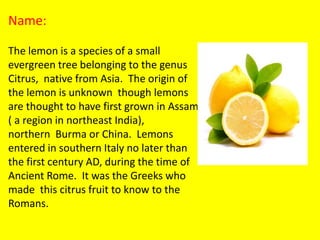
The lemon is a species of a small
evergreen tree belonging to the genus
Citrus, native from Asia. The origin of
the lemon is unknown though lemons
are thought to have first grown in Assam
( a region in northeast India),
northern Burma or China. Lemons
entered in southern Italy no later than
the first century AD, during the time of
Ancient Rome. It was the Greeks who
made this citrus fruit to know to the
Romans.
History:
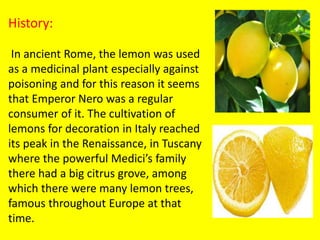
In ancient Rome, the lemon was used
as a medicinal plant especially against
poisoning and for this reason it seems
that Emperor Nero was a regular
consumer of it. The cultivation of
lemons for decoration in Italy reached
its peak in the Renaissance, in Tuscany
where the powerful Medici’s family
there had a big citrus grove, among
which there were many lemon trees,
famous throughout Europe at that
time.
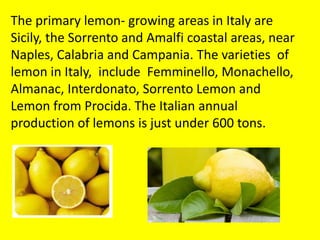
The primary lemon- growing areas in Italy are
Sicily, the Sorrento and Amalfi coastal areas, near
Naples, Calabria and Campania. The varieties of
lemon in Italy, include Femminello, Monachello,
Almanac, Interdonato, Sorrento Lemon and
Lemon from Procida. The Italian annual
production of lemons is just under 600 tons.
Uses:
The lemon juice, rind, and zest are used in a wide variety of
foods and drinks.
Lemon juice is used to make lemonade, soft drinks and
cocktails. It is used in marinades for fish, where its acid
neutralizes amines in fish by converting them into
nonvolatile ammonium salt, and in the meat. Lemon juice is
frequently used in the United Kingdom to add to pancakes,
especially on Shrove Tuesday. The lemon juice is also used as
a short-term preservative on certain foods that tend to
oxidize and turn brown after being sliced, such as apples,
bananas, and avocados, where its acid denatures the
enzymes.
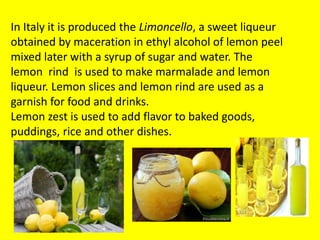
In Italy it is produced the Limoncello, a sweet liqueur
obtained by maceration in ethyl alcohol of lemon peel
mixed later with a syrup of sugar and water. The
lemon rind is used to make marmalade and lemon
liqueur. Lemon slices and lemon rind are used as a
garnish for food and drinks.
Lemon zest is used to add flavor to baked goods,
puddings, rice and other dishes.
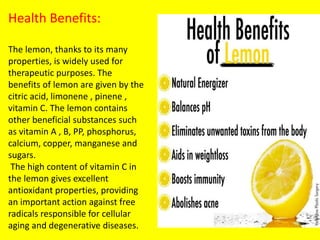
Health Benefits:
The lemon, thanks to its many
properties, is widely used for
therapeutic purposes. The
benefits of lemon are given by the
citric acid, limonene , pinene ,
vitamin C. The lemon contains
other beneficial substances such
as vitamin A , B, PP, phosphorus,
calcium, copper, manganese and
sugars.
The high content of vitamin C in
the lemon gives excellent
antioxidant properties, providing
an important action against free
radicals responsible for cellular
aging and degenerative diseases.
Health Benefits:
Thanks to the high content of
vitamin C has properties
antiscorbutic , and it is an
exceptional remedy in
hemorrhagic manifestations
due to avitaminosi.
The lemon has purifying and
detoxfying and rebalacing
effects to the intestines.
The acidity of the lemon also
facilitates the formation of
potassium carbonate, useful
against gastric acidity. The
lemon’s use helps against
atherosclerosis, high cholesterol
and lowers the level of uric acid.
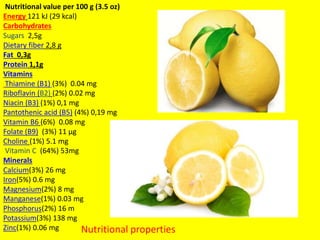
Nutritional value per 100 g (3.5 oz)
Energy 121 kJ (29 kcal)
Carbohydrates
Sugars 2,5g
Dietary fiber 2,8 g
Fat 0,3g
Protein 1,1g
Vitamins
Thiamine (B1) (3%) 0.04 mg
Riboflavin (B2) (2%) 0.02 mg
Niacin (B3) (1%) 0,1 mg
Pantothenic acid (B5) (4%) 0,19 mg
Vitamin B6 (6%) 0.08 mg
Folate (B9) (3%) 11 μg
Choline (1%) 5.1 mg
Vitamin C (64%) 53mg
Minerals
Calcium(3%) 26 mg
Iron(5%) 0.6 mg
Magnesium(2%) 8 mg
Manganese(1%) 0.03 mg
Phosphorus(2%) 16 m
Potassium(3%) 138 mg
Zinc(1%) 0.06 mg Nutritional properties
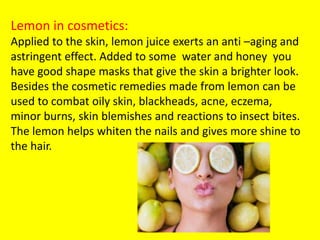
Lemon in cosmetics:
Applied to the skin, lemon juice exerts an anti –aging and
astringent effect. Added to some water and honey you
have good shape masks that give the skin a brighter look.
Besides the cosmetic remedies made from lemon can be
used to combat oily skin, blackheads, acne, eczema,
minor burns, skin blemishes and reactions to insect bites.
The lemon helps whiten the nails and gives more shine to
the hair.
Interesting fact:
The leaves of the lemon tree are used to make a tea and for
preparing cooked meats and seafoods. Lemons were the primary
commercial source of citric acid before the development of
fermentation based processes.
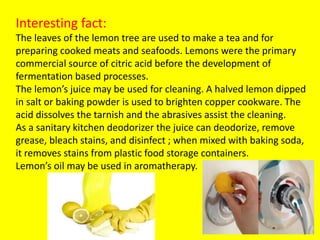
The lemon’s juice may be used for cleaning. A halved lemon dipped
in salt or baking powder is used to brighten copper cookware. The
acid dissolves the tarnish and the abrasives assist the cleaning.
As a sanitary kitchen deodorizer the juice can deodorize, remove
grease, bleach stains, and disinfect ; when mixed with baking soda,
it removes stains from plastic food storage containers.
Lemon’s oil may be used in aromatherapy.
Lemon’s oil doesn’t influence the human immune
system, but may enhance mood. The low PH of juice
makes it antibacterial. One educational science
experiment involves attaching electrodes to a lemon
and using it as a battery to produce electricity.
The lemon’s juice may be used as a simple invisible
ink, after rendered visible by heating the paper.
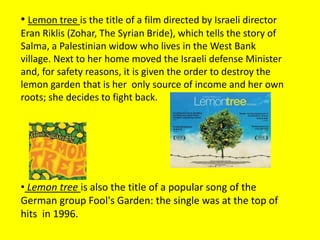
• Lemon tree is the title of a film directed by Israeli director
Eran Riklis (Zohar, The Syrian Bride), which tells the story of
Salma, a Palestinian widow who lives in the West Bank
village. Next to her home moved the Israeli defense Minister
and, for safety reasons, it is given the order to destroy the
lemon garden that is her only source of income and her own
roots; she decides to fight back.
• Lemon tree is also the title of a popular song of the
German group Fool's Garden: the single was at the top of
hits in 1996.

Lemon

  • 1.
    A superfood fromItaly THE LEMON
  • 2.
    Name: The lemon isa species of a small evergreen tree belonging to the genus Citrus, native from Asia. The origin of the lemon is unknown though lemons are thought to have first grown in Assam ( a region in northeast India), northern Burma or China. Lemons entered in southern Italy no later than the first century AD, during the time of Ancient Rome. It was the Greeks who made this citrus fruit to know to the Romans.
  • 3.
    History: In ancient Rome,the lemon was used as a medicinal plant especially against poisoning and for this reason it seems that Emperor Nero was a regular consumer of it. The cultivation of lemons for decoration in Italy reached its peak in the Renaissance, in Tuscany where the powerful Medici’s family there had a big citrus grove, among which there were many lemon trees, famous throughout Europe at that time.
  • 4.
    The primary lemon-growing areas in Italy are Sicily, the Sorrento and Amalfi coastal areas, near Naples, Calabria and Campania. The varieties of lemon in Italy, include Femminello, Monachello, Almanac, Interdonato, Sorrento Lemon and Lemon from Procida. The Italian annual production of lemons is just under 600 tons.
  • 5.
    Uses: The lemon juice,rind, and zest are used in a wide variety of foods and drinks. Lemon juice is used to make lemonade, soft drinks and cocktails. It is used in marinades for fish, where its acid neutralizes amines in fish by converting them into nonvolatile ammonium salt, and in the meat. Lemon juice is frequently used in the United Kingdom to add to pancakes, especially on Shrove Tuesday. The lemon juice is also used as a short-term preservative on certain foods that tend to oxidize and turn brown after being sliced, such as apples, bananas, and avocados, where its acid denatures the enzymes.
  • 6.
    In Italy itis produced the Limoncello, a sweet liqueur obtained by maceration in ethyl alcohol of lemon peel mixed later with a syrup of sugar and water. The lemon rind is used to make marmalade and lemon liqueur. Lemon slices and lemon rind are used as a garnish for food and drinks. Lemon zest is used to add flavor to baked goods, puddings, rice and other dishes.
  • 7.
    Health Benefits: The lemon,thanks to its many properties, is widely used for therapeutic purposes. The benefits of lemon are given by the citric acid, limonene , pinene , vitamin C. The lemon contains other beneficial substances such as vitamin A , B, PP, phosphorus, calcium, copper, manganese and sugars. The high content of vitamin C in the lemon gives excellent antioxidant properties, providing an important action against free radicals responsible for cellular aging and degenerative diseases.
  • 8.
    Health Benefits: Thanks tothe high content of vitamin C has properties antiscorbutic , and it is an exceptional remedy in hemorrhagic manifestations due to avitaminosi. The lemon has purifying and detoxfying and rebalacing effects to the intestines. The acidity of the lemon also facilitates the formation of potassium carbonate, useful against gastric acidity. The lemon’s use helps against atherosclerosis, high cholesterol and lowers the level of uric acid.
  • 9.
    Nutritional value per100 g (3.5 oz) Energy 121 kJ (29 kcal) Carbohydrates Sugars 2,5g Dietary fiber 2,8 g Fat 0,3g Protein 1,1g Vitamins Thiamine (B1) (3%) 0.04 mg Riboflavin (B2) (2%) 0.02 mg Niacin (B3) (1%) 0,1 mg Pantothenic acid (B5) (4%) 0,19 mg Vitamin B6 (6%) 0.08 mg Folate (B9) (3%) 11 μg Choline (1%) 5.1 mg Vitamin C (64%) 53mg Minerals Calcium(3%) 26 mg Iron(5%) 0.6 mg Magnesium(2%) 8 mg Manganese(1%) 0.03 mg Phosphorus(2%) 16 m Potassium(3%) 138 mg Zinc(1%) 0.06 mg Nutritional properties
  • 10.
    Lemon in cosmetics: Appliedto the skin, lemon juice exerts an anti –aging and astringent effect. Added to some water and honey you have good shape masks that give the skin a brighter look. Besides the cosmetic remedies made from lemon can be used to combat oily skin, blackheads, acne, eczema, minor burns, skin blemishes and reactions to insect bites. The lemon helps whiten the nails and gives more shine to the hair.
  • 11.
    Interesting fact: The leavesof the lemon tree are used to make a tea and for preparing cooked meats and seafoods. Lemons were the primary commercial source of citric acid before the development of fermentation based processes. The lemon’s juice may be used for cleaning. A halved lemon dipped in salt or baking powder is used to brighten copper cookware. The acid dissolves the tarnish and the abrasives assist the cleaning. As a sanitary kitchen deodorizer the juice can deodorize, remove grease, bleach stains, and disinfect ; when mixed with baking soda, it removes stains from plastic food storage containers. Lemon’s oil may be used in aromatherapy.
  • 12.
    Lemon’s oil doesn’tinfluence the human immune system, but may enhance mood. The low PH of juice makes it antibacterial. One educational science experiment involves attaching electrodes to a lemon and using it as a battery to produce electricity. The lemon’s juice may be used as a simple invisible ink, after rendered visible by heating the paper.
  • 13.
    • Lemon treeis the title of a film directed by Israeli director Eran Riklis (Zohar, The Syrian Bride), which tells the story of Salma, a Palestinian widow who lives in the West Bank village. Next to her home moved the Israeli defense Minister and, for safety reasons, it is given the order to destroy the lemon garden that is her only source of income and her own roots; she decides to fight back. • Lemon tree is also the title of a popular song of the German group Fool's Garden: the single was at the top of hits in 1996.