Honey
Prepared by : Madhu Bharvadiya
B.Pharm (3rd Sem)
Apip, Jamnagar.
Synonyms :
• Madhu, Honey purified, Me.
Biological Source :
• Honey is a sugar secretion deposited in honey comb by the
bees.
• APIs mellifera, Apis dorsata and other species of Apis.
• Family Apdae, order Hymenoptera.
Geographical Source :
• Honey is produced in Africa, Australia, New Zealand,
California and India.
Description :
Colour : pale yellow to yellowish brown
Odour : Characteristic, pleasant.
Odour and taste depend very largely on the flowers used in
its preparation.
Taste : Sweet and faintly acid.
Standards :
1. Weight per ml : 1.35 to 1.40 gm.
2. Specific rotation : +3° to -10°.
3. Total Ash : 0.1 to 0.8%
• It has to pass limit tests for chloride and sulphate.
• It is soluble in water and insoluble in alcohol.
Chemical Constituents:
• Honey is aqueous solution of glucose 35%, fructose 45%, and
sucrose about 2%.
• The proportion of sugar may vary depending upon the source of
nectar and enzymatic activity responsible for converting nectar into
the honey.
• The other constituents of honey are maltose, gum, traces of
succinic acid, acetic acid, dextrin, formic acid, colouring matters,
enzymes (invertase, insulase) and traces of vitamins.
• Proteins and pollen grains from various flowers are also found in
honey.
• Since, honey is a saturated solution of sugar, on keeping, it starts
crystallising.
• A product which contains crystallised dextrose is called as
Granulated honey.
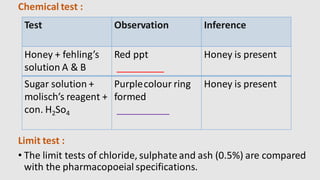
Chemical test :
Limit test :
• The limit tests of chloride, sulphate and ash (0.5%) are compared
with the pharmacopoeial specifications.
Test Observation Inference
Honey + fehling’s
solution A & B
Red ppt
_________
Honey is present
Sugar solution +
molisch’s reagent +
con. H2So4
Purplecolour ring
formed
__________
Honey is present
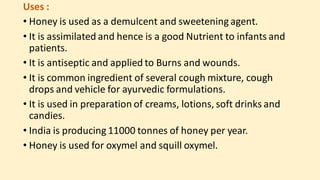
Uses :
• Honey is used as a demulcent and sweetening agent.
• It is assimilated and hence is a good Nutrient to infants and
patients.
• It is antiseptic and applied to Burns and wounds.
• It is common ingredient of several cough mixture, cough
drops and vehicle for ayurvedic formulations.
• It is used in preparation of creams, lotions, soft drinks and
candies.
• India is producing 11000 tonnes of honey per year.
• Honey is used for oxymel and squill oxymel.
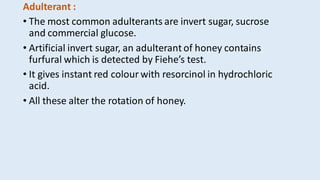
Adulterant :
• The most common adulterants are invert sugar, sucrose
and commercial glucose.
• Artificial invert sugar, an adulterant of honey contains
furfural which is detected by Fiehe’s test.
• It gives instant red colour with resorcinol in hydrochloric
acid.
• All these alter the rotation of honey.
Honey

Honey

  • 1.
    Honey Prepared by :Madhu Bharvadiya B.Pharm (3rd Sem) Apip, Jamnagar.
  • 2.
    Synonyms : • Madhu,Honey purified, Me. Biological Source : • Honey is a sugar secretion deposited in honey comb by the bees. • APIs mellifera, Apis dorsata and other species of Apis. • Family Apdae, order Hymenoptera. Geographical Source : • Honey is produced in Africa, Australia, New Zealand, California and India.
  • 3.
    Description : Colour :pale yellow to yellowish brown Odour : Characteristic, pleasant. Odour and taste depend very largely on the flowers used in its preparation. Taste : Sweet and faintly acid. Standards : 1. Weight per ml : 1.35 to 1.40 gm. 2. Specific rotation : +3° to -10°. 3. Total Ash : 0.1 to 0.8% • It has to pass limit tests for chloride and sulphate. • It is soluble in water and insoluble in alcohol.
  • 4.
    Chemical Constituents: • Honeyis aqueous solution of glucose 35%, fructose 45%, and sucrose about 2%. • The proportion of sugar may vary depending upon the source of nectar and enzymatic activity responsible for converting nectar into the honey. • The other constituents of honey are maltose, gum, traces of succinic acid, acetic acid, dextrin, formic acid, colouring matters, enzymes (invertase, insulase) and traces of vitamins. • Proteins and pollen grains from various flowers are also found in honey. • Since, honey is a saturated solution of sugar, on keeping, it starts crystallising. • A product which contains crystallised dextrose is called as Granulated honey.
  • 5.
    Chemical test : Limittest : • The limit tests of chloride, sulphate and ash (0.5%) are compared with the pharmacopoeial specifications. Test Observation Inference Honey + fehling’s solution A & B Red ppt _________ Honey is present Sugar solution + molisch’s reagent + con. H2So4 Purplecolour ring formed __________ Honey is present
  • 6.
    Uses : • Honeyis used as a demulcent and sweetening agent. • It is assimilated and hence is a good Nutrient to infants and patients. • It is antiseptic and applied to Burns and wounds. • It is common ingredient of several cough mixture, cough drops and vehicle for ayurvedic formulations. • It is used in preparation of creams, lotions, soft drinks and candies. • India is producing 11000 tonnes of honey per year. • Honey is used for oxymel and squill oxymel.
  • 7.
    Adulterant : • Themost common adulterants are invert sugar, sucrose and commercial glucose. • Artificial invert sugar, an adulterant of honey contains furfural which is detected by Fiehe’s test. • It gives instant red colour with resorcinol in hydrochloric acid. • All these alter the rotation of honey.