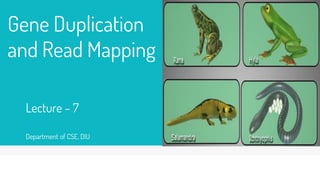
Gene Duplication
and Read Mapping
Lecture – 7
Department of CSE, DIU
CONTENTS
1. Mutation
2. Gene Duplication
3. Read Mapping
- Keyword Tree
- Suffix Tree
- Suffix Array
- Burrows Wheeler Transform
1. DNA Mutation
What and how mutation occurs, common forms
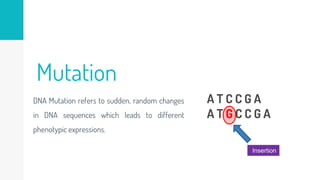
Mutation
DNA Mutation refers to sudden, random changes
in DNA sequences which leads to different
phenotypic expressions.
A T C C G A
A T G C C G A
Insertion
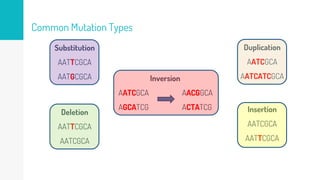
Common Mutation Types
Substitution
AATTCGCA
AATGCGCA
Deletion
AATTCGCA
AATCGCA
Insertion
AATCGCA
AATTCGCA
Duplication
AATCGCA
AATCATCGCA
Inversion
AATCGCA AACGGCA
AGCATCG ACTATCG
2. Gene Duplication
Duplication of Genes, Homolog, Ortholog, Paralogs
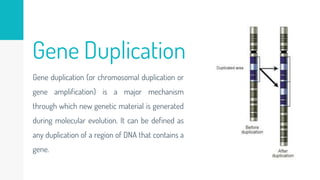
Gene Duplication
Gene duplication (or chromosomal duplication or
gene amplification) is a major mechanism
through which new genetic material is generated
during molecular evolution. It can be defined as
any duplication of a region of DNA that contains a
gene.
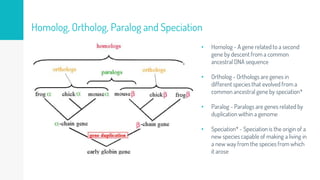
Homolog, Ortholog, Paralog and Speciation
• Homolog - A gene related to a second
gene by descent from a common
ancestral DNA sequence
• Ortholog - Orthologs are genes in
different species that evolved from a
common ancestral gene by speciation*
• Paralog - Paralogs are genes related by
duplication within a genome
• Speciation* - Speciation is the origin of a
new species capable of making a living in
a new way from the species from which
it arose
3. Read Mapping
Short Read Mapping, Genome Indexing
Read Mapping
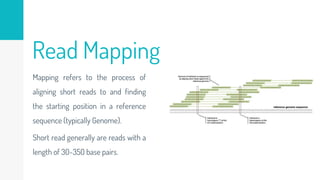
Mapping refers to the process of
aligning short reads to and finding
the starting position in a reference
sequence (typically Genome).
Short read generally are reads with a
length of 30-350 base pairs.
Genome Indexing (Keyword Tree)
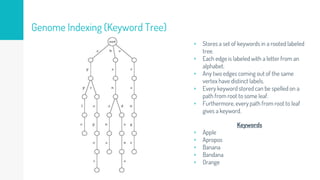
▹ Stores a set of keywords in a rooted labeled
tree.
▹ Each edge is labeled with a letter from an
alphabet.
▹ Any two edges coming out of the same
vertex have distinct labels.
▹ Every keyword stored can be spelled on a
path from root to some leaf.
▹ Furthermore, every path from root to leaf
gives a keyword.
Keywords
▹ Apple
▹ Apropos
▹ Banana
▹ Bandana
▹ Orange
Genome Indexing (Suffix Tree)
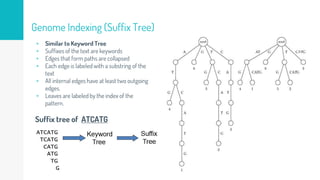
▹ Similar to Keyword Tree
▹ Suffixes of the text are keywords
▹ Edges that form paths are collapsed
▹ Each edge is labeled with a substring of the
text
▹ All internal edges have at least two outgoing
edges.
▹ Leaves are labeled by the index of the
pattern.
Suffix tree of ATCATG
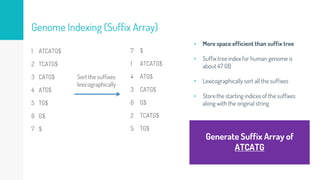
Genome Indexing (Suffix Array)
▹ More space efficient than suffix tree
▹ Suffix tree index for human genome is
about 47 GB
▹ Lexicographically sort all the suffixes
▹ Store the starting indices of the suffixes
along with the original string
Generate Suffix Array of
ATCATG
1 ATCATG$
2 TCATG$
3 CATG$
4 ATG$
5 TG$
6 G$
7 $
Sort the suffixes
lexicographically
7 $
1 ATCATG$
4 ATG$
3 CATG$
6 G$
2 TCATG$
5 TG$
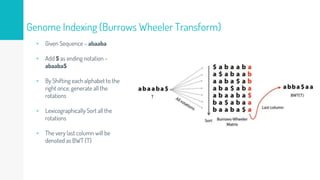
Genome Indexing (Burrows Wheeler Transform)
▹ Given Sequence – abaaba
▹ Add $ as ending notation –
abaaba$
▹ By Shifting each alphabet to the
right once, generate all the
rotations
▹ Lexicographically Sort all the
rotations
▹ The very last column will be
denoted as BWT (T)
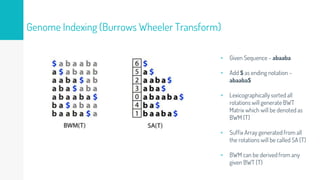
Genome Indexing (Burrows Wheeler Transform)
▹ Given Sequence – abaaba
▹ Add $ as ending notation –
abaaba$
▹ Lexicographically sorted all
rotations will generate BWT
Matrix which will be denoted as
BWM (T)
▹ Suffix Array generated from all
the rotations will be called SA (T)
▹ BWM can be derived from any
given BWT (T)
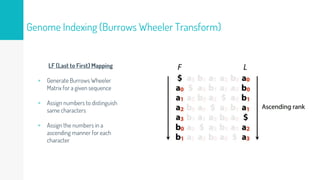
Genome Indexing (Burrows Wheeler Transform)
LF (Last to First) Mapping
▹ Generate Burrows Wheeler
Matrix for a given sequence
▹ Assign numbers to distinguish
same characters
▹ Assign the numbers in a
ascending manner for each
character
Genome Indexing (Burrows Wheeler Transform)
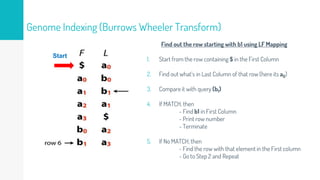
Find out the row starting with b1 using LF Mapping
1. Start from the row containing $ in the First Column
2. Find out what’s in Last Column of that row (here its a0)
3. Compare it with query (b1)
4. If MATCH, then
- Find b1 in First Column
- Print row number
- Terminate
5. If No MATCH, then
- Find the row with that element in the First column
- Go to Step 2 and Repeat
Start
Genome Indexing (Burrows Wheeler Transform)
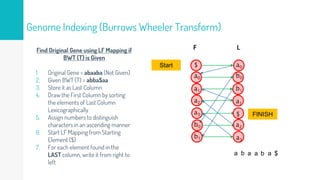
Find Original Gene using LF Mapping if
BWT (T) is Given
1. Original Gene = abaaba (Not Given)
2. Given BWT (T) = abba$aa
3. Store it as Last Column
4. Draw the First Column by sorting
the elements of Last Column
Lexicographically
5. Assign numbers to distinguish
characters in an ascending manner
6. Start LF Mapping from Starting
Element ($)
7. For each element found in the
LAST column, write it from right to
left
$ a0
a0 b0
a1 b1
a2 a1
a3 $
b0 a2
b1 a3
F L
$
a
b
a
a
b
a
FINISH
Start
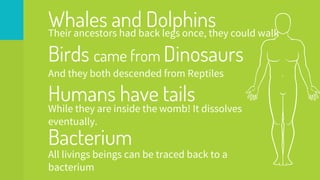
Whales and Dolphins
Their ancestors had back legs once, they could walk
Humans have tails
While they are inside the womb! It dissolves
eventually.
Birds came from Dinosaurs
And they both descended from Reptiles
Bacterium
All livings beings can be traced back to a
bacterium

Lecture-7-Gene Duplication (1).pptx

  • 1.
    Gene Duplication and ReadMapping Lecture – 7 Department of CSE, DIU
  • 2.
    CONTENTS 1. Mutation 2. GeneDuplication 3. Read Mapping - Keyword Tree - Suffix Tree - Suffix Array - Burrows Wheeler Transform
  • 3.
    1. DNA Mutation Whatand how mutation occurs, common forms
  • 4.
    Mutation DNA Mutation refersto sudden, random changes in DNA sequences which leads to different phenotypic expressions. A T C C G A A T G C C G A Insertion
  • 5.
  • 6.
    2. Gene Duplication Duplicationof Genes, Homolog, Ortholog, Paralogs
  • 7.
    Gene Duplication Gene duplication(or chromosomal duplication or gene amplification) is a major mechanism through which new genetic material is generated during molecular evolution. It can be defined as any duplication of a region of DNA that contains a gene.
  • 8.
    Homolog, Ortholog, Paralogand Speciation • Homolog - A gene related to a second gene by descent from a common ancestral DNA sequence • Ortholog - Orthologs are genes in different species that evolved from a common ancestral gene by speciation* • Paralog - Paralogs are genes related by duplication within a genome • Speciation* - Speciation is the origin of a new species capable of making a living in a new way from the species from which it arose
  • 9.
    3. Read Mapping ShortRead Mapping, Genome Indexing
  • 10.
    Read Mapping Mapping refersto the process of aligning short reads to and finding the starting position in a reference sequence (typically Genome). Short read generally are reads with a length of 30-350 base pairs.
  • 11.
    Genome Indexing (KeywordTree) ▹ Stores a set of keywords in a rooted labeled tree. ▹ Each edge is labeled with a letter from an alphabet. ▹ Any two edges coming out of the same vertex have distinct labels. ▹ Every keyword stored can be spelled on a path from root to some leaf. ▹ Furthermore, every path from root to leaf gives a keyword. Keywords ▹ Apple ▹ Apropos ▹ Banana ▹ Bandana ▹ Orange
  • 12.
    Genome Indexing (SuffixTree) ▹ Similar to Keyword Tree ▹ Suffixes of the text are keywords ▹ Edges that form paths are collapsed ▹ Each edge is labeled with a substring of the text ▹ All internal edges have at least two outgoing edges. ▹ Leaves are labeled by the index of the pattern. Suffix tree of ATCATG
  • 13.
    Genome Indexing (SuffixArray) ▹ More space efficient than suffix tree ▹ Suffix tree index for human genome is about 47 GB ▹ Lexicographically sort all the suffixes ▹ Store the starting indices of the suffixes along with the original string Generate Suffix Array of ATCATG 1 ATCATG$ 2 TCATG$ 3 CATG$ 4 ATG$ 5 TG$ 6 G$ 7 $ Sort the suffixes lexicographically 7 $ 1 ATCATG$ 4 ATG$ 3 CATG$ 6 G$ 2 TCATG$ 5 TG$
  • 14.
    Genome Indexing (BurrowsWheeler Transform) ▹ Given Sequence – abaaba ▹ Add $ as ending notation – abaaba$ ▹ By Shifting each alphabet to the right once, generate all the rotations ▹ Lexicographically Sort all the rotations ▹ The very last column will be denoted as BWT (T)
  • 15.
    Genome Indexing (BurrowsWheeler Transform) ▹ Given Sequence – abaaba ▹ Add $ as ending notation – abaaba$ ▹ Lexicographically sorted all rotations will generate BWT Matrix which will be denoted as BWM (T) ▹ Suffix Array generated from all the rotations will be called SA (T) ▹ BWM can be derived from any given BWT (T)
  • 16.
    Genome Indexing (BurrowsWheeler Transform) LF (Last to First) Mapping ▹ Generate Burrows Wheeler Matrix for a given sequence ▹ Assign numbers to distinguish same characters ▹ Assign the numbers in a ascending manner for each character
  • 17.
    Genome Indexing (BurrowsWheeler Transform) Find out the row starting with b1 using LF Mapping 1. Start from the row containing $ in the First Column 2. Find out what’s in Last Column of that row (here its a0) 3. Compare it with query (b1) 4. If MATCH, then - Find b1 in First Column - Print row number - Terminate 5. If No MATCH, then - Find the row with that element in the First column - Go to Step 2 and Repeat Start
  • 18.
    Genome Indexing (BurrowsWheeler Transform) Find Original Gene using LF Mapping if BWT (T) is Given 1. Original Gene = abaaba (Not Given) 2. Given BWT (T) = abba$aa 3. Store it as Last Column 4. Draw the First Column by sorting the elements of Last Column Lexicographically 5. Assign numbers to distinguish characters in an ascending manner 6. Start LF Mapping from Starting Element ($) 7. For each element found in the LAST column, write it from right to left $ a0 a0 b0 a1 b1 a2 a1 a3 $ b0 a2 b1 a3 F L $ a b a a b a FINISH Start
  • 19.
    Whales and Dolphins Theirancestors had back legs once, they could walk Humans have tails While they are inside the womb! It dissolves eventually. Birds came from Dinosaurs And they both descended from Reptiles Bacterium All livings beings can be traced back to a bacterium