The Predicate Calculus
Chapter 15.
2
Outline
 Motivation
 The Language and Its Syntax
 Semantics
 Quantification
 Semantics of Quantifiers
 Predicate Calculus as a Language for
Representing Knowledge
3
15.1 Motivation
 Propositional calculus
 Expressional limitation
 Atoms have no internal structures.
 First-order predicate calculus
 has names for objects as well as propositions.
 Symbols
 Object constants
 Relation constants
 Function constants
 Other constructs
 Refer to objects in the world
 Refer to propositions about the world
4
The Language and its Syntax
 Components
 Infinite set of object constants
 Aa, 125, 23B, Q, John, EiffelTower
 Infinite set of function constants
 fatherOf1, distanceBetween2, times2
 Infinite set of relation constants
 B173, Parent2, Large1, Clear1, X114
 Propositional connectives
 Delimiters
 (, ), [, ] ,(separator)
 ,,,
5
The Language and its Syntax
 Terms
 Object constant is a term
 Functional expression
 fatherOf(John, Bill), times(4, plus(3, 6)), Sam
 wffs
 Atoms
 Relation constant of arity n followed by n terms is an atom (atomic
formula)
 An atom is a wff.
 Greaterthan(7,2), P(A, B, C, D), Q
 Propositional wff
PSam)hn,Brother(Jo5,4)]Lessthan(1n(7,2)Greatertha[ 
6
15.3 Semantics
 Worlds
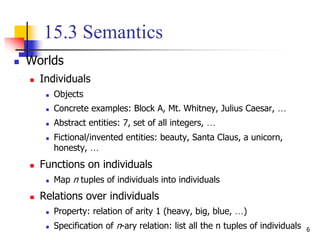
 Individuals
 Objects
 Concrete examples: Block A, Mt. Whitney, Julius Caesar, …
 Abstract entities: 7, set of all integers, …
 Fictional/invented entities: beauty, Santa Claus, a unicorn,
honesty, …
 Functions on individuals
 Map n tuples of individuals into individuals
 Relations over individuals
 Property: relation of arity 1 (heavy, big, blue, …)
 Specification of n-ary relation: list all the n tuples of individuals
7
15.3 Semantics
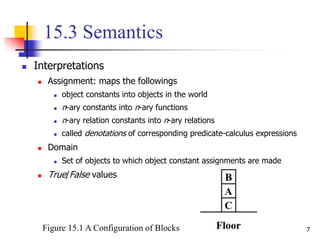
 Interpretations
 Assignment: maps the followings
 object constants into objects in the world
 n-ary constants into n-ary functions
 n-ary relation constants into n-ary relations
 called denotations of corresponding predicate-calculus expressions
 Domain
 Set of objects to which object constant assignments are made
 True/False values
Figure 15.1 A Configuration of Blocks
8
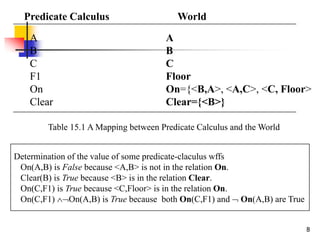
Table 15.1 A Mapping between Predicate Calculus and the World
Determination of the value of some predicate-claculus wffs
On(A,B) is False because <A,B> is not in the relation On.
Clear(B) is True because <B> is in the relation Clear.
On(C,F1) is True because <C,Floor> is in the relation On.
On(C,F1) On(A,B) is True because both On(C,F1) and  On(A,B) are True
Predicate Calculus
A
B
C
F1
On
Clear
World
A
B
C
Floor
On={<B,A>, <A,C>, <C, Floor>
Clear={<B>}
9
15.3 Semantics
 Models and Related Notions
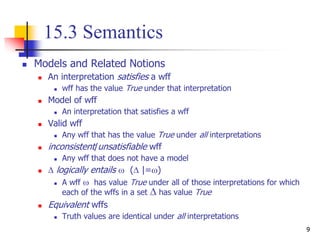
 An interpretation satisfies a wff
 wff has the value True under that interpretation
 Model of wff
 An interpretation that satisfies a wff
 Valid wff
 Any wff that has the value True under all interpretations
 inconsistent/unsatisfiable wff
 Any wff that does not have a model
  logically entails  ( |=)
 A wff  has value True under all of those interpretations for which
each of the wffs in a set  has value True
 Equivalent wffs
 Truth values are identical under all interpretations
10
15.3 Semantics
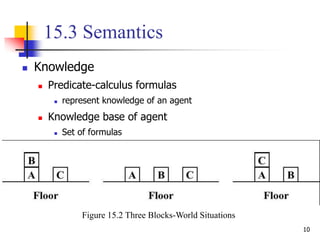
 Knowledge
 Predicate-calculus formulas
 represent knowledge of an agent
 Knowledge base of agent
 Set of formulas
 The agent knows  = the agent believes 
Figure 15.2 Three Blocks-World Situations
11
15.4 Quantification
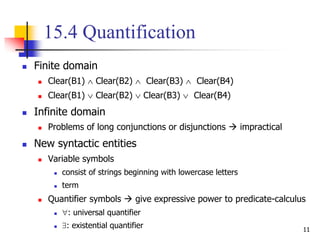
 Finite domain
 Clear(B1)  Clear(B2)  Clear(B3)  Clear(B4)
 Clear(B1)  Clear(B2)  Clear(B3)  Clear(B4)
 Infinite domain
 Problems of long conjunctions or disjunctions  impractical
 New syntactic entities
 Variable symbols
 consist of strings beginning with lowercase letters
 term
 Quantifier symbols  give expressive power to predicate-calculus
 : universal quantifier
 : existential quantifier
12
15.4 Quantification
 : wff
 : wff  within the scope of the quantifier
 : quantified variable
 Closed wff (closed sentence)
 All variable symbols besides  in  are quantified over in 
 Property
 First-order predicate calculi
 restrict quantification over relation and function symbols
 )(,)( 
))]]((),()[()()[()],()()[( xfSyxREyxPxxRxPAx 
]))[((]))[((
),(]))[((]))[((


xyyx
yxxyyx


13
15.5 Semantics of Quantifiers
 Universal Quantifiers
 ()() = True
 () is True for all assignments of  to objects in the domain
 Example: (x)[On(x,C)  Clear(C)]? in Figure 15.2
 x: A, B, C, Floor
 investigate each of assignments in turn for each of the interpretations
 Existential Quantifiers
 ()() = True
 () is True for at least one assignments of  to objects in the
domain
14
15.5 Semantics of Quantifiers
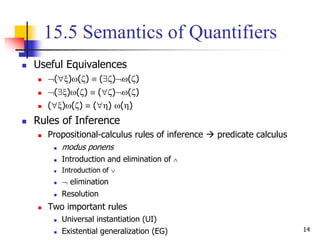
 Useful Equivalences
 ()()  ()()
 ()()  ()()
 ()()  () ()
 Rules of Inference
 Propositional-calculus rules of inference  predicate calculus
 modus ponens
 Introduction and elimination of 
 Introduction of 
  elimination
 Resolution
 Two important rules
 Universal instantiation (UI)
 Existential generalization (EG)
15
15.5 Semantics of Quantifiers
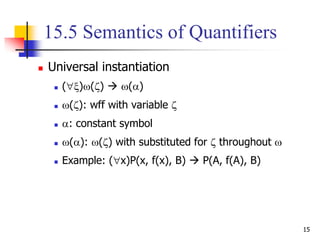
 Universal instantiation
 ()()  ()
 (): wff with variable 
 : constant symbol
 (): () with substituted for  throughout 
 Example: (x)P(x, f(x), B)  P(A, f(A), B)
16
15.5 Semantics of Quantifiers
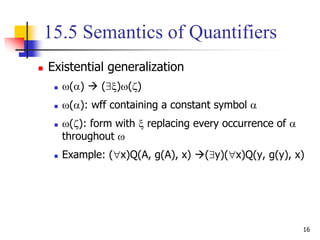
 Existential generalization
 ()  ()()
 (): wff containing a constant symbol 
 (): form with  replacing every occurrence of 
throughout 
 Example: (x)Q(A, g(A), x) (y)(x)Q(y, g(y), x)
17
15.6 Predicate Calculus as a Language
for Representing Knowledge
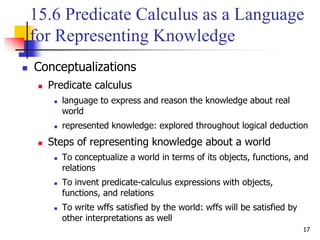
 Conceptualizations
 Predicate calculus
 language to express and reason the knowledge about real
world
 represented knowledge: explored throughout logical deduction
 Steps of representing knowledge about a world
 To conceptualize a world in terms of its objects, functions, and
relations
 To invent predicate-calculus expressions with objects,
functions, and relations
 To write wffs satisfied by the world: wffs will be satisfied by
other interpretations as well
18
15.6 Predicate Calculus as a Language
for Representing Knowledge
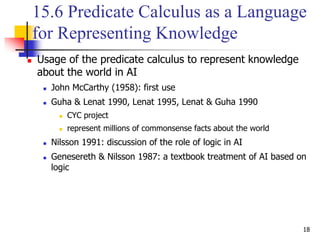
 Usage of the predicate calculus to represent knowledge
about the world in AI
 John McCarthy (1958): first use
 Guha & Lenat 1990, Lenat 1995, Lenat & Guha 1990
 CYC project
 represent millions of commonsense facts about the world
 Nilsson 1991: discussion of the role of logic in AI
 Genesereth & Nilsson 1987: a textbook treatment of AI based on
logic
19
15.6 Predicate Calculus as a Language
for Representing Knowledge
 Examples
 Examples of the process of conceptualizing knowledge
about a world
 Agent: deliver packages in an office building
 Package(x): the property of something being a package
 Inroom(x, y): certain object is in a certain room
 Relation constant Smaller(x,y): certain object is smaller than
another certain object
 “All of the packages in room 27 are smaller than any of the
packages in room 28”
)},Smaller(
)]28,Inroom()27,Inroom()Package()Package(){[,(
yx
yxyxyx 
20
15.6 Language for Representing
Knowledge
 “Every package in room 27 is smaller than one of the
packages in room 29”
 Way of stating the arrival time of an object
 Arrived(x,z)
 X: arriving object
 Z: time interval during which it arrived
 “Package A arrived before Package B”
 Temporal logic: method of dealing with time in computer science
and AI
)},Smaller(
)]28,Inroom()27,Inroom()Package()Package(){[)((
)},Smaller(
)]28,Inroom()27,Inroom()Package()Package(){[)((
yx
yxyxyx
yx
yxyxxy


z2)]Before(z1,z2)Arrived(B,z1)d(A,z2)[Arrivez1,( 
21
15.6 Language for Representing
Knowledge
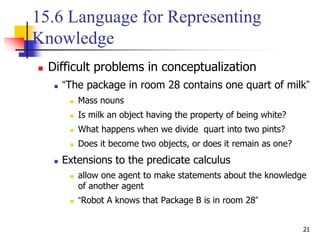
 Difficult problems in conceptualization
 “The package in room 28 contains one quart of milk”
 Mass nouns
 Is milk an object having the property of being white?
 What happens when we divide quart into two pints?
 Does it become two objects, or does it remain as one?
 Extensions to the predicate calculus
 allow one agent to make statements about the knowledge
of another agent
 “Robot A knows that Package B is in room 28”

15 predicate

  • 1.
  • 2.
    2 Outline  Motivation  TheLanguage and Its Syntax  Semantics  Quantification  Semantics of Quantifiers  Predicate Calculus as a Language for Representing Knowledge
  • 3.
    3 15.1 Motivation  Propositionalcalculus  Expressional limitation  Atoms have no internal structures.  First-order predicate calculus  has names for objects as well as propositions.  Symbols  Object constants  Relation constants  Function constants  Other constructs  Refer to objects in the world  Refer to propositions about the world
  • 4.
    4 The Language andits Syntax  Components  Infinite set of object constants  Aa, 125, 23B, Q, John, EiffelTower  Infinite set of function constants  fatherOf1, distanceBetween2, times2  Infinite set of relation constants  B173, Parent2, Large1, Clear1, X114  Propositional connectives  Delimiters  (, ), [, ] ,(separator)  ,,,
  • 5.
    5 The Language andits Syntax  Terms  Object constant is a term  Functional expression  fatherOf(John, Bill), times(4, plus(3, 6)), Sam  wffs  Atoms  Relation constant of arity n followed by n terms is an atom (atomic formula)  An atom is a wff.  Greaterthan(7,2), P(A, B, C, D), Q  Propositional wff PSam)hn,Brother(Jo5,4)]Lessthan(1n(7,2)Greatertha[ 
  • 6.
    6 15.3 Semantics  Worlds Individuals  Objects  Concrete examples: Block A, Mt. Whitney, Julius Caesar, …  Abstract entities: 7, set of all integers, …  Fictional/invented entities: beauty, Santa Claus, a unicorn, honesty, …  Functions on individuals  Map n tuples of individuals into individuals  Relations over individuals  Property: relation of arity 1 (heavy, big, blue, …)  Specification of n-ary relation: list all the n tuples of individuals
  • 7.
    7 15.3 Semantics  Interpretations Assignment: maps the followings  object constants into objects in the world  n-ary constants into n-ary functions  n-ary relation constants into n-ary relations  called denotations of corresponding predicate-calculus expressions  Domain  Set of objects to which object constant assignments are made  True/False values Figure 15.1 A Configuration of Blocks
  • 8.
    8 Table 15.1 AMapping between Predicate Calculus and the World Determination of the value of some predicate-claculus wffs On(A,B) is False because <A,B> is not in the relation On. Clear(B) is True because <B> is in the relation Clear. On(C,F1) is True because <C,Floor> is in the relation On. On(C,F1) On(A,B) is True because both On(C,F1) and  On(A,B) are True Predicate Calculus A B C F1 On Clear World A B C Floor On={<B,A>, <A,C>, <C, Floor> Clear={<B>}
  • 9.
    9 15.3 Semantics  Modelsand Related Notions  An interpretation satisfies a wff  wff has the value True under that interpretation  Model of wff  An interpretation that satisfies a wff  Valid wff  Any wff that has the value True under all interpretations  inconsistent/unsatisfiable wff  Any wff that does not have a model   logically entails  ( |=)  A wff  has value True under all of those interpretations for which each of the wffs in a set  has value True  Equivalent wffs  Truth values are identical under all interpretations
  • 10.
    10 15.3 Semantics  Knowledge Predicate-calculus formulas  represent knowledge of an agent  Knowledge base of agent  Set of formulas  The agent knows  = the agent believes  Figure 15.2 Three Blocks-World Situations
  • 11.
    11 15.4 Quantification  Finitedomain  Clear(B1)  Clear(B2)  Clear(B3)  Clear(B4)  Clear(B1)  Clear(B2)  Clear(B3)  Clear(B4)  Infinite domain  Problems of long conjunctions or disjunctions  impractical  New syntactic entities  Variable symbols  consist of strings beginning with lowercase letters  term  Quantifier symbols  give expressive power to predicate-calculus  : universal quantifier  : existential quantifier
  • 12.
    12 15.4 Quantification  :wff  : wff  within the scope of the quantifier  : quantified variable  Closed wff (closed sentence)  All variable symbols besides  in  are quantified over in   Property  First-order predicate calculi  restrict quantification over relation and function symbols  )(,)(  ))]]((),()[()()[()],()()[( xfSyxREyxPxxRxPAx  ]))[((]))[(( ),(]))[((]))[((   xyyx yxxyyx  
  • 13.
    13 15.5 Semantics ofQuantifiers  Universal Quantifiers  ()() = True  () is True for all assignments of  to objects in the domain  Example: (x)[On(x,C)  Clear(C)]? in Figure 15.2  x: A, B, C, Floor  investigate each of assignments in turn for each of the interpretations  Existential Quantifiers  ()() = True  () is True for at least one assignments of  to objects in the domain
  • 14.
    14 15.5 Semantics ofQuantifiers  Useful Equivalences  ()()  ()()  ()()  ()()  ()()  () ()  Rules of Inference  Propositional-calculus rules of inference  predicate calculus  modus ponens  Introduction and elimination of   Introduction of    elimination  Resolution  Two important rules  Universal instantiation (UI)  Existential generalization (EG)
  • 15.
    15 15.5 Semantics ofQuantifiers  Universal instantiation  ()()  ()  (): wff with variable   : constant symbol  (): () with substituted for  throughout   Example: (x)P(x, f(x), B)  P(A, f(A), B)
  • 16.
    16 15.5 Semantics ofQuantifiers  Existential generalization  ()  ()()  (): wff containing a constant symbol   (): form with  replacing every occurrence of  throughout   Example: (x)Q(A, g(A), x) (y)(x)Q(y, g(y), x)
  • 17.
    17 15.6 Predicate Calculusas a Language for Representing Knowledge  Conceptualizations  Predicate calculus  language to express and reason the knowledge about real world  represented knowledge: explored throughout logical deduction  Steps of representing knowledge about a world  To conceptualize a world in terms of its objects, functions, and relations  To invent predicate-calculus expressions with objects, functions, and relations  To write wffs satisfied by the world: wffs will be satisfied by other interpretations as well
  • 18.
    18 15.6 Predicate Calculusas a Language for Representing Knowledge  Usage of the predicate calculus to represent knowledge about the world in AI  John McCarthy (1958): first use  Guha & Lenat 1990, Lenat 1995, Lenat & Guha 1990  CYC project  represent millions of commonsense facts about the world  Nilsson 1991: discussion of the role of logic in AI  Genesereth & Nilsson 1987: a textbook treatment of AI based on logic
  • 19.
    19 15.6 Predicate Calculusas a Language for Representing Knowledge  Examples  Examples of the process of conceptualizing knowledge about a world  Agent: deliver packages in an office building  Package(x): the property of something being a package  Inroom(x, y): certain object is in a certain room  Relation constant Smaller(x,y): certain object is smaller than another certain object  “All of the packages in room 27 are smaller than any of the packages in room 28” )},Smaller( )]28,Inroom()27,Inroom()Package()Package(){[,( yx yxyxyx 
  • 20.
    20 15.6 Language forRepresenting Knowledge  “Every package in room 27 is smaller than one of the packages in room 29”  Way of stating the arrival time of an object  Arrived(x,z)  X: arriving object  Z: time interval during which it arrived  “Package A arrived before Package B”  Temporal logic: method of dealing with time in computer science and AI )},Smaller( )]28,Inroom()27,Inroom()Package()Package(){[)(( )},Smaller( )]28,Inroom()27,Inroom()Package()Package(){[)(( yx yxyxyx yx yxyxxy   z2)]Before(z1,z2)Arrived(B,z1)d(A,z2)[Arrivez1,( 
  • 21.
    21 15.6 Language forRepresenting Knowledge  Difficult problems in conceptualization  “The package in room 28 contains one quart of milk”  Mass nouns  Is milk an object having the property of being white?  What happens when we divide quart into two pints?  Does it become two objects, or does it remain as one?  Extensions to the predicate calculus  allow one agent to make statements about the knowledge of another agent  “Robot A knows that Package B is in room 28”