Planning, Acting, and
Learning
Chapter 10
2
Contents
 The Sense/Plan/Act Cycle
 Approximate Search
 Learning Heuristic Functions
 Rewards Instead of Goals
3
Learning Heuristic Functions
 Learning from experiences
 continuous feedback from the environment is one way to
reduce uncertainties and to compensate for an agent’s lack
of knowledge about the effects of its actions.
 Useful information can be extracted from the experience of
interacting the environments.
 Explicit Graphs and Implicit Graphs
4
Learning Heuristic Functions
 Explicit Graphs
 Agent has a good model of the effects of its actions and
knows the costs of moving from any node to its successor
nodes.
 C(ni, nj): the cost of moving from ni to nj.
 (n0, a): the description of the state reached from node n after
taking action a.
 DYNA [Sutton 1990]
 Combination of “learning in the world” with “learning and
planning in the model”.
)],()(ˆ[min)(ˆ
)(
jij
nSn
i nncnhnh
ij


 )),(,()),((ˆminarg anncanha i
a
 
5
Learning Heuristic Functions
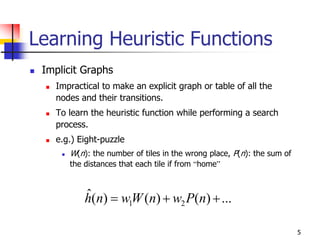
 Implicit Graphs
 Impractical to make an explicit graph or table of all the
nodes and their transitions.
 To learn the heuristic function while performing a search
process.
 e.g.) Eight-puzzle
 W(n): the number of tiles in the wrong place, P(n): the sum of
the distances that each tile if from “home”
...)()()(ˆ
21  nPwnWwnh
6
Learning Heuristic Functions
 Learning the weights
 Minimizing the sum of the squared errors between the
training samples and the h’ function given by the
weighted combination.
 Node expansion
 Temporal difference learning [Sutton 1988]: the weight
adjustment depends only on two temporally adjacent
values of a function.
 ),()(ˆmin)(ˆ)1()(ˆ
)(ˆ)],()(ˆ[min)(ˆ)(ˆ
)(
)(
jij
nSn
ii
ijij
nSn
ii
nncnhnhnh
nhnncnhnhnh
ij
ij






 




7
Rewards Instead of Goals
 State-space search
 more theoretical conditions
 It is assumed that the agent had a single, short-term task
that could be described by a goal condition.
 Practical problem
 the task cannot be so simply stated.
 The user expresses his or her satisfaction and dissatisfaction
with task performance by giving the agent positive and
negative rewards.
 The task for the agent can be formalized to maximize the
amount of reward it receives.
8
Rewards Instead of Goals
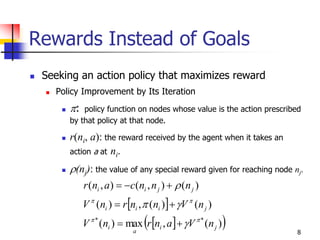
 Seeking an action policy that maximizes reward
 Policy Improvement by Its Iteration
 : policy function on nodes whose value is the action prescribed
by that policy at that node.
 r(ni, a): the reward received by the agent when it takes an
action a at ni.
 (nj): the value of any special reward given for reaching node nj.
 
  )(,max)(
)()(,)(
)(),(),(
**
ji
a
i
jiii
jjii
nVanrnV
nVnnrnV
nnncanr








9
 Value iteration
 [Barto, Bradtke, and Singh, 1995]
 delayed-reinforcement learning
 learning action policies in settings in which rewards depend on
a sequence of earlier actions
 temporal credit assignment
 credit those state-action pairs most responsible for the reward
 structural credit assignment
 in state space too large for us to store the entire graph, we must
aggregate states with similar V’ values.
 [Kaelbling, Littman, and Moore, 1996]
  )(,maxarg)(* *
ii
a
i nVanrn 
 
 )(ˆ),()(ˆ)1()(ˆ
jiii nVanrnVnV  

10 2 sum

  • 1.
  • 2.
    2 Contents  The Sense/Plan/ActCycle  Approximate Search  Learning Heuristic Functions  Rewards Instead of Goals
  • 3.
    3 Learning Heuristic Functions Learning from experiences  continuous feedback from the environment is one way to reduce uncertainties and to compensate for an agent’s lack of knowledge about the effects of its actions.  Useful information can be extracted from the experience of interacting the environments.  Explicit Graphs and Implicit Graphs
  • 4.
    4 Learning Heuristic Functions Explicit Graphs  Agent has a good model of the effects of its actions and knows the costs of moving from any node to its successor nodes.  C(ni, nj): the cost of moving from ni to nj.  (n0, a): the description of the state reached from node n after taking action a.  DYNA [Sutton 1990]  Combination of “learning in the world” with “learning and planning in the model”. )],()(ˆ[min)(ˆ )( jij nSn i nncnhnh ij    )),(,()),((ˆminarg anncanha i a  
  • 5.
    5 Learning Heuristic Functions Implicit Graphs  Impractical to make an explicit graph or table of all the nodes and their transitions.  To learn the heuristic function while performing a search process.  e.g.) Eight-puzzle  W(n): the number of tiles in the wrong place, P(n): the sum of the distances that each tile if from “home” ...)()()(ˆ 21  nPwnWwnh
  • 6.
    6 Learning Heuristic Functions Learning the weights  Minimizing the sum of the squared errors between the training samples and the h’ function given by the weighted combination.  Node expansion  Temporal difference learning [Sutton 1988]: the weight adjustment depends only on two temporally adjacent values of a function.  ),()(ˆmin)(ˆ)1()(ˆ )(ˆ)],()(ˆ[min)(ˆ)(ˆ )( )( jij nSn ii ijij nSn ii nncnhnhnh nhnncnhnhnh ij ij            
  • 7.
    7 Rewards Instead ofGoals  State-space search  more theoretical conditions  It is assumed that the agent had a single, short-term task that could be described by a goal condition.  Practical problem  the task cannot be so simply stated.  The user expresses his or her satisfaction and dissatisfaction with task performance by giving the agent positive and negative rewards.  The task for the agent can be formalized to maximize the amount of reward it receives.
  • 8.
    8 Rewards Instead ofGoals  Seeking an action policy that maximizes reward  Policy Improvement by Its Iteration  : policy function on nodes whose value is the action prescribed by that policy at that node.  r(ni, a): the reward received by the agent when it takes an action a at ni.  (nj): the value of any special reward given for reaching node nj.     )(,max)( )()(,)( )(),(),( ** ji a i jiii jjii nVanrnV nVnnrnV nnncanr        
  • 9.
    9  Value iteration [Barto, Bradtke, and Singh, 1995]  delayed-reinforcement learning  learning action policies in settings in which rewards depend on a sequence of earlier actions  temporal credit assignment  credit those state-action pairs most responsible for the reward  structural credit assignment  in state space too large for us to store the entire graph, we must aggregate states with similar V’ values.  [Kaelbling, Littman, and Moore, 1996]   )(,maxarg)(* * ii a i nVanrn     )(ˆ),()(ˆ)1()(ˆ jiii nVanrnVnV  