ENGINEERING GEOLOGY
CE-226
Lecture 03: Mechanical Weathering and its types
Topics to be covered in this Lecture
1. Weathering
2. Processes of mechanical weathering
3. Processes of chemical weathering
4. Resistance to weathering
5. Soil profiles
6. Controls of soil profile development
7. Soil hazards: expansive soil
WEATHERING
• What is weathering?
• Weathering is the physical breakdown (disintegration) and chemical alteration
(decomposition) of rocks to form soil or loose particles at or near Earth's surface.
Weathering causes deterioration of building materials. It also weakens rocks, a great
concern when weathered rocks are used for foundation.
1. Mechanical weathering is accomplished by physical forces that break rock
into smaller and smaller pieces without changing the rock's mineral composition.
2. Chemical weathering involves breaking down rock components and internal
structure and forming new compounds.
• Whereas weathering breaks rocks apart, erosion removes rock debris by mobile
agents such as water, wind, or ice.
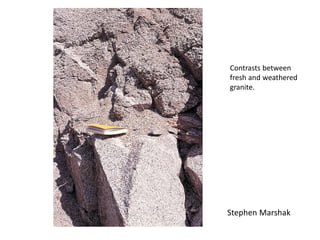
Stephen Marshak
Contrasts between
fresh and weathered
granite.
MECHANICAL WEATHERING
• Mechanical weathering: unloading
• Upon removal of overburden (unloading), the elastic component of rock
deformation is recovered and the rock expands, e.g. the overlying rocks
are eroded or rocks are removed from a quarry.
• The expansion caused by unloading may be sufficient to fracture the
rock. Such naturally formed cracks are called, joints.
MECHANICAL WEATHERING
• Physical weathering occurs everywhere, but is especially
predominantly in areas of the Earth that are
• either very hot (e.g., deserts) or
• very cold (e.g., mountains, tundra).
• In hot areas, alternations between hot and cold conditions
causes rock to expand and contract.
MECHANICAL WEATHERING
• Following are the basic types of mechanical weathering
1. Exfoliation
2. Frost Wedging
3. Salt Wedging
4. Root Wedging
5. Expansion & Contraction
TYPES OF MECHANICAL WEATHERING
1. Exfoliation
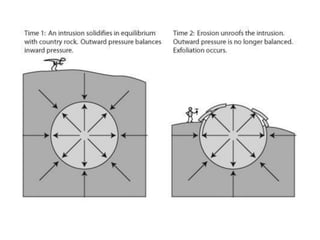
The unloading of large plutons may split into sheets that are
parallel to the mountain face, a process called exfoliation. It is
also known as sheeting if the expansion occurs in granite to
form rock slabs.
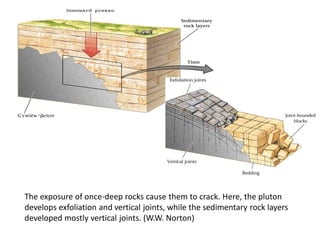
The exposure of once-deep rocks cause them to crack. Here, the pluton
develops exfoliation and vertical joints, while the sedimentary rock layers
developed mostly vertical joints. (W.W. Norton)
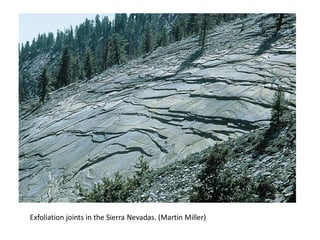
Exfoliation joints in the Sierra Nevadas. (Martin Miller)
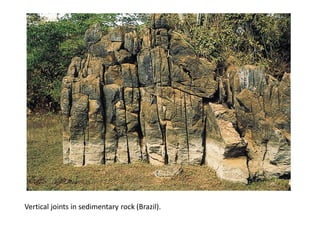
Vertical joints in sedimentary rock (Brazil).
• Sheeting of in granite in Olmstead Point, Yosemite National Park, CA.
Sheeting occurs as erosion removes the overlying rock cover and
reduces the confining pressure. The bedrock expands, and large
fractures develop parallel to the surface. Frost wedging may later
enlarge the fractures.
TYPES OF MECHANICAL WEATHERING
2. Frost Wedging (Ice Wedging)
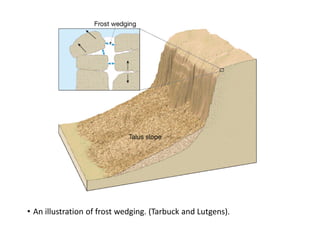
• Liquid water expand by 9% in volume when freezing. So one of
the most effective mechanical weathering processes is the
wedging action of repeated cycles of freezing and thawing of
water in rock fractures.
• Conditions for frost wedging include moisture, rock fracture or
weakness planes, and temperature fluctuation around the
freezing point.
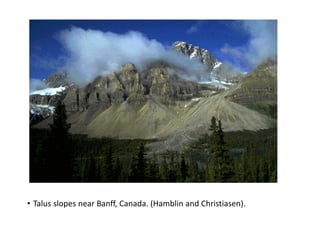
• A product of frost wedging is talus slope made of angular rock
pieces piling up at the base of steep cliffs.
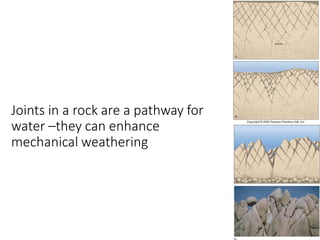
Joints in a rock are a pathway for
water –they can enhance
mechanical weathering
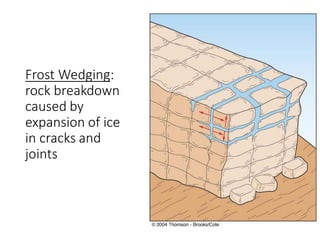
Frost Wedging:
rock breakdown
caused by
expansion of ice
in cracks and
joints
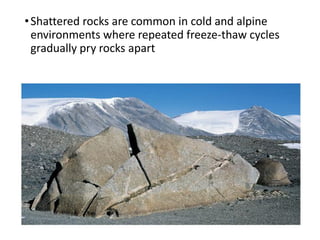
•Shattered rocks are common in cold and alpine
environments where repeated freeze-thaw cycles
gradually pry rocks apart
• An illustration of frost wedging. (Tarbuck and Lutgens).
• Talus slopes near Banff, Canada. (Hamblin and Christiasen).
TYPES OF MECHANICAL WEATHERING
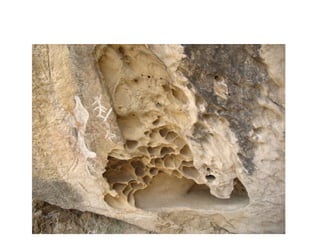
3. Salt Wedging
In arid climates, dissolved salt precipitates in the small pores and joints
between grains, wedging them apart on a small scale.
Water evaporates from the saltwater leaving behind salts.
These salts crystallize and expand, breaking apart rocks.
TYPES OF MECHANICAL WEATHERING
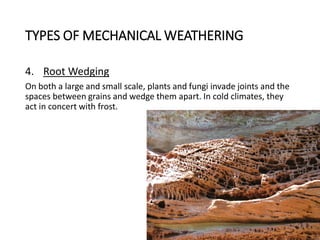
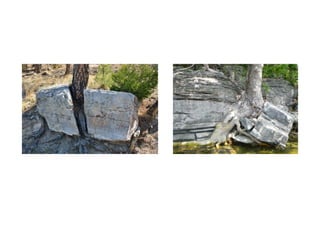
4. Root Wedging
On both a large and small scale, plants and fungi invade joints and the
spaces between grains and wedge them apart. In cold climates, they
act in concert with frost.
TYPES OF MECHANICAL WEATHERING
5. Thermal Expansion And Contraction
As temperature changes, not all parts of a rock or all its
minerals expand or contract by the same amount. So when
rocks are heated or cooled, the mineral grains are subjected
to differential stresses.
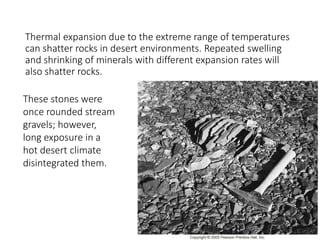
Thermal expansion due to the extreme range of temperatures
can shatter rocks in desert environments. Repeated swelling
and shrinking of minerals with different expansion rates will
also shatter rocks.
These stones were
once rounded stream
gravels; however,
long exposure in a
hot desert climate
disintegrated them.

Lecture#3 (Mechanical Weathering and its types).pdf

  • 1.
    ENGINEERING GEOLOGY CE-226 Lecture 03:Mechanical Weathering and its types
  • 2.
    Topics to becovered in this Lecture 1. Weathering 2. Processes of mechanical weathering 3. Processes of chemical weathering 4. Resistance to weathering 5. Soil profiles 6. Controls of soil profile development 7. Soil hazards: expansive soil
  • 3.
    WEATHERING • What isweathering? • Weathering is the physical breakdown (disintegration) and chemical alteration (decomposition) of rocks to form soil or loose particles at or near Earth's surface. Weathering causes deterioration of building materials. It also weakens rocks, a great concern when weathered rocks are used for foundation. 1. Mechanical weathering is accomplished by physical forces that break rock into smaller and smaller pieces without changing the rock's mineral composition. 2. Chemical weathering involves breaking down rock components and internal structure and forming new compounds. • Whereas weathering breaks rocks apart, erosion removes rock debris by mobile agents such as water, wind, or ice.
  • 5.
  • 6.
    MECHANICAL WEATHERING • Mechanicalweathering: unloading • Upon removal of overburden (unloading), the elastic component of rock deformation is recovered and the rock expands, e.g. the overlying rocks are eroded or rocks are removed from a quarry. • The expansion caused by unloading may be sufficient to fracture the rock. Such naturally formed cracks are called, joints.
  • 7.
  • 8.
    MECHANICAL WEATHERING • Physicalweathering occurs everywhere, but is especially predominantly in areas of the Earth that are • either very hot (e.g., deserts) or • very cold (e.g., mountains, tundra). • In hot areas, alternations between hot and cold conditions causes rock to expand and contract.
  • 9.
    MECHANICAL WEATHERING • Followingare the basic types of mechanical weathering 1. Exfoliation 2. Frost Wedging 3. Salt Wedging 4. Root Wedging 5. Expansion & Contraction
  • 10.
    TYPES OF MECHANICALWEATHERING 1. Exfoliation The unloading of large plutons may split into sheets that are parallel to the mountain face, a process called exfoliation. It is also known as sheeting if the expansion occurs in granite to form rock slabs.
  • 11.
    The exposure ofonce-deep rocks cause them to crack. Here, the pluton develops exfoliation and vertical joints, while the sedimentary rock layers developed mostly vertical joints. (W.W. Norton)
  • 12.
    Exfoliation joints inthe Sierra Nevadas. (Martin Miller)
  • 15.
    Vertical joints insedimentary rock (Brazil).
  • 16.
    • Sheeting ofin granite in Olmstead Point, Yosemite National Park, CA. Sheeting occurs as erosion removes the overlying rock cover and reduces the confining pressure. The bedrock expands, and large fractures develop parallel to the surface. Frost wedging may later enlarge the fractures.
  • 17.
    TYPES OF MECHANICALWEATHERING 2. Frost Wedging (Ice Wedging) • Liquid water expand by 9% in volume when freezing. So one of the most effective mechanical weathering processes is the wedging action of repeated cycles of freezing and thawing of water in rock fractures. • Conditions for frost wedging include moisture, rock fracture or weakness planes, and temperature fluctuation around the freezing point. • A product of frost wedging is talus slope made of angular rock pieces piling up at the base of steep cliffs.
  • 18.
    Joints in arock are a pathway for water –they can enhance mechanical weathering
  • 19.
    Frost Wedging: rock breakdown causedby expansion of ice in cracks and joints
  • 20.
    •Shattered rocks arecommon in cold and alpine environments where repeated freeze-thaw cycles gradually pry rocks apart
  • 21.
    • An illustrationof frost wedging. (Tarbuck and Lutgens).
  • 22.
    • Talus slopesnear Banff, Canada. (Hamblin and Christiasen).
  • 23.
    TYPES OF MECHANICALWEATHERING 3. Salt Wedging In arid climates, dissolved salt precipitates in the small pores and joints between grains, wedging them apart on a small scale. Water evaporates from the saltwater leaving behind salts. These salts crystallize and expand, breaking apart rocks.
  • 25.
    TYPES OF MECHANICALWEATHERING 4. Root Wedging On both a large and small scale, plants and fungi invade joints and the spaces between grains and wedge them apart. In cold climates, they act in concert with frost.
  • 27.
    TYPES OF MECHANICALWEATHERING 5. Thermal Expansion And Contraction As temperature changes, not all parts of a rock or all its minerals expand or contract by the same amount. So when rocks are heated or cooled, the mineral grains are subjected to differential stresses.
  • 28.
    Thermal expansion dueto the extreme range of temperatures can shatter rocks in desert environments. Repeated swelling and shrinking of minerals with different expansion rates will also shatter rocks. These stones were once rounded stream gravels; however, long exposure in a hot desert climate disintegrated them.