Climate
Change
Two types of weathering are recognized: mechanical
and chemical. Both proceed at the same time, but at a
given site one type will be predominant.
In their resistance to weathering, rocks are not
homogeneous. One may weather faster or slower than
another. Parts of the same rock may weather at
different rates.
Introduction:
weathering
• Mechanical weathering – physical breakdown of
rocks without changing the composition (freeze
thaw)
• Chemical weathering – breakdown of minerals by
chemical reactions with air or water
Chemical Weathering
2 3
1
solution Oxidation Hydrolysis
When soluble minerals such as halite
(NaCl) come in contact with water, the
positively charged sodium ions are
attracted to the negative end of the water
molecules, and negatively charged
chloride ions are attracted to the positive
end of the water molecules .
Oxidation is a chemical
weathering reaction whereby
metal elements like iron
combine with oxygen to form
oxides.
In the chemical weathering reaction
known as hydrolysis, hydrogen ions
(H+) contained in water replace
positive ions in a mineral.
How Fast is Chemical
Weathering?
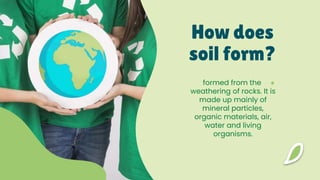
How does
soil form?
●
formed from the
weathering of rocks. It is
made up mainly of
mineral particles,
organic materials, air,
water and living
organisms.
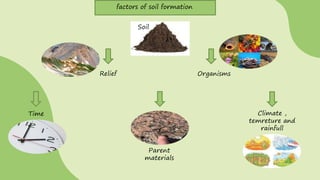
Time
Organisms
Parent
materials
Relief
Climate ,
temreture and
rainfull
Soil
factors of soil formation
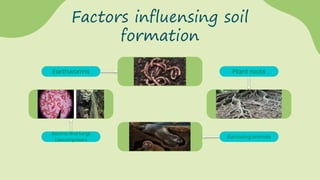
Factors influensing soil
formation
Plant roots
Earthworms
Bactria and fungi
(decomposers
Burrowing animals
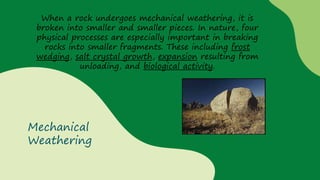
Mechanical
Weathering
When a rock undergoes mechanical weathering, it is
broken into smaller and smaller pieces. In nature, four
physical processes are especially important in breaking
rocks into smaller fragments. These including frost
wedging, salt crystal growth, expansion resulting from
unloading, and biological activity.
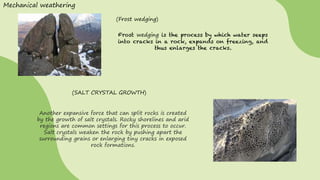
Another expansive force that can split rocks is created
by the growth of salt crystals. Rocky shorelines and arid
regions are common settings for this process to occur.
Salt crystals weaken the rock by pushing apart the
surrounding grains or enlarging tiny cracks in exposed
rock formations.
(SALT CRYSTAL GROWTH)
(Frost wedging)
Frost wedging is the process by which water seeps
into cracks in a rock, expands on freezing, and
thus enlarges the cracks.
Mechanical weathering
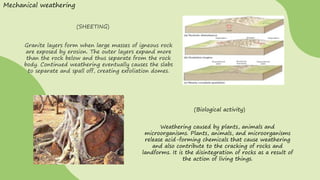
Granite layers form when large masses of igneous rock
are exposed by erosion. The outer layers expand more
than the rock below and thus separate from the rock
body. Continued weathering eventually causes the slabs
to separate and spall off, creating exfoliation domes.
(SHEETING)
Weathering caused by plants, animals and
microorganisms. Plants, animals, and microorganisms
release acid-forming chemicals that cause weathering
and also contribute to the cracking of rocks and
landforms. It is the disintegration of rocks as a result of
the action of living things.
(Biological activity)
Prssure release
Itisdefinedasaprocessinwhichthelowerlayerof
rocksisunderpressure.Sotoreleasethepressure,it
comes tothesurface,whiletheupperlayeriseroded
due toerosion,andhencethelowerlayercomesto
thesurface,releasingitspressure(Prosvirnikov,
2017).
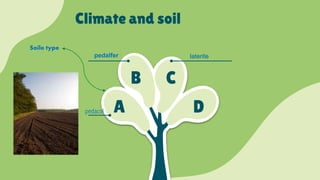
Climate and soil
A
B C
D
Soile type
pedalfer laterite
pedacol
yer on the Earth's surface. It is made up
erial. It is usually made up of weathering
composed of mainly water and nutrients
supports life and hence it can be ideal
r plant growth (Akitt, 2018).
Desecribing soil
conclusion
Resources of this presentation
● Akitt, J. W. (2018). Some observations on the
greenhouse effect at the Earth's
surface. Spectrochimica Acta Part A: Molecular
and Biomolecular Spectroscopy, 188, 127-134.
● Malyan, S. K., Kumar, A., Baram, S., Kumar, J.,
Singh, S., Kumar, S. S., & Yadav, A. N. (2019). Role
of fungi in climate change abatement through
carbon sequestration. In Recent advancement
in white biotechnology through fungi (pp. 283-
295). Springer, Cham.
●
● Prosvirnikov, D. B., Baigildeeva, E. I., Sadrtdinov, A.
R., & Fomin, A. A. (2017, May). Modelling heat and
mass transfer processes in capillary-porous
materials at their grinding by pressure release.
In 2017 International Conference on Industrial
Engineering, Applications and Manufacturing
(ICIEAM) (pp. 1-7). IEEE.

Climate change

  • 1.
  • 2.
    Two types ofweathering are recognized: mechanical and chemical. Both proceed at the same time, but at a given site one type will be predominant. In their resistance to weathering, rocks are not homogeneous. One may weather faster or slower than another. Parts of the same rock may weather at different rates. Introduction:
  • 3.
    weathering • Mechanical weathering– physical breakdown of rocks without changing the composition (freeze thaw) • Chemical weathering – breakdown of minerals by chemical reactions with air or water
  • 4.
    Chemical Weathering 2 3 1 solutionOxidation Hydrolysis When soluble minerals such as halite (NaCl) come in contact with water, the positively charged sodium ions are attracted to the negative end of the water molecules, and negatively charged chloride ions are attracted to the positive end of the water molecules . Oxidation is a chemical weathering reaction whereby metal elements like iron combine with oxygen to form oxides. In the chemical weathering reaction known as hydrolysis, hydrogen ions (H+) contained in water replace positive ions in a mineral.
  • 5.
    How Fast isChemical Weathering?
  • 6.
    How does soil form? ● formedfrom the weathering of rocks. It is made up mainly of mineral particles, organic materials, air, water and living organisms.
  • 7.
  • 8.
    Factors influensing soil formation Plantroots Earthworms Bactria and fungi (decomposers Burrowing animals
  • 9.
    Mechanical Weathering When a rockundergoes mechanical weathering, it is broken into smaller and smaller pieces. In nature, four physical processes are especially important in breaking rocks into smaller fragments. These including frost wedging, salt crystal growth, expansion resulting from unloading, and biological activity.
  • 10.
    Another expansive forcethat can split rocks is created by the growth of salt crystals. Rocky shorelines and arid regions are common settings for this process to occur. Salt crystals weaken the rock by pushing apart the surrounding grains or enlarging tiny cracks in exposed rock formations. (SALT CRYSTAL GROWTH) (Frost wedging) Frost wedging is the process by which water seeps into cracks in a rock, expands on freezing, and thus enlarges the cracks. Mechanical weathering
  • 11.
    Mechanical weathering Granite layersform when large masses of igneous rock are exposed by erosion. The outer layers expand more than the rock below and thus separate from the rock body. Continued weathering eventually causes the slabs to separate and spall off, creating exfoliation domes. (SHEETING) Weathering caused by plants, animals and microorganisms. Plants, animals, and microorganisms release acid-forming chemicals that cause weathering and also contribute to the cracking of rocks and landforms. It is the disintegration of rocks as a result of the action of living things. (Biological activity)
  • 12.
  • 13.
    Climate and soil A BC D Soile type pedalfer laterite pedacol
  • 14.
    yer on theEarth's surface. It is made up erial. It is usually made up of weathering composed of mainly water and nutrients supports life and hence it can be ideal r plant growth (Akitt, 2018). Desecribing soil
  • 15.
  • 16.
    Resources of thispresentation ● Akitt, J. W. (2018). Some observations on the greenhouse effect at the Earth's surface. Spectrochimica Acta Part A: Molecular and Biomolecular Spectroscopy, 188, 127-134. ● Malyan, S. K., Kumar, A., Baram, S., Kumar, J., Singh, S., Kumar, S. S., & Yadav, A. N. (2019). Role of fungi in climate change abatement through carbon sequestration. In Recent advancement in white biotechnology through fungi (pp. 283- 295). Springer, Cham. ● ● Prosvirnikov, D. B., Baigildeeva, E. I., Sadrtdinov, A. R., & Fomin, A. A. (2017, May). Modelling heat and mass transfer processes in capillary-porous materials at their grinding by pressure release. In 2017 International Conference on Industrial Engineering, Applications and Manufacturing (ICIEAM) (pp. 1-7). IEEE.