gareth j rowlands
AND TOTAL
SYNTHESIS
123.713 A/B
STEREOSELECTIVE
1
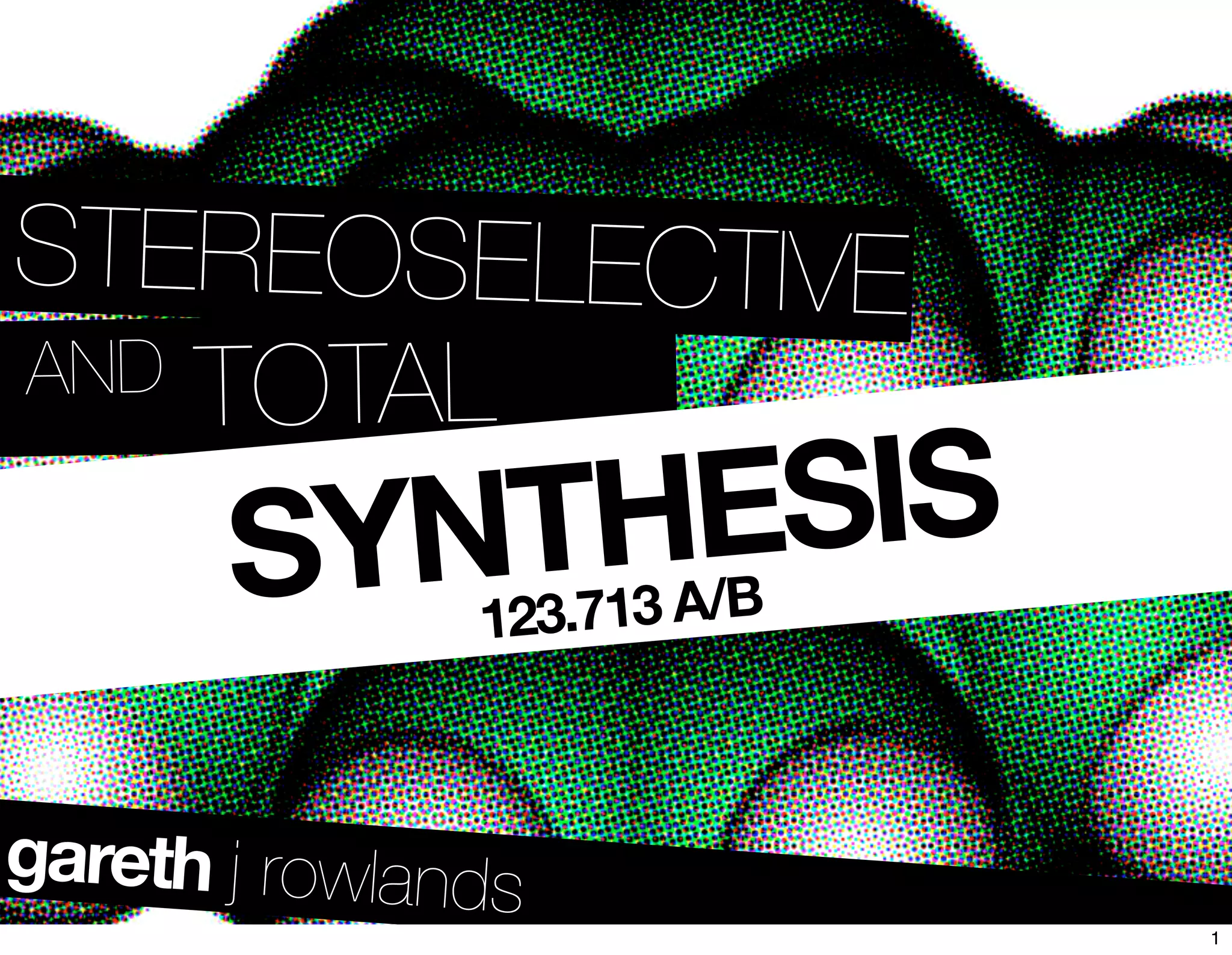
why do we needTotal Synthesis?
©Wsiegmund@wikimedia commons
O
AcO
H
OH
OBz
OH
O
O
OH
Ph
BzHN
AcO O
AcO
taxol
2
©ALTO CONTRASTE . Edgar AVG --BUSY--@flickr
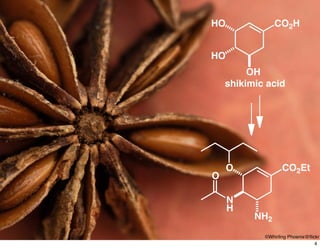
AcHN
O
H2N
CO2Et
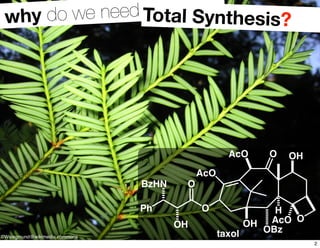
Tamiflu®
oseltamivir
3
©Whirling Phoenix@flickr
CO2H
OH
HO
HO
shikimic acid
CO2EtO
N
H
NH2
O
4
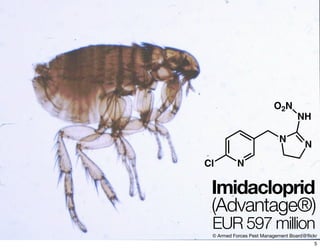
© Armed Forces Pest Management Board@flickr
N
N
Cl
N
NH
O2N
Imidacloprid
(Advantage®)
EUR 597 million
5
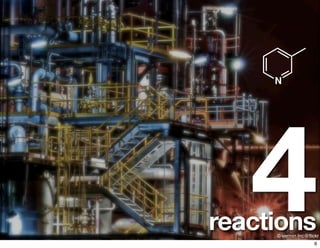
N
© vermin Inc@flickr
4reactions
6
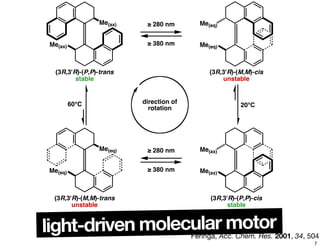
light-driven molecular motor
Me(ax)
Me(ax)
(3R,3'R)-(P,P)-trans
stable
Me(eq)
Me(eq)
(3R,3'R)-(M,M)-trans
unstable
(3R,3'R)-(M,M)-cis
unstable
Me(eq)
Me(eq)
(3R,3'R)-(P,P)-cis
stable
Me(ax)
Me(ax)
≥ 280 nm
≥ 380 nm
≥ 280 nm
≥ 380 nm
20°C60°C direction of
rotation
Feringa, Acc. Chem. Res. 2001, 34, 504
7
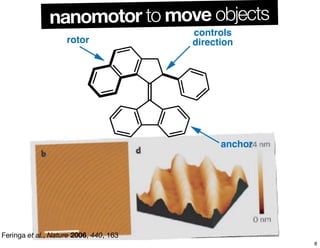
nanomotor to move objects
rotor
controls
direction
anchor
Feringa et al., Nature 2006, 440, 163
8
nanomotor to move objects
Feringa et al., Nature 2006, 440, 163
x8 real time
9
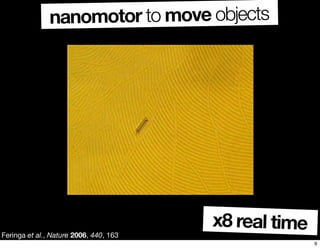
nanomotor to move objects
Feringa et al., Nature 2006, 440, 163
x8 real time
9
O
AcO
H
OH
OBz
OH
O
O
OH
Ph
BzHN
AcO O
AcO
taxol
Me(ax)
Me(ax)
AcHN
O
H2N
CO2Et
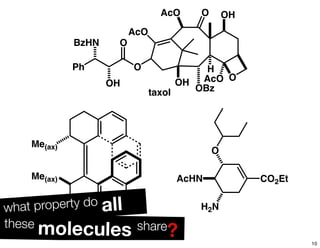
what property do all
these
molecules share
? 10
chiralchiral
11
course structure
Lecture 1: introduction
Lecture 1: problems
Lecture 2: catalysis
Lecture 2: problems
Lecture 3: retrosynthesis
Lecture 3: examples
Lecture 4: synthesis
Lecture 4: assignment
12
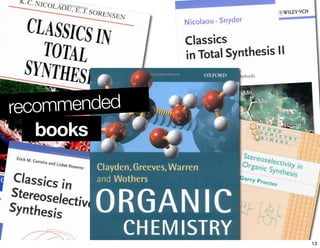
recommended
books
13
Number16|2009
ChemComm
Pages2053–2224
FEATURE ARTICLE
Toshifumi Dohi and Yasuyuki Kita
Hypervalent iodine reagents as a new
entrance to organocatalystsISSN 1359-7345 COMMUNICATION
Norifumi Fujita, Seiji Shinkai et al.
An organogel system can control the
stereochemical course of anthracene
photodimerization
1359-7345(2009)16;1-0
www.rsc.org/chemcomm
Number 16 | 28 April 2009 | Pages 2053–2224
Chemical Communications
As featured in:
See Debashish Roy, Jennifer N. Cambre
and Brent S. Sumerlin, Chem. Commun.,
2009, 2106.
www.rsc.org/chemcomm
Registered Charity Number 207890
By including polymer segments that are sensitive to three different
stimuli,“schizophrenic”, triply-responsive block copolymers were
obtained. RAFT copolymerization with a boronic acid containing
monomer led to block copolymers capable of forming both
micelles and reverse micelles, with the self-assembly being
governed by the temperature, pH, and sugar concentration of the
local environment.
Title: Triply-responsive boronic acid block copolymers
Showcasing research from Professor Brent Sumerlin’s
laboratory, Southern Methodist University, USA.
FEATURE
ARTICLE
Toshifumi
Dohi and Yasuyuki
Kita
Hypervalent
iodine reagents
as a new
entrance
to organocataly
stsISSN 1359-7345 COMMUNICA
TION
Norifumi
Fujita, Seiji Shinkai et al.
An organogel
system can control the
stereochemic
al course of anthracene
photodimeri
zation
1359-7345(20
09)16;1-0
www.rsc.org
/chemcomm
Number
16 | 28 April 2009 | Pages 2053–2224
Chemical Communications
ume7|Number9|2009
www.rsc.org/obc
Volume 7 | Number 9 | 7 May 2009 | Pages 1737–1988
COMMUNICATIONJennifer R. Hiscock et al.Fluorescent carbazolylurea anion
receptors
1477-0520(2009)7:9;1-6
D7903 · ASCAF7 · 351 (5) · 661–804 (2009) · ISSN 1615-4150 · No. 5, March 2009 5/2009
ASC
5-Year Impact Factor 2007
5.193
The Cutting Edge
that Stays Sharp!
Review:
Transition Metal-Catalysed, Direct and
Site-Selective N1-, C2- or C3-Arylation
of the Indole Nucleus:
20 Years of Improvements
Lionel Joucla, Laurent Djakovitch
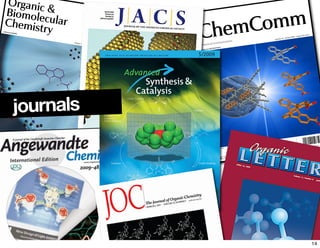
journals
14
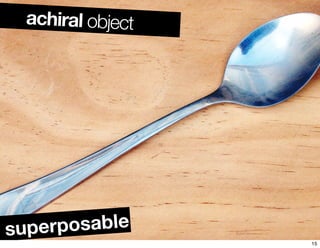
achiral object
superposable
15
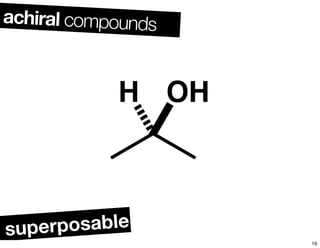
achiral compounds
superposable
H OH
16
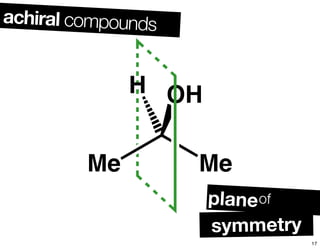
achiral compounds
symmetry
planeof
Me Me
H OH
17
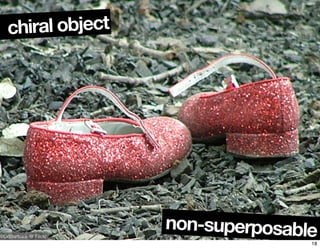
©DrStarbuck @ Flickr
chiral object
non-superposable18
OH
O
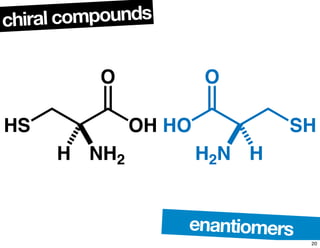
HS
NH2H
HO
O
SH
H2N H
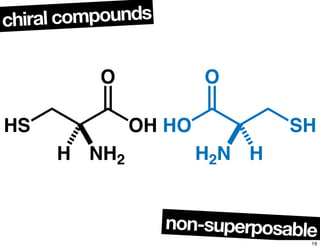
chiral compounds
non-superposable19
OH
O
HS
NH2H
HO
O
SH
H2N H
chiral compounds
enantiomers
20
OH
O
HS
NH2H
HO
O
SH
H2N H
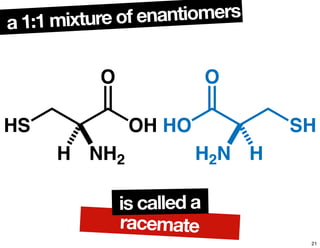
a 1:1 mixture of enantiomers
racemate
is called a
21
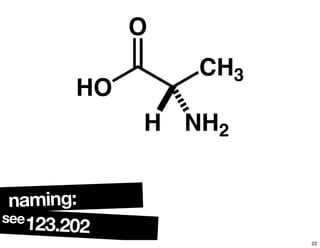
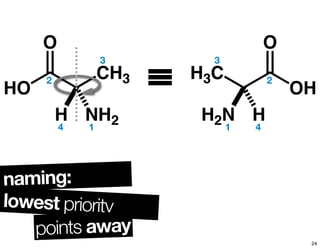
naming:
123.202
see
CH3
HO
O
H NH2
22
CH3
HO
O
H NH214
2
3
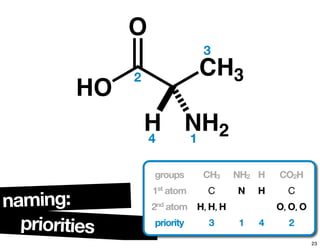
naming:
priorities
groups CH3 NH2 H CO2H
1st atom C N H C
2nd atom H, H, H O, O, O
priority 3 1 4 2
23
naming:
lowest priority
points away
CH3
HO
O
H NH2
H3C
OH
O
HH2N
≡
14
2
3
1 4
2
3
24
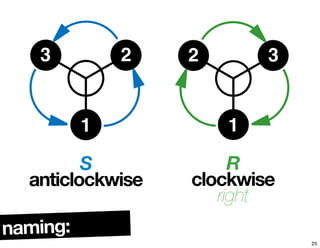
naming:
S
anticlockwise
R
clockwise
right
1
23
1
2 3
25
NH2
H3C CO2H
≡H3C
OH
O
HH2N
1
4
2
3
1
23
SS
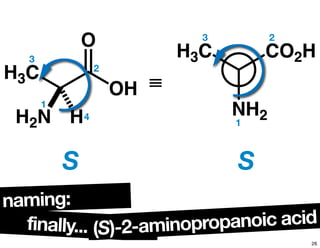
naming:
finally... (S)-2-aminopropanoic acid
26
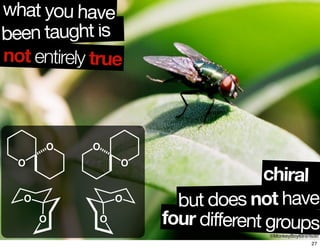
been taught is
what you have
O
O
O
O
O
O
O
O
©MonkeyBoy69@flickr
not entirely true
chiral
four different groups
but does not have
27
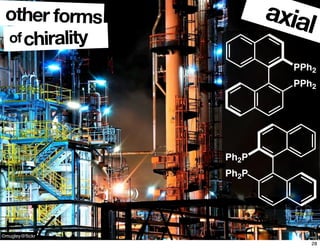
chiralityof
other forms
©mugley@flickr
PPh2
PPh2
Ph2P
Ph2P
axial
28
chiralityof
other forms helical
P [8]helicene M [8]helicene
29
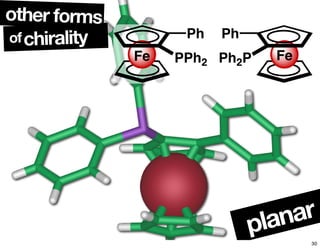
chiralityof
other forms
planar
Fe PPh2
Ph
FePh2P
Ph
30
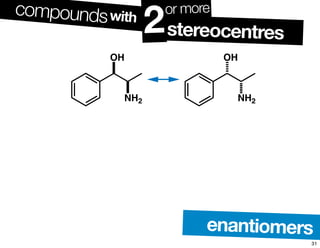
compoundswith
enantiomers
stereocentres2or more
OH
NH2
OH
NH2
31
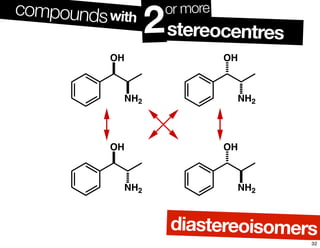
compoundswith
diastereoisomers
stereocentres2or more
OH
NH2
OH
NH2
OH
NH2
OH
NH2
32
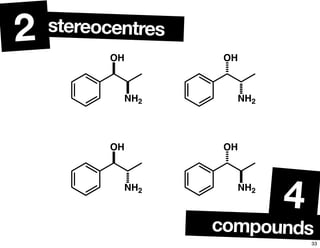
stereocentres2
compounds
4
OH
NH2
OH
NH2
OH
NH2
OH
NH2
33
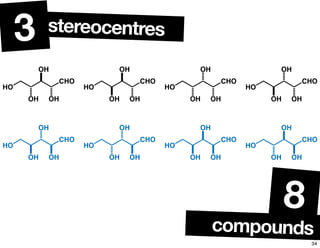
stereocentres3
compounds
8
HO
CHO
OH OH
OH
HO
CHO
OH OH
OH
HO
CHO
OH OH
OH
HO
CHO
OH OH
OH
HO
CHO
OH OH
OH
HO
CHO
OH OH
OH
HO
CHO
OH OH
OH
HO
CHO
OH OH
OH
34
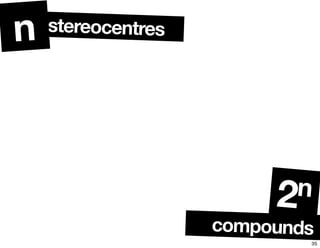
stereocentresn
compounds
2n
35
HO2C
CO2H
OH
OH
HO2C
CO2H
OH
OH
HO2C
CO2H
OH
OH
HO2C
CO2H
OH
OH
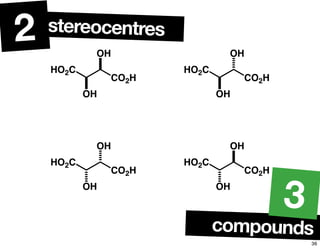
stereocentres2
compounds
3
36
HO2C
CO2H
OH
OH
HO2C
CO2H
OH
OH
HO2C
CO2H
OH
OH
HO2C
CO2H
OH
OH
stereocentres2
compounds
3
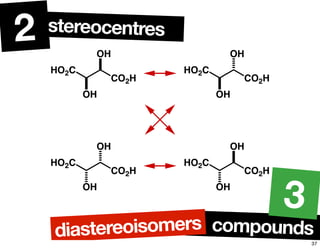
diastereoisomers
37
HO2C
CO2H
OH
OH
HO2C
CO2H
OH
OH
HO2C
CO2H
OH
OH
HO2C
CO2H
OH
OH
stereocentres2
compounds
3
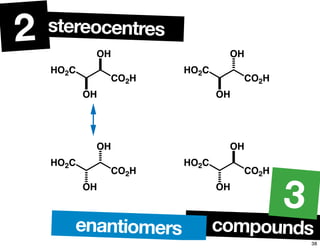
enantiomers
38
stereocentres2
compounds
3
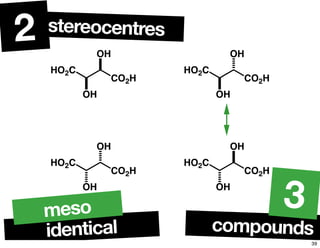
identical
meso
HO2C
CO2H
OH
OH
HO2C
CO2H
OH
OH
HO2C
CO2H
OH
OH
HO2C
CO2H
OH
OH
39
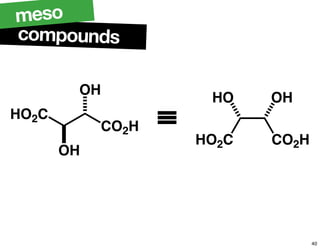
compounds
meso
HO2C
OH
CO2H
HO
HO2C
CO2H
OH
OH
≡
40
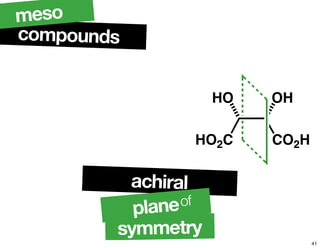
symmetry
compounds
meso
achiral
planeof
HO
HO2C
OH
CO2H
41
practice
drawing
molecules
& manipulating
42
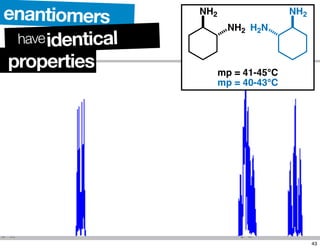
properties
enantiomers
identicalhave
NH2
NH2
NH2
H2N
mp = 41-45°C
mp = 40-43°C
43
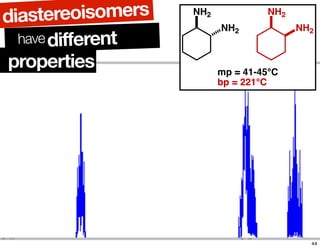
properties
differenthave
diastereoisomers NH2
NH2
mp = 41-45°C
bp = 221°C
NH2
NH2
44
difference between
diastereoisomers
synthesis
asymmetricto
key
45
©brittanyculver@flickr
how do we measure
purity?
46
NH2
NH2
NH2
H2N
NH2
NH2
=
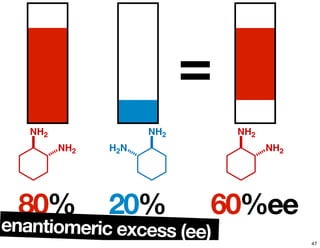
80% 20% 60%ee
enantiomeric excess (ee) 47
NH2
NH2
NH2
H2N
=
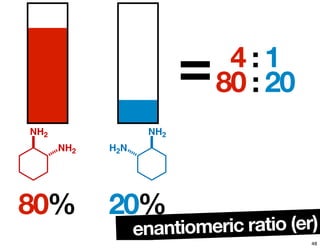
80% 20%
4 : 1
enantiomeric ratio (er)
80 : 20
48
NH2
NH2
NH2
NH2
80% 20%
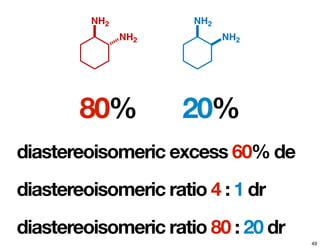
diastereoisomeric excess 60% de
diastereoisomeric ratio 4 : 1 dr
diastereoisomeric ratio 80 : 20 dr
49
©brittanyculver@flickr
how do we measure
ee?
50
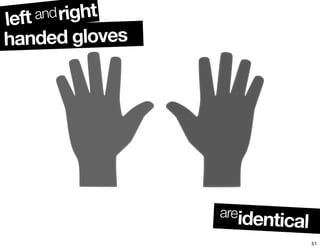
handed gloves
left rightand
identical
are
51
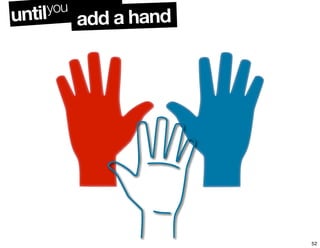
untilyou
add a hand
52
samethe
©David Reeves from Flickr
chemistry
diastereoisomers
need
53
samethe
chemistry
diastereoisomers
need..
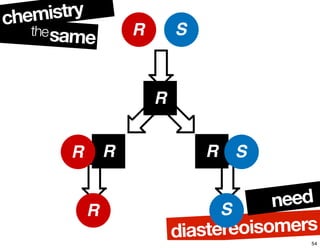
R S
R
R R SR
R S
54
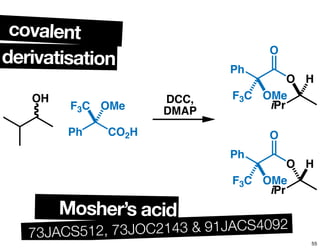
OH
Ph CO2H
DCC,
DMAPOMeF3C iPr
O H
O
Ph
F3C OMe
iPr
O H
O
Ph
F3C OMe
covalent
Mosher’s acid
73JACS512, 73JOC2143 & 91JACS4092
derivatisation
55
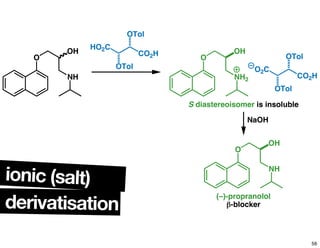
HO2C
CO2H
OTol
OTol
O2C
CO2H
OTol
OTol
S diastereoisomer is insoluble
NaOH
(–)-propranolol
β-blocker
O
OH
NH
O
OH
NH2
O
OH
NH
ionic (salt)
derivatisation
56
©Pere Tubert Juhé@flickr
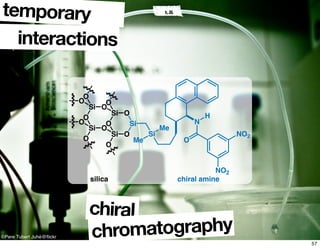
temporary
interactions
chiral
chromatography
Si
N
H
O
NO2
NO2
Si
OSi
Si O
O
O
O
OSi
OSi
O
O
O
O
O
Me
Me
silica chiral amine
57
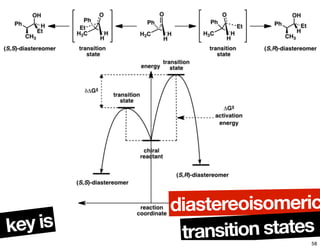
key is
diastereoisomeric
transition states
58
7
=
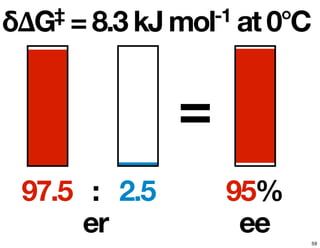
97.5 2.5 95%:
er ee
δ𝚫G‡ = 8.3 kJ mol-1 at 0°C
59
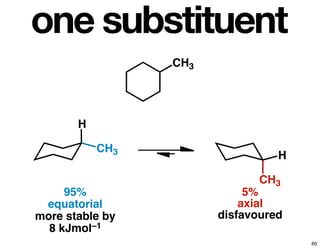
one substituent
CH3
CH3
H
CH3
H
95%
equatorial
more stable by
8 kJmol–1
5%
axial
disfavoured
60
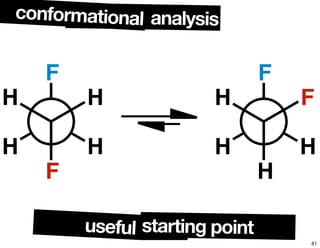
analysis
F
HH
F
HH
F
HH
H
FH
conformational
useful starting point
61
H3C H
Ph
O
H
Et
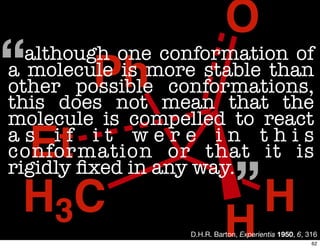
...although one conformation of
a molecule is more stable than
other possible conformations,
this does not mean that the
molecule is compelled to react
a s i f i t w e r e i n t h i s
conformation or that it is
rigidly fixed in any way.
“
..”
D.H.R. Barton, Experientia 1950, 6, 316
62

Lecture1 123713A