EEE 4117 Radio and TV Engineering
Contact hours/week: 3 Credits: 3.00
Introduction to radio communication, History, Frequency
management. Design of radio transmitter and receiver circuits
using scattering-parameter methods. Circuits include
oscillators, radio frequency amplifiers and matching networks,
mixers and detectors. Design of amplitude, frequency, and
pulse-modulated communication systems, including
modulators, detectors, and the effects of noise.
Radio Communication
• Radio or radio communication means any transmission,
emission, or reception of signs, signals, writing, images,
sounds or intelligence of any nature by means of
electromagnetic waves of frequencies lower than three
thousand gigacycles per second (3000 GHz) propagated in
space without artificial guide.
• Examples of radio communication systems:
– Radio broadcasting.
– TV broadcasting.
– Satellite communication.
– Mobile Cellular Telephony.
– Wireless LAN.
– Multimedia communication & Mobile Internet
History
• 1864: Maxwell describes radio wave mathematically
• 1888: Hertz generates radio waves
• 1890: Detection of radio waves
• 1896: Marconi makes the first radio transmission
• 1915: Radio tubes are invented
• 1948: Shannon’s law
• 1948: Transistor
• 1960: Communication Satellites
• 1981: Cellular technology
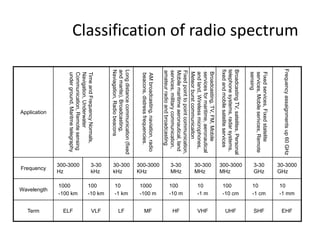
Classification of radio spectrum
Application
Time
and
Frequency
Normals,
Navigation,
Underwater
Communication,
Remote
sensing
under
ground,
Maritme
telegraphy
Long
distance
communication
(fixed
and
marite),
Broadcasting,
Naviagation,
Radio
beacons
AM
broadcasting,
naviation,
radio
beacons,
distress
frequencies.
Fixed
point
to
point
communication,
Mobile
maritime
aeronautical,
land
services,
military
communication,
amateur
radio
and
broadcasting
Broadcasting,
TV,
FM,
Mobile
services
for
maritime,
aeronautical
and
land,
Wireless
microphones,
Meteor
burst
communicaiton
Broadcasting
TV,
satelites,
Personal
telephone
systems,
radar
systems,
fixed
and
mobile
satelite
services
Fixed
services,
Fixed
statelite
services,
Mobile
serivces,
Remote
sensing
Frequency
assaignments
up
60
GHz
Frequency
300-3000
Hz
3-30
kHz
30-300
kHz
300-3000
KHz
3-30
MHz
30-300
MHz
300-3000
MHz
3-30
GHz
30-3000
GHz
Wavelength
1000
-100 km
100
-10 km
10
-1 km
1000
-100 m
100
-10 m
10
-1 m
100
-10 cm
10
-1 cm
10
-1 mm
Term ELF VLF LF MF HF VHF UHF SHF EHF
Radio Communication
• Three main problems:
– The path loss
– Noise
– Sharing the radio spectrum
Communication Systems
Source of
information
Information
sink
Transmitter
Channel
Receiver
Message
signal
Estimate of
message signal
Transmitted signal
Received signal
+ Noise & Interference
Analog Communication System
Source of
information
Signal
Processing
Modulator RF-Stage
Channel
RF-Stage
Information
sink
Signal
Processing
Demodulator
Digital Communication System
decibels
• The bel is a logarithmic unit of power ratios. One bel corresponds to an increase
of power by a factor of 10 relative to some reference power, Pref.









ref
bel
P
P
P 10
]
[ log









ref
dB
P
P
P 10
]
[ log
10
• The bel is a large unit, so that decibel (dB) is almost always used:
• The above equation may also be used to express a ratio of voltages (or field
strengths) provided that they appear across the same impedance (or in a
medium with the same wave impedance):









ref
dB
V
V
V 10
]
[ log
20
decibels
Unit Reference Power Application
dBW 1 W Absolute power
dBm 1 mW Absolute power
P [dBW] = P [dBm] - 30
dBmV 1 mV Absolute voltage, typically at the input
terminals of a receiver
dB any Gain or loss of a network
dBmV/m 1 mV/m Electric field strength
dBi Power radiated by an isotropic
reference antenna
Gain of an antenna
dBd Power radiated by a half-wave
dipole
Gain of an antenna
0 dBd = 2.15 dBi

Lecture_01.pptx

  • 1.
    EEE 4117 Radioand TV Engineering Contact hours/week: 3 Credits: 3.00 Introduction to radio communication, History, Frequency management. Design of radio transmitter and receiver circuits using scattering-parameter methods. Circuits include oscillators, radio frequency amplifiers and matching networks, mixers and detectors. Design of amplitude, frequency, and pulse-modulated communication systems, including modulators, detectors, and the effects of noise.
  • 2.
    Radio Communication • Radioor radio communication means any transmission, emission, or reception of signs, signals, writing, images, sounds or intelligence of any nature by means of electromagnetic waves of frequencies lower than three thousand gigacycles per second (3000 GHz) propagated in space without artificial guide. • Examples of radio communication systems: – Radio broadcasting. – TV broadcasting. – Satellite communication. – Mobile Cellular Telephony. – Wireless LAN. – Multimedia communication & Mobile Internet
  • 5.
    History • 1864: Maxwelldescribes radio wave mathematically • 1888: Hertz generates radio waves • 1890: Detection of radio waves • 1896: Marconi makes the first radio transmission • 1915: Radio tubes are invented • 1948: Shannon’s law • 1948: Transistor • 1960: Communication Satellites • 1981: Cellular technology
  • 6.
    Classification of radiospectrum Application Time and Frequency Normals, Navigation, Underwater Communication, Remote sensing under ground, Maritme telegraphy Long distance communication (fixed and marite), Broadcasting, Naviagation, Radio beacons AM broadcasting, naviation, radio beacons, distress frequencies. Fixed point to point communication, Mobile maritime aeronautical, land services, military communication, amateur radio and broadcasting Broadcasting, TV, FM, Mobile services for maritime, aeronautical and land, Wireless microphones, Meteor burst communicaiton Broadcasting TV, satelites, Personal telephone systems, radar systems, fixed and mobile satelite services Fixed services, Fixed statelite services, Mobile serivces, Remote sensing Frequency assaignments up 60 GHz Frequency 300-3000 Hz 3-30 kHz 30-300 kHz 300-3000 KHz 3-30 MHz 30-300 MHz 300-3000 MHz 3-30 GHz 30-3000 GHz Wavelength 1000 -100 km 100 -10 km 10 -1 km 1000 -100 m 100 -10 m 10 -1 m 100 -10 cm 10 -1 cm 10 -1 mm Term ELF VLF LF MF HF VHF UHF SHF EHF
  • 7.
    Radio Communication • Threemain problems: – The path loss – Noise – Sharing the radio spectrum
  • 8.
    Communication Systems Source of information Information sink Transmitter Channel Receiver Message signal Estimateof message signal Transmitted signal Received signal + Noise & Interference
  • 9.
    Analog Communication System Sourceof information Signal Processing Modulator RF-Stage Channel RF-Stage Information sink Signal Processing Demodulator
  • 10.
  • 11.
    decibels • The belis a logarithmic unit of power ratios. One bel corresponds to an increase of power by a factor of 10 relative to some reference power, Pref.          ref bel P P P 10 ] [ log          ref dB P P P 10 ] [ log 10 • The bel is a large unit, so that decibel (dB) is almost always used: • The above equation may also be used to express a ratio of voltages (or field strengths) provided that they appear across the same impedance (or in a medium with the same wave impedance):          ref dB V V V 10 ] [ log 20
  • 12.
    decibels Unit Reference PowerApplication dBW 1 W Absolute power dBm 1 mW Absolute power P [dBW] = P [dBm] - 30 dBmV 1 mV Absolute voltage, typically at the input terminals of a receiver dB any Gain or loss of a network dBmV/m 1 mV/m Electric field strength dBi Power radiated by an isotropic reference antenna Gain of an antenna dBd Power radiated by a half-wave dipole Gain of an antenna 0 dBd = 2.15 dBi