ITM 309     Customer Relationship Management Dr. Frederick Rodammer Michigan State University Eli Broad College of Business [email_address] November 5, 2008
Today’s Learning Objectives Understand the definition and the basic principles of Customer Relationship Management (CRM) Discuss the Mini Customer First Case Understand operational and analytical customer relationship management
OPENING CASE  Mini Cooper – Customer First How could Mini’s sales department and/or customer service department use CRM technology to improve its operations? How could analytical CRM be applied to benefit companies like Mini ? How might Mini’s business model change if it decreased its investments in CRM technologies?
CUSTOMER RELATIONSHIPS What happens if our customers are not satisfied and relationships are poor ? What happens if our customers are delighted and relationships are great ? What ideas do you have to establish superior relationships with customers ?
Customer Relationship Management:  Definition The use of information technology to create a  cross-functional  enterprise system that integrates and automates many of the  customer-serving  processes in sales, marketing, and customer services that interact with a company’s  customers
Customer  Relationship Management Provides customer-facing employees with a single, complete  view  of every  customer  at every touch point Provides customers with a single complete  company  view Integrates   and automates many customer processes Creates an IT framework of Web-enabled software and databases that integrates  front  office with back office Includes many software modules and tools
CRM Benefits CRM allows a business to identify and target their best customers so they can be  retained   as lifelong customers for greater and more profitable services. CRM makes possible real-time customization and personalization of products and services based on  customer   wants, needs, buying habits, and life cycles. CRM can keep track of when a customer contacts the company, regardless of the  contact point . CRM systems can enable a company to provide a consistent customer experience and superior service and support across all the contact points a customer chooses.
BUSINESS BENEFITS OF CRM CRM enables an organization to: Provide better customer service Make call centers more efficient Cross sell products more effectively Help sales staff close deals faster Simplify marketing and sales processes Discover new customers Increase customer revenues
CRM BASICS Organizations can find their most valuable customers through “RFM” -  R ecency,  F requency, and  M onetary value How recently a customer purchased items (Recency) How frequently a customer purchased items (Frequency) How much a customer spends on each purchase (Monetary Value)
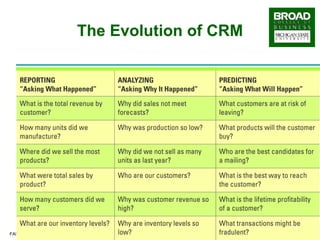
The Evolution of CRM Three phases in the evolution of CRM include reporting, analyzing, and predicting
The Evolution of CRM CRM reporting technology  – help organizations identify their customers across other applications CRM analysis technologies  – help organization segment their customers into categories such as best and worst customers CRM predicting technologies  – help organizations make predictions regarding customer behavior such as which customers are at risk of leaving
The Evolution of CRM
Operational and Analytical CRM Operational CRM  – supports traditional transactional processing for day-to-day front-office operations or systems that deal directly with the customers Analytical CRM  – supports back-office operations and strategic analysis and includes all systems that do not deal directly with the customers
MINI CASE:  ANALYTICAL CRM Personalization  – when a Web site knows enough about a persons likes and dislikes that it can fashion offers that are more likely to appeal to that person Analytical CRM relies heavily on data warehousing technologies and business intelligence to glean insights into customer behavior These systems quickly aggregate, analyze, and disseminate customer information throughout an organization
ITM 309 Homework Do great with your Team Projects ! Check ANGEL for your grades  Assignment #5 due November 19-20

Lecture Slides 11 05 08

  • 1.
    ITM 309 Customer Relationship Management Dr. Frederick Rodammer Michigan State University Eli Broad College of Business [email_address] November 5, 2008
  • 2.
    Today’s Learning ObjectivesUnderstand the definition and the basic principles of Customer Relationship Management (CRM) Discuss the Mini Customer First Case Understand operational and analytical customer relationship management
  • 3.
    OPENING CASE Mini Cooper – Customer First How could Mini’s sales department and/or customer service department use CRM technology to improve its operations? How could analytical CRM be applied to benefit companies like Mini ? How might Mini’s business model change if it decreased its investments in CRM technologies?
  • 4.
    CUSTOMER RELATIONSHIPS Whathappens if our customers are not satisfied and relationships are poor ? What happens if our customers are delighted and relationships are great ? What ideas do you have to establish superior relationships with customers ?
  • 5.
    Customer Relationship Management: Definition The use of information technology to create a cross-functional enterprise system that integrates and automates many of the customer-serving processes in sales, marketing, and customer services that interact with a company’s customers
  • 6.
    Customer RelationshipManagement Provides customer-facing employees with a single, complete view of every customer at every touch point Provides customers with a single complete company view Integrates and automates many customer processes Creates an IT framework of Web-enabled software and databases that integrates front office with back office Includes many software modules and tools
  • 7.
    CRM Benefits CRMallows a business to identify and target their best customers so they can be retained as lifelong customers for greater and more profitable services. CRM makes possible real-time customization and personalization of products and services based on customer wants, needs, buying habits, and life cycles. CRM can keep track of when a customer contacts the company, regardless of the contact point . CRM systems can enable a company to provide a consistent customer experience and superior service and support across all the contact points a customer chooses.
  • 8.
    BUSINESS BENEFITS OFCRM CRM enables an organization to: Provide better customer service Make call centers more efficient Cross sell products more effectively Help sales staff close deals faster Simplify marketing and sales processes Discover new customers Increase customer revenues
  • 9.
    CRM BASICS Organizationscan find their most valuable customers through “RFM” - R ecency, F requency, and M onetary value How recently a customer purchased items (Recency) How frequently a customer purchased items (Frequency) How much a customer spends on each purchase (Monetary Value)
  • 10.
    The Evolution ofCRM Three phases in the evolution of CRM include reporting, analyzing, and predicting
  • 11.
    The Evolution ofCRM CRM reporting technology – help organizations identify their customers across other applications CRM analysis technologies – help organization segment their customers into categories such as best and worst customers CRM predicting technologies – help organizations make predictions regarding customer behavior such as which customers are at risk of leaving
  • 12.
  • 13.
    Operational and AnalyticalCRM Operational CRM – supports traditional transactional processing for day-to-day front-office operations or systems that deal directly with the customers Analytical CRM – supports back-office operations and strategic analysis and includes all systems that do not deal directly with the customers
  • 14.
    MINI CASE: ANALYTICAL CRM Personalization – when a Web site knows enough about a persons likes and dislikes that it can fashion offers that are more likely to appeal to that person Analytical CRM relies heavily on data warehousing technologies and business intelligence to glean insights into customer behavior These systems quickly aggregate, analyze, and disseminate customer information throughout an organization
  • 15.
    ITM 309 HomeworkDo great with your Team Projects ! Check ANGEL for your grades Assignment #5 due November 19-20