Overview of CRM
Learning Objectives
At the end of the course, participants should be
able to do the following:
Explain the concepts of CRM
Explain the concepts of eCRM
Identify the difference between CRM and
Traditional Marketing
Identify the difference between CRM and
Database Marketing
Identify the relationship between CRM and
eCRM
“Customer Relationship Management is a
comprehensive strategy and process of
acquiring, retaining and partnering with
selective customers to create superior value
for the company and the customer.”
- Parvatiyar and Sheth
“Customer relationship management is about
attracting, developing, maintaining and
retaining profitable customers over a period
of time.”
- Massey, Montoya-Weiss & Holcom
“CRM relates to strategy, managing the dual-
creation or value, the intelligent use of data
and technology, the acquisition of customer
knowledge and the diffusion of this
knowledge to the appropriate stakeholders,
the development of appropriate (long-term)
relationships with specific customers and/or
customer groups and the integration of
processes across the many areas of the firm
and across the network of firms that
collaborate to generate customer value.”
- Boulding, Staelin, Ehret and Johnston
CRM versus Traditional Marketing
Traditional marketing focus on the four Ps
(price, product, place and promotion) for
increasing market share through increase in
the volume of transactions between seller and
buyer. While customer relationship
management focus on using strategies,
procedures, tools and technology for
promoting the relationship between the seller
and customer so as to increase sales revenue,
profitability and customer satisfaction.
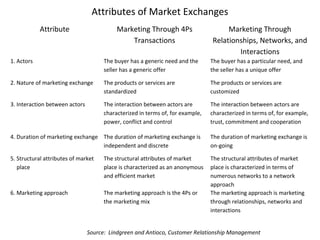
Attributes of Market Exchanges
Attribute Marketing Through 4Ps
Transactions
Marketing Through
Relationships, Networks, and
Interactions
1. Actors The buyer has a generic need and the
seller has a generic offer
The buyer has a particular need, and
the seller has a unique offer
2. Nature of marketing exchange The products or services are
standardized
The products or services are
customized
3. Interaction between actors The interaction between actors are
characterized in terms of, for example,
power, conflict and control
The interaction between actors are
characterized in terms of, for example,
trust, commitment and cooperation
4. Duration of marketing exchange The duration of marketing exchange is
independent and discrete
The duration of marketing exchange is
on-going
5. Structural attributes of market
place
The structural attributes of market
place is characterized as an anonymous
and efficient market
The structural attributes of market
place is characterized in terms of
numerous networks to a network
approach
6. Marketing approach The marketing approach is the 4Ps or
the marketing mix
The marketing approach is marketing
through relationships, networks and
interactions
Source: Lindgreen and Antioco, Customer Relationship Management
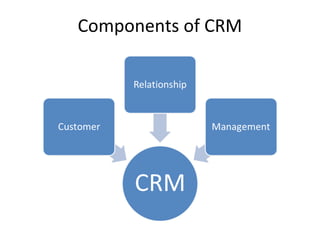
Components of CRM
Business Drivers of CRM
• Averagely, the cost of retaining a customer is
less than that of acquiring a new one.
• A dissatisfied customer may become
aggressive opposition
• Advances in electronic commerce provides
wide range of relationship opportunities for
boosting customer loyalty and satisfaction
Assumptions of CRM
• Current information is right
• Consumers prefer individual, differentiated
treatment, services and products
• The future behaviour of consumers depends
on their past behaviour
Myths of CRM
Successful CRM needs complete customer
data and a very large database
CRM is a gigantic project
Very good CRM technology system guarantee
excellence in business
Segmentation is a prerequisite to CRM
CRM needs highly advanced analytics
Key Cost Goals of CRM & Action Points
• Trim down cost of sales and distribution
- Deploy web applications for reducing sales force
- Manage customer relationships instead of products
- Use focused advertising to target customers
• Boost sales revenue growth by increasing customer satisfaction
- Enhance sales by cross-selling
- Enhance sales by up-selling
• Reduce customer support costs
- Provision of appropriate level of information to customer facing
personnel
- Call center automation for easy access to information
• Reduce cost requirements for customer satisfaction
- Manage customer experience
- Deploy customer profitability analytics
CRM versus Database Marketing
Database marketing is a company-centric technique
which focus on using discount programmes and
promotions to sell more products to customers
for less cost: Therefore it’s difficult to use it for
building customer loyalty. While Customer
relationship management focus on enduring
relationship with customers by identifying and
providing customer values in the context of
customer’s viewpoint and not based on the
company’s opinion: Therefore it’s easy to use it
for building customer loyalty.
eCRM
eCRM involves matching and blending people,
processes and technology for enabling an
organisation to attract, retain and partner
with customers to facilitate enhancement of
value to both customers and the organisation.
CRM versus eCRM
The infusion of applicable electronic technology
including database-driven software, business
intelligence and web systems to the customer
relationship strategy of a firm so as to achieve
established objectives depicts eCRM. While
CRM focus on the generic application of a
firm’s customer relationship strategy in
achieving established objectives.
Customer relationship management provides
opportunity for expectations of customers to
be properly identified, explored and used for
controlling value proposition with the aim of
increasing customer satisfaction.
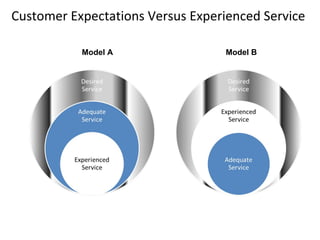
Customer Expectations Versus Experienced Service
Model A Model B
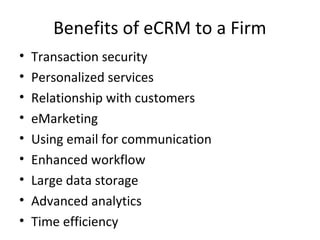
Benefits of eCRM to a Firm
• Transaction security
• Personalized services
• Relationship with customers
• eMarketing
• Using email for communication
• Enhanced workflow
• Large data storage
• Advanced analytics
• Time efficiency
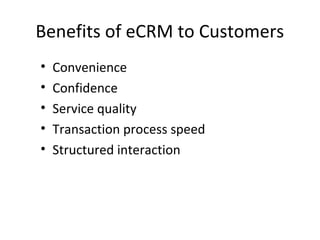
Benefits of eCRM to Customers
• Convenience
• Confidence
• Service quality
• Transaction process speed
• Structured interaction
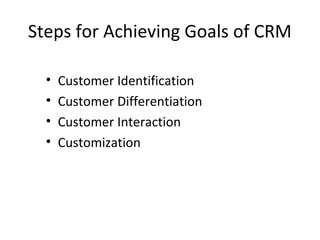
Steps for Achieving Goals of CRM
• Customer Identification
• Customer Differentiation
• Customer Interaction
• Customization
Dr Elijah Ezendu is Award-Winning Business Expert & Certified Management Consultant with expertise
in Interim Management, Strategy, Competitive Intelligence, Transformation, Restructuring, Turnaround
Management, Business Development, Marketing, Project & Cost Management, Leadership, HR, CSR, e-
Business & Software Architecture. He had functioned as Founder, Initiative for Sustainable Business
Equity; Chairman of Board, Charisma Broadcast Film Academy; Group Chief Operating Officer, Idova
Group; CEO, Rubiini (UAE); Special Advisor, RTEAN; Director, MMNA Investments; Chair, Int’l Board of
GCC Business Council (UAE); Senior Partner, Shevach Consulting; Chairman (Certification & Training),
Coordinator (Board of Fellows), Lead Assessor & Governing Council Member, Institute of Management
Consultants, Nigeria; Lead Resource, Centre for Competitive Intelligence Development; Lead
Consultant/ Partner, JK Michaels; Turnaround Project Director, Consolidated Business Holdings Limited;
Technical Director, Gestalt; Chief Operating Officer, Rohan Group; Executive Director (Various Roles),
Fortuna, Gambia & Malta; Chief Advisor/ Partner, D & E; Vice Chairman of Board, Refined Shipping;
Director of Programmes & Governing Council Member, Institute of Business Development, Nigeria;
Member of TDD Committee, International Association of Software Architects, USA; Member of Strategic
Planning and Implementation Committee, Chartered Institute of Personnel Management of Nigeria;
Country Manager (Nigeria) & Adjunct Faculty (MBA Programme), Regent Business School, South Africa;
Adjunct Faculty (MBA Programme), Ladoke Akintola University of Technology; Editor-in-Chief, Cost
Management Journal; Council Member, Institute of Internal Auditors of Nigeria; Member, Board of
Directors (Several Organizations). He holds Doctoral Degree in Management, Master of Business
Administration and Fellow of Professional Institutes in North America, UK & Nigeria. He is Innovator of
Corporate Investment Structure Based on Financials and Intangibles, for valuation highlighting
intangible contributions of host communities and ecological environment: A model celebrated globally
as remedy for unmitigated depreciation of ecological capital and developmental deprivation of host
communities. He had served as Examiner to Professional Institutes and Universities. He had been a
member of Guild of Soundtrack Producers of Nigeria. He's an author and extensively featured speaker.
Thank You

Overview Of CRM

  • 1.
  • 2.
    Learning Objectives At theend of the course, participants should be able to do the following: Explain the concepts of CRM Explain the concepts of eCRM Identify the difference between CRM and Traditional Marketing Identify the difference between CRM and Database Marketing Identify the relationship between CRM and eCRM
  • 3.
    “Customer Relationship Managementis a comprehensive strategy and process of acquiring, retaining and partnering with selective customers to create superior value for the company and the customer.” - Parvatiyar and Sheth
  • 4.
    “Customer relationship managementis about attracting, developing, maintaining and retaining profitable customers over a period of time.” - Massey, Montoya-Weiss & Holcom
  • 5.
    “CRM relates tostrategy, managing the dual- creation or value, the intelligent use of data and technology, the acquisition of customer knowledge and the diffusion of this knowledge to the appropriate stakeholders, the development of appropriate (long-term) relationships with specific customers and/or customer groups and the integration of processes across the many areas of the firm and across the network of firms that collaborate to generate customer value.” - Boulding, Staelin, Ehret and Johnston
  • 6.
    CRM versus TraditionalMarketing Traditional marketing focus on the four Ps (price, product, place and promotion) for increasing market share through increase in the volume of transactions between seller and buyer. While customer relationship management focus on using strategies, procedures, tools and technology for promoting the relationship between the seller and customer so as to increase sales revenue, profitability and customer satisfaction.
  • 7.
    Attributes of MarketExchanges Attribute Marketing Through 4Ps Transactions Marketing Through Relationships, Networks, and Interactions 1. Actors The buyer has a generic need and the seller has a generic offer The buyer has a particular need, and the seller has a unique offer 2. Nature of marketing exchange The products or services are standardized The products or services are customized 3. Interaction between actors The interaction between actors are characterized in terms of, for example, power, conflict and control The interaction between actors are characterized in terms of, for example, trust, commitment and cooperation 4. Duration of marketing exchange The duration of marketing exchange is independent and discrete The duration of marketing exchange is on-going 5. Structural attributes of market place The structural attributes of market place is characterized as an anonymous and efficient market The structural attributes of market place is characterized in terms of numerous networks to a network approach 6. Marketing approach The marketing approach is the 4Ps or the marketing mix The marketing approach is marketing through relationships, networks and interactions Source: Lindgreen and Antioco, Customer Relationship Management
  • 8.
  • 9.
    Business Drivers ofCRM • Averagely, the cost of retaining a customer is less than that of acquiring a new one. • A dissatisfied customer may become aggressive opposition • Advances in electronic commerce provides wide range of relationship opportunities for boosting customer loyalty and satisfaction
  • 10.
    Assumptions of CRM •Current information is right • Consumers prefer individual, differentiated treatment, services and products • The future behaviour of consumers depends on their past behaviour
  • 11.
    Myths of CRM SuccessfulCRM needs complete customer data and a very large database CRM is a gigantic project Very good CRM technology system guarantee excellence in business Segmentation is a prerequisite to CRM CRM needs highly advanced analytics
  • 12.
    Key Cost Goalsof CRM & Action Points • Trim down cost of sales and distribution - Deploy web applications for reducing sales force - Manage customer relationships instead of products - Use focused advertising to target customers • Boost sales revenue growth by increasing customer satisfaction - Enhance sales by cross-selling - Enhance sales by up-selling • Reduce customer support costs - Provision of appropriate level of information to customer facing personnel - Call center automation for easy access to information • Reduce cost requirements for customer satisfaction - Manage customer experience - Deploy customer profitability analytics
  • 13.
    CRM versus DatabaseMarketing Database marketing is a company-centric technique which focus on using discount programmes and promotions to sell more products to customers for less cost: Therefore it’s difficult to use it for building customer loyalty. While Customer relationship management focus on enduring relationship with customers by identifying and providing customer values in the context of customer’s viewpoint and not based on the company’s opinion: Therefore it’s easy to use it for building customer loyalty.
  • 14.
    eCRM eCRM involves matchingand blending people, processes and technology for enabling an organisation to attract, retain and partner with customers to facilitate enhancement of value to both customers and the organisation.
  • 15.
    CRM versus eCRM Theinfusion of applicable electronic technology including database-driven software, business intelligence and web systems to the customer relationship strategy of a firm so as to achieve established objectives depicts eCRM. While CRM focus on the generic application of a firm’s customer relationship strategy in achieving established objectives.
  • 16.
    Customer relationship managementprovides opportunity for expectations of customers to be properly identified, explored and used for controlling value proposition with the aim of increasing customer satisfaction.
  • 17.
    Customer Expectations VersusExperienced Service Model A Model B
  • 18.
    Benefits of eCRMto a Firm • Transaction security • Personalized services • Relationship with customers • eMarketing • Using email for communication • Enhanced workflow • Large data storage • Advanced analytics • Time efficiency
  • 19.
    Benefits of eCRMto Customers • Convenience • Confidence • Service quality • Transaction process speed • Structured interaction
  • 20.
    Steps for AchievingGoals of CRM • Customer Identification • Customer Differentiation • Customer Interaction • Customization
  • 21.
    Dr Elijah Ezenduis Award-Winning Business Expert & Certified Management Consultant with expertise in Interim Management, Strategy, Competitive Intelligence, Transformation, Restructuring, Turnaround Management, Business Development, Marketing, Project & Cost Management, Leadership, HR, CSR, e- Business & Software Architecture. He had functioned as Founder, Initiative for Sustainable Business Equity; Chairman of Board, Charisma Broadcast Film Academy; Group Chief Operating Officer, Idova Group; CEO, Rubiini (UAE); Special Advisor, RTEAN; Director, MMNA Investments; Chair, Int’l Board of GCC Business Council (UAE); Senior Partner, Shevach Consulting; Chairman (Certification & Training), Coordinator (Board of Fellows), Lead Assessor & Governing Council Member, Institute of Management Consultants, Nigeria; Lead Resource, Centre for Competitive Intelligence Development; Lead Consultant/ Partner, JK Michaels; Turnaround Project Director, Consolidated Business Holdings Limited; Technical Director, Gestalt; Chief Operating Officer, Rohan Group; Executive Director (Various Roles), Fortuna, Gambia & Malta; Chief Advisor/ Partner, D & E; Vice Chairman of Board, Refined Shipping; Director of Programmes & Governing Council Member, Institute of Business Development, Nigeria; Member of TDD Committee, International Association of Software Architects, USA; Member of Strategic Planning and Implementation Committee, Chartered Institute of Personnel Management of Nigeria; Country Manager (Nigeria) & Adjunct Faculty (MBA Programme), Regent Business School, South Africa; Adjunct Faculty (MBA Programme), Ladoke Akintola University of Technology; Editor-in-Chief, Cost Management Journal; Council Member, Institute of Internal Auditors of Nigeria; Member, Board of Directors (Several Organizations). He holds Doctoral Degree in Management, Master of Business Administration and Fellow of Professional Institutes in North America, UK & Nigeria. He is Innovator of Corporate Investment Structure Based on Financials and Intangibles, for valuation highlighting intangible contributions of host communities and ecological environment: A model celebrated globally as remedy for unmitigated depreciation of ecological capital and developmental deprivation of host communities. He had served as Examiner to Professional Institutes and Universities. He had been a member of Guild of Soundtrack Producers of Nigeria. He's an author and extensively featured speaker.
  • 22.