EC8352-SIGNALS AND SYSTEMS
KARPAGAM INSTITUTE OF TECHNOLOGY,
COIMBATORE - 105
Course Code with Name :OEC753/Signals and Systems
Staff Name / Designation : Mr.S.Pragadeswaran/ AP
Department : ECE
Year / Semester : IV/07
Department of Electronics and Communication Engineering
COURSE SYLLABUS
UNIT I CLASSIFICATION OF SIGNALS AND SYSTEMS
Standard signals- Step, Ramp, Pulse, Impulse, Real and complex exponentials and Sinusoids_ Classification of signals –
Continuous time (CT) and Discrete Time (DT) signals, Periodic & Aperiodic signals, Deterministic & Random signals, Energy &
Power signals – Classification of systems- CT systems and DT systems- – Linear & Nonlinear, Time-variant & Time-invariant,
Causal & Non-causal, Stable & Unstable.
UNIT II ANALYSIS OF CONTINUOUS TIME SIGNALS
Fourier series for periodic signals – Fourier Transform – properties- Laplace Transforms and properties
UNIT III LINEAR TIME INVARIANT CONTINUOUS TIME SYSTEMS
Impulse response – convolution integrals- Differential Equation- Fourier and Laplace transforms in Analysis of CT systems –
Systems connected in series / parallel.
UNIT IV ANALYSIS OF DISCRETE TIME SIGNALS
Baseband signal Sampling – Fourier Transform of discrete time signals (DTFT) – Properties of DTFT – Z Transform & Properties
UNIT V LINEAR TIME INVARIANT-DISCRETE TIME SYSTEMS
Impulse response – Difference equations-Convolution sum- Discrete Fourier Transform and Z Transform Analysis of Recursive &
Non-Recursive systems-DT systems connected in series and parallel.
UNIT I CLASSIFICATION OF SIGNALS AND
SYSTEMS
Standard signals- Step, Ramp, Pulse, Impulse, Real and complex
exponentials and Sinusoids_ Classification of signals – Continuous time
(CT) and Discrete Time (DT) signals, Periodic & Aperiodic signals,
Deterministic & Random signals, Energy & Power signals -
Classification of systems- CT systems and DT systems- – Linear &
Nonlinear, Time-variant & Time-invariant, Causal & Non-causal,
Stable & Unstable.
⮚ Signals are variables that carry information.
⮚ It is described as a function ofone or more
independent variables.
⮚ Basically it is a physical quantity. Itvaries with
some independent or dependent variables.
⮚ Signals can be One-dimensional or multi-
dimensional
Introduction to Signals
⮚ Signal: A function of one or more variables that
convey information on the nature of a physical
phenomenon.
Examples: v(t),i(t),x(t),heartbeat, blood pressure,
temperature, vibration.
• One-dimensional signals: function depends on a single
variable, e.g., speech signal
• Multi-dimensional signals: function depends on two or
more variables, e.g., image
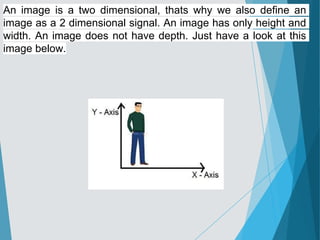
An image is a two dimensional, thats why we also define an
image as a 2 dimensional signal. An image has only height and
width. An image does not have depth. Just have a look at this
image below.
ELEMENTARY SIGNALS
❏ Impulse Signal
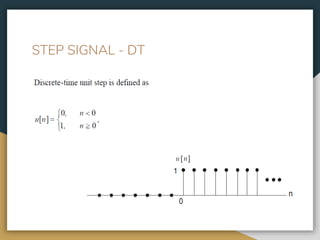
❏ Step Signal
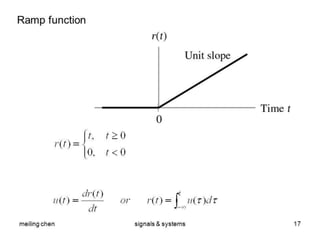
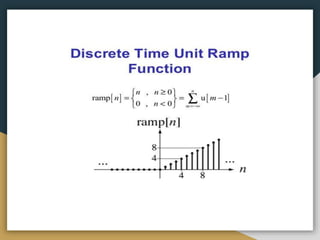
❏ Ramp Signal
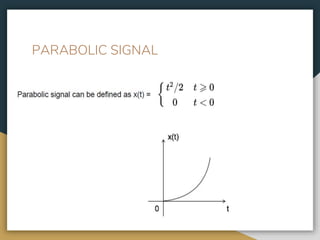
❏ Parabolic Signal
❏ Sinusoidal Signal
❏ Exponential Signal
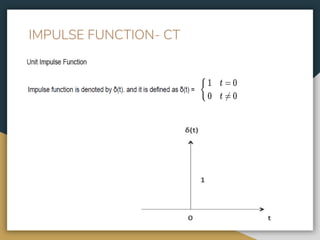
IMPULSE FUNCTION- CT
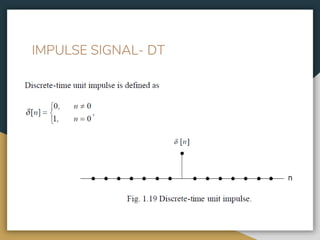
IMPULSE SIGNAL- DT
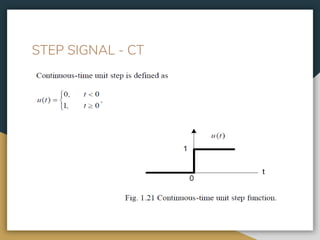
STEP SIGNAL - CT
STEP SIGNAL - DT
PARABOLIC SIGNAL
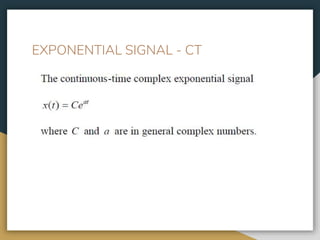
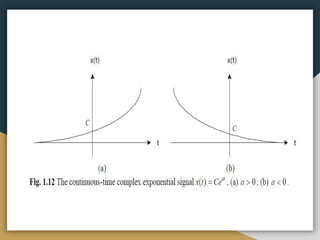
EXPONENTIAL SIGNAL - CT
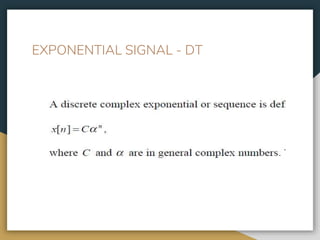
EXPONENTIAL SIGNAL - DT
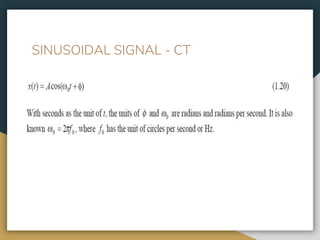
SINUSOIDAL SIGNAL - CT
Classification of signals
⮚ Continuous-time and discrete-time signals
⮚ Periodic and non-periodic signals
⮚ Casual and Non-casual signals
⮚ Deterministic and random signals
⮚ Even and odd signals
Continuous Time (CT) &
Discrete Time (DT) Signals
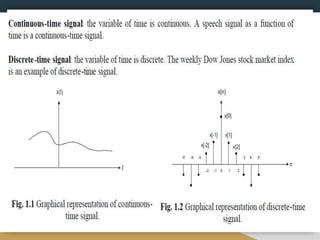
⮚ CT signals take on real or complex values as a function of an indepe
ndent variable that ranges over the real numbers and are denoted as
x( t ) .
⮚ DT signals take on real or complex values as a function of an
independent variable that ranges over the integers and are denoted as
x[ n] .
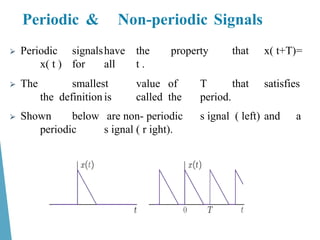
Periodic & Non-periodic Signals
⮚ Periodic signalshave the property that x( t+T)=
x( t ) for all t .
⮚ The smallest value of T that satisfies
the definition is called the period.
⮚ Shown below are non- periodic s ignal ( left) and a
periodic s ignal ( r ight).
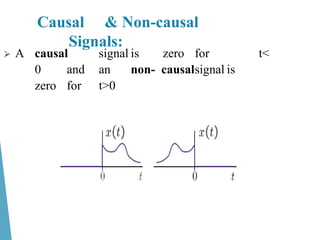
⮚ A causal signal is zero for t<
0 and an non- causalsignal is
zero for t>0
Causal & Non-causal
Signals:
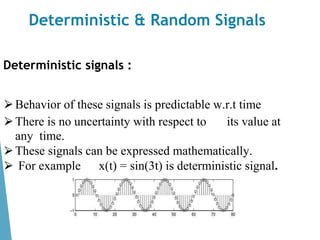
Deterministic & Random Signals
Deterministic signals :
⮚Behavior of these signals is predictable w.r.t time
⮚There is no uncertainty with respect to its value at
any time.
⮚These signals can be expressed mathematically.
⮚ For example x(t) = sin(3t) is deterministic signal.
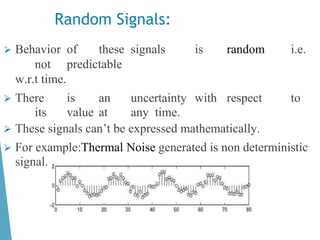
⮚ Behavior of these signals is random i.e.
not predictable
w.r.t time.
⮚ There is an uncertainty with respect to
its value at any time.
⮚ These signals can’t be expressed mathematically.
⮚ For example:Thermal Noise generated is non deterministic
signal.
Random Signals:
Even &Odd
Signals
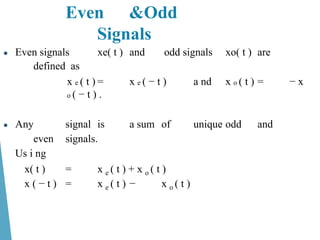
● Even signals xe( t ) and odd signals xo( t ) are
defined as
x e ( t ) = x e ( − t ) a nd x o ( t ) = − x
o ( − t ) .
● Any signal is a sum of unique odd and
even signals.
Us i ng
x( t ) = x e ( t ) + x o ( t )
x ( − t ) = x e ( t ) − x o ( t )
Even:
x(−t) = x(t)
x[−n] = x[n]
Odd:
x(−t) = −x(t)
x[−n] = −x[n]
⚫ Any signal x(t) can be expressed as
x(t) = xe(t) +
xo(t) )
x(−t) = xe(t) − xo(t)
where
xe(t) = 1/2(x(t) + x(−t))
xo(t) = 1/2(x(t) − x(−t))
Even &Odd
Signals:
Elementary signals
⮚ Step function
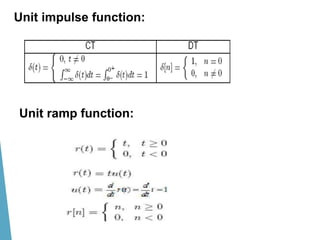
⮚ Impulse function
⮚ Ramp function
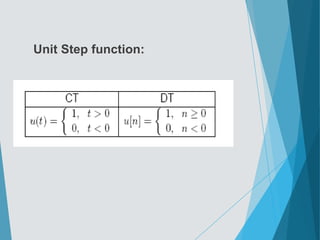
Unit Step function:
Unit ramp function:
Unit impulse function:
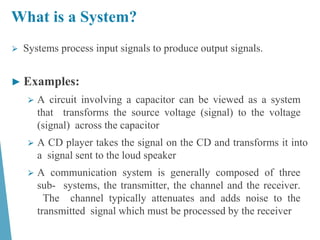
What is a System?
⮚ Systems process input signals to produce output signals.
► Examples:
⮚ A circuit involving a capacitor can be viewed as a system
that transforms the source voltage (signal) to the voltage
(signal) across the capacitor
⮚ A CD player takes the signal on the CD and transforms it into
a signal sent to the loud speaker
⮚ A communication system is generally composed of three
sub- systems, the transmitter, the channel and the receiver.
The channel typically attenuates and adds noise to the
transmitted signal which must be processed by the receiver
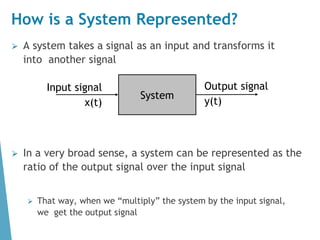
How is a System Represented?
⮚ A system takes a signal as an input and transforms it
into another signal
⮚ In a very broad sense, a system can be represented as the
ratio of the output signal over the input signal
⮚ That way, when we “multiply” the system by the input signal,
we get the output signal
System
Input signal
x(t)
Output signal
y(t)
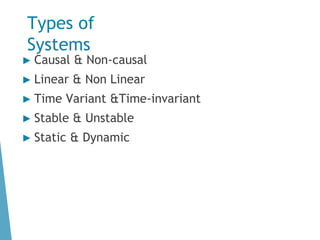
Types of
Systems
► Causal & Non-causal
► Linear & Non Linear
► Time Variant &Time-invariant
► Stable & Unstable
► Static & Dynamic
Signals and System

Signals and System

  • 1.
  • 2.
    KARPAGAM INSTITUTE OFTECHNOLOGY, COIMBATORE - 105 Course Code with Name :OEC753/Signals and Systems Staff Name / Designation : Mr.S.Pragadeswaran/ AP Department : ECE Year / Semester : IV/07 Department of Electronics and Communication Engineering
  • 3.
    COURSE SYLLABUS UNIT ICLASSIFICATION OF SIGNALS AND SYSTEMS Standard signals- Step, Ramp, Pulse, Impulse, Real and complex exponentials and Sinusoids_ Classification of signals – Continuous time (CT) and Discrete Time (DT) signals, Periodic & Aperiodic signals, Deterministic & Random signals, Energy & Power signals – Classification of systems- CT systems and DT systems- – Linear & Nonlinear, Time-variant & Time-invariant, Causal & Non-causal, Stable & Unstable. UNIT II ANALYSIS OF CONTINUOUS TIME SIGNALS Fourier series for periodic signals – Fourier Transform – properties- Laplace Transforms and properties UNIT III LINEAR TIME INVARIANT CONTINUOUS TIME SYSTEMS Impulse response – convolution integrals- Differential Equation- Fourier and Laplace transforms in Analysis of CT systems – Systems connected in series / parallel. UNIT IV ANALYSIS OF DISCRETE TIME SIGNALS Baseband signal Sampling – Fourier Transform of discrete time signals (DTFT) – Properties of DTFT – Z Transform & Properties UNIT V LINEAR TIME INVARIANT-DISCRETE TIME SYSTEMS Impulse response – Difference equations-Convolution sum- Discrete Fourier Transform and Z Transform Analysis of Recursive & Non-Recursive systems-DT systems connected in series and parallel.
  • 4.
    UNIT I CLASSIFICATIONOF SIGNALS AND SYSTEMS Standard signals- Step, Ramp, Pulse, Impulse, Real and complex exponentials and Sinusoids_ Classification of signals – Continuous time (CT) and Discrete Time (DT) signals, Periodic & Aperiodic signals, Deterministic & Random signals, Energy & Power signals - Classification of systems- CT systems and DT systems- – Linear & Nonlinear, Time-variant & Time-invariant, Causal & Non-causal, Stable & Unstable.
  • 5.
    ⮚ Signals arevariables that carry information. ⮚ It is described as a function ofone or more independent variables. ⮚ Basically it is a physical quantity. Itvaries with some independent or dependent variables. ⮚ Signals can be One-dimensional or multi- dimensional Introduction to Signals
  • 6.
    ⮚ Signal: Afunction of one or more variables that convey information on the nature of a physical phenomenon. Examples: v(t),i(t),x(t),heartbeat, blood pressure, temperature, vibration. • One-dimensional signals: function depends on a single variable, e.g., speech signal • Multi-dimensional signals: function depends on two or more variables, e.g., image
  • 8.
    An image isa two dimensional, thats why we also define an image as a 2 dimensional signal. An image has only height and width. An image does not have depth. Just have a look at this image below.
  • 9.
    ELEMENTARY SIGNALS ❏ ImpulseSignal ❏ Step Signal ❏ Ramp Signal ❏ Parabolic Signal ❏ Sinusoidal Signal ❏ Exponential Signal
  • 11.
  • 12.
  • 13.
  • 14.
  • 17.
  • 18.
  • 20.
  • 21.
  • 22.
    Classification of signals ⮚Continuous-time and discrete-time signals ⮚ Periodic and non-periodic signals ⮚ Casual and Non-casual signals ⮚ Deterministic and random signals ⮚ Even and odd signals
  • 23.
    Continuous Time (CT)& Discrete Time (DT) Signals ⮚ CT signals take on real or complex values as a function of an indepe ndent variable that ranges over the real numbers and are denoted as x( t ) . ⮚ DT signals take on real or complex values as a function of an independent variable that ranges over the integers and are denoted as x[ n] .
  • 24.
    Periodic & Non-periodicSignals ⮚ Periodic signalshave the property that x( t+T)= x( t ) for all t . ⮚ The smallest value of T that satisfies the definition is called the period. ⮚ Shown below are non- periodic s ignal ( left) and a periodic s ignal ( r ight).
  • 25.
    ⮚ A causalsignal is zero for t< 0 and an non- causalsignal is zero for t>0 Causal & Non-causal Signals:
  • 26.
    Deterministic & RandomSignals Deterministic signals : ⮚Behavior of these signals is predictable w.r.t time ⮚There is no uncertainty with respect to its value at any time. ⮚These signals can be expressed mathematically. ⮚ For example x(t) = sin(3t) is deterministic signal.
  • 27.
    ⮚ Behavior ofthese signals is random i.e. not predictable w.r.t time. ⮚ There is an uncertainty with respect to its value at any time. ⮚ These signals can’t be expressed mathematically. ⮚ For example:Thermal Noise generated is non deterministic signal. Random Signals:
  • 28.
    Even &Odd Signals ● Evensignals xe( t ) and odd signals xo( t ) are defined as x e ( t ) = x e ( − t ) a nd x o ( t ) = − x o ( − t ) . ● Any signal is a sum of unique odd and even signals. Us i ng x( t ) = x e ( t ) + x o ( t ) x ( − t ) = x e ( t ) − x o ( t )
  • 29.
    Even: x(−t) = x(t) x[−n]= x[n] Odd: x(−t) = −x(t) x[−n] = −x[n] ⚫ Any signal x(t) can be expressed as x(t) = xe(t) + xo(t) ) x(−t) = xe(t) − xo(t) where xe(t) = 1/2(x(t) + x(−t)) xo(t) = 1/2(x(t) − x(−t)) Even &Odd Signals:
  • 30.
    Elementary signals ⮚ Stepfunction ⮚ Impulse function ⮚ Ramp function
  • 31.
  • 32.
    Unit ramp function: Unitimpulse function:
  • 33.
    What is aSystem? ⮚ Systems process input signals to produce output signals. ► Examples: ⮚ A circuit involving a capacitor can be viewed as a system that transforms the source voltage (signal) to the voltage (signal) across the capacitor ⮚ A CD player takes the signal on the CD and transforms it into a signal sent to the loud speaker ⮚ A communication system is generally composed of three sub- systems, the transmitter, the channel and the receiver. The channel typically attenuates and adds noise to the transmitted signal which must be processed by the receiver
  • 34.
    How is aSystem Represented? ⮚ A system takes a signal as an input and transforms it into another signal ⮚ In a very broad sense, a system can be represented as the ratio of the output signal over the input signal ⮚ That way, when we “multiply” the system by the input signal, we get the output signal System Input signal x(t) Output signal y(t)
  • 35.
    Types of Systems ► Causal& Non-causal ► Linear & Non Linear ► Time Variant &Time-invariant ► Stable & Unstable ► Static & Dynamic