CHCAOD511BSession 531/03/11
Making sense of narrative therapyPeople use stories that frame their lives and impact how they think and behaveThese stories are formed from previous experiences and how the individual has interpreted these and the ongoing presumptions, beliefs and values they have formed due to itThey have the power to control how people makes sense of their past, present and future
Making sense...Re-focusing any negative themes in an individual’s story can assist them to build their self esteem and improve their general wellbeingProblem saturated stories can become identities and be difficult to overcome
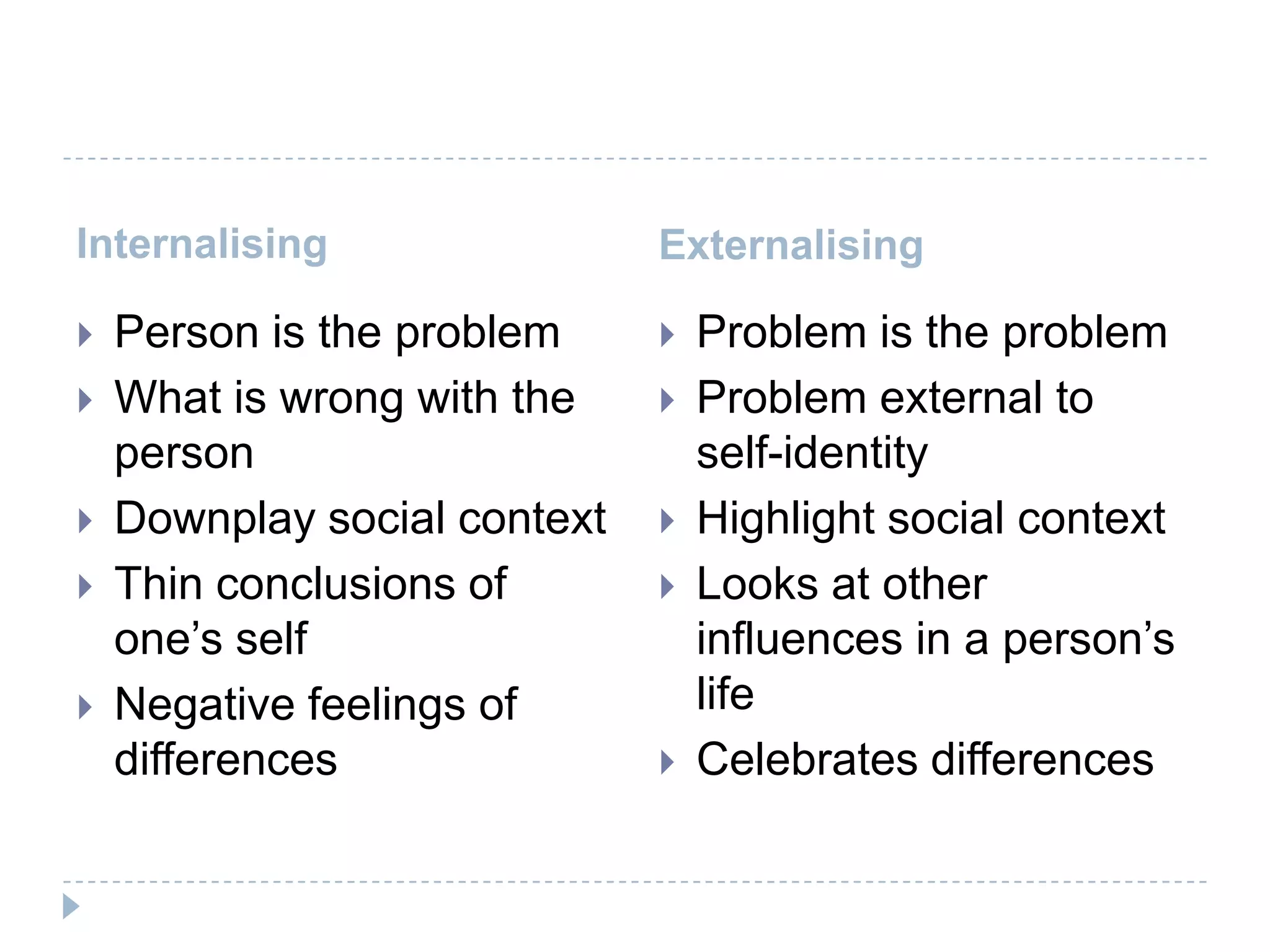
Things such as feelings, problems between people, cultural and social practices, fears, addictions, and other ills can be externalized. All externalized stories are about the problems that are outside individuals and the effects they have on the individual. What does “the fear,” “the addiction,” “the anger or guilt,” or” the depression” have to say about how you live your daily life?Many people internalise problems, externalising them gives them a different perspective as seen in the comparison slides following
InternalisingExternalisingPerson is the problemWhat is wrong with the personDownplay social contextThin conclusions of one’s selfNegative feelings of differencesProblem is the problemProblem external to self-identityHighlight social contextLooks at other influences in a person’s lifeCelebrates differences
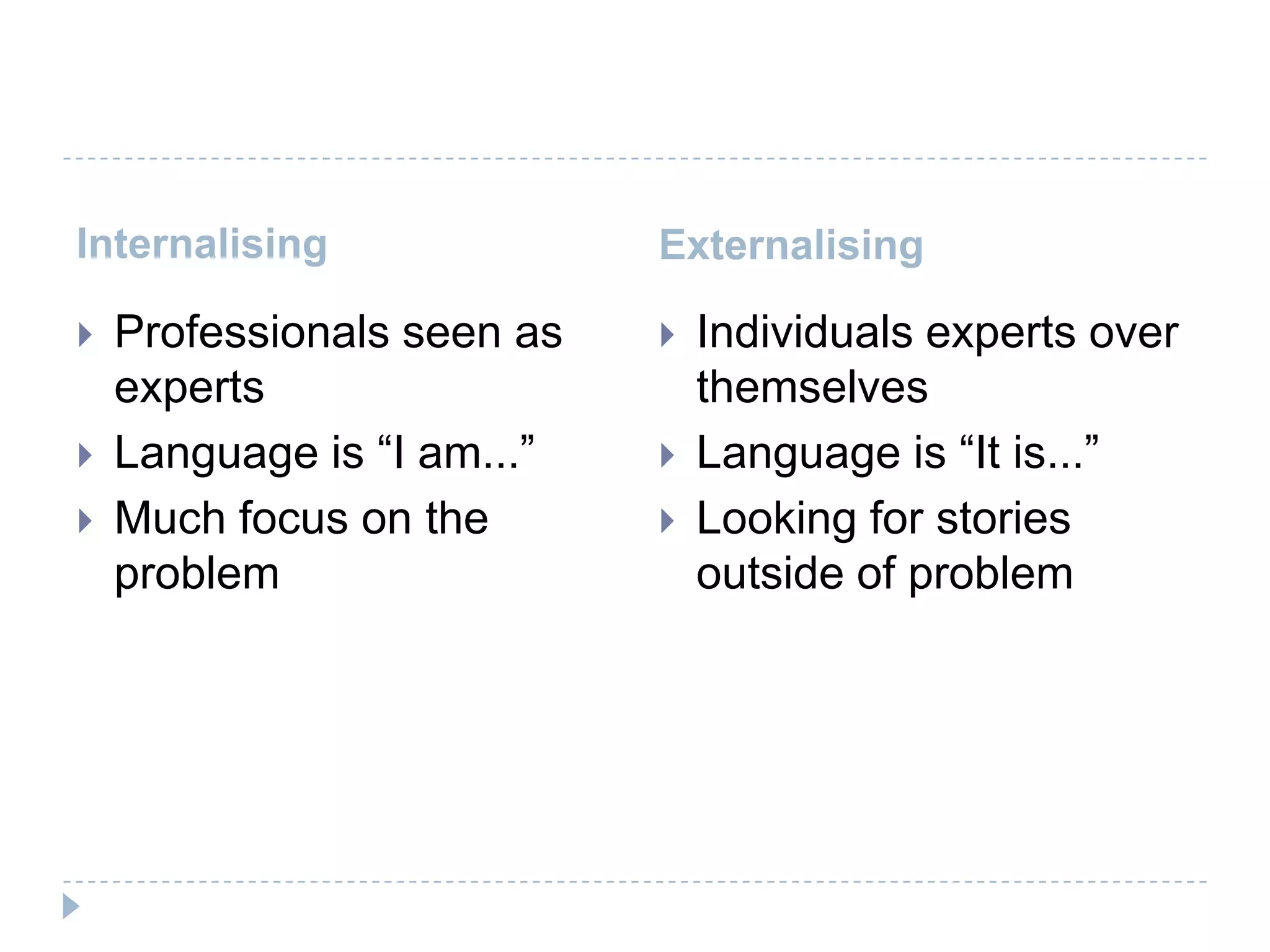
InternalisingExternalisingProfessionals seen as expertsLanguage is “I am...”Much focus on the problemIndividuals experts over themselvesLanguage is “It is...”Looking for stories outside of problem
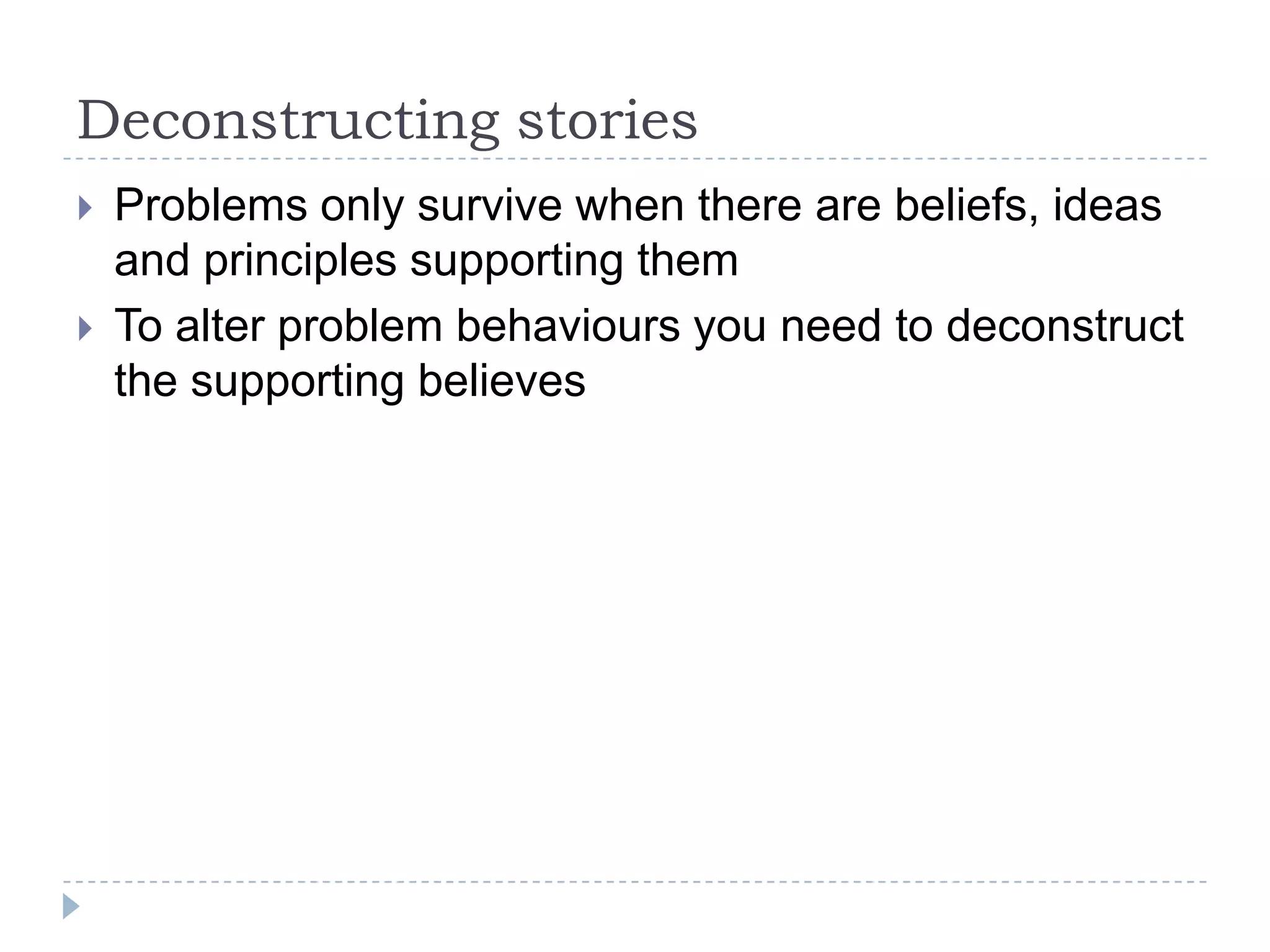
Deconstructing storiesProblems only survive when there are beliefs, ideas and principles supporting themTo alter problem behaviours you need to deconstruct the supporting believes
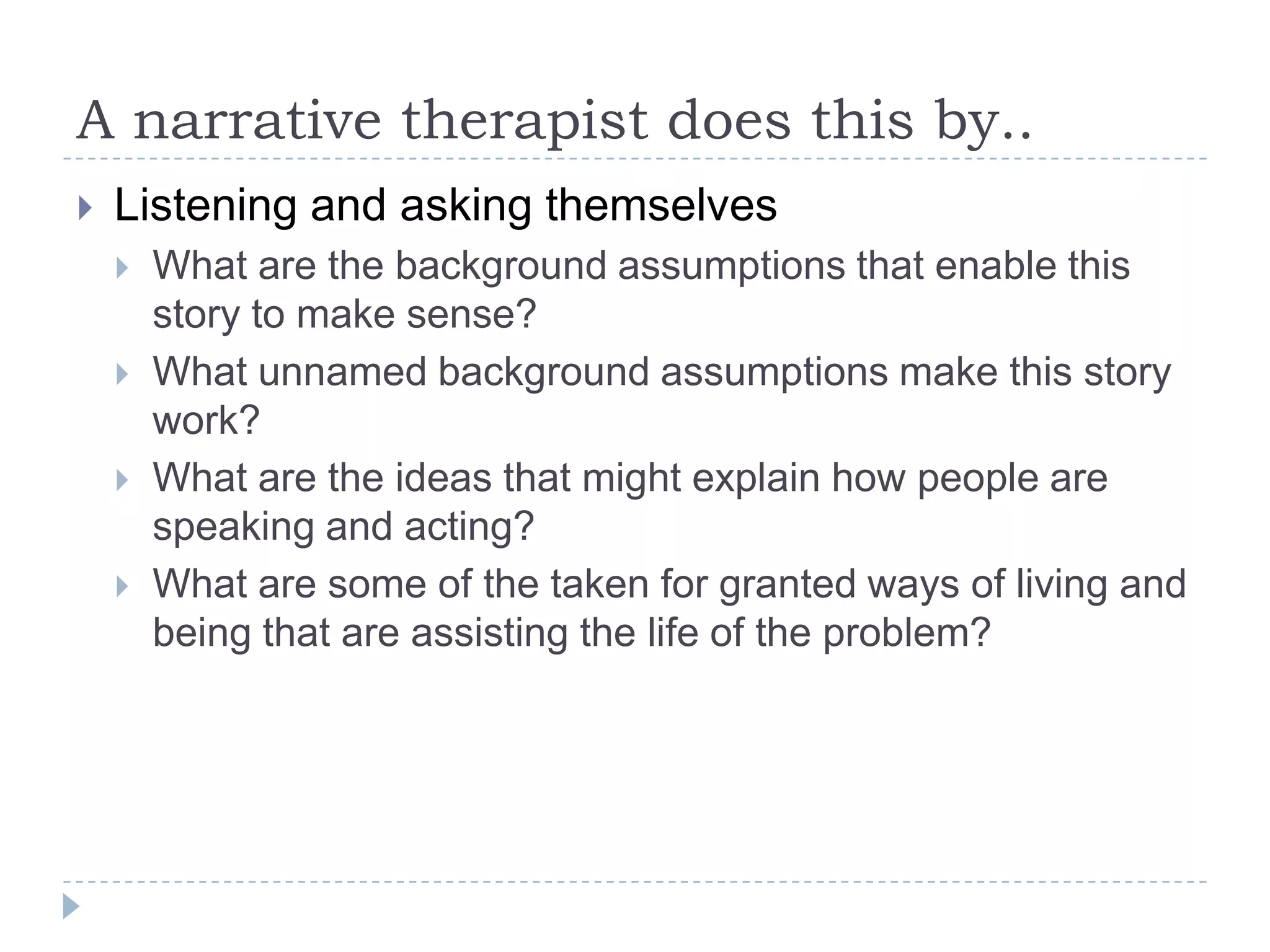
A narrative therapist does this by..Listening and asking themselvesWhat are the background assumptions that enable this story to make sense?What unnamed background assumptions make this story work?What are the ideas that might explain how people are speaking and acting?What are some of the taken for granted ways of living and being that are assisting the life of the problem?
The use of questionsQuestions are essential to deconstruct the story and to identify problems and explore them in depthHow have you kept the problem from becoming worse?Describe the times the problem is manageable?How do you cope when things require the problem not get in the way?What kind of things are more important to you than your problem and when have you followed your impulses not to let the problem get in your way?
Some examples..Addictive thinking (Self)How does addictive thinking get you to use more than you intended to?What are some things that give addictive thinking more space?How does addictive thinking get you to use during times when you don’t want to?Does addictive thinking get you to believe that you are not in danger when in fact you are?Does addictive thinking cause you to be dishonest with yourself?
Even more examplesAddictive thinking (relationships)
Does addictive thinking separate you from people who really care about you?
Does addictive thinking cause you to be dishonest with others?
Do you find that addictive thinking interferes with your abilities to be the parent that you prefer to be?
How has addictive thinking changed one of your relationships?
Do you find that addictive thinking causes you to associate with others who are also having problems with addictive thinking?
Do you find that addictive thinking causes you to avoid other people who do not have problems with addictive thinking?Let’s have a go at some questioning to deconstruct stories
Alternative storylinesBy deconstructing an individual’s story, a counsellor can listen to any alternative story lines which may be presentClients should be encouraged to name this alternative storyline
Alternative storylines....
Problems never totally dominate lives and relationships. One mother’s experience of depression dominated stories of herself as mother, yet she told us, “the only reason I get up in the morning is that I have to make my kids breakfast and make sure they get off t o school in time”. In narrative practice, we are curious: “Is ‘getting up in the morning’ something you do every day or once in a while? Is this something new or did you always get up in the morning for your children? What steps do you take to insure you’ll get up, is there something you say or do to remind yourself of its importance? Who or what supports you in this commitment? How does this make a difference for your children or for you?” and so on. A new story emerges about a simple event in life that has perhaps been taken for granted. Given a platform, it can provide clues to the hopes and dreams, purposes and intentions that have not been overtaken by troubles. Further questions, “Are there other sorts of things you do for your children that you’d never give up on, despite difficulties?”, can bring richness to an alternative storyline.http://www.dulwichcentre.com.au/new-narratives-for-parents-with-mental-health-difficulties.pdf
ANOTHER EXAMPLE from http://www.narrativetherapycentre.com/index_files/Page2198.htm
A young boy steps in front of his mother in an attempt to protect her from abuse by her husband.  While one might legitimately be concerned about the effects on the boy of the violence against his mother, a subordinate storyline might also emerge from an exploration of why it is important to the boy to intervene, what it says about what he values for his life, what is the history of these values, etc.  Other examples might be elicited of times when the boy took actions in keeping with these values.  A different relationship to the violence is being storied
The absent but implicit approachThe absent but implicit perspective allows persons to articulate what it is about their use of substances that has been, and may still be, important to them. It is a way of honouring a person’s past without judgement, and finding out what the person values in life.If a person’s use of substances is a key aspect of their life, then it is safe to assume that the use of substances, at least at some stage, has been linked to various purposes, hopes and values that the person holds.
Narrative therapy in addiction treatmentExamples of questions may include: 	• When you first began using, how was this substance use helpful to you in your life? 	• What does this say about what is important to you? 	• What purposes has it served and what has it enabled you to do that you value?	• Is there anything that the substance gives you that you feel you just can’t live without? • If you were to decide to leave substances behind, is there anything you feel that you might miss?
Seeking out what is absent but implicit in a person’s substance use can provide the means for people to identify what is important in their lives, and this can be the first step in engaging with a sense of personal agency in relation to their substance use.
The benefits in addiction treatment“ Separating my identity from the  identity of the problem, allows me to distance enough from my immediate experience with ‘addiction’, to discern and unmask the drug thinking that can be so capturing”
Re-authoring & re-membering
What is re-authoring?Re-authoring conversations invite people to do what they routinely do - that is, to link events of their lives in sequences through time according to a theme/plot. However, in this activity, people are assisted to identify the more neglected events of their lives - the unique outcomes or exceptions - and are encouraged to take these into alternative story lines.
Unique outcomes or exceptionsListening for unique outcomes or exceptions is essential to the re-authoring processThese include times when the client has behaved differently to their dominant storyE.g. When they did not consume alcohol when they went out with friendsCounsellors use questions called scaffolding in order to fill the gaps between the dominant storyline and the exceptions
Questions are introduced that encourage people to generate new proposals for action, accounts of the circumstances likely to be favourable to these proposals for action, and predictions about the outcome of these proposals.
In the first place, people are likely to respond to landscape of identity questions by generating identity conclusions that are informed by the well known structuralist categories of identity - needs, motives, attributes, traits, strengths, deficits, resources, properties, characteristics, drives and so onAs these conversations further evolve, there is opportunity for people to generate identity conclusions that informed by the well known non-structuralist categories of identity – intentions and purposes, values and beliefs, hopes, dreams and visions, commitments to ways of living, and so on
Re-membering conversations“I have revoked the membership of all mood-altering substances to my life, and have downgraded relationships with persons to whom I feel my only connection was through substances” (Andrew C http://www.dulwichcentre.com.au/narrative-maps-of-practice-deconstructing-addiction.pdf)
Open possibilities for the revision of one’s membership of life: for the upgrading of some memberships and the downgrading of others; for the honouring of some memberships and for the revoking of others; for the granting of authority to some voices in regard to matters of one’s personal identity, and for the disqualification of other voices in regard to this matter
Re-membering conversations are often initiated through two sets of inquiry: a) The first set of inquiry invites: i. a recounting of what the significant figure contributed to the person’s life (figure’s contribution to person’s life), ii. the person to enter the consciousness of this figure on matters of the person’s identity, initiating a rich description of the ways in which this connection shaped/had the potential to shape the person’s sense of who they are and what their life is about (person’s identity through the eyes of the figure).
b) The second set of inquiry invites: i. a recounting of what the person contributed to the life of this figure (person’s contribution to the figure’s life), and ii. the person to enter the consciousness of this figure on matters of this figure’s identity, initiating a rich description of the ways in which this connection shaped/had the potential to shape this figure’s sense of who they were and what their life was about (implications of this contribution for the figure’s sense of identity).
Using re-remembering conversations to enrich the presentation of the alternative new story. Who would validate the new story by personal experience with the person? Such is a way to link to the past, near present and future vital social supports These recollections may also be related or unrelated, real or imaginary, and may include animals, toys, pets, places symbols or objects.http://www.able-differently.org/PDF_forms/usingStories/Narrative%20Therapy.pdf
Documentation
Therapeutic documents are written when people make important commitments or when they are celebrating important achievements. They may include;letters to and from significant people that follow on from a re-membering conversationdocuments which records the commitments and directions that people have chosen to redirect their lives with

Chcaod511 b session five 310311

  • 1.
  • 2.
    Making sense ofnarrative therapyPeople use stories that frame their lives and impact how they think and behaveThese stories are formed from previous experiences and how the individual has interpreted these and the ongoing presumptions, beliefs and values they have formed due to itThey have the power to control how people makes sense of their past, present and future
  • 3.
    Making sense...Re-focusing anynegative themes in an individual’s story can assist them to build their self esteem and improve their general wellbeingProblem saturated stories can become identities and be difficult to overcome
  • 4.
    Things such asfeelings, problems between people, cultural and social practices, fears, addictions, and other ills can be externalized. All externalized stories are about the problems that are outside individuals and the effects they have on the individual. What does “the fear,” “the addiction,” “the anger or guilt,” or” the depression” have to say about how you live your daily life?Many people internalise problems, externalising them gives them a different perspective as seen in the comparison slides following
  • 5.
    InternalisingExternalisingPerson is theproblemWhat is wrong with the personDownplay social contextThin conclusions of one’s selfNegative feelings of differencesProblem is the problemProblem external to self-identityHighlight social contextLooks at other influences in a person’s lifeCelebrates differences
  • 6.
    InternalisingExternalisingProfessionals seen asexpertsLanguage is “I am...”Much focus on the problemIndividuals experts over themselvesLanguage is “It is...”Looking for stories outside of problem
  • 7.
    Deconstructing storiesProblems onlysurvive when there are beliefs, ideas and principles supporting themTo alter problem behaviours you need to deconstruct the supporting believes
  • 8.
    A narrative therapistdoes this by..Listening and asking themselvesWhat are the background assumptions that enable this story to make sense?What unnamed background assumptions make this story work?What are the ideas that might explain how people are speaking and acting?What are some of the taken for granted ways of living and being that are assisting the life of the problem?
  • 9.
    The use ofquestionsQuestions are essential to deconstruct the story and to identify problems and explore them in depthHow have you kept the problem from becoming worse?Describe the times the problem is manageable?How do you cope when things require the problem not get in the way?What kind of things are more important to you than your problem and when have you followed your impulses not to let the problem get in your way?
  • 10.
    Some examples..Addictive thinking(Self)How does addictive thinking get you to use more than you intended to?What are some things that give addictive thinking more space?How does addictive thinking get you to use during times when you don’t want to?Does addictive thinking get you to believe that you are not in danger when in fact you are?Does addictive thinking cause you to be dishonest with yourself?
  • 11.
    Even more examplesAddictivethinking (relationships)
  • 12.
    Does addictive thinkingseparate you from people who really care about you?
  • 13.
    Does addictive thinkingcause you to be dishonest with others?
  • 14.
    Do you findthat addictive thinking interferes with your abilities to be the parent that you prefer to be?
  • 15.
    How has addictivethinking changed one of your relationships?
  • 16.
    Do you findthat addictive thinking causes you to associate with others who are also having problems with addictive thinking?
  • 17.
    Do you findthat addictive thinking causes you to avoid other people who do not have problems with addictive thinking?Let’s have a go at some questioning to deconstruct stories
  • 18.
    Alternative storylinesBy deconstructingan individual’s story, a counsellor can listen to any alternative story lines which may be presentClients should be encouraged to name this alternative storyline
  • 19.
  • 20.
    Problems never totallydominate lives and relationships. One mother’s experience of depression dominated stories of herself as mother, yet she told us, “the only reason I get up in the morning is that I have to make my kids breakfast and make sure they get off t o school in time”. In narrative practice, we are curious: “Is ‘getting up in the morning’ something you do every day or once in a while? Is this something new or did you always get up in the morning for your children? What steps do you take to insure you’ll get up, is there something you say or do to remind yourself of its importance? Who or what supports you in this commitment? How does this make a difference for your children or for you?” and so on. A new story emerges about a simple event in life that has perhaps been taken for granted. Given a platform, it can provide clues to the hopes and dreams, purposes and intentions that have not been overtaken by troubles. Further questions, “Are there other sorts of things you do for your children that you’d never give up on, despite difficulties?”, can bring richness to an alternative storyline.http://www.dulwichcentre.com.au/new-narratives-for-parents-with-mental-health-difficulties.pdf
  • 21.
    ANOTHER EXAMPLE fromhttp://www.narrativetherapycentre.com/index_files/Page2198.htm
  • 22.
    A young boysteps in front of his mother in an attempt to protect her from abuse by her husband.  While one might legitimately be concerned about the effects on the boy of the violence against his mother, a subordinate storyline might also emerge from an exploration of why it is important to the boy to intervene, what it says about what he values for his life, what is the history of these values, etc.  Other examples might be elicited of times when the boy took actions in keeping with these values.  A different relationship to the violence is being storied
  • 23.
    The absent butimplicit approachThe absent but implicit perspective allows persons to articulate what it is about their use of substances that has been, and may still be, important to them. It is a way of honouring a person’s past without judgement, and finding out what the person values in life.If a person’s use of substances is a key aspect of their life, then it is safe to assume that the use of substances, at least at some stage, has been linked to various purposes, hopes and values that the person holds.
  • 24.
    Narrative therapy inaddiction treatmentExamples of questions may include: • When you first began using, how was this substance use helpful to you in your life? • What does this say about what is important to you? • What purposes has it served and what has it enabled you to do that you value? • Is there anything that the substance gives you that you feel you just can’t live without? • If you were to decide to leave substances behind, is there anything you feel that you might miss?
  • 25.
    Seeking out whatis absent but implicit in a person’s substance use can provide the means for people to identify what is important in their lives, and this can be the first step in engaging with a sense of personal agency in relation to their substance use.
  • 26.
    The benefits inaddiction treatment“ Separating my identity from the identity of the problem, allows me to distance enough from my immediate experience with ‘addiction’, to discern and unmask the drug thinking that can be so capturing”
  • 27.
  • 28.
    What is re-authoring?Re-authoringconversations invite people to do what they routinely do - that is, to link events of their lives in sequences through time according to a theme/plot. However, in this activity, people are assisted to identify the more neglected events of their lives - the unique outcomes or exceptions - and are encouraged to take these into alternative story lines.
  • 29.
    Unique outcomes orexceptionsListening for unique outcomes or exceptions is essential to the re-authoring processThese include times when the client has behaved differently to their dominant storyE.g. When they did not consume alcohol when they went out with friendsCounsellors use questions called scaffolding in order to fill the gaps between the dominant storyline and the exceptions
  • 30.
    Questions are introducedthat encourage people to generate new proposals for action, accounts of the circumstances likely to be favourable to these proposals for action, and predictions about the outcome of these proposals.
  • 31.
    In the firstplace, people are likely to respond to landscape of identity questions by generating identity conclusions that are informed by the well known structuralist categories of identity - needs, motives, attributes, traits, strengths, deficits, resources, properties, characteristics, drives and so onAs these conversations further evolve, there is opportunity for people to generate identity conclusions that informed by the well known non-structuralist categories of identity – intentions and purposes, values and beliefs, hopes, dreams and visions, commitments to ways of living, and so on
  • 32.
    Re-membering conversations“I haverevoked the membership of all mood-altering substances to my life, and have downgraded relationships with persons to whom I feel my only connection was through substances” (Andrew C http://www.dulwichcentre.com.au/narrative-maps-of-practice-deconstructing-addiction.pdf)
  • 33.
    Open possibilities forthe revision of one’s membership of life: for the upgrading of some memberships and the downgrading of others; for the honouring of some memberships and for the revoking of others; for the granting of authority to some voices in regard to matters of one’s personal identity, and for the disqualification of other voices in regard to this matter
  • 34.
    Re-membering conversations areoften initiated through two sets of inquiry: a) The first set of inquiry invites: i. a recounting of what the significant figure contributed to the person’s life (figure’s contribution to person’s life), ii. the person to enter the consciousness of this figure on matters of the person’s identity, initiating a rich description of the ways in which this connection shaped/had the potential to shape the person’s sense of who they are and what their life is about (person’s identity through the eyes of the figure).
  • 35.
    b) The secondset of inquiry invites: i. a recounting of what the person contributed to the life of this figure (person’s contribution to the figure’s life), and ii. the person to enter the consciousness of this figure on matters of this figure’s identity, initiating a rich description of the ways in which this connection shaped/had the potential to shape this figure’s sense of who they were and what their life was about (implications of this contribution for the figure’s sense of identity).
  • 36.
    Using re-remembering conversationsto enrich the presentation of the alternative new story. Who would validate the new story by personal experience with the person? Such is a way to link to the past, near present and future vital social supports These recollections may also be related or unrelated, real or imaginary, and may include animals, toys, pets, places symbols or objects.http://www.able-differently.org/PDF_forms/usingStories/Narrative%20Therapy.pdf
  • 37.
  • 38.
    Therapeutic documents arewritten when people make important commitments or when they are celebrating important achievements. They may include;letters to and from significant people that follow on from a re-membering conversationdocuments which records the commitments and directions that people have chosen to redirect their lives with
  • 39.
    Types of documentsFamilypeace document – reminding all family members of commitments they have madeDeclarations- written with the intention of sharing them with others e.g. a new and preferred storyCertificates- can be drawn up and signed to commemorate special events or turning pointsHandbooks- a way to formally record people’s knowledges and expertiseNotes from session Lists- keep track of experiencesPictures
  • 40.
  • 41.
  • 42.
    What helps melead a drug free life
  • 43.
  • 44.
  • 45.
  • 46.
  • 47.
  • 48.
  • 49.
    Not going tocounselling
  • 50.
  • 51.
  • 52.
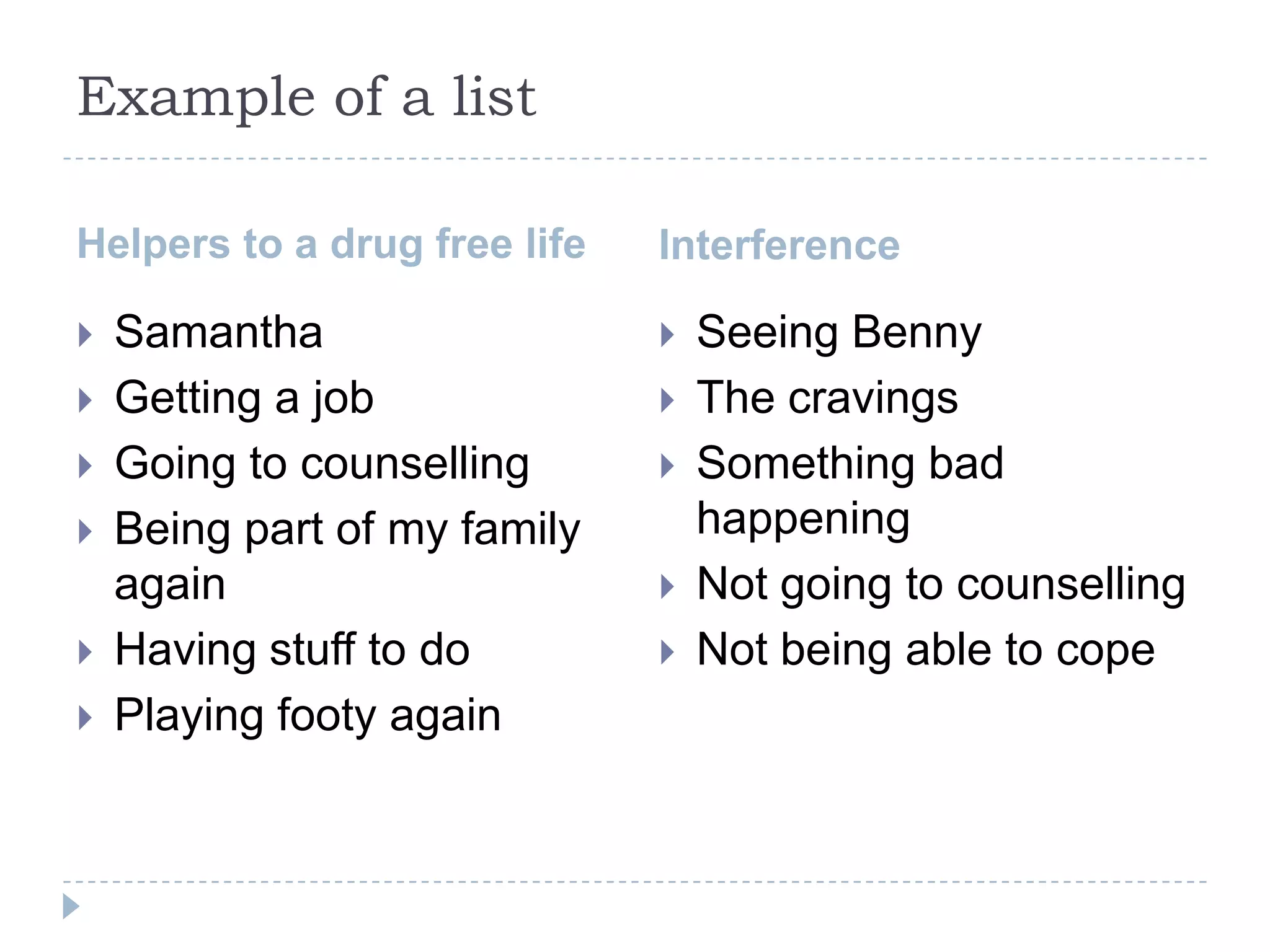
     Example of alistHelpers to a drug free lifeInterferenceSamantha Getting a jobGoing to counsellingBeing part of my family againHaving stuff to doPlaying footy againSeeing BennyThe cravingsSomething bad happeningNot going to counsellingNot being able to cope
  • 53.
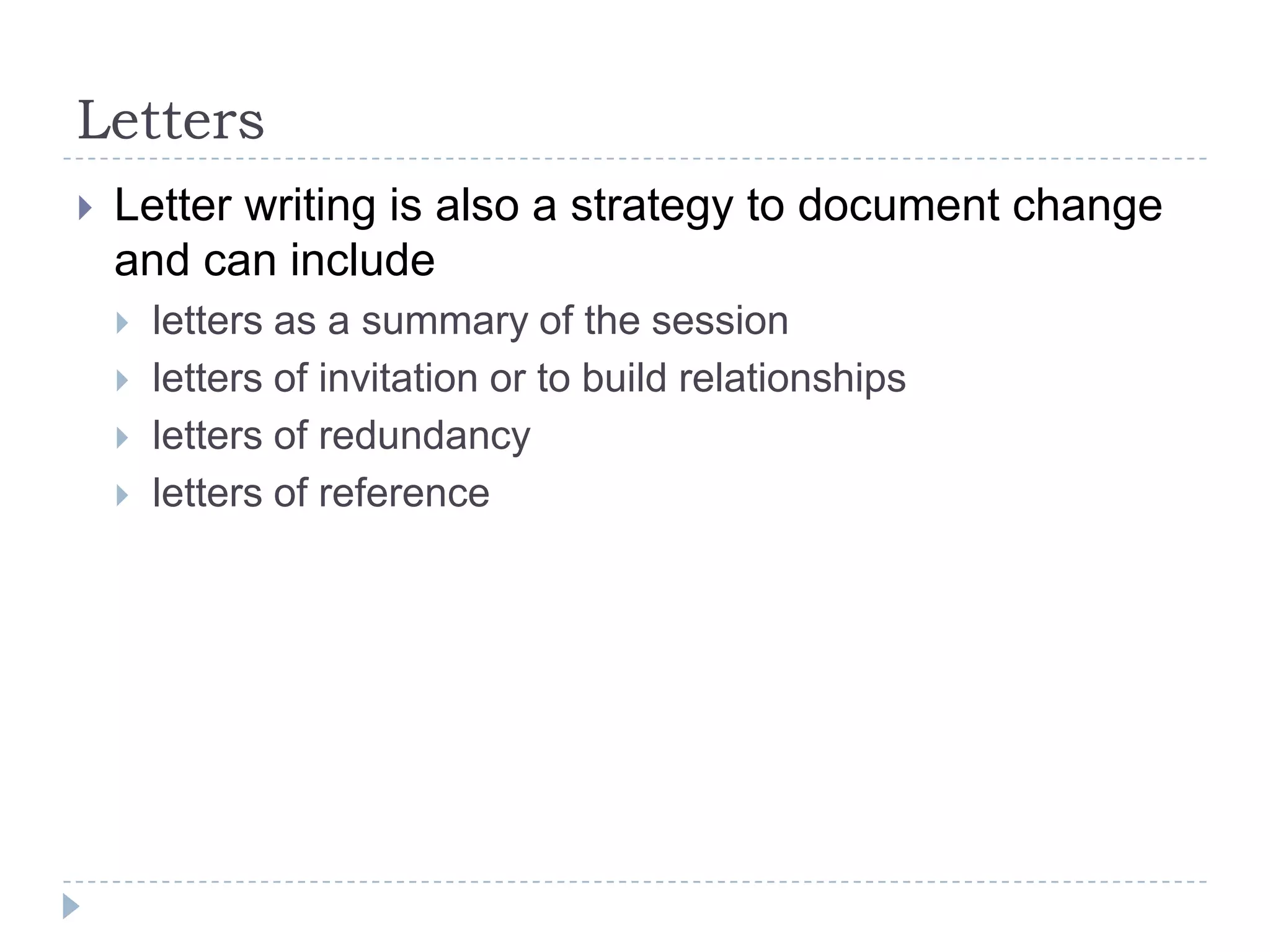
    LettersLetter writing isalso a strategy to document change and can includeletters as a summary of the sessionletters of invitation or to build relationshipsletters of redundancyletters of reference