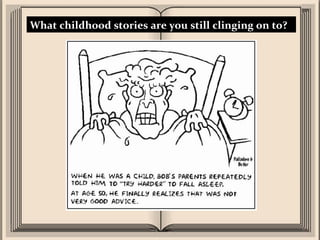
What childhood stories are you still clinging on to?
 
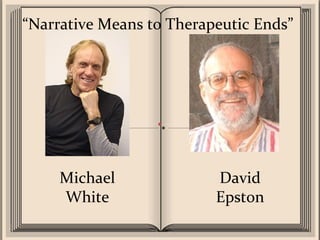
Michael White David Epston “ Narrative Means to Therapeutic Ends”
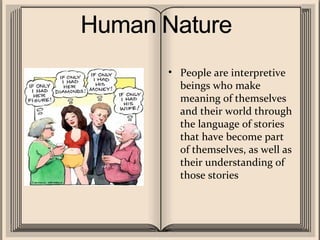
People are interpretive beings who make meaning of themselves and their world through the language of stories that have become part of themselves, as well as their understanding of those stories
Problems are manufactured in social, cultural, familial, political and historical contexts rather than being intrinsic to or inherent in the person. People’s lives are created and interpreted through their stories… ones they hear, create in their own minds, and ones they tell and retell
Drawing people’s attention to subtle changes in their lives can foster new insights, promote empowerment and help people develop better ways to resolve difficulties… through this knowledge people can truly become  authors of their own lives… Client is an expert on his own life and counselor is an expert of narrative therapy
Stories give messages and become road maps of our lives Believes stories have cultural and interpersonal basis and meaning are generated in social interaction Person isn’t the problem the problem is the problem
Therapeutic  Anthropologists Supportive, facilitator, encourager… not an expert Never Judges Active role… suggesting exercised, offering new viewpoints, soliciting feed back Create shifts  to bring about new meaning to the client’s story Does not seek to heal or “fix” people but to learn about client & understand them
Suggest alternative viewpoints and  elicit stories Mirroring- reflect themselves as well as the client Emphasis on being respective & encouraging of client’s strengths and resources Participatory witness and interpersonal relationship based on collaboration not just reflection (person-centered) but interactive Careful listening, empathetic, summarization and paraphrasing to give people ownership


Narrativerevised2 110213204018-phpapp01

  • 1.
  • 2.
    What childhood storiesare you still clinging on to?
  • 3.
  • 4.
    Michael White DavidEpston “ Narrative Means to Therapeutic Ends”
  • 5.
    People are interpretivebeings who make meaning of themselves and their world through the language of stories that have become part of themselves, as well as their understanding of those stories
  • 6.
    Problems are manufacturedin social, cultural, familial, political and historical contexts rather than being intrinsic to or inherent in the person. People’s lives are created and interpreted through their stories… ones they hear, create in their own minds, and ones they tell and retell
  • 7.
    Drawing people’s attentionto subtle changes in their lives can foster new insights, promote empowerment and help people develop better ways to resolve difficulties… through this knowledge people can truly become authors of their own lives… Client is an expert on his own life and counselor is an expert of narrative therapy
  • 8.
    Stories give messagesand become road maps of our lives Believes stories have cultural and interpersonal basis and meaning are generated in social interaction Person isn’t the problem the problem is the problem
  • 9.
    Therapeutic AnthropologistsSupportive, facilitator, encourager… not an expert Never Judges Active role… suggesting exercised, offering new viewpoints, soliciting feed back Create shifts to bring about new meaning to the client’s story Does not seek to heal or “fix” people but to learn about client & understand them
  • 10.
    Suggest alternative viewpointsand elicit stories Mirroring- reflect themselves as well as the client Emphasis on being respective & encouraging of client’s strengths and resources Participatory witness and interpersonal relationship based on collaboration not just reflection (person-centered) but interactive Careful listening, empathetic, summarization and paraphrasing to give people ownership
  • 11.
  • 12.
  • 13.
  • 14.
  • 15.
  • 16.
  • 17.
  • 18.

Editor's Notes

  • #2 Narrative- A holistic approaches (others include transpersonal, constructivist, feminist) - emphasized emotions and sensations; co-construction of real, imagined, or possible stories of past, present or future
  • #5 In the 1970’s Michel Foucault a prominent French intellectual who greatly influenced a number of fields and professions and Gregory Bateson a British anthropologist, and social scientist began developing the idea of narrative therapy within the field of family therapy. Their ideas greatly influenced White and Epston. In the late 70’s Michael White a social worker and family therapist in Australia along with David Epston began to formulate writing and expand on Batson and Foucault’s theory. In 1990 they co-authored “Narrative Means to Therapeutic Ends.”
  • #7 People have a library of stories …. All are legitimate and important
  • #10 Counselors Role Therapeutic anthropologists Supportive, facilitator, encourager… not an expert Does not seek to promote change but create shifts and bring about new meaning to the client’s story Does not seek to heal or “fix” people but to learn about them and understand them and provide a different and helpful perspective Emphasis on being respective and encouraging of client’s strengths and resources Never judge Suggest alternative viewpoints and elicit stories of power and resourcefulness Active role… suggesting exercised, offering new viewpoints, soliciting feed back Careful listening, empathetic, summarization and paraphrasing to give people ownership Participatory witness and interpersonal relationship based on collaboration not just reflection (person-centered) but interactive Mirroring- reflect themselves as well as the client