OARABILE ENAMETSE KUDUMANE
201000829
EFH 641
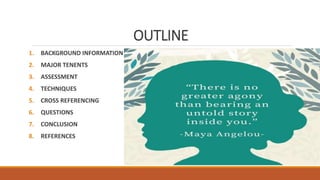
OUTLINE
1. BACKGROUND INFORMATION
2. MAJOR TENENTS
3. ASSESSMENT
4. TECHNIQUES
5. CROSS REFERENCING
6. QUESTIONS
7. CONCLUSION
8. REFERENCES
BACKGROUND INFORMATION
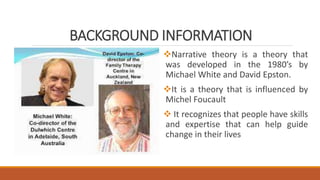
Narrative theory is a theory that
was developed in the 1980’s by
Michael White and David Epston.
It is a theory that is influenced by
Michel Foucault
 It recognizes that people have skills
and expertise that can help guide
change in their lives
BACKGROUND INFORMATION
Narrative therapy seeks to be a respectful, non-blaming approach
to counselling and community work, which centers people as the
experts in their own lives.
It views problems as separate from people and assumes people
have many skills, competencies, beliefs, values, commitments and
abilities that will assist them to reduce the influence of problems in
their lives. (White, M., & Morgan, A., 2006)
Narrative therapy uses the power of these stories to help people
discover their life purpose. This is often done by assigning that
person the role of “narrator” in their own story.
MAJOR TENENTS
ASSESSMENT
 Narrative theory is a non- pathological theory and it is non
blaming
 Clients give meaning to their lives by talking about their
experiences
 The counselor just listens to the client telling their story
INTERVENTION TECHNIQUES
1. QUESTIONS AND MORE QUESTIONS
 Asking questions can lead to separating “person” from “problem”
identifying preferred directions and creating alternative stories to
support these directions.
 Provide client with an opportunity to explore various dimensions
of their situation.
How the problem first become evident , how they affected clients’
view of themselves.
2. Externalizing and deconstruction
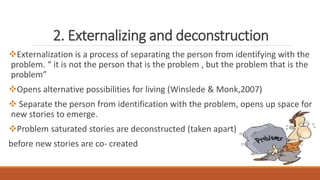
Externalization is a process of separating the person from identifying with the
problem. “ it is not the person that is the problem , but the problem that is the
problem”
Opens alternative possibilities for living (Winslede & Monk,2007)
 Separate the person from identification with the problem, opens up space for
new stories to emerge.
Problem saturated stories are deconstructed (taken apart)
before new stories are co- created
3. Search for unique outcomes
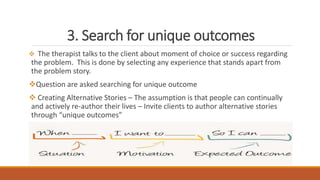
 The therapist talks to the client about moment of choice or success regarding
the problem. This is done by selecting any experience that stands apart from
the problem story.
Question are asked searching for unique outcome
 Creating Alternative Stories – The assumption is that people can continually
and actively re-author their lives – Invite clients to author alternative stories
through “unique outcomes”
4. ALTERNATIVE STORIES AND
REAUTHORING
The turning point in this therapy is when the client makes the
choices to stop living in a problem saturated story and create an
alternative story ( re-authoring ).
 Develop an alternative new stories.
 Re-authoring occurs either in free flowing conversation or through
questioning
Build the competence already present in the person
5. DOCUMENTING THE EVIDENCE
Narrative therapist believe new stories take hold when there is an
audience to appreciate and support them.
Letter writing can be re-inspiring
 Changes client have achieves tend to strengthen the significance of
the changes, both for the client and for others in the client’s life.
CROSS REFERENCING WITH OTHER
THEORY
Narrative theory VS Cognitive behavioral theory (CBT)
Both CBT and narrative therapy seek to change a client's negative
thought patterns.
Both the CBT and the narrative therapist helps the client construct
alternative beliefs about themselves.
Narrative therapy and CBT both externalize the problem, defining
the problem behaviors or symptoms as separate from the client.
Who is the most important person?
The client
What motivates people to live on?
The desire to tell their success stories
What are the causes of mental dysfunction?
Societal expectation
What is the most important developmental stage of life?
The theory does not say anything about developmental stage nonetheless
I believe that adolescent stage is the most important stage because it
when one will care about the world around and the desire to tell their
story
The most important among emotion, cognition and behavior
Cognition emotion behavior
CONCLUSION
 Narrative theory was formed by Michael White and David Eston in
the 1980’s
It is more concerned with separating the problem from the client.
The theorist believe that people are not the problem, the problem
is the problem on its own and it is not part of the person.
 The therapist that use this method believe that talking helps client
to solve their problems
REFERENCES
Bruner, J. (1986). Actual minds/possible worlds. Cambridge, MA:
Harvard University Press.
https://www.ehow.co.uk/info_8383265_similarities-differences-
between-cbt-narrative.html
White, M., & Morgan, A. (2006). Narrative therapy with children and
their families. Dulwich Centre Publications.
Winslade. J & Monk. G (2007). Narrative Counseling in Schools:
Powerful & Brief. Corwin Press

NARRATIVE.pptx

  • 1.
  • 2.
    OUTLINE 1. BACKGROUND INFORMATION 2.MAJOR TENENTS 3. ASSESSMENT 4. TECHNIQUES 5. CROSS REFERENCING 6. QUESTIONS 7. CONCLUSION 8. REFERENCES
  • 3.
    BACKGROUND INFORMATION Narrative theoryis a theory that was developed in the 1980’s by Michael White and David Epston. It is a theory that is influenced by Michel Foucault  It recognizes that people have skills and expertise that can help guide change in their lives
  • 4.
    BACKGROUND INFORMATION Narrative therapyseeks to be a respectful, non-blaming approach to counselling and community work, which centers people as the experts in their own lives. It views problems as separate from people and assumes people have many skills, competencies, beliefs, values, commitments and abilities that will assist them to reduce the influence of problems in their lives. (White, M., & Morgan, A., 2006) Narrative therapy uses the power of these stories to help people discover their life purpose. This is often done by assigning that person the role of “narrator” in their own story.
  • 5.
  • 6.
    ASSESSMENT  Narrative theoryis a non- pathological theory and it is non blaming  Clients give meaning to their lives by talking about their experiences  The counselor just listens to the client telling their story
  • 7.
    INTERVENTION TECHNIQUES 1. QUESTIONSAND MORE QUESTIONS  Asking questions can lead to separating “person” from “problem” identifying preferred directions and creating alternative stories to support these directions.  Provide client with an opportunity to explore various dimensions of their situation. How the problem first become evident , how they affected clients’ view of themselves.
  • 8.
    2. Externalizing anddeconstruction Externalization is a process of separating the person from identifying with the problem. “ it is not the person that is the problem , but the problem that is the problem” Opens alternative possibilities for living (Winslede & Monk,2007)  Separate the person from identification with the problem, opens up space for new stories to emerge. Problem saturated stories are deconstructed (taken apart) before new stories are co- created
  • 9.
    3. Search forunique outcomes  The therapist talks to the client about moment of choice or success regarding the problem. This is done by selecting any experience that stands apart from the problem story. Question are asked searching for unique outcome  Creating Alternative Stories – The assumption is that people can continually and actively re-author their lives – Invite clients to author alternative stories through “unique outcomes”
  • 10.
    4. ALTERNATIVE STORIESAND REAUTHORING The turning point in this therapy is when the client makes the choices to stop living in a problem saturated story and create an alternative story ( re-authoring ).  Develop an alternative new stories.  Re-authoring occurs either in free flowing conversation or through questioning Build the competence already present in the person
  • 11.
    5. DOCUMENTING THEEVIDENCE Narrative therapist believe new stories take hold when there is an audience to appreciate and support them. Letter writing can be re-inspiring  Changes client have achieves tend to strengthen the significance of the changes, both for the client and for others in the client’s life.
  • 12.
    CROSS REFERENCING WITHOTHER THEORY Narrative theory VS Cognitive behavioral theory (CBT) Both CBT and narrative therapy seek to change a client's negative thought patterns. Both the CBT and the narrative therapist helps the client construct alternative beliefs about themselves. Narrative therapy and CBT both externalize the problem, defining the problem behaviors or symptoms as separate from the client.
  • 13.
    Who is themost important person? The client What motivates people to live on? The desire to tell their success stories What are the causes of mental dysfunction? Societal expectation What is the most important developmental stage of life? The theory does not say anything about developmental stage nonetheless I believe that adolescent stage is the most important stage because it when one will care about the world around and the desire to tell their story The most important among emotion, cognition and behavior Cognition emotion behavior
  • 14.
    CONCLUSION  Narrative theorywas formed by Michael White and David Eston in the 1980’s It is more concerned with separating the problem from the client. The theorist believe that people are not the problem, the problem is the problem on its own and it is not part of the person.  The therapist that use this method believe that talking helps client to solve their problems
  • 15.
    REFERENCES Bruner, J. (1986).Actual minds/possible worlds. Cambridge, MA: Harvard University Press. https://www.ehow.co.uk/info_8383265_similarities-differences- between-cbt-narrative.html White, M., & Morgan, A. (2006). Narrative therapy with children and their families. Dulwich Centre Publications. Winslade. J & Monk. G (2007). Narrative Counseling in Schools: Powerful & Brief. Corwin Press