“ THE PROBLEM IS THE PROBLEM, THE
PERSON IS NOT THE PROBLEM.”
– MICHAEL WHITE & DAVID EPSTON
Narrative therapy & it’s relationship
with positive psychology
By Prateek, (MA Clinical Psychology), AIBAS, AUMP
The static definition
Narrative therapy seeks to be a respectful, non-blaming approach to
counselling and community work, which centres people as the
experts in their own lives. It views problems as separate from people
and assumes people have many skills, competencies, beliefs, values,
commitments and abilities that will assist them to reduce the
influence of problems in their lives. (White, M., & Morgan, A.,
2006).
#Personcentered #Strengthfocused #Nonpathologizing
#Storytelling #SocialLens
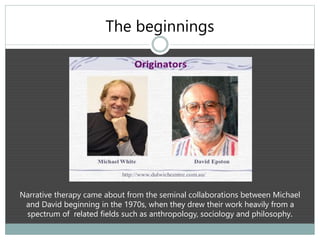
The beginnings
Narrative therapy came about from the seminal collaborations between Michael
and David beginning in the 1970s, when they drew their work heavily from a
spectrum of related fields such as anthropology, sociology and philosophy.
Background of narrative approaches
 Post-structuralism: 1960s was the time for post-structuralism-a response to
the so called structuralism movement which emphasized on the existence
of universal laws and rules. Post-structuralism brought a radical shift by
stressing on the meaning of things rather than their underlying structure
while also considering language as an important medium of spreading
knowledge (Payne, 2011).
 Proponents: The post structuralist movement included names such as
Michel Foucault (Madness & civilization) and Jaques Lacan. These folks
were mainly concerned about how the social construct or ‘discourses’ have
been regulating us, defining us and sustaining our individuality.
Narrative approaches also owe their emergence to the rise in social reforms
in the 1960s (Such as Marxism, the feminist movement & student protests)
Key features
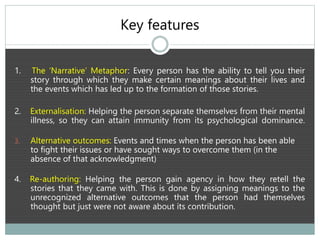
1. The ‘Narrative’ Metaphor: Every person has the ability to tell you their
story through which they make certain meanings about their lives and
the events which has led up to the formation of those stories.
2. Externalisation: Helping the person separate themselves from their mental
illness, so they can attain immunity from its psychological dominance.
3. Alternative outcomes: Events and times when the person has been able
to fight their issues or have sought ways to overcome them (in the
absence of that acknowledgment)
4. Re-authoring: Helping the person gain agency in how they retell the
stories that they came with. This is done by assigning meanings to the
unrecognized alternative outcomes that the person had themselves
thought but just were not aware about its contribution.
Key features (as explained by professionals)
“Narrative therapy works on the belief that people are experts in their own
lives and make meaning of distressing situations based on their own past,
culture, history and social identities. Often this is not visible because their
problems have taken up so much space. But when we use the medium of
narratives and stories as a metaphor, the problems and their influence
start to unveil to the person.”
(Jehanzeb Baldiwala, psychologist, Mumbai)
“Take the example of an abusive relationship, there is no way I can directly ask
the person to leave or sort it out quickly, but the questions I ask can make
them negotiate their safe space in the relationship and their capability to
deal with it, and eventually, they will make the right decisions themselves.
This is the environment narrative therapy provides.”
(Sadaf Vidha, psychologist, Mumbai)
Key features (as explained by professionals)
“The notion that people are always responding to circumstances opens up
possibilities for their skills to emerge, which would otherwise remain
invisible to them. The key intention then is to make these personal
responses visible, help the person realise where it is coming from (for
example, responding to patriarchy) and then identify possible future steps
the person wants to take that fit in with their hopes and dreams.”
(Radhika Sharma, PSW, Mumbai)
“If the person remains unaware of inequalities and oppression, it becomes
hard for them to understand why they have been feeling the distress in
the first place. Take the example of a woman with anorexia stressed about
losing weight while wanting to get married. Now, if we don't explore the
underpinning issues of body image and gender role expectations, things
will not progress.”
(Jehanzeb Baldiwala, psychologist, Mumbai)
A basic model of narrative therapy
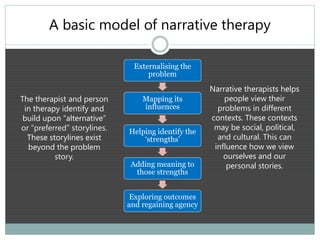
Externalising the
problem
Mapping its
influences
Helping identify the
‘strengths’
Adding meaning to
those strengths
Exploring outcomes
and regaining agency
The therapist and person
in therapy identify and
build upon “alternative”
or “preferred” storylines.
These storylines exist
beyond the problem
story.
Narrative therapists helps
people view their
problems in different
contexts. These contexts
may be social, political,
and cultural. This can
influence how we view
ourselves and our
personal stories.
Techniques that are used in narrative approaches
 Externalisation
 Mapping
 Scaffolding
 Re-membering
 Re-authoring
 Deconstruction
 Existentialism
 Using ‘here-and-now’
The value of ‘stories’
 People have the ability to tell stories and many of them which
have shaped over time with influences from socio-cultural-
political background.
 The dominant story: The ‘problem-saturated account, the
”thin” narrative full of despair, sadness, crisis and distress that
has dominated the person’s life and which the person initially
tells the therapist.
 The alternative story: The vaguely remembered unique times
when the person was able to overpower these “issues”.
Narrative therapists are interested in extorting these
alternative stories out from the person which they further use
to help the person regain their lost agency.
A case example
Louise, a schoolteacher, and Jim, a machine operator, married after a
whirlwind courtship. After a happy year Jim’s health deteriorated and
Louise nursed him for six months through a long and distressing illness
until his death eight months before she came to counselling. She attributed
his illness to his employer’s neglect of safety precautions and to a culture of
macho risk-taking in the workforce. She described the circumstances of his
illness and death and how her feelings were still overwhelming her; she
could not sleep, her work was suffering, and she would find herself crying
when shopping or driving. I invited her to describe other ways in which her
life was affected, and she spoke of many other reactions, including
nightmares, inability to enjoy life and a sense of hopelessness.
(The Dominant Story of Louise)
A case example
1. Naming the problem
// Louise named her problems as ‘Grief, Frustration and Anger’. When
we had looked more closely at the circumstances and cause of her
husband’s illness Louise changed the name ‘Anger’ to ‘Justified
Outrage’. //
(Externalisation begins)
A case example
2. Analyzing socio-cultural aspects of the problem:
I encouraged Louise to say why she considered that his death had resulted
from inadequate safety precautions at his place of work, and to explore what
she might wish to do about this. She decided to bring the matter to the
attention of the appropriate legal authorities, both as something worth doing in
itself, and as a therapeutic activity in tribute to her husband. We also discussed
the expectations of ‘getting over it and moving on with your life’ being placed
on her by others which made her suspect that her continuing, powerful
emotions of grief might indicate instability. Louise concluded that in British
middle-class culture many people are embarrassed at witnessing powerful
feelings, and that the intensity of her grief was appropriate – a problem for
others, not for her.
A case example
2. Finding alternative stories.
Louise identified some unique outcomes – instances which contradicted her
dominant story of being overwhelmed. She had continued with her work, she
had dealt with the legal and financial aspects of her husband’s death, she had
continued to run a hockey team for handicapped young people and she had cut
down on her drinking, which had increased considerably in the period immediately
after her loss.She had also come to recognize that attempts to persuade her
to ‘move on in her life’were inappropriate and unhelpful. On the whole, despite
occasional moments of panic when she wondered if the intensity of her feelings
did indicate ‘instability’, she managed to hold on to recognition that powerful
grief and justified outrage were natural and appropriate.
A case example
3. Deconstructing the unique outcomes
Among the unique outcomes I deconstructed with Louise, her desire to take
direct legal and political action loomed large. She recognized that outrage at
what had happened to her husband was not actually a problem at all but a
wholly appropriate reaction, and that her determination to gain retribution for
her husband was a healing element in her life. By outlining in great detail the
carelessness, negligence and macho culture at his place of employment, which
led him to undertake work without insisting on full safety measures, she gained
both a conviction that she had to act, and the energy to do so. By discussing in
detail the action she intended to take, she gained a perspective of resistance
which contradicted her previously dominant story of being overwhelmed and
powerless. Her continuing to run the hockey team involved skills in organization
and human relations, and she was sure that the members of the team and their
parents would recognize that she had not allowed her personal situation to
stand in the way of fulfilling this responsibility. She began to see herself in a new
light. In discussing all these details of continuing activity, she became aware that
alongside her periods of accepting her immense grief, there was another, complementary
story, of competence and pushing on with life.
A case example
3. Person decides to take a new stand
After several sessions Louise gained a richer perspective. She no longer
internalized powerful grief in self-blaming terms, but allowed it as appropriate,
proportionate and inevitable. At the same time, she was aware that frustration
and grief had not wholly overwhelmed her life. I had no need to ‘raise the
dilemma’ by exploring whether she wished her life to remain as it was because
her decision to take legal action on behalf of her husband was energizing and
therapeutic, giving her a sense of taking control rather than being a passive
victim.
(The person can decide to remain dominated
by the problem-saturated story of her life, or she can decide to take fully
into account the richer story the therapist has encouraged her to tell.)
A case example
3. Using re-membering technique
Louise’s personal book, and the reminiscences of her time with her husband
which she shared with me, assisted her to keep his presence in her life rather than
to follow the advice of others to try to exclude him from her life and ‘move on’.
4. Using outsider witness
Louise completed her personal book several months after counselling ended,
then made an appointment to show it to me and to discuss what writing it had
meant to her. She also wanted to bring me up to date on her campaign about
safety at her husband’s workplace. At this session she agreed to my tentative
request for her to discuss her whole experience of loss, grief, retribution and healing
with two of my colleagues, who were exploring narrative therapy. This session
took place three weeks later, and Louise said at the end of it that sharing her
experiences, and hearing others relate these experiences to their own lives, had
been moving and helpful.
Questions to ask in sessions (examples)
 “How does that Mr Mischief manage to trick you?’ or ‘when is Mr Mischief most
likely to visit?” (Externalisation)
 When did these nightmares start to appear? (rather than, ‘When did you start to
have nightmares?’) (Externalisation/Metaphor)
 Loneliness seems to have been with you for most of your life (rather than, ‘You
have been a lonely person most of your life’).
 “How is the <problem> affecting you? How does it affect your relationship with
your son?” (Mapping influences)
 Have there been any times when you have been able to rebel against it and satisfy
some other of your desires? Did this bring you delight or pleasure? (Unique
outcomes)
 What does this tell you about yourself that you otherwise would not have known?
(Re-authoring)
Effects of narrative approaches on well-being
 Person-centered narrative therapy has a positive effect on
increasing happiness and reducing death anxiety. The effects of
these improvements largely remained during follow up period.
(Heidari F et al., 2016).
 Narrative practices have been helpful in providing a meaningful
life and positive interpretations to people with severe mental
illness (Roberts,2000).
 Narrative therapy focuses on the strengths of the individual
embedded in their concealed abilities, talents and coping skills
(Payne, 2011)
The efficacy of narrative approaches
 Family conflicts
 Trauma
 Marital issues
 Relationship challenges
 Obsessive-compulsive disorder (OCD)
 Anger problems
 Phobias
 Depression/Anxiety
 Substance addiction
 Bipolar disorder
 Neurodevelopmental disorders
 Eating disorders
 Chronic illness
 Abuse (PTSD)
References
 Heidari F, Amiri A, Amiri Z (2016) The Effect of Person-Centered
Narrative Therapy on Happiness and Death Anxiety of Elderly People.
Abnorm Behav Psychol 2:123. doi: 10.4172/2472-0496.1000123
 Payne, M. (2011). Narrative therapy an introduction for counsellors.
Sage.
 Roberts, G. A. (2000, 11). Narrative and severe mental illness: What
place do stories have in an evidence-based world? Advances in
Psychiatric Treatment, 6(6), 432-441. doi:10.1192/apt.6.6.432
 White, M., & Morgan, A. (2006). Narrative therapy with children and
their families. Dulwich Centre Publications.
“It ‘s the client who knows what hurts, what directions to go, what
problems are crucial, what experiences have been deeply
buried. It began to occur to me that unless I had a need to
demonstrate my own cleverness and learning, I would do better
to rely upon the client for the direction of movement in the
process.”
― Carl R. Rogers

Narrative Therapy by Michael White & David Epston

  • 1.
    “ THE PROBLEMIS THE PROBLEM, THE PERSON IS NOT THE PROBLEM.” – MICHAEL WHITE & DAVID EPSTON Narrative therapy & it’s relationship with positive psychology By Prateek, (MA Clinical Psychology), AIBAS, AUMP
  • 2.
    The static definition Narrativetherapy seeks to be a respectful, non-blaming approach to counselling and community work, which centres people as the experts in their own lives. It views problems as separate from people and assumes people have many skills, competencies, beliefs, values, commitments and abilities that will assist them to reduce the influence of problems in their lives. (White, M., & Morgan, A., 2006). #Personcentered #Strengthfocused #Nonpathologizing #Storytelling #SocialLens
  • 3.
    The beginnings Narrative therapycame about from the seminal collaborations between Michael and David beginning in the 1970s, when they drew their work heavily from a spectrum of related fields such as anthropology, sociology and philosophy.
  • 4.
    Background of narrativeapproaches  Post-structuralism: 1960s was the time for post-structuralism-a response to the so called structuralism movement which emphasized on the existence of universal laws and rules. Post-structuralism brought a radical shift by stressing on the meaning of things rather than their underlying structure while also considering language as an important medium of spreading knowledge (Payne, 2011).  Proponents: The post structuralist movement included names such as Michel Foucault (Madness & civilization) and Jaques Lacan. These folks were mainly concerned about how the social construct or ‘discourses’ have been regulating us, defining us and sustaining our individuality. Narrative approaches also owe their emergence to the rise in social reforms in the 1960s (Such as Marxism, the feminist movement & student protests)
  • 5.
    Key features 1. The‘Narrative’ Metaphor: Every person has the ability to tell you their story through which they make certain meanings about their lives and the events which has led up to the formation of those stories. 2. Externalisation: Helping the person separate themselves from their mental illness, so they can attain immunity from its psychological dominance. 3. Alternative outcomes: Events and times when the person has been able to fight their issues or have sought ways to overcome them (in the absence of that acknowledgment) 4. Re-authoring: Helping the person gain agency in how they retell the stories that they came with. This is done by assigning meanings to the unrecognized alternative outcomes that the person had themselves thought but just were not aware about its contribution.
  • 6.
    Key features (asexplained by professionals) “Narrative therapy works on the belief that people are experts in their own lives and make meaning of distressing situations based on their own past, culture, history and social identities. Often this is not visible because their problems have taken up so much space. But when we use the medium of narratives and stories as a metaphor, the problems and their influence start to unveil to the person.” (Jehanzeb Baldiwala, psychologist, Mumbai) “Take the example of an abusive relationship, there is no way I can directly ask the person to leave or sort it out quickly, but the questions I ask can make them negotiate their safe space in the relationship and their capability to deal with it, and eventually, they will make the right decisions themselves. This is the environment narrative therapy provides.” (Sadaf Vidha, psychologist, Mumbai)
  • 7.
    Key features (asexplained by professionals) “The notion that people are always responding to circumstances opens up possibilities for their skills to emerge, which would otherwise remain invisible to them. The key intention then is to make these personal responses visible, help the person realise where it is coming from (for example, responding to patriarchy) and then identify possible future steps the person wants to take that fit in with their hopes and dreams.” (Radhika Sharma, PSW, Mumbai) “If the person remains unaware of inequalities and oppression, it becomes hard for them to understand why they have been feeling the distress in the first place. Take the example of a woman with anorexia stressed about losing weight while wanting to get married. Now, if we don't explore the underpinning issues of body image and gender role expectations, things will not progress.” (Jehanzeb Baldiwala, psychologist, Mumbai)
  • 8.
    A basic modelof narrative therapy Externalising the problem Mapping its influences Helping identify the ‘strengths’ Adding meaning to those strengths Exploring outcomes and regaining agency The therapist and person in therapy identify and build upon “alternative” or “preferred” storylines. These storylines exist beyond the problem story. Narrative therapists helps people view their problems in different contexts. These contexts may be social, political, and cultural. This can influence how we view ourselves and our personal stories.
  • 9.
    Techniques that areused in narrative approaches  Externalisation  Mapping  Scaffolding  Re-membering  Re-authoring  Deconstruction  Existentialism  Using ‘here-and-now’
  • 10.
    The value of‘stories’  People have the ability to tell stories and many of them which have shaped over time with influences from socio-cultural- political background.  The dominant story: The ‘problem-saturated account, the ”thin” narrative full of despair, sadness, crisis and distress that has dominated the person’s life and which the person initially tells the therapist.  The alternative story: The vaguely remembered unique times when the person was able to overpower these “issues”. Narrative therapists are interested in extorting these alternative stories out from the person which they further use to help the person regain their lost agency.
  • 11.
    A case example Louise,a schoolteacher, and Jim, a machine operator, married after a whirlwind courtship. After a happy year Jim’s health deteriorated and Louise nursed him for six months through a long and distressing illness until his death eight months before she came to counselling. She attributed his illness to his employer’s neglect of safety precautions and to a culture of macho risk-taking in the workforce. She described the circumstances of his illness and death and how her feelings were still overwhelming her; she could not sleep, her work was suffering, and she would find herself crying when shopping or driving. I invited her to describe other ways in which her life was affected, and she spoke of many other reactions, including nightmares, inability to enjoy life and a sense of hopelessness. (The Dominant Story of Louise)
  • 12.
    A case example 1.Naming the problem // Louise named her problems as ‘Grief, Frustration and Anger’. When we had looked more closely at the circumstances and cause of her husband’s illness Louise changed the name ‘Anger’ to ‘Justified Outrage’. // (Externalisation begins)
  • 13.
    A case example 2.Analyzing socio-cultural aspects of the problem: I encouraged Louise to say why she considered that his death had resulted from inadequate safety precautions at his place of work, and to explore what she might wish to do about this. She decided to bring the matter to the attention of the appropriate legal authorities, both as something worth doing in itself, and as a therapeutic activity in tribute to her husband. We also discussed the expectations of ‘getting over it and moving on with your life’ being placed on her by others which made her suspect that her continuing, powerful emotions of grief might indicate instability. Louise concluded that in British middle-class culture many people are embarrassed at witnessing powerful feelings, and that the intensity of her grief was appropriate – a problem for others, not for her.
  • 14.
    A case example 2.Finding alternative stories. Louise identified some unique outcomes – instances which contradicted her dominant story of being overwhelmed. She had continued with her work, she had dealt with the legal and financial aspects of her husband’s death, she had continued to run a hockey team for handicapped young people and she had cut down on her drinking, which had increased considerably in the period immediately after her loss.She had also come to recognize that attempts to persuade her to ‘move on in her life’were inappropriate and unhelpful. On the whole, despite occasional moments of panic when she wondered if the intensity of her feelings did indicate ‘instability’, she managed to hold on to recognition that powerful grief and justified outrage were natural and appropriate.
  • 15.
    A case example 3.Deconstructing the unique outcomes Among the unique outcomes I deconstructed with Louise, her desire to take direct legal and political action loomed large. She recognized that outrage at what had happened to her husband was not actually a problem at all but a wholly appropriate reaction, and that her determination to gain retribution for her husband was a healing element in her life. By outlining in great detail the carelessness, negligence and macho culture at his place of employment, which led him to undertake work without insisting on full safety measures, she gained both a conviction that she had to act, and the energy to do so. By discussing in detail the action she intended to take, she gained a perspective of resistance which contradicted her previously dominant story of being overwhelmed and powerless. Her continuing to run the hockey team involved skills in organization and human relations, and she was sure that the members of the team and their parents would recognize that she had not allowed her personal situation to stand in the way of fulfilling this responsibility. She began to see herself in a new light. In discussing all these details of continuing activity, she became aware that alongside her periods of accepting her immense grief, there was another, complementary story, of competence and pushing on with life.
  • 16.
    A case example 3.Person decides to take a new stand After several sessions Louise gained a richer perspective. She no longer internalized powerful grief in self-blaming terms, but allowed it as appropriate, proportionate and inevitable. At the same time, she was aware that frustration and grief had not wholly overwhelmed her life. I had no need to ‘raise the dilemma’ by exploring whether she wished her life to remain as it was because her decision to take legal action on behalf of her husband was energizing and therapeutic, giving her a sense of taking control rather than being a passive victim. (The person can decide to remain dominated by the problem-saturated story of her life, or she can decide to take fully into account the richer story the therapist has encouraged her to tell.)
  • 17.
    A case example 3.Using re-membering technique Louise’s personal book, and the reminiscences of her time with her husband which she shared with me, assisted her to keep his presence in her life rather than to follow the advice of others to try to exclude him from her life and ‘move on’. 4. Using outsider witness Louise completed her personal book several months after counselling ended, then made an appointment to show it to me and to discuss what writing it had meant to her. She also wanted to bring me up to date on her campaign about safety at her husband’s workplace. At this session she agreed to my tentative request for her to discuss her whole experience of loss, grief, retribution and healing with two of my colleagues, who were exploring narrative therapy. This session took place three weeks later, and Louise said at the end of it that sharing her experiences, and hearing others relate these experiences to their own lives, had been moving and helpful.
  • 18.
    Questions to askin sessions (examples)  “How does that Mr Mischief manage to trick you?’ or ‘when is Mr Mischief most likely to visit?” (Externalisation)  When did these nightmares start to appear? (rather than, ‘When did you start to have nightmares?’) (Externalisation/Metaphor)  Loneliness seems to have been with you for most of your life (rather than, ‘You have been a lonely person most of your life’).  “How is the <problem> affecting you? How does it affect your relationship with your son?” (Mapping influences)  Have there been any times when you have been able to rebel against it and satisfy some other of your desires? Did this bring you delight or pleasure? (Unique outcomes)  What does this tell you about yourself that you otherwise would not have known? (Re-authoring)
  • 19.
    Effects of narrativeapproaches on well-being  Person-centered narrative therapy has a positive effect on increasing happiness and reducing death anxiety. The effects of these improvements largely remained during follow up period. (Heidari F et al., 2016).  Narrative practices have been helpful in providing a meaningful life and positive interpretations to people with severe mental illness (Roberts,2000).  Narrative therapy focuses on the strengths of the individual embedded in their concealed abilities, talents and coping skills (Payne, 2011)
  • 20.
    The efficacy ofnarrative approaches  Family conflicts  Trauma  Marital issues  Relationship challenges  Obsessive-compulsive disorder (OCD)  Anger problems  Phobias  Depression/Anxiety  Substance addiction  Bipolar disorder  Neurodevelopmental disorders  Eating disorders  Chronic illness  Abuse (PTSD)
  • 21.
    References  Heidari F,Amiri A, Amiri Z (2016) The Effect of Person-Centered Narrative Therapy on Happiness and Death Anxiety of Elderly People. Abnorm Behav Psychol 2:123. doi: 10.4172/2472-0496.1000123  Payne, M. (2011). Narrative therapy an introduction for counsellors. Sage.  Roberts, G. A. (2000, 11). Narrative and severe mental illness: What place do stories have in an evidence-based world? Advances in Psychiatric Treatment, 6(6), 432-441. doi:10.1192/apt.6.6.432  White, M., & Morgan, A. (2006). Narrative therapy with children and their families. Dulwich Centre Publications.
  • 22.
    “It ‘s theclient who knows what hurts, what directions to go, what problems are crucial, what experiences have been deeply buried. It began to occur to me that unless I had a need to demonstrate my own cleverness and learning, I would do better to rely upon the client for the direction of movement in the process.” ― Carl R. Rogers